

How Really Ancient Is Paulinella Chromatophora?
Open accessThe DOI matches its Crossref record; 23 of the 23 references it cites were found in a registry or an index.
Abstract
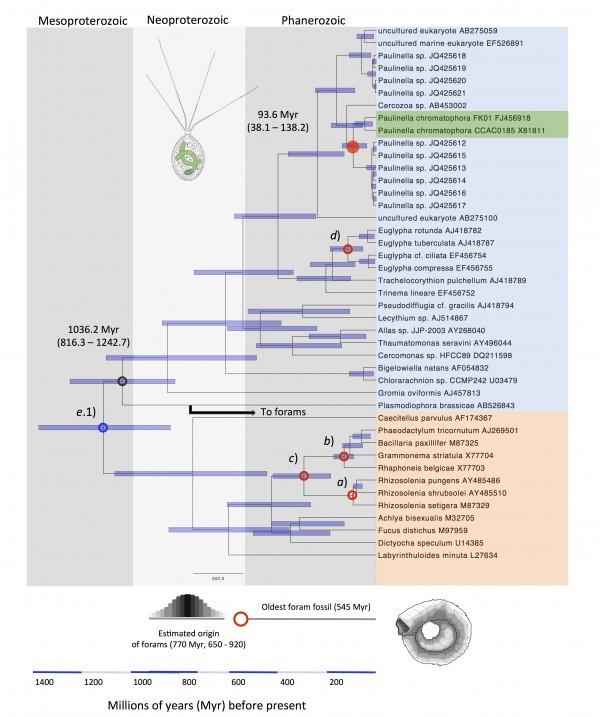
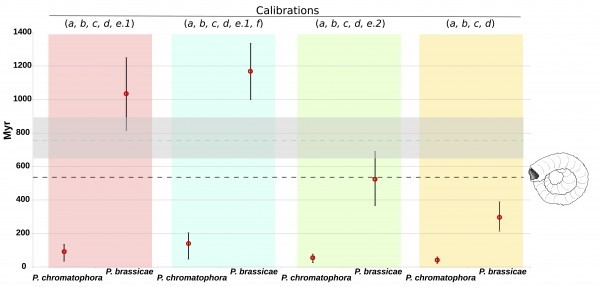
The ancestor of Paulinella chromatophora established a symbiotic relationship with cyanobacteria related to the Prochloroccocus/Synechococcus clade. This event has been described as a second primary endosymbiosis leading to a plastid in the making. Based on the rate of pseudogene disintegration in the endosymbiotic bacteria Buchnera aphidicola, it was suggested that the chromatophore in P. chromatophora has a minimum age of ~60 Myr. Here we revisit this estimation by using a lognormal relaxed molecular clock on the 18S rRNA of P. chromatophora. Our time estimates show that depending on the assumptions made to calibrate the molecular clock, P. chromatophora diverged from heterotrophic Paulinella spp. ~ 90 to 140 Myr ago, thus establishing a maximum date for the origin of the chromatophore.
Overview
The claims and statistics of this paper haven’t been checked yet.
Free: it reads the open-access text and checks the first 5 claims that cite a source we can check. Create a free account to check every claim.
Integrity signals
Registry
Cites
Statistics
Figures
Verification
Claims the paper makes
The claims and statistics of this paper haven’t been checked yet.
Free: it reads the open-access text and checks the first 5 claims that cite a source we can check. Create a free account to check every claim.
Claims other papers make about this one
Each is checked against this paper’s own text: does it say what the citing paper says it does?
The source backs part of the claim, not all of it — or backs it for a different population, condition or comparison.
In the citing paper
“Recent molecular clock analyses estimate that the Paulinella chromatophore evolved a mere 90–140 Ma (Delaye et al. 2016).”
From Genomic Insights into Plastid Evolution (2020) · cites this paper as Delaye et al. 2016
Experimental — accuracy not yet measured
Self-check
Percentages, sums and reported differences re-computed from the paper’s own numbers.
The self-check needs the paper’s full text.
Citations
Cites
MUSCLE: multiple sequence alignment with high accuracy and high throughput
Edgar, R. C. (2004) · Nucleic Acids Research · doi:10.1093/nar/gkh340 · Cited by 44,662
The SILVA ribosomal RNA gene database project: improved data processing and web-based tools
Quast, C., Pruesse, E., Yilmaz, P., Gerken, J., Schweer, T., Yarza, P., Peplies, J., & Glöckner, F. O. (2012) · Nucleic Acids Research · doi:10.1093/nar/gks1219 · Cited by 33,055
jModelTest 2: more models, new heuristics and parallel computing
Darriba, D., Taboada, G. L., Doallo, R., & Posada, D. (2012) · Nature Methods · doi:10.1038/nmeth.2109 · Cited by 16,785
BEAST 2: a software platform for Bayesian evolutionary analysis
Bouckaert, R., Heled, J., Kühnert, D., Vaughan, T., Wu, C.-H., Xie, D., Suchard, M. A., Rambaut, A., & Drummond, A. J. (2014) · PLoS Computational Biology · doi:10.1371/journal.pcbi.1003537 · Cited by 6,527
On the origin of mitosing cells
Sagan, L. (1967) · Journal of Theoretical Biology · doi:10.1016/0022-5193(67)90079-3 · Cited by 1,870
Estimating the timing of early eukaryotic diversification with multigene molecular clocks
Parfrey, L. W., Lahr, D. J. G., Knoll, A. H., & Katz, L. A. (2011) · Proceedings of the National Academy of Sciences · doi:10.1073/pnas.1110633108 · Cited by 899
Molecular clocks: when timesare a-changin'
HO, S., & LARSON, G. (2006) · Trends in Genetics · doi:10.1016/j.tig.2005.11.006 · Cited by 400
Nowack, E. C. M., Melkonian, M., & Glöckner, G. (2008) · Current Biology · doi:10.1016/j.cub.2008.02.051 · Cited by 329
Porter, S. M., & Knoll, A. H. (2000) · Paleobiology · doi:10.1666/0094-8373(2000)026<0360:taitne>2.0.co;2 · Cited by 327
A plastid in the making: evidence for a second primary endosymbiosis
Marin, B., M. Nowack, E. C., & Melkonian, M. (2005) · Protist · doi:10.1016/j.protis.2005.09.001 · Cited by 324
Research works printed but not linked: 1
- [20]Kooistra, W., Gersonde, R., Medlin, L., Mann, D.G. (2007). In The Evolution of Primary Producers in the Sea, The origin and evolution of the diatoms: Their adaptation to a planktonic existence, eds Falkowski PG, Knoll AH (Elsevier, Burlington, MA), pp 201–249.
Cited by
Functional horizontal gene transfer from bacteria to eukaryotes
Husnik, F., & McCutcheon, J. P. (2018) · Nature Reviews Microbiology · doi:10.1038/nrmicro.2017.137 · Cited by 480
Nitrogen-fixing organelle in a marine alga
Coale, T. H., Loconte, V., Turk-Kubo, K. A., Vanslembrouck, B., Mak, W. K. E., Cheung, S., Ekman, A., Chen, J.-H., Hagino, K., Takano, Y., et al. (2024) · Science · doi:10.1126/science.adk1075 · Cited by 214
Genomic Insights into Plastid Evolution
Sibbald, S. J., & Archibald, J. M. (2020) · Genome Biology and Evolution · doi:10.1093/gbe/evaa096 · Cited by 161
Symbiosis in eukaryotic evolution
López-García, P., Eme, L., & Moreira, D. (2017) · Journal of Theoretical Biology · doi:10.1016/j.jtbi.2017.02.031 · Cited by 154
Singer, A., Poschmann, G., Mühlich, C., Valadez-Cano, C., Hänsch, S., Hüren, V., Rensing, S. A., Stühler, K., & Nowack, E. C. M. (2017) · Current Biology · doi:10.1016/j.cub.2017.08.010 · Cited by 116
“chromatophora harbors photosynthetic organelles termed ‘‘chromatophores’’ that originated only 90–140 Ma ago [4] from an a-cyanobacterium through an endosymbiotic event that is independent of the one that gave rise to plastids in the Archaeplastida [5, 6].”
Self-citationHorizontal and endosymbiotic gene transfer in early plastid evolution
Ponce‐Toledo, R. I., López‐García, P., & Moreira, D. (2019) · New Phytologist · doi:10.1111/nph.15965 · Cited by 107
Brodie, J. A., Chan, C. X., Clerck, O. D., Cock, J. M., Coelho, S. M., Gachon, C. M. M., Grossman, A. R., Möck, T., Raven, J. A., Smith, A. G., et al. (2017) · Trends in Plant Science · doi:10.1016/j.tplants.2017.05.005 · Cited by 109
Lahr, D. J. G., Kosakyan, A., Lara, E., Mitchell, E. A. D., Morais, L., Porfírio‐Sousa, A. L., Ribeiro, G. M., Tice, A. K., Pánek, T., Kang, S., et al. (2019) · Current Biology · doi:10.1016/j.cub.2019.01.078 · Cited by 90
The origin of phagocytosis in Earth history
Mills, D. B. (2020) · Interface Focus · doi:10.1098/rsfs.2020.0019 · Cited by 84
“The only other known example of primary plastid acquisition directly from cyanobacteria (and not from algae)—Paulinella chromatophora [15]—likely occurred via phagocytosis [16], but only 140– 90 Ma [17], and therefore cannot be considered among the earliest evidence for bacterivory in the rock record.”
BackgroundGenomics-Informed Insights into Endosymbiotic Organelle Evolution in Photosynthetic Eukaryotes
Nowack, E. C. M., & Weber, A. P. M. (2018) · Annual Review of Plant Biology · doi:10.1146/annurev-arplant-042817-040209 · Cited by 74
Are Cyanobacteria an Ancestor of Chloroplasts or Just One of the Gene Donors for Plants and Algae?
Sato, N. (2021) · Genes · doi:10.3390/genes12060823 · Cited by 66
Phytoplankton pangenome reveals extensive prokaryotic horizontal gene transfer of diverse functions
Fan, X., Qiu, H., Han, W., Wang, Y., Xu, D., Zhang, X., Bhattacharya, D., & Ye, N. (2020) · Science Advances · doi:10.1126/sciadv.aba0111 · Cited by 66
Evolutionary dynamics of the chromatophore genome in three photosynthetic Paulinella species
Lhee, D., Ha, J.-S., Kim, S., Park, M. G., Bhattacharya, D., & Yoon, H. S. (2019) · Scientific Reports · doi:10.1038/s41598-019-38621-8 · Cited by 54
Biotic Host–Pathogen Interactions As Major Drivers of Plastid Endosymbiosis
Cenci, U., Bhattacharya, D., Weber, A. P. M., Colleoni, C., Subtil, A., & Ball, S. G. (2017) · Trends in Plant Science · doi:10.1016/j.tplants.2016.12.007 · Cited by 57
Endosymbiotic Evolution of Algae, Secondary Heterotrophy and Parasitism
Oborník, M. (2019) · Biomolecules · doi:10.3390/biom9070266 · Cited by 58
“The timing of this unexpected second primary endosymbiotic event was dated to between 60 and 140 MYA [24].”
BackgroundPaulinella , a model for understanding plastid primary endosymbiosis
Gabr, A., Grossman, A. R., & Bhattacharya, D. (2020) · Journal of Phycology · doi:10.1111/jpy.13003 · Cited by 53
Engineering artificial photosynthetic life-forms through endosymbiosis
Cournoyer, J. E., Altman, S. D., Gao, Y.-L., Wallace, C. L., Zhang, D., Lo, G.-H., Haskin, N. T., & Mehta, A. P. (2022) · Nature Communications · doi:10.1038/s41467-022-29961-7 · Cited by 50
“…event which only occurred 2.7 – 1.7 Gya, phylogenetic analysis has revealed that the chro-matophore of the ameboid Paulinella , which contains cyano-bacterial endosymbionts, diverged from its relatives about 140 million years ago through a separate primary endosymbiotic event 50 – 52 .”
InfluentialLhee, D., Yang, E. C., Kim, J. I., Nakayama, T., Zuccarello, G. C., Andersen, R. A., & Yoon, H. S. (2017) · Protist · doi:10.1016/j.protis.2017.01.003 · Cited by 42
“Furthermore, the primary endosymbiosis of P. chromatophora occurred relatively recently (90-140 Mya) (Delaye et al. 2016), whereas the primary endosymbiosis that gave rise to the Archaeplastida occurred before 1,500 Mya (Yoon et al. 2004).”
BackgroundMacorano, L., & Nowack, E. (2021) · Current Biology · doi:10.1016/j.cub.2021.07.028 · Cited by 13
Biotic interactions as drivers of algal origin and evolution
Brodie, J. A., Ball, S. G., Bouget, F., Chan, C. X., Clerck, O. D., Cock, J. M., Gachon, C. M. M., Grossman, A. R., Möck, T., Raven, J. A., et al. (2017) · New Phytologist · doi:10.1111/nph.14760 · Cited by 42
“chromatophora is certainly expected, but surprisingly, it is not primarily EGT and rerouting of host proteins in this relatively ‘young’ endosymbiosis (i.e., 90-140 million years old; Delaye et al., 2016) that facilitates this process, but rather, repurposing of environmental DNA as a result of biotic interactions.”
BackgroundStadnichuk, I. N., & Kusnetsov, V. V. (2023) · International Journal of Molecular Sciences · doi:10.3390/ijms24032290 · Cited by 39
Zhang, R., Nowack, E. C. M., Price, D. C., Bhattacharya, D., & Grossman, A. R. (2017) · The Plant Journal · doi:10.1111/tpj.13488 · Cited by 36
Speijer, D., Hammond, M., & Lukeš, J. (2020) · mBio · doi:10.1128/mbio.00955-20 · Cited by 33
Evidence Supporting an Antimicrobial Origin of Targeting Peptides to Endosymbiotic Organelles
Garrido, C., Caspari, O. D., Choquet, Y., Wollman, F.-A., & Lafontaine, I. (2020) · Cells · doi:10.3390/cells9081795 · Cited by 34
“Further support for this view came from recent studies 662 of the amoeba Paulinella chromatophora, which acquired a novel primary endosymbiotic organelle 663 called “chromatophore” approximately 100 million years ago [100].”
ResultOberleitner, L., Poschmann, G., Macorano, L., Schott‐Verdugo, S., Gohlke, H., Stühler, K., & Nowack, E. C. M. (2020) · Frontiers in Microbiology · doi:10.3389/fmicb.2020.607182 · Cited by 23
“The photosynthetically active ‘chromatophore’ of cercozoan amoebae of the genus 72 Paulinella evolved around 100 million years ago from a cyanobacterium (3, 4).”
BackgroundHow did cyanobacteria first embark on the path to becoming plastids?: lessons from protist symbioses
Gavelis, G. S., & Gile, G. H. (2018) · FEMS Microbiology Letters · doi:10.1093/femsle/fny209 · Cited by 30
Oberleitner, L., Perrar, A., Macorano, L., Huesgen, P. F., & Nowack, E. C. M. (2022) · PLANT PHYSIOLOGY · doi:10.1093/plphys/kiac012 · Cited by 19
Evolving Perspective on the Origin and Diversification of Cellular Life and the Virosphere
Spang, A., Mahendrarajah, T., Offre, P., & Stairs, C. W. (2022) · Genome Biology and Evolution · doi:10.1093/gbe/evac034 · Cited by 22
“This amoeba houses a specialized organelle called the chromatophore that has its own genome and is thought to have evolved from an ancestral endosymbiont of the Synechococcus/Prochlorococcus clade (Marin et al. 2005) roughly 90–140 Ma (Delaye et al. 2016).”
BackgroundCoherent phenomena in photosynthetic light harvesting: part two—observations in biological systems
Rathbone, H. W., Davis, J. A., Michie, K. A., Goodchild, S. C., Robertson, N. O., & Curmi, P. M. G. (2018) · Biophysical Reviews · doi:10.1007/s12551-018-0456-x · Cited by 21
Protein import into bacterial endosymbionts and evolving organelles
Sørensen, M., Stiller, M. L., Kröninger, L., & Nowack, E. C. M. (2024) · FEBS Journal · doi:10.1111/febs.17356 · Cited by 15
“Many bacterial endosymbionts are vertically transmitted from one host generation to the next and have coevolved with their hosts for sometimes hundreds of millions of years [29 – 34].”
In the beginning was the word: How terminology drives our understanding of endosymbiotic organelles
Oborník, M. (2019) · Microbial Cell · doi:10.15698/mic2019.02.669 · Cited by 18
“What is even more interesting is the fact that primary endosymbioses leading to the presence of what we call “organelles” are quite rare, apparently having happened only twice (once for mitochondria, once for plastids; a second cyanobacterial primary endosymbiosis in cercozoans was relatively recent [26] and resulted…”
Gagat, P., & Mackiewicz, P. (2016) · Symbiosis · doi:10.1007/s13199-016-0464-1 · Cited by 14
“However, taking into account the time that has passed since the primary endosymbiosis (~1500 million years) and Paulinella endosymbiosis (~60 – 140 million years), the opposite should be expected (Nowack et al. 2008; Parfrey et al. 2011; Delaye et al. 2016).”
BackgroundLarge DNA virus promoted the endosymbiotic evolution to make a photosynthetic eukaryotePreprint
Matsuo, M., Katahata, A., Tachikawa, M., Minakuchi, Y., Noguchi, H., Toyoda, A., Fujiyama, A., Suzuki, Y., Hata, T., Satoh, S., et al. (2019) · bioRxiv (Cold Spring Harbor Laboratory) · doi:10.1101/809541 · Cited by 14
Tracking the early events of photosymbiosis evolution
Quevarec, L., Brasseur, G., Aragnol, D., & Robaglia, C. (2023) · Trends in Plant Science · doi:10.1016/j.tplants.2023.11.005 · Cited by 13
The role of antimicrobial peptides in the evolution of endosymbiotic protein import
Caspari, O. D., & Lafontaine, I. (2021) · PLoS Pathogens · doi:10.1371/journal.ppat.1009466 · Cited by 12
A diverse Palaeoproterozoic microbial ecosystem implies early eukaryogenesis
Javaux, E. (2025) · Philosophical Transactions of the Royal Society B Biological Sciences · doi:10.1098/rstb.2024.0092 · Cited by 16
Comparative Plastid Genomics of Glaucophytes
Reyes‐Prieto, A., Russell, S., Figueroa‐Martinez, F., & Jackson, C. J. (2017) · Advances in botanical research · doi:10.1016/bs.abr.2017.11.012 · Cited by 13
A reassessment of the “hard-steps” model for the evolution of intelligent life
Mills, D. B., Macalady, J. L., Frank, A., & Wright, J. T. (2025) · Science Advances · doi:10.1126/sciadv.ads5698 · Cited by 18
“However, this conclusion became complicated with the recognition that the rhizar-ian amoeba Paulinella chromatophora has photosynthetic structures called “chromatophores” acquired from a distinct cyanobacterial lineage only 90 to 140 million years ago (Ma) ( 57 , 58 ).”
Organellar Evolution: A Path from Benefit to Dependence
Oborník, M. (2022) · Microorganisms · doi:10.3390/microorganisms10010122 · Cited by 9
Understanding protein import in diverse non-green plastids
Christian, R. W., Labbancz, J., Usadel, B., & Dhingra, A. (2023) · Frontiers in Genetics · doi:10.3389/fgene.2023.969931 · Cited by 7
Evidence for a robust photosystem II in the photosynthetic amoeba Paulinella
Gabr, A., Zournas, A., Stephens, T. G., Dismukes, G. C., & Bhattacharya, D. (2022) · New Phytologist · doi:10.1111/nph.18052 · Cited by 8
Position of Algae on the Tree of Life
Gololobova, M. A., & Belyakova, G. A. (2022) · Doklady Biological Sciences · doi:10.1134/s0012496622060035 · Cited by 12
“Paulinella chloroplasts are thought to originate relatively recently, approximately 90–140 billion years ago (Delaye et al., 2016).”
BackgroundNatural selection drove metabolic specialization of the chromatophore in Paulinella chromatophora
Valadez‐Cano, C., Olivares‐Hernández, R., Reséndis-Antonio, O., DeLuna, A., & Delaye, L. (2017) · BMC Evolutionary Biology · doi:10.1186/s12862-017-0947-6 · Cited by 8
Self-citationMatsuo, M., Katahata, A., Satoh, S., Matsuzaki, M., Nomura, M., Ishida, K., Inagaki, Y., & Obokata, J. (2018) · PLoS ONE · doi:10.1371/journal.pone.0200961 · Cited by 11
Algae obscura: The potential of rare species as model systems
Etten, J. V., Benites, L. F., Stephens, T. G., Yoon, H. S., & Bhattacharya, D. (2023) · Journal of Phycology · doi:10.1111/jpy.13321 · Cited by 8
“…spp., on the other hand, are true transitional organisms, having gained their photosynthetic organelle via primary endosymbiosis ~140– 90 mya (Delaye et al., 2016; Gabr et al., 2020), although other estimates point to a more ancient origin of 634– 350 mya (Sánchez- Baracaldo et al., 2017).”
BackgroundCoherent Processes in Photosynthetic Energy Transport and Transduction
Rathbone, H. W., Davis, J. A., & Curmi, P. M. G. (2020) · Advances in photosynthesis and respiration · doi:10.1007/978-3-030-33397-3_15 · Cited by 5
Dating the Origin and Spread of Plastids and Chromatophores
Pietluch, F., Mackiewicz, P., Sidorczuk, K., & Gagat, P. (2025) · International Journal of Molecular Sciences · doi:10.3390/ijms26125569 · Cited by 5
The Photosynthetic Adventure of Paulinella Spp
Gagat, P., Sidorczuk, K., Pietluch, F., & Mackiewicz, P. (2020) · Results and problems in cell differentiation · doi:10.1007/978-3-030-51849-3_13 · Cited by 3
Hypothesis: Trans‐splicing Generates Evolutionary Novelty in the Photosynthetic Amoeba Paulinella
Gabr, A., Stephens, T. G., & Bhattacharya, D. (2022) · Journal of Phycology · doi:10.1111/jpy.13247 · Cited by 3
“…Paulinella lineage is more amenable in this respect because of the more recent plastid derivation (80–140 Ma; Reyes-Prieto et al. 2007, Nowack 2014, Delaye et al. 2016, Gabr et al. 2020), making it a model for studying primary endosymbiosis (Yoon et al. 2006, 2009, Nowack et al. 2008, 2011,…”
BackgroundEvidence supporting an antimicrobial origin of targeting peptides to endosymbiotic organellesPreprint
Garrido, C., Caspari, O. D., Choquet, Y., Wollman, F.-A., & Lafontaine, I. (2020) · bioRxiv (Cold Spring Harbor Laboratory) · doi:10.1101/2020.03.04.974964 · Cited by 4
Algae from Primary Endosymbioses
Büdel, B., & Friedl, T. (2024) · Springer eBooks · doi:10.1007/978-3-662-65712-6_4 · Cited by 4
The Evolutionary Origin of Primary Plastids
Lhee, D., Bhattacharya, D., & Yoon, H. S. (2024) · Springer eBooks · doi:10.1007/978-3-031-57446-7_1 · Cited by 4
Gabr, A., Stephens, T. G., Reinfelder, J. R., Liau, P., Calatrava, V., Grossman, A. R., & Bhattacharya, D. (2024) · Environmental Microbiology Reports · doi:10.1111/1758-2229.13304 · Cited by 1
“…system for studying the earlier stages of organellogenesis relative to the much longer evolutionary history (>1.6 Bya) of the Archaeplastida (Bhattacharya et al., 2023; Delaye et al., 2016; Gabr et al., 2020; Lhee et al., 2019; Nowack et al., 2008; Stephens et al., 2021; Van Etten et al., 2023).”
BackgroundInfluentialEvidence of Relaxed Selection in the Mitochondrial Genomes of Phototrophic Paulinella Lineages
Han, S., Lhee, D., Yang, J. H., Bhattacharya, D., & Yoon, H. S. (2026) · Genome Biology and Evolution · doi:10.1093/gbe/evag052 · Cited by 1
“Although the primary endosymbiotic event in phototrophic Paulinella is relatively ancient (ca. 90 to 140 Ma) (Delaye et al. 2016; Lhee et al. 2019), signatures of relaxed selection can still be detected despite the an-tiquity of such events (Uthanumallian et al. 2022).”
Evolution of trans-isoprenyl diphosphate synthases in the plant kingdom
Chen, X., Nakanishi, M., Han, J., Hemmi, H., & Chen, F. (2026) · PLANT PHYSIOLOGY · doi:10.1093/plphys/kiag238 · Cited by 1
Paulinella chromatophora – niezwykła fotosyntetyczna przygoda ameby i sinicy
Sidorczuk, K., Mackiewicz, P., & Gagat, P. (2018) · Kosmos · doi:10.36921/kos.2018_2455 · Cited by 1
Back to primary endosymbiosis: from plastids to artificial photosynthetic life-forms
Flores-Tinoco, V., Herrera‐Estrella, L., & López-Arredondo, D. L. (2023) · Trends in Plant Science · doi:10.1016/j.tplants.2023.03.026 · Cited by 2
The Appearance of Eukaryotic Microalgae
Sánchez‐Baracaldo, P., & Raven, J. A. (2024) · Cambridge University Press eBooks · doi:10.1017/9781139049979.006 · Cited by 1
Hoskinson, J. S., & Wideman, J. G. (2025) · The American Biology Teacher · doi:10.1525/abt.2025.87.2.93 · Cited by 1
“There are younger endosymbioses that have resulted in relationships that blur the boundaries between organelle and endosymbiont (McCutcheon, 2021), one of which is the focus of the activity presented below (Delaye et al., 2016; Stephens et al., 2021).”
Easier Lost than Found? What We Know about Plastid Genome Reduction
Konupková, A., Tomečková, L., Záhonová, K., Oborník, M., & Füssy, Z. (2024) · Springer eBooks · doi:10.1007/978-3-031-57446-7_5 · Cited by 1
Mikrobielle Symbiosen und die Evolution neuer Organellen
Oberleitner, L., Ehret, G., & Nowack, E. C. M. (2019) · BIOspektrum · doi:10.1007/s12268-019-1043-9
Oberleitner, L., Perrar, A., Macorano, L., Huesgen, P. F., & Nowack, E. C. M. (2021) · bioRxiv (Cold Spring Harbor Laboratory) · doi:10.1101/2021.09.19.461000
“The photosynthetic ‘chromatophore’ of cercozoan amoebae of the genus Paulinella evolved around 100 million years ago from a cyanobacterium (Marin et al., 2005; Delaye et al., 2016).”
BackgroundSampaio, A. (2022) · Revista de Ciência Elementar · doi:10.24927/rce2022.022
The Extent, Role, and Timing of Endosymbiotic Gene Transfer in Plastids
Hehenberger, E., & Burki, F. (2024) · Springer eBooks · doi:10.1007/978-3-031-57446-7_4 · Cited by 2
Origins and Consequences of Early Photosynthetic Organisms
Giordano, M., Beardall, J., Raven, J. A., & Maberly, S. C. (2024) · Cambridge University Press eBooks · doi:10.1017/9781139049979.003
Oxygen as a primary selective pressure for photo-endosymbiosis evolutionPreprint
Quevarec, L., Bonnarde, R., Robaglia, C., & Brasseur, G. (2025) · bioRxiv (Cold Spring Harbor Laboratory) · doi:10.1101/2025.05.28.656558
Origins and early evolution of photosynthetic eukaryotes
Ponce-Toledo, R. I. (2018) · theses.fr (ABES) · doi:10.70675/e80da54ez4400z4af2z90ccza6b6fb5b6bc7 · Cited by 1
“, 2011) which is temporally congruent for a “red” period also within a putative cercozoan lineage, followed by the loss of the red plastid and a more recent endosymbiotic event between the chlorarachniophyte ancestor and a green alga some 100-150 Mya (Delaye et al., 2016).”
BackgroundNouveaux regards sur l’individualité biologique : autoproduction, composition, transition
Hernández, I. (2018) · theses.fr (ABES) · doi:10.70675/a432e682zcce3z42f8zb66czeec7348827fd · Cited by 2
Manzotti, A. (2022) · theses.fr (ABES) · doi:10.70675/f8143d4czab93z4250z91abz54432e53522f · Cited by 1
De l’origine des peptides d’adressage aux organites (mitochondries et chloroplastes)
Garrido, C. (2021) · theses.fr (ABES) · doi:10.70675/f6b6ea2azc533z4250za563zea353e4e22c1 · Cited by 1
The evolution of red algal organellar genomes and the origin of red complex plastids
van Beveren, F. (2022) · theses.fr (ABES) · doi:10.70675/1d5ed7dezb138z4504za194z566b690fb2db · Cited by 1
Viruses as Living Systems? Borrowed Closure and the Limits of Autopoiesis
Yolles, M. I. (2026) · Systems · doi:10.3390/systems14111358
Metadata
- Authors
- Delaye, L., Valadez-Cano, C., & Pérez-Zamorano, B.
- Affiliations
- Centro de Investigación y de Estudios Avanzados del Instituto Politécnico Nacional (MX)
- ORCID
- Delaye, Luis
- Venue
- PLoS Currents
- Publisher
- Public Library of Science (PLoS)
- Published
- 2016
- Volume
- 8
- ISSN
- 2157-3999 (ISSN-L)
- PMC
- PMC4866557
- OpenAlex
- W2400754086
- Semantic Scholar
- 56631945101f79061210cdfecde2577b87772a9a
- Cited by
- 72
- References
- 22
- Citations by year
- 2026: 3 · 2025: 5 · 2024: 9 · 2023: 5 · 2022: 10 · 2021: 5 · 2020: 10 · 2019: 7 · 2018: 7 · 2017: 10 · 2016: 1
- FWCI
- 4.33
- Type
- journal article
- Language
- en
- Open access
- hybrid
- doi.org
- Licence
- cc-by
- Locations
- PLoS Currents (publishedVersion, cc-by)
- PubMed Central (publishedVersion, cc-by)
- PubMed (publishedVersion)
- Topics
- Life Sciences › Agricultural and Biological Sciences › Ecology, Evolution, Behavior and Systematics › Protist diversity and phylogeny
- Life Sciences › Biochemistry, Genetics and Molecular Biology › Molecular Biology › Photosynthetic Processes and Mechanisms
- Life Sciences › Biochemistry, Genetics and Molecular Biology › Genetics › Chromosomal and Genetic Variations
- Keywords
- Paulinella chromatophora, secondary endosymbiosis, cyanobacterial symbionts, Buchnera aphidicola, relaxed molecular clock, 18S rRNA, divergence time estimation, plastid evolution
About these checks
Registry, retraction, Cites and statistics results are computed, not judged, with one exception: a printed reference that no index lists is read once by a model before it counts as a citation error. Claims are extracted by a model and kept only when their quote appears verbatim in the text; each cited source is then checked, with a model’s help, for whether it says what the claim relies on. Those verdicts can be wrong — read the claim’s quote and the cited source before relying on one.
Statistics and arithmetic are recomputed, not judged.
Confidence bands are shown only for fields calibrated on our annotated test set. None is calibrated yet, so no band is shown.
What counts as a claim ›How we measure confidence ›How we check this ›
Are you an author, or do you see a problem with this page? Request a review
Data sources
Bibliographic data: Semantic Scholar, OpenAlex, Crossref.
Contains information from the Semantic Scholar Academic Graph Datasets, made available under the ODC Attribution License (ODC-BY 1.0).
Semantic Scholar’s data is described in: Kinney, R., et al. (2023). The Semantic Scholar Open Data Platform. arXiv:2301.10140.
