

How Really Ancient Is Paulinella Chromatophora?
Open accessThe DOI matches its Crossref record; 23 of the 23 references it cites were found in a registry or an index.
Abstract
The ancestor of Paulinella chromatophora established a symbiotic relationship with cyanobacteria related to the Prochloroccocus/Synechococcus clade. This event has been described as a second primary endosymbiosis leading to a plastid in the making. Based on the rate of pseudogene disintegration in the endosymbiotic bacteria Buchnera aphidicola, it was suggested that the chromatophore in P. chromatophora has a minimum age of ~60 Myr. Here we revisit this estimation by using a lognormal relaxed molecular clock on the 18S rRNA of P. chromatophora. Our time estimates show that depending on the assumptions made to calibrate the molecular clock, P. chromatophora diverged from heterotrophic Paulinella spp. ~ 90 to 140 Myr ago, thus establishing a maximum date for the origin of the chromatophore.
Overview
The claims and statistics of this paper haven’t been checked yet.
Free: it reads the open-access text and checks the first 5 claims that cite a source we can check. Create a free account to check every claim.
Integrity signals
Registry
Cites
Statistics
Figures
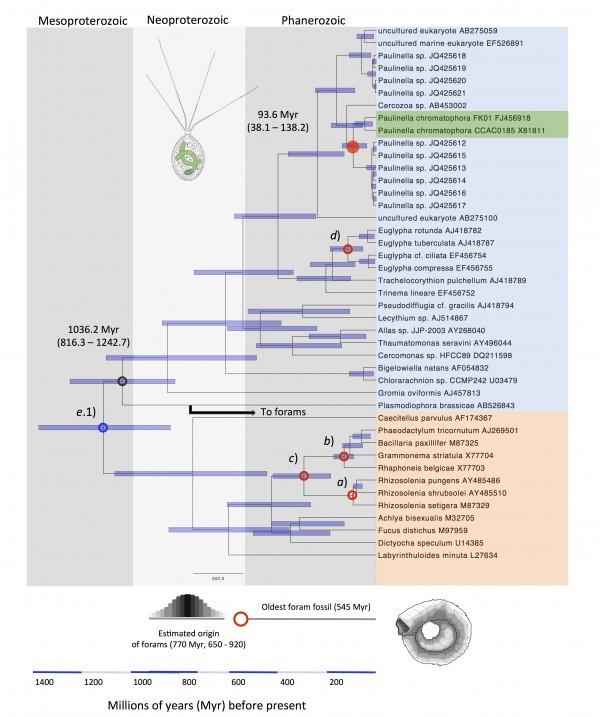
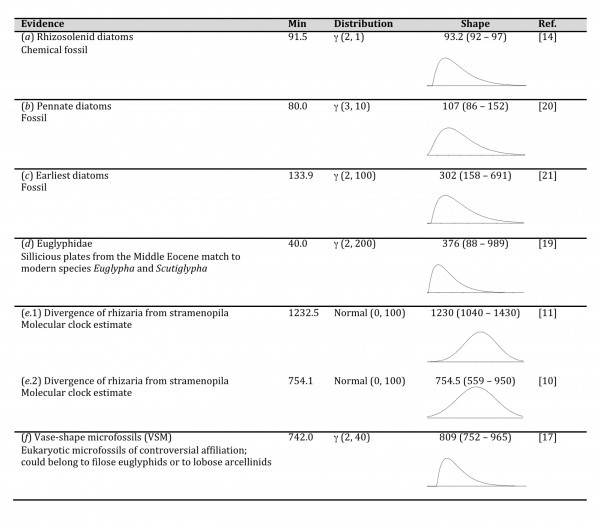
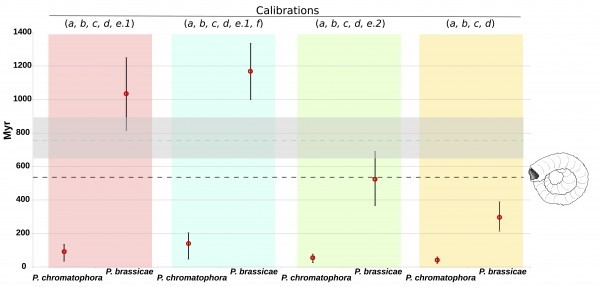
Verification
Claims the paper makes
The claims and statistics of this paper haven’t been checked yet.
Free: it reads the open-access text and checks the first 5 claims that cite a source we can check. Create a free account to check every claim.
Claims other papers make about this one
Each is checked against this paper’s own text: does it say what the citing paper says it does?
The source backs part of the claim, not all of it — or backs it for a different population, condition or comparison.
In the citing paper
“Recent molecular clock analyses estimate that the Paulinella chromatophore evolved a mere 90–140 Ma (Delaye et al. 2016).”
From Genomic Insights into Plastid Evolution (2020) · cites this paper as Delaye et al. 2016
Experimental — accuracy not yet measured
Self-check
Percentages, sums and reported differences re-computed from the paper’s own numbers.
The self-check needs the paper’s full text.
Citations
Cites
MUSCLE: multiple sequence alignment with high accuracy and high throughput
Edgar, R. C. (2004) · Nucleic Acids Research · doi:10.1093/nar/gkh340 · Cited by 44,662
The SILVA ribosomal RNA gene database project: improved data processing and web-based tools
Quast, C., Pruesse, E., Yilmaz, P., Gerken, J., Schweer, T., Yarza, P., Peplies, J., & Glöckner, F. O. (2012) · Nucleic Acids Research · doi:10.1093/nar/gks1219 · Cited by 33,055
jModelTest 2: more models, new heuristics and parallel computing
Darriba, D., Taboada, G. L., Doallo, R., & Posada, D. (2012) · Nature Methods · doi:10.1038/nmeth.2109 · Cited by 16,785
BEAST 2: a software platform for Bayesian evolutionary analysis
Bouckaert, R., Heled, J., Kühnert, D., Vaughan, T., Wu, C.-H., Xie, D., Suchard, M. A., Rambaut, A., & Drummond, A. J. (2014) · PLoS Computational Biology · doi:10.1371/journal.pcbi.1003537 · Cited by 6,527
On the origin of mitosing cells
Sagan, L. (1967) · Journal of Theoretical Biology · doi:10.1016/0022-5193(67)90079-3 · Cited by 1,870
Estimating the timing of early eukaryotic diversification with multigene molecular clocks
Parfrey, L. W., Lahr, D. J. G., Knoll, A. H., & Katz, L. A. (2011) · Proceedings of the National Academy of Sciences · doi:10.1073/pnas.1110633108 · Cited by 899
Molecular clocks: when timesare a-changin'
HO, S., & LARSON, G. (2006) · Trends in Genetics · doi:10.1016/j.tig.2005.11.006 · Cited by 400
Nowack, E. C. M., Melkonian, M., & Glöckner, G. (2008) · Current Biology · doi:10.1016/j.cub.2008.02.051 · Cited by 329
Porter, S. M., & Knoll, A. H. (2000) · Paleobiology · doi:10.1666/0094-8373(2000)026<0360:taitne>2.0.co;2 · Cited by 327
A plastid in the making: evidence for a second primary endosymbiosis
Marin, B., M. Nowack, E. C., & Melkonian, M. (2005) · Protist · doi:10.1016/j.protis.2005.09.001 · Cited by 324
The Rise of the Rhizosolenid Diatoms
Damsté, J. S. S., Muyzer, G., Abbas, B., Rampen, S. W., Massé, G., Allard, W. G., Belt, S. T., Robert, J.-M., Rowland, S. J., Moldowan, J. M., et al. (2004) · Science · doi:10.1126/science.1096806 · Cited by 277
A molecular time-scale for eukaryote evolution recalibrated with the continuous microfossil record
Berney, C., & Pawlowski, J. (2006) · Proceedings of the Royal Society B: Biological Sciences · doi:10.1098/rspb.2006.3537 · Cited by 212
Nowack, E. C. M., & Grossman, A. R. (2012) · Proceedings of the National Academy of Sciences · doi:10.1073/pnas.1118800109 · Cited by 167
Differential Gene Retention in Plastids of Common Recent Origin
Reyes-Prieto, A., Yoon, H. S., Moustafa, A., Yang, E. C., Andersen, R. A., Boo, S. M., Nakayama, T., Ishida, K.-I., & Bhattacharya, D. (2010) · Molecular Biology and Evolution · doi:10.1093/molbev/msq032 · Cited by 102
Early Cambrian Foraminifera from West Africa
Culver, S. J. (1991) · Science · doi:10.1126/science.254.5032.689 · Cited by 100
Large-Scale Phylogenomic Analyses Indicate a Deep Origin of Primary Plastids within Cyanobacteria
Criscuolo, A., & Gribaldo, S. (2011) · Molecular Biology and Evolution · doi:10.1093/molbev/msr108 · Cited by 97
Paulinella chromatophora – rethinking the transition from endosymbiont to organelle
Nowack, E. C. M. (2014) · Acta Societatis Botanicorum Poloniae · doi:10.5586/asbp.2014.049 · Cited by 82
The Evolutionary Fate of Nonfunctional DNA in the Bacterial Endosymbiont Buchnera aphidicola
Gómez-Valero, L., Latorre, A., & Silva, F. J. (2004) · Molecular Biology and Evolution · doi:10.1093/molbev/msh232 · Cited by 68
Heger, T. J., Mitchell, E. A. D., Todorov, M., Golemansky, V., Lara, E., Leander, B. S., & Pawlowski, J. W. (2009) · Molecular Phylogenetics and Evolution · doi:10.1016/j.ympev.2009.11.023 · Cited by 68
Single cell genome analysis supports a link between phagotrophy and primary plastid endosymbiosis
Bhattacharya, D., Price, D. C., Yoon, H. S., Yang, E. C., Poulton, N. J., Andersen, R. A., & Das, S. P. (2012) · Scientific Reports · doi:10.1038/srep00356 · Cited by 66
Bayesian relaxed clock estimation of divergence times in foraminifera
Groussin, M., Pawlowski, J., & Yang, Z. (2011) · Molecular Phylogenetics and Evolution · doi:10.1016/j.ympev.2011.06.008 · Cited by 41
Ancient Gene Paralogy May Mislead Inference of Plastid Phylogeny
Qiu, H., Yang, E. C., Bhattacharya, D., & Yoon, H. S. (2012) · Molecular Biology and Evolution · doi:10.1093/molbev/mss137 · Cited by 36
Barber, A., Siver, P. A., & Karis, W. (2013) · Protist · doi:10.1016/j.protis.2013.05.001 · Cited by 25
Research works printed but not linked: 1
- [20]Kooistra, W., Gersonde, R., Medlin, L., Mann, D.G. (2007). In The Evolution of Primary Producers in the Sea, The origin and evolution of the diatoms: Their adaptation to a planktonic existence, eds Falkowski PG, Knoll AH (Elsevier, Burlington, MA), pp 201–249.
Cited by
Functional horizontal gene transfer from bacteria to eukaryotes
Husnik, F., & McCutcheon, J. P. (2018) · Nature Reviews Microbiology · doi:10.1038/nrmicro.2017.137 · Cited by 480
Nitrogen-fixing organelle in a marine alga
Coale, T. H., Loconte, V., Turk-Kubo, K. A., Vanslembrouck, B., Mak, W. K. E., Cheung, S., Ekman, A., Chen, J.-H., Hagino, K., Takano, Y., et al. (2024) · Science · doi:10.1126/science.adk1075 · Cited by 214
Genomic Insights into Plastid Evolution
Sibbald, S. J., & Archibald, J. M. (2020) · Genome Biology and Evolution · doi:10.1093/gbe/evaa096 · Cited by 161
Symbiosis in eukaryotic evolution
López-García, P., Eme, L., & Moreira, D. (2017) · Journal of Theoretical Biology · doi:10.1016/j.jtbi.2017.02.031 · Cited by 154
Singer, A., Poschmann, G., Mühlich, C., Valadez-Cano, C., Hänsch, S., Hüren, V., Rensing, S. A., Stühler, K., & Nowack, E. C. M. (2017) · Current Biology · doi:10.1016/j.cub.2017.08.010 · Cited by 116
“chromatophora harbors photosynthetic organelles termed ‘‘chromatophores’’ that originated only 90–140 Ma ago [4] from an a-cyanobacterium through an endosymbiotic event that is independent of the one that gave rise to plastids in the Archaeplastida [5, 6].”
Self-citation
Metadata
- Authors
- Delaye, L., Valadez-Cano, C., & Pérez-Zamorano, B.
- Affiliations
- Centro de Investigación y de Estudios Avanzados del Instituto Politécnico Nacional (MX)
- ORCID
- Delaye, Luis
- Venue
- PLoS Currents
- Publisher
- Public Library of Science (PLoS)
- Published
- 2016
- Volume
- 8
- ISSN
- 2157-3999 (ISSN-L)
- PMC
- PMC4866557
- OpenAlex
- W2400754086
- Cited by
- 72
- References
- 22
- Citations by year
- 2026: 3 · 2025: 5 · 2024: 9 · 2023: 5 · 2022: 10 · 2021: 5 · 2020: 10 · 2019: 7 · 2018: 7 · 2017: 10 · 2016: 1
- FWCI
- 4.33
- Type
- journal article
- Language
- en
- Open access
- hybrid
- doi.org
- Licence
- cc-by
- Locations
- PLoS Currents (publishedVersion, cc-by)
- PubMed Central (publishedVersion, cc-by)
- PubMed (publishedVersion)
- Topics
- Life Sciences › Agricultural and Biological Sciences › Ecology, Evolution, Behavior and Systematics › Protist diversity and phylogeny
- Life Sciences › Biochemistry, Genetics and Molecular Biology › Molecular Biology › Photosynthetic Processes and Mechanisms
- Life Sciences › Biochemistry, Genetics and Molecular Biology › Genetics › Chromosomal and Genetic Variations
- Keywords
- Paulinella chromatophora, secondary endosymbiosis, cyanobacterial symbionts, Buchnera aphidicola, relaxed molecular clock, 18S rRNA, divergence time estimation, plastid evolution
About these checks
Registry, retraction, Cites and statistics results are computed, not judged, with one exception: a printed reference that no index lists is read once by a model before it counts as a citation error. Claims are extracted by a model and kept only when their quote appears verbatim in the text; each cited source is then checked, with a model’s help, for whether it says what the claim relies on. Those verdicts can be wrong — read the claim’s quote and the cited source before relying on one.
Statistics and arithmetic are recomputed, not judged.
Confidence bands are shown only for fields calibrated on our annotated test set. None is calibrated yet, so no band is shown.
What counts as a claim ›How we measure confidence ›How we check this ›
Are you an author, or do you see a problem with this page? Request a review
Data sources
Bibliographic data: Semantic Scholar, OpenAlex, Crossref.
Contains information from the Semantic Scholar Academic Graph Datasets, made available under the ODC Attribution License (ODC-BY 1.0).
Semantic Scholar’s data is described in: Kinney, R., et al. (2023). The Semantic Scholar Open Data Platform. arXiv:2301.10140.
