

The Origin of Glucocorticoid Hormone Oscillations
Open accessThe DOI matches its Crossref record; 56 of the 56 references it cites were found in a registry or an index.
Abstract
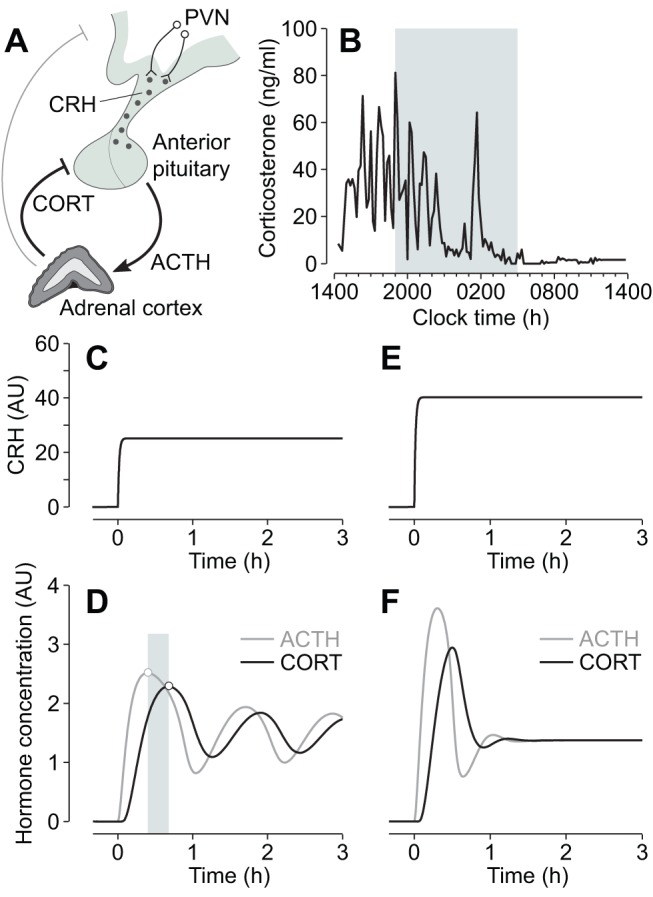
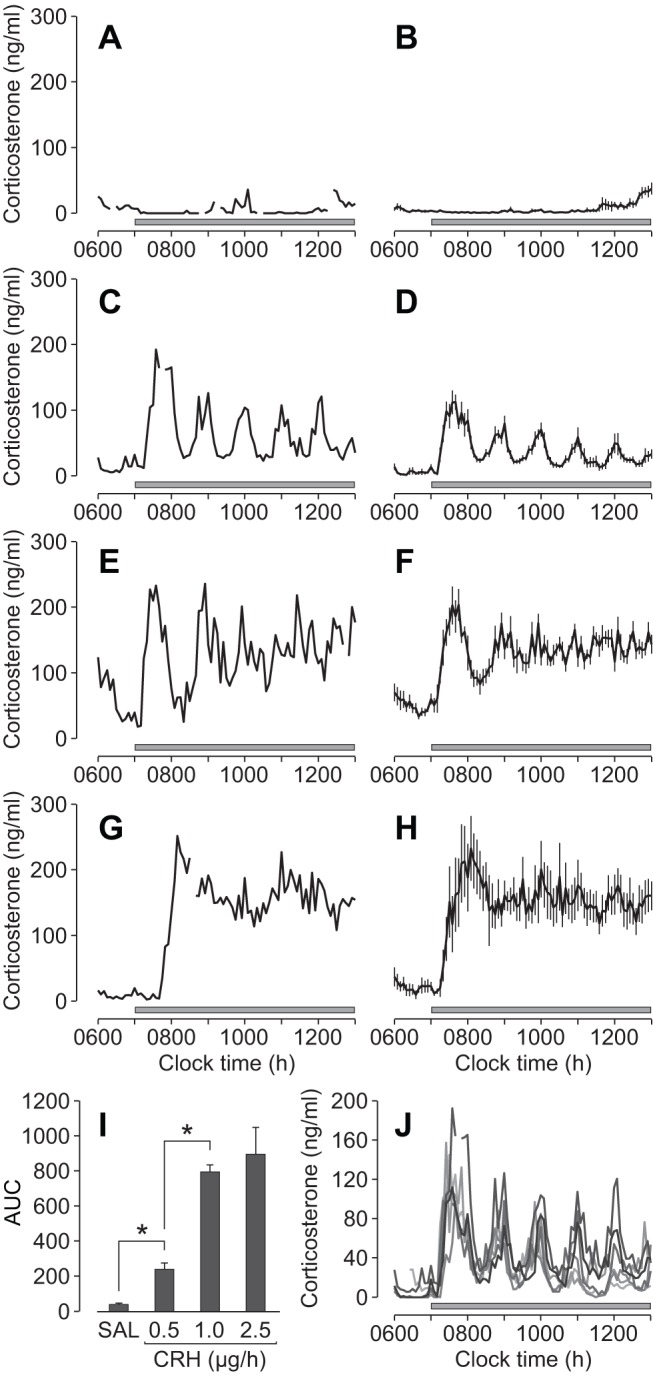
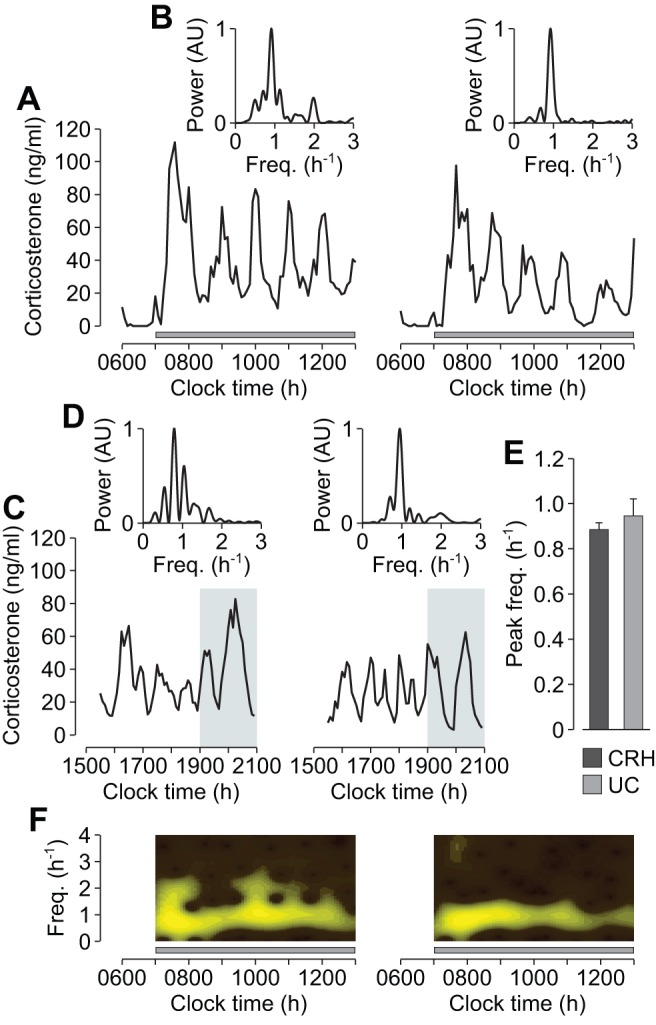
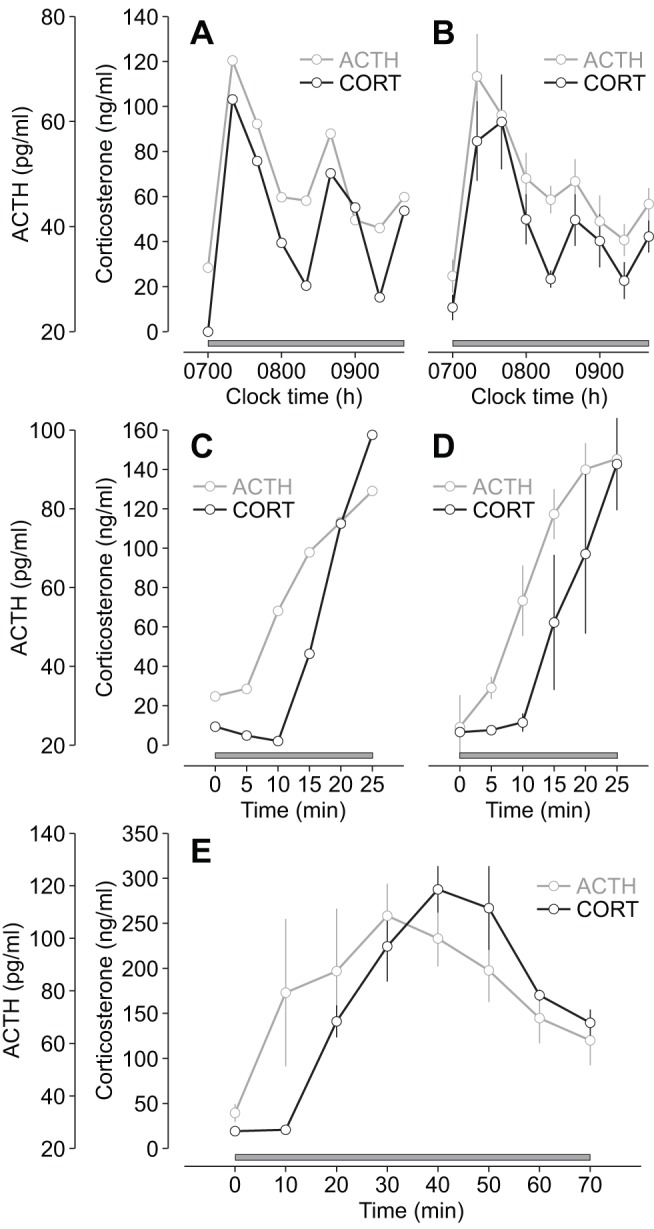
Oscillating levels of adrenal glucocorticoid hormones are essential for optimal gene expression, and for maintaining physiological and behavioural responsiveness to stress. The biological basis for these oscillations is not known, but a neuronal "pulse generator" within the hypothalamus has remained a popular hypothesis. We demonstrate that pulsatile hypothalamic activity is not required for generating ultradian glucocorticoid oscillations. We show that a constant level of corticotrophin-releasing hormone (CRH) can activate a dynamic pituitary-adrenal peripheral network to produce ultradian adrenocorticotrophic hormone and glucocorticoid oscillations with a physiological frequency. This oscillatory response to CRH is dose dependent and becomes disrupted for higher levels of CRH. These data suggest that glucocorticoid oscillations result from a sub-hypothalamic pituitary-adrenal system, which functions as a deterministic peripheral hormone oscillator with a characteristic ultradian frequency. This constitutes a novel mechanism by which the level, rather than the pattern, of CRH determines the dynamics of glucocorticoid hormone secretion.
Overview
The claims and statistics of this paper haven’t been checked yet.
Free: it reads the open-access text and checks the first 5 claims that cite a source we can check. Create a free account to check every claim.
Integrity signals
Registry
Cites
Statistics
Figures
Verification
Claims the paper makes
The claims and statistics of this paper haven’t been checked yet.
Free: it reads the open-access text and checks the first 5 claims that cite a source we can check. Create a free account to check every claim.
Claims other papers make about this one
Each is checked against this paper’s own text: does it say what the citing paper says it does?
The cited source says what the claim attributes to it.
In the citing paper
“Subsequent experiments confirmed this model prediction 48, 49, which demonstrated that a previously hypothesised hypothalamic ‘pulse generator’ [50] is not essential to generate ultradian glucocorticoid oscillations.”
From Mathematical Modelling of Endocrine Systems (2019) · cites this paper as [49]
The cited source says what the claim attributes to it.
In the citing paper
“This mathematical hypothesis has been supported by a series of in vivo experiments where CRH was infused at constant levels during the circadian nadir of HPA activity and hourly pulses in both ACTH and CORT were observed [2].”
From Rapid intra-adrenal feedback regulation of glucocorticoid synthesis (2015) · cites this paper as [2]
Self-check
Percentages, sums and reported differences re-computed from the paper’s own numbers.
The self-check needs the paper’s full text.
Citations
Cites
Sapolsky, R. M., Romero, L. M., & Munck, A. U. (2000) · Endocrine Reviews · doi:10.1210/edrv.21.1.0389 · Cited by 7,541 · cited 1×
“This neuroendocrine system regulates the secretion of vital adrenal glucocorticoid hormones (cortisol in humans and corticosterone in rodents), which have major effects on brain and metabolic function and are essential for successful recovery and adaptation to stress [4,5].”
BackgroundSapolsky, R. M. (2000) · Endocrine Reviews · doi:10.1210/er.21.1.55 · Cited by 7,533
Physiology and neurobiology of stress and adaptation: central role of the brain
McEwen, B. S. (2007) · Physiological Reviews · doi:10.1152/physrev.00041.2006 · Cited by 5,429 · cited 1×
“This ability to respond to change or ‘‘stress’’ becomes more complex in multicellular organisms, and mammals have developed a well-integrated organization of hormonal, neural, and immunological systems that protect them from internal and external threats to their homeostatic state [1–3].”
BackgroundStress and the brain: from adaptation to disease
de Kloet, E. R., Joëls, M., & Holsboer, F. (2005) · Nature Reviews Neuroscience · doi:10.1038/nrn1683 · Cited by 4,621 · cited 1×
“This neuroendocrine system regulates the secretion of vital adrenal glucocorticoid hormones (cortisol in humans and corticosterone in rodents), which have major effects on brain and metabolic function and are essential for successful recovery and adaptation to stress [4,5].”
BackgroundVale, W., Spiess, J., Rivier, C., & Rivier, J. (1981) · Science · doi:10.1126/science.6267699 · Cited by 3,965
VALE, W., SPIESS, J., RIVIER, C., & RIVIER, J. (1982) · Obstetrical & Gynecological Survey · doi:10.1097/00006254-198205000-00013 · Cited by 3,904 · cited 1×
“Central regulation of glucocorticoid secretion is predominantly coordinated by the hypothalamic peptide corticotrophin-releasing hormone (CRH) [6,7], the efficacy of which can be significantly potentiated by other hypothalamic factors, most notably vasopressin [8].”
BackgroundThe Concepts of Stress and Stress System Disorders: Overview of Physical and Behavioral Homeostasis
Chrousos, G. P. (1992) · JAMA · doi:10.1001/jama.1992.03480090092034 · Cited by 2,689 · cited 1×
“Exposure of tissues to abnormal glucocorticoid levels due to prolonged stress [46] and raised CRH [47,48], or due to the loss of ultradian pulsatility that has been detected in ageing animals [49], will modify glucocorticoid signalling, and could be an important factor for both stress- and age-related disease.”
BackgroundTwo receptor systems for corticosterone in rat brain: Microdistribution and differential occupation
REUL, J. M. H. M., & KLOET, E. R. D. (1985) · Endocrinology · doi:10.1210/endo-117-6-2505 · Cited by 2,580 · cited 1×
“Circulating glucocorticoids regulate gene expression in cells throughout the organism via activation of two widely expressed transcription factors—the glucocorticoid receptor (GR) and mineralocorticoid receptor (MR) [11]—as well as acting directly at the cell membrane to initiate more rapid non-genomic signalling proc…”
BackgroundThe Hypothalamic–Pituitary–Adrenal Axis and Immune-Mediated Inflammation
Chrousos, G. P. (1995) · New England Journal of Medicine · doi:10.1056/nejm199505183322008 · Cited by 2,579 · cited 1×
“A fundamental requisite for survival is the ability to respond and adapt to a changing environment. This ability to respond to change or “stress” becomes more complex in multicellular organisms, and mammals have developed a well-integrated organization of hormonal, neural, and immunological systems that protect them f…”
BackgroundJoëls, M., & Baram, T. Z. (2009) · Nature Reviews Neuroscience · doi:10.1038/nrn2632 · Cited by 1,521 · cited 1×
“This ability to respond to change or ‘‘stress’’ becomes more complex in multicellular organisms, and mammals have developed a well-integrated organization of hormonal, neural, and immunological systems that protect them from internal and external threats to their homeostatic state [1–3].”
Background
Cited by
Russell, G., & Lightman, S. (2019) · Nature Reviews Endocrinology · doi:10.1038/s41574-019-0228-0 · Cited by 1,032
Self-citationThe Functional and Clinical Significance of the 24-Hour Rhythm of Circulating Glucocorticoids
Oster, H., Challet, E., Ott, V., Arvat, E., de Kloet, E. R., Dijk, D.-J., Lightman, S., Vgontzas, A., & Van Cauter, E. (2017) · Endocrine Reviews · doi:10.1210/er.2015-1080 · Cited by 548
“during the nadir of HPA activity is sufficient to result in pulsatile ACTH and corticosterone secretion (172), whereas blocking the activity of the SCN abolishes cir-”
Dynamics of ACTH and Cortisol Secretion and Implications for Disease
Lightman, S. L., Birnie, M. T., & Conway-Campbell, B. L. (2020) · Endocrine Reviews · doi:10.1210/endrev/bnaa002 · Cited by 439
“This was tested with a constant CRH infusion in the rat (58).”
MethodSelf-citationRole of glucocorticoid negative feedback in the regulation of HPA axis pulsatility
Gjerstad, J. K., Lightman, S. L., & Spiga, F. (2018) · Stress · doi:10.1080/10253890.2018.1470238 · Cited by 437
“Our experiments also confirmed the model prediction that in rats infused with low CRH each pulse of ACTH is followed by a pulse of CORT (Walker et al., 2012).”
BackgroundResultInfluentialSelf-citationSheng, J. A., Bales, N. J., Myers, S. A., Bautista, A. I., Roueinfar, M., Hale, T. M., & Handa, R. J. (2021) · Frontiers in Behavioral Neuroscience · doi:10.3389/fnbeh.2020.601939 · Cited by 418
“An ultradian variation in GC secretion is composed of the pulsatile release of corticosterone and ACTH that occur in response to differential timing of the stimulus and feedback signals within the HPA axis (Walker et al., 2012).”
Background
Metadata
- Authors
- Walker, J. J., Spiga, F., Waite, E., Zhao, Z., Kershaw, Y., Terry, J. R., & Lightman, S. L.
- Affiliations
- University of Bristol (GB)
- University of Exeter (GB)
- Corresponding author
- Walker, Jamie J.
- Venue
- PLoS Biology
- Publisher
- Public Library of Science (PLoS)
- Published
- 2012-06-05
- Volume
- 10
- Issue
- 6
- Pages
- e1001341
- ISSN
- 1544-9173 (ISSN-L)
- 1545-7885
- PMC
- PMC3367982
- OpenAlex
- W1998486709
- Cited by
- 189
- References
- 55
- Citations by year
- 2026: 5 · 2025: 5 · 2024: 9 · 2023: 10 · 2022: 15 · 2021: 15 · 2020: 13 · 2019: 13 · 2018: 17 · 2017: 14 · 2016: 17 · 2015: 22 · 2014: 21 · 2013: 8 · 2012: 3
- FWCI
- 7.16
- Type
- journal article
- Language
- en
- Open access
- gold
- doi.org
- Locations
- PLoS Biology (publishedVersion, cc-by)
- Europe PMC (PubMed Central) (publishedVersion, cc-by)
- PubMed Central (publishedVersion, cc-by)
- PubMed (publishedVersion)
- Explore Bristol Research (submittedVersion, cc-by)
- DOAJ (DOAJ: Directory of Open Access Journals) (submittedVersion, cc-by-sa)
- University of Birmingham Research Portal (University of Birmingham) (submittedVersion)
- Bristol Research (University of Bristol) (submittedVersion)
- Funders
- Wellcome Trust (074112)
- British Society for Neuroendocrinology
- Directorate for Biological Sciences
- Medical Research Council (MR/J008893/1)
- Engineering and Physical Sciences Research Council (EP/E032249/1)
- Biotechnology and Biological Sciences Research Council (BB/H015779/1)
- Topics
- Life Sciences › Neuroscience › Behavioral Neuroscience › Stress Responses and Cortisol
- Health Sciences › Medicine › Endocrinology, Diabetes and Metabolism › Adrenal Hormones and Disorders
- Health Sciences › Medicine › Reproductive Medicine › Hypothalamic control of reproductive hormones
- Keywords
- ultradian rhythms, corticotropin-releasing factor, pituitary-adrenal axis, ACTH, hypothalamus, stress response, glucocorticoid secretion
- MeSH terms
- Adrenal Glands, Animals, Corticosterone, Corticotropin-Releasing Hormone, Glucocorticoids, Male, Pituitary Gland, Pituitary-Adrenal System, Stress, Physiological, Signal Transduction, Rats, Sprague-Dawley, Rats
About these checks
Registry, retraction, Cites and statistics results are computed, not judged, with one exception: a printed reference that no index lists is read once by a model before it counts as a citation error. Claims are extracted by a model and kept only when their quote appears verbatim in the text; each cited source is then checked, with a model’s help, for whether it says what the claim relies on. Those verdicts can be wrong — read the claim’s quote and the cited source before relying on one.
Statistics and arithmetic are recomputed, not judged.
Confidence bands are shown only for fields calibrated on our annotated test set. None is calibrated yet, so no band is shown.
What counts as a claim ›How we measure confidence ›How we check this ›
Are you an author, or do you see a problem with this page? Request a review
How to cite
Cite CoChat for the checks on this page, and the paper for its own findings.
- This page
- CoChat. (2026). Citation check: The Origin of Glucocorticoid Hormone Oscillations. https://app.cochat.ai/papers/10.1371/journal.pbio.1001341
- The paper
- Walker, J. J., Spiga, F., Waite, E., Zhao, Z., Kershaw, Y., Terry, J. R., & Lightman, S. L. (2012). The Origin of Glucocorticoid Hormone Oscillations. PLoS Biology. https://doi.org/10.1371/journal.pbio.1001341
Data sources
Bibliographic data: Semantic Scholar, OpenAlex, Crossref.
Contains information from the Semantic Scholar Academic Graph Datasets, made available under the ODC Attribution License (ODC-BY 1.0).
Semantic Scholar’s data is described in: Kinney, R., et al. (2023). The Semantic Scholar Open Data Platform. arXiv:2301.10140.
