

Prediction Errors but Not Sharpened Signals Simulate Multivoxel fMRI Patterns during Speech Perception
Open accessThe DOI matches its Crossref record; 114 of the 114 references it cites were found in a registry or an index.
Abstract
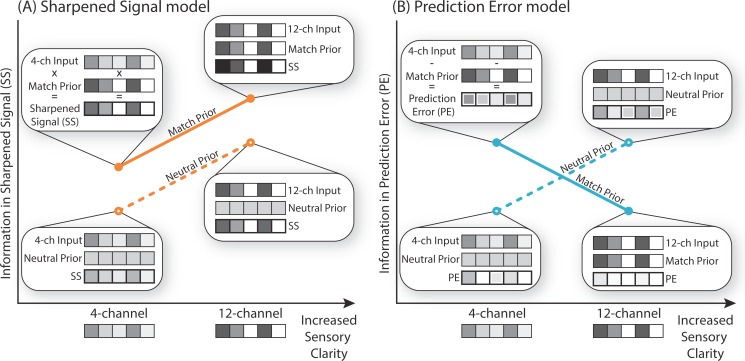
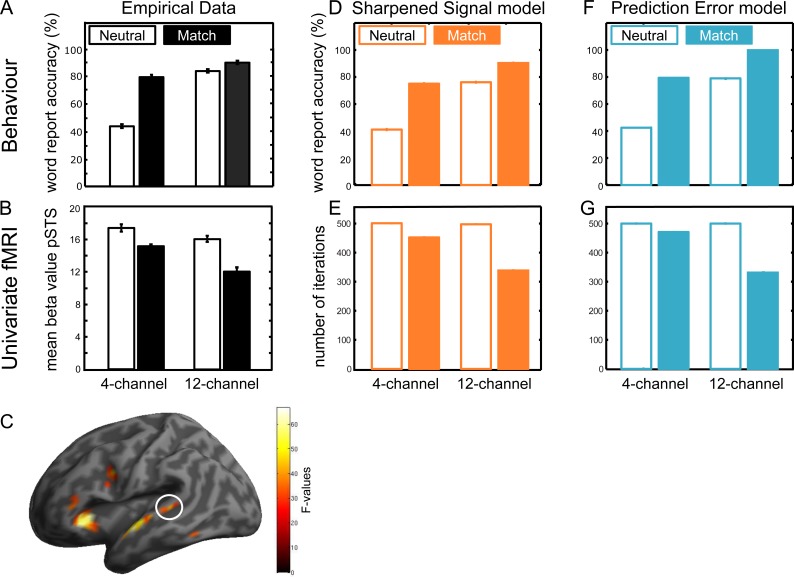
Successful perception depends on combining sensory input with prior knowledge. However, the underlying mechanism by which these two sources of information are combined is unknown. In speech perception, as in other domains, two functionally distinct coding schemes have been proposed for how expectations influence representation of sensory evidence. Traditional models suggest that expected features of the speech input are enhanced or sharpened via interactive activation (Sharpened Signals). Conversely, Predictive Coding suggests that expected features are suppressed so that unexpected features of the speech input (Prediction Errors) are processed further. The present work is aimed at distinguishing between these two accounts of how prior knowledge influences speech perception. By combining behavioural, univariate, and multivariate fMRI measures of how sensory detail and prior expectations influence speech perception with computational modelling, we provide evidence in favour of Prediction Error computations. Increased sensory detail and informative expectations have additive behavioural and univariate neural effects because they both improve the accuracy of word report and reduce the BOLD signal in lateral temporal lobe regions. However, sensory detail and informative expectations have interacting effects on speech representations shown by multivariate fMRI in the posterior superior temporal sulcus. When prior knowledge was absent, increased sensory detail enhanced the amount of speech information measured in superior temporal multivoxel patterns, but with informative expectations, increased sensory detail reduced the amount of measured information. Computational simulations of Sharpened Signals and Prediction Errors during speech perception could both explain these behavioural and univariate fMRI observations. However, the multivariate fMRI observations were uniquely simulated by a Prediction Error and not a Sharpened Signal model. The interaction between prior expectation and sensory detail provides evidence for a Predictive Coding account of speech perception. Our work establishes methods that can be used to distinguish representations of Prediction Error and Sharpened Signals in other perceptual domains.
Overview
The claims and statistics of this paper haven’t been checked yet.
Free: it reads the open-access text and checks the first 5 claims that cite a source we can check. Create a free account to check every claim.
Integrity signals
Registry
Cites
Statistics
Figures


Verification
Claims the paper makes
The claims and statistics of this paper haven’t been checked yet.
Free: it reads the open-access text and checks the first 5 claims that cite a source we can check. Create a free account to check every claim.
Claims other papers make about this one
Each is checked against this paper’s own text: does it say what the citing paper says it does?
The source backs part of the claim, not all of it — or backs it for a different population, condition or comparison.
In the citing paper
“that BOLD responses in posterior superior temporal sulcus (pSTS) to expected words were weaker and contained less information, as quantified by representational similarity analysis (RSA) [88];”
From How Do Expectations Shape Perception? (2018) · cites this paper as [88]
Experimental — accuracy not yet measured
Self-check
Percentages, sums and reported differences re-computed from the paper’s own numbers.
The self-check needs the paper’s full text.
Citations
Cites
Hearing lips and seeing voices
MCGURK, H., & MACDONALD, J. (1976) · Nature · doi:10.1038/264746a0 · Cited by 6,183
Whatever next? Predictive brains, situated agents, and the future of cognitive science
Clark, A. (2013) · Behavioral and Brain Sciences · doi:10.1017/s0140525x12000477 · Cited by 5,924
The cortical organization of speech processing
Hickok, G., & Poeppel, D. (2007) · Nature Reviews Neuroscience · doi:10.1038/nrn2113 · Cited by 5,495
Rao, R. P. N., & Ballard, D. H. (1999) · Nature Neuroscience · doi:10.1038/4580 · Cited by 5,483
A theory of cortical responses.
Friston, K. (2005) · Philosophical Transactions of the Royal Society B: Biological Sciences · doi:10.1098/rstb.2005.1622 · Cited by 4,578
Rubber hands ‘feel’ touch that eyes see
Botvinick, M., & Cohen, J. (1998) · Nature · doi:10.1038/35784 · Cited by 4,410
Representational similarity analysis-connecting the branches of systems neuroscience
Kriegeskorte, N. (2008) · Frontiers in Systems Neuroscience · doi:10.3389/neuro.06.004.2008 · Cited by 3,355
Speech Recognition with Primarily Temporal Cues
Shannon, R. V., Zeng, F.-G., Kamath, V., Wygonski, J., & Ekelid, M. (1995) · Science · doi:10.1126/science.270.5234.303 · Cited by 3,024
The TRACE model of speech perception
McClelland, J. L., & Elman, J. L. (1986) · Cognitive Psychology · doi:10.1016/0010-0285(86)90015-0 · Cited by 2,956
AIC model selection using Akaike weights
Wagenmakers, E.-J., & Farrell, S. (2004) · Psychonomic Bulletin & Review · doi:10.3758/bf03206482 · Cited by 2,684
Cited by
Items 101–174 of 174
Predictive encoding of pure tones and FM-sweeps in the human auditory cortex
Stein, J., von Kriegstein, K., & Tabas, A. (2022) · Cerebral Cortex Communications · doi:10.1093/texcom/tgac047 · Cited by 6
Co-existence of prediction and error signals in electrophysiological responses to natural speechPreprint
Broderick, M. P., & Lalor, E. C. (2020) · bioRxiv (Cold Spring Harbor Laboratory) · doi:10.1101/2020.11.20.391227 · Cited by 6
Contributions of pragmatics to word learning and interpretation
Grigoroglou, M., & Papafragou, A. (2022) · Oxford University Press eBooks · doi:10.1093/oxfordhb/9780198845003.013.21 · Cited by 6
Cortical tracking of prediction error during perception of connected speechPreprint
Webb, J. M., & Sohoglu, E. (2025) · bioRxiv (Cold Spring Harbor Laboratory) · doi:10.1101/2025.07.18.665498 · Cited by 5
Crinnion, A. M., Luthra, S., Gaston, P., & Magnuson, J. S. (2024) · Attention Perception & Psychophysics · doi:10.3758/s13414-024-02849-y · Cited by 4
Perceiving speech from a familiar speaker engages the person identity network
Cordero, G., Paredes, J. R. P., von Kriegstein, K., & Díaz, B. (2025) · PLoS ONE · doi:10.1371/journal.pone.0322927 · Cited by 4
Dyslexia: a window into the cortical mechanisms of adaptive speech analysis
Klimovich‐Gray, A., Božić, M., Molinaro, N., & Lallier, M. (2026) · Trends in Neurosciences · doi:10.1016/j.tins.2025.12.004 · Cited by 4
Ardıç, E. E., & Besken, M. (2022) · Memory & Cognition · doi:10.3758/s13421-022-01370-7 · Cited by 5
Sentence predictability modulates cortical response to phonetic ambiguity
Mechtenberg, H., Xie, X., & Myers, E. B. (2021) · Brain and Language · doi:10.1016/j.bandl.2021.104959 · Cited by 4
Infants’ Learning of Speech Sounds and Word-Forms
Swingley, D. (2022) · Oxford University Press eBooks · doi:10.1093/oxfordhb/9780198845003.013.6 · Cited by 5
Language and thought: The lexicon and beyond
Landau, B. (2022) · Oxford University Press eBooks · doi:10.1093/oxfordhb/9780198845003.013.5 · Cited by 7
A Predictive Coding Model of the N400Preprint
Eddine, S. N., Brothers, T. A., Wang, L., Spratling, M., & Kuperberg, G. R. (2023) · bioRxiv (Cold Spring Harbor Laboratory) · doi:10.1101/2023.04.10.536279 · Cited by 7
Schneider, F., & Blank, H. (2026) · PLoS Biology · doi:10.1371/journal.pbio.3003588 · Cited by 6
Self-citationSarrett, M. E., & McMurray, B. (2024) · Language Cognition and Neuroscience · doi:10.1080/23273798.2024.2409136 · Cited by 4
Corcoran, A. W., Perera, R., Koroma, M., Kouider, S., Hohwy, J., & Andrillon, T. (2021) · bioRxiv (Cold Spring Harbor Laboratory) · doi:10.1101/2021.09.06.459160 · Cited by 3
Phonological variation and lexical form
Purse, R., Tamminga, M., & White, Y. (2022) · Oxford University Press eBooks · doi:10.1093/oxfordhb/9780198845003.013.15 · Cited by 3
Schwarz, F., & Zehr, J. (2022) · Oxford University Press eBooks · doi:10.1093/oxfordhb/9780198845003.013.18 · Cited by 3
Decoupling Speech Processing from TimePreprint
Muegge, J. B., Kim, H., & McMurray, B. (2024) · PsyArXiv (OSF Preprints) · doi:10.31234/osf.io/uwyfn · Cited by 3
Opposing plasticity mechanisms enhance visual inputs that violate their contextPreprint
Seignette, K., de Kraker, L., Halak, M., Papale, P., Petro, L. S., Petro, L. S., Montijn, J. S., Self, M. W., Wilmes, K. A., Roelfsema, P. R., et al. (2024) · bioRxiv (Cold Spring Harbor Laboratory) · doi:10.1101/2024.06.10.598181 · Cited by 6
Xu, W., & Futrell, R. (2025) · Journal of Memory and Language · doi:10.1016/j.jml.2025.104706 · Cited by 7
A Broken Duet: Multistable Dynamics in Dyadic Interactions
Medrano, J., & Sajid, N. (2024) · Entropy · doi:10.3390/e26090731 · Cited by 2
Liuzzi, A. G., Meersmans, K., Storms, G., Deyne, S. D., Dupont, P. J., & Vandenberghe, R. R. (2022) · Neurobiology of Language · doi:10.1162/nol_a_00095 · Cited by 4
Shun, L., Zhang, W., & Wang, S. (2025) · Journal of Cognitive Neuroscience · doi:10.1162/jocn.a.84 · Cited by 3
Munich Sentence (MuSe) Database: Completion norms and audio recordings for 619 German sentences
Sterner, E., Stadler, M., & Knolle, F. (2026) · Behavior Research Methods · doi:10.3758/s13428-026-02993-3 · Cited by 3
Nagy, P., Kovács, P., Boncz, Á., Szalárdy, O., Baumgartner, R., Ignatiadis, K., Winkler, I., & Tóth, B. (2026) · Frontiers in Neuroscience · doi:10.3389/fnins.2026.1739294 · Cited by 2
The effects of dual-task interference in predicting turn-ends in speech and music
Fisher, N. K., Hadley, L. V., Corps, R. E., & Pickering, M. J. (2021) · Brain Research · doi:10.1016/j.brainres.2021.147571 · Cited by 2
Children’s Use of Syntax In Word Learning
Lidz, J. L. (2022) · Oxford University Press eBooks · doi:10.1093/oxfordhb/9780198845003.013.10 · Cited by 4
Word-meaning access: The one-to-many mapping from form to meaning
Rodd, J. M. (2022) · Oxford University Press eBooks · doi:10.1093/oxfordhb/9780198845003.013.1 · Cited by 4
Phonological Abstraction in The Mental Lexicon
Bakovic, E. J., Heinz, J. N., & Rawski, J. (2022) · Oxford University Press eBooks · doi:10.1093/oxfordhb/9780198845003.013.14 · Cited by 3
Completion norms for 3085 English sentence contextsPreprint
Peelle, J. E., Miller, R. L., Rogers, C. S., Spehar, B., Sommers, M. S., & Engen, K. J. V. (2019) · doi:10.31234/osf.io/r8gsy · Cited by 2
Allostasis and uncertainty: An active inference perspective
Corcoran, A. W. (2021) · Figshare · doi:10.26180/16570770 · Cited by 3
Forward and backward prediction in learning and perception
de Lange, F. P., & Press, C. (2025) · Current Opinion in Neurobiology · doi:10.1016/j.conb.2025.103144 · Cited by 3
Neural tracking of continuous speech reveals enhanced late responses to degraded speech
Na, Y., Quan, L. D. A., Joo, H., Choi, I., & Woo, J. (2026) · Frontiers in Neuroscience · doi:10.3389/fnins.2026.1751421 · Cited by 1
Synigal, S. R., Broderick, M. P., & Lalor, E. C. (2026) · European Journal of Neuroscience · doi:10.1111/ejn.70569 · Cited by 2
The modulating effect of lexical predictability on perceptual learning of degraded speech
Li, Y., Chen, F., Liu, C., & Li, X. (2023) · Frontiers in Language Sciences · doi:10.3389/flang.2023.1139073 · Cited by 1
Why might there be lexical-prelexical feedback in speech recognition?
Norris, D. G., & McQueen, J. M. (2024) · Cognition · doi:10.1016/j.cognition.2024.106025 · Cited by 1
Never mind the repeat: How speech expectations reduce tracking at the cocktail party
Sánchez‐Costa, T., Carboni, A., & Constantino, F. C. (2025) · Cortex · doi:10.1016/j.cortex.2025.05.003 · Cited by 1
Shimaya, J., Hanyu, N., & Nakamura, Y. (2019) · Communications in computer and information science · doi:10.1007/978-3-030-23528-4_9 · Cited by 1
Prediction Cannot Be Directly Trained: An Extension to Jones and Westermann (2021)
Jones, S. D., & Westermann, G. (2022) · Journal of Speech Language and Hearing Research · doi:10.1044/2022_jslhr-22-00332 · Cited by 1
The Structure of The Lexical Item and Sentence Meaning Composition
Piñango, M. M. (2022) · Oxford University Press eBooks · doi:10.1093/oxfordhb/9780198845003.013.13 · Cited by 1
Systematicity and Arbitrariness In Language: Saussurean rhapsody
Yang, C. D. (2022) · Oxford University Press eBooks · doi:10.1093/oxfordhb/9780198845003.013.9 · Cited by 1
Neural encoding of speech and word forms
Poeppel, D., & Sun, Y. (2022) · Oxford University Press eBooks · doi:10.1093/oxfordhb/9780198845003.013.16 · Cited by 1
Disorders of Lexical Access And Production
Mirman, D., & Middleton, E. L. (2022) · Oxford University Press eBooks · doi:10.1093/oxfordhb/9780198845003.013.28 · Cited by 1
Differences in vocabulary growth across groups and individuals
Potter, C. E., & Lew‐Williams, C. (2022) · Oxford University Press eBooks · doi:10.1093/oxfordhb/9780198845003.013.22 · Cited by 1
Lexical representation and access in sign languages
Mayberry, R. I., & Wille, B. (2022) · Oxford University Press eBooks · doi:10.1093/oxfordhb/9780198845003.013.27 · Cited by 1
Huang, L., Shen, S., Sun, Y., Ou, S., Zhang, R., de Lange, F. P., & Zhang, X. (2025) · eLife · doi:10.1101/2024.08.26.609781 · Cited by 1
Diffuse predictions stabilize and reshape the neural code during working memory encodingPreprint
Ataseven, N., Özdemir, Ş., Kruijne, W., Schneider, D. A., & Akyürek, E. G. (2026) · bioRxiv (Cold Spring Harbor Laboratory) · doi:10.64898/2026.02.23.707359 · Cited by 1
Isolating neural indices of continuous speech processing from multivariate neural data
Liberto, D., & de Marco, G. (2017) · Arrow@dit (Dublin Institute of Technology)
Domain-general perspectives on the neurocognitive specialization of language
Castillo, G. (2017) · Dipòsit Digital de la Universitat de Barcelona (Universitat de Barcelona)
Learning and Using Written Word Forms
Treiman, R., & Kessler, B. (2022) · Oxford University Press eBooks · doi:10.1093/oxfordhb/9780198845003.013.24
Learning words amidst speech sound variability
Creel, S. C. (2022) · Oxford University Press eBooks · doi:10.1093/oxfordhb/9780198845003.013.7
The Dynamics of Word Production
Kilbourn-Ceron, O., & Goldrick, M. (2022) · Oxford University Press eBooks · doi:10.1093/oxfordhb/9780198845003.013.25 · Cited by 1
How Learners Move From Sound To Morphology
Demuth, K. (2022) · Oxford University Press eBooks · doi:10.1093/oxfordhb/9780198845003.013.8
Crain, S. (2022) · Oxford University Press eBooks · doi:10.1093/oxfordhb/9780198845003.013.11
Αλεξιάδου, Ά. (2022) · Oxford University Press eBooks · doi:10.1093/oxfordhb/9780198845003.013.2
Easy words: Reference resolution in a malevolent referent world
Gleitman, L. R., & Trueswell, J. C. (2022) · Oxford University Press eBooks · doi:10.1093/oxfordhb/9780198845003.013.30
Papafragou, A., Trueswell, J. C., & Gleitman, L. R. (2022) · Oxford University Press eBooks · doi:10.1093/oxfordhb/9780198845003.013.29
Logic and The Lexicon: Insights from modality
Hacquard, V. (2022) · Oxford University Press eBooks · doi:10.1093/oxfordhb/9780198845003.013.4 · Cited by 1
Stojnić, G., & Lepore, E. (2022) · Oxford University Press eBooks · doi:10.1093/oxfordhb/9780198845003.013.20
(2022) · Oxford University Press eBooks · doi:10.1093/oxfordhb/9780198845003.002.0088
(2022) · Oxford University Press eBooks · doi:10.1093/oxfordhb/9780198845003.002.0006
(2022) · Oxford University Press eBooks · doi:10.1093/oxfordhb/9780198845003.002.0004
Decoding the temporal dynamics of spoken word and nonword processing from EEGPreprint
McMurray, B., Sarrett, M. E., Chiu, S. L., Black, A. K., Canale, R. R., Wang, A., & Aslin, R. Ν. (2022) · PsyArXiv (OSF Preprints) · doi:10.31234/osf.io/6ng2k_v1
Cognitive and Neural Mechanisms for Perceiving and Misperceiving Speech
Tolkacheva, V. (2025) · QUT ePrints (Queensland University of Technology) · doi:10.5204/thesis.eprints.257998
Center-surround inhibition by expectation: a neuro-computational accountPreprint
Huang, L., Shen, S., Sun, Y., Ou, S., Zhang, R., de Lange, F. P., & Zhang, X. (2025) · eLife · doi:10.7554/elife.107301.1
Center-surround inhibition by expectation: a neuro-computational accountPreprint
Huang, L., Shen, S., Sun, Y., Ou, S., Zhang, R., de Lange, F. P., & Zhang, X. (2025) · eLife · doi:10.7554/elife.107301.2
Neural correlates of form- and meaning-based predictability during speech perception
Signoret, C., Andin, J., & Dahlström, Ö. (2025) · Brain and Cognition · doi:10.1016/j.bandc.2025.106379
Huang, L., Shen, S., Sun, Y., Ou, S., Zhang, R., de Lange, F. P., & Zhang, X. (2025) · eLife · doi:10.7554/elife.107301.3.sa3
Shun, L., Wang, S., & Liu, X. (2026) · Language and Speech · doi:10.1177/00238309261441302 · Cited by 1
Gagl, B., & Eisenhauer, S. (2021) · OSF Preprints (OSF Preprints)
Prior Context Scaffolds Sentential Semantic Integration during Noisy Speech ComprehensionPreprint
Zhang, X., Li, Z., & Zhang, D. (2026) · bioRxiv (Cold Spring Harbor Laboratory) · doi:10.64898/2026.07.11.737996
Extending a Formal Model of Predictive Coding to Human Spoken Word Recognition
Rogers, B., Li, M. Y.-C., Hannagan, T., Magnuson, J. S., & Brown, K. S. (2026) · Neural Computation · doi:10.1162/neco.a.1570
Optimizing pre-listening activities with AI-assisted priming for L2 listening comprehension
Vu, D. C., & Vu, B. C. (2026) · Discover Education · doi:10.1007/s44217-026-02256-5
Metadata
- Authors
- Blank, H., & Davis, M. H.
- Affiliations
- MRC Cognition and Brain Sciences Unit (GB)
- Corresponding author
- Blank, Helen
- Venue
- PLOS Biology
- Publisher
- Public Library of Science (PLoS)
- Published
- 2016-11-15
- Volume
- 14
- Issue
- 11
- Pages
- e1002577
- ISSN
- 1544-9173 (ISSN-L)
- 1545-7885
- PMC
- PMC5112801
- OpenAlex
- W2549771691
- Cited by
- 181
- References
- 112
- Citations by year
- 2026: 10 · 2025: 15 · 2024: 21 · 2023: 14 · 2022: 55 · 2021: 14 · 2020: 18 · 2019: 14 · 2018: 13 · 2017: 7
- FWCI
- 7.21
- Type
- journal article
- Language
- en
- Open access
- gold
- doi.org
- Licence
- Locations
- PLoS Biology (publishedVersion, cc-by)
- PubMed Central (publishedVersion, cc-by)
- PubMed (publishedVersion)
- RePEc: Research Papers in Economics (submittedVersion)
- DOAJ (DOAJ: Directory of Open Access Journals) (submittedVersion)
- OSF Preprints (OSF Preprints) (submittedVersion)
- Funders
- Medical Research Council (MC-A060-5PQ80)
- Topics
- Life Sciences › Neuroscience › Cognitive Neuroscience › Neurobiology of Language and Bilingualism
- Social Sciences › Psychology › Experimental and Cognitive Psychology › Phonetics and Phonology Research
- Life Sciences › Neuroscience › Cognitive Neuroscience › Neuroscience and Music Perception
- Keywords
- speech perception, prediction error, predictive coding, interactive activation, prior expectations, sensory detail, posterior superior temporal sulcus, lateral temporal lobe, perceptual representation
- MeSH terms
- Behavior, Humans, Magnetic Resonance Imaging, Models, Theoretical, Speech Perception, Temporal Lobe, Multivariate Analysis
About these checks
Registry, retraction, Cites and statistics results are computed, not judged, with one exception: a printed reference that no index lists is read once by a model before it counts as a citation error. Claims are extracted by a model and kept only when their quote appears verbatim in the text; each cited source is then checked, with a model’s help, for whether it says what the claim relies on. Those verdicts can be wrong — read the claim’s quote and the cited source before relying on one.
Statistics and arithmetic are recomputed, not judged.
Confidence bands are shown only for fields calibrated on our annotated test set. None is calibrated yet, so no band is shown.
What counts as a claim ›How we measure confidence ›How we check this ›
Are you an author, or do you see a problem with this page? Request a review
Data sources
Bibliographic data: Semantic Scholar, OpenAlex, Crossref.
Contains information from the Semantic Scholar Academic Graph Datasets, made available under the ODC Attribution License (ODC-BY 1.0).
Semantic Scholar’s data is described in: Kinney, R., et al. (2023). The Semantic Scholar Open Data Platform. arXiv:2301.10140.
