

Prediction Errors but Not Sharpened Signals Simulate Multivoxel fMRI Patterns during Speech Perception
Open accessThe DOI matches its Crossref record; 114 of the 114 references it cites were found in a registry or an index.
Abstract
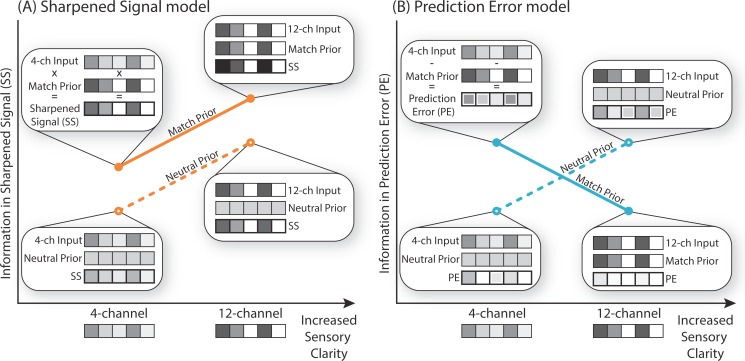
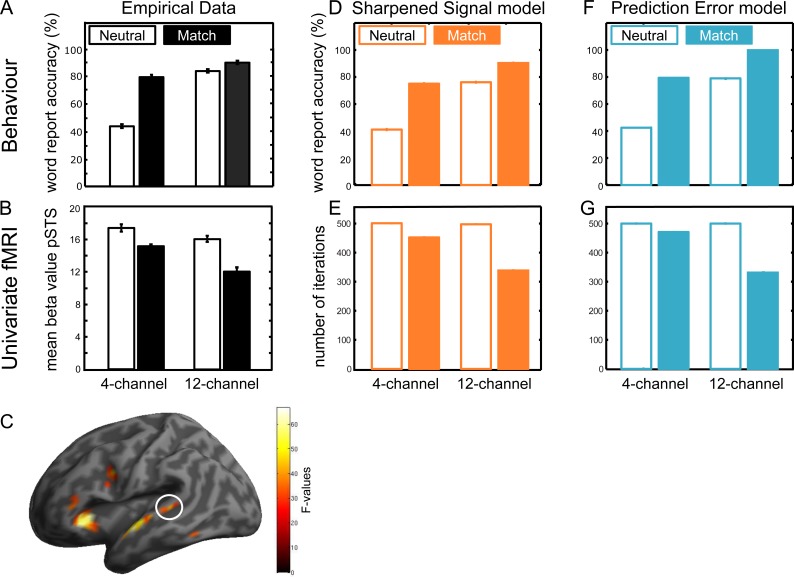
Successful perception depends on combining sensory input with prior knowledge. However, the underlying mechanism by which these two sources of information are combined is unknown. In speech perception, as in other domains, two functionally distinct coding schemes have been proposed for how expectations influence representation of sensory evidence. Traditional models suggest that expected features of the speech input are enhanced or sharpened via interactive activation (Sharpened Signals). Conversely, Predictive Coding suggests that expected features are suppressed so that unexpected features of the speech input (Prediction Errors) are processed further. The present work is aimed at distinguishing between these two accounts of how prior knowledge influences speech perception. By combining behavioural, univariate, and multivariate fMRI measures of how sensory detail and prior expectations influence speech perception with computational modelling, we provide evidence in favour of Prediction Error computations. Increased sensory detail and informative expectations have additive behavioural and univariate neural effects because they both improve the accuracy of word report and reduce the BOLD signal in lateral temporal lobe regions. However, sensory detail and informative expectations have interacting effects on speech representations shown by multivariate fMRI in the posterior superior temporal sulcus. When prior knowledge was absent, increased sensory detail enhanced the amount of speech information measured in superior temporal multivoxel patterns, but with informative expectations, increased sensory detail reduced the amount of measured information. Computational simulations of Sharpened Signals and Prediction Errors during speech perception could both explain these behavioural and univariate fMRI observations. However, the multivariate fMRI observations were uniquely simulated by a Prediction Error and not a Sharpened Signal model. The interaction between prior expectation and sensory detail provides evidence for a Predictive Coding account of speech perception. Our work establishes methods that can be used to distinguish representations of Prediction Error and Sharpened Signals in other perceptual domains.
Overview
The claims and statistics of this paper haven’t been checked yet.
Free: it reads the open-access text and checks the first 5 claims that cite a source we can check. Create a free account to check every claim.
Integrity signals
Registry
Cites
Statistics
Figures


Verification
Claims the paper makes
The claims and statistics of this paper haven’t been checked yet.
Free: it reads the open-access text and checks the first 5 claims that cite a source we can check. Create a free account to check every claim.
Claims other papers make about this one
Each is checked against this paper’s own text: does it say what the citing paper says it does?
The source backs part of the claim, not all of it — or backs it for a different population, condition or comparison.
In the citing paper
“that BOLD responses in posterior superior temporal sulcus (pSTS) to expected words were weaker and contained less information, as quantified by representational similarity analysis (RSA) [88];”
From How Do Expectations Shape Perception? (2018) · cites this paper as [88]
Experimental — accuracy not yet measured
Self-check
Percentages, sums and reported differences re-computed from the paper’s own numbers.
The self-check needs the paper’s full text.
Citations
Cites
Hearing lips and seeing voices
MCGURK, H., & MACDONALD, J. (1976) · Nature · doi:10.1038/264746a0 · Cited by 6,183
Whatever next? Predictive brains, situated agents, and the future of cognitive science
Clark, A. (2013) · Behavioral and Brain Sciences · doi:10.1017/s0140525x12000477 · Cited by 5,924
The cortical organization of speech processing
Hickok, G., & Poeppel, D. (2007) · Nature Reviews Neuroscience · doi:10.1038/nrn2113 · Cited by 5,495
Rao, R. P. N., & Ballard, D. H. (1999) · Nature Neuroscience · doi:10.1038/4580 · Cited by 5,483
A theory of cortical responses.
Friston, K. (2005) · Philosophical Transactions of the Royal Society B: Biological Sciences · doi:10.1098/rstb.2005.1622 · Cited by 4,578
Rubber hands ‘feel’ touch that eyes see
Botvinick, M., & Cohen, J. (1998) · Nature · doi:10.1038/35784 · Cited by 4,410
Representational similarity analysis-connecting the branches of systems neuroscience
Kriegeskorte, N. (2008) · Frontiers in Systems Neuroscience · doi:10.3389/neuro.06.004.2008 · Cited by 3,355
Speech Recognition with Primarily Temporal Cues
Shannon, R. V., Zeng, F.-G., Kamath, V., Wygonski, J., & Ekelid, M. (1995) · Science · doi:10.1126/science.270.5234.303 · Cited by 3,024
The TRACE model of speech perception
McClelland, J. L., & Elman, J. L. (1986) · Cognitive Psychology · doi:10.1016/0010-0285(86)90015-0 · Cited by 2,956
AIC model selection using Akaike weights
Wagenmakers, E.-J., & Farrell, S. (2004) · Psychonomic Bulletin & Review · doi:10.3758/bf03206482 · Cited by 2,684
Visual Contribution to Speech Intelligibility in Noise
Sumby, W. H., & Pollack, I. (1954) · The Journal of the Acoustical Society of America · doi:10.1121/1.1907309 · Cited by 2,583
Using confidence intervals in within-subject designs
Loftus, G. R., & Masson, M. E. J. (1994) · Psychonomic Bulletin & Review · doi:10.3758/bf03210951 · Cited by 2,448
Repetition and the brain: neural models of stimulus-specific effects
Grill-Spector, K., Henson, R., & Martin, A. (2006) · Trends in Cognitive Sciences · doi:10.1016/j.tics.2005.11.006 · Cited by 2,256
Information-based functional brain mapping
Kriegeskorte, N., Goebel, R., & Bandettini, P. (2006) · Proceedings of the National Academy of Sciences · doi:10.1073/pnas.0600244103 · Cited by 2,113
Handbuch der physiologischen Optik
Helmholtz, H. L. F. (2011) · DFG Viewer (DFG Viewer) · Cited by 1,947
Cortical oscillations and speech processing: emerging computational principles and operations
Giraud, A.-L., & Poeppel, D. (2012) · Nature Neuroscience · doi:10.1038/nn.3063 · Cited by 1,917
A cochlear frequency-position function for several species—29 years later
Greenwood, D. D. (1990) · The Journal of the Acoustical Society of America · doi:10.1121/1.399052 · Cited by 1,890
Hill, K. C., & Ladefoged, P. (1977) · Language · doi:10.2307/412918 · Cited by 1,768
Kastner, S., Pinsk, M. A., De Weerd, P., Desimone, R., & Ungerleider, L. G. (1999) · Neuron · doi:10.1016/s0896-6273(00)80734-5 · Cited by 1,622
Top-down facilitation of visual recognition
Bar, M., Kassam, K. S., Ghuman, A. S., Boshyan, J., Schmid, A. M., Dale, A. M., Hämäläinen, M. S., Marinkovic, K., Schacter, D. L., Rosen, B. R., et al. (2006) · Proceedings of the National Academy of Sciences · doi:10.1073/pnas.0507062103 · Cited by 1,489
A "Rationalized" Arcsine Transform
Studebaker, G. A. (1985) · Journal of Speech, Language, and Hearing Research · doi:10.1044/jshr.2803.455 · Cited by 1,479
Hierarchical Bayesian inference in the visual cortex
Lee, T. S., & Mumford, D. (2003) · Journal of the Optical Society of America A · doi:10.1364/josaa.20.001434 · Cited by 1,473
Shams, L., Kamitani, Y., & Shimojo, S. (2000) · Nature · doi:10.1038/35048669 · Cited by 1,262
Shortlist: a connectionist model of continuous speech recognition
Norris, D. (1994) · Cognition · doi:10.1016/0010-0277(94)90043-4 · Cited by 1,250
Cortical oscillations and sensory predictions
Arnal, L. H., & Giraud, A.-L. (2012) · Trends in Cognitive Sciences · doi:10.1016/j.tics.2012.05.003 · Cited by 1,114
On the computational architecture of the neocortex: II The role of cortico-cortical loops
Mumford, D. (1992) · Biological Cybernetics · doi:10.1007/bf00198477 · Cited by 1,074
Selective cortical representation of attended speaker in multi-talker speech perception
Mesgarani, N., & Chang, E. F. (2012) · Nature · doi:10.1038/nature11020 · Cited by 1,007
Phonetic Feature Encoding in Human Superior Temporal Gyrus
Mesgarani, N., Cheung, C., Johnson, K., & Chang, E. F. (2014) · Science · doi:10.1126/science.1245994 · Cited by 993
Expectation (and attention) in visual cognition
Summerfield, C., & Egner, T. (2009) · Trends in Cognitive Sciences · doi:10.1016/j.tics.2009.06.003 · Cited by 950
A Toolbox for Representational Similarity Analysis
Nili, H., Wingfield, C., Walther, A., Su, L., Marslen-Wilson, W., & Kriegeskorte, N. (2014) · PLoS Computational Biology · doi:10.1371/journal.pcbi.1003553 · Cited by 937
On the computational architecture of the neocortex: I. The role of the thalamo-cortical loop
Mumford, D. (1991) · Biological Cybernetics · doi:10.1007/bf00202389 · Cited by 929
Mechanisms underlying selective neuronal tracking of attended speech at a “cocktail party”
Zion Golumbic, E. M., Ding, N., Bickel, S., Lakatos, P., Schevon, C. A., McKhann, G. M., Goodman, R. R., Emerson, R., Mehta, A. D., Simon, J. Z., et al. (2013) · Neuron · doi:10.1016/j.neuron.2012.12.037 · Cited by 909
Predicting the orientation of invisible stimuli from activity in human primary visual cortex
Haynes, J.-D., & Rees, G. (2005) · Nature Neuroscience · doi:10.1038/nn1445 · Cited by 867
Expectation in perceptual decision making: neural and computational mechanisms
Summerfield, C., & de Lange, F. P. (2014) · Nature Reviews Neuroscience · doi:10.1038/nrn3838 · Cited by 832
Speech perception without traditional speech cues
Remez, R. E., Rubin, P. E., Pisoni, D. B., & Carrell, T. D. (1981) · Science · doi:10.1126/science.7233191 · Cited by 800
Less Is More: Expectation Sharpens Representations in the Primary Visual Cortex
Kok, P., Jehee, J. F. M., & de Lange, F. P. (2012) · Neuron · doi:10.1016/j.neuron.2012.04.034 · Cited by 798
Hierarchical Processing in Spoken Language Comprehension
Davis, M. H., & Johnsrude, I. S. (2003) · The Journal of Neuroscience · doi:10.1523/jneurosci.23-08-03423.2003 · Cited by 772
Self-citationThe intelligibility of speech as a function of the context of the test materials.
Miller, G. A., Heise, G. A., & Lichten, W. (1951) · Journal of Experimental Psychology · doi:10.1037/h0062491 · Cited by 769
Merging information in speech recognition: Feedback is never necessary
Norris, D., McQueen, J. M., & Cutler, A. (2000) · Behavioral and Brain Sciences · doi:10.1017/s0140525x00003241 · Cited by 761
The neuroanatomical and functional organization of speech perception
Scott, S. K., & Johnsrude, I. S. (2003) · Trends in Neurosciences · doi:10.1016/s0166-2236(02)00037-1 · Cited by 705
Shortlist B: A Bayesian model of continuous speech recognition.
Norris, D., & McQueen, J. M. (2008) · Psychological Review · doi:10.1037/0033-295x.115.2.357 · Cited by 686
Who “Is Saying What”? Brain-based decoding of human voice and speech
Formisano, E., De Martino, F., Bonte, M., & Goebel, R. (2008) · Science · doi:10.1126/science.1164318 · Cited by 599 · cited 1×
“Third and perhaps most important, however, is that the representations of Prediction Error that we have observed during speech perception might apply to many other sensory domains in which prior knowledge has been shown to influence perception (such as audition [6,7,76,97], vision [9–12,20,98,99], touch [13], gustatio…”
Categorical speech representation in human superior temporal gyrus
Chang, E. F., Rieger, J. W., Johnson, K., Berger, M. S., Barbaro, N. M., & Knight, R. T. (2010) · Nature Neuroscience · doi:10.1038/nn.2641 · Cited by 588
Evidence for a hierarchy of predictions and prediction errors in human cortex
Wacongne, C., Labyt, E., van Wassenhove, V., Bekinschtein, T., Naccache, L., & Dehaene, S. (2011) · Proceedings of the National Academy of Sciences · doi:10.1073/pnas.1117807108 · Cited by 560
Integrating Form and Meaning: A Distributed Model of Speech Perception
Gaskell, M. G., & Marslen-Wilson, W. D. (1997) · Language and Cognitive Processes · doi:10.1080/016909697386646 · Cited by 543
Theory of Mind: A Neural Prediction Problem
Koster-Hale, J., & Saxe, R. (2013) · Neuron · doi:10.1016/j.neuron.2013.08.020 · Cited by 513
Placebo Analgesia: A Predictive Coding Perspective
Büchel, C., Geuter, S., Sprenger, C., & Eippert, F. (2014) · Neuron · doi:10.1016/j.neuron.2014.02.042 · Cited by 505
Predictive codes for forthcoming perception in the frontal cortex.
Summerfield, C., Egner, T., Greene, M., Koechlin, E., Mangels, J., & Hirsch, J. (2006) · Science · doi:10.1126/science.1132028 · Cited by 496
Comparison of multivariate classifiers and response normalizations for pattern-information fMRI
Misaki, M., Kim, Y., Bandettini, P. A., & Kriegeskorte, N. (2010) · NeuroImage · doi:10.1016/j.neuroimage.2010.05.051 · Cited by 458
Intact But Less Accessible Phonetic Representations in Adults with Dyslexia
Boets, B., Op de Beeck, H. P., Vandermosten, M., Scott, S. K., Gillebert, C. R., Mantini, D., Bulthé, J., Sunaert, S., Wouters, J., & Ghesquière, P. (2013) · Science · doi:10.1126/science.1244333 · Cited by 446
Quantifying the contribution of vision to speech perception in noise
Macleod, A., & Summerfield, Q. (1987) · British Journal of Audiology · doi:10.3109/03005368709077786 · Cited by 426
Contextual Feedback to Superficial Layers of V1
Muckli, L., De Martino, F., Vizioli, L., Petro, L. S., Smith, F. W., Ugurbil, K., Goebel, R., & Yacoub, E. (2015) · Current Biology · doi:10.1016/j.cub.2015.08.057 · Cited by 423
Selective Activation of the Deep Layers of the Human Primary Visual Cortex by Top-Down Feedback
Kok, P., Bains, L. J., van Mourik, T., Norris, D. G., & de Lange, F. P. (2016) · Current Biology · doi:10.1016/j.cub.2015.12.038 · Cited by 397
Prior expectation mediates neural adaptation to repeated sounds in the auditory cortex: an MEG study
Todorovic, A., van Ede, F., Maris, E., & de Lange, F. P. (2011) · Journal of Neuroscience · doi:10.1523/jneurosci.1425-11.2011 · Cited by 391
Predictive top-down integration of prior knowledge during speech perception
Sohoglu, E., Peelle, J. E., Carlyon, R. P., & Davis, M. H. (2012) · Journal of Neuroscience · doi:10.1523/jneurosci.5069-11.2012 · Cited by 388 · cited 2×
“Implications for the Perception of Speech and Other Sensory Signals Our work joins a number of recent fMRI and MEG/EEG studies in proposing an important role for Prediction Error computations in speech perception [4,7,8,39,81].”
Self-citationThe Leading Sense: Supramodal Control of Neurophysiological Context by Attention
Lakatos, P., O'Connell, M. N., Barczak, A., Mills, A., Javitt, D. C., & Schroeder, C. E. (2009) · Neuron · doi:10.1016/j.neuron.2009.10.014 · Cited by 381
Decision-related activity in sensory neurons reflects more than a neuron’s causal effect
Nienborg, H., & Cumming, B. G. (2009) · Nature · doi:10.1038/nature07821 · Cited by 369
Obleser, J., Wise, R. J. S., Alex Dresner, M., & Scott, S. K. (2007) · The Journal of Neuroscience · doi:10.1523/jneurosci.4663-06.2007 · Cited by 354
Transitions in neural oscillations reflect prediction errors generated in audiovisual speech
Arnal, L. H., Wyart, V., & Giraud, A.-L. (2011) · Nature Neuroscience · doi:10.1038/nn.2810 · Cited by 353
Expectation and Surprise Determine Neural Population Responses in the Ventral Visual Stream
Egner, T., Monti, J. M., & Summerfield, C. (2010) · The Journal of Neuroscience · doi:10.1523/jneurosci.2770-10.2010 · Cited by 350
Neural dynamics of word recognition and recall: Attentional priming, learning, and resonance.
Grossberg, S., & Stone, G. (1986) · Psychological Review · doi:10.1037/0033-295x.93.1.46 · Cited by 340
Todorovic, A., & de Lange, F. P. (2012) · The Journal of Neuroscience · doi:10.1523/jneurosci.2227-12.2012 · Cited by 326
A Dual Role for Prediction Error in Associative Learning
den Ouden, H. E. M., Friston, K. J., Daw, N. D., McIntosh, A. R., & Stephan, K. E. (2009) · Cerebral Cortex · doi:10.1093/cercor/bhn161 · Cited by 306
Expectation and Attention in Hierarchical Auditory Prediction
Chennu, S., Noreika, V., Gueorguiev, D., Blenkmann, A., Kochen, S., Ibanez, A., Owen, A. M., & Bekinschtein, T. A. (2013) · Journal of Neuroscience · doi:10.1523/jneurosci.0114-13.2013 · Cited by 299
Prior Expectations Evoke Stimulus Templates in the Primary Visual Cortex
Kok, P., Failing, M. F., & de Lange, F. P. (2014) · Journal of Cognitive Neuroscience · doi:10.1162/jocn_a_00562 · Cited by 293
Neural correlates of switching from auditory to speech perception
Dehaene-Lambertz, G., Pallier, C., Serniclaes, W., Sprenger-Charolles, L., Jobert, A., & Dehaene, S. (2005) · NeuroImage · doi:10.1016/j.neuroimage.2004.09.039 · Cited by 283
Phonotactics, Neighborhood Activation, and Lexical Access for Spoken Words
Vitevitch, M. S., Luce, P. A., Pisoni, D. B., & Auer, E. T. (1999) · Brain and Language · doi:10.1006/brln.1999.2116 · Cited by 274
Image and Video Compression for Multimedia Engineering: Fundamentals, Algorithms, and Standards
Shi, Y. Q., & Sun, H. (1999) · Thammasat University Digital Collections · Cited by 272
Prior expectations bias sensory representations in visual cortex
Kok, P., Brouwer, G. J., van Gerven, M. A. J., & de Lange, F. P. (2013) · The Journal of Neuroscience · doi:10.1523/jneurosci.0742-13.2013 · Cited by 260
Are there interactive processes in speech perception?
MCCLELLAND, J., MIRMAN, D., & HOLT, L. (2006) · Trends in Cognitive Sciences · doi:10.1016/j.tics.2006.06.007 · Cited by 246
Image and Video Compression for Multimedia Engineering: Fundamentals, Algorithms, and Standards
Shi, Y., & Sun, H. (1999) · Image Processing Series · doi:10.1201/9781420049794 · Cited by 244
Dual Neural Routing of Visual Facilitation in Speech Processing
Arnal, L. H., Morillon, B., Kell, C. A., & Giraud, A.-L. (2009) · The Journal of Neuroscience · doi:10.1523/jneurosci.3194-09.2009 · Cited by 241
At what time is the cocktail party? A late locus of selective attention to natural speech
Power, A. J., Foxe, J. J., Forde, E., Reilly, R. B., & Lalor, E. C. (2012) · European Journal of Neuroscience · doi:10.1111/j.1460-9568.2012.08060.x · Cited by 239
Temporal predictive codes for spoken words in auditory cortex
Gagnepain, P., Henson, R. N., & Davis, M. H. (2012) · Current Biology · doi:10.1016/j.cub.2012.02.015 · Cited by 235
Self-citationNoise differentially impacts phoneme representations in the auditory and speech motor systems
Du, Y., Buchsbaum, B. R., Grady, C. L., & Alain, C. (2014) · Proceedings of the National Academy of Sciences · doi:10.1073/pnas.1318738111 · Cited by 220
Top-down effects on early visual processing in humans: A predictive coding framework
Rauss, K., Schwartz, S., & Pourtois, G. (2011) · Neuroscience & Biobehavioral Reviews · doi:10.1016/j.neubiorev.2010.12.011 · Cited by 219
Olfactory Predictive Codes and Stimulus Templates in Piriform Cortex
Zelano, C., Mohanty, A., & Gottfried, J. A. (2011) · Neuron · doi:10.1016/j.neuron.2011.08.010 · Cited by 219
Crosse, M. J., Butler, J. S., & Lalor, E. C. (2015) · The Journal of Neuroscience · doi:10.1523/jneurosci.1829-15.2015 · Cited by 208
Tactile expectation modulates pre-stimulus β-band oscillations in human sensorimotor cortex
van Ede, F., Jensen, O. B., & Maris, E. (2010) · NeuroImage · doi:10.1016/j.neuroimage.2010.02.053 · Cited by 177
Cusack, R., Vicente-Grabovetsky, A., Mitchell, D. J., Wild, C. J., Auer, T., Linke, A. C., & Peelle, J. E. (2015) · Frontiers in Neuroinformatics · doi:10.3389/fninf.2014.00090 · Cited by 173
The Effect of Prior Visual Information on Recognition of Speech and Sounds
Noppeney, U., Josephs, O., Hocking, J., Price, C. J., & Friston, K. J. (2008) · Cerebral Cortex · doi:10.1093/cercor/bhm091 · Cited by 172
Nath, A. R., & Beauchamp, M. S. (2011) · The Journal of Neuroscience · doi:10.1523/jneurosci.4853-10.2011 · Cited by 171
Perceptual grouping and the interactions between visual cortical areas
Murray, S. O., Schrater, P., & Kersten, D. (2004) · Neural Networks · doi:10.1016/j.neunet.2004.03.010 · Cited by 167
Perceptual learning of noise vocoded words: Effects of feedback and lexicality.
Hervais-Adelman, A., Davis, M. H., Johnsrude, I. S., & Carlyon, R. P. (2008) · Journal of Experimental Psychology: Human Perception and Performance · doi:10.1037/0096-1523.34.2.460 · Cited by 166
Self-citationNeural dynamics of variable-rate speech categorization.
Grossberg, S., Boardman, I., & Cohen, M. (1997) · Journal of Experimental Psychology: Human Perception and Performance · doi:10.1037//0096-1523.23.2.481 · Cited by 164
Visual Localization Ability Influences Cross-Modal Bias
Hairston, W. D., Wallace, M. T., Vaughan, J. W., Stein, B. E., Norris, J. L., & Schirillo, J. A. (2003) · Journal of Cognitive Neuroscience · doi:10.1162/089892903321107792 · Cited by 164
Expectations influence sensory experience in a wine tasting
Siegrist, M., & Cousin, M. (2009) · Appetite · doi:10.1016/j.appet.2009.02.002 · Cited by 163
Simulation of talking faces in the human brain improves auditory speech recognition
von Kriegstein, K., Dogan, Ö., Grüter, M., Giraud, A.-L., Kell, C. A., Grüter, T., Kleinschmidt, A., & Kiebel, S. J. (2008) · Proceedings of the National Academy of Sciences · doi:10.1073/pnas.0710826105 · Cited by 160
Möttönen, R., Calvert, G. A., Jääskeläinen, I. P., Matthews, P. M., Thesen, T., Tuomainen, J., & Sams, M. (2006) · NeuroImage · doi:10.1016/j.neuroimage.2005.10.002 · Cited by 158
Davis, M. H., Ford, M. A., Kherif, F., & Johnsrude, I. S. (2011) · Journal of Cognitive Neuroscience · doi:10.1162/jocn_a_00084 · Cited by 155
Self-citationReconciling predictive coding and biased competition models of cortical function
Spratling, M. W. (2008) · Frontiers in Computational Neuroscience · doi:10.3389/neuro.10.004.2008 · Cited by 153
SanMiguel, I., Widmann, A., Bendixen, A., Trujillo-Barreto, N., & Schröger, E. (2013) · The Journal of Neuroscience · doi:10.1523/jneurosci.5821-12.2013 · Cited by 141
Evans, S., & Davis, M. H. (2015) · Cerebral Cortex · doi:10.1093/cercor/bhv136 · Cited by 130
Self-citationLee, Y.-S., Turkeltaub, P., Granger, R., & Raizada, R. D. S. (2012) · The Journal of Neuroscience · doi:10.1523/jneurosci.3814-11.2012 · Cited by 123
Perceptual learning of degraded speech by minimizing prediction error
Sohoglu, E., & Davis, M. H. (2016) · Proceedings of the National Academy of Sciences · doi:10.1073/pnas.1523266113 · Cited by 122
Self-citationHuman auditory cortex is sensitive to the perceived clarity of speech
Wild, C. J., Davis, M. H., & Johnsrude, I. S. (2012) · NeuroImage · doi:10.1016/j.neuroimage.2012.01.035 · Cited by 116
Self-citationAuditory Cortex Encodes the Perceptual Interpretation of Ambiguous Sound
Kilian-Hütten, N., Valente, G., Vroomen, J., & Formisano, E. (2011) · The Journal of Neuroscience · doi:10.1523/jneurosci.4572-10.2011 · Cited by 115
Recognition Alters the Spatial Pattern of fMRI Activation in Early Retinotopic Cortex
Hsieh, P.-J., Vul, E., & Kanwisher, N. (2010) · Journal of Neurophysiology · doi:10.1152/jn.00812.2009 · Cited by 114
An interactive Hebbian account of lexically guided tuning of speech perception
Mirman, D., McClelland, J. L., & Holt, L. L. (2006) · Psychonomic Bulletin & Review · doi:10.3758/bf03213909 · Cited by 111
Distributed neural representations of phonological features during speech perception
Arsenault, J. S., & Buchsbaum, B. R. (2015) · The Journal of Neuroscience · doi:10.1523/jneurosci.2454-14.2015 · Cited by 111
Neural dynamics of variable-rate speech categorization.
Grossberg, S., Boardman, I., & Cohen, M. M. (1997) · Journal of Experimental Psychology Human Perception & Performance · doi:10.1037/0096-1523.23.2.481 · Cited by 109
Decoding Articulatory Features from fMRI Responses in Dorsal Speech Regions
Correia, J. M., Jansma, B. M. B., & Bonte, M. (2015) · The Journal of Neuroscience · doi:10.1523/jneurosci.0977-15.2015 · Cited by 99
Encoding and Tracking of Outcome-Specific Expectancy in the Gustatory Cortex of Alert Rats
Gardner, M. P. H., & Fontanini, A. (2014) · The Journal of Neuroscience · doi:10.1523/jneurosci.1820-14.2014 · Cited by 93
Top-down influences of written text on perceived clarity of degraded speech.
Sohoglu, E., Peelle, J. E., Carlyon, R. P., & Davis, M. H. (2013) · Journal of Experimental Psychology Human Perception & Performance · doi:10.1037/a0033206 · Cited by 89
Self-citationPredictive Coding and the Neural Response to Predictable Stimuli
de-Wit, L., Machilsen, B., & Putzeys, T. (2010) · Journal of Neuroscience · doi:10.1523/jneurosci.2248-10.2010 · Cited by 88
Mattys, S. L., & Liss, J. M. (2008) · Perception & Psychophysics · doi:10.3758/pp.70.7.1235 · Cited by 73
Temporal prediction errors in visual and auditory cortices
Lee, H. L., & Noppeney, U. (2014) · Current Biology · doi:10.1016/j.cub.2014.02.007 · Cited by 71
Hsu, Y.-F., Le Bars, S., Hämäläinen, J. A., & Waszak, F. (2015) · The Journal of Neuroscience · doi:10.1523/jneurosci.2204-15.2015 · Cited by 67
Interpreting response time effects in functional imaging studies
Taylor, J. S. H., Rastle, K., & Davis, M. H. (2014) · NeuroImage · doi:10.1016/j.neuroimage.2014.05.073 · Cited by 66
Self-citationHow the human brain exchanges information across sensory modalities to recognize other people
Blank, H., Kiebel, S. J., & von Kriegstein, K. (2014) · Human Brain Mapping · doi:10.1002/hbm.22631 · Cited by 48
Self-citationMechanisms of enhancing visual–speech recognition by prior auditory information
Blank, H., & von Kriegstein, K. (2012) · NeuroImage · doi:10.1016/j.neuroimage.2012.09.047 · Cited by 42
Self-citationPutting the Listening Brain in Context
Obleser, J. (2014) · Language and Linguistics Compass · doi:10.1111/lnc3.12098 · Cited by 32
Overlapping multivoxel patterns for two levels of visual expectation
de Gardelle, V., Stokes, M., Johnen, V. M., Wyart, V., & Summerfield, C. (2013) · Frontiers in Human Neuroscience · doi:10.3389/fnhum.2013.00158 · Cited by 21
When Believing is Seeing: The Role of Predictions in Shaping Visual Perception
Król, M. E., & El‐Deredy, W. (2011) · Quarterly Journal of Experimental Psychology · doi:10.1080/17470218.2011.559587 · Cited by 18
Cited by
How Do Expectations Shape Perception?
de Lange, F. P., Heilbron, M., & Kok, P. (2018) · Trends in Cognitive Sciences · doi:10.1016/j.tics.2018.06.002 · Cited by 975
The Encoding of Speech Sounds in the Superior Temporal Gyrus
Yi, H. G., Leonard, M. K., & Chang, E. F. (2019) · Neuron · doi:10.1016/j.neuron.2019.04.023 · Cited by 417
A hierarchy of linguistic predictions during natural language comprehension
Heilbron, M., Armeni, K., Schoffelen, J.-M., Hagoort, P., & de Lange, F. P. (2022) · Proceedings of the National Academy of Sciences · doi:10.1073/pnas.2201968119 · Cited by 343
Evaluating the neurophysiological evidence for predictive processing as a model of perception
Walsh, K. S., McGovern, D. P., Clark, A., & O'Connell, R. G. (2020) · Annals of the New York Academy of Sciences · doi:10.1111/nyas.14321 · Cited by 333
The Perceptual Prediction Paradox
Press, C., Kok, P., & Yon, D. (2020) · Trends in Cognitive Sciences · doi:10.1016/j.tics.2019.11.003 · Cited by 246
Metadata
- Authors
- Blank, H., & Davis, M. H.
- Affiliations
- MRC Cognition and Brain Sciences Unit (GB)
- Corresponding author
- Blank, Helen
- Venue
- PLOS Biology
- Publisher
- Public Library of Science (PLoS)
- Published
- 2016-11-15
- Volume
- 14
- Issue
- 11
- Pages
- e1002577
- ISSN
- 1544-9173 (ISSN-L)
- 1545-7885
- PMC
- PMC5112801
- OpenAlex
- W2549771691
- Cited by
- 181
- References
- 112
- Citations by year
- 2026: 10 · 2025: 15 · 2024: 21 · 2023: 14 · 2022: 55 · 2021: 14 · 2020: 18 · 2019: 14 · 2018: 13 · 2017: 7
- FWCI
- 7.21
- Type
- journal article
- Language
- en
- Open access
- gold
- doi.org
- Licence
- Locations
- PLoS Biology (publishedVersion, cc-by)
- PubMed Central (publishedVersion, cc-by)
- PubMed (publishedVersion)
- RePEc: Research Papers in Economics (submittedVersion)
- DOAJ (DOAJ: Directory of Open Access Journals) (submittedVersion)
- OSF Preprints (OSF Preprints) (submittedVersion)
- Funders
- Medical Research Council (MC-A060-5PQ80)
- Topics
- Life Sciences › Neuroscience › Cognitive Neuroscience › Neurobiology of Language and Bilingualism
- Social Sciences › Psychology › Experimental and Cognitive Psychology › Phonetics and Phonology Research
- Life Sciences › Neuroscience › Cognitive Neuroscience › Neuroscience and Music Perception
- Keywords
- speech perception, prediction error, predictive coding, interactive activation, prior expectations, sensory detail, posterior superior temporal sulcus, lateral temporal lobe, perceptual representation
- MeSH terms
- Behavior, Humans, Magnetic Resonance Imaging, Models, Theoretical, Speech Perception, Temporal Lobe, Multivariate Analysis
About these checks
Registry, retraction, Cites and statistics results are computed, not judged, with one exception: a printed reference that no index lists is read once by a model before it counts as a citation error. Claims are extracted by a model and kept only when their quote appears verbatim in the text; each cited source is then checked, with a model’s help, for whether it says what the claim relies on. Those verdicts can be wrong — read the claim’s quote and the cited source before relying on one.
Statistics and arithmetic are recomputed, not judged.
Confidence bands are shown only for fields calibrated on our annotated test set. None is calibrated yet, so no band is shown.
What counts as a claim ›How we measure confidence ›How we check this ›
Are you an author, or do you see a problem with this page? Request a review
Data sources
Bibliographic data: Semantic Scholar, OpenAlex, Crossref.
Contains information from the Semantic Scholar Academic Graph Datasets, made available under the ODC Attribution License (ODC-BY 1.0).
Semantic Scholar’s data is described in: Kinney, R., et al. (2023). The Semantic Scholar Open Data Platform. arXiv:2301.10140.
