

Prediction Errors but Not Sharpened Signals Simulate Multivoxel fMRI Patterns during Speech Perception
Open accessThe DOI matches its Crossref record; 114 of the 114 references it cites were found in a registry or an index.
Abstract
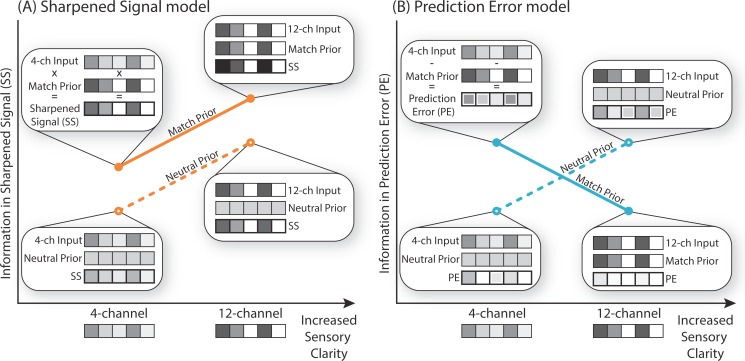
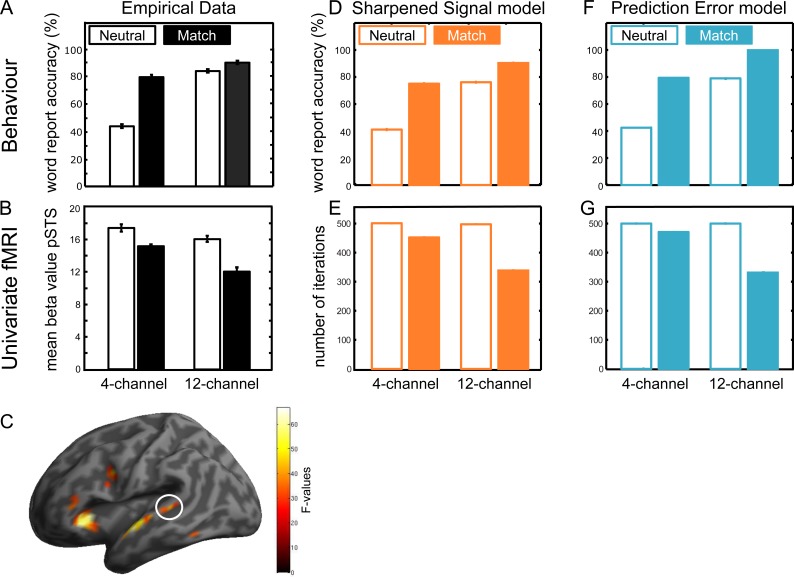
Successful perception depends on combining sensory input with prior knowledge. However, the underlying mechanism by which these two sources of information are combined is unknown. In speech perception, as in other domains, two functionally distinct coding schemes have been proposed for how expectations influence representation of sensory evidence. Traditional models suggest that expected features of the speech input are enhanced or sharpened via interactive activation (Sharpened Signals). Conversely, Predictive Coding suggests that expected features are suppressed so that unexpected features of the speech input (Prediction Errors) are processed further. The present work is aimed at distinguishing between these two accounts of how prior knowledge influences speech perception. By combining behavioural, univariate, and multivariate fMRI measures of how sensory detail and prior expectations influence speech perception with computational modelling, we provide evidence in favour of Prediction Error computations. Increased sensory detail and informative expectations have additive behavioural and univariate neural effects because they both improve the accuracy of word report and reduce the BOLD signal in lateral temporal lobe regions. However, sensory detail and informative expectations have interacting effects on speech representations shown by multivariate fMRI in the posterior superior temporal sulcus. When prior knowledge was absent, increased sensory detail enhanced the amount of speech information measured in superior temporal multivoxel patterns, but with informative expectations, increased sensory detail reduced the amount of measured information. Computational simulations of Sharpened Signals and Prediction Errors during speech perception could both explain these behavioural and univariate fMRI observations. However, the multivariate fMRI observations were uniquely simulated by a Prediction Error and not a Sharpened Signal model. The interaction between prior expectation and sensory detail provides evidence for a Predictive Coding account of speech perception. Our work establishes methods that can be used to distinguish representations of Prediction Error and Sharpened Signals in other perceptual domains.
Overview
The claims and statistics of this paper haven’t been checked yet.
Free: it reads the open-access text and checks the first 5 claims that cite a source we can check. Create a free account to check every claim.
Integrity signals
Registry
Cites
Statistics
Figures


Verification
Claims the paper makes
The claims and statistics of this paper haven’t been checked yet.
Free: it reads the open-access text and checks the first 5 claims that cite a source we can check. Create a free account to check every claim.
Claims other papers make about this one
Each is checked against this paper’s own text: does it say what the citing paper says it does?
The source backs part of the claim, not all of it — or backs it for a different population, condition or comparison.
In the citing paper
“that BOLD responses in posterior superior temporal sulcus (pSTS) to expected words were weaker and contained less information, as quantified by representational similarity analysis (RSA) [88];”
From How Do Expectations Shape Perception? (2018) · cites this paper as [88]
Experimental — accuracy not yet measured
Self-check
Percentages, sums and reported differences re-computed from the paper’s own numbers.
The self-check needs the paper’s full text.
Citations
Cites
Hearing lips and seeing voices
MCGURK, H., & MACDONALD, J. (1976) · Nature · doi:10.1038/264746a0 · Cited by 6,183
Whatever next? Predictive brains, situated agents, and the future of cognitive science
Clark, A. (2013) · Behavioral and Brain Sciences · doi:10.1017/s0140525x12000477 · Cited by 5,924
The cortical organization of speech processing
Hickok, G., & Poeppel, D. (2007) · Nature Reviews Neuroscience · doi:10.1038/nrn2113 · Cited by 5,495
Rao, R. P. N., & Ballard, D. H. (1999) · Nature Neuroscience · doi:10.1038/4580 · Cited by 5,483
A theory of cortical responses.
Friston, K. (2005) · Philosophical Transactions of the Royal Society B: Biological Sciences · doi:10.1098/rstb.2005.1622 · Cited by 4,578
Rubber hands ‘feel’ touch that eyes see
Botvinick, M., & Cohen, J. (1998) · Nature · doi:10.1038/35784 · Cited by 4,410
Representational similarity analysis-connecting the branches of systems neuroscience
Kriegeskorte, N. (2008) · Frontiers in Systems Neuroscience · doi:10.3389/neuro.06.004.2008 · Cited by 3,355
Speech Recognition with Primarily Temporal Cues
Shannon, R. V., Zeng, F.-G., Kamath, V., Wygonski, J., & Ekelid, M. (1995) · Science · doi:10.1126/science.270.5234.303 · Cited by 3,024
The TRACE model of speech perception
McClelland, J. L., & Elman, J. L. (1986) · Cognitive Psychology · doi:10.1016/0010-0285(86)90015-0 · Cited by 2,956
AIC model selection using Akaike weights
Wagenmakers, E.-J., & Farrell, S. (2004) · Psychonomic Bulletin & Review · doi:10.3758/bf03206482 · Cited by 2,684
Cited by
How Do Expectations Shape Perception?
de Lange, F. P., Heilbron, M., & Kok, P. (2018) · Trends in Cognitive Sciences · doi:10.1016/j.tics.2018.06.002 · Cited by 975
The Encoding of Speech Sounds in the Superior Temporal Gyrus
Yi, H. G., Leonard, M. K., & Chang, E. F. (2019) · Neuron · doi:10.1016/j.neuron.2019.04.023 · Cited by 417
A hierarchy of linguistic predictions during natural language comprehension
Heilbron, M., Armeni, K., Schoffelen, J.-M., Hagoort, P., & de Lange, F. P. (2022) · Proceedings of the National Academy of Sciences · doi:10.1073/pnas.2201968119 · Cited by 343
Evaluating the neurophysiological evidence for predictive processing as a model of perception
Walsh, K. S., McGovern, D. P., Clark, A., & O'Connell, R. G. (2020) · Annals of the New York Academy of Sciences · doi:10.1111/nyas.14321 · Cited by 333
The Perceptual Prediction Paradox
Press, C., Kok, P., & Yon, D. (2020) · Trends in Cognitive Sciences · doi:10.1016/j.tics.2019.11.003 · Cited by 246
Large-scale cortical networks for hierarchical prediction and prediction error in the primate brain
Chao, Z. C., Takaura, K., Wang, L., Fujii, N., & Dehaene, S. (2018) · Neuron · doi:10.1016/j.neuron.2018.10.004 · Cited by 238
Pearce, M. T. (2018) · Annals of the New York Academy of Sciences · doi:10.1111/nyas.13654 · Cited by 214
Forms of prediction in the nervous system
Teufel, C., & Fletcher, P. C. (2020) · Nature Reviews Neuroscience · doi:10.1038/s41583-020-0275-5 · Cited by 155
Suppressed Sensory Response to Predictable Object Stimuli throughout the Ventral Visual Stream
Richter, D., Ekman, M., & de Lange, F. P. (2018) · The Journal of Neuroscience · doi:10.1523/jneurosci.3421-17.2018 · Cited by 150
Evidence for causal top-down frontal contributions to predictive processes in speech perception
Cope, T. E., Sohoglu, E., Sedley, W., Patterson, K., Jones, P. S., Wiggins, J., Dawson, C., Grube, M., Carlyon, R. P., Griffiths, T. D., et al. (2017) · Nature Communications · doi:10.1038/s41467-017-01958-7 · Cited by 150
Self-citationDelta- and theta-band cortical tracking and phase-amplitude coupling to sung speech by infants
Attaheri, A., Choisdealbha, Á. N., Liberto, G. M. D., Rocha, S., Brusini, P., Mead, N., Olawole‐Scott, H., Boutris, P., Gibbon, S., Williams, I., et al. (2021) · NeuroImage · doi:10.1016/j.neuroimage.2021.118698 · Cited by 155
Sustained neural rhythms reveal endogenous oscillations supporting speech perception
van Bree, S., Sohoglu, E., Davis, M. H., & Zoefel, B. (2021) · PLoS Biology · doi:10.1371/journal.pbio.3001142 · Cited by 131
Self-citationLesenfants, D., Vanthornhout, J., Verschueren, E., Decruy, L. P., & Francart, T. (2019) · Hearing Research · doi:10.1016/j.heares.2019.05.006 · Cited by 96
The Predictive Brain as a Stubborn Scientist
Yon, D., de Lange, F. P., & Press, C. (2019) · Trends in Cognitive Sciences · doi:10.1016/j.tics.2018.10.003 · Cited by 84
The Oxford Handbook of the Mental Lexicon
Papafragou, A., Trueswell, J. C., & Gleitman, L. R. (2022) · Oxford University Press eBooks · doi:10.1093/oxfordhb/9780198845003.001.0001 · Cited by 88
Encoding of predictable and unpredictable stimuli by inferior temporal cortical neurons
Kumar, S., Kaposvari, P., & Vogels, R. (2017) · Journal of Cognitive Neuroscience · doi:10.1162/jocn_a_01135 · Cited by 75
Causal cortical dynamics of a predictive enhancement of speech intelligibility
Liberto, G. M. D., Lalor, E. C., & Millman, R. E. (2017) · NeuroImage · doi:10.1016/j.neuroimage.2017.10.066 · Cited by 77
A predictive coding model of the N400
Eddine, S. N., Brothers, T. A., Wang, L., Spratling, M., & Kuperberg, G. R. (2024) · Cognition · doi:10.1016/j.cognition.2024.105755 · Cited by 90
Liberto, G. M. D., Crosse, M. J., & Lalor, E. C. (2018) · eNeuro · doi:10.1523/eneuro.0084-18.2018 · Cited by 78
From speech and talkers to the social world: The neural processing of human spoken language
Scott, S. K. (2019) · Science · doi:10.1126/science.aax0288 · Cited by 69
A hierarchy of linguistic predictions during natural language comprehension
(2020) · doi:10.1101/2020.12.03.410399 · Cited by 63
The promise of layer-specific neuroimaging for testing predictive coding theories of psychosis
Haarsma, J., Kok, P., & Browning, M. (2022) · Schizophrenia Research · doi:10.1016/j.schres.2020.10.009 · Cited by 59
Haarsma, J., Knolle, F., Griffin, J. D., Taverne, H., Mada, M., Goodyer, I. M., The NSPN Consortium, Fletcher, P. C., & Murray, G. K. (2020) · Journal of Abnormal Psychology · doi:10.1037/abn0000494 · Cited by 60
“Studies of the neural mechanisms underlying the influence of lip-movements on auditory perception provide support for the Bayesian framework, in that lip-movements are suggested to constitute a prior expectation with respect to the incoming auditory signal (Arnal et al., 2012; Blank & Davis, 2016).”
BackgroundPredictions and errors are distinctly represented across V1 layers
Thomas, E. R., Haarsma, J., Nicholson, J. L., Yon, D., Kok, P., & Press, C. (2024) · Current Biology · doi:10.1016/j.cub.2024.04.036 · Cited by 71
Rapid computations of spectrotemporal prediction error support perception of degraded speech
Sohoglu, E., & Davis, M. H. (2020) · eLife · doi:10.7554/elife.58077 · Cited by 66
Self-citationFocal versus distributed temporal cortex activity for speech sound category assignment
Bouton, S., Chambon, V., Tyrand, R., Guggisberg, A. G., Seeck, M., Karkar, S., Ville, D. V. D., & Giraud, A. (2018) · Proceedings of the National Academy of Sciences · doi:10.1073/pnas.1714279115 · Cited by 67
Predicting speech from a cortical hierarchy of event-based time scales
Schmitt, L., Erb, J., Tune, S., Rysop, A. U., Hartwigsen, G., & Obleser, J. (2021) · Science Advances · doi:10.1126/sciadv.abi6070 · Cited by 61
Rommers, J., & Federmeier, K. D. (2018) · Cortex · doi:10.1016/j.cortex.2017.12.018 · Cited by 61
Mapping visual symbols onto spoken language along the ventral visual stream
Taylor, J. S. H., Davis, M. H., & Rastle, K. (2019) · Proceedings of the National Academy of Sciences · doi:10.1073/pnas.1818575116 · Cited by 66
Self-citationCan expectation suppression be explained by reduced attention to predictable stimuli?
Alink, A., & Blank, H. (2021) · NeuroImage · doi:10.1016/j.neuroimage.2021.117824 · Cited by 62
Self-citationPredictive coding across the left fronto-temporal hierarchy during language comprehension
Wang, L., Schoot, L., Brothers, T. A., Alexander, E., Warnke, L., Kim, M. J., Khan, S., Hämäläinen, M., & Kuperberg, G. R. (2022) · Cerebral Cortex · doi:10.1093/cercor/bhac356 · Cited by 59
Does signal reduction imply predictive coding in models of spoken word recognition?
Luthra, S., Li, M. Y. C., You, H., Brodbeck, C. J., & Magnuson, J. S. (2021) · Psychonomic Bulletin & Review · doi:10.3758/s13423-021-01924-x · Cited by 48
Predictive processing models and affective neuroscience
Lee, K. M., Ferreira‐Santos, F., & Satpute, A. B. (2021) · Neuroscience & Biobehavioral Reviews · doi:10.1016/j.neubiorev.2021.09.009 · Cited by 58
Nourski, K. V., Steinschneider, M., Rhone, A. E., Kawasaki, H., Howard, M. A., & Banks, M. I. (2018) · NeuroImage · doi:10.1016/j.neuroimage.2018.08.027 · Cited by 46
Auditory Mismatch Negativity Under Predictive Coding Framework and Its Role in Psychotic Disorders
Fong, C. Y., Law, W. H. C., Uka, T., & Koike, S. (2020) · Frontiers in Psychiatry · doi:10.3389/fpsyt.2020.557932 · Cited by 41
Metacognitive Feelings: A Predictive-Processing Perspective
Velasco, P. F., & Loev, S. (2024) · Perspectives on Psychological Science · doi:10.1177/17456916231221976 · Cited by 73
Sarrett, M. E., McMurray, B., & Kapnoula, E. C. (2020) · Brain and Language · doi:10.1016/j.bandl.2020.104875 · Cited by 52
Xie, X., Jaeger, T. F., & Kurumada, C. (2023) · Cortex · doi:10.1016/j.cortex.2023.05.003 · Cited by 48
Prefrontal cortex supports speech perception in listeners with cochlear implants
Sherafati, A., Dwyer, N. Y., Bajracharya, A., Hassanpour, M. S., Eggebrecht, A. T., Firszt, J. B., Culver, J. P., & Peelle, J. E. (2022) · eLife · doi:10.7554/elife.75323 · Cited by 44
Neural Prediction Errors Distinguish Perception and Misperception of Speech
Blank, H., Spangenberg, M., & Davis, M. H. (2018) · Journal of Neuroscience · doi:10.1523/jneurosci.3258-17.2018 · Cited by 44
Self-citationDampened sensory representations for expected input across the ventral visual stream
Richter, D., Heilbron, M., & de Lange, F. P. (2022) · Oxford Open Neuroscience · doi:10.1093/oons/kvac013 · Cited by 43
Zekveld, A. A., Kramer, S. E., Rönnberg, J., & Rudner, M. (2019) · Ear & Hearing · doi:10.1097/aud.0000000000000612 · Cited by 28
The N400 in silico: A review of computational models
Eddine, S. N., Brothers, T. A., & Kuperberg, G. R. (2022) · The Psychology of learning and motivation/The psychology of learning and motivation · doi:10.1016/bs.plm.2022.03.005 · Cited by 39
Perceptual Prediction: Rapidly Making Sense of a Noisy World
Press, C., & Yon, D. (2019) · Current Biology · doi:10.1016/j.cub.2019.06.054 · Cited by 35
Completion norms for 3085 English sentence contexts
Peelle, J. E., Miller, R. L., Rogers, C. S., Spehar, B., Sommers, M. S., & Engen, K. J. V. (2020) · Behavior Research Methods · doi:10.3758/s13428-020-01351-1 · Cited by 46
Extracting Language Content from Speech Sounds: The Information Theoretic Approach
Gwilliams, L., & Davis, M. H. (2022) · Springer handbook of auditory research · doi:10.1007/978-3-030-81542-4_5 · Cited by 39
Self-citationCope, T., Sohoglu, E., Peterson, K. A., Jones, P. S., Rua, C., Passamonti, L., Sedley, W., Post, B., Coebergh, J. W. W., Butler, C., et al. (2023) · Cell Reports · doi:10.1016/j.celrep.2023.112422 · Cited by 33
Self-citationGarlichs, A., & Blank, H. (2024) · Nature Communications · doi:10.1038/s41467-024-47749-9 · Cited by 36
Self-citationChao, Z. C., Huang, Y. T., & Wu, C. (2022) · Communications Biology · doi:10.1038/s42003-022-04049-6 · Cited by 29
Predictable tones elicit stimulus-specific suppression of evoked activity in auditory cortex
Han, B., Mostert, P., & de Lange, F. P. (2019) · NeuroImage · doi:10.1016/j.neuroimage.2019.06.033 · Cited by 29
Decoding of Envelope vs. Fundamental Frequency During Complex Auditory Stream Segregation
Greenlaw, K., Puschmann, S., & Coffey, E. B. J. (2020) · Neurobiology of Language · doi:10.1162/nol_a_00013 · Cited by 21
Benetti, S., Ferrari, A., & Pavani, F. (2023) · Frontiers in Human Neuroscience · doi:10.3389/fnhum.2023.1108354 · Cited by 24
Corps, R. E., & Rabagliati, H. (2020) · Journal of Memory and Language · doi:10.1016/j.jml.2020.104114 · Cited by 25
Corcoran, A. W., Perera, R., Koroma, M., Kouider, S., Hohwy, J., & Andrillon, T. (2022) · Cerebral Cortex · doi:10.1093/cercor/bhac094 · Cited by 21
Mai, G., & Wang, W. Y. (2023) · Human Brain Mapping · doi:10.1002/hbm.26503 · Cited by 27
Eisenhauer, S., Gagl, B., & Fiebach, C. J. (2021) · Psychophysiology · doi:10.1111/psyp.13970 · Cited by 21
Decoding the temporal dynamics of spoken word and nonword processing from EEG
McMurray, B., Sarrett, M. E., Chiu, S. L., Black, A. K., Wang, A., Canale, R. R., & Aslin, R. Ν. (2022) · NeuroImage · doi:10.1016/j.neuroimage.2022.119457 · Cited by 23
Wang, X., Delgado, J., Marchesotti, S., Kojovic, N., Sperdin, H. F., Rihs, T. A., Schaer, M., & Giraud, A. (2023) · Journal of Neuroscience · doi:10.1523/jneurosci.0112-22.2023 · Cited by 19
The perceptual prediction paradoxPreprint
Press, C., Kok, P., & Yon, D. (2019) · PsyArXiv (OSF Preprints) · doi:10.31234/osf.io/hdsmz · Cited by 16
Immediate neural impact and incomplete compensation after semantic hub disconnection
Kocsis, Z., Jenison, R. L., Taylor, P. N., Calmus, R., McMurray, B., Rhone, A. E., Sarrett, M. E., Streese, C. D., Kikuchi, Y., Gander, P. E., et al. (2023) · Nature Communications · doi:10.1038/s41467-023-42088-7 · Cited by 15
Eisenhauer, S., Fiebach, C. J., & Gagl, B. (2019) · eNeuro · doi:10.1523/eneuro.0321-18.2019 · Cited by 16
Dynamic Brain Responses Modulated by Precise Timing Prediction in an Opposing Process
Xu, M., Meng, J., Yu, H., Jung, T., & Ming, D. (2020) · Neuroscience Bulletin · doi:10.1007/s12264-020-00527-1 · Cited by 20
Magnuson, J. S., Crinnion, A. M., Luthra, S., Gaston, P., & Grubb, S. (2023) · Cognition · doi:10.1016/j.cognition.2023.105661 · Cited by 22
Hakonen, M., May, P., Jääskeläinen, I. P., Jokinen, E., Sams, M. E., & Tiitinen, H. (2017) · Brain and Behavior · doi:10.1002/brb3.789 · Cited by 15
Banellis, L., Sokoliuk, R., Wild, C. J., Bowman, H., & Cruse, D. (2020) · Neuroscience of Consciousness · doi:10.1093/nc/niaa022 · Cited by 13
On The Dynamics of Lexical Access In Two or More Languages
Kroll, J. F., Bice, K., Botezatu, M. R., & Zirnstein, M. (2022) · Oxford University Press eBooks · doi:10.1093/oxfordhb/9780198845003.013.26 · Cited by 15
The pupil dilation response as an indicator of visual cue uncertainty and auditory outcome surprise
Becker, J., Viertler, M., Korn, C. W., & Blank, H. (2024) · European Journal of Neuroscience · doi:10.1111/ejn.16306 · Cited by 12
Self-citationLoneliness and social conformity: A predictive processing perspective
Haihambo, N. P., Layiwola, D., Blank, H., Hurlemann, R., & Scheele, D. (2025) · Annals of the New York Academy of Sciences · doi:10.1111/nyas.15324 · Cited by 16
Self-citationGuided by Expectations: Overweighted Semantic Priors in Schizotypy and Their Links to Glutamate
Knolle, F., Sterner, E., Demler, V. F., MacGregor, L. J., & Mathys, C. D. (2025) · Biological Psychiatry · doi:10.1016/j.biopsych.2025.06.025 · Cited by 22
Blank, H., Alink, A., & Büchel, C. (2023) · Communications Biology · doi:10.1038/s42003-023-04508-8 · Cited by 16
Self-citationThe neural basis of word production
Nozari, N. (2022) · Oxford University Press eBooks · doi:10.1093/oxfordhb/9780198845003.013.12 · Cited by 15
Auditory cortex encodes lipreading information through spatially distributed activity
Karthik, G., Cao, C. Z., Demidenko, M. I., Jahn, A., Stacey, W. C., Wasade, V. S., & Brang, D. (2024) · Current Biology · doi:10.1016/j.cub.2024.07.073 · Cited by 13
Domain-general and domain-specific computations in single word processing
Klimovich‐Gray, A., & Božić, M. (2019) · NeuroImage · doi:10.1016/j.neuroimage.2019.116112 · Cited by 13
Auditory areas are recruited for naturalistic visual meaning in early deaf people
Zimmermann, M., Cusack, R., Bedny, M., & Szwed, M. (2024) · Nature Communications · doi:10.1038/s41467-024-52383-6 · Cited by 15
Klimovich‐Gray, A., Barrena, A., Agirre, E., & Molinaro, N. (2021) · Cerebral Cortex · doi:10.1093/cercor/bhab071 · Cited by 15
Ufer, C., & Blank, H. (2023) · Language Cognition and Neuroscience · doi:10.1080/23273798.2023.2166679 · Cited by 12
Self-citationWang, L., Eddine, S. N., Brothers, T. A., Jensen, O. B., & Kuperberg, G. R. (2024) · NeuroImage · doi:10.1016/j.neuroimage.2024.120977 · Cited by 9
Sublexical cues affect degraded speech processing: insights from fMRI
Al-Zubaidi, A., Bräuer, S., Holdgraf, C., Schepers, I. M., & Rieger, J. W. (2022) · Cerebral Cortex Communications · doi:10.1093/texcom/tgac007 · Cited by 9
Mice can learn phonetic categories
Saunders, J. L., & Wehr, M. (2019) · The Journal of the Acoustical Society of America · doi:10.1121/1.5091776 · Cited by 14
The promise of layer-specific neuroimaging for testing predictive coding theories of psychosisPreprint
Haarsma, J., Kok, P., & Browning, M. D. (2020) · PsyArXiv (OSF Preprints) · doi:10.31234/osf.io/5p64f · Cited by 10
Magnuson, J. S., & Crinnion, A. M. (2022) · Oxford University Press eBooks · doi:10.1093/oxfordhb/9780198845003.013.23 · Cited by 12
Oxford Handbooks in Linguistics
(2022) · Oxford University Press eBooks · doi:10.1093/9780191954481.003.0108 · Cited by 9
Sohoglu, E., Beckers, L., & Davis, M. H. (2024) · Nature Communications · doi:10.1038/s41467-024-53782-5 · Cited by 13
Self-citationYan, Y., Zhan, J., Ince, R. A. A., & Schyns, P. G. (2023) · Journal of Neuroscience · doi:10.1523/jneurosci.0156-23.2023 · Cited by 10
Wang, Y. C., Sohoglu, E., Gilbert, R. A., Henson, R. N., & Davis, M. H. (2021) · Journal of Neuroscience · doi:10.1523/jneurosci.1685-20.2021 · Cited by 8
Self-citationBoosting lexical support does not enhance lexically guided perceptual learning.
Luthra, S., Magnuson, J. S., & Myers, E. B. (2020) · Journal of Experimental Psychology Learning Memory and Cognition · doi:10.1037/xlm0000945 · Cited by 7
Intelligibility improves perception of timing changes in speech
Zoefel, B., Gilbert, R. A., & Davis, M. H. (2023) · PLoS ONE · doi:10.1371/journal.pone.0279024 · Cited by 8
Self-citationHow to study spoken language understanding: a survey of neuroscientific methods
Rodd, J. M., & Davis, M. H. (2017) · Language Cognition and Neuroscience · doi:10.1080/23273798.2017.1323110 · Cited by 10
Self-citationTask-dependent modulation of the visual sensory thalamus assists visual-speech recognition
Díaz, B., Blank, H., & von Kriegstein, K. (2018) · NeuroImage · doi:10.1016/j.neuroimage.2018.05.032 · Cited by 11
Self-citationMorphology and The Mental Lexicon: Three questions about decomposition
Embick, D., Creemers, A., & Davies, A. J. G. (2022) · Oxford University Press eBooks · doi:10.1093/oxfordhb/9780198845003.013.17 · Cited by 14
Efficient Communication and The Organization of The Lexicon
Mahowald, K., Dautriche, I., Braginsky, M., & Gibson, T. (2022) · Oxford University Press eBooks · doi:10.1093/oxfordhb/9780198845003.013.19 · Cited by 11
Tolkacheva, V., Brownsett, S. L. E., McMahon, K. L., & de Zubicaray, G. I. (2024) · Cerebral Cortex · doi:10.1093/cercor/bhae087 · Cited by 6
Tabas, A., Kiebel, S. J., Marxen, M., & von Kriegstein, K. (2024) · Imaging Neuroscience · doi:10.1162/imag_a_00292 · Cited by 10
Lexical learning shapes the development of speech perception until late adolescencePreprint
Davis, M. H., Evans, S., McCarthy, K. M., Evans, L. M., Giannakopoulou, A., & Taylor, J. S. H. (2019) · PsyArXiv (OSF Preprints) · doi:10.31234/osf.io/ktsey · Cited by 7
Self-citationJackendoff, R. S. (2022) · Oxford University Press eBooks · doi:10.1093/oxfordhb/9780198845003.013.3 · Cited by 11
Preisig, B. C., & Meyer, M. E. (2025) · Neuroscience & Biobehavioral Reviews · doi:10.1016/j.neubiorev.2025.106111 · Cited by 8
Can prediction error explain predictability effects on the N1 during picture-word verification?
Taylor, J. E., Rousselet, G. A., & Sereno, S. C. (2024) · Imaging Neuroscience · doi:10.1162/imag_a_00131 · Cited by 9
Informativity enhances memory robustness against interference in sentence comprehension
Xu, W., & Futrell, R. (2025) · Journal of Memory and Language · doi:10.1016/j.jml.2024.104603 · Cited by 5
Anticipating multisensory environments: Evidence for a supra-modal predictive system
Sabio‐Albert, M., Fuentemilla, L., & Pérez-Bellido, A. (2024) · Cognition · doi:10.1016/j.cognition.2024.105970 · Cited by 6
Quaranta, D., Tella, S. D., Marra, C., Gaudino, S., L’Abbate, F., & Silveri, M. C. (2022) · Brain Sciences · doi:10.3390/brainsci12070910 · Cited by 7
Metadata
- Authors
- Blank, H., & Davis, M. H.
- Affiliations
- MRC Cognition and Brain Sciences Unit (GB)
- Corresponding author
- Blank, Helen
- Venue
- PLOS Biology
- Publisher
- Public Library of Science (PLoS)
- Published
- 2016-11-15
- Volume
- 14
- Issue
- 11
- Pages
- e1002577
- ISSN
- 1544-9173 (ISSN-L)
- 1545-7885
- PMC
- PMC5112801
- OpenAlex
- W2549771691
- Cited by
- 181
- References
- 112
- Citations by year
- 2026: 10 · 2025: 15 · 2024: 21 · 2023: 14 · 2022: 55 · 2021: 14 · 2020: 18 · 2019: 14 · 2018: 13 · 2017: 7
- FWCI
- 7.21
- Type
- journal article
- Language
- en
- Open access
- gold
- doi.org
- Licence
- Locations
- PLoS Biology (publishedVersion, cc-by)
- PubMed Central (publishedVersion, cc-by)
- PubMed (publishedVersion)
- RePEc: Research Papers in Economics (submittedVersion)
- DOAJ (DOAJ: Directory of Open Access Journals) (submittedVersion)
- OSF Preprints (OSF Preprints) (submittedVersion)
- Funders
- Medical Research Council (MC-A060-5PQ80)
- Topics
- Life Sciences › Neuroscience › Cognitive Neuroscience › Neurobiology of Language and Bilingualism
- Social Sciences › Psychology › Experimental and Cognitive Psychology › Phonetics and Phonology Research
- Life Sciences › Neuroscience › Cognitive Neuroscience › Neuroscience and Music Perception
- Keywords
- speech perception, prediction error, predictive coding, interactive activation, prior expectations, sensory detail, posterior superior temporal sulcus, lateral temporal lobe, perceptual representation
- MeSH terms
- Behavior, Humans, Magnetic Resonance Imaging, Models, Theoretical, Speech Perception, Temporal Lobe, Multivariate Analysis
About these checks
Registry, retraction, Cites and statistics results are computed, not judged, with one exception: a printed reference that no index lists is read once by a model before it counts as a citation error. Claims are extracted by a model and kept only when their quote appears verbatim in the text; each cited source is then checked, with a model’s help, for whether it says what the claim relies on. Those verdicts can be wrong — read the claim’s quote and the cited source before relying on one.
Statistics and arithmetic are recomputed, not judged.
Confidence bands are shown only for fields calibrated on our annotated test set. None is calibrated yet, so no band is shown.
What counts as a claim ›How we measure confidence ›How we check this ›
Are you an author, or do you see a problem with this page? Request a review
Data sources
Bibliographic data: Semantic Scholar, OpenAlex, Crossref.
Contains information from the Semantic Scholar Academic Graph Datasets, made available under the ODC Attribution License (ODC-BY 1.0).
Semantic Scholar’s data is described in: Kinney, R., et al. (2023). The Semantic Scholar Open Data Platform. arXiv:2301.10140.
