

The DOI matches its Crossref record; 49 of the 49 references it cites were found in a registry or an index.
Flexible Cognitive Strategies during Motor Learning
Open accessAbstract
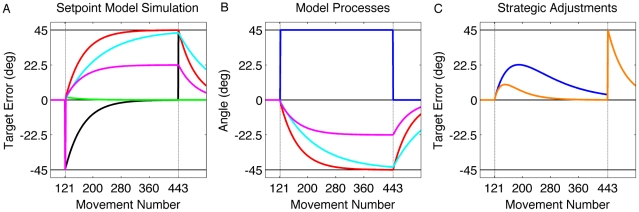
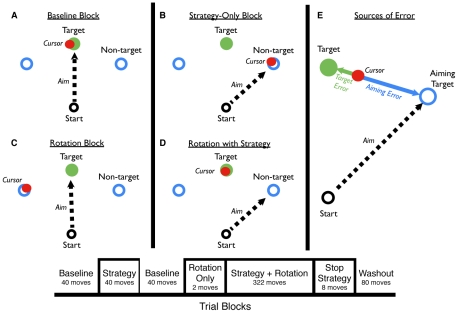
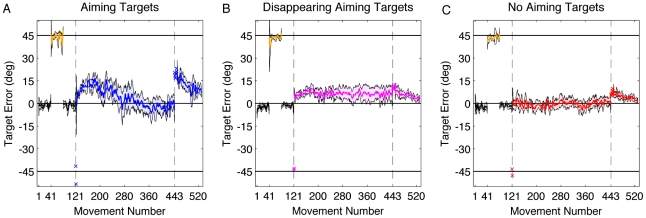
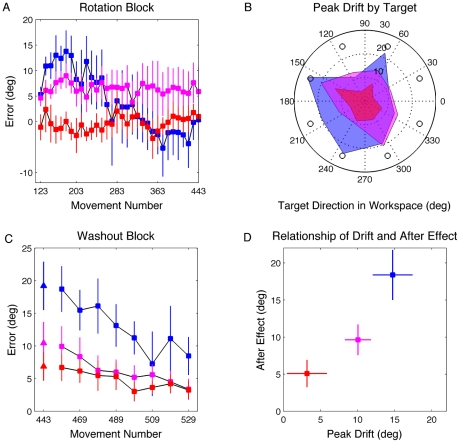
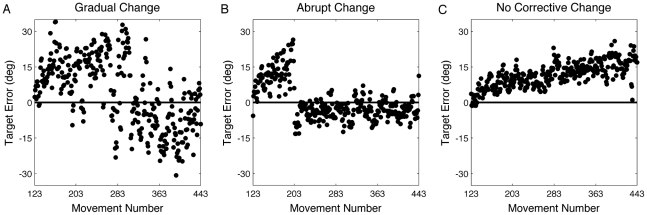
Visuomotor rotation tasks have proven to be a powerful tool to study adaptation of the motor system. While adaptation in such tasks is seemingly automatic and incremental, participants may gain knowledge of the perturbation and invoke a compensatory strategy. When provided with an explicit strategy to counteract a rotation, participants are initially very accurate, even without on-line feedback. Surprisingly, with further testing, the angle of their reaching movements drifts in the direction of the strategy, producing an increase in endpoint errors. This drift is attributed to the gradual adaptation of an internal model that operates independently from the strategy, even at the cost of task accuracy. Here we identify constraints that influence this process, allowing us to explore models of the interaction between strategic and implicit changes during visuomotor adaptation. When the adaptation phase was extended, participants eventually modified their strategy to offset the rise in endpoint errors. Moreover, when we removed visual markers that provided external landmarks to support a strategy, the degree of drift was sharply attenuated. These effects are accounted for by a setpoint state-space model in which a strategy is flexibly adjusted to offset performance errors arising from the implicit adaptation of an internal model. More generally, these results suggest that strategic processes may operate in many studies of visuomotor adaptation, with participants arriving at a synergy between a strategic plan and the effects of sensorimotor adaptation.
Overview
The claims and statistics of this paper haven’t been checked yet.
Run the check — free, no account needed. It reads the open-access text and checks the sources it cites.
Integrity signals
Registry
Cites
Statistics
Figures
Verification
Claims the paper makes
The claims and statistics of this paper haven’t been checked yet.
Run the check — free, no account needed. It reads the open-access text and checks the sources it cites.
Claims other papers make about this one
Each is checked against this paper’s own text: does it say what the citing paper says it does?
The source backs part of the claim, not all of it — or backs it for a different population, condition or comparison.
In the citing paper
“However, when adaptation is allowed to progress over a large number of trials, task performance errors plateau and then decrease (Taylor and Ivry, 2011; Figure 1C).”
From Cerebellum, Predictions and Errors (2019) · cites this paper as Taylor and Ivry, 2011
Experimental — accuracy not yet measuredThe source backs part of the claim, not all of it — or backs it for a different population, condition or comparison.
In the citing paper
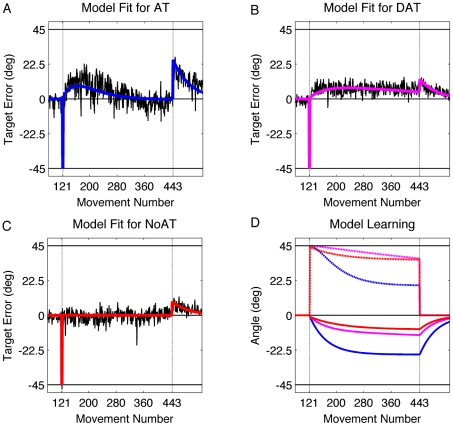
“Recent work has emphasized that controlling and learning self-directed motor behaviors involves both an implicit forward model of the effector and an explicit model of the task (Taylor and Ivry, 2011; Streng et al., 2018b; see Figure 1F).”
From Cerebellum, Predictions and Errors (2019) · cites this paper as Taylor and Ivry, 2011
Experimental — accuracy not yet measured
Self-check
Percentages, sums and reported differences re-computed from the paper’s own numbers.
The self-check needs the paper’s full text.
Citations
Cites
A Simplex Method for Function Minimization
Nelder, J. A., & Mead, R. (1965) · The Computer Journal · doi:10.1093/comjnl/7.4.308 · Cited by 28,905 · cited 1×
“The Nelder–Mead method or simplex method [43], imple-”
MethodReinforcement Learning: An Introduction
Sutton, R. S., & Barto, A. G. (1998) · IEEE Transactions on Neural Networks · doi:10.1109/tnn.1998.712192 · Cited by 27,225 · cited 1×
“An alternative approach to model strategy change could be derived from models of reinforcement learning [34–37].”
MethodReinforcement Learning: An Introduction
Sutton, R. S., & Barto, A. (2005) · IEEE Transactions on Neural Networks · doi:10.1109/tnn.2004.842673 · Cited by 25,268
Humans integrate visual and haptic information in a statistically optimal fashion
Ernst, M. O., & Banks, M. S. (2002) · Nature · doi:10.1038/415429a · Cited by 4,844 · cited 2×
“Several studies have shown that adaptation rates can change when the certainty of sensory information is manipulated [31,32].”
BackgroundAdaptive representation of dynamics during learning of a motor task
Shadmehr, R., & Mussa-Ivaldi, F. (1994) · The Journal of Neuroscience · doi:10.1523/jneurosci.14-05-03208.1994 · Cited by 2,612 · cited 1×
“[5–7] would be hard to verbalize.”
Statistical Analysis of Circular Data.
LANGE, N. D., & Fisher, N. I. (1995) · Journal of the American Statistical Association · doi:10.2307/2291098 · Cited by 2,155
Statistical Analysis of Circular Data
Fisher, N. I. (1993) · Cambridge University Press eBooks · doi:10.1017/cbo9780511564345 · Cited by 1,826 · cited 2×
“To minimize these problems, we used a boostrapping [42] method to estimate peak drift.”
MethodBrogan, W. L. (1971) · International Linear Collider · Cited by 1,206
Interacting adaptive processes with different timescales underlie short-term motor learning
Smith, M. A., Ghazizadeh, A., & Shadmehr, R. (2006) · PLoS Biology · doi:10.1371/journal.pbio.0040179 · Cited by 1,113 · cited 3×
“Thus, the final version of our model is a variant of a two-rate state space model [28], but with the two rates reflecting different error sources.”
BackgroundMethodInfluentialCausal Inference in Multisensory Perception
Körding, K. P., Beierholm, U., Ma, W. J., Quartz, S., Tenenbaum, J. B., & Shams, L. (2007) · PLoS ONE · doi:10.1371/journal.pone.0000943 · Cited by 1,069 · cited 1×
“This may impede drift because participants observe the casual relationship between movement of their hand and the endpoint, cursor feedback [33].”
BackgroundConsolidation in human motor memory
Brashers-Krug, T. M., Shadmehr, R., & Bizzi, E. (1996) · Nature · doi:10.1038/382252a0 · Cited by 976 · cited 1×
“The reconceptualization hypothesis would predict that peak drift should equal or be greater than the aftereffect. This follows from the idea that adaptation of the internal model should cease at the time the task goal changes from reaching to tool mastery. Once the participant switches from learning about their arm to…”
BackgroundLearning of action through adaptive combination of motor primitives
Thoroughman, K. A., & Shadmehr, R. (2000) · Nature · doi:10.1038/35037588 · Cited by 945
Learning of Visuomotor Transformations for Vectorial Planning of Reaching Trajectories
Krakauer, J. W., Pine, Z. M., Ghilardi, M. F., & Ghez, C. P. (2000) · Journal of Neuroscience · doi:10.1523/jneurosci.20-23-08916.2000 · Cited by 874 · cited 1×
“The benefits of an explicit strategy may be illusory with adaptive processes arising from automatic and incremental updating of a motor system that is impenetrable to conscious intervention [12–16].”
BackgroundAn implicit plan overrides an explicit strategy during visuomotor adaptation
Mazzoni, P., & Krakauer, J. W. (2006) · The Journal of Neuroscience · doi:10.1523/jneurosci.5317-05.2006 · Cited by 833 · cited 10×
“Mazzoni and Krakauer [9] suggested that drift reflects the interaction of the independent contribution of strategic and implicit learning processes in movement execution.”
BackgroundMethodResultInfluentialPrinciples derived from the study of simple skills do not generalize to complex skill learning
Wulf, G., & Shea, C. H. (2002) · Psychonomic Bulletin & Review · doi:10.3758/bf03196276 · Cited by 829 · cited 1×
“The type of motor task and nature of the instruction can have varying effects on motor execution and learning [1–3].”
BackgroundRapid adaptation to Coriolis force perturbations of arm trajectory
Lackner, J. R., & DiZio, P. A. (1994) · Journal of Neurophysiology · doi:10.1152/jn.1994.72.1.299 · Cited by 776 · cited 1×
“[5–7] would be hard to verbalize.”
Directing attention to movement effects enhances learning: a review
Wulf, G., & Prinz, W. (2001) · Psychonomic Bulletin & Review · doi:10.3758/bf03196201 · Cited by 729 · cited 1×
“The type of motor task and nature of the instruction can have varying effects on motor execution and learning [1–3].”
BackgroundInside the brain of an elite athlete: the neural processes that support high achievement in sports
Yarrow, K., Brown, P., & Krakauer, J. W. (2009) · Nature reviews. Neuroscience · doi:10.1038/nrn2672 · Cited by 675 · cited 1×
“The type of motor task and nature of the instruction can have varying effects on motor execution and learning [1–3].”
BackgroundAttentional and nonattentional forms of sequence learning.
Curran, T., & Keele, S. W. (1993) · Journal of Experimental Psychology: Learning, Memory, and Cognition · doi:10.1037/0278-7393.19.1.189 · Cited by 594 · cited 1×
“sequence, learning occurs much more rapidly compared to when sequential learning arises from repeated performance [4].”
BackgroundMartin, T. A., Keating, J. G., Goodkin, H. P., Bastian, A. J., & Thach, W. T. (1996) · Brain · doi:10.1093/brain/119.4.1199 · Cited by 585 · cited 2×
“To quantify the deadaptation rate during the washout phase, we fit an exponential function [26] to the time series of target endpoint errors.”
BackgroundMethodMotor learning by field approximation.
Gandolfo, F., Mussa-Ivaldi, F. A., & Bizzi, E. (1996) · Proceedings of the National Academy of Sciences · doi:10.1073/pnas.93.9.3843 · Cited by 486 · cited 1×
“[5–7] would be hard to verbalize.”
Robotic neurorehabilitation: a computational motor learning perspective
Huang, V. S., & Krakauer, J. W. (2009) · Journal of NeuroEngineering and Rehabilitation · doi:10.1186/1743-0003-6-5 · Cited by 441
The statistical determinants of adaptation rate in human reaching
Burge, J., Ernst, M. O., & Banks, M. S. (2008) · Journal of Vision · doi:10.1167/8.4.20 · Cited by 400 · cited 2×
“Several studies have shown that adaptation rates can change when the certainty of sensory information is manipulated [31,32].”
BackgroundContributions of Spatial Working Memory to Visuomotor Learning
Anguera, J. A., Reuter‐Lorenz, P. A., Willingham, D. T., & Seidler, R. D. (2009) · Journal of Cognitive Neuroscience · doi:10.1162/jocn.2009.21351 · Cited by 337 · cited 1×
“Moreover, the rate of learning, at least in the early phase of adaptation, correlates positively with spatial working memory span [21], suggesting that strategic compensation may be dependent on working memory capacity.”
BackgroundAdaptation to gradual as compared with sudden visuo-motor distortions
Kagerer, F. A., Contreras-Vidal, J. L., & Stelmach, G. E. (1997) · Experimental Brain Research · doi:10.1007/pl00005727 · Cited by 319 · cited 1×
“However, performance measures indicate that adaptation may differ between conditions in which participants are either aware or unaware of the changes in the environment [17].”
BackgroundEstimating the sources of motor errors for adaptation and generalization
Berniker, M., & Kording, K. (2008) · Nature Neuroscience · doi:10.1038/nn.2229 · Cited by 316 · cited 1×
“For example, rather than view the task goal as one involving reaching to targets, the participant may have switched to an orientation in which the task goal involved mastering a game in which the hand is a tool [38–40].”
BackgroundMalfait, N., & Ostry, D. J. (2004) · Journal of Neuroscience · doi:10.1523/jneurosci.1742-04.2004 · Cited by 218
Kluzik, J., Diedrichsen, J., Shadmehr, R., & Bastian, A. J. (2008) · Journal of Neurophysiology · doi:10.1152/jn.90334.2008 · Cited by 217 · cited 1×
“Qualitative changes in performance may also indicate that the participants have fundamentally changed their conceptualization of the task. For example, rather than view the task goal as one involving reaching to targets, the participant may have switched to an orientation in which the task goal involved mastering a ga…”
BackgroundModern control theory (3rd ed.)
Brogan, W. L. (1991) · Prentice-Hall, Inc eBooks · Cited by 207
Aiming error under transformed spatial mappings suggests a structure for visual-motor maps.
Cunningham, H. A. (1989) · Journal of Experimental Psychology Human Perception & Performance · doi:10.1037//0096-1523.15.3.493 · Cited by 199 · cited 1×
“The benefits of an explicit strategy may be illusory with adaptive processes arising from automatic and incremental updating of a motor system that is impenetrable to conscious intervention [12–16].”
BackgroundRandom presentation enables subjects to adapt to two opposing forces on the hand
Osu, R., Hirai, S., Yoshioka, T., & Kawato, M. (2004) · Nature Neuroscience · doi:10.1038/nn1184 · Cited by 196
Aiming error under transformed spatial mappings suggests a structure for visual-motor maps.
Cunningham, H. A. (1989) · Journal of Experimental Psychology Human Perception & Performance · doi:10.1037/0096-1523.15.3.493 · Cited by 185
Preserved Adjustment but Impaired Awareness in a Sensory-Motor Conflict following Prefrontal Lesions
Slachevsky, A., Pillon, B., Fourneret, P., Pradat-Diehl, P., Jeannerod, M., & Dubois, B. (2001) · Journal of Cognitive Neuroscience · doi:10.1162/08989290151137386 · Cited by 172 · cited 1×
“The abrupt onset of large unexpected errors may promote the use of cognitive strategies [18–20].”
BackgroundMcNay, E. C., & Willingham, D. B. (1998) · Learning & Memory · doi:10.1101/lm.4.5.411 · Cited by 170 · cited 1×
“Studies of sensorimotor adaptation during aging also indicate that the rate of learning is slower in older adults compared to young adults, despite similar aftereffects [22–24].”
ResultStroke Rehabilitation Reaches a Threshold
Han, C. E., Arbib, M. A., & Schweighofer, N. (2008) · PLoS Computational Biology · doi:10.1371/journal.pcbi.1000133 · Cited by 162 · cited 1×
“An alternative approach to model strategy change could be derived from models of reinforcement learning [34–37].”
MethodComponents of sensorimotor adaptation in young and elderly subjects
Bock, O. L. (2004) · Experimental Brain Research · doi:10.1007/s00221-004-2133-5 · Cited by 160 · cited 1×
“The effect of the visual landmarks on adaptation also provides insight into why other studies have not observed drift, even when participants develop some explicit awareness of the rotation, and presumably, use that knowledge [8,10,11,24,25] to improve performance rapidly.”
BackgroundAdaptation to visuomotor rotations in younger and older adults.
Heuer, H., & Hegele, M. (2008) · Psychology and Aging · doi:10.1037/0882-7974.23.1.190 · Cited by 144 · cited 2×
“The effect of the visual landmarks on adaptation also provides insight into why other studies have not observed drift, even when participants develop some explicit awareness of the rotation, and presumably, use that knowledge [8,10,11,24,25] to improve performance rapidly.”
BackgroundPrism adaptation in normal aging: slower adaptation rate and larger aftereffect
Fernández-Ruíz, J., Hall, C., Aragón, P. V., & Dı́az, R. (2000) · Cognitive Brain Research · doi:10.1016/s0926-6410(99)00057-9 · Cited by 141 · cited 1×
“Studies of sensorimotor adaptation during aging also indicate that the rate of learning is slower in older adults compared to young adults, despite similar aftereffects [22–24].”
ResultImamizu, H., & Shimojo, S. (1995) · Journal of Experimental Psychology Human Perception & Performance · doi:10.1037//0096-1523.21.4.719 · Cited by 135 · cited 1×
“The benefits of an explicit strategy may be illusory with adaptive processes arising from automatic and incremental updating of a motor system that is impenetrable to conscious intervention [12–16].”
BackgroundMultiple concurrent visual-motor mappings: Implications for models of adaptation.
Cunningham, H. A., & Welch, R. B. (1994) · Journal of Experimental Psychology Human Perception & Performance · doi:10.1037//0096-1523.20.5.987 · Cited by 128 · cited 1×
“The benefits of an explicit strategy may be illusory with adaptive processes arising from automatic and incremental updating of a motor system that is impenetrable to conscious intervention [12–16].”
BackgroundTakahashi, Y. K. (2008) · Frontiers in Neuroscience · doi:10.3389/neuro.01.014.2008 · Cited by 122 · cited 1×
“An alternative approach to model strategy change could be derived from models of reinforcement learning [34–37].”
MethodRapid Reshaping of Human Motor Generalization
Thoroughman, K. A., & Taylor, J. A. (2005) · Journal of Neuroscience · doi:10.1523/jneurosci.1771-05.2005 · Cited by 115 · cited 1×
“To statistically evaluate the results of the bootstrapping procedures, the mean statistics of each resampled iteration were calculated and then used to determine p values [29,42].”
MethodSelf-citationImamizu, H., & Shimojo, S. (1995) · Journal of Experimental Psychology Human Perception & Performance · doi:10.1037/0096-1523.21.4.719 · Cited by 103
Dissociable effects of the implicit and explicit memory systems on learning control of reaching
Hwang, E. J., Smith, M. A., & Shadmehr, R. (2006) · Experimental Brain Research · doi:10.1007/s00221-006-0391-0 · Cited by 95 · cited 1×
“The abrupt onset of large unexpected errors may promote the use of cognitive strategies [18–20].”
BackgroundMultiple concurrent visual-motor mappings: Implications for models of adaptation.
Cunningham, H. A., & Welch, R. B. (1994) · Journal of Experimental Psychology Human Perception & Performance · doi:10.1037/0096-1523.20.5.987 · Cited by 91
Functional independence of explicit and implicit motor adjustments
Sülzenbrück, S., & Heuer, H. (2009) · Consciousness and Cognition · doi:10.1016/j.concog.2008.12.001 · Cited by 79 · cited 1×
“The effect of the visual landmarks on adaptation also provides insight into why other studies have not observed drift, even when participants develop some explicit awareness of the rotation, and presumably, use that knowledge [8,10,11,24,25] to improve performance rapidly.”
BackgroundHuman adaptation to rotated vision: interplay of a continuous and a discrete process
Bock, O. L., Abeele, S. V., & Eversheim, U. (2003) · Experimental Brain Research · doi:10.1007/s00221-003-1643-x · Cited by 62 · cited 1×
“The effect of the visual landmarks on adaptation also provides insight into why other studies have not observed drift, even when participants develop some explicit awareness of the rotation, and presumably, use that knowledge [8,10,11,24,25] to improve performance rapidly.”
BackgroundWerner, S., & Bock, O. L. (2007) · Experimental Brain Research · doi:10.1007/s00221-007-0925-0 · Cited by 46 · cited 2×
“The effect of the visual landmarks on adaptation also provides insight into why other studies have not observed drift, even when participants develop some explicit awareness of the rotation, and presumably, use that knowledge [8,10,11,24,25] to improve performance rapidly.”
BackgroundDimensional reduction for reward-based learning
Swinehart, C. D., & Abbott, L. F. (2006) · Network Computation in Neural Systems · doi:10.1080/09548980600773215 · Cited by 9
Cited by
Sorted by citations
Explicit and implicit contributions to learning in a sensorimotor adaptation task
Taylor, J. A., Krakauer, J. W., & Ivry, R. B. (2014) · The Journal of Neuroscience · doi:10.1523/jneurosci.3619-13.2014 · Cited by 768
“Indeed, the saliency of the sensory-prediction error is critical with respect to implicit learning, such that when the landmark is absent participants are still able to employ the strategy to reduce target error but at the cost of reduced implicit learning (Benson et al., 2011; Taylor and Ivry, 2011).”
BackgroundMethodInfluentialSelf-citationKrakauer, J. W., Hadjiosif, A. M., Xu, J., Wong, A. L., & Haith, A. M. (2019) · Comprehensive physiology · doi:10.1002/cphy.c170043 · Cited by 918
Human sensorimotor learning: adaptation, skill, and beyond
Krakauer, J. W., & Mazzoni, P. (2011) · Current Opinion in Neurobiology · doi:10.1016/j.conb.2011.06.012 · Cited by 558
Flexible explicit but rigid implicit learning in a visuomotor adaptation task
Bond, K. M., & Taylor, J. A. (2015) · Journal of Neurophysiology · doi:10.1152/jn.00009.2015 · Cited by 269
“This complex, nonmonotonic behavior can be explained by a dynamic interplay between explicit learning, related to fluctuations in aiming strategies, and implicit learning, related to the training of a forward model (Mazzoni and Krakauer 2006; Taylor and Ivry 2011).”
BackgroundMethodInfluentialSelf-citationCharacteristics of Implicit Sensorimotor Adaptation Revealed by Task-irrelevant Clamped Feedback
Morehead, J. R., Taylor, J. A., Parvin, D. E., & Ivry, R. B. (2017) · Journal of Cognitive Neuroscience · doi:10.1162/jocn_a_01108 · Cited by 284
“This results in interesting interactions between explicit aiming and implicit adaptation, but the dual operation of both processes makes it difficult to characterize their individual features (Taylor, Krakauer, & Ivry, 2014; Taylor & Ivry, 2011).”
BackgroundMethodSelf-citation
Metadata
- Authors
- Taylor, J. A., & Ivry, R. B.
- Affiliations
- University of California, Berkeley (US)
- Corresponding author
- Taylor, Jordan A.
- Ivry, Richard B.
- Venue
- PLoS Computational Biology
- Publisher
- Public Library of Science (PLoS)
- Published
- 2011-03-03
- Volume
- 7
- Issue
- 3
- Pages
- e1001096
- ISSN
- 1553-734X (ISSN-L)
- 1553-7358
- PMC
- PMC3048379
- OpenAlex
- W1989328619
- Cited by
- 352
- References
- 47
- Citations by year
- 2026: 25 · 2025: 28 · 2024: 44 · 2023: 28 · 2022: 26 · 2021: 36 · 2020: 37 · 2019: 25 · 2018: 21 · 2017: 10 · 2016: 10 · 2015: 13 · 2014: 14 · 2013: 14 · 2012: 11
- FWCI
- 7.95
- Type
- journal article
- Language
- en
- Open access
- gold
- doi.org
- Locations
- PLoS Computational Biology (publishedVersion, cc-by)
- Europe PMC (PubMed Central) (publishedVersion, cc-by)
- PubMed Central (publishedVersion, cc-by)
- PubMed (publishedVersion)
- RePEc: Research Papers in Economics (submittedVersion)
- DOAJ (DOAJ: Directory of Open Access Journals) (submittedVersion, cc-by-sa)
- Funders
- National Science Foundation
- National Institute of Neurological Disorders and Stroke (P01NS040813, F32NS064749)
- Eunice Kennedy Shriver National Institute of Child Health and Human Development (R01HD060306)
- Topics
- Life Sciences › Neuroscience › Cognitive Neuroscience › Motor Control and Adaptation
- Life Sciences › Neuroscience › Cognitive Neuroscience › Tactile and Sensory Interactions
- Life Sciences › Neuroscience › Cognitive Neuroscience › Visual perception and processing mechanisms
- Keywords
- visuomotor adaptation, visuomotor rotation, motor learning, compensatory strategies, internal models, state-space model, sensorimotor adaptation, visual landmarks, reaching movements
- MeSH terms
- Algorithms, Cognition, Female, Humans, Learning, Models, Neurological, Motor Skills, Psychomotor Performance, Task Performance and Analysis, Computational Biology, Feedback, Physiological
About these checks
Registry, retraction, Cites and statistics results are computed, not judged, with one exception: a printed reference that no index lists is read once by a model before it counts as a citation error. Claims are extracted by a model and kept only when their quote appears verbatim in the text; each cited source is then checked, with a model’s help, for whether it says what the claim relies on. Those verdicts can be wrong — read the claim’s quote and the cited source before relying on one.
Statistics and arithmetic are recomputed, not judged.
Confidence bands are shown only for fields calibrated on our annotated test set. None is calibrated yet, so no band is shown.
What counts as a claim ›How we measure confidence ›How we check this ›
Are you an author, or do you see a problem with this page? Request a review
