

The DOI matches its Crossref record; 125 of the 125 references it cites were found in a registry or an index.
Task-Based Core-Periphery Organization of Human Brain Dynamics
Open accessAbstract
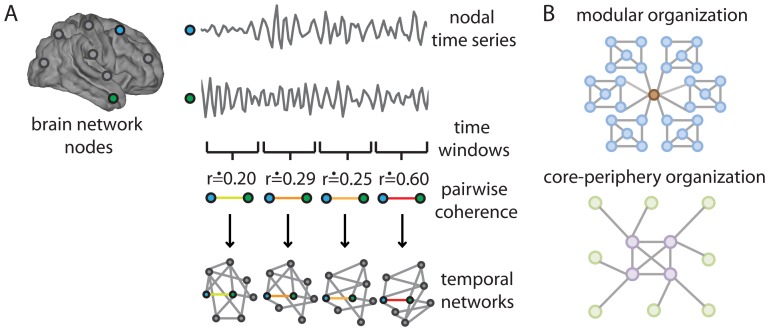
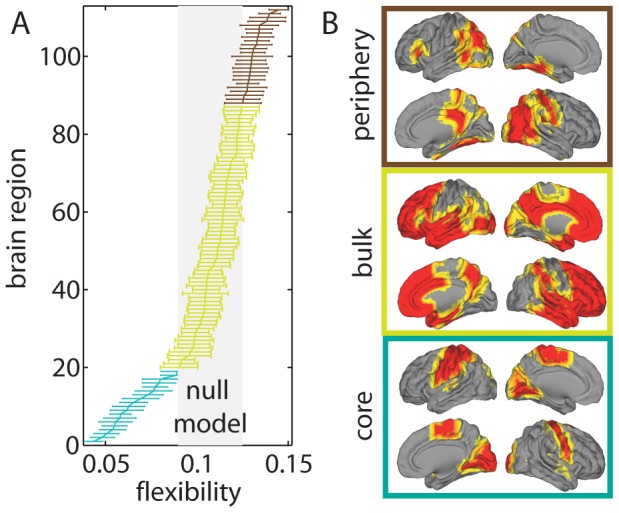
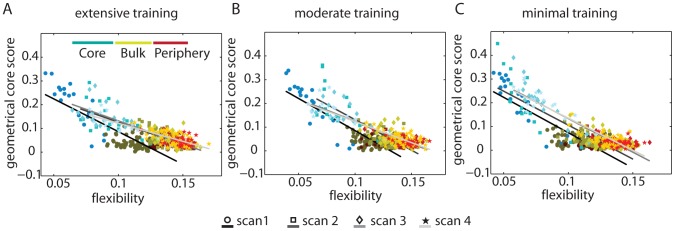
As a person learns a new skill, distinct synapses, brain regions, and circuits are engaged and change over time. In this paper, we develop methods to examine patterns of correlated activity across a large set of brain regions. Our goal is to identify properties that enable robust learning of a motor skill. We measure brain activity during motor sequencing and characterize network properties based on coherent activity between brain regions. Using recently developed algorithms to detect time-evolving communities, we find that the complex reconfiguration patterns of the brain's putative functional modules that control learning can be described parsimoniously by the combined presence of a relatively stiff temporal core that is composed primarily of sensorimotor and visual regions whose connectivity changes little in time and a flexible temporal periphery that is composed primarily of multimodal association regions whose connectivity changes frequently. The separation between temporal core and periphery changes over the course of training and, importantly, is a good predictor of individual differences in learning success. The core of dynamically stiff regions exhibits dense connectivity, which is consistent with notions of core-periphery organization established previously in social networks. Our results demonstrate that core-periphery organization provides an insightful way to understand how putative functional modules are linked. This, in turn, enables the prediction of fundamental human capacities, including the production of complex goal-directed behavior.
Overview
The claims and statistics of this paper haven’t been checked yet.
Run the check — free, no account needed. It reads the open-access text and checks the sources it cites.
Integrity signals
Registry
Cites
Statistics
Figures
Verification
Claims the paper makes
The claims and statistics of this paper haven’t been checked yet.
Run the check — free, no account needed. It reads the open-access text and checks the sources it cites.
Claims other papers make about this one
Each is checked against this paper’s own text: does it say what the citing paper says it does?
In the citing paper
“suggesting that they form a stable task-based core that supports higher order cognitive functions (40).”
From Dynamic reconfiguration of frontal brain networks during executive cognition in humans (2015) · cites this paper as [40]
Self-check
Percentages, sums and reported differences re-computed from the paper’s own numbers.
The self-check needs the paper’s full text.
Citations
Cites
Fast unfolding of communities in large networks
Blondel, V. D., Guillaume, J.-L., Lambiotte, R., & Lefebvre, E. (2008) · Journal of Statistical Mechanics: Theory and Experiment · doi:10.1088/1742-5468/2008/10/p10008 · Cited by 21,424
Finding and evaluating community structure in networks
Newman, M. E. J., & Girvan, M. (2004) · Physical Review E · doi:10.1103/physreve.69.026113 · Cited by 13,931
Advances in functional and structural MR image analysis and implementation as FSL
Smith, S. M., Jenkinson, M., Woolrich, M. W., Beckmann, C. F., Behrens, T. E. J., Johansen-Berg, H., Bannister, P. R., De Luca, M., Drobnjak, I., Flitney, D. E., et al. (2004) · NeuroImage · doi:10.1016/j.neuroimage.2004.07.051 · Cited by 13,630
Modularity and community structure in networks
Newman, M. E. J. (2006) · Proceedings of the National Academy of Sciences · doi:10.1073/pnas.0601602103 · Cited by 12,256
Complex brain networks: graph theoretical analysis of structural and functional systems
Bullmore, E., & Sporns, O. (2009) · Nature Reviews Neuroscience · doi:10.1038/nrn2575 · Cited by 11,820
Fortunato, S. (2010) · Physics Reports · doi:10.1016/j.physrep.2009.11.002 · Cited by 11,293
Statistical parametric maps in functional imaging: A general linear approach
Friston, K. J., Holmes, A. P., Worsley, K. J., Poline, J. ‐., Frith, C. D., & Frackowiak, R. S. J. (1994) · Human Brain Mapping · doi:10.1002/hbm.460020402 · Cited by 9,688
Mersenne twister: a 623-dimensionally equidistributed uniform pseudo-random number generator
Matsumoto, M., & Nishimura, T. (1998) · ACM Transactions on Modeling and Computer Simulation · doi:10.1145/272991.272995 · Cited by 5,780
Fast algorithm for detecting community structure in networks
Newman, M. E. J. (2004) · Physical Review E · doi:10.1103/physreve.69.066133 · Cited by 5,415
Finding community structure in networks using the eigenvectors of matrices
Newman, M. E. J. (2006) · Physical Review E · doi:10.1103/physreve.74.036104 · Cited by 4,799
Cited by
Sorted by citations
Kivela, M., Arenas, A., Barthelemy, M., Gleeson, J. P., Moreno, Y., & Porter, M. A. (2014) · Journal of Complex Networks · doi:10.1093/comnet/cnu016 · Cited by 3,235
Self-citationIntrinsic and task-evoked network architectures of the human brain
Cole, M. W., Bassett, D. S., Power, J. D., Braver, T. S., & Petersen, S. E. (2014) · Neuron · doi:10.1016/j.neuron.2014.05.014 · Cited by 1,564
Self-citationCommunication dynamics in complex brain networks
Avena-Koenigsberger, A., Misic, B., & Sporns, O. (2018) · Nature Reviews Neuroscience · doi:10.1038/nrn.2017.149 · Cited by 856
Small-World Brain Networks Revisited
Bassett, D. S., & Bullmore, E. T. (2016) · The Neuroscientist · doi:10.1177/1073858416667720 · Cited by 887
Self-citationDynamic reconfiguration of frontal brain networks during executive cognition in humans
Braun, U., Schäfer, A., Walter, H., Erk, S., Romanczuk-Seiferth, N., Haddad, L., Schweiger, J. I., Grimm, O., Heinz, A., Tost, H., et al. (2015) · Proceedings of the National Academy of Sciences · doi:10.1073/pnas.1422487112 · Cited by 791
Self-citation
Metadata
- Authors
- Bassett, D. S., Wymbs, N. F., Rombach, M. P., Porter, M. A., Mucha, P. J., & Grafton, S. T.
- Affiliations
- University of California, Santa Barbara (US)
- University of Oxford (GB)
- University of North Carolina at Chapel Hill (US)
- Corresponding author
- Bassett, Danielle S.
- Wymbs, Nicholas F.
- Rombach, M. Puck
- Porter, Mason A.
- Mucha, Peter J.
- Grafton, Scott T.
- Venue
- PLoS Computational Biology
- Publisher
- Public Library of Science (PLoS)
- Published
- 2013-09-26
- Volume
- 9
- Issue
- 9
- Pages
- e1003171
- ISSN
- 1553-734X (ISSN-L)
- 1553-7358
- PMC
- PMC3784512
- OpenAlex
- W2962725064
- Cited by
- 356
- References
- 124
- Citations by year
- 2026: 12 · 2025: 15 · 2024: 24 · 2023: 23 · 2022: 28 · 2021: 32 · 2020: 29 · 2019: 31 · 2018: 37 · 2017: 51 · 2016: 34 · 2015: 21 · 2014: 15 · 2013: 4
- FWCI
- 13.29
- Type
- journal article
- Language
- en
- Update notices
- correction (2014-04-11)
- Open access
- gold
- doi.org
- Locations
- PLoS Computational Biology (publishedVersion, cc-by)
- Europe PMC (PubMed Central) (publishedVersion, cc-by)
- PubMed Central (publishedVersion, cc-by)
- PubMed (publishedVersion)
- Oxford University Research Archive (ORA) (University of Oxford) (acceptedVersion)
- Carolina Digital Repository (University of North Carolina at Chapel Hill) (submittedVersion)
- RePEc: Research Papers in Economics (submittedVersion)
- DOAJ (DOAJ: Directory of Open Access Journals) (submittedVersion, cc-by-sa)
- eScholarship (California Digital Library) (submittedVersion)
- eScholarship (California Digital Library) (submittedVersion, cc-by)
- Figshare (submittedVersion, cc-by)
- UNC Libraries
- Funders
- David and Lucile Packard Foundation (W911NF-09-D-0001)
- James S. McDonnell Foundation (220020177)
- John Templeton Foundation
- Errett Fisher Foundation
- European Commission (FP7 ICT, 317614, ICT-2011, FP7‐ICT‐2011‐8, FP7‐ICT‐2011)
- Engineering and Physical Sciences Research Council (EP/J001759/1, 317614, 220020177)
- National Institute of General Medical Sciences (R21GM099493, D-0001)
- National Institute of Neurological Disorders and Stroke (NS 44393, P01NS044393)
- Army Research Office (#W911NF-09-D-0001, W911NF)
- FP7 Information and Communication Technologies (FP7-ICT-2011-8)
- Institute for Collaborative Biotechnologies (W911NF‐09‐D‐0001)
- Topics
- Life Sciences › Neuroscience › Cognitive Neuroscience › Functional Brain Connectivity Studies
- Life Sciences › Neuroscience › Cognitive Neuroscience › Neural dynamics and brain function
- Physical Sciences › Physics and Astronomy › Statistical and Nonlinear Physics › Complex Network Analysis Techniques
- Keywords
- brain dynamics, motor skill learning, motor sequencing, sensorimotor regions, individual differences in learning, goal-directed behavior, brain connectivity
- MeSH terms
- Brain, Humans, Learning, Task Performance and Analysis
About these checks
Registry, retraction, Cites and statistics results are computed, not judged, with one exception: a printed reference that no index lists is read once by a model before it counts as a citation error. Claims are extracted by a model and kept only when their quote appears verbatim in the text; each cited source is then checked, with a model’s help, for whether it says what the claim relies on. Those verdicts can be wrong — read the claim’s quote and the cited source before relying on one.
Statistics and arithmetic are recomputed, not judged.
Confidence bands are shown only for fields calibrated on our annotated test set. None is calibrated yet, so no band is shown.
What counts as a claim ›How we measure confidence ›How we check this ›
Are you an author, or do you see a problem with this page? Request a review
