

The DOI matches its Crossref record; 125 of the 125 references it cites were found in a registry or an index.
Task-Based Core-Periphery Organization of Human Brain Dynamics
Open accessAbstract
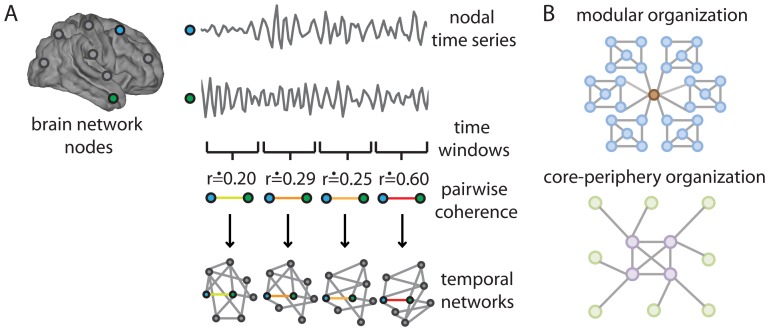
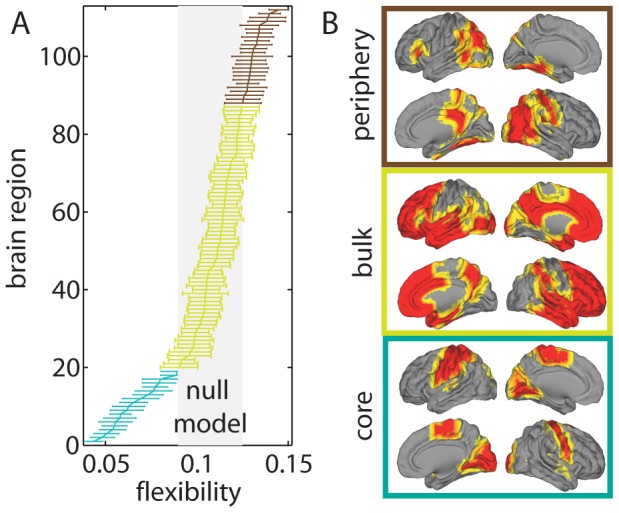
As a person learns a new skill, distinct synapses, brain regions, and circuits are engaged and change over time. In this paper, we develop methods to examine patterns of correlated activity across a large set of brain regions. Our goal is to identify properties that enable robust learning of a motor skill. We measure brain activity during motor sequencing and characterize network properties based on coherent activity between brain regions. Using recently developed algorithms to detect time-evolving communities, we find that the complex reconfiguration patterns of the brain's putative functional modules that control learning can be described parsimoniously by the combined presence of a relatively stiff temporal core that is composed primarily of sensorimotor and visual regions whose connectivity changes little in time and a flexible temporal periphery that is composed primarily of multimodal association regions whose connectivity changes frequently. The separation between temporal core and periphery changes over the course of training and, importantly, is a good predictor of individual differences in learning success. The core of dynamically stiff regions exhibits dense connectivity, which is consistent with notions of core-periphery organization established previously in social networks. Our results demonstrate that core-periphery organization provides an insightful way to understand how putative functional modules are linked. This, in turn, enables the prediction of fundamental human capacities, including the production of complex goal-directed behavior.
Overview
The claims and statistics of this paper haven’t been checked yet.
Run the check — free, no account needed. It reads the open-access text and checks the sources it cites.
Integrity signals
Registry
Cites
Statistics
Figures
Verification
Claims the paper makes
The claims and statistics of this paper haven’t been checked yet.
Run the check — free, no account needed. It reads the open-access text and checks the sources it cites.
Claims other papers make about this one
Each is checked against this paper’s own text: does it say what the citing paper says it does?
In the citing paper
“suggesting that they form a stable task-based core that supports higher order cognitive functions (40).”
From Dynamic reconfiguration of frontal brain networks during executive cognition in humans (2015) · cites this paper as [40]
Self-check
Percentages, sums and reported differences re-computed from the paper’s own numbers.
The self-check needs the paper’s full text.
Citations
Cites
Fast unfolding of communities in large networks
Blondel, V. D., Guillaume, J.-L., Lambiotte, R., & Lefebvre, E. (2008) · Journal of Statistical Mechanics: Theory and Experiment · doi:10.1088/1742-5468/2008/10/p10008 · Cited by 21,424
Finding and evaluating community structure in networks
Newman, M. E. J., & Girvan, M. (2004) · Physical Review E · doi:10.1103/physreve.69.026113 · Cited by 13,931
Advances in functional and structural MR image analysis and implementation as FSL
Smith, S. M., Jenkinson, M., Woolrich, M. W., Beckmann, C. F., Behrens, T. E. J., Johansen-Berg, H., Bannister, P. R., De Luca, M., Drobnjak, I., Flitney, D. E., et al. (2004) · NeuroImage · doi:10.1016/j.neuroimage.2004.07.051 · Cited by 13,630
Modularity and community structure in networks
Newman, M. E. J. (2006) · Proceedings of the National Academy of Sciences · doi:10.1073/pnas.0601602103 · Cited by 12,256
Complex brain networks: graph theoretical analysis of structural and functional systems
Bullmore, E., & Sporns, O. (2009) · Nature Reviews Neuroscience · doi:10.1038/nrn2575 · Cited by 11,820
Fortunato, S. (2010) · Physics Reports · doi:10.1016/j.physrep.2009.11.002 · Cited by 11,293
Statistical parametric maps in functional imaging: A general linear approach
Friston, K. J., Holmes, A. P., Worsley, K. J., Poline, J. ‐., Frith, C. D., & Frackowiak, R. S. J. (1994) · Human Brain Mapping · doi:10.1002/hbm.460020402 · Cited by 9,688
Mersenne twister: a 623-dimensionally equidistributed uniform pseudo-random number generator
Matsumoto, M., & Nishimura, T. (1998) · ACM Transactions on Modeling and Computer Simulation · doi:10.1145/272991.272995 · Cited by 5,780
Fast algorithm for detecting community structure in networks
Newman, M. E. J. (2004) · Physical Review E · doi:10.1103/physreve.69.066133 · Cited by 5,415
Finding community structure in networks using the eigenvectors of matrices
Newman, M. E. J. (2006) · Physical Review E · doi:10.1103/physreve.74.036104 · Cited by 4,799
Motor Control and Learning: A Behavioral Emphasis
Schmidt, R. A. (1982) · Cited by 4,770
Mapping the structural core of human cerebral cortex
Hagmann, P., Cammoun, L., Gigandet, X., Meuli, R., Honey, C. J., Wedeen, V. J., & Sporns, O. (2008) · PLoS Biology · doi:10.1371/journal.pbio.0060159 · Cited by 4,173
Functional Network Organization of the Human Brain
Power, J. D., Cohen, A. L., Nelson, S. M., Wig, G. S., Barnes, K. A., Church, J. A., Vogel, A. C., Laumann, T. O., Miezin, F. M., Schlaggar, B. L., et al. (2011) · Neuron · doi:10.1016/j.neuron.2011.09.006 · Cited by 4,124
Functional cartography of complex metabolic networks
Guimerà, R., & Nunes Amaral, L. A. (2005) · Nature · doi:10.1038/nature03288 · Cited by 3,983 · cited 1×
“While the roles of nodes in a static network can be studied in multiple ways [28,29], we focus on describing the geometrical core-periphery organization— which can be used to help characterize the organization of edge strengths throughout a network —to compare it with the temporal core-periphery organization discussed…”
BackgroundNode centrality in weighted networks: Generalizing degree and shortest paths
Opsahl, T., Agneessens, F., & Skvoretz, J. V. (2010) · Social Networks · doi:10.1016/j.socnet.2010.03.006 · Cited by 3,854
Functional and Effective Connectivity: A Review
Friston, K. J. (2011) · Brain Connectivity · doi:10.1089/brain.2011.0008 · Cited by 3,415
Wavelet Methods for Time SeriesAnalysis
Percival, D. B., & Walden, A. T. (2000) · Cambridge University Press eBooks · doi:10.1017/cbo9780511841040 · Cited by 3,210
Mesulam, M. (1998) · Brain · doi:10.1093/brain/121.6.1013 · Cited by 3,072
Tracking whole-brain connectivity dynamics in the resting state
Allen, E. A., Damaraju, E., Plis, S. M., Erhardt, E. B., Eichele, T., & Calhoun, V. D. (2014) · Cerebral Cortex · doi:10.1093/cercor/bhs352 · Cited by 2,992
Cognitive Skills and Their Acquisition
Anderson, J. R. (2013) · Psychology Press eBooks · doi:10.4324/9780203728178 · Cited by 2,928
Holme, P., & Saramäki, J. (2012) · Physics Reports · doi:10.1016/j.physrep.2012.03.001 · Cited by 2,736
Bassett, D. S., & Bullmore, E. (2006) · The Neuroscientist · doi:10.1177/1073858406293182 · Cited by 2,600
Self-citationWavelet methods for time series analysis
Percival, D. B., & Walden, A. T. (2001) · Choice Reviews Online · doi:10.5860/choice.38-4508 · Cited by 2,570
Efficiency and Cost of Economical Brain Functional Networks
Achard, S., & Bullmore, E. (2007) · PLoS Computational Biology · doi:10.1371/journal.pcbi.0030017 · Cited by 2,553
Achard, S., Salvador, R., Whitcher, B., Suckling, J., & Bullmore, E. (2006) · The Journal of Neuroscience · doi:10.1523/jneurosci.3874-05.2006 · Cited by 2,393
Bayesian analysis of neuroimaging data in FSL
Woolrich, M. W., Jbabdi, S., Patenaude, B., Chappell, M., Makni, S., Behrens, T., Beckmann, C., Jenkinson, M., & Smith, S. M. (2009) · NeuroImage · doi:10.1016/j.neuroimage.2008.10.055 · Cited by 2,385
Rich-club organization of the human connectome
van den Heuvel, M. P., & Sporns, O. (2011) · The Journal of Neuroscience · doi:10.1523/jneurosci.3539-11.2011 · Cited by 2,354
Models of core/periphery structures
Borgatti, S. P., & Everett, M. G. (2000) · Social Networks · doi:10.1016/s0378-8733(99)00019-2 · Cited by 2,295
Community Structure in Time-Dependent, Multiscale, and Multiplex Networks
Mucha, P. J., Richardson, T., Macon, K., Porter, M. A., & Onnela, J.-P. (2010) · Science · doi:10.1126/science.1184819 · Cited by 2,123
Self-citationStatistical mechanics of community detection
Reichardt, J., & Bornholdt, S. (2006) · Physical Review E · doi:10.1103/physreve.74.016110 · Cited by 2,048
Network modelling methods for FMRI
Smith, S. M., Miller, K. L., Salimi-Khorshidi, G., Webster, M., Beckmann, C. F., Nichols, T. E., Ramsey, J. D., & Woolrich, M. W. (2011) · NeuroImage · doi:10.1016/j.neuroimage.2010.08.063 · Cited by 1,878
A Core System for the Implementation of Task Sets
Dosenbach, N. U. F., Visscher, K. M., Palmer, E. D., Miezin, F. M., Wenger, K. K., Kang, H. C., Burgund, E. D., Grimes, A. L., Schlaggar, B. L., & Petersen, S. E. (2006) · Neuron · doi:10.1016/j.neuron.2006.04.031 · Cited by 1,772
Dynamic reconfiguration of human brain networks during learning
Bassett, D. S., Wymbs, N. F., Porter, M. A., Mucha, P. J., Carlson, J. M., & Grafton, S. T. (2011) · Proceedings of the National Academy of Sciences · doi:10.1073/pnas.1018985108 · Cited by 1,705
Self-citationMechanisms of skill acquisition and the law of practice
Newell, A., & Rosenbloom, P. S. (2018) · Figshare · doi:10.1184/r1/6607196 · Cited by 1,501
Neuroplasticity Subserving Motor Skill Learning
Dayan, E., & Cohen, L. G. (2011) · Neuron · doi:10.1016/j.neuron.2011.10.008 · Cited by 1,408
Mechanisms of skill acquisition and the law of practice
Newell, A., & Rosenbloom, P. S. (2018) · Figshare · doi:10.1184/r1/6607199.v1 · Cited by 1,365
Functional Connectivity and Brain Networks in Schizophrenia
Lynall, M.-E., Bassett, D. S., Kerwin, R., McKenna, P. J., Kitzbichler, M. G., Müller, U., & Bullmore, E. T. (2010) · Journal of Neuroscience · doi:10.1523/jneurosci.0333-10.2010 · Cited by 1,348
Self-citationWhole-brain anatomical networks: does the choice of nodes matter?
Zalesky, A., Fornito, A., Harding, I. H., Cocchi, L., Yücel, M., Pantelis, C., & Bullmore, E. T. (2010) · NeuroImage · doi:10.1016/j.neuroimage.2009.12.027 · Cited by 1,169
Brain Graphs: Graphical Models of the Human Brain Connectome
Bullmore, E. T., & Bassett, D. S. (2011) · Annual Review of Clinical Psychology · doi:10.1146/annurev-clinpsy-040510-143934 · Cited by 1,165
Self-citationThe pulvinar regulates information transmission between cortical areas based on attention demands
Saalmann, Y. B., Pinsk, M. A., Wang, L., Li, X., & Kastner, S. (2012) · Science · doi:10.1126/science.1223082 · Cited by 1,016
Detecting rich-club ordering in complex networks
Colizza, V., Flammini, A., Serrano, M. A., & Vespignani, A. (2006) · Nature Physics · doi:10.1038/nphys209 · Cited by 1,001
Human brain networks in health and disease
Bassett, D. S., & Bullmore, E. T. (2009) · Current Opinion in Neurology · doi:10.1097/wco.0b013e32832d93dd · Cited by 922
Self-citationAdaptive reconfiguration of fractal small-world human brain functional networks
Bassett, D. S., Meyer-Lindenberg, A., Achard, S., Duke, T., & Bullmore, E. (2006) · Proceedings of the National Academy of Sciences · doi:10.1073/pnas.0606005103 · Cited by 814
Self-citationHigh-cost, high-capacity backbone for global brain communication
van den Heuvel, M. P., Kahn, R. S., Goñi, J., & Sporns, O. (2012) · Proceedings of the National Academy of Sciences · doi:10.1073/pnas.1203593109 · Cited by 781
The elusive concept of brain connectivity
Horwitz, B. (2003) · NeuroImage · doi:10.1016/s1053-8119(03)00112-5 · Cited by 779
The power law repealed: The case for an exponential law of practice
Heathcote, A., Brown, S. D., & Mewhort, D. J. K. (2000) · Psychonomic Bulletin & Review · doi:10.3758/bf03212979 · Cited by 735
Rosenbaum, D. Α. (1990) · doi:10.1016/b978-0-12-374226-1.x0001-0 · Cited by 684
Inside the brain of an elite athlete: the neural processes that support high achievement in sports
Yarrow, K., Brown, P., & Krakauer, J. W. (2009) · Nature reviews. Neuroscience · doi:10.1038/nrn2672 · Cited by 675
Parcellation‐dependent small‐world brain functional networks: A resting‐state fMRI study
Wang, J., Wang, L. Y., Zang, Y., Yang, H., Tang, H., Gong, Q., Chen, Z., Zhu, C., & Yong He, A. (2008) · Human Brain Mapping · doi:10.1002/hbm.20623 · Cited by 670
Enhanced Brain Correlations during Rest Are Related to Memory for Recent Experiences
Tambini, A., Ketz, N., & Davachi, L. (2010) · Neuron · doi:10.1016/j.neuron.2010.01.001 · Cited by 596
Fornito, A., Harrison, B. J., Zalesky, A., & Simons, J. S. (2012) · Proceedings of the National Academy of Sciences · doi:10.1073/pnas.1204185109 · Cited by 555
Uddin, L. Q., Supekar, K. S., Ryali, S., & Menon, V. (2011) · The Journal of Neuroscience · doi:10.1523/jneurosci.4465-11.2011 · Cited by 520
Communities in NetworksPreprint
Porter, M. A., Onnela, J.-P. “., & Mucha, P. J. (2009) · arXiv (Cornell University) · doi:10.48550/arxiv.0902.3788 · Cited by 518
Self-citationA THEORY OF THE ACQUISITION OF SPEED-SKILL∗
CROSSMAN, E. R. F. W. (1959) · Ergonomics · doi:10.1080/00140135908930419 · Cited by 517
Gates, K. M., & Molenaar, P. C. M. (2012) · NeuroImage · doi:10.1016/j.neuroimage.2012.06.026 · Cited by 478
The Oxford Dictionary of Statistical Terms
(2004) · Technometrics · doi:10.1198/tech.2004.s820 · Cited by 448
Comparing Community Structure to Characteristics in Online Collegiate Social Networks
Red, V., Kelsic, E. D., Mucha, P. J., & Porter, M. A. (2011) · SIAM Review · doi:10.1137/080734315 · Cited by 443
Self-citationNon-Stationarity in the “Resting Brain’s” Modular Architecture
Jones, D. T., Vemuri, P., Murphy, M. C., Gunter, J. L., Senjem, M. L., Machulda, M. M., Przybelski, S. A., Gregg, B. E., Kantarci, K., Knopman, D. S., et al. (2012) · PLoS ONE · doi:10.1371/journal.pone.0039731 · Cited by 435
Cognitive fitness of cost-efficient brain functional networks
Bassett, D. S., Bullmore, E. T., Meyer‐Lindenberg, A., Apud, J. A., Weinberger, D. R., & Coppola, R. (2009) · Proceedings of the National Academy of Sciences · doi:10.1073/pnas.0903641106 · Cited by 429
Self-citationRobust detection of dynamic community structure in networks
Bassett, D. S., Porter, M. A., Wymbs, N. F., Grafton, S. T., Carlson, J. M., & Mucha, P. J. (2013) · Chaos: An Interdisciplinary Journal of Nonlinear Science · doi:10.1063/1.4790830 · Cited by 425
Self-citationA Cortical Core for Dynamic Integration of Functional Networks in the Resting Human Brain
de Pasquale, F., Penna, S. D., Snyder, A. Z., Marzetti, L., Pizzella, V., Romani, G. L., & Corbetta, M. (2012) · Neuron · doi:10.1016/j.neuron.2012.03.031 · Cited by 422
Classes of complex networks defined by role-to-role connectivity profiles
Guimerà, R., Sales‐Pardo, M., & Amaral, L. A. N. (2006) · Nature Physics · doi:10.1038/nphys489 · Cited by 422
Robust detection of dynamic community structure in networks
Bassett, D. S., Porter, M. A., Wymbs, N. F., Grafton, S. T., Carlson, J. M., & Mucha, P. J. (2013) · Oxford University Research Archive (ORA) (University of Oxford) · Cited by 411
Self-citationSun, F. T., Miller, L. M., & D’Esposito, M. (2004) · NeuroImage · doi:10.1016/j.neuroimage.2003.09.056 · Cited by 406
Prominence and Control: The Weighted Rich-Club Effect
Opsahl, T., Colizza, V., Panzarasa, P., & Ramasco, J. J. (2008) · Physical Review Letters · doi:10.1103/physrevlett.101.168702 · Cited by 392
Core-Periphery Structure in NetworksPreprint
Puck, M., Mason, R., Porter, A., Fowler, J. H., & Mucha, P. J. (2013) · Cited by 392
Self-citationConserved and variable architecture of human white matter connectivity
Bassett, D., Brown, J. A., Deshpande, V., Carlson, J., & Grafton, S. T. (2011) · NeuroImage · doi:10.1016/j.neuroimage.2010.09.006 · Cited by 380
Self-citationEvaluation of different measures of functional connectivity using a neural mass model
Olivier David, A., Cosmelli, D. J., & Friston, K. J. (2003) · NeuroImage · doi:10.1016/j.neuroimage.2003.10.006 · Cited by 339
Direct Comparison of Neural Systems Mediating Conscious and Unconscious Skill Learning
Willingham, D. B., Salidis, J., & Gabrieli, J. D. E. (2002) · Journal of Neurophysiology · doi:10.1152/jn.2002.88.3.1451 · Cited by 327
Stepwise Connectivity of the Modal Cortex Reveals the Multimodal Organization of the Human Brain
Sepulcre, J., Sabuncu, M. R., Yeo, T. B., Liu, H., & Johnson, K. A. (2012) · Journal of Neuroscience · doi:10.1523/jneurosci.0759-12.2012 · Cited by 323
Double dissociation without modularity: Evidence from connectionist neuropsychology
Plaut, D. C. (1995) · Journal of Clinical and Experimental Neuropsychology · doi:10.1080/01688639508405124 · Cited by 306
A k -shell decomposition method for weighted networks
Garas, A., Schweitzer, F., & Havlin, S. (2012) · New Journal of Physics · doi:10.1088/1367-2630/14/8/083030 · Cited by 302
Functional brain network efficiency predicts intelligence
Langer, N., Pedroni, A., Gianotti, L. R. R., Hänggi, J., Knoch, D., & Jäncke, L. (2011) · Human Brain Mapping · doi:10.1002/hbm.21297 · Cited by 297
Concepts and principles in the analysis of brain networks
Wig, G. S., Schlaggar, B. L., & Petersen, S. E. (2011) · Annals of the New York Academy of Sciences · doi:10.1111/j.1749-6632.2010.05947.x · Cited by 295
Interpreting fMRI data: maps, modules and dimensions
de Beeck, H. O., Haushofer, J., & Kanwisher, N. (2008) · Nature reviews. Neuroscience · doi:10.1038/nrn2314 · Cited by 291
The parcellation-based connectome: limitations and extensions
de Reus, M. A., & van den Heuvel, M. P. (2013) · NeuroImage · doi:10.1016/j.neuroimage.2013.03.053 · Cited by 282
Snoddy, G. S. (1926) · Journal of Applied Psychology · doi:10.1037/h0075814 · Cited by 275
Detection of time-varying signals in event-related fMRI designs
Grinband, J., Wager, T. D., Lindquist, M. A., Ferrera, V. P., & Hirsch, J. (2008) · NeuroImage · doi:10.1016/j.neuroimage.2008.07.065 · Cited by 271
Core-periphery organization of complex networks
Holme, P. (2005) · Physical Review E · doi:10.1103/physreve.72.046111 · Cited by 257
Wavelets and functional magnetic resonance imaging of the human brain
Bullmore, E. T., Fadili, J. M., Maxim, V., Sendur, L., Whitcher, B. J., John Suckling, A., Brammer, M. J., & Breakspear, M. J. (2004) · NeuroImage · doi:10.1016/j.neuroimage.2004.07.012 · Cited by 257
Fast unfolding of community hierarchies in large networks
Blondel, V. D., Guillaume, J., Lambiotte, R., & Lefebvre, E. (2008) · Cited by 253
Activity in the lateral prefrontal cortex reflects multiple steps of future events in action plans
Mushiake, H., Saito, N., Sakamoto, K., Itoyama, Y., & Tanji, J. (2006) · Neuron · doi:10.1016/j.neuron.2006.03.045 · Cited by 249
The Oxford Dictionary Of Statistical Terms
(2003) · doi:10.1093/oso/9780198509943.001.0001 · Cited by 238
Ryali, S., Chen, T., Supekar, K., & Menon, V. (2011) · NeuroImage · doi:10.1016/j.neuroimage.2011.11.054 · Cited by 221
Organization of Action Sequences and the Role of the Pre-SMA
Kennerley, S. W., Sakai, K., & Rushworth, M. F. S. (2004) · Journal of Neurophysiology · doi:10.1152/jn.00651.2003 · Cited by 215
The Statistical Analysis of Functional MRI Data
Lazar, N. A. (2008) · Statistics in the health sciences · doi:10.1007/978-0-387-78191-4 · Cited by 197
Functional Connectivity of Cortical Networks Involved in Bimanual Motor Sequence Learning
Sun, F. T., Miller, L. M., Rao, A. A., & D’Esposito, M. (2006) · Cerebral Cortex · doi:10.1093/cercor/bhl033 · Cited by 188
Destrebecqz, A., Peigneux, P., Laureys, S., Degueldre, C., Fiore, G. D., Aerts, J. J., Luxen, A., der Linden, M. V., Cleeremans, A., & Maquet, P. (2005) · Learning & Memory · doi:10.1101/lm.95605 · Cited by 187
A pairwise maximum entropy model accurately describes resting-state human brain networks
Watanabe, T., Hirose, S., Wada, H., Imai, Y., Machida, T., Shirouzu, I., Konishi, S., Miyashita, Y., & Masuda, N. (2013) · Nature Communications · doi:10.1038/ncomms2388 · Cited by 186
A k-shell decomposition method for weighted networks
Garas, A., Schweitzer, F., & Havlin, S. (2012) · Repository for Publications and Research Data (ETH Zurich) · doi:10.3929/ethz-b-000055291 · Cited by 176
Endogenous Human Brain Dynamics Recover Slowly Following Cognitive Effort
Barnes, A., Bullmore, E. T., & Suckling, J. (2009) · PLoS ONE · doi:10.1371/journal.pone.0006626 · Cited by 174
Calhoun, V. D., Adalı, T., & Pekar, J. J. (2004) · Magnetic Resonance Imaging · doi:10.1016/j.mri.2004.09.004 · Cited by 173
Jones, T. B., Bandettini, P. A., Kenworthy, L., Case, L. K., Milleville, S. C., Martin, A., & Birn, R. M. (2010) · NeuroImage · doi:10.1016/j.neuroimage.2009.07.051 · Cited by 172
Emergence of Stable Functional Networks in Long-Term Human Electroencephalography
Chu, C. J., Kramer, M., Pathmanathan, J. S., Bianchi, M. T., Westover, M. B., Wizon, L., & Cash, S. S. (2012) · Journal of Neuroscience · doi:10.1523/jneurosci.5669-11.2012 · Cited by 170
Neural Substrates of Response-based Sequence Learning using fMRI
Bischoff‐Grethe, A., Goedert, K. M., Willingham, D. T., & Grafton, S. T. (2004) · Journal of Cognitive Neuroscience · doi:10.1162/089892904322755610 · Cited by 165
Self-citationSkill representation in the primary motor cortex after long-term practice
Matsuzaka, Y., Picard, N., & Strick, P. L. (2007) · Journal of Neurophysiology · doi:10.1152/jn.00784.2006 · Cited by 156 · cited 1×
“At the level of individual neurons, this induces changes in firing behavior in the motor cortex [8].”
BackgroundIs Kurtosis Really "Peakedness?"
Darlington, R. B. (1970) · The American Statistician · doi:10.1080/00031305.1970.10478885 · Cited by 156
Stability of amygdala BOLD response to fearful faces over multiple scan sessions
Johnstone, T., Somerville, L. H., Alexander, A. L., Oakes, T. R., Davidson, R. J., Kalin, N. H., & Whalen, P. J. (2005) · NeuroImage · doi:10.1016/j.neuroimage.2004.12.016 · Cited by 155
Predicting errors from reconfiguration patterns in human brain networks
Ekman, M., Derrfuß, J., Tittgemeyer, M., & Fiebach, C. J. (2012) · Proceedings of the National Academy of Sciences · doi:10.1073/pnas.1207523109 · Cited by 155
Dynamic network structure of interhemispheric coordination
Doron, K. W., Bassett, D. S., & Gazzaniga, M. S. (2012) · Proceedings of the National Academy of Sciences · doi:10.1073/pnas.1216402109 · Cited by 153
Self-citationStatistics: The Art and Science of Learning from Data
Agresti, A., & Franklin, C. (2005) · Cited by 139
Inducing motor skill improvements with a declarative task
Brown, R. M., & Robertson, E. M. (2007) · Nature Neuroscience · doi:10.1038/nn1836 · Cited by 135
Fractal connectivity of long-memory networks
Achard, S., Bassett, D. S., Meyer‐Lindenberg, A., & Bullmore, E. T. (2008) · Physical Review E · doi:10.1103/physreve.77.036104 · Cited by 133
Self-citationWavelets and statistical analysis of functional magnetic resonance images of the human brain
Bullmore, E. T., Fadili, J. M., Breakspear, M. J., Salvador, R. M., John Suckling, A., & Brammer, M. J. (2003) · Statistical Methods in Medical Research · doi:10.1191/0962280203sm339ra · Cited by 130
Emergence of Persistent Networks in Long-Term Intracranial EEG Recordings
Kramer, M., Eden, U. T., Lepage, K. Q., Kolaczyk, E. D., Bianchi, M. T., & Cash, S. S. (2011) · Journal of Neuroscience · doi:10.1523/jneurosci.2287-11.2011 · Cited by 118
P4‐158: Nonstationarity in the ‘resting brain's’ modular architecture
Jones, D. T., Vemuri, P., Murphy, M. C., Gunter, J. L., Senjem, M. L., Machulda, M. M., Przybelski, S. A., Gregg, B. E., Kantarci, K., Knopman, D. S., et al. (2012) · Alzheimer s & Dementia · doi:10.1016/j.jalz.2012.05.1862 · Cited by 116
Simpson, S. L., Moussa, M. N., & Laurienti, P. J. (2012) · NeuroImage · doi:10.1016/j.neuroimage.2012.01.071 · Cited by 112
da Silva, M. R., Ma, H., & Zeng, A. (2008) · Proceedings of the IEEE · doi:10.1109/jproc.2008.925418 · Cited by 90
Whitlow, C. T., Casanova, R., & Maldjian, J. A. (2011) · Radiology · doi:10.1148/radiol.11101708 · Cited by 77
MRI-related anxiety levels change within and between repeated scanning sessions
Chapman, H. A., Bernier, D. C., & Rusak, B. (2010) · Psychiatry Research Neuroimaging · doi:10.1016/j.pscychresns.2010.01.005 · Cited by 75
Is Kurtosis Really "Peakedness?"
Darlington, R. B. (1970) · The American Statistician · doi:10.2307/2681925 · Cited by 70
Investigating hemodynamic response variability at the group level using basis functions
Steffener, J., Tabert, M. H., Reuben, A., & Stern, Y. (2009) · NeuroImage · doi:10.1016/j.neuroimage.2009.11.014 · Cited by 67
Dynamic network centrality summarizes learning in the human brain
Mantzaris, A. V., Bassett, D. S., Wymbs, N. F., Estrada, E., Porter, M. A., Mucha, P. J., Grafton, S. T., & Higham, D. J. (2013) · Journal of Complex Networks · doi:10.1093/comnet/cnt001 · Cited by 64
Self-citationIntra- and Inter-Frequency Brain Network Structure in Health and Schizophrenia
Siebenhühner, F., Weiss, S. A., Coppola, R., Weinberger, D. R., & Bassett, D. S. (2013) · PLoS ONE · doi:10.1371/journal.pone.0072351 · Cited by 63
Self-citationActivation on the Medial Wall During Remembered Sequences of Reaching Movements in Monkeys
Picard, N., & Strick, P. L. (1997) · Journal of Neurophysiology · doi:10.1152/jn.1997.77.4.2197 · Cited by 63
Knotty-Centrality: Finding the Connective Core of a Complex Network
Shanahan, M., & Wildie, M. (2012) · PLoS ONE · doi:10.1371/journal.pone.0036579 · Cited by 55
Neural Substrates of Practice Structure That Support Future Off-Line Learning
Wymbs, N. F., & Grafton, S. T. (2009) · Journal of Neurophysiology · doi:10.1152/jn.00315.2009 · Cited by 54
Self-citationLueken, U., Muehlhan, M., Evens, R., Wïttchen, H., & Kirschbaum, C. (2012) · Psychoneuroendocrinology · doi:10.1016/j.psyneuen.2012.01.003 · Cited by 51
Endogenous human brain dynamics recover slowly following cognitive effortPreprint
Suckling, J., Barnes, A., & Bullmore, E. T. (2008) · Nature Precedings · doi:10.1038/npre.2008.2665.1 · Cited by 50
Core-Periphery Structure in NetworksPreprint
Rombach, M. P., Porter, M. A., Fowler, J. H., & Mucha, P. J. (2012) · SSRN Electronic Journal · doi:10.2139/ssrn.2002684 · Cited by 46
Self-citationGavrilescu, M. C., Stuart, G. W., Rossell, S. L., Henshall, K. R., McKay, C. M., Sergejew, A. A., Copolov, D., & Egan, G. F. (2007) · Human Brain Mapping · doi:10.1002/hbm.20446 · Cited by 45
Large-scale Cortical Network Properties Predict Future Sound-to-Word Learning Success
Sheppard, J. P., Wang, J., & Wong, P. C. M. (2012) · Journal of Cognitive Neuroscience · doi:10.1162/jocn_a_00210 · Cited by 44
Opsahl, T., Vittoria Colizza, A., Panzarasa, P., & Ramasco, J. J. (2008) · Physical Review Letters · doi:10.1103/physrevlett.101.189903 · Cited by 37
Coherent Behavior in Neuronal Networks
Josić́, K., Jonathan Rubin, A., Matias, M., & Romo, R. (2009) · Springer eBooks · doi:10.1007/978-1-4419-0389-1 · Cited by 33
Cited by
Sorted by citations
Kivela, M., Arenas, A., Barthelemy, M., Gleeson, J. P., Moreno, Y., & Porter, M. A. (2014) · Journal of Complex Networks · doi:10.1093/comnet/cnu016 · Cited by 3,235
Self-citationIntrinsic and task-evoked network architectures of the human brain
Cole, M. W., Bassett, D. S., Power, J. D., Braver, T. S., & Petersen, S. E. (2014) · Neuron · doi:10.1016/j.neuron.2014.05.014 · Cited by 1,564
Self-citationCommunication dynamics in complex brain networks
Avena-Koenigsberger, A., Misic, B., & Sporns, O. (2018) · Nature Reviews Neuroscience · doi:10.1038/nrn.2017.149 · Cited by 856
Small-World Brain Networks Revisited
Bassett, D. S., & Bullmore, E. T. (2016) · The Neuroscientist · doi:10.1177/1073858416667720 · Cited by 887
Self-citationDynamic reconfiguration of frontal brain networks during executive cognition in humans
Braun, U., Schäfer, A., Walter, H., Erk, S., Romanczuk-Seiferth, N., Haddad, L., Schweiger, J. I., Grimm, O., Heinz, A., Tost, H., et al. (2015) · Proceedings of the National Academy of Sciences · doi:10.1073/pnas.1422487112 · Cited by 791
Self-citation
Metadata
- Authors
- Bassett, D. S., Wymbs, N. F., Rombach, M. P., Porter, M. A., Mucha, P. J., & Grafton, S. T.
- Affiliations
- University of California, Santa Barbara (US)
- University of Oxford (GB)
- University of North Carolina at Chapel Hill (US)
- Corresponding author
- Bassett, Danielle S.
- Wymbs, Nicholas F.
- Rombach, M. Puck
- Porter, Mason A.
- Mucha, Peter J.
- Grafton, Scott T.
- Venue
- PLoS Computational Biology
- Publisher
- Public Library of Science (PLoS)
- Published
- 2013-09-26
- Volume
- 9
- Issue
- 9
- Pages
- e1003171
- ISSN
- 1553-734X (ISSN-L)
- 1553-7358
- PMC
- PMC3784512
- OpenAlex
- W2962725064
- Cited by
- 356
- References
- 124
- Citations by year
- 2026: 12 · 2025: 15 · 2024: 24 · 2023: 23 · 2022: 28 · 2021: 32 · 2020: 29 · 2019: 31 · 2018: 37 · 2017: 51 · 2016: 34 · 2015: 21 · 2014: 15 · 2013: 4
- FWCI
- 13.29
- Type
- journal article
- Language
- en
- Update notices
- correction (2014-04-11)
- Open access
- gold
- doi.org
- Locations
- PLoS Computational Biology (publishedVersion, cc-by)
- Europe PMC (PubMed Central) (publishedVersion, cc-by)
- PubMed Central (publishedVersion, cc-by)
- PubMed (publishedVersion)
- Oxford University Research Archive (ORA) (University of Oxford) (acceptedVersion)
- Carolina Digital Repository (University of North Carolina at Chapel Hill) (submittedVersion)
- RePEc: Research Papers in Economics (submittedVersion)
- DOAJ (DOAJ: Directory of Open Access Journals) (submittedVersion, cc-by-sa)
- eScholarship (California Digital Library) (submittedVersion)
- eScholarship (California Digital Library) (submittedVersion, cc-by)
- Figshare (submittedVersion, cc-by)
- UNC Libraries
- Funders
- David and Lucile Packard Foundation (W911NF-09-D-0001)
- James S. McDonnell Foundation (220020177)
- John Templeton Foundation
- Errett Fisher Foundation
- European Commission (FP7 ICT, 317614, ICT-2011, FP7‐ICT‐2011‐8, FP7‐ICT‐2011)
- Engineering and Physical Sciences Research Council (EP/J001759/1, 317614, 220020177)
- National Institute of General Medical Sciences (R21GM099493, D-0001)
- National Institute of Neurological Disorders and Stroke (NS 44393, P01NS044393)
- Army Research Office (#W911NF-09-D-0001, W911NF)
- FP7 Information and Communication Technologies (FP7-ICT-2011-8)
- Institute for Collaborative Biotechnologies (W911NF‐09‐D‐0001)
- Topics
- Life Sciences › Neuroscience › Cognitive Neuroscience › Functional Brain Connectivity Studies
- Life Sciences › Neuroscience › Cognitive Neuroscience › Neural dynamics and brain function
- Physical Sciences › Physics and Astronomy › Statistical and Nonlinear Physics › Complex Network Analysis Techniques
- Keywords
- brain dynamics, motor skill learning, motor sequencing, sensorimotor regions, individual differences in learning, goal-directed behavior, brain connectivity
- MeSH terms
- Brain, Humans, Learning, Task Performance and Analysis
About these checks
Registry, retraction, Cites and statistics results are computed, not judged, with one exception: a printed reference that no index lists is read once by a model before it counts as a citation error. Claims are extracted by a model and kept only when their quote appears verbatim in the text; each cited source is then checked, with a model’s help, for whether it says what the claim relies on. Those verdicts can be wrong — read the claim’s quote and the cited source before relying on one.
Statistics and arithmetic are recomputed, not judged.
Confidence bands are shown only for fields calibrated on our annotated test set. None is calibrated yet, so no band is shown.
What counts as a claim ›How we measure confidence ›How we check this ›
Are you an author, or do you see a problem with this page? Request a review
