

Feed-Forward versus Feedback Inhibition in a Basic Olfactory Circuit
Open accessThe DOI matches its Crossref record; 71 of the 71 references it cites were found in a registry or an index.
Abstract
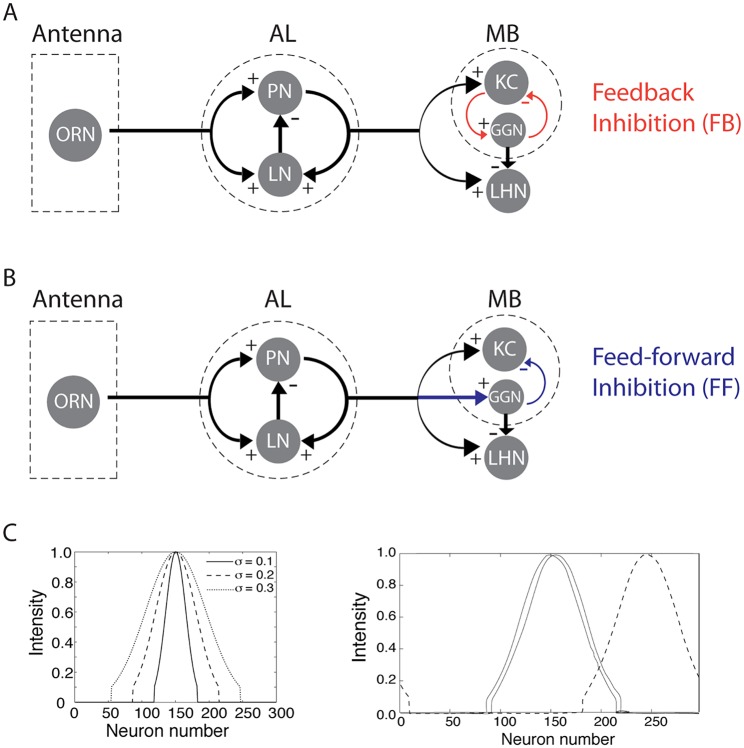
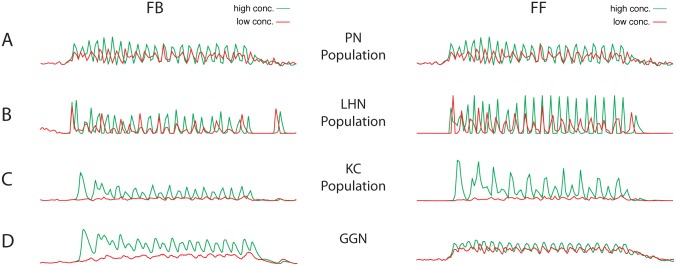
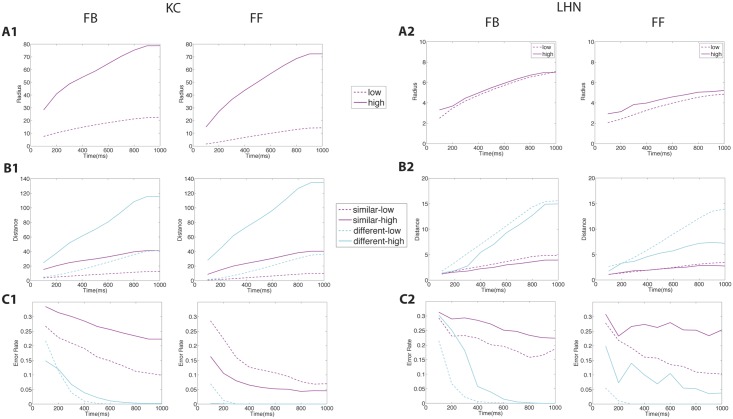
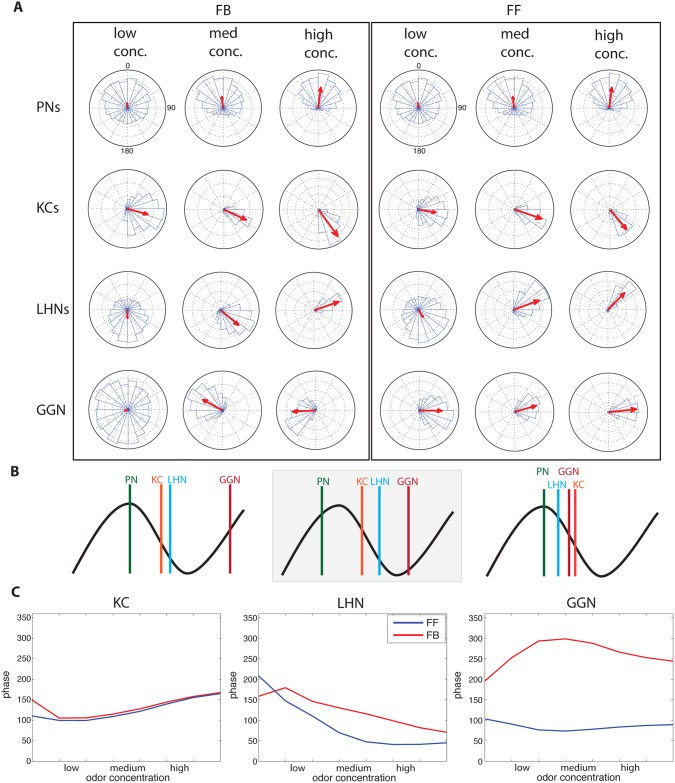
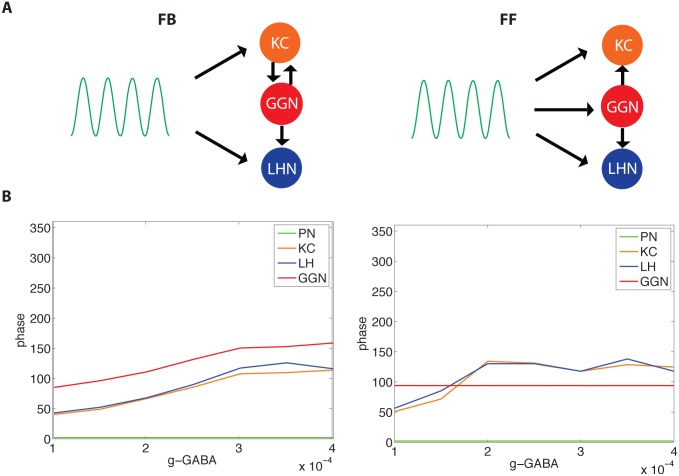
Inhibitory interneurons play critical roles in shaping the firing patterns of principal neurons in many brain systems. Despite difference in the anatomy or functions of neuronal circuits containing inhibition, two basic motifs repeatedly emerge: feed-forward and feedback. In the locust, it was proposed that a subset of lateral horn interneurons (LHNs), provide feed-forward inhibition onto Kenyon cells (KCs) to maintain their sparse firing--a property critical for olfactory learning and memory. But recently it was established that a single inhibitory cell, the giant GABAergic neuron (GGN), is the main and perhaps sole source of inhibition in the mushroom body, and that inhibition from this cell is mediated by a feedback (FB) loop including KCs and the GGN. To clarify basic differences in the effects of feedback vs. feed-forward inhibition in circuit dynamics we here use a model of the locust olfactory system. We found both inhibitory motifs were able to maintain sparse KCs responses and provide optimal odor discrimination. However, we further found that only FB inhibition could create a phase response consistent with data recorded in vivo. These findings describe general rules for feed-forward versus feedback inhibition and suggest GGN is potentially capable of providing the primary source of inhibition to the KCs. A better understanding of how inhibitory motifs impact post-synaptic neuronal activity could be used to reveal unknown inhibitory structures within biological networks.
Overview
The claims and statistics of this paper haven’t been checked yet.
Free: it reads the open-access text and checks the first 5 claims that cite a source we can check. Create a free account to check every claim.
Integrity signals
Registry
Cites
Statistics
Figures


Verification
Claims the paper makes
The claims and statistics of this paper haven’t been checked yet.
Free: it reads the open-access text and checks the first 5 claims that cite a source we can check. Create a free account to check every claim.
Claims other papers make about this one
Each is checked against this paper’s own text: does it say what the citing paper says it does?
In the citing paper
“The reciprocal loop circuit motif, in which X excites Y and Y inhibits X, can modulate the duration and magnitude of incoming excitatory signals and prevent an overly excited state, but can also lead to the emergence of oscillations, because the feedback inhibition of Y cannot fully suppress the firing of X47,48.”
From Comparative connectomics of Drosophila descending and ascending neurons (2025) · cites this paper as [47]
Self-check
Percentages, sums and reported differences re-computed from the paper’s own numbers.
The self-check needs the paper’s full text.
Citations
Cites
Hodgkin, A. L., & Huxley, A. F. (1952) · The Journal of Physiology · doi:10.1113/jphysiol.1952.sp004764 · Cited by 23,191 · cited 2×
“Membrane potentials: PN and LN membrane potential equations [26]”
BackgroundMethodMarr, D. (1969) · The Journal of Physiology · doi:10.1113/jphysiol.1969.sp008820 · Cited by 3,253 · cited 1×
“, olfactory cortex [52], hippocampus [4, 53], cerebellum [54, 55], LGN [56]), feedforward inhibition mediated by a population of inhibitory cells in the locust lateral horn (LH) was until recently thought to provide the necessary inhibitory input to the Kenyon cells (KCs) of the mushroom body [9, 23].”
BackgroundHow Inhibition Shapes Cortical Activity
Isaacson, J. S., & Scanziani, M. (2011) · Neuron · doi:10.1016/j.neuron.2011.09.027 · Cited by 1,678
The role of phase synchronization in memory processes
Fell, J., & Axmacher, N. (2011) · Nature Reviews Neuroscience · doi:10.1038/nrn2979 · Cited by 1,620 · cited 3×
“Since plasticity of the KCs-> bLN-2 pathway is based on spike timing [16], the stability of spike timing in KCs may support reliable synaptic changes and communication between the KCs and bLN-2s [63, 64] The FB inhibitory motif produced spike phase responses matching those observed in vivo.”
BackgroundMethodSparse coding of sensory inputs
Olshausen, B. A., & Field, D. J. (2004) · Current Opinion in Neurobiology · doi:10.1016/j.conb.2004.07.007 · Cited by 1,404 · cited 1×
“Sparse codes support learning and memory by reducing interference between memory traces, increase storage capacity, and save energy expended by action potentials [16, 18, 50, 51].”
BackgroundMushroom body memoir: from maps to models
Heisenberg, M. (2003) · Nature Reviews Neuroscience · doi:10.1038/nrn1074 · Cited by 1,286
Bronshtein, I. N., Semendyayev, K. A., Musiol, G., & Muehlig, H. (2004) · Springer eBooks · doi:10.1007/978-3-662-05382-9 · Cited by 1,239
Enforcement of Temporal Fidelity in Pyramidal Cells by Somatic Feed-Forward Inhibition
Pouille, F., & Scanziani, M. (2001) · Science · doi:10.1126/science.1060342 · Cited by 1,097
Kanerva, P. (1988) · Medical Entomology and Zoology · Cited by 976
Oscillations and Sparsening of Odor Representations in the Mushroom Body
Perez-Orive, J., Mazor, O., Turner, G. C., Cassenaer, S., Wilson, R. I., & Laurent, G. (2002) · Science · doi:10.1126/science.1070502 · Cited by 806 · cited 6×
“Anatomical evidence suggests that GGN inhibits both the KCs in the mushroom body (MB) and the LHNs in the lateral horn (LH), yet KCs fire sparsely while LHNs respond to odors with dense spiking [9, 12].”
BackgroundResultInfluential
Cited by
Re-evaluating Circuit Mechanisms Underlying Pattern Separation
Cayco-Gajic, N. A., & Silver, R. A. (2019) · Neuron · doi:10.1016/j.neuron.2019.01.044 · Cited by 222
“Feedback inhibition adaptively regulates excitability (Hamann et al., 2002; Papadopoulou et al., 2011; Gupta and Stopfer 2012; Lin et al., 2014; Temprana et al., 2014; Kee et al., 2015), in part by matching spike threshold to the overall activity level (Mitchell and Silver, 2003; Billings et al.”
Gorur-Shandilya, S., Demir, M., Long, J., Clark, D. A., & Emonet, T. (2017) · eLife · doi:10.7554/elife.27670 · Cited by 97
“Thus it could be a useful tool in modeling ORN responses received by PNs, or in constructing computational models of the antennal lobe (Assisi et al., 2011; Bazhenov et al., 2001; Berck et al., 2016; Capurro et al., 2012; Chong et al., 2012; Hopfield, 1991; Kee et al., 2015; Koulakov et al., 2007; Luo et al., 2010; Sa…”
Central processing in the mushroom bodies
Stopfer, M. (2014) · Current Opinion in Insect Science · doi:10.1016/j.cois.2014.10.009 · Cited by 62
Self-citationComparative connectomics of Drosophila descending and ascending neurons
Stürner, T., Brooks, P., Serratosa Capdevila, L., Morris, B. J., Javier, A., Fang, S., Gkantia, M., Cachero, S., Beckett, I. R., Marin, E. C., et al. (2025) · Nature · doi:10.1038/s41586-025-08925-z · Cited by 43
A neural network model for familiarity and context learning during honeybee foraging flights
Müller, J., Nawrot, M. P., Menzel, R., & Landgraf, T. (2017) · Biological Cybernetics · doi:10.1007/s00422-017-0732-z · Cited by 39
Metadata
- Authors
- Kee, T., Sanda, P., Gupta, N., Stopfer, M., & Bazhenov, M.
- Affiliations
- University of California, Riverside (US)
- Indian Institute of Technology Kanpur (IN)
- National Institutes of Health (US)
- Corresponding author
- Bazhenov, Maxim
- Venue
- PLOS Computational Biology
- Publisher
- Public Library of Science (PLoS)
- Published
- 2015-10-12
- Volume
- 11
- Issue
- 10
- Pages
- e1004531
- ISSN
- 1553-734X (ISSN-L)
- 1553-7358
- PMC
- PMC4601731
- OpenAlex
- W2130171498
- Cited by
- 40
- References
- 70
- Citations by year
- 2025: 3 · 2024: 5 · 2023: 3 · 2022: 2 · 2021: 3 · 2020: 5 · 2019: 6 · 2018: 3 · 2017: 5 · 2016: 4
- FWCI
- 1.87
- Type
- journal article
- Language
- en
- Open access
- gold
- doi.org
- Licence
- public-domain
- creativecommons.org/publicdomain/zero/1.0/ (vor)
- Locations
- PLoS Computational Biology (publishedVersion, public-domain)
- Europe PMC (PubMed Central) (publishedVersion, public-domain)
- PubMed Central (publishedVersion, public-domain)
- PubMed (publishedVersion)
- DOAJ (DOAJ: Directory of Open Access Journals) (submittedVersion, cc-by-sa)
- Funders
- National Institute on Deafness and Other Communication Disorders (R01DC012943)
- Topics
- Life Sciences › Neuroscience › Cellular and Molecular Neuroscience › Neurobiology and Insect Physiology Research
- Life Sciences › Neuroscience › Cognitive Neuroscience › Neural dynamics and brain function
- Life Sciences › Neuroscience › Cellular and Molecular Neuroscience › Neuroscience and Neuropharmacology Research
- Keywords
- feedforward inhibition, product inhibition, olfactory circuitry, Kenyon cells, mushroom body, odor discrimination, phase response, locusts, inhibitory interneurons
- MeSH terms
- Action Potentials, Animals, Computer Simulation, Grasshoppers, Models, Neurological, Nerve Net, Neural Inhibition, Synaptic Transmission, Olfactory Pathways, Smell, Excitatory Postsynaptic Potentials, Mushroom Bodies, Feedback, Physiological
About these checks
Registry, retraction, Cites and statistics results are computed, not judged, with one exception: a printed reference that no index lists is read once by a model before it counts as a citation error. Claims are extracted by a model and kept only when their quote appears verbatim in the text; each cited source is then checked, with a model’s help, for whether it says what the claim relies on. Those verdicts can be wrong — read the claim’s quote and the cited source before relying on one.
Statistics and arithmetic are recomputed, not judged.
Confidence bands are shown only for fields calibrated on our annotated test set. None is calibrated yet, so no band is shown.
What counts as a claim ›How we measure confidence ›How we check this ›
Are you an author, or do you see a problem with this page? Request a review
How to cite
Cite CoChat for the checks on this page, and the paper for its own findings.
- This page
- CoChat. (2026). Citation check: Feed-Forward versus Feedback Inhibition in a Basic Olfactory Circuit. https://app.cochat.ai/papers/10.1371/journal.pcbi.1004531
- The paper
- Kee, T., Sanda, P., Gupta, N., Stopfer, M., & Bazhenov, M. (2015). Feed-Forward versus Feedback Inhibition in a Basic Olfactory Circuit. PLOS Computational Biology. https://doi.org/10.1371/journal.pcbi.1004531
Data sources
Bibliographic data: Semantic Scholar, OpenAlex, Crossref.
Contains information from the Semantic Scholar Academic Graph Datasets, made available under the ODC Attribution License (ODC-BY 1.0).
Semantic Scholar’s data is described in: Kinney, R., et al. (2023). The Semantic Scholar Open Data Platform. arXiv:2301.10140.
