

The DOI matches its Crossref record; 20 of the 20 references it cites were found in a registry or an index.
PyPhi: A toolbox for integrated information theory
Open accessAbstract
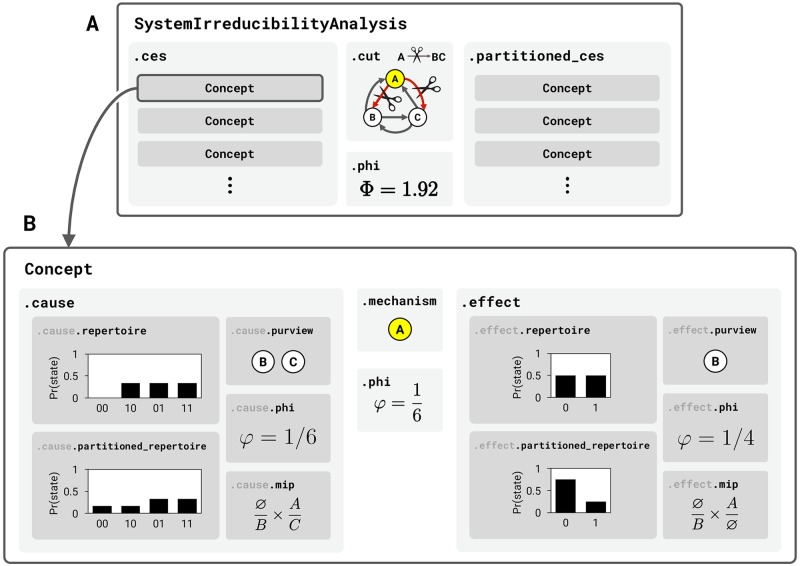
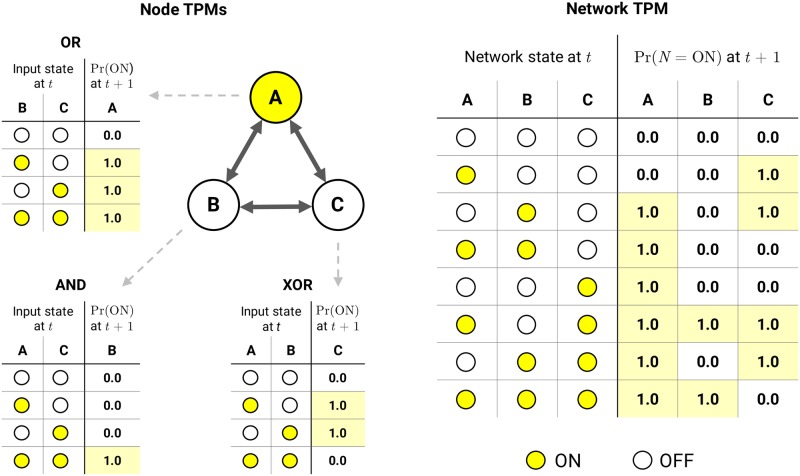
Integrated information theory provides a mathematical framework to fully characterize the cause-effect structure of a physical system. Here, we introduce PyPhi, a Python software package that implements this framework for causal analysis and unfolds the full cause-effect structure of discrete dynamical systems of binary elements. The software allows users to easily study these structures, serves as an up-to-date reference implementation of the formalisms of integrated information theory, and has been applied in research on complexity, emergence, and certain biological questions. We first provide an overview of the main algorithm and demonstrate PyPhi's functionality in the course of analyzing an example system, and then describe details of the algorithm's design and implementation. PyPhi can be installed with Python's package manager via the command 'pip install pyphi' on Linux and macOS systems equipped with Python 3.4 or higher. PyPhi is open-source and licensed under the GPLv3; the source code is hosted on GitHub at https://github.com/wmayner/pyphi. Comprehensive and continually-updated documentation is available at https://pyphi.readthedocs.io. The pyphi-users mailing list can be joined at https://groups.google.com/forum/#!forum/pyphi-users. A web-based graphical interface to the software is available at http://integratedinformationtheory.org/calculate.html.
Overview
The claims and statistics of this paper haven’t been checked yet.
Free: it reads the open-access text and checks the first 5 claims that cite a source we can check. Create a free account to check every claim.
Integrity signals
Registry
Cites
Statistics
Figures


Verification
Claims the paper makes
The claims and statistics of this paper haven’t been checked yet.
Free: it reads the open-access text and checks the first 5 claims that cite a source we can check. Create a free account to check every claim.
Claims other papers make about this one
Each is checked against this paper’s own text: does it say what the citing paper says it does?
The source backs part of the claim, not all of it — or backs it for a different population, condition or comparison.
In the citing paper
“This is because the computer contains modules that are connected to the rest of the system in a purely feedforward manner.This violates the requirement for integration”
From Dissociating Artificial Intelligence from Artificial Consciousness (2024) · cites this paper as [43]
Experimental — accuracy not yet measuredThe source backs part of the claim, not all of it — or backs it for a different population, condition or comparison.
In the citing paper
“This is because, despite the presence of feedback connections, the computer has many fault lines, such as sparse connectivity and bottlenecks, along which it segregates into smaller, nonoverlapping and maximally integrated pieces”
From Dissociating Artificial Intelligence from Artificial Consciousness (2024) · cites this paper as [43]
Experimental — accuracy not yet measuredThe cited source says what the claim attributes to it.
In the citing paper
“For these reasons, a full analysis of complexes and their cause–effect structure can only be performed on idealized systems of a few units [37].”
From Integrated information theory (IIT) 4.0: Formulating the properties of phenomenal existence in physical terms (2023) · cites this paper as [37]
The check wasn’t confident either way, so it gives no verdict — never disputed.
In the citing paper
“Specifically, uncertainty in the macro TPM reduces the selectivity of the macro system, and thus both its intrinsic information and integrated information [43].”
From Dissociating Artificial Intelligence from Artificial Consciousness (2024) · cites this paper as [43]
Experimental — accuracy not yet measured
Self-check
Percentages, sums and reported differences re-computed from the paper’s own numbers.
The self-check needs the paper’s full text.
Citations
Cites
Causality: Models, Reasoning, and Inference
Pearl, J. (2009) · doi:10.1017/cbo9780511803161 · Cited by 11,653
The NumPy Array: A Structure for Efficient Numerical Computation
van der Walt, S., Colbert, S. C., & Varoquaux, G. (2011) · Computing in Science & Engineering · doi:10.1109/mcse.2011.37 · Cited by 9,381
An information integration theory of consciousness
Tononi, G. (2004) · BMC Neuroscience · doi:10.1186/1471-2202-5-42 · Cited by 1,958 · cited 1×
“…to itself); (2) composition (it must be composed of parts that have causal power within the whole); (3) information (its causal power must be specific); (4) integration (its causal power must not be reducible to that of its parts); and (5) exclusion (it must be maximally irreducible) [1–5].”
Self-citationIntegrated information theory: from consciousness to its physical substrate
Tononi, G., Boly, M., Massimini, M., & Koch, C. (2016) · Nature Reviews Neuroscience · doi:10.1038/nrn.2016.44 · Cited by 1,727
Self-citationFrom the phenomenology to the mechanisms of consciousness: integrated information theory 3.0
Oizumi, M., Albantakis, L., & Tononi, G. (2014) · PLoS Computational Biology · doi:10.1371/journal.pcbi.1003588 · Cited by 1,128
Self-citationFast and robust Earth Mover's Distances
Pele, O., & Werman, M. (2009) · 2009 IEEE 12th International Conference on Computer Vision · doi:10.1109/iccv.2009.5459199 · Cited by 805
Integrated information in discrete dynamical systems: motivation and theoretical framework
Balduzzi, D., & Tononi, G. (2008) · PLoS Computational Biology · doi:10.1371/journal.pcbi.1000091 · Cited by 419
Self-citationQuantifying causal emergence shows that macro can beat micro
Hoel, E. P., Albantakis, L., & Tononi, G. (2013) · Proceedings of the National Academy of Sciences · doi:10.1073/pnas.1314922110 · Cited by 378
Self-citationInformation Flows in Causal Networks
AY, N., & POLANI, D. (2008) · Advances in Complex Systems · doi:10.1142/s0219525908001465 · Cited by 287 · cited 2×
“In this way, the analysis captures how a mechanism in a state constrains a purview without being biased by whether certain states arise more frequently than others in the dynamical evolution of the system [3,4,11,16].”
Tononi, G. (2015) · Scholarpedia · doi:10.4249/scholarpedia.4164 · Cited by 188
Self-citation
Research works printed but not linked: 1
- L Albantakis, 2017, Chapter 14: Automata and Animats, From Matter to Life: Information and Causality, 334
Cited by
Albantakis, L., Barbosa, L., Findlay, G., Grasso, M., Haun, A. M., Marshall, W., Mayner, W. G. P., Zaeemzadeh, A., Boly, M., Juel, B. E., et al. (2023) · PLoS Computational Biology · doi:10.1371/journal.pcbi.1011465 · Cited by 292
Self-citationEntropy and the Brain: An Overview
Keshmiri, S. (2020) · Entropy · doi:10.3390/e22090917 · Cited by 165
Why Does Space Feel the Way it Does? Towards a Principled Account of Spatial Experience
Haun, A., & Tononi, G. (2019) · Entropy · doi:10.3390/e21121160 · Cited by 143
Self-citationThe integrated information theory of consciousness: A case of mistaken identity
Merker, B., Williford, K., & Rudrauf, D. (2022) · Behavioral and Brain Sciences · doi:10.1017/s0140525x21000881 · Cited by 49
Consciousness and the Collapse of the Wave Function
Chalmers, D. J., & McQueen, K. J. (2022) · Oxford University Press eBooks · doi:10.1093/oso/9780197501665.003.0002 · Cited by 158
Metadata
- Authors
- Mayner, W. G. P., Marshall, W., Albantakis, L., Findlay, G., Marchman, R., & Tononi, G.
- Affiliations
- University of Wisconsin–Madison (US)
- Corresponding author
- Mayner, William G. P.
- Tononi, Giulio
- Venue
- PLOS Computational Biology
- Publisher
- Public Library of Science (PLoS)
- Published
- 2018-07-26
- Volume
- 14
- Issue
- 7
- Pages
- e1006343
- ISSN
- 1553-734X (ISSN-L)
- 1553-7358
- PMC
- PMC6080800
- OpenAlex
- W2779419474
- Cited by
- 118
- References
- 20
- Citations by year
- 2026: 14 · 2025: 29 · 2024: 14 · 2023: 12 · 2022: 7 · 2021: 13 · 2020: 16 · 2019: 12 · 2018: 1
- FWCI
- 5.37
- Type
- journal article
- Language
- en
- Update notices
- new_version (2018-08-07)
- Open access
- gold
- doi.org
- Licence
- Locations
- PLoS Computational Biology (publishedVersion, cc-by)
- Europe PMC (PubMed Central) (publishedVersion, cc-by)
- PubMed Central (publishedVersion, cc-by)
- PubMed (publishedVersion)
- arXiv (Cornell University) (submittedVersion)
- RePEc: Research Papers in Economics (submittedVersion)
- DOAJ (DOAJ: Directory of Open Access Journals) (submittedVersion, cc-by-sa)
- Figshare (submittedVersion, cc-by)
- arXiv (Cornell University) (cc-by)
- Funders
- Templeton World Charities Foundation (0067/AB41)
- National Institutes of Health (US) (NRSA T32 GM007507)
- Topics
- Physical Sciences › Physics and Astronomy › Statistical and Nonlinear Physics › Complex Systems and Dynamics
- Life Sciences › Neuroscience › Cognitive Neuroscience › Functional Brain Connectivity Studies
- Social Sciences › Arts and Humanities › History and Philosophy of Science › Philosophy of Biology and Scientific Explanation
- Keywords
- integrated information theory, causal structure, discrete dynamical systems, causal analysis, computational complexity, emergence, open source software, Python library
- MeSH terms
- Algorithms, Computer Simulation, Information Theory, Markov Chains, Software Design, User-Computer Interface
About these checks
Registry, retraction, Cites and statistics results are computed, not judged, with one exception: a printed reference that no index lists is read once by a model before it counts as a citation error. Claims are extracted by a model and kept only when their quote appears verbatim in the text; each cited source is then checked, with a model’s help, for whether it says what the claim relies on. Those verdicts can be wrong — read the claim’s quote and the cited source before relying on one.
Statistics and arithmetic are recomputed, not judged.
Confidence bands are shown only for fields calibrated on our annotated test set. None is calibrated yet, so no band is shown.
What counts as a claim ›How we measure confidence ›How we check this ›
Are you an author, or do you see a problem with this page? Request a review
How to cite
Cite CoChat for the checks on this page, and the paper for its own findings.
- This page
- CoChat. (2026). Citation check: PyPhi: A toolbox for integrated information theory. https://app.cochat.ai/papers/10.1371/journal.pcbi.1006343
- The paper
- Mayner, W. G. P., Marshall, W., Albantakis, L., Findlay, G., Marchman, R., & Tononi, G. (2018). PyPhi: A toolbox for integrated information theory. PLOS Computational Biology. https://doi.org/10.1371/journal.pcbi.1006343
Data sources
Bibliographic data: Semantic Scholar, OpenAlex, Crossref.
Contains information from the Semantic Scholar Academic Graph Datasets, made available under the ODC Attribution License (ODC-BY 1.0).
Semantic Scholar’s data is described in: Kinney, R., et al. (2023). The Semantic Scholar Open Data Platform. arXiv:2301.10140.
