

The DOI matches its Crossref record; 30 of the 30 references it cites were found in a registry or an index.
Pervasive Sharing of Genetic Effects in Autoimmune Disease
Open accessAbstract
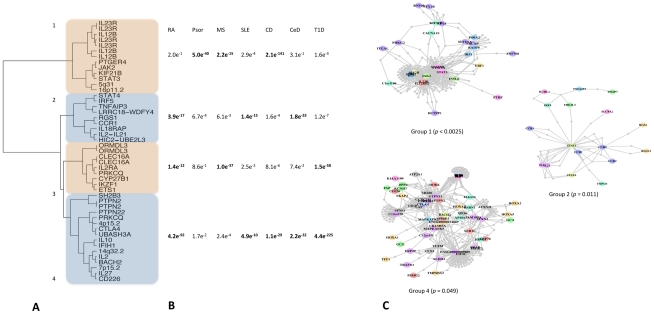
Genome-wide association (GWA) studies have identified numerous, replicable, genetic associations between common single nucleotide polymorphisms (SNPs) and risk of common autoimmune and inflammatory (immune-mediated) diseases, some of which are shared between two diseases. Along with epidemiological and clinical evidence, this suggests that some genetic risk factors may be shared across diseases-as is the case with alleles in the Major Histocompatibility Locus. In this work we evaluate the extent of this sharing for 107 immune disease-risk SNPs in seven diseases: celiac disease, Crohn's disease, multiple sclerosis, psoriasis, rheumatoid arthritis, systemic lupus erythematosus, and type 1 diabetes. We have developed a novel statistic for Cross Phenotype Meta-Analysis (CPMA) which detects association of a SNP to multiple, but not necessarily all, phenotypes. With it, we find evidence that 47/107 (44%) immune-mediated disease risk SNPs are associated to multiple-but not all-immune-mediated diseases (SNP-wise P(CPMA)<0.01). We also show that distinct groups of interacting proteins are encoded near SNPs which predispose to the same subsets of diseases; we propose these as the mechanistic basis of shared disease risk. We are thus able to leverage genetic data across diseases to construct biological hypotheses about the underlying mechanism of pathogenesis.
Overview
The claims and statistics of this paper haven’t been checked yet.
Run the check — free, no account needed. It reads the open-access text and checks the sources it cites.
Integrity signals
Registry
Cites
Statistics
Figures
Verification
Claims the paper makes
The claims and statistics of this paper haven’t been checked yet.
Run the check — free, no account needed. It reads the open-access text and checks the sources it cites.
Claims other papers make about this one
Each is checked against this paper’s own text: does it say what the citing paper says it does?
The source backs part of the claim, not all of it — or backs it for a different population, condition or comparison.
In the citing paper
“many loci were associated with multiple diseases and that the genes encoded in those loci fall into distinct immune pathways.69, 70”
From Genome‐wide association studies of multiple sclerosis (2018) · cites this paper as [70]
Experimental — accuracy not yet measuredThe cited source says what the claim attributes to it.
In the citing paper
“These results suggest that perturbations to key immune processes mediate risk to multiple diseases.”
From Genome‐wide association studies of multiple sclerosis (2018) · cites this paper as [70]
In the citing paper
“Some of these relationships are expected, such as the impact of obesity variants on risk of hepatic steatosis and type 2 diabetes84 or variants that influence multiple autoimmune conditions85.”
From A brief history of human disease genetics (2020) · cites this paper as [85]
Self-check
Percentages, sums and reported differences re-computed from the paper’s own numbers.
The self-check needs the paper’s full text.
Citations
Cites
R: A Language and Environment for Statistical Computing
R Core Team (2000) · doi:10.32614/r.manuals · Cited by 355,893
Hierarchical Grouping to Optimize an Objective Function
Ward, J. H. (1963) · Journal of the American Statistical Association · doi:10.1080/01621459.1963.10500845 · Cited by 21,341
A General Coefficient of Similarity and Some of Its Properties
Gower, J. C. (1971) · Biometrics · doi:10.2307/2528823 · Cited by 5,517
Hindorff, L. A., Sethupathy, P., Junkins, H. A., Ramos, E. M., Mehta, J. P., Collins, F. S., & Manolio, T. A. (2009) · Proceedings of the National Academy of Sciences · doi:10.1073/pnas.0903103106 · Cited by 4,013
Genome-wide association defines more than 30 distinct susceptibility loci for Crohn's disease
the NIDDK IBD Genetics Consortium, Barrett, J. C., the Belgian-French IBD Consortium, the Wellcome Trust Case Control Consortium, Hansoul, S., Nicolae, D. L., Cho, J. H., Duerr, R. H., Rioux, J. D., Brant, S. R., et al. (2008) · Nature Genetics · doi:10.1038/ng.175 · Cited by 2,593
Self-citationThe Type 1 Diabetes Genetics Consortium, Barrett, J. C., Clayton, D. G., Concannon, P., Akolkar, B., Cooper, J. D., Erlich, H. A., Julier, C., Morahan, G., Nerup, J., et al. (2009) · Nature Genetics · doi:10.1038/ng.381 · Cited by 1,746
Self-citationGenome-wide scan reveals association of psoriasis with IL-23 and NF-κB pathways
Nair, R. P., Duffin, K. C., Helms, C., Ding, J., Stuart, P. E., Goldgar, D. E., Gudjonsson, J. E., Li, Y., Tejasvi, T., Feng, B., et al. (2009) · Nature Genetics · doi:10.1038/ng.311 · Cited by 1,433
Self-citationSNAP: a web-based tool for identification and annotation of proxy SNPs using HapMap
Johnson, A. D., Handsaker, R. E., Pulit, S. L., Nizzari, M. M., O’Donnell, C. J., & de Bakker, P. I. W. (2008) · Bioinformatics · doi:10.1093/bioinformatics/btn564 · Cited by 1,339
Genome-wide association study meta-analysis identifies seven new rheumatoid arthritis risk loci
BIRAC Consortium, Stahl, E. A., YEAR Consortium, Raychaudhuri, S., Remmers, E. F., Xie, G., Eyre, S., Thomson, B. P., Li, Y., Kurreeman, F. A. S., et al. (2010) · Nature Genetics · doi:10.1038/ng.582 · Cited by 1,253
Self-citationSTAT4 and the Risk of Rheumatoid Arthritis and Systemic Lupus Erythematosus
Remmers, E. F., Plenge, R. M., Lee, A. T., Graham, R., Hom, G., Behrens, T. W., de Bakker, P. I. W., Le, J. M., Lee, H., Batliwalla, F., et al. (2007) · New England Journal of Medicine · doi:10.1056/nejmoa073003 · Cited by 1,055
Self-citationMultiple common variants for celiac disease influencing immune gene expression
Dubois, P. C. A., Trynka, G., Franke, L., Hunt, K. A., Romanos, J., Curtotti, A., Zhernakova, A., Heap, G., Ádány, R., Aromaa, A. J., et al. (2010) · Nature Genetics · doi:10.1038/ng.543 · Cited by 1,027
Self-citationA human phenome-interactome network of protein complexes implicated in genetic disorders
Lage, K., Karlberg, E., Størling, Z. M., Olason, P., Pedersen, A., Rigina, O., Hinsby, A., Tümer, Z., Pociot, F., Tommerup, N., et al. (2007) · Nature Biotechnology · doi:10.1038/nbt1295 · Cited by 973
Self-citationGateva, V., Sandling, J. K., Hom, G., Taylor, K. E., Chung, S. A., Sun, X., Ortmann, W. A., Kosoy, R., Ferreira, R. C., Nordmark, G., et al. (2009) · Nature Genetics · doi:10.1038/ng.468 · Cited by 815
Self-citationInternational MS Genetics Consortium, De Jager, P. L., Jia, X., Wang, J., de Bakker, P. I. W., Ottoboni, L., Aggarwal, N. T., Piccio, L., Raychaudhuri, S., Tran, D., et al. (2009) · Nature Genetics · doi:10.1038/ng.401 · Cited by 800
Self-citationde Bakker, P. I. W., McVean, G., Sabeti, P. C., Miretti, M. M., Green, T., Marchini, J., Ke, X., Monsuur, A. J., Whittaker, P., Delgado, M., et al. (2006) · Nature Genetics · doi:10.1038/ng1885 · Cited by 766
Self-citationShared and Distinct Genetic Variants in Type 1 Diabetes and Celiac Disease
Smyth, D. J., Plagnol, V., Walker, N. M., Cooper, J. D., Downes, K., Yang, J. H. M., Howson, J. M. M., Stevens, H. E., McManus, R., Wijmenga, C., et al. (2008) · New England Journal of Medicine · doi:10.1056/nejmoa0807917 · Cited by 750
Self-citationGenetic Analysis of Autoimmune Disease
Vyse, T. J., & Todd, J. A. (1996) · Cell · doi:10.1016/s0092-8674(00)81110-1 · Cited by 716
Self-citationNewly identified genetic risk variants for celiac disease related to the immune response
Hunt, K. A., Zhernakova, A., Turner, G., Heap, G., Franke, L., Bruinenberg, M., Romanos, J., Dinesen, L. C., Ryan, A. W., Panesar, D., et al. (2008) · Nature Genetics · doi:10.1038/ng.102 · Cited by 685
Self-citationCriswell, L. A., Pfeiffer, K. A., Lum, R. F., Gonzales, B., Novitzke, J. M., Kern, M., Moser, K. L., Begovich, A. B., Carlton, V. E. H., Li, W., et al. (2005) · The American Journal of Human Genetics · doi:10.1086/429096 · Cited by 601
Self-citationGenetic variants near TNFAIP3 on 6q23 are associated with systemic lupus erythematosus
Graham, R., Cotsapas, C. J., Davies, L. R. L., Hackett, R., Lessard, C. J., Leon, J. M., Burtt, N. P., Guiducci, C., Parkin, M., Gates, C., et al. (2008) · Nature Genetics · doi:10.1038/ng.200 · Cited by 588
Self-citationTodd, J. A. (2010) · Immunity · doi:10.1016/j.immuni.2010.04.001 · Cited by 560
Self-citationTwo independent alleles at 6q23 associated with risk of rheumatoid arthritis
Plenge, R. M., Cotsapas, C. J., Davies, L. R. L., Price, A. L., de Bakker, P. I. W., Maller, J., Pe’er, I., Burtt, N. P., Blumenstiel, B. S., DeFelice, M., et al. (2007) · Nature Genetics · doi:10.1038/ng.2007.27 · Cited by 552
Self-citationDetecting shared pathogenesis from the shared genetics of immune-related diseases
Zhernakova, A., van Diemen, C. C., & Wijmenga, C. (2009) · Nature Reviews Genetics · doi:10.1038/nrg2489 · Cited by 551
Self-citationRossin, E. J., Lage, K., Raychaudhuri, S., Xavier, R. J., Tatar, D., Benita, Y., Constortium, I. I. B. D. G., Cotsapas, C., & Daly, M. J. (2011) · PLoS Genetics · doi:10.1371/journal.pgen.1001273 · Cited by 438
Self-citationEpidemiology of autoimmune diseases in Denmark
Eaton, W. W., Rose, N. R., Kalaydjian, A., Pedersen, M. G., & Mortensen, P. B. (2007) · Journal of Autoimmunity · doi:10.1016/j.jaut.2007.05.002 · Cited by 425
The genetics of complex autoimmune diseases: non-MHC susceptibility genes
Wanstrat, A., & Wakeland, E. K. (2001) · Nature Immunology · doi:10.1038/ni0901-802 · Cited by 387
A common allele in RPGRIP1L is a modifier of retinal degeneration in ciliopathies
Khanna, H., Davis, E. E., Murga‐Zamalloa, C., Estrada‐Cuzcano, A., López, I., den Hollander, A. I., Zonneveld, M. N., Othman, M., Waseem, N. H., Chakarova, C. F., et al. (2009) · Nature Genetics · doi:10.1038/ng.366 · Cited by 272
Fung, E., Smyth, D. J., Howson, J. M. M., Cooper, J. D., Walker, N. M., Stevens, H. E., Wicker, L. S., & Todd, J. A. (2008) · Genes and Immunity · doi:10.1038/gene.2008.99 · Cited by 265
Self-citationMaier, L. M., Lowe, C. E., Cooper, J. D., Downes, K., Anderson, D. E., Severson, C., Clark, P., Healy, B. C., Walker, N. M., Aubin, C., et al. (2009) · PLoS Genetics · doi:10.1371/journal.pgen.1000322 · Cited by 260
Self-citationAutoimmune Disease Classification by Inverse Association with SNP Alleles
Sirota, M., Schaub, M. A., Batzoglou, S., Robinson, W. H., & Butte, A. J. (2009) · PLoS Genetics · doi:10.1371/journal.pgen.1000792 · Cited by 170
Cited by
Sorted by citations
Giambartolomei, C., Vukcevic, D., Schadt, E. E., Franke, L., Hingorani, A. D., Wallace, C., & Plagnol, V. (2014) · PLoS Genetics · doi:10.1371/journal.pgen.1004383 · Cited by 4,261
Self-citationAn atlas of genetic correlations across human diseases and traits
ReproGen Consortium, Bulik-Sullivan, B., Psychiatric Genomics Consortium, Genetic Consortium for Anorexia Nervosa of the Wellcome Trust Case Control Consortium 3, Finucane, H. K., Anttila, V., Gusev, A., Day, F. R., Loh, P.-R., Duncan, L., et al. (2015) · Nature Genetics · doi:10.1038/ng.3406 · Cited by 4,255
Self-citationSystematic Localization of Common Disease-Associated Variation in Regulatory DNA
Maurano, M. T., Humbert, R., Rynes, E., Thurman, R. E., Haugen, E., Wang, H., Reynolds, A. P., Sandstrom, R., Qu, H., Brody, J., et al. (2012) · Science · doi:10.1126/science.1222794 · Cited by 3,716
Self-citation(2013) · The Lancet · doi:10.1016/s0140-6736(12)62129-1 · Cited by 3,010
An Expanded View of Complex Traits: From Polygenic to Omnigenic
Boyle, E. A., Li, Y. I., & Pritchard, J. K. (2017) · Cell · doi:10.1016/j.cell.2017.05.038 · Cited by 2,851
Metadata
- Authors
- Cotsapas, C., Voight, B. F., Rossin, E., Lage, K., Neale, B. M., Wallace, C., Abecasis, G. R., Barrett, J. C., Behrens, T., Cho, J., De Jager, P. L., Elder, J. T., Graham, R. R., Gregersen, P., Klareskog, L., Siminovitch, K. A., van Heel, D. A., Wijmenga, C., Worthington, J., Todd, J. A., Hafler, D. A., Rich, S. S., Daly, M. J., & on behalf of the FOCiS Network of Consortia
- Affiliations
- Massachusetts General Hospital (US)
- Broad Institute (US)
- University of Cambridge (GB)
- University of Michigan (US)
- Wellcome Sanger Institute (GB)
- Genentech (US)
- Yale University (US)
- Northwell Health (US)
- Karolinska Institutet (SE)
- Mount Sinai Hospital (CA)
- University Medical Center Groningen (NL)
- Manchester Academic Health Science Centre (GB)
- University of Virginia (US)
- Corresponding author
- Daly, Mark J.
- ORCID
- Cotsapas, Chris
- Voight, Benjamin F.
- Rossin, Elizabeth
- Lage, Kasper
- Neale, Benjamin M.
- Wallace, Chris
- Abecasis, Gonçalo R.
- Barrett, Jeffrey C.
- Behrens, Timothy
- Cho, Judy
- Elder, James T.
- Graham, Robert R.
- Gregersen, Peter
- Klareskog, Lars
- Wijmenga, Cisca
- Worthington, Jane
- Todd, John A.
- Hafler, David A.
- Rich, Stephen S.
- Daly, Mark J.
- Venue
- PLoS Genetics
- Publisher
- Public Library of Science (PLoS)
- Published
- 2011-08-10
- Volume
- 7
- Issue
- 8
- Pages
- e1002254
- ISSN
- 1553-7390 (ISSN-L)
- 1553-7404
- PMC
- PMC3154137
- OpenAlex
- W1859891932
- Cited by
- 606
- References
- 30
- Citations by year
- 2026: 18 · 2025: 18 · 2024: 21 · 2023: 26 · 2022: 26 · 2021: 27 · 2020: 40 · 2019: 37 · 2018: 40 · 2017: 77 · 2016: 40 · 2015: 54 · 2014: 57 · 2013: 63 · 2012: 52
- FWCI
- 6.01
- Type
- journal article
- Language
- en
- Open access
- gold
- doi.org
- Locations
- PLoS Genetics (publishedVersion, cc-by)
- Europe PMC (PubMed Central) (publishedVersion, cc-by)
- PubMed Central (publishedVersion, cc-by)
- PubMed (publishedVersion)
- Research Explorer (The University of Manchester) (submittedVersion)
- DOAJ (DOAJ: Directory of Open Access Journals) (submittedVersion, cc-by-sa)
- DSpace@MIT (Massachusetts Institute of Technology) (submittedVersion, cc-by-nc)
- Figshare (submittedVersion, cc-by)
- Technical University of Denmark, DTU Orbit (Technical University of Denmark, DTU) (submittedVersion, other-oa)
- University of Groningen research database (University of Groningen / Centre for Information Technology) (submittedVersion, cc-by)
- Queen Mary Research Online (Queen Mary University of London) (submittedVersion, cc-by)
- PLoS eBooks
- Funders
- Wellcome Trust (091157, 089989)
- National Institute for Health and Care Research (NF-SI-0508-10275)
- Versus Arthritis (/17552)
- National Institute of General Medical Sciences (T32GM007753)
- National Institute of Diabetes and Digestive and Kidney Diseases (P30DK043351)
- National Institute of Arthritis and Musculoskeletal and Skin Diseases (R01AR050511, R01AR042742, R01AR054966)
- Topics
- Life Sciences › Biochemistry, Genetics and Molecular Biology › Genetics › Genetic Associations and Epidemiology
- Health Sciences › Medicine › Clinical Neurology › Multiple Sclerosis Research Studies
- Life Sciences › Biochemistry, Genetics and Molecular Biology › Genetics › Genetic Mapping and Diversity in Plants and Animals
- Keywords
- autoimmune disease, shared genetic risk, immune-mediated diseases, single nucleotide polymorphisms, celiac disease, Crohn's disease, multiple sclerosis, psoriasis, rheumatoid arthritis, systemic lupus erythematosus, type 1 diabetes, protein-protein interaction network, pathogenesis, MHC locus
- MeSH terms
- Autoimmune Diseases, Humans, Phenotype, Comorbidity, Cluster Analysis, Polymorphism, Single Nucleotide, Genome-Wide Association Study, Genetic Loci, Protein Interaction Maps
About these checks
Registry, retraction, Cites and statistics results are computed, not judged, with one exception: a printed reference that no index lists is read once by a model before it counts as a citation error. Claims are extracted by a model and kept only when their quote appears verbatim in the text; each cited source is then checked, with a model’s help, for whether it says what the claim relies on. Those verdicts can be wrong — read the claim’s quote and the cited source before relying on one.
Statistics and arithmetic are recomputed, not judged.
Confidence bands are shown only for fields calibrated on our annotated test set. None is calibrated yet, so no band is shown.
What counts as a claim ›How we measure confidence ›How we check this ›
Are you an author, or do you see a problem with this page? Request a review
