

The DOI matches its Crossref record; 46 of the 46 references it cites were found in a registry or an index.
Genomic Ancestry of North Africans Supports Back-to-Africa Migrations
Open accessAbstract
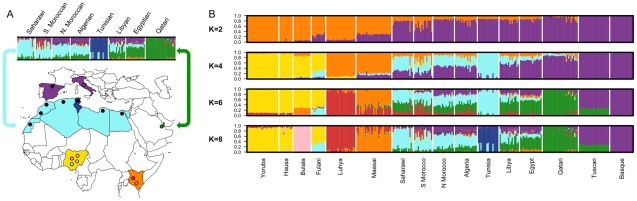
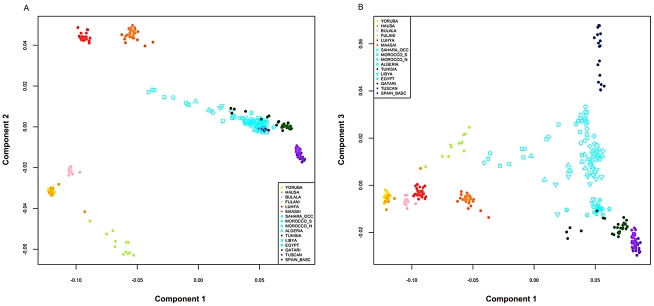
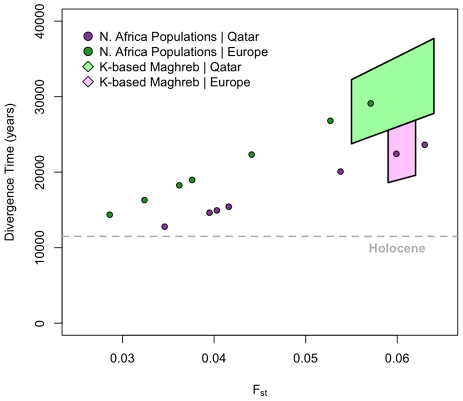
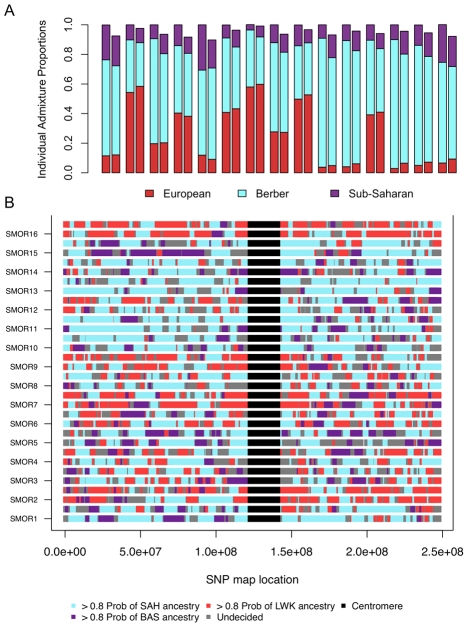
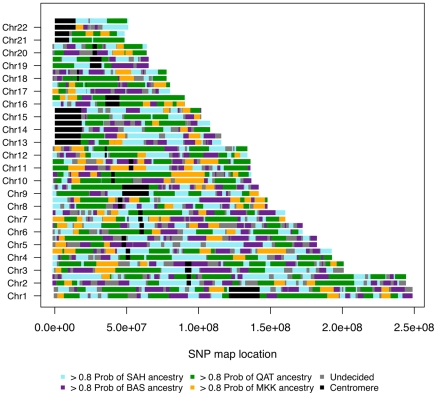
North African populations are distinct from sub-Saharan Africans based on cultural, linguistic, and phenotypic attributes; however, the time and the extent of genetic divergence between populations north and south of the Sahara remain poorly understood. Here, we interrogate the multilayered history of North Africa by characterizing the effect of hypothesized migrations from the Near East, Europe, and sub-Saharan Africa on current genetic diversity. We present dense, genome-wide SNP genotyping array data (730,000 sites) from seven North African populations, spanning from Egypt to Morocco, and one Spanish population. We identify a gradient of likely autochthonous Maghrebi ancestry that increases from east to west across northern Africa; this ancestry is likely derived from "back-to-Africa" gene flow more than 12,000 years ago (ya), prior to the Holocene. The indigenous North African ancestry is more frequent in populations with historical Berber ethnicity. In most North African populations we also see substantial shared ancestry with the Near East, and to a lesser extent sub-Saharan Africa and Europe. To estimate the time of migration from sub-Saharan populations into North Africa, we implement a maximum likelihood dating method based on the distribution of migrant tracts. In order to first identify migrant tracts, we assign local ancestry to haplotypes using a novel, principal component-based analysis of three ancestral populations. We estimate that a migration of western African origin into Morocco began about 40 generations ago (approximately 1,200 ya); a migration of individuals with Nilotic ancestry into Egypt occurred about 25 generations ago (approximately 750 ya). Our genomic data reveal an extraordinarily complex history of migrations, involving at least five ancestral populations, into North Africa.
Overview
The claims and statistics of this paper haven’t been checked yet.
Run the check — free, no account needed. It reads the open-access text and checks the sources it cites.
Integrity signals
Registry
Cites
Statistics
Figures
Verification
Claims the paper makes
The claims and statistics of this paper haven’t been checked yet.
Run the check — free, no account needed. It reads the open-access text and checks the sources it cites.
Claims other papers make about this one
Each is checked against this paper’s own text: does it say what the citing paper says it does?
The cited source says what the claim attributes to it.
In the citing paper
“We then used ALDER40 to estimate the time of a putative pulse-like admixture event, which was estimated to have occurred 24 generations ago (700 years ago), consistent with previous results from Henn and colleagues16.”
From Ancient Egyptian mummy genomes suggest an increase of Sub-Saharan African ancestry in post-Roman periods (2017) · cites this paper as [16]
The cited source says what the claim attributes to it.
In the citing paper
“By comparing ancient individuals from Abusir el-Meleq with modern Egyptian reference populations, we found an influx of sub-Saharan African ancestry after the Roman Period, which corroborates the findings by Henn and colleagues16.”
From Ancient Egyptian mummy genomes suggest an increase of Sub-Saharan African ancestry in post-Roman periods (2017) · cites this paper as [16]
Self-check
Percentages, sums and reported differences re-computed from the paper’s own numbers.
The self-check needs the paper’s full text.
Citations
Cites
PLINK: a tool set for whole-genome association and population-based linkage analyses.
Purcell, S., Neale, B., Todd-Brown, K., Thomas, L., Ferreira, M. A. R., Bender, D., Maller, J., Sklar, P., de Bakker, P. I. W., Daly, M. J., et al. (2007) · The American Journal of Human Genetics · doi:10.1086/519795 · Cited by 34,089
Fast model-based estimation of ancestry in unrelated individuals
Alexander, D. H., Novembre, J., & Lange, K. (2009) · Genome Research · doi:10.1101/gr.094052.109 · Cited by 9,898
Browning, S. R., & Browning, B. L. (2007) · The American Journal of Human Genetics · doi:10.1086/521987 · Cited by 3,217
Integrating common and rare genetic variation in diverse human populations
The International HapMap 3 Consortium (2010) · Nature · doi:10.1038/nature09298 · Cited by 3,026
Worldwide Human Relationships Inferred from Genome-Wide Patterns of Variation
Li, J. Z., Absher, D. M., Tang, H., Southwick, A. M., Casto, A. M., Ramachandran, S., Cann, H. M., Barsh, G. S., Feldman, M. W., Cavalli-Sforza, L. L., et al. (2008) · Science · doi:10.1126/science.1153717 · Cited by 1,915
Genetics in geographically structured populations: defining, estimating and interpreting FST
Holsinger, K. E., & Weir, B. S. (2009) · Nature Reviews Genetics · doi:10.1038/nrg2611 · Cited by 1,480
A worldwide survey of haplotype variation and linkage disequilibrium in the human genome
Conrad, D. F., Jakobsson, M., Coop, G., Wen, X., Wall, J. D., Rosenberg, N. A., & Pritchard, J. K. (2006) · Nature Genetics · doi:10.1038/ng1911 · Cited by 546
Sensitive detection of chromosomal segments of distinct ancestry in admixed populations
Price, A. L., Tandon, A., Patterson, N., Barnes, K. C., Rafaels, N., Ruczinski, I., Beaty, T. H., Mathias, R., Reich, D., & Myers, S. (2009) · PLoS Genetics · doi:10.1371/journal.pgen.1000519 · Cited by 539
Hunter-gatherer genomic diversity suggests a southern African origin for modern humans
Henn, B. M., Gignoux, C. R., Jobin, M., Granka, J. M., Macpherson, J. M., Kidd, J. M., Rodríguez-Botigué, L., Ramachandran, S., Hon, L., Brisbin, A., et al. (2011) · Proceedings of the National Academy of Sciences · doi:10.1073/pnas.1017511108 · Cited by 502
Self-citationGenome-wide patterns of population structure and admixture in West Africans and African Americans
Bryc, K., Auton, A., Nelson, M. R., Oksenberg, J. R., Hauser, S. L., Williams, S., Froment, A., Bodo, J.-M., Wambebe, C., Tishkoff, S. A., et al. (2010) · Proceedings of the National Academy of Sciences · doi:10.1073/pnas.0909559107 · Cited by 455
Self-citation
Cited by
Sorted by citations
Items 201–300 of 331
Sequence diversity of the Rh blood group system in Basques
Flores-Bello, A., Mas-Ponte, D., Rosu, M. E., Bosch, E., Calafell, F., & Comas, D. (2018) · European Journal of Human Genetics · doi:10.1038/s41431-018-0232-1 · Cited by 10
Self-citationGenetic Heterogeneity between Berbers and Arabs
Arauna, L. R., & Comas, D. (2017) · Wiley eBooks · doi:10.1002/9780470015902.a0027485 · Cited by 10
Self-citationKöksal, Z., Meyer, O. S., Andersen, J. D., Gusmão, L., Mogensen, H. S., Pereira, V., & Børsting, C. (2023) · Forensic Science International Genetics · doi:10.1016/j.fsigen.2023.102934 · Cited by 9
Tracing human genetic histories and natural selection with precise local ancestry inference
Lerga-Jaso, J., Novković, B., Unnikrishnan, D., Bamunusinghe, V., Hatorangan, M. R., Manson, C., Pedersen, H., Osama, A., Terpolovsky, A., Bohn, S., et al. (2025) · Nature Communications · doi:10.1038/s41467-025-59936-3 · Cited by 9
A multi-ancestry genetic reference for the Quebec population
McClelland, P., Femerling, G., Laflamme, R., Mejia-Garcia, A., Dehkordi, M. S., Xiao, H., Diaz-Papkovich, A., Pelletier, J., Grenier, J., Lo, K. S., et al. (2026) · Nature Communications · doi:10.1038/s41467-026-68820-7 · Cited by 9
Self-citationThe Qatari population’s genetic structure and gene flow as revealed by the Y chromosome
Almohammed, E. K., Hadi, A., Al‐Asmakh, M., & Lazim, H. (2023) · PLoS ONE · doi:10.1371/journal.pone.0290844 · Cited by 9
Africa, the Cradle of Human Diversity
Fortes‐Lima, C., Mtetwa, E., & Schlebusch, C. M. (2021) · BRILL eBooks · doi:10.1163/9789004500228 · Cited by 9
Hamadeh, I. S., Mh, S., Lima, S., Oliveira, F., Wilson, L., Khalifa, S. I., Langaee, T. Y., Cooper-DeHoff, R., Cavallari, L. H., & Johnson, J. A. (2016) · Clinical and Translational Science · doi:10.1111/cts.12385 · Cited by 9
Aluinsertion polymorphisms in the African Sahel and the origin of Fulani pastoralists
Čížková, M., Hofmanová, Z., Mokhtar, M. G., Janoušek, V., Diallo, I., Munclinger, P., & Černý, V. (2017) · Annals of Human Biology · doi:10.1080/03014460.2017.1328073 · Cited by 9
Salem, A. B., Attaoua, R., Mtiraoui, N., Meddeb, S., Kacem, O., Ajina, M., Souissi, M., Poucheret, P., Normand, C., Mahjoub, T., et al. (2014) · Gene · doi:10.1016/j.gene.2014.12.004 · Cited by 9
Moroccan genome project: genomic insight into a North African population
Fahime, E. E., Kartti, S., Chemao-Elfihri, M. W., Festali, R., Hakmi, M., Ibrahimi, A., Boutayeb, S., & Belyamani, L. (2025) · Communications Biology · doi:10.1038/s42003-025-08020-z · Cited by 12
Serradell, J. M., Lorenzo-Salazar, J. M., Flores, C., Lao, Ó., & Comas, D. (2024) · Genome biology · doi:10.1186/s13059-024-03341-4 · Cited by 8
Self-citationZanetti, D., Vía, M., Carreras‐Torres, R., Esteban, E., Chaabani, H., Anaibar, F.-E., Harich, N., Habbal, R., Ghalim, N., & Moral, P. (2016) · Journal of Epidemiology · doi:10.2188/jea.je20150034 · Cited by 8
Anagnostou, P., Dominici, V., Battaggia, C., Boukhchim, N., Nasr, J. B., Boussoffara, R., Cancellieri, E., Marnaoui, M., Marzouki, M., Brahim, H. B. H., et al. (2020) · American Journal of Physical Anthropology · doi:10.1002/ajpa.24139 · Cited by 8
RetractedBardan, F., Higgins, D., & Austin, J. J. (2022) · Forensic Science International Genetics · doi:10.1016/j.fsigen.2022.102822 · Cited by 8
Identification of single nucleotide variants in the Moroccan population by whole-genome sequencing
Crooks, L., Cooper‐Knock, J., Heath, P. R., Bouhouche, A., Fahime, E. E., Azzouz, M., Bakri, Y., Adnaoui, M., Ibrahimi, A., Amzazi, S., et al. (2020) · BMC Genetics · doi:10.1186/s12863-020-00917-4 · Cited by 8
Romdhane, L., Mezzi, N., Dallali, H., Messaoud, O., Shan, J., Fakhro, K. A., Kéfi, R., Chouchane, L., & Abdelhak, S. (2021) · npj Genomic Medicine · doi:10.1038/s41525-020-00166-5 · Cited by 9
D’Atanasio, E., Trionfetti, F., Bonito, M., Sellitto, D., Coppa, A., Berti, A., Trombetta, B., & Cruciani, F. (2020) · Genome Biology and Evolution · doi:10.1093/gbe/evaa176 · Cited by 8
Boukhalfa, W., Jmel, H., Kheriji, N., Gouiza, I., Dallali, H., Hechmi, M., & Kéfi, R. (2023) · Frontiers in Aging Neuroscience · doi:10.3389/fnagi.2023.1114810 · Cited by 7
William, M. B., Hamed, S. A., Shalash, A., Khedr, E. M., Yousef, M. H., El-Jaafary, S. I., Fawi, G., Helmy, A. K., Hamid, E., Essam, M., et al. (2024) · npj Parkinson s Disease · doi:10.1038/s41531-024-00826-8 · Cited by 7
The origin of modern North Africans as depicted by a massive survey of mitogenomes
Colombo, G., Moroni, E., Raveane, A., Migliore, N. R., Agostini, V., Gerlando, R. D., Fiorini, C., Caporali, L., Gandini, F., Raimondi, E., et al. (2025) · Scientific Reports · doi:10.1038/s41598-025-12209-x · Cited by 7
Ancestry Inference in Complex Admixtures via Variable-Length Markov Chain Linkage Models
Bercovici, S., Rodriguez, J. M., Elmore, M., & Batzoglou, S. (2012) · Lecture notes in computer science · doi:10.1007/978-3-642-29627-7_2 · Cited by 7
Genomic continuity of Argentinean Mennonites
Pardo‐Seco, J., Llull, C., Berardi, G., Gómez, A., Andreatta, F., Martinón‐Torres, F., Toscanini, U. F., & Salas, A. (2016) · Scientific Reports · doi:10.1038/srep36392 · Cited by 7
Henn, B. M., Cavalli-Sforza, L. L., & Feldman, M. W. (2019) · Resonance · doi:10.1007/s12045-019-0830-4 · Cited by 9
Self-citationNovillo, A., Gaibar, M., Romero‐Lorca, A., Chaabani, H., Amir, N., Moral, P., Esteban, E., & Fernández‐Santander, A. (2018) · Annals of Human Biology · doi:10.1080/03014460.2018.1559354 · Cited by 7
Consanguinité et son impact sur la santé et la dynamique du génome : Un exemple de la Tunisie
Mezzi, N., Abassi, N., Fatnassi, F., Abdelhak, S., & Romdhane, L. (2024) · La Tunisie Médicale · doi:10.62438/tunismed.v102i5.4787 · Cited by 6
The Impact of Recent Demography on Functional Genetic Variation in North African Human Groups
Lucas-Sánchez, M., Abdeli, A., Bekada, A., Calafell, F., Benhassine, T., & Comas, D. (2023) · Molecular Biology and Evolution · doi:10.1093/molbev/msad283 · Cited by 6
Self-citationOkoh, A. C., Onyeso, O. K., Ekemezie, W., Oyinlola, O., Akinrolie, O., Kalu, M. E., & on behalf of the Emerging Researchers & Professionals in Ageing-African Network (2024) · PLoS ONE · doi:10.1371/journal.pone.0298541 · Cited by 6
Jointly representing long-range genetic similarity and spatially heterogeneous isolation-by-distance
Shastry, V., Musiani, M., & Novembre, J. (2025) · PLoS Genetics · doi:10.1371/journal.pgen.1011612 · Cited by 7
Demography, Language, Ethnicity, Religion, and Refugee Crises
Bhattarai, K., & Yousef, M. (2025) · World regional geography book series · doi:10.1007/978-3-031-83967-2_3 · Cited by 6
Raveane, A., Molinaro, L., Aneli, S., Capodiferro, M. R., de Gennaro, L., Ongaro, L., Migliore, N. R., Soffiati, S., Scarano, T., Torroni, A., et al. (2022) · Genomics · doi:10.1016/j.ygeno.2022.110405 · Cited by 8
Aizpurua-Iraola, J., Abdeli, A., Benhassine, T., Calafell, F., & Comas, D. (2023) · Scientific Reports · doi:10.1038/s41598-023-37549-4 · Cited by 6
Self-citationImmunoglobulin genes in Andalusia (Spain). Genetic diversity in the Mediterranean space
Fortes‐Lima, C., Dugoujon, J., Hernández, C. L., Reales, G., & Calderón, R. (2014) · Comptes Rendus Biologies · doi:10.1016/j.crvi.2014.08.004 · Cited by 6
Kumar, H. R. S., Haddish, K., Lacerenza, D., Aneli, S., Gaetano, C. D., Gebremariam, G. T., Manukonda, R. V., Futwi, N., Álvarez‐Iglesias, V., de la Puente, M., et al. (2019) · Forensic Science International Genetics · doi:10.1016/j.fsigen.2019.102207 · Cited by 6
Association of single nucleotide polymorphisms with renal cell carcinoma in Algerian population
Bensouilah, F., Chellat-Rezgoun, D., García-González, M. Á., Carrera, N., Abadi, N., Dahdouh, A., & Satta, D. (2020) · African Journal of Urology · doi:10.1186/s12301-020-00055-4 · Cited by 6
Levens, A. D., Moes, D. J. A. R., Boer, Y., de Vries, A. P. J., de Vries, D. K., van der Helm, D., Meziyerh, S., Roelen, D. L., Böhringer, S., van Gelder, T., et al. (2025) · Clinical Pharmacology & Therapeutics · doi:10.1002/cpt.70162 · Cited by 5
Identifying signatures of positive selection in human populations from North Africa
Caro-Consuegra, R., Lucas-Sánchez, M., Comas, D., & Bosch, E. (2023) · Scientific Reports · doi:10.1038/s41598-023-35312-3 · Cited by 5
Self-citationExceptional diversity of KIR and HLA class I in Egypt
Montero-Martín, G., Kichula, K. M., Misra, M. K., Vargas, L. B., Marin, W. M., Hollenbach, J. A., Fernández-Viña, M., Elfishawi, S. M., & Norman, P. J. (2023) · HLA · doi:10.1111/tan.15177 · Cited by 5
Lisi, A., & Campbell, M. C. (2024) · Bioinformatics · doi:10.1093/bioinformatics/btae616 · Cited by 5
Ena, G. F., Giménez, A., Carballo-Mesa, A., Lišková, P., Silva, M. A. C. E., & Comas, D. (2025) · Human Genetics · doi:10.1007/s00439-025-02735-z · Cited by 5
Self-citationOliva, A., Foare, R., Campbell, P. M., Twine, N. A., Bauer, D. C., & Johar, A. (2025) · Biomolecules · doi:10.3390/biom15040582 · Cited by 5
Mixed Ancestry and Disease Risk Transferability
Shriner, D. (2015) · Current Genetic Medicine Reports · doi:10.1007/s40142-015-0080-z · Cited by 5
The genomic echoes of the last Green Sahara on the Fulani and Sahelian people
D’Atanasio, E., Risi, F., Ravasini, F., Montinaro, F., Hajiesmaeil, M., Bonucci, B., Pistacchia, L., Amoako-Sakyi, D., Bonito, M., Onidi, S., et al. (2023) · Current Biology · doi:10.1016/j.cub.2023.10.075 · Cited by 5
Local ancestry inference provides insight into Tilapia breeding programmes
Avallone, A., Bartie, K. L., Selly, S.-L. C., Taslima, K., Mendoza, A. C., & Bekaert, M. (2020) · Scientific Reports · doi:10.1038/s41598-020-75744-9 · Cited by 5
Paternal lineage of the Berbers from Aurès in Algeria: estimate of their genetic variation
Abdeli, A., & Benhassine, T. (2019) · Annals of Human Biology · doi:10.1080/03014460.2019.1602166 · Cited by 5
McDonald, M. M. A. (2020) · Journal of Anthropological Archaeology · doi:10.1016/j.jaa.2020.101199 · Cited by 5
Genetic polymorphisms with erythrocyte traits in malaria endemic areas of Mali
Traoré, K., Konaté, S., Thera, M. A., Niangaly, A., Ba, A., NIARE, A., Arama, C., Cristofaro, J. D., Baby, M., Picot, S., et al. (2019) · PLoS ONE · doi:10.1371/journal.pone.0209966 · Cited by 5
Population Genetics of Identity By DescentPreprint
Palamara, P. F. (2014) · arXiv (Cornell University) · doi:10.7916/d8v122xt · Cited by 5
The evolution of medicinal floras: insights from Moroccan medicinal plant knowledge transmission
Teixidor‐Toneu, I. (2017) · CentAUR (University of Reading) · Cited by 5
Tapsoba, A. S. R., Yougbaré, B., Traoré, F. G., Béré, F. W., Ouédraogo, D., Zoma, B. L., Sanou, M., Soudré, A., Dao, V., Tamboura, H. H., et al. (2020) · International Journal of Biological and Chemical Sciences · doi:10.4314/ijbcs.v14i8.11 · Cited by 4
Souissi, A., Gibriel, A. A., & Masmoudi, S. (2021) · Human Genetics · doi:10.1007/s00439-021-02314-y · Cited by 4
Migration Route Out of Africa Unresolved by 225 Egyptian and Ethiopian Whole Genome Sequences
Shriner, D., & Keita, S. O. Y. (2016) · Frontiers in Genetics · doi:10.3389/fgene.2016.00098 · Cited by 4
Demographic history shapes genomic ancestry in hybrid zones
Frayer, M. E., & Payseur, B. A. (2021) · Ecology and Evolution · doi:10.1002/ece3.7833 · Cited by 3
Vilà-Valls, L., Abdeli, A., Lucas-Sánchez, M., Bekada, A., Calafell, F., Benhassine, T., & Comas, D. (2024) · Scientific Reports · doi:10.1038/s41598-024-60568-8 · Cited by 4
Self-citationGenetic landscape of forensic DNA phenotyping markers among Mediterranean populations
Becher, D., Jmel, H., Kheriji, N., Sarno, S., & Kéfi, R. (2023) · Forensic Science International · doi:10.1016/j.forsciint.2023.111906 · Cited by 3
CYP2C gene polymorphisms in North African populations
Messaoudi, M., PAKSTIS, A. J., Boussetta, S., Elgaaïed, A. B. A., Kídd, K. K., & Cherni, L. (2024) · Molecular Biology Reports · doi:10.1007/s11033-024-10093-8 · Cited by 3
Abdeli, A., & Benhassine, T. (2020) · Annals of Human Biology · doi:10.1080/03014460.2020.1736628 · Cited by 3
Mestiri, S., Boussetta, S., PAKSTIS, A. J., Elkamel, S., Gaaied, A. B. A. E., Kídd, K. K., & Cherni, L. (2022) · Molecular Genetics & Genomic Medicine · doi:10.1002/mgg3.1871 · Cited by 3
Developing CIRdb as a catalog of natural genetic variation in the Canary Islanders
Usera, A. D.-D., Rubio‐Rodríguez, L. A., Muñoz‐Barrera, A., Lorenzo-Salazar, J. M., Guillén‐Guío, B., Jáspez, D., Corrales, A., Íñigo-Campos, A., García‐Olivares, V., Pérez, M. D. C. R., et al. (2022) · Scientific Reports · doi:10.1038/s41598-022-20442-x · Cited by 3
Impact of Natural Selection Due to Malarial Disease on Human Genetic Variation
Gomez, F., Ko, W., Davis, A., & Tishkoff, S. A. (2013) · Springer eBooks · doi:10.1007/978-1-4614-7181-3_5 · Cited by 3
Extending genome-wide association studies to admixed cohorts with high degrees of relatedness
Tan, T., Vergara-Lope, A., Martínez‐Magaña, J. J., Shah, N. N., Lin, Y.-S., Yuan, K., Berumen-Campos, J., Alegre-Díaz, J., Kuri-Morales, P. A., Tapia‐Conyer, R., et al. (2026) · Nature Genetics · doi:10.1038/s41588-026-02689-6 · Cited by 2
Grazzini, C., Spera, G., Morelli, S., Castellana, D., Cosenza, G., Baccini, M., Cereda, G., & Pilli, E. (2025) · Expert Systems with Applications · doi:10.1016/j.eswa.2025.129662 · Cited by 2
Deciphering the genetic diversity in the Arabian Peninsula and Africa: insights from Y-STR data
Hadi, A., Hadi, S., Almohammed, E. K., & Lazim, H. (2025) · Forensic Science Medicine and Pathology · doi:10.1007/s12024-025-01115-3 · Cited by 2
Hereditary ovarian cancer in women with African ancestry: a scoping review
Rossouw, B., Araujo, M., Krause, A., & Baine, F. (2026) · Familial Cancer · doi:10.1007/s10689-026-00530-x · Cited by 2
Badache, H., Boussetta, S., Elgaaeid, A. B., Cherni, L., & Khodjet‐El‐Khil, H. (2019) · Annals of Human Biology · doi:10.1080/03014460.2019.1588994 · Cited by 2
Lithic technology at the Early Dabban in Hagfet ed Dabba (Cyrenaica, Libya)
Maíllo‐Fernández, J., & Jiménez‐García, B. (2021) · Archaeological and Anthropological Sciences · doi:10.1007/s12520-021-01364-7 · Cited by 2
Asia or Africa? Locating the Afrasian Homeland
Kozintsev, A. G. (2021) · Etnograficheskoe obozrenie · doi:10.31857/s086954150016797-6 · Cited by 2
Cheffi, K., Khair, A. E., Dahbi, N., Talbi, J., Hilali, A., & Ossmani, H. E. (2023) · Molecular Genetics and Genomics · doi:10.1007/s00438-023-02028-y · Cited by 2
Pharmacogenetic landscape of pain management variants among Mediterranean populations
Jmel, H., Boukhalfa, W., Gouiza, I., Seghaier, R. O., Dallali, H., & Kéfi, R. (2024) · Frontiers in Pharmacology · doi:10.3389/fphar.2024.1380613 · Cited by 2
Thompson, J. (2014) · Rock Art Research · doi:10.69978/rar.v31i2.130 · Cited by 2
Torero, M. (2016) · Cited by 2
Mestiri, S., Boussetta, S., PAKSTIS, A. J., Elkamel, S., Elgaaïed, A. B. A., Kídd, K. K., & Cherni, L. (2021) · Gene · doi:10.1016/j.gene.2021.145466 · Cited by 2
Genetic diversity of North African populations in the 17q21 genomic region
Messaoudi, M., PAKSTIS, A. J., Ezzaher, T., Boussetta, S., Elgaaïed, A. B. A., Kídd, K. K., & Cherni, L. (2024) · Mammalian Genome · doi:10.1007/s00335-024-10051-6 · Cited by 2
Current immunogenetic predisposition to tuberculosis in the Moroccan population
Qrafli, M., Najimi, M., Aouad, R. E., & Sadki, K. (2017) · International Journal of Immunogenetics · doi:10.1111/iji.12340 · Cited by 2
Paleogenomics of the Neolithic Transition in North Africa
Fregel, R. (2021) · BRILL eBooks · doi:10.1163/9789004500228_009 · Cited by 2
An integrated personal and population-based Egyptian genome referencePreprint
Wohlers, I., Künstner, A., Munz, M., Olbrich, M. R., Fähnrich, A., Calonga-Solís, V., Ma, C., Hirose, M., El-Mosallamy, S., Salama, M., et al. (2019) · bioRxiv (Cold Spring Harbor Laboratory) · doi:10.1101/681254 · Cited by 2
Mohamed, W. M. Y., Eltantawy, M. A., Agarwal, V., Bandrés‐Ciga, S., Makarious, M. B., Mecheri, Y., Zewde, Y. Z., Kamel, W. A., Al-Mubarak, B. R., Alzoubi, K. H., et al. (2024) · Journal of Integrative Neuroscience · doi:10.31083/j.jin2308152 · Cited by 1
Zhang, X., Zhu, L., Yang, J., Sachdev, N., Mooney, J. A., Wang, H. Z., Sankararaman, S., & Lohmueller, K. E. (2026) · Nature Communications · doi:10.1101/2025.05.07.652751 · Cited by 1
Kassem, M. A. (2025) · Atlas Journal of Biology · doi:10.5147/ajb.260 · Cited by 1
STAT3 rs1053005 (T/C) contributes to Behçet’s disease risk and ocular lesions
Lahmar, R., Zemni, R., Ahmed, G., Chabchoub, E., Mzabi, A., Ghannouchi, N., & Slama, F. B. H. (2025) · Clinical Rheumatology · doi:10.1007/s10067-025-07628-0 · Cited by 1
Piedvache, A., Rashed, W. M., Petridou, E. T., Mueller, B. A., Bonaventure, A., Clavel, J., de Smith, A. J., Scheurer, M. E., Dockerty, J. D., Metayer, C., et al. (2025) · International Journal of Epidemiology · doi:10.1093/ije/dyaf167 · Cited by 1
Recovering the precolonial population structure of Khoe-San descendant populations
Edington, S., Al-Hindi, D. R., Font‐Porterias, N., Surowiec, A., Palmer, W. J., Myrick, J. W., Norman, P. J., Uren, C., Möller, M., Henn, B. M., et al. (2026) · Science Advances · doi:10.1126/sciadv.adz7115 · Cited by 1
Self-citationApproche anthropologique des groupes sanguins érythrocytaires
Mazières, S., & Chiaroni, J. (2016) · Cited by 1
Álvarez‐Álvarez, M. M., Carreras‐Torres, R., Zanetti, D., Vegas, E., & Moral, P. (2016) · American Journal of Human Biology · doi:10.1002/ajhb.22887 · Cited by 1
Admixture Mapping of Sepsis in European Individuals With African Ancestries
Hernández-Beeftink, T., Marcelino-Rodríguez, I., Guillén‐Guío, B., Rodríguez‐Pérez, H., Lorenzo-Salazar, J. M., Corrales, A., Usera, A. D.-D., González‐Montelongo, R., Domínguez, D., Espinosa, E., et al. (2022) · Frontiers in Medicine · doi:10.3389/fmed.2022.754440 · Cited by 1
Ferreira, R. C., Rodrigues, C. R., Broach, J. R., & Briones, M. R. S. (2024) · International Journal of Molecular Sciences · doi:10.3390/ijms25073785 · Cited by 1
El Hierro Genome Study: A Genomic and Health Study in an Isolated Canary Island Population
Puga, M., Serrano, J. G., García, E. L., Carracedo, M. A. G., Jiménez-Canino, R., Pino-Yanes, M. D. M., Karlsson, R., Sullivan, P. F., & Fregel, R. (2024) · Journal of Personalized Medicine · doi:10.3390/jpm14060626 · Cited by 1
Garcea, E. A. A. (2023) · Springer eBooks · doi:10.1007/978-3-031-20290-2_44 · Cited by 1
Population Structure, Demography and Recent Admixture
Hellenthal, G. (2019) · Wiley eBooks · doi:10.1002/9781119487845.ch8 · Cited by 1
Unravelling evolution in the homoploid complex of Baccharis L. in ChilePreprint
Schneider, F. T., Zafra‐Delgado, O., Köllner, T. G., & Hellwig, F. H. (2025) · doi:10.22541/au.173884703.35814174/v1 · Cited by 1
Origine génétique des descendants Africains de l'Amérique du Sud
Fortes‐Lima, C. (2015) · theses.fr (ABES) · doi:10.70675/8698b3d4zc4b9z4f32za395z194340f5c923 · Cited by 1
Amer, K., Moustafa, A., Hassan, W. A., Adel, E., AbdElaal, K. R., Ghanim, T. A., El-Raouf, A. A., Hosseiny, A. E., El-Sayed, A. F. A. A., Badr, A. H., et al. (2026) · bioRxiv (Cold Spring Harbor Laboratory) · doi:10.64898/2026.04.02.715521 · Cited by 1
North African genetic variation of cytochrome and sulfotransferase genes
Gaibar, M., Arqués, M., Fernández‐Santander, A., Novillo, A., Romero‐Lorca, A., Li, Q. W., & Esteban, E. (2015) · International Journal of Modern Anthropology · doi:10.4314/ijma.v1i8.1
Understanding the impact of chromosomal inversion on the evolution of the human genome
Alves, J. M. (2014) · Portuguese National Funding Agency for Science, Research and Technology (RCAAP Project by FCT) · doi:10.34626/kmk9-cy21
Genetics and the Reconstruction of African Population History
Calafell, F., & Comas, D. (2015) · Oxford University Press eBooks · doi:10.1093/acprof:oso/9780199688203.003.0014
Self-citationInsights into the human demographic history of africa through whole-genome sequence analysis
Vidal, S., & Gérard (2018) · LA Referencia (Red Federada de Repositorios Institucionales de Publicaciones Científicas)
The Parallel Lives of Human Y Chromosome Lineages Across the Strait of Gibraltar
García-Fernández, C., & Calafell, F. (2019) · Springer eBooks · doi:10.1007/978-3-030-30363-1_11
Moussouni, A. (2020) · International Journal of Modern Anthropology · doi:10.4314/ijma.v2i13.6
Genome‐wide Genetic Approaches to Metabolic and Inflammatory Health Disparities
Winkler, C. A. (2021) · Wiley eBooks · doi:10.1002/9781119374855.ch7
Metadata
- Authors
- Henn, B. M., Botigué, L. R., Gravel, S., Wang, W., Brisbin, A., Byrnes, J. K., Fadhlaoui-Zid, K., Zalloua, P. A., Moreno-Estrada, A., Bertranpetit, J., Bustamante, C. D., & Comas, D.
- Affiliations
- Stanford University (US)
- Consejo Superior de Investigaciones Científicas (ES)
- Cornell University (US)
- Lebanese American University (LB)
- Corresponding author
- Bustamante, Carlos D.
- Comas, David
- ORCID
- Venue
- PLoS Genetics
- Publisher
- Public Library of Science (PLoS)
- Published
- 2012-01-12
- Volume
- 8
- Issue
- 1
- Pages
- e1002397
- ISSN
- 1553-7390 (ISSN-L)
- 1553-7404
- PMC
- PMC3257290
- OpenAlex
- W2059277852
- Cited by
- 331
- References
- 46
- Citations by year
- 2026: 11 · 2025: 25 · 2024: 16 · 2023: 26 · 2022: 11 · 2021: 29 · 2020: 16 · 2019: 28 · 2018: 29 · 2017: 27 · 2016: 29 · 2015: 22 · 2014: 26 · 2013: 23 · 2012: 13
- FWCI
- 16.19
- Type
- journal article
- Language
- en
- Open access
- gold
- doi.org
- Locations
- PLoS Genetics (publishedVersion, cc-by)
- Europe PMC (PubMed Central) (publishedVersion, cc-by)
- PubMed Central (publishedVersion, cc-by)
- PubMed (publishedVersion)
- RECERCAT (Consorci de Serveis Universitaris de Catalunya) (publishedVersion, other-oa)
- eScholarship (California Digital Library) (submittedVersion, cc-by)
- DIGITAL.CSIC (Spanish National Research Council (CSIC)) (submittedVersion)
- DOAJ (DOAJ: Directory of Open Access Journals) (submittedVersion, cc-by-sa)
- eScholarship (California Digital Library) (submittedVersion)
- Figshare (submittedVersion, cc-by)
- Repositori digital de la UPF (Universitat Pompeu Fabra) (submittedVersion, other-oa)
- Greater South Information System
- Funders
- Generalitat de Catalunya (2009SGR1101)
- National Institutes of Health
- National Human Genome Research Institute (R01HG003229)
- National Institute of General Medical Sciences (R01GM083606)
- Topics
- Life Sciences › Biochemistry, Genetics and Molecular Biology › Genetics › Forensic and Genetic Research
- Life Sciences › Biochemistry, Genetics and Molecular Biology › Genetics › Genetic diversity and population structure
- Social Sciences › Anthropology › Race, Genetics, and Society
- Keywords
- Berber populations, migration timing, local ancestry, Morocco
- MeSH terms
- Egypt, Ancient, Africa, Northern, DNA, Mitochondrial, Emigration and Immigration, Europe, Gene Pool, Genotype, Haplotypes, Humans, Middle East, Morocco, Population, Population Dynamics, Genetic Variation, Africa South of the Sahara, Polymorphism, Single Nucleotide, Genomics, Black People, White People, History, Ancient, Gene Flow
About these checks
Registry, retraction, Cites and statistics results are computed, not judged, with one exception: a printed reference that no index lists is read once by a model before it counts as a citation error. Claims are extracted by a model and kept only when their quote appears verbatim in the text; each cited source is then checked, with a model’s help, for whether it says what the claim relies on. Those verdicts can be wrong — read the claim’s quote and the cited source before relying on one.
Statistics and arithmetic are recomputed, not judged.
Confidence bands are shown only for fields calibrated on our annotated test set. None is calibrated yet, so no band is shown.
What counts as a claim ›How we measure confidence ›How we check this ›
Are you an author, or do you see a problem with this page? Request a review
