

The DOI matches its Crossref record; 61 of the 63 references it cites were found in a registry or an index.
Mining the Unknown: A Systems Approach to Metabolite Identification Combining Genetic and Metabolic Information
Open accessAbstract
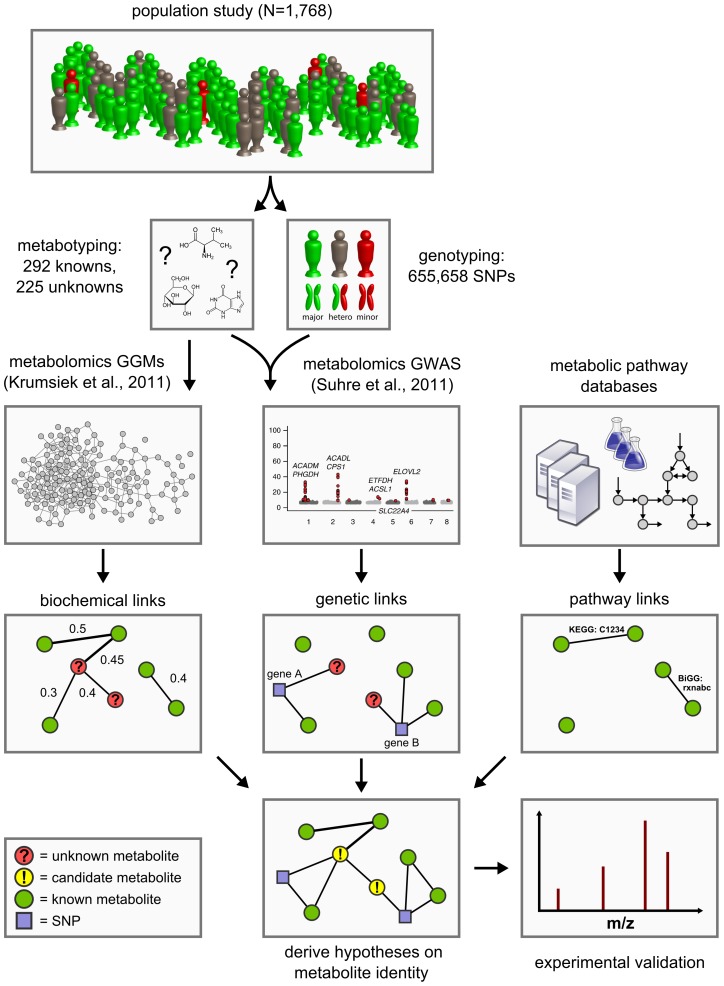
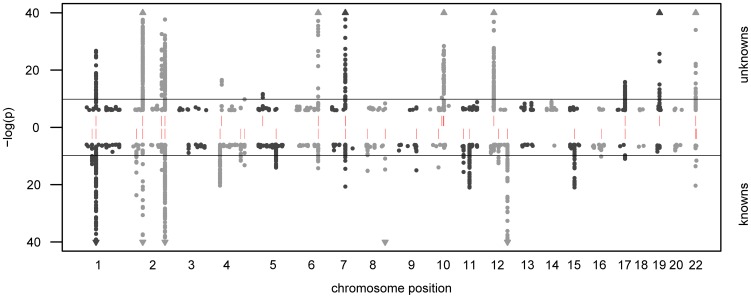
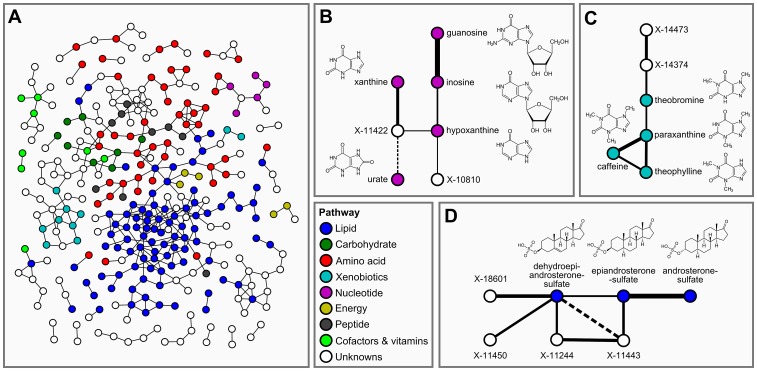
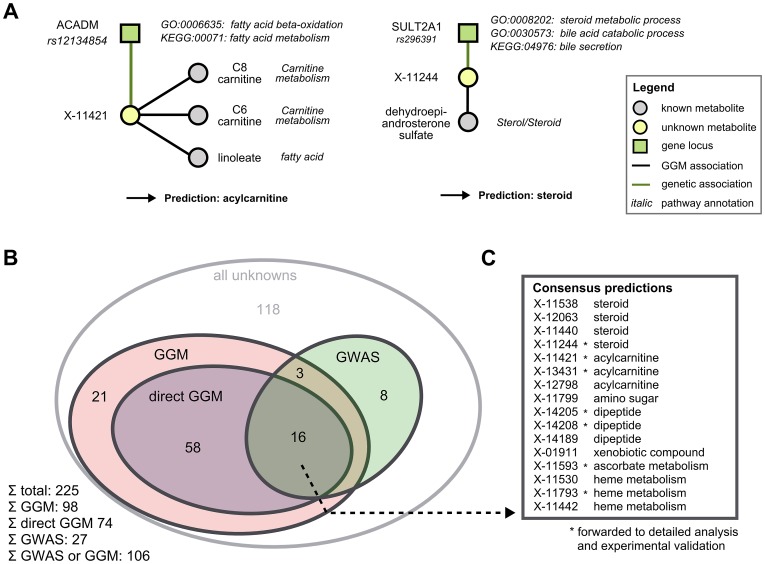
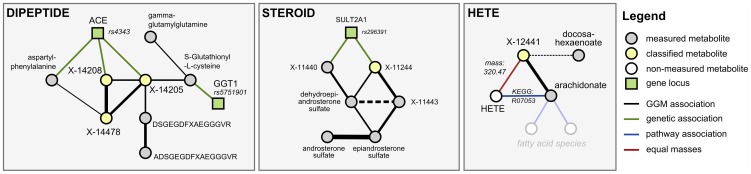
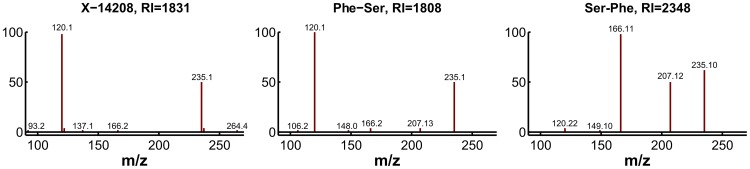
Recent genome-wide association studies (GWAS) with metabolomics data linked genetic variation in the human genome to differences in individual metabolite levels. A strong relevance of this metabolic individuality for biomedical and pharmaceutical research has been reported. However, a considerable amount of the molecules currently quantified by modern metabolomics techniques are chemically unidentified. The identification of these "unknown metabolites" is still a demanding and intricate task, limiting their usability as functional markers of metabolic processes. As a consequence, previous GWAS largely ignored unknown metabolites as metabolic traits for the analysis. Here we present a systems-level approach that combines genome-wide association analysis and Gaussian graphical modeling with metabolomics to predict the identity of the unknown metabolites. We apply our method to original data of 517 metabolic traits, of which 225 are unknowns, and genotyping information on 655,658 genetic variants, measured in 1,768 human blood samples. We report previously undescribed genotype-metabotype associations for six distinct gene loci (SLC22A2, COMT, CYP3A5, CYP2C18, GBA3, UGT3A1) and one locus not related to any known gene (rs12413935). Overlaying the inferred genetic associations, metabolic networks, and knowledge-based pathway information, we derive testable hypotheses on the biochemical identities of 106 unknown metabolites. As a proof of principle, we experimentally confirm nine concrete predictions. We demonstrate the benefit of our method for the functional interpretation of previous metabolomics biomarker studies on liver detoxification, hypertension, and insulin resistance. Our approach is generic in nature and can be directly transferred to metabolomics data from different experimental platforms.
Overview
The claims and statistics of this paper haven’t been checked yet.
Run the check — free, no account needed. It reads the open-access text and checks the sources it cites.
Integrity signals
Registry
Cites
Statistics
Figures
Verification
Claims the paper makes
The claims and statistics of this paper haven’t been checked yet.
Run the check — free, no account needed. It reads the open-access text and checks the sources it cites.
Claims other papers make about this one
Each is checked against this paper’s own text: does it say what the citing paper says it does?
In the citing paper
“In both targeted and untargeted methods, even for confidently identified compounds, the biological processes that generated them are often poorly understood122–125.”
From Measuring biological age using omics data (2022) · cites this paper as [125]
Self-check
Percentages, sums and reported differences re-computed from the paper’s own numbers.
The self-check needs the paper’s full text.
Citations
Cites
Gene Ontology: tool for the unification of biology
Ashburner, M., Ball, C. A., Blake, J. A., Botstein, D., Butler, H., Cherry, J. M., Davis, A. P., Dolinski, K., Dwight, S. S., Eppig, J. T., et al. (2000) · Nature Genetics · doi:10.1038/75556 · Cited by 43,206 · cited 2×
“For each enzyme catalyzing one or more reactions in our pathway model, we retrieved functional annotations from two independent sources: (i) GO-Terms from the Gene Ontology [48] and (ii) enzyme pathway annotations from the KEGG PATHWAY database [47].”
MethodKEGG: Kyoto Encyclopedia of Genes and Genomes
Kanehisa, M. (2000) · Nucleic Acids Research · doi:10.1093/nar/28.1.27 · Cited by 37,077 · cited 2×
“For each enzyme catalyzing one or more reactions in our pathway model, we retrieved functional annotations from two independent sources: (i) GO-Terms from the Gene Ontology [48] and (ii) enzyme pathway annotations from the KEGG PATHWAY database [47].”
MethodPLINK: a tool set for whole-genome association and population-based linkage analyses.
Purcell, S., Neale, B., Todd-Brown, K., Thomas, L., Ferreira, M. A. R., Bender, D., Maller, J., Sklar, P., de Bakker, P. I. W., Daly, M. J., et al. (2007) · The American Journal of Human Genetics · doi:10.1086/519795 · Cited by 34,089 · cited 1×
“06) [41] with age”
KEGG: Kyoto Encyclopedia of Genes and Genomes
Ogata, H., Goto, S., Sato, K., Fujibuchi, W., Bono, H., & Kanehisa, M. (1999) · Nucleic Acids Research · doi:10.1093/nar/27.1.29 · Cited by 31,232
Draper, N. R., & Smith, H. (2005) · Technometrics · doi:10.1198/tech.2005.s303 · Cited by 17,993
mice: Multivariate Imputation by Chained Equations in R
Buuren, S. V., & Groothuis-Oudshoorn, K. (2011) · Journal of Statistical Software · doi:10.18637/jss.v045.i03 · Cited by 13,870
(2010) · University of Twente Research Information · Cited by 6,037
Nist chemistry webbook, nist standard reference database number 69
Linstorm, P. (1998) · Medical Entomology and Zoology · Cited by 4,606
Szklarczyk, D., Franceschini, A., Kuhn, M., Simonovic, M., Roth, A. C., Mínguez, P., Doerks, T., Stark, M., Muller, J., Bork, P., et al. (2010) · Nucleic Acids Research · doi:10.1093/nar/gkq973 · Cited by 3,469 · cited 1×
“This annotation idea parallels classical concepts from functional genomics, where, for instance, co-expression between RNA transcripts is used to predict the function of poorly characterized genes [23,24].”
BackgroundIntegrating common and rare genetic variation in diverse human populations
The International HapMap 3 Consortium (2010) · Nature · doi:10.1038/nature09298 · Cited by 3,026
Cited by
Sorted by citations
An atlas of genetic influences on human blood metabolites
The Multiple Tissue Human Expression Resource (MuTHER) Consortium, Shin, S.-Y., Fauman, E. B., Petersen, A.-K., Krumsiek, J., Santos, R., Huang, J., Arnold, M., Erte, I., Forgetta, V., et al. (2014) · Nature Genetics · doi:10.1038/ng.2982 · Cited by 1,515
“58 Pantothenate and CoA (1) 56 Hemoglobin and porphyrin (5) 55 Tocopherol (2) 53 Fibrinogen cleavage peptide (3) 52 Dipeptide (9) 49 Polyamine metabolism (1) 48 Amino fatty acid (1) 47 Guanidino and acetamido (1) 45 Tryptophan (10) 44 Glutathione (2) 42 Branched-chain amino acid (14) 41 Butanoate (3) 37 Glutamate (3)…”
Self-citationAnalytical Methods in Untargeted Metabolomics: State of the Art in 2015
Alonso, A., Marsal, S., & Julià, A. (2015) · Frontiers in Bioengineering and Biotechnology · doi:10.3389/fbioe.2015.00023 · Cited by 727
“One of these methods, Gaussian Graphical Modeling (GGM), has been recently used to identify unknown metabolites through the integration of metabolomics, GWAS, and pathway data (Krumsiek et al., 2012).”
Measuring biological age using omics data
Rutledge, J., Oh, H., & Wyss-Coray, T. (2022) · Nature Reviews Genetics · doi:10.1038/s41576-022-00511-7 · Cited by 570
“In both targeted and untargeted methods, even for confidently identified compounds, the biological processes that generated them are often poorly understood 122–125 .”
BackgroundMetabolic network failures in Alzheimer's disease: A biochemical road map
Toledo, J. B., Arnold, M., Kastenmüller, G., Chang, R. R., Baillie, R., Han, X., Thambisetty, M., Tenenbaum, J. D., Suhre, K., Thompson, J. W., et al. (2017) · Alzheimer s & Dementia · doi:10.1016/j.jalz.2017.01.020 · Cited by 463
“The partial correlation networks established direct connections between the measured metabolites, which have been shown to depict direct biochemical relationships between metabolites while omitting mediated correlations [55,57].”
BackgroundSelf-citationWhole-genome sequencing identifies common-to-rare variants associated with human blood metabolites
Long, T., Hicks, M. A., Yu, H., Biggs, W., Kirkness, E. F., Menni, C., Zierer, J., Small, K. S., Mangino, M., Messier, H., et al. (2017) · Nature Genetics · doi:10.1038/ng.3809 · Cited by 423
Self-citation
Metadata
- Authors
- Krumsiek, J., Suhre, K., Evans, A. M., Mitchell, M. W., Mohney, R. P., Milburn, M. V., Wägele, B., Römisch-Margl, W., Illig, T., Adamski, J., Gieger, C., Theis, F. J., & Kastenmüller, G.
- Affiliations
- Helmholtz Munich (DE)
- Metabolon (United States) (US)
- Corresponding author
- Kastenmüller, Gabi
- ORCID
- Venue
- PLoS Genetics
- Publisher
- Public Library of Science (PLoS)
- Published
- 2012-10-18
- Volume
- 8
- Issue
- 10
- Pages
- e1003005
- ISSN
- 1553-7390 (ISSN-L)
- 1553-7404
- PMC
- PMC3475673
- OpenAlex
- W2080426060
- Cited by
- 197
- References
- 63
- Citations by year
- 2026: 9 · 2025: 15 · 2024: 19 · 2023: 8 · 2022: 15 · 2021: 16 · 2020: 16 · 2019: 9 · 2018: 16 · 2017: 18 · 2016: 14 · 2015: 16 · 2014: 17 · 2013: 6 · 2012: 3
- FWCI
- 5.40
- Type
- journal article
- Language
- en
- Open access
- gold
- doi.org
- Locations
- PLoS Genetics (publishedVersion, cc-by)
- Europe PMC (PubMed Central) (publishedVersion, cc-by)
- PubMed Central (publishedVersion, cc-by)
- PubMed (publishedVersion)
- DOAJ (DOAJ: Directory of Open Access Journals) (submittedVersion, cc-by-sa)
- Figshare (submittedVersion, cc-by)
- Site cant be reached (submittedVersion, cc-by)
- Funders
- Qatar Foundation
- Bundesministerium für Bildung und Forschung (0315494A, 03IS2061B)
- Studienstiftung des Deutschen Volkes
- Topics
- Life Sciences › Biochemistry, Genetics and Molecular Biology › Molecular Biology › Metabolomics and Mass Spectrometry Studies
- Life Sciences › Biochemistry, Genetics and Molecular Biology › Molecular Biology › Bioinformatics and Genomic Networks
- Life Sciences › Biochemistry, Genetics and Molecular Biology › Genetics › Genetic Associations and Epidemiology
- Keywords
- genome-wide association study, metabolic networks, SLC22A2, catechol-O-methyltransferase, CYP3A5, CYP2C18, liver detoxification, hypertension, insulin resistance, blood metabolites, systems biology
- MeSH terms
- Humans, Reproducibility of Results, Models, Statistical, Signal Transduction, Computational Biology, Polymorphism, Single Nucleotide, Genomics, Genome-Wide Association Study, Metabolomics, Metabolome, Data Mining
About these checks
Registry, retraction, Cites and statistics results are computed, not judged, with one exception: a printed reference that no index lists is read once by a model before it counts as a citation error. Claims are extracted by a model and kept only when their quote appears verbatim in the text; each cited source is then checked, with a model’s help, for whether it says what the claim relies on. Those verdicts can be wrong — read the claim’s quote and the cited source before relying on one.
Statistics and arithmetic are recomputed, not judged.
Confidence bands are shown only for fields calibrated on our annotated test set. None is calibrated yet, so no band is shown.
What counts as a claim ›How we measure confidence ›How we check this ›
Are you an author, or do you see a problem with this page? Request a review
