

The DOI matches its Crossref record; 58 of the 58 references it cites were found in a registry or an index.
Admixture in Latin America: Geographic Structure, Phenotypic Diversity and Self-Perception of Ancestry Based on 7,342 Individuals
Open accessAbstract
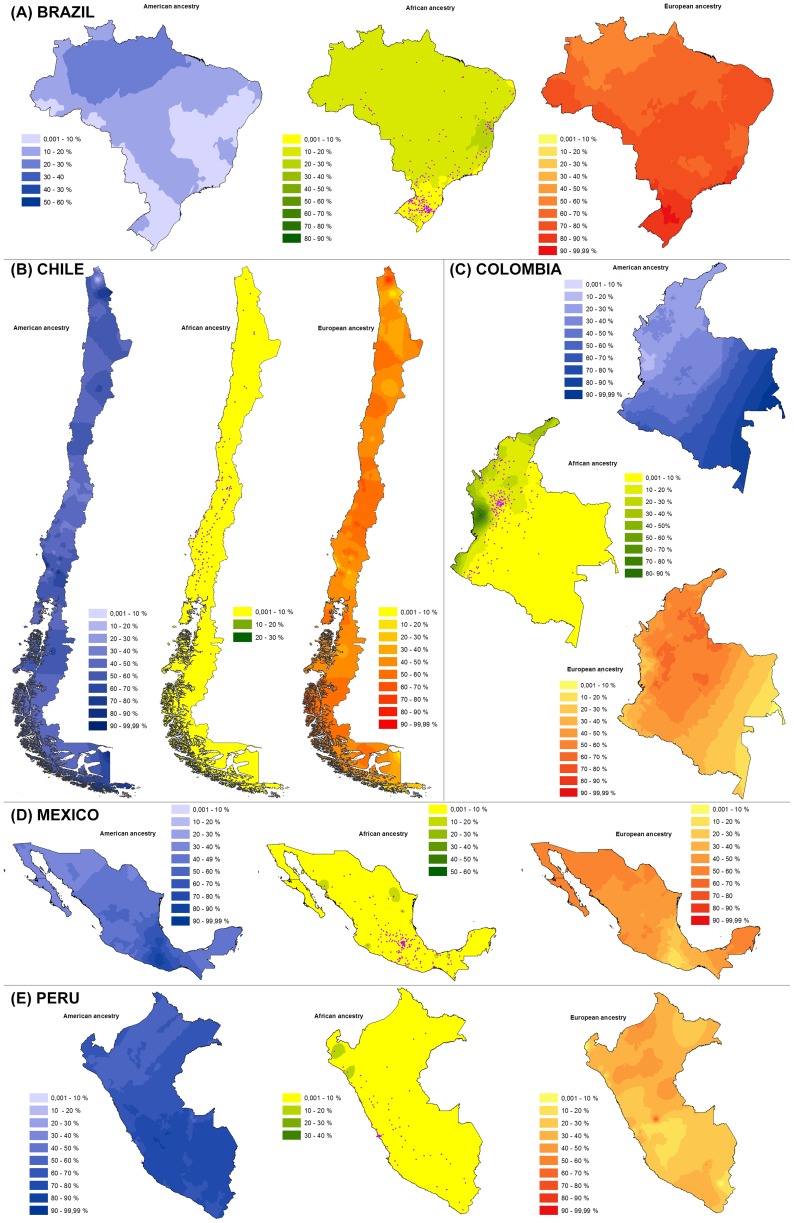
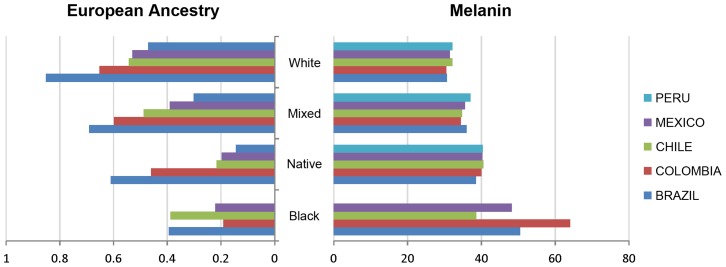
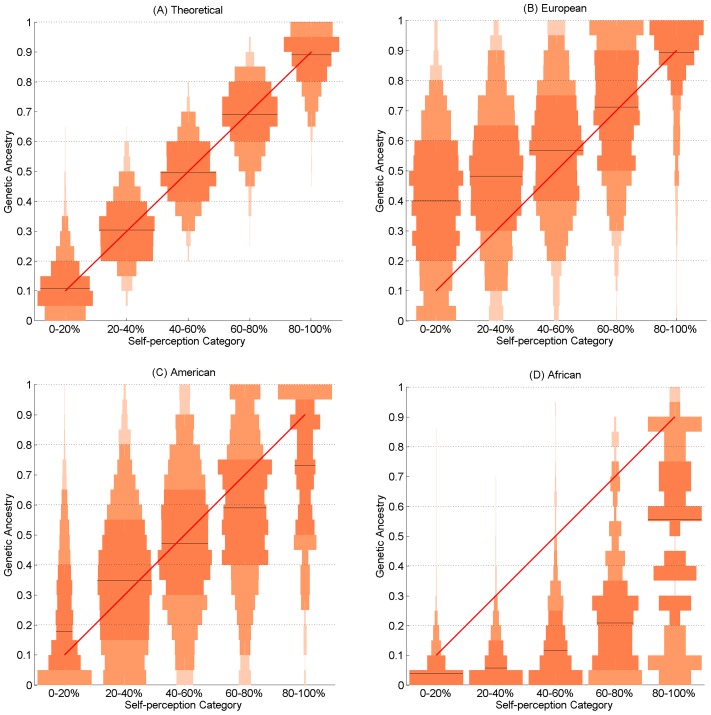
The current genetic makeup of Latin America has been shaped by a history of extensive admixture between Africans, Europeans and Native Americans, a process taking place within the context of extensive geographic and social stratification. We estimated individual ancestry proportions in a sample of 7,342 subjects ascertained in five countries (Brazil, Chile, Colombia, México and Perú). These individuals were also characterized for a range of physical appearance traits and for self-perception of ancestry. The geographic distribution of admixture proportions in this sample reveals extensive population structure, illustrating the continuing impact of demographic history on the genetic diversity of Latin America. Significant ancestry effects were detected for most phenotypes studied. However, ancestry generally explains only a modest proportion of total phenotypic variation. Genetically estimated and self-perceived ancestry correlate significantly, but certain physical attributes have a strong impact on self-perception and bias self-perception of ancestry relative to genetically estimated ancestry.
Overview
The claims and statistics of this paper haven’t been checked yet.
Run the check — free, no account needed. It reads the open-access text and checks the sources it cites.
Integrity signals
Registry
Cites
Statistics
Figures
Verification
Claims the paper makes
The claims and statistics of this paper haven’t been checked yet.
Run the check — free, no account needed. It reads the open-access text and checks the sources it cites.
Claims other papers make about this one
Each is checked against this paper’s own text: does it say what the citing paper says it does?
The cited source doesn’t support the claim as written.
In the citing paper
“They assessed genetic ancestry with 15,000 SNPs, making their index highly-reliable [56].”
From Global Ancestry and Cognitive Ability (2019) · cites this paper as [56]
Checked by a reasoning model — may be wrong.
Experimental — accuracy not yet measured
Self-check
Percentages, sums and reported differences re-computed from the paper’s own numbers.
The self-check needs the paper’s full text.
Citations
Cites
R: A Language and Environment for Statistical Computing
R Core Team (2000) · doi:10.32614/r.manuals · Cited by 355,893
Fast model-based estimation of ancestry in unrelated individuals
Alexander, D. H., Novembre, J., & Lange, K. (2009) · Genome Research · doi:10.1101/gr.094052.109 · Cited by 9,898 · cited 2×
“Individual African, European and Native American ancestry proportions were estimated using the ADMIXTURE program [17] using supervised runs where African, European and Native American reference groups (K = 3) were provided (see below).”
MethodCommon SNPs explain a large proportion of the heritability for human height
Yang, J., Benyamin, B., McEvoy, B. P., Gordon, S., Henders, A. K., Nyholt, D. R., Madden, P. A., Heath, A. C., Martin, N. G., Montgomery, G. W., et al. (2010) · Nature Genetics · doi:10.1038/ng.608 · Cited by 4,446 · cited 1×
“Recent genome-wide association analyses in Europeans have implicated loci for variation in height and related anthropometric traits [43,44].”
BackgroundThe History and Geography of Human Genes
Cavalli-Sforza, L. L., Menozzi, P., & Piazza, A. (2018) · Princeton University Press eBooks · doi:10.2307/j.ctv301gjp · Cited by 3,175
Hundreds of variants clustered in genomic loci and biological pathways affect human height
Lango Allen, H., Estrada, K., Lettre, G., Berndt, S. I., Weedon, M. N., Rivadeneira, F., Willer, C. J., Jackson, A. U., Vedantam, S., Raychaudhuri, S., et al. (2010) · Nature · doi:10.1038/nature09410 · Cited by 1,945
Worldwide Human Relationships Inferred from Genome-Wide Patterns of Variation
Li, J. Z., Absher, D. M., Tang, H., Southwick, A. M., Casto, A. M., Ramachandran, S., Cann, H. M., Barsh, G. S., Feldman, M. W., Cavalli-Sforza, L. L., et al. (2008) · Science · doi:10.1126/science.1153717 · Cited by 1,915
Color and genomic ancestry in Brazilians
Parra, F. C., Amado, R. C., Lambertucci, J., Rocha, J., Antunes, C., & Pena, S. D. (2002) · Proceedings of the National Academy of Sciences of the United States of America · doi:10.1073/pnas.0126614100 · Cited by 939 · cited 1×
“Few studies have examined the impact of genetic ancestry on physical appearance or the relationship of these to individual notions of ethnicity and ancestry [15,16].”
BackgroundRace and Ethnicity in Latin America
Wade, P. (2010) · Pluto Press eBooks · doi:10.2307/j.ctt183p73f · Cited by 822
Informativeness of Genetic Markers for Inference of Ancestry*
Rosenberg, N. A., Li, L. M., Ward, R. H., & Pritchard, J. K. (2003) · The American Journal of Human Genetics · doi:10.1086/380416 · Cited by 710 · cited 2×
“…of 5,000 markers, highly informative for world-wide continental ancestry estimation, identified by Paschou et al (2010) [18] using the approach of Rosenberg et al. (2003) [55] based on the worldwide CEPH-HGDP cell panel genotyped with Illumina’s Human610-Quad beadchip (including data for about…”
MethodReconstructing Native American population history
Reich, D., Patterson, N., Campbell, D., Tandon, A., Mazieres, S., Ray, N., Parra, M. V., Rojas, W., Duque, C., Mesa, N., et al. (2012) · Nature · doi:10.1038/nature11258 · Cited by 696 · cited 5×
“Of the final set of 30 markers retained, 13 are monomorphic in 408 Native Americans (from 47 populations from México Southwards [57]), the rest have minor allele frequencies ranging from 0.01 to 0.15 (median 0.06) in that group of populations.”
BackgroundMethodInfluentialSelf-citation
Cited by
Sorted by citations
Items 401–442 of 442
Echeverry, L. M., Candelo, E., Gómez, E., Solís, P., Ramírez, D., Ortiz, D., González, A., Sevillano, X., Cuéllar, J. C., Pachajoa, H., et al. (2022) · medRxiv · doi:10.1101/2022.11.25.22282761
Medium and large alleles of the PGC gene are risk factors for gastric cancer
Sánchez-López, J. Y., Vázquez-Ibarra, K. C., García-Muro, A. M., García-Ruvalcaba, A., Pacheco-Sotelo, S., Díaz-Herrera, L. C., & Marín-Contreras, M. E. (2023) · Tumor Biology · doi:10.3233/tub-220025
Téllez, G. M., Rosales, Y. Z., Bybjerg‐Grauholm, J., Mors, O. N., & Teruel, B. M. (2023) · Current pharmacogenomics and personalized medicine (Online)/Current pharmacogenomics and personalized medicine · doi:10.2174/1875692120666230816152420
Suarez‐Kurtz, G. (2023) · Pharmacogenetics and Genomics · doi:10.1097/fpc.0000000000000508
MC1R and age heteroclassification of face phenotypes in the Rio Grande do Sul population
Bettim, C. A. R., da Silva, A. V., Kahmann, A., Dorn, M., Alho, C. S., & Avila, E. (2023) · International Journal of Legal Medicine · doi:10.1007/s00414-023-03143-6
“…space of the country — where higher levels of European ancestry are observed in the southern region (states of Paraná, Santa Catarina, and Rio Grande do Sul), while Amerindian and African ancestry are more observed in the north/west and northeast/southeast/midwest regions, respectively [25–27].”
French, J. N., Pua, V. B., Laboulaye, R., Leal, T. P., Cornejo‐Olivas, M., Lima‐Costa, M. F., Horta, B. L., Barreto, M. L., Tarazona‐Santos, E., Mata, I. F., et al. (2024) · bioRxiv (Cold Spring Harbor Laboratory) · doi:10.1101/2024.04.11.589057
Genetic Variability of SNP rs7089580 in latin american populations and its impact on Warfarin dosage
Flores-Carrasco, S. V., Montaña, R. M., Roco-Videla, Á., Caviedes-Olmos, M., Pérez-Jiménez, S., & Aguilera-Eguía, R. A. (2024) · Data & Metadata · doi:10.56294/dm2024440
de Souza, J. L., Guerra, M. V. D. F., de Mesquita, T. G. R., Santo, J. D. E., Sequera, H. D. G., da Silva, L. S., Silva, L. A., Moura, F. M., Menescal, L. S. F., Torres, J. D. C., et al. (2024) · International Journal of Molecular Sciences · doi:10.3390/ijms252212438
Multiple sclerosis in Colombia: A review of the literature
Acuña, J. A. S., Vanegas, A. C., McCauley, J. L., Castro-Castro, P., & Amezcua, L. (2024) · Multiple Sclerosis Journal - Experimental Translational and Clinical · doi:10.1177/20552173241293921
“48 On the other hand, Hispanic and Asian populations share quite a genetic similarity, especially regarding HLA.”
Wegman-Ostrosky, T., Taja‐Chayeb, L., Zatarain-Barrón, Z. L., Trejo‐Becerril, C., Gerson, D. S., Espino-Gutiérrez, I., Gutiérrez-Lara, A., Salcedo, A., Mares, M. C., García‐Ortíz, J. E., et al. (2025) · JCO Global Oncology · doi:10.1200/go-24-00389
Müller, M., Blandino, A., Scherer, D., Zulantay, I., Apt, W., Figueroa, N. M. V., Valeri, M. C. L., García, L., Ortiz, L., Nicastri, E., et al. (2025) · SSRN Electronic Journal · doi:10.2139/ssrn.5209475
Wegman-Ostrosky, T., Taja‐Chayeb, L., Zatarain-Barrón, Z. L., Trejo‐Becerril, C., Ramírez-González, A., Romo-Huerta, J., Rodriguez-Rojas, L. X., Espino-Gutiérrez, I., Vilchis-Zapata, Z. H., Harari-Arakindji, S., et al. (2025) · JCO Global Oncology · doi:10.1200/go-24-00433
Reyes‐Madrid, M., Vásquez-Estay, F., Gutiérrez, V., & Montalva, N. (2025) · Annals of Human Biology · doi:10.1080/03014460.2025.2486156
“The central Andean region was densely populated by complex societies before colonisation, and the western Amazonian region in Peru and Bolivia experienced relatively less impact from European gene flow than other South American populations (Ruiz-Linares et al. 2014; Adhikari et al. 2017).”
Executive function and decision-making in Colombian patients with paranoid schizophrenia
Acosta-López, J. E., Cervantes-Henríquez, M. L., Téllez-Bustillo, S., Ahmad, M., Sánchez-Rojas, M., Paredes-Manrique, C., & Zegarra-Valdivia, J. A. (2025) · F1000Research · doi:10.12688/f1000research.143978.2
Pezo, P., Orellana‐Soto, M., Salcedo, A., Rodríguez-Rodríguez, J. E., Yañez, C. M., Llop, E., Aspillaga, E., Parolín, M. L., Moreno‐Estrada, A., Bustamante, C. D., et al. (2025) · medRxiv · doi:10.1101/2025.08.21.25334163
Zambrano, A. K., Guevara‐Ramírez, P., Cadena-Ullauri, S., Basantes, C., Nicola, S., Hidalgo, S., & Felix, M. L. (2025) · International Journal of Molecular Sciences · doi:10.3390/ijms26199300
“In South America, the high genetic variability results from a complex admixture of Native American, European, and African ancestries [13,14].”
Fernández-Gajardo, R., Urra, H., Sáez, M., Pihán, P., Fonseca, B., Sánchez-Doñas, C., Ali, M. M. U., Rouse, S. L., Cavada, G., Tissera, C., et al. (2025) · Scientific Reports · doi:10.1038/s41598-025-06129-z
Reis, L. B., Bakos, R. M., Vianna, F. S. L., Macedo, G. S., Jacovas, V. C., Ribeiro-dos-Santos, A. M., Santos, S., Bakos, L., & Ashton-Prolla, P. (2020) · Figshare · doi:10.6084/m9.figshare.13212362
Pizuorno, A., Fierro, N. A., Copado-Villagrana, E. D., Herrera-Solís, M. E., Oskrochi, G., Brim, H., & Ashktorab, H. (2021) · Figshare · doi:10.6084/m9.figshare.14773813
Zollner, L., Torres, D., Briceño, I., Gilbert, M., Torres-Mejía, G., Dennis, J., Bolla, M. K., Wang, Q., Hamann, U., & Lorenzo Bermejo, J. (2023) · Figshare · doi:10.6084/m9.figshare.24234121
Zollner, L., Boekstegers, F., Ponce, C. B., Scherer, D., Marcelain, K., Gárate-Calderón, V., Waldenberger, M., Morales, E., Armando Rojas, R., Munoz, C., et al. (2022) · medRxiv · doi:10.1101/2022.05.03.22274595
Self-citationEuropean Colonial Echoes in Cancer Risk: Lessons from the TP53 p.R337H Founder Variant in Brazil
Carvajal‐Carmona, L. G. (2026) · Cancer Epidemiology Biomarkers & Prevention · doi:10.1158/1055-9965.epi-25-1843
Montalvo‐Ortiz, J. L., Martínez‐Magaña, J. J., Brito, D. E. A., Trichia, E., Rivera-Hernández, M., Porras, L. M., Sullivan, K. A., Jacobson, D., Kember, R. L., Núñez, D., et al. (2026) · Research Square · doi:10.21203/rs.3.rs-8789707/v1
Flores‐Ocampo, V., Reyes‐Pérez, P., Ogonowski, N. S., Sevilla-Parra, G., Díaz‐Torres, S., Leal, T. P., Waldo, E., Ruiz‐Contreras, A. E., Alcauter, S., Arguello-Pascualli, P., et al. (2026) · medRxiv · doi:10.64898/2026.03.02.26347226
Distribution of Polymorphisms Associated With Obesity in a Sample of Admixed Mexican Adults
Perez, L., Ruderman, A., Chacón-Duque, J. C., Adhikari, K., Bortolini, M. C., Acuña-Alonzo, V., Canizales‐Quinteros, S., Gallo, C., Poletti, G., Rothhammer, F., et al. (2026) · American Journal of Human Biology · doi:10.1002/ajhb.70244
“It included questions about education and information regarding salary, home appliances, domestic services, transportation and infrastructure, among other variables (Ruiz-Linares et al. 2014).”
Self-citationda Silva, L. S., de Souza, J. L., Menescal, L. S. F., Torres, J. D. C., Gouveia, A. V. S., Silva, E. G. R., de Oliveira, M. D. L., Guerra, M. V. D. F., Ogusku, M. M., Mombo, L. E., et al. (2026) · The Journal of Infectious Diseases · doi:10.1093/infdis/jiag175
Origine génétique des descendants Africains de l'Amérique du Sud
Fortes‐Lima, C. (2015) · theses.fr (ABES) · doi:10.70675/8698b3d4zc4b9z4f32za395z194340f5c923 · Cited by 1
HADDAD, Y. L. (2026) · Biology & Philosophy · doi:10.1007/s10539-026-10017-9 · Cited by 1
“For instance, studies focusing on regional admixture use more fine-grained divisions (for examples see: Adhikari et al. 2016; Ruiz-Linares et al. 2014).”
Aneli, S., Dominici, A., Chierto, E., Riem, A., Gardois, P., & Carlo, R. (2026) · Forensic Science International Genetics · doi:10.1016/j.fsigen.2026.103515
Porras‐Hurtado, G. L., Mejía‐García, A., Sinisterra‐Díaz, S. E., Velandia-Piedrahita, C. A., Geles, J., Pachajoa, H., Bello, S., & Gálvez, J. M. (2026) · American Journal of Medical Genetics Part A · doi:10.1002/ajmg.a.70185
Yang, L., Nematbakhsh, S., Norseen, A., & McLaughlin, R. N. (2026) · bioRxiv (Cold Spring Harbor Laboratory) · doi:10.64898/2026.05.14.725010
“Colombian haplotypes from Medellín fall closer to Europeans, matching prior analyses showing predominantly European ancestry in that population, with lower Native American and African contributions on average [35,36].”
Lima-Silva, M. L., Mambrini, J. V. D. M., Torres, K. C. D. L., Martins‐Filho, O. A., Teixeira-Carvalho, A., Lima-Costa, M. F., & Peixoto, S. V. (2026) · Cadernos de Saúde Pública · doi:10.1590/0102-311xpt172124
“Adicionalmente, Ruiz-Li-nares et al. 53 identificaram que a maior predominância de ancestralidade nativo-americana está concentrada na Região Amazônica, no Norte do Brasil 16,52,53 .”
Family-Based Study of the BMP2 RS235768 Variant in Cleft Lip and Palate
Téllez-Conti, C., Escobar, L. M., Bendahan, Z., Restrepo, C., Fonseca, D. J., Riaño, D. J. A., Coronel, C., Díaz-Báez, D., Nieto, C. A., Castellanos, J., et al. (2026) · Journal of Craniofacial Surgery · doi:10.1097/scs.0000000000013163
Carrier frequency of autosomal recessive monogenic disorders in the peruvian population
Abarca-Barriga, H. H., Sotomayor, F. V., & Luciano, R. P. (2026) · Frontiers in Genetics · doi:10.3389/fgene.2026.1876411
NMOSD and MOGAD in Latin America: A consensus-informed regional perspective
Boldrini, V. D. O., Samadzadeh, S., Contentti, E. C., Pimentel, V., Szejko, N., Ciampi, E., Palace, J. A., Paul, F., Becker, J., & Damasceno, A. (2026) · Multiple Sclerosis and Related Disorders · doi:10.1016/j.msard.2026.107438
Genetic Variation in ADHD ‐Related Risk Genes in an Indigenous Population of the Amazon
de Matos, H. P., Monte, N., Aguiar, K. E. C., Coelho, R. D. C. C., Santos, A. P., Rodrigues, J. C. G., Ribeiro‐dos‐Santos, A. M., SOUZA, S. J. D., Ribeiro‐dos‐Santos, Â., Guerreiro, J. F., et al. (2026) · American Journal of Medical Genetics Part B Neuropsychiatric Genetics · doi:10.1002/ajmg.b.70028
“This result is consistent with the history of the peopling of the Americas, marked by dispersal through Beringia and subsequent isolation (Goebel et al. 2008).”
Mapping Hepatitis B Virus Research and Genomic Diversity in Latin America and the Caribbean
José-Ábrego, A., Román, S., Mariscal-Martinez, I. M., González-Aldaco, K., & Panduro, A. (2026) · Pathogens · doi:10.3390/pathogens15101025
Whole genome sequencing of 1427 Mexican individuals from the oriGen cohort
Aguilar-Ordóñez, I., Cerezo, E. G., Torres-Treviño, D., Colin-Oviedo, Á., Ortiz-Lopez, R., Gonzalez-Castillo, E.-C., Rubio‐Infante, N., Ramírez-Vega, J., Chávez-Santoscoy, R. A., Ruíz-Matus, C., et al. (2026) · Nature Communications · doi:10.1038/s41467-026-77389-0
Paixão, M. N. D. J., & Lowe, R. H. (2026) · Latin American Research Review · doi:10.1017/lar.2026.10153
Tejos‐Bravo, M., Torres, G., Espinoza, F., & Calvo, M. (2026) · European Journal of Pain · doi:10.1002/ejp.70396
“Complete QST datasets from Latin America are scarce; the few available used reduced or region-specific protocols in Colombian and Brazilian cohorts (Schestatsky et al. 2011; Costa et al. 2019; Faux et al. 2023), none comparing a full profile against the DFNS reference.”
InfluentialPezo, P., Orellana‐Soto, M., Salcedo, A. M., Rodríguez-Rodríguez, J. E., Yañez, C. M., Llop, E., Aspillaga, E., Parolín, M. L., Moreno‐Estrada, A., Bustamante, C. D., et al. (2026) · Genome Biology and Evolution · doi:10.1093/gbe/evag231
Metadata
- Authors
- Ruiz-Linares, A., Adhikari, K., Acuña-Alonzo, V., Quinto-Sanchez, M., Jaramillo, C., Arias, W., Fuentes, M., Pizarro, M., Everardo, P., de Avila, F., Gómez-Valdés, J., León-Mimila, P., Hunemeier, T., Ramallo, V., Silva de Cerqueira, C. C., Burley, M.-W., Konca, E., de Oliveira, M. Z., Veronez, M. R., Rubio-Codina, M., Attanasio, O., Gibbon, S., Ray, N., Gallo, C., Poletti, G., Rosique, J., Schuler-Faccini, L., Salzano, F. M., Bortolini, M.-C., Canizales-Quinteros, S., Rothhammer, F., Bedoya, G., Balding, D., & Gonzalez-José, R.
- Affiliations
- University College London (GB)
- Universidad de Antioquia (CO)
- University of Tarapacá (CL)
- National Institute of Anthropology and History (MX)
- Universidade Federal do Rio Grande do Sul (BR)
- Institute for Fiscal Studies (GB)
- University of Geneva (CH)
- Universidad Peruana Cayetano Heredia (PE)
- ORCID
- Venue
- PLoS Genetics
- Publisher
- Public Library of Science (PLoS)
- Published
- 2014-09-25
- Volume
- 10
- Issue
- 9
- Pages
- e1004572
- ISSN
- 1553-7390 (ISSN-L)
- 1553-7404
- PMC
- PMC4177621
- OpenAlex
- W2112602049
- Cited by
- 442
- References
- 58
- Citations by year
- 2026: 24 · 2025: 39 · 2024: 25 · 2023: 40 · 2022: 27 · 2021: 45 · 2020: 41 · 2019: 46 · 2018: 41 · 2017: 38 · 2016: 45 · 2015: 28 · 2014: 2
- FWCI
- 24.74
- Type
- journal article
- Language
- en
- Open access
- gold
- doi.org
- Locations
- PLoS Genetics (publishedVersion, cc-by)
- Europe PMC (PubMed Central) (publishedVersion, cc-by)
- PubMed Central (publishedVersion, cc-by)
- PubMed (publishedVersion)
- Archive ouverte UNIGE (University of Geneva) (publishedVersion, other-oa)
- Open Research Online (The Open University) (acceptedVersion)
- Minerva Access (University of Melbourne) (submittedVersion, cc-by)
- LA Referencia (Red Federada de Repositorios Institucionales de Publicaciones Científicas) (submittedVersion, cc-by-nc-sa)
- Americanae (AECID Library) (submittedVersion, cc-by)
- Institutional Repository University of Antioquia (University of Antioquia) (submittedVersion, cc-by-nc-nd)
- DOAJ (DOAJ: Directory of Open Access Journals) (submittedVersion, cc-by-sa)
- UCL Discovery (University College London) (submittedVersion)
- Figshare (submittedVersion, cc-by)
- Universidad de Chile (submittedVersion, cc-by-nc-nd)
- LA Referencia (Red Federada de Repositorios Institucionales de Publicaciones Científicas) (submittedVersion, cc-by)
- Archive ouverte UNIGE (University of Geneva) (submittedVersion, cc-by)
- Greater South Information System
- Funders
- Leverhulme Trust (F/07 134/DF)
- Biotechnology and Biological Sciences Research Council (BB/I021213/1)
- Economic and Social Research Council (ES/H021221/1)
- Topics
- Life Sciences › Biochemistry, Genetics and Molecular Biology › Genetics › Forensic and Genetic Research
- Life Sciences › Biochemistry, Genetics and Molecular Biology › Genetics › Genetic diversity and population structure
- Social Sciences › Anthropology › Race, Genetics, and Society
- Keywords
- admixture, genetic ancestry estimation, population structure, phenotypic diversity, demographic history, genetic diversity, self-perception bias
- MeSH terms
- Ethnicity, Biological Evolution, Female, Genetics, Population, Geography, Humans, Latin America, Male, Phenotype, Self Concept, Genetic Variation, Quantitative Trait, Heritable
About these checks
Registry, retraction, Cites and statistics results are computed, not judged, with one exception: a printed reference that no index lists is read once by a model before it counts as a citation error. Claims are extracted by a model and kept only when their quote appears verbatim in the text; each cited source is then checked, with a model’s help, for whether it says what the claim relies on. Those verdicts can be wrong — read the claim’s quote and the cited source before relying on one.
Statistics and arithmetic are recomputed, not judged.
Confidence bands are shown only for fields calibrated on our annotated test set. None is calibrated yet, so no band is shown.
What counts as a claim ›How we measure confidence ›How we check this ›
Are you an author, or do you see a problem with this page? Request a review
