

Factors Associated with Findings of Published Trials of Drug–Drug Comparisons: Why Some Statins Appear More Efficacious than Others
Open accessThe DOI matches its Crossref record; 59 of the 59 references it cites were found in a registry or an index.
Abstract
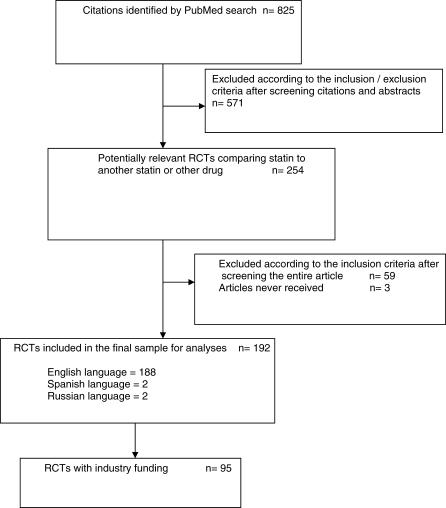
BACKGROUND: Published pharmaceutical industry-sponsored trials are more likely than non-industry-sponsored trials to report results and conclusions that favor drug over placebo. Little is known about potential biases in drug-drug comparisons. This study examined associations between research funding source, study design characteristics aimed at reducing bias, and other factors that potentially influence results and conclusions in randomized controlled trials (RCTs) of statin-drug comparisons. METHODS AND FINDINGS: This is a cross-sectional study of 192 published RCTs comparing a statin drug to another statin drug or non-statin drug. Data on concealment of allocation, selection bias, blinding, sample size, disclosed funding source, financial ties of authors, results for primary outcomes, and author conclusions were extracted by two coders (weighted kappa 0.80 to 0.97). Univariate and multivariate logistic regression identified associations between independent variables and favorable results and conclusions. Of the RCTs, 50% (95/192) were funded by industry, and 37% (70/192) did not disclose any funding source. Looking at the totality of available evidence, we found that almost all studies (98%, 189/192) used only surrogate outcome measures. Moreover, study design weaknesses common to published statin-drug comparisons included inadequate blinding, lack of concealment of allocation, poor follow-up, and lack of intention-to-treat analyses. In multivariate analysis of the full sample, trials with adequate blinding were less likely to report results favoring the test drug, and sample size was associated with favorable conclusions when controlling for other factors. In multivariate analysis of industry-funded RCTs, funding from the test drug company was associated with results (odds ratio = 20.16 [95% confidence interval 4.37-92.98], p < 0.001) and conclusions (odds ratio = 34.55 [95% confidence interval 7.09-168.4], p < 0.001) that favor the test drug when controlling for other factors. Studies with adequate blinding were less likely to report statistically significant results favoring the test drug. CONCLUSIONS: RCTs of head-to-head comparisons of statins with other drugs are more likely to report results and conclusions favoring the sponsor's product compared to the comparator drug. This bias in drug-drug comparison trials should be considered when making decisions regarding drug choice.
Overview
The claims and statistics of this paper haven’t been checked yet.
Free: it reads the open-access text and checks the first 5 claims that cite a source we can check. Create a free account to check every claim.
Integrity signals
Registry
Cites
Statistics
Figures
Verification
Claims the paper makes
The claims and statistics of this paper haven’t been checked yet.
Free: it reads the open-access text and checks the first 5 claims that cite a source we can check. Create a free account to check every claim.
Claims other papers make about this one
Each is checked against this paper’s own text: does it say what the citing paper says it does?
In the citing paper
“For example, among industry-sponsored head-to-head comparisons of statin drugs, the results favor the statin made by the company that sponsored the study [37].”
Self-check
Percentages, sums and reported differences re-computed from the paper’s own numbers.
The self-check needs the paper’s full text.
Citations
Cites
Why Most Published Research Findings Are False
Ioannidis, J. P. A. (2005) · PLoS Medicine · doi:10.1371/journal.pmed.0020124 · Cited by 10,505
Grundy, S. M., Cleeman, J. I., Merz, C. N. B., Brewer, H. B., Clark, L. T., Hunninghake, D. B., Pasternak, R. C., Smith, S. C., & Stone, N. J. (2004) · Circulation · doi:10.1161/01.cir.0000133317.49796.0e · Cited by 6,902
Schulz (1995) · doi:10.1001/jama.1995.03520290060030 · Cited by 5,634 · cited 4×
“For example, Schulz and colleagues found that estimates of treatment effects were exaggerated by 41% for inadequately concealed trials and by 17% for trials with inadequate double blinding [10].”
BackgroundInfluentialWhy Most Published Research Findings Are False
Ioannidis, J. P. A. (2005) · CHANCE · doi:10.1080/09332480.2005.10722754 · Cited by 4,702 · cited 1×
“Bias is the combination of various study design, data analysis, and presentation factors that make the results differ systematically from the truth [1].”
BackgroundPharmaceutical industry sponsorship and research outcome and quality: systematic review
Lexchin, J., Bero, L. A., Djulbegovic, B., & Clark, O. (2003) · BMJ · doi:10.1136/bmj.326.7400.1167 · Cited by 2,147 · cited 1×
“Although the association of pharmaceutical industry sponsorship with results and conclusions that favor the sponsor’s product over placebo is clear [22,23], the potential influence of funding source when the funder manufactures one of two competing drugs undergoing comparison has not been well described.”
BackgroundSelf-citationThe Hazards of Scoring the Quality of Clinical Trials for Meta-analysis
Jüni, P. (1999) · JAMA · doi:10.1001/jama.282.11.1054 · Cited by 1,981 · cited 1×
“], the unreliability of quality scores has led to the recommendation that trial quality be assessed for individual features that are aimed to reduce bias, such as concealment of allocation or blinding [”
BackgroundChan, A.-W., Hróbjartsson, A., Haahr, M. T., Gøtzsche, P. C., & Altman, D. G. (2004) · JAMA · doi:10.1001/jama.291.20.2457 · Cited by 1,845 · cited 2×
“Selective reporting of outcomes can also contribute to biased results and conclusions [4–6].”
ResultScope and Impact of Financial Conflicts of Interest in Biomedical Research: A Systematic Review
Bekelman, J. E., Li, Y., & Gross, C. P. (2003) · JAMA · doi:10.1001/jama.289.4.454 · Cited by 1,816 · cited 1×
“Although the association of pharmaceutical industry sponsorship with results and conclusions that favor the sponsor’s product over placebo is clear [22,23], the potential influence of funding source when the funder manufactures one of two competing drugs undergoing comparison has not been well described.”
BackgroundLaw, M. R., Wald, N. J., & Rudnicka, A. R. (2003) · BMJ · doi:10.1136/bmj.326.7404.1423 · Cited by 1,720 · cited 1×
“As strong evidence suggests that statins are more effective than placebo in reducing lipids [31], drug– drug comparison trials involving statins are the most relevant for making policy decisions about choosing a statin.”
BackgroundThe Existence of Publication Bias and Risk Factors for Its Occurrence
Dickersin, K. (1990) · JAMA: The Journal of the American Medical Association · doi:10.1001/jama.1990.03440100097014 · Cited by 1,417 · cited 1×
“Whether the results are reported in full, or whether there is selective reporting of outcomes can also contribute to biased results and conclusions [4–7].”
Result
Research works printed but not linked: 2
- Institute for Scientific Information (2005) Science citation index: Journal citation reports. Philadelphia (Pennsylvania): Institute for Scientific Information. Available at: http://portal.isiknowledge.com/portal. cgi?DestApp¼JCR&Func¼Frame. Accessed 4 May 2007.
- Dickersin K, Min Y-I, Meinert C (1992) Factors influencing publication of research results. JAMA 267: 374-378.
Cited by
Moher, D., Hopewell, S., Schulz, K. F., Montori, V., Gotzsche, P. C., Devereaux, P. J., Elbourne, D., Egger, M., & Altman, D. G. (2010) · BMJ · doi:10.1136/bmj.c869 · Cited by 8,883
Moher, D., Hopewell, S., Schulz, K. F., Montori, V., Gøtzsche, P. C., Devereaux, P. J., Elbourne, D., Egger, M., & Altman, D. G. (2012) · International Journal of Surgery · doi:10.1016/j.ijsu.2011.10.001 · Cited by 2,345
Moher, D., Hopewell, S., Schulz, K. F., Montori, V., Gøtzsche, P. C., Devereaux, P. J., Elbourne, D., Egger, M., & Altman, D. G. (2010) · Journal of Clinical Epidemiology · doi:10.1016/j.jclinepi.2010.03.004 · Cited by 1,858
Industry sponsorship and research outcome
Lundh, A., Lexchin, J., Mintzes, B., Schroll, J. B., & Bero, L. (2017) · Cochrane Database of Systematic Reviews · doi:10.1002/14651858.mr000033.pub3 · Cited by 1,697
Self-citationBoutron, I. (2010) · JAMA · doi:10.1001/jama.2010.651 · Cited by 842
Metadata
- Authors
- Bero, L., Oostvogel, F., Bacchetti, P., & Lee, K.
- Affiliations
- University of California, San Francisco (US)
- Leiden University (NL)
- Corresponding author
- Bero, Lisa
- Venue
- PLoS Medicine
- Publisher
- Public Library of Science (PLoS)
- Published
- 2007-06-05
- Volume
- 4
- Issue
- 6
- Pages
- e184
- ISSN
- 1549-1277 (ISSN-L)
- 1549-1676
- PMC
- PMC1885451
- OpenAlex
- W2152340675
- Cited by
- 249
- References
- 58
- Citations by year
- 2026: 3 · 2025: 3 · 2024: 7 · 2023: 9 · 2022: 6 · 2021: 7 · 2020: 9 · 2019: 10 · 2018: 15 · 2017: 9 · 2016: 10 · 2015: 16 · 2014: 20 · 2013: 19 · 2012: 17
- FWCI
- 20.19
- Type
- journal article
- Language
- en
- Open access
- gold
- doi.org
- Locations
- PLoS Medicine (publishedVersion, cc-by)
- PubMed Central (publishedVersion, cc-by)
- PubMed (publishedVersion)
- RePEc: Research Papers in Economics (submittedVersion)
- DOAJ (DOAJ: Directory of Open Access Journals) (submittedVersion, cc-by-sa)
- eScholarship (California Digital Library) (submittedVersion)
- eScholarship (California Digital Library) (submittedVersion, cc-by)
- Figshare (submittedVersion, cc-by)
- DigitalGeorgetown (Georgetown University Library) (submittedVersion)
- Funders
- Tobacco-Related Disease Research Program
- University of California, San Francisco
- Topics
- Health Sciences › Nursing › Issues, ethics and legal aspects › Pharmaceutical industry and healthcare
- Physical Sciences › Mathematics › Statistics and Probability › Statistical Methods in Clinical Trials
- Social Sciences › Decision Sciences › Statistics, Probability and Uncertainty › Meta-analysis and systematic reviews
- Keywords
- statins, pharmaceutical industry sponsorship, publication bias, trial bias, blinding, allocation concealment, surrogate endpoints, sample size, financial conflicts of interest, randomized controlled trials, intention-to-treat analysis, primary outcome reporting
- MeSH terms
- Drug Industry, Humans, Research Support as Topic, Randomized Controlled Trials as Topic, Conflict of Interest, Treatment Outcome, Publication Bias, Hydroxymethylglutaryl-CoA Reductase Inhibitors
About these checks
Registry, retraction, Cites and statistics results are computed, not judged, with one exception: a printed reference that no index lists is read once by a model before it counts as a citation error. Claims are extracted by a model and kept only when their quote appears verbatim in the text; each cited source is then checked, with a model’s help, for whether it says what the claim relies on. Those verdicts can be wrong — read the claim’s quote and the cited source before relying on one.
Statistics and arithmetic are recomputed, not judged.
Confidence bands are shown only for fields calibrated on our annotated test set. None is calibrated yet, so no band is shown.
What counts as a claim ›How we measure confidence ›How we check this ›
Are you an author, or do you see a problem with this page? Request a review
Data sources
Bibliographic data: Semantic Scholar, OpenAlex, Crossref.
Contains information from the Semantic Scholar Academic Graph Datasets, made available under the ODC Attribution License (ODC-BY 1.0).
Semantic Scholar’s data is described in: Kinney, R., et al. (2023). The Semantic Scholar Open Data Platform. arXiv:2301.10140.
