

Factors Associated with Findings of Published Trials of Drug–Drug Comparisons: Why Some Statins Appear More Efficacious than Others
Open accessThe DOI matches its Crossref record; 59 of the 59 references it cites were found in a registry or an index.
Abstract
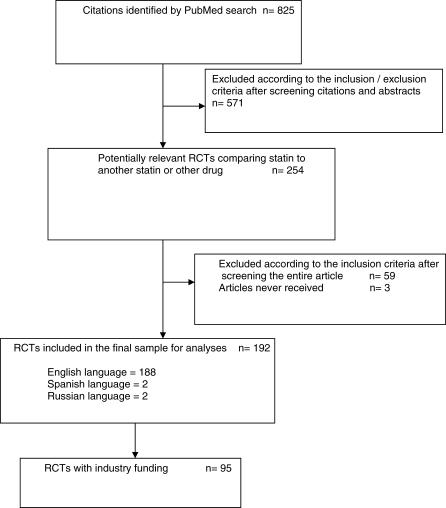
BACKGROUND: Published pharmaceutical industry-sponsored trials are more likely than non-industry-sponsored trials to report results and conclusions that favor drug over placebo. Little is known about potential biases in drug-drug comparisons. This study examined associations between research funding source, study design characteristics aimed at reducing bias, and other factors that potentially influence results and conclusions in randomized controlled trials (RCTs) of statin-drug comparisons. METHODS AND FINDINGS: This is a cross-sectional study of 192 published RCTs comparing a statin drug to another statin drug or non-statin drug. Data on concealment of allocation, selection bias, blinding, sample size, disclosed funding source, financial ties of authors, results for primary outcomes, and author conclusions were extracted by two coders (weighted kappa 0.80 to 0.97). Univariate and multivariate logistic regression identified associations between independent variables and favorable results and conclusions. Of the RCTs, 50% (95/192) were funded by industry, and 37% (70/192) did not disclose any funding source. Looking at the totality of available evidence, we found that almost all studies (98%, 189/192) used only surrogate outcome measures. Moreover, study design weaknesses common to published statin-drug comparisons included inadequate blinding, lack of concealment of allocation, poor follow-up, and lack of intention-to-treat analyses. In multivariate analysis of the full sample, trials with adequate blinding were less likely to report results favoring the test drug, and sample size was associated with favorable conclusions when controlling for other factors. In multivariate analysis of industry-funded RCTs, funding from the test drug company was associated with results (odds ratio = 20.16 [95% confidence interval 4.37-92.98], p < 0.001) and conclusions (odds ratio = 34.55 [95% confidence interval 7.09-168.4], p < 0.001) that favor the test drug when controlling for other factors. Studies with adequate blinding were less likely to report statistically significant results favoring the test drug. CONCLUSIONS: RCTs of head-to-head comparisons of statins with other drugs are more likely to report results and conclusions favoring the sponsor's product compared to the comparator drug. This bias in drug-drug comparison trials should be considered when making decisions regarding drug choice.
Overview
The claims and statistics of this paper haven’t been checked yet.
Free: it reads the open-access text and checks the first 5 claims that cite a source we can check. Create a free account to check every claim.
Integrity signals
Registry
Cites
Statistics
Figures
Verification
Claims the paper makes
The claims and statistics of this paper haven’t been checked yet.
Free: it reads the open-access text and checks the first 5 claims that cite a source we can check. Create a free account to check every claim.
Claims other papers make about this one
Each is checked against this paper’s own text: does it say what the citing paper says it does?
In the citing paper
“For example, among industry-sponsored head-to-head comparisons of statin drugs, the results favor the statin made by the company that sponsored the study [37].”
Self-check
Percentages, sums and reported differences re-computed from the paper’s own numbers.
The self-check needs the paper’s full text.
Citations
Cites
Why Most Published Research Findings Are False
Ioannidis, J. P. A. (2005) · PLoS Medicine · doi:10.1371/journal.pmed.0020124 · Cited by 10,505
Grundy, S. M., Cleeman, J. I., Merz, C. N. B., Brewer, H. B., Clark, L. T., Hunninghake, D. B., Pasternak, R. C., Smith, S. C., & Stone, N. J. (2004) · Circulation · doi:10.1161/01.cir.0000133317.49796.0e · Cited by 6,902
Schulz (1995) · doi:10.1001/jama.1995.03520290060030 · Cited by 5,634 · cited 4×
“For example, Schulz and colleagues found that estimates of treatment effects were exaggerated by 41% for inadequately concealed trials and by 17% for trials with inadequate double blinding [10].”
BackgroundInfluentialWhy Most Published Research Findings Are False
Ioannidis, J. P. A. (2005) · CHANCE · doi:10.1080/09332480.2005.10722754 · Cited by 4,702 · cited 1×
“Bias is the combination of various study design, data analysis, and presentation factors that make the results differ systematically from the truth [1].”
BackgroundPharmaceutical industry sponsorship and research outcome and quality: systematic review
Lexchin, J., Bero, L. A., Djulbegovic, B., & Clark, O. (2003) · BMJ · doi:10.1136/bmj.326.7400.1167 · Cited by 2,147 · cited 1×
“Although the association of pharmaceutical industry sponsorship with results and conclusions that favor the sponsor’s product over placebo is clear [22,23], the potential influence of funding source when the funder manufactures one of two competing drugs undergoing comparison has not been well described.”
BackgroundSelf-citationThe Hazards of Scoring the Quality of Clinical Trials for Meta-analysis
Jüni, P. (1999) · JAMA · doi:10.1001/jama.282.11.1054 · Cited by 1,981 · cited 1×
“], the unreliability of quality scores has led to the recommendation that trial quality be assessed for individual features that are aimed to reduce bias, such as concealment of allocation or blinding [”
BackgroundChan, A.-W., Hróbjartsson, A., Haahr, M. T., Gøtzsche, P. C., & Altman, D. G. (2004) · JAMA · doi:10.1001/jama.291.20.2457 · Cited by 1,845 · cited 2×
“Selective reporting of outcomes can also contribute to biased results and conclusions [4–6].”
ResultScope and Impact of Financial Conflicts of Interest in Biomedical Research: A Systematic Review
Bekelman, J. E., Li, Y., & Gross, C. P. (2003) · JAMA · doi:10.1001/jama.289.4.454 · Cited by 1,816 · cited 1×
“Although the association of pharmaceutical industry sponsorship with results and conclusions that favor the sponsor’s product over placebo is clear [22,23], the potential influence of funding source when the funder manufactures one of two competing drugs undergoing comparison has not been well described.”
BackgroundLaw, M. R., Wald, N. J., & Rudnicka, A. R. (2003) · BMJ · doi:10.1136/bmj.326.7404.1423 · Cited by 1,720 · cited 1×
“As strong evidence suggests that statins are more effective than placebo in reducing lipids [31], drug– drug comparison trials involving statins are the most relevant for making policy decisions about choosing a statin.”
BackgroundThe Existence of Publication Bias and Risk Factors for Its Occurrence
Dickersin, K. (1990) · JAMA: The Journal of the American Medical Association · doi:10.1001/jama.1990.03440100097014 · Cited by 1,417 · cited 1×
“Whether the results are reported in full, or whether there is selective reporting of outcomes can also contribute to biased results and conclusions [4–7].”
Result
Research works printed but not linked: 2
- Institute for Scientific Information (2005) Science citation index: Journal citation reports. Philadelphia (Pennsylvania): Institute for Scientific Information. Available at: http://portal.isiknowledge.com/portal. cgi?DestApp¼JCR&Func¼Frame. Accessed 4 May 2007.
- Dickersin K, Min Y-I, Meinert C (1992) Factors influencing publication of research results. JAMA 267: 374-378.
Cited by
Moher, D., Hopewell, S., Schulz, K. F., Montori, V., Gotzsche, P. C., Devereaux, P. J., Elbourne, D., Egger, M., & Altman, D. G. (2010) · BMJ · doi:10.1136/bmj.c869 · Cited by 8,883
Moher, D., Hopewell, S., Schulz, K. F., Montori, V., Gøtzsche, P. C., Devereaux, P. J., Elbourne, D., Egger, M., & Altman, D. G. (2012) · International Journal of Surgery · doi:10.1016/j.ijsu.2011.10.001 · Cited by 2,345
Moher, D., Hopewell, S., Schulz, K. F., Montori, V., Gøtzsche, P. C., Devereaux, P. J., Elbourne, D., Egger, M., & Altman, D. G. (2010) · Journal of Clinical Epidemiology · doi:10.1016/j.jclinepi.2010.03.004 · Cited by 1,858
Industry sponsorship and research outcome
Lundh, A., Lexchin, J., Mintzes, B., Schroll, J. B., & Bero, L. (2017) · Cochrane Database of Systematic Reviews · doi:10.1002/14651858.mr000033.pub3 · Cited by 1,697
Self-citationBoutron, I. (2010) · JAMA · doi:10.1001/jama.2010.651 · Cited by 842
Hand‐held Dynamometry Correlation With the Gold Standard Isokinetic Dynamometry: A Systematic Review
Stark, T., Walker, B., Phillips, J. K., Fejer, R., & Beck, R. (2011) · PM&R · doi:10.1016/j.pmrj.2010.10.025 · Cited by 816
Conflict of Interest in Medical Research, Education, and Practice
(2009) · National Academies Press eBooks · doi:10.17226/12598 · Cited by 807
“Examples include clinical trials of statins for the treatment of elevated cholesterol levels (Bero et al., 2007), breast cancer studies (Peppercorn et al.”
BackgroundComparison of Registered and Published Primary Outcomes in Randomized Controlled Trials
Mathieu, S. (2009) · JAMA · doi:10.1001/jama.2009.1242 · Cited by 730
“Data on the funding source of each published study was collected and categorized as no funding, government, industry, private nonprofit, other source, or not reported.(19)”
BackgroundIoannidis, J. P. A. (2009) · Canadian Medical Association Journal · doi:10.1503/cmaj.081086 · Cited by 716
Hopewell, S., Clarke, M., Moher, D., Wager, E., Middleton, P., Altman, D. G., Schulz, K. F., & and the CONSORT Group (2008) · PLoS Medicine · doi:10.1371/journal.pmed.0050020 · Cited by 674
“Similarly, authors should report any other sources of support, such as in the preparation of the abstract, presentation, or manuscript [74].”
BackgroundIndustry sponsorship and research outcome
Lundh, A., Sismondo, S., Lexchin, J., Busuioc, O. A., & Bero, L. (2012) · Cochrane Database of Systematic Reviews · doi:10.1002/14651858.mr000033.pub2 · Cited by 605
Self-citationWoodruff, T. J., & Sutton, P. (2014) · Environmental Health Perspectives · doi:10.1289/ehp.1307175 · Cited by 427
“…is based on empiri cal data from studies of the health effects of tobacco (Barnes and Bero 1997, 1998), the safety and efficacy of pharmaceuticals (Bero et al. 2007; Lexchin et al. 2003; Lundh et al. 2012), and medical procedures (Popelut et al. 2010; Shah et al. 2005), which have all shown that,…”
BackgroundMethodGalactomannan detection for invasive aspergillosis in immunocompromized patients
Leeflang, M. M., Debets-Ossenkopp, Y. J., Visser, C. E., Scholten, R. J., Hooft, L., Bijlmer, H. A., Reitsma, J. B., Bossuyt, P. M., & Vandenbroucke-Grauls, C. M. (2008) · Cochrane Database of Systematic Reviews · doi:10.1002/14651858.cd007394 · Cited by 362
Outcome Reporting Among Drug Trials Registered in ClinicalTrials.gov
Bourgeois, F. T., Murthy, S., & Mandl, K. D. (2010) · Annals of Internal Medicine · doi:10.7326/0003-4819-153-3-201008030-00006 · Cited by 332
“ing from the company marketing the statin under study was associated with a 16-fold increase in the likelihood of reporting results favoring the study drug (25).”
The Influence of Industry Sponsorship on the Research Agenda: A Scoping Review
Fabbri, A., Lai, A., Grundy, Q., & Bero, L. A. (2018) · American Journal of Public Health · doi:10.2105/ajph.2018.304677 · Cited by 317
Self-citationYank, V., Rennie, D., & Bero, L. A. (2007) · BMJ · doi:10.1136/bmj.39376.447211.be · Cited by 235
Self-citationExploring the Geometry of Treatment Networks
Salanti, G., Kavvoura, F. K., & Ioannidis, J. P. A. (2008) · Annals of Internal Medicine · doi:10.7326/0003-4819-148-7-200804010-00011 · Cited by 231
Mangin, D., Bahat, G., Golomb, B. A., Mallery, L. H., Moorhouse, P., Onder, G., Petrovic, M., & Garfinkel, D. (2018) · Drugs & Aging · doi:10.1007/s40266-018-0554-2 · Cited by 226
Accuracy of Conflict-of-Interest Disclosures Reported by Physicians
Okike, K., Kocher, M. S., Wei, E. X., Mehlman, C. T., & Bhandari, M. (2009) · New England Journal of Medicine · doi:10.1056/nejmsa0807160 · Cited by 192
Flacco, M. E., Manzoli, L., Boccia, S., Capasso, L., Aleksovska, K., Rosso, A., Scaioli, G., De Vito, C., Siliquini, R., Villari, P., et al. (2015) · Journal of Clinical Epidemiology · doi:10.1016/j.jclinepi.2014.12.016 · Cited by 177
Industry sponsorship and research outcome: systematic review with meta-analysis
Lundh, A., Lexchin, J., Mintzes, B., Schroll, J. B., & Bero, L. (2018) · Intensive Care Medicine · doi:10.1007/s00134-018-5293-7 · Cited by 162
Self-citationMandrioli, D., Kearns, C. E., & Bero, L. A. (2016) · PLOS ONE · doi:10.1371/journal.pone.0162198 · Cited by 160
Self-citationLexchin, J. (2011) · Science and Engineering Ethics · doi:10.1007/s11948-011-9265-3 · Cited by 190
“Similarly, RCTs of head-to-head comparisons of statins were more likely to report results and conclusions favouring the sponsor’s product compared to the comparator drug (Bero et al. 2007).”
Moral Disengagement in the Corporate World
White, J., Bandura, A., & Bero, L. A. (2009) · Accountability in Research · doi:10.1080/08989620802689847 · Cited by 178
“Numerous studies have documented how industries influence research activities to contest the evidence of harmful effects of their products and practices, and to weaken or block regulatory policies (Bekelman et al., 2003; Bero et al., 2007; Cho and Bero, 1996; Levine et al., 2003; Lexchin et al., 2003; Nestle, 2002).”
BackgroundSelf-citationReporting of conflicts of interest in meta-analyses of trials of pharmacological treatments
Roseman, M. (2011) · JAMA · doi:10.1001/jama.2011.257 · Cited by 145
“Pharmaceutical industry funding and author-industry financial ties are associated with a bias toward favorable results even when controlling for other study characteristics.(12,13) Based on empirical evidence of bias related to COI, an Agency for Healthcare Research and Quality systematic review of tools used to rate…”
ResultWhy we need easy access to all data from all clinical trials and how to accomplish it
Gøtzsche, P. C. (2011) · Trials · doi:10.1186/1745-6215-12-249 · Cited by 137
“Head-to-head comparisons of drugs can be subject to bias, in all phases of a trial, in design, analysis and reporting [2-8], and can cause the reported results to be misleading.”
Schaad, U. B. (2010) · World Journal of Pediatrics · doi:10.1007/s12519-010-0001-x · Cited by 132
The Impact of Disclosing Financial Ties in Research and Clinical Care: A Systematic Review
Licurse, A. M., Barber, E., Joffe, S., & Gross, C. (2010) · Archives of Internal Medicine · doi:10.1001/archinternmed.2010.39 · Cited by 125
Tramacere, I., Boncoraglio, G. B., Banzi, R., Giovane, C. D., Kwag, K. H., Squizzato, A., & Moja, L. (2019) · BMC Medicine · doi:10.1186/s12916-019-1298-5 · Cited by 141
Adjustment for reporting bias in network meta-analysis of antidepressant trials
Trinquart, L., Chatellier, G., & Ravaud, P. (2012) · BMC Medical Research Methodology · doi:10.1186/1471-2288-12-150 · Cited by 122
“In head-to-head trials, the direction of bias is uncertain but assumptions in defining Iijk could be that the sponsored treatment is favored (sponsorship bias) [45,46] or that the newest treatment is favored (optimism bias) [37,47,48].”
BackgroundYan, P., Yao, L., Li, H., Zhang, M., Xun, Y., Li, M., Cai, H., Lu, C., Hu, L., Guo, T., et al. (2019) · Journal of Clinical Epidemiology · doi:10.1016/j.jclinepi.2018.12.013 · Cited by 107
Medical reversal: why we must raise the bar before adopting new technologies.
Prasad, V. K., & Cifu, A. S. (2011) · PubMed Central · Cited by 125
The Financing of Drug Trials by Pharmaceutical Companies and Its Consequences
Schott, G., Pachl, H., Limbach, U., Gundert-Remy, U., Ludwig, W.-D., & Lieb, K. (2010) · Deutsches Ärzteblatt international · doi:10.3238/arztebl.2010.0279 · Cited by 101
Industry sponsorship and selection of comparators in randomized clinical trials
Lathyris, D. N., Patsopoulos, N. A., Salanti, G., & Ioannidis, J. P. A. (2010) · European Journal of Clinical Investigation · doi:10.1111/j.1365-2362.2009.02240.x · Cited by 100
Minimizing Bias in Randomized Trials: The Importance of Blinding
Psaty, B. M., & Prentice, R. L. (2010) · JAMA · doi:10.1001/jama.2010.1161 · Cited by 105
The Drug Facts Box: Improving the communication of prescription drug information
Schwartz, L. M., & Woloshin, S. (2013) · Proceedings of the National Academy of Sciences · doi:10.1073/pnas.1214646110 · Cited by 97
Why the Cochrane Risk of Bias Tool Should Include Funding Source as a Standard Item
Bero, L. A. (2013) · Cochrane Database of Systematic Reviews · doi:10.1002/14651858.ed000075 · Cited by 96
Self-citationTreatment of ankylosing spondylitis with TNF blockers: a meta-analysis
Machado, M. A. D. Á., Barbosa, M. M., Almeida, A. M., de Araújo, V. E., Kakehasi, A. M., Andrade, E. I. G., Cherchiglia, M. L., & Acúrcio, F. D. A. (2013) · Rheumatology International · doi:10.1007/s00296-013-2772-6 · Cited by 112
“Systematic reviews have shown that studies connected to the pharmaceutical industry tend to report outcomes favorable to the medication produced by the sponsor [60–62].”
BackgroundRooney, A. A., Cooper, G. S., Jahnke, G. D., Lam, J., Morgan, R. L., Boyles, A. L., Ratcliffe, J. M., Kraft, A. D., Schünemann, H. J., Schwingl, P., et al. (2016) · Environment International · doi:10.1016/j.envint.2016.01.005 · Cited by 95
“…ability of funding source to influence study outcome, from studies on health impacts of tobacco (Barnes and Bero, 1997, 1998), to safety and efficacy of pharmaceuticals (Bero et al., 2007; Lexchin et al., 2003; Lundh et al., 2012; Perlis et al., 2005), and medical procedures (Popelut et al., 2010).”
Killeen, S., Sourallous, P., Hunter, I. A., Hartley, J. E., & Grady, H. L. O. (2014) · Annals of Surgery · doi:10.1097/sla.0b013e318299d00b · Cited by 90
Relationship between sponsorship and failure rate of dental implants: a systematic approach
Popelut, A., Valet, F., Fromentin, O., Thomas, A., & Bouchard, P. (2010) · PLoS ONE · doi:10.1371/journal.pone.0010274 · Cited by 86
“literature showing that industry sponsoring may affect biomedical research outcomes [16,32].”
BackgroundResultDunn, A. G., Arachi, D., Hudgins, J., Tsafnat, G., Coiera, E., & Bourgeois, F. T. (2014) · Annals of Internal Medicine · doi:10.7326/m14-0933 · Cited by 84
Public Availability of Results of Trials Assessing Cancer Drugs in the United States
Nguyen, T.-A.-H., Dechartres, A., Belgherbi, S., & Ravaud, P. (2013) · Journal of Clinical Oncology · doi:10.1200/jco.2012.46.9577 · Cited by 83
Action to protect the independence and integrity of global health research
Storeng, K. T., Abímbọ́lá, Ṣ., Balabanova, D., McCoy, D., Ridde, V., Filippi, V., Roalkvam, S., Akello, G., Parker, M., & Palmer, J. J. (2019) · BMJ Global Health · doi:10.1136/bmjgh-2019-001746 · Cited by 84
Jørgensen, A. W., Maric, K. L., Tendal, B., Faurschou, A., & Gøtzsche, P. C. (2008) · BMC Medical Research Methodology · doi:10.1186/1471-2288-8-60 · Cited by 80
Multimorbidity: a challenge for evidence-based medicine
Campbell-Scherer, D. L. (2010) · BMJ Evidence-Based Medicine · doi:10.1136/ebm1154 · Cited by 89
Industry Bias in Randomized Controlled Trials in General and Abdominal Surgery: An Empirical Study
Probst, P., Knebel, P., Grummich, K., Tenckhoff, S., Ulrich, A. B., Büchler, M. W., & Diener, M. K. (2015) · Annals of Surgery · doi:10.1097/sla.0000000000001372 · Cited by 89
Quality of Conduct and Reporting of Meta-analyses of Surgical Interventions
Adie, S., Ma, D., Harris, I. A., Naylor, J. M., & Craig, J. C. (2015) · Annals of Surgery · doi:10.1097/sla.0000000000000836 · Cited by 76
“Orthopaedic 25 (17) Cardiothoracic 18 (12) Vascular 12 (8) Urology 10 (7) ENT/head and neck 8 (5) Neurosurgery 5 (3) Plastic and reconstructive 1 (1) Funding source, n (%) Industry 4 (3) Unclear 78 (52) No external source 33 (22) Non-industry 35 (23) Conclusion, n (%) Supports surgical intervention 74 (49) Further res…”
BackgroundPerfect Study, Poor Evidence: Interpretation of Biases Preceding Study Design
Ioannidis, J. P. A. (2008) · Seminars in Hematology · doi:10.1053/j.seminhematol.2008.04.010 · Cited by 74
Dangerous interconnectedness: economists' conflicts of interest, ideology and financial crisis
Carrick-Hagenbarth, J., & Epstein, G. A. (2012) · Cambridge Journal of Economics · doi:10.1093/cje/ber036 · Cited by 92
“A substantial set of studies done from the 1980s through the present time have found that the pharmaceutical affiliations of the researchers and study authors biased outcomes in favour of the sponsoring affiliation (Barnes and Bero, 1998; Bekelman et al., 2003; Bero et al., 2007; Davidson, 1986; Friedberg et al., 1999…”
ResultGolder, S., & Loke, Y. K. (2008) · British Journal of Clinical Pharmacology · doi:10.1111/j.1365-2125.2008.03272.x · Cited by 71
Silverman, G. K., Loewenstein, G. F., Anderson, B. L., Ubel, P. A., Zinberg, S., & Schulkin, J. A. (2010) · Journal of Medical Ethics · doi:10.1136/jme.2009.034496 · Cited by 66
Okike, K. M., Kocher, M. S., Mehlman, C. T., & Bhandari, M. (2008) · Injury · doi:10.1016/j.injury.2008.02.013 · Cited by 66
Food industry sponsorship of academic research: investigating commercial bias in the research agenda
Fabbri, A., Holland, T. J., & Bero, L. A. (2018) · Public Health Nutrition · doi:10.1017/s1368980018002100 · Cited by 63
Self-citationNaci, H., Dias, S., & Ades, A. E. (2014) · BMJ · doi:10.1136/bmj.g5741 · Cited by 61
Rasmussen, N., Lee, K., & Bero, L. (2009) · Trials · doi:10.1186/1745-6215-10-116 · Cited by 62
Self-citationJust a paradigm: evidence-based medicine in epistemological context
Solomon, M. (2011) · European Journal for Philosophy of Science · doi:10.1007/s13194-011-0034-6 · Cited by 82
“…astonishingly higher chance (three or four times the probability of studies not funded by pharmaceutical companies) of showing effectiveness of an intervention than studies not funded by pharmaceutical companies (Als-Nielsen et al. 2003; Bekelman et al. 2003; Bero et al. 2007; Lexchin et al. 2003).”
BackgroundCharacteristics of funding of clinical trials: cross-sectional survey and proposed guidance
Hakoum, M. B., Jouni, N., Abou-Jaoude, E. A., Hasbani, D. J., Abou-Jaoude, E. A., Lopes, L. C., Khaldieh, M., Hammoud, M. Z., Al-Gibbawi, M., Anouti, S., et al. (2017) · BMJ Open · doi:10.1136/bmjopen-2017-015997 · Cited by 61
CYD-TDV dengue vaccine: systematic review and meta-analysis of efficacy, immunogenicity and safety
Godói, I. P. D., de Lemos, L. L. P., de Araújo, V. E., Bonoto, B. C., Godman, B., & Guerra, A. A. (2017) · Journal of Comparative Effectiveness Research · doi:10.2217/cer-2016-0045 · Cited by 66
Lexchin, J., & O’Donovan, Ó. (2009) · Social Science & Medicine · doi:10.1016/j.socscimed.2009.09.002 · Cited by 58
The alcohol industry and public interest science
Stenius, K., & Babor, T. F. (2009) · Addiction · doi:10.1111/j.1360-0443.2009.02688.x · Cited by 59
Reporting of conflicts of interest from drug trials in Cochrane reviews: cross sectional study
Roseman, M., Turner, E. H., Lexchin, J., Coyne, J. C., Bero, L. A., & Thombs, B. D. (2012) · BMJ · doi:10.1136/bmj.e5155 · Cited by 55
Self-citationAn overview of the current status of clinical trials on endometriosis: issues and concerns
Guo, S. (2013) · Fertility and Sterility · doi:10.1016/j.fertnstert.2013.08.050 · Cited by 56
Impact of Reporting Bias in Network Meta-Analysis of Antidepressant Placebo-Controlled Trials
Trinquart, L., Abbé, A., & Ravaud, P. (2012) · PLoS ONE · doi:10.1371/journal.pone.0035219 · Cited by 54
“The direction of bias in estimating treatment effect because of reporting bias is uncertain in head-to-head trials: the sponsored treatment could be favored [5,42] or the newest treatment could be favored [43,44] and disentangling the sources of bias operating on direct and indirect evidence would be difficult.”
BackgroundMoher, D. (2010) · Journal of Chinese Integrative Medicine · doi:10.3736/jcim20100801 · Cited by 57
Hopewell, S. (2008) · Journal of Chinese Integrative Medicine · doi:10.3736/jcim20080301 · Cited by 53
Evidence from Toxicology: The Most Essential Science for Prevention
Mandrioli, D., & Silbergeld, E. K. (2015) · Environmental Health Perspectives · doi:10.1289/ehp.1509880 · Cited by 56
“Bero and others have demonstrated that the source of the piper’s pay in research, from clinical trials to tobacco studies, introduces a predictable risk of bias in results and conclusions (Barnes and Bero 1998; Bero et al. 2007; Lundh et al. 2012).”
BackgroundPitfalls in the use of randomised controlled trials for fish oil studies with cardiac patients
James, M. J., Sullivan, T., Metcalf, R. G., & Cleland, L. G. (2014) · British Journal Of Nutrition · doi:10.1017/s0007114514001408 · Cited by 55
“results and conclusions overwhelmingly favour the sponsor’s product((15)).”
Resultde Lemos, L. L. P., Costa, J. D. O., Almeida, A. M., de Oliveira, H. A., Barbosa, M. M., Kakehasi, A. M., & Acúrcio, F. D. A. (2014) · Rheumatology International · doi:10.1007/s00296-014-3006-2 · Cited by 53
“SRs revealed that industry-funded studies tend to show results favorable to their product when compared to studies not funded by industry [68, 69].”
ResultMorimoto, T., Crawford, B., Wada, K., & Ueda, S. (2015) · Journal of Cardiology · doi:10.1016/j.jjcc.2015.05.018 · Cited by 52
Nejstgaard, C. H., Bero, L. A., Hróbjartsson, A., Jørgensen, A. W., Jørgensen, K. J., Le, M., & Lundh, A. (2020) · Cochrane Database of Systematic Reviews · doi:10.1002/14651858.mr000040.pub3 · Cited by 61
“Bero 2007 Bero L, Oostvogel F, Bacchetti P, Lee K. Factors associated with findings of published trials of drug-drug comparisons: why some statins appear more eBicacious than others.”
BackgroundSelf-citationReporting Science and Conflicts of Interest in the Lay Press
Cook, D. M., Boyd, E. A., Grossmann, C., & Bero, L. A. (2007) · PLoS ONE · doi:10.1371/journal.pone.0001266 · Cited by 45
“stock ownership and consulting income) are associated with the reporting of favorable research results and conclusions for the sponsor [13,14,15,16].”
BackgroundSelf-citationNeglected tropical diseases: survey and geometry of randomised evidence
Kappagoda, S., & Ioannidis, J. P. A. (2012) · BMJ · doi:10.1136/bmj.e6512 · Cited by 49
Evaluation of Spin in the Abstracts of Emergency Medicine Randomized Controlled Trials
Vaughn, V., Riddle, J., Brown, J., Schiesel, M., Wayant, C., & Vassar, M. B. (2019) · Annals of Emergency Medicine · doi:10.1016/j.annemergmed.2019.03.011 · Cited by 49
The mediterranean diet: Rationale and evidence for its benefit
de Lorgeril, M., & Salen, P. (2008) · Current Atherosclerosis Reports · doi:10.1007/s11883-008-0080-5 · Cited by 53
“If we specifi cally look at the overall mortality outcome (the only end point that can be easily verifi ed through National Death Registries) and thus control for potential bias due to tight connections between investigators and sponsors [ 43 ], what do we see?”
BackgroundLack of Transparency of Clinical Trials on Endometriosis
Guo, S.-W., & Evers, J. L. H. (2013) · Obstetrics & Gynecology · doi:10.1097/aog.0b013e318291f299 · Cited by 40
Boyd, E. A., Akl, E. A., Baumann, M., Curtis, J. R., Field, M. J., Jaeschke, R., Osborne, M., & Schünemann, H. J. (2012) · Proceedings of the American Thoracic Society · doi:10.1513/pats.201208-057st · Cited by 40
Roundtree, A. K., Kallen, M. A., Lopez-Olivo, M. A., Kimmel, B., Skidmore, B., Ortiz, Z., Cox, V., & Suarez-Almazor, M. E. (2008) · Journal of Clinical Epidemiology · doi:10.1016/j.jclinepi.2008.08.003 · Cited by 43
Mathieu, S., Giraudeau, B., Soubrier, M., & Ravaud, P. (2012) · Joint Bone Spine · doi:10.1016/j.jbspin.2011.05.008 · Cited by 37
The Impact of Corporate Payments on Robotic Surgery Research: A Systematic Review
Criss, C. N., MacEachern, M., Matusko, N., Dimick, J. B., Maggard-Gibbons, M. A., & Gadepalli, S. K. (2018) · Annals of Surgery · doi:10.1097/sla.0000000000003000 · Cited by 40
Strategies for obtaining unpublished drug trial data: a qualitative interview study
Wolfe, N., Gøtzsche, P. C., & Bero, L. (2013) · Systematic Reviews · doi:10.1186/2046-4053-2-31 · Cited by 30
“Other drug agencies should follow suit, as the traditional secrecy is not in the patients’ interest and cannot be defended ethically [25].”
BackgroundSelf-citationKrauth, D., Anglemyer, A., Philipps, R., & Bero, L. (2014) · PLoS Biology · doi:10.1371/journal.pbio.1001770 · Cited by 36
“Previous research has shown that randomized controlled clinical trials of head-to-head comparisons of statins with other drugs are more likely to report results and conclusions favoring the sponsor’s product compared to the comparator drug, even when controlling for other risks of bias [14].”
BackgroundSelf-citationSamargandi, O. A., Hasan, H., & Thoma, A. (2015) · Plastic & Reconstructive Surgery · doi:10.1097/prs.0000000000001898 · Cited by 38
Ungprasert, P., Thongprayoon, C., & Davis, J. M. (2015) · Seminars in Arthritis and Rheumatism · doi:10.1016/j.semarthrit.2015.09.004 · Cited by 37
The Cycle of Bias in Health Research: A Framework and Toolbox for Critical Appraisal Training
Odierna, D. H., Forsyth, S. R., White, J., & Bero, L. A. (2013) · Accountability in Research · doi:10.1080/08989621.2013.768931 · Cited by 34
“Although industry-sponsored studies may have a high risk of bias (Lundh et al., 2012; Yank et al., 2007; Bero et al., 2007; Barnes and Bero, 1998) and be less likely than publicly-funded studies to include minority and disadvantaged populations (Dickerson et al., 2009; Rochon et al., 1998; Rochon…”
BackgroundSelf-citationWu, D., Yue, J., & Tam, L. (2017) · Rheumatology · doi:10.1093/rheumatology/kex452 · Cited by 35
McCarthyism, conflict of interest andAddiction's new transparency declaration procedures
Babor, T. F., & Miller, P. G. (2014) · Addiction · doi:10.1111/add.12384 · Cited by 36
Catalá-López, F., Sanfélix‐Gimeno, G., Ridao-López, M., & Peiró, S. (2013) · PLoS ONE · doi:10.1371/journal.pone.0069462 · Cited by 36
“Another source of sponsorship bias could be that dragged from efficacy studies, which was shown by Bero and colleagues [8], who reported in a cross-sectional study of 192 randomized trials that comparative trials of statins were more likely to report outcomes favouring the sponsor’s statin compared to the comparator d…”
ResultSun, X., Zhou, X., Yu, Y., & Liu, H. (2018) · BMC Medical Research Methodology · doi:10.1186/s12874-018-0622-7 · Cited by 34
Research Misconduct: The Peril of Publish or Perish
Al‐Adawi, S., Ali, B. H., & Al-Zakwani, I. S. (2016) · Oman Medical Journal · doi:10.5001/omj.2016.02 · Cited by 33
Shnier, A., Lexchin, J., Romero, M., & Brown, K. A. (2016) · BMC Health Services Research · doi:10.1186/s12913-016-1646-5 · Cited by 36
Independent discussion sections for improving inferential reproducibility in published research
Avidan, M. S., Ioannidis, J. P. A., & Mashour, G. A. (2019) · British Journal of Anaesthesia · doi:10.1016/j.bja.2018.12.010 · Cited by 34
Catalá-López, F., Alonso‐Arroyo, A., Aleixandre‐Benavent, R., Ridao-López, M., Bolaños-Pizarro, M., García‐Altés, A., Sanfélix‐Gimeno, G., & Peiró, S. (2012) · PLoS ONE · doi:10.1371/journal.pone.0038012 · Cited by 35
“At the same time, and as was the case with clinical research [1–4], conflicts of interest due to the influence of the pharmaceutical and medical technology industries is emerging as a critical issue in economic research [5,6].”
ResultSome main problems eroding the credibility and relevance of randomized trials.
Ioannidis, J. P. A. (2008) · PubMed · Cited by 30
Brignardello-Petersen, R., Carrasco-Labra, A., Yanine, N., Ulloa, C., Araya, I., Pintor, F., Villanueva, J., & Cornejo-Ovalle, M. (2013) · The Journal of the American Dental Association · doi:10.14219/jada.archive.2013.0035 · Cited by 29
Steel, D. P. (2018) · Kennedy Institute of Ethics journal · doi:10.1353/ken.2018.0011 · Cited by 35
Gundle, K. R., Dingel, M. J., & Koenig, B. A. (2010) · Addiction · doi:10.1111/j.1360-0443.2010.02940.x · Cited by 30
“Funding sources may influence study design, hypothesis formulation, interpretation of results, whether a study is actually published, and how well it is disseminated [85,86,87,88,89,90,91].”
BackgroundVested interests, addiction research and public policy
Babor, T. F., Miller, P. G., & Edwards, G. (2009) · Addiction · doi:10.1111/j.1360-0443.2009.02664.x · Cited by 29
Exploring the Asymmetrical Relationship Between the Power of Finance Bias and Evidence
Howick, J. (2019) · Perspectives in biology and medicine · doi:10.1353/pbm.2019.0009 · Cited by 31
Comparative Effectiveness Research: An Empirical Study of Trials Registered in ClinicalTrials.gov
Bourgeois, F. T., Murthy, S., & Mandl, K. D. (2012) · PLoS ONE · doi:10.1371/journal.pone.0028820 · Cited by 26
Metadata
- Authors
- Bero, L., Oostvogel, F., Bacchetti, P., & Lee, K.
- Affiliations
- University of California, San Francisco (US)
- Leiden University (NL)
- Corresponding author
- Bero, Lisa
- Venue
- PLoS Medicine
- Publisher
- Public Library of Science (PLoS)
- Published
- 2007-06-05
- Volume
- 4
- Issue
- 6
- Pages
- e184
- ISSN
- 1549-1277 (ISSN-L)
- 1549-1676
- PMC
- PMC1885451
- OpenAlex
- W2152340675
- Cited by
- 249
- References
- 58
- Citations by year
- 2026: 3 · 2025: 3 · 2024: 7 · 2023: 9 · 2022: 6 · 2021: 7 · 2020: 9 · 2019: 10 · 2018: 15 · 2017: 9 · 2016: 10 · 2015: 16 · 2014: 20 · 2013: 19 · 2012: 17
- FWCI
- 20.19
- Type
- journal article
- Language
- en
- Open access
- gold
- doi.org
- Locations
- PLoS Medicine (publishedVersion, cc-by)
- PubMed Central (publishedVersion, cc-by)
- PubMed (publishedVersion)
- RePEc: Research Papers in Economics (submittedVersion)
- DOAJ (DOAJ: Directory of Open Access Journals) (submittedVersion, cc-by-sa)
- eScholarship (California Digital Library) (submittedVersion)
- eScholarship (California Digital Library) (submittedVersion, cc-by)
- Figshare (submittedVersion, cc-by)
- DigitalGeorgetown (Georgetown University Library) (submittedVersion)
- Funders
- Tobacco-Related Disease Research Program
- University of California, San Francisco
- Topics
- Health Sciences › Nursing › Issues, ethics and legal aspects › Pharmaceutical industry and healthcare
- Physical Sciences › Mathematics › Statistics and Probability › Statistical Methods in Clinical Trials
- Social Sciences › Decision Sciences › Statistics, Probability and Uncertainty › Meta-analysis and systematic reviews
- Keywords
- statins, pharmaceutical industry sponsorship, publication bias, trial bias, blinding, allocation concealment, surrogate endpoints, sample size, financial conflicts of interest, randomized controlled trials, intention-to-treat analysis, primary outcome reporting
- MeSH terms
- Drug Industry, Humans, Research Support as Topic, Randomized Controlled Trials as Topic, Conflict of Interest, Treatment Outcome, Publication Bias, Hydroxymethylglutaryl-CoA Reductase Inhibitors
About these checks
Registry, retraction, Cites and statistics results are computed, not judged, with one exception: a printed reference that no index lists is read once by a model before it counts as a citation error. Claims are extracted by a model and kept only when their quote appears verbatim in the text; each cited source is then checked, with a model’s help, for whether it says what the claim relies on. Those verdicts can be wrong — read the claim’s quote and the cited source before relying on one.
Statistics and arithmetic are recomputed, not judged.
Confidence bands are shown only for fields calibrated on our annotated test set. None is calibrated yet, so no band is shown.
What counts as a claim ›How we measure confidence ›How we check this ›
Are you an author, or do you see a problem with this page? Request a review
Data sources
Bibliographic data: Semantic Scholar, OpenAlex, Crossref.
Contains information from the Semantic Scholar Academic Graph Datasets, made available under the ODC Attribution License (ODC-BY 1.0).
Semantic Scholar’s data is described in: Kinney, R., et al. (2023). The Semantic Scholar Open Data Platform. arXiv:2301.10140.
