

Factors Associated with Findings of Published Trials of Drug–Drug Comparisons: Why Some Statins Appear More Efficacious than Others
Open accessThe DOI matches its Crossref record; 59 of the 59 references it cites were found in a registry or an index.
Abstract
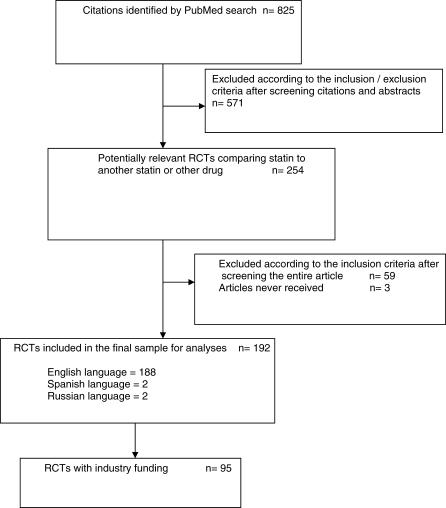
BACKGROUND: Published pharmaceutical industry-sponsored trials are more likely than non-industry-sponsored trials to report results and conclusions that favor drug over placebo. Little is known about potential biases in drug-drug comparisons. This study examined associations between research funding source, study design characteristics aimed at reducing bias, and other factors that potentially influence results and conclusions in randomized controlled trials (RCTs) of statin-drug comparisons. METHODS AND FINDINGS: This is a cross-sectional study of 192 published RCTs comparing a statin drug to another statin drug or non-statin drug. Data on concealment of allocation, selection bias, blinding, sample size, disclosed funding source, financial ties of authors, results for primary outcomes, and author conclusions were extracted by two coders (weighted kappa 0.80 to 0.97). Univariate and multivariate logistic regression identified associations between independent variables and favorable results and conclusions. Of the RCTs, 50% (95/192) were funded by industry, and 37% (70/192) did not disclose any funding source. Looking at the totality of available evidence, we found that almost all studies (98%, 189/192) used only surrogate outcome measures. Moreover, study design weaknesses common to published statin-drug comparisons included inadequate blinding, lack of concealment of allocation, poor follow-up, and lack of intention-to-treat analyses. In multivariate analysis of the full sample, trials with adequate blinding were less likely to report results favoring the test drug, and sample size was associated with favorable conclusions when controlling for other factors. In multivariate analysis of industry-funded RCTs, funding from the test drug company was associated with results (odds ratio = 20.16 [95% confidence interval 4.37-92.98], p < 0.001) and conclusions (odds ratio = 34.55 [95% confidence interval 7.09-168.4], p < 0.001) that favor the test drug when controlling for other factors. Studies with adequate blinding were less likely to report statistically significant results favoring the test drug. CONCLUSIONS: RCTs of head-to-head comparisons of statins with other drugs are more likely to report results and conclusions favoring the sponsor's product compared to the comparator drug. This bias in drug-drug comparison trials should be considered when making decisions regarding drug choice.
Overview
The claims and statistics of this paper haven’t been checked yet.
Free: it reads the open-access text and checks the first 5 claims that cite a source we can check. Create a free account to check every claim.
Integrity signals
Registry
Cites
Statistics
Figures
Verification
Claims the paper makes
The claims and statistics of this paper haven’t been checked yet.
Free: it reads the open-access text and checks the first 5 claims that cite a source we can check. Create a free account to check every claim.
Claims other papers make about this one
Each is checked against this paper’s own text: does it say what the citing paper says it does?
In the citing paper
“For example, among industry-sponsored head-to-head comparisons of statin drugs, the results favor the statin made by the company that sponsored the study [37].”
Self-check
Percentages, sums and reported differences re-computed from the paper’s own numbers.
The self-check needs the paper’s full text.
Citations
Cites
Why Most Published Research Findings Are False
Ioannidis, J. P. A. (2005) · PLoS Medicine · doi:10.1371/journal.pmed.0020124 · Cited by 10,505
Grundy, S. M., Cleeman, J. I., Merz, C. N. B., Brewer, H. B., Clark, L. T., Hunninghake, D. B., Pasternak, R. C., Smith, S. C., & Stone, N. J. (2004) · Circulation · doi:10.1161/01.cir.0000133317.49796.0e · Cited by 6,902
Schulz (1995) · doi:10.1001/jama.1995.03520290060030 · Cited by 5,634 · cited 4×
“For example, Schulz and colleagues found that estimates of treatment effects were exaggerated by 41% for inadequately concealed trials and by 17% for trials with inadequate double blinding [10].”
BackgroundInfluentialWhy Most Published Research Findings Are False
Ioannidis, J. P. A. (2005) · CHANCE · doi:10.1080/09332480.2005.10722754 · Cited by 4,702 · cited 1×
“Bias is the combination of various study design, data analysis, and presentation factors that make the results differ systematically from the truth [1].”
BackgroundPharmaceutical industry sponsorship and research outcome and quality: systematic review
Lexchin, J., Bero, L. A., Djulbegovic, B., & Clark, O. (2003) · BMJ · doi:10.1136/bmj.326.7400.1167 · Cited by 2,147 · cited 1×
“Although the association of pharmaceutical industry sponsorship with results and conclusions that favor the sponsor’s product over placebo is clear [22,23], the potential influence of funding source when the funder manufactures one of two competing drugs undergoing comparison has not been well described.”
BackgroundSelf-citationThe Hazards of Scoring the Quality of Clinical Trials for Meta-analysis
Jüni, P. (1999) · JAMA · doi:10.1001/jama.282.11.1054 · Cited by 1,981 · cited 1×
“], the unreliability of quality scores has led to the recommendation that trial quality be assessed for individual features that are aimed to reduce bias, such as concealment of allocation or blinding [”
BackgroundChan, A.-W., Hróbjartsson, A., Haahr, M. T., Gøtzsche, P. C., & Altman, D. G. (2004) · JAMA · doi:10.1001/jama.291.20.2457 · Cited by 1,845 · cited 2×
“Selective reporting of outcomes can also contribute to biased results and conclusions [4–6].”
ResultScope and Impact of Financial Conflicts of Interest in Biomedical Research: A Systematic Review
Bekelman, J. E., Li, Y., & Gross, C. P. (2003) · JAMA · doi:10.1001/jama.289.4.454 · Cited by 1,816 · cited 1×
“Although the association of pharmaceutical industry sponsorship with results and conclusions that favor the sponsor’s product over placebo is clear [22,23], the potential influence of funding source when the funder manufactures one of two competing drugs undergoing comparison has not been well described.”
BackgroundLaw, M. R., Wald, N. J., & Rudnicka, A. R. (2003) · BMJ · doi:10.1136/bmj.326.7404.1423 · Cited by 1,720 · cited 1×
“As strong evidence suggests that statins are more effective than placebo in reducing lipids [31], drug– drug comparison trials involving statins are the most relevant for making policy decisions about choosing a statin.”
BackgroundThe Existence of Publication Bias and Risk Factors for Its Occurrence
Dickersin, K. (1990) · JAMA: The Journal of the American Medical Association · doi:10.1001/jama.1990.03440100097014 · Cited by 1,417 · cited 1×
“Whether the results are reported in full, or whether there is selective reporting of outcomes can also contribute to biased results and conclusions [4–7].”
ResultDickersin, K. (1992) · JAMA · doi:10.1001/jama.1992.03480030052036 · Cited by 854
Als-Nielsen, B., Chen, W., Gluud, C., & Kjaergard, L. L. (2003) · JAMA · doi:10.1001/jama.290.7.921 · Cited by 746 · cited 3×
“Our study adds new information to the body of literature showing that pharmaceutical industry– sponsored studies comparing drug and placebo are more likely to favor the drug [14,21–23,25,27,28,39].”
BackgroundResultImpact of covert duplicate publication on meta-analysis: a case study
Tramèr, M. R., Reynolds, D. J. M., Moore, R. A., & McQuay, H. J. (1997) · BMJ · doi:10.1136/bmj.315.7109.635 · Cited by 702
Chan, A.-W., & Altman, D. G. (2005) · BMJ · doi:10.1136/bmj.38356.424606.8f · Cited by 613
Genetic associations in large versus small studies: an empirical assessment
Ioannidis, J. P., Trikalinos, T. A., Ntzani, E. E., & Contopoulos-Ioannidis, D. G. (2003) · The Lancet · doi:10.1016/s0140-6736(03)12516-0 · Cited by 579 · cited 1×
“Most studies that have attempted to identify factors that may be associated with bias have examined individual design features, including randomization [8,9], concealment of allocation [10], double blinding [9,10], sample size [11–14], choice of drug comparator [15–18], and choice of statistical analysis [19,20].”
BackgroundBhandari, M., Busse, J. W., Jackowski, D., Montori, V. M., Schünemann, H. J., Sprague, S., Mears, D., Schemitsch, E. H., Heels-Ansdell, D., & Devereaux, P. J. (2004) · Europe PMC (PubMed Central) · Cited by 551
How study design affects outcomes in comparisons of therapy. I: Medical
Colditz, G. A., Miller, J. N., & Mosteller, F. (1989) · Statistics in Medicine · doi:10.1002/sim.4780080408 · Cited by 520 · cited 1×
“Most studies that have attempted to identify factors that may be associated with bias have examined individual design features, including randomization [8,9], concealment of allocation [10], double blinding [9,10], sample size [11–14], choice of drug comparator [15–18], and choice of statistical analysis [19,20].”
BackgroundMedical Journals Are an Extension of the Marketing Arm of Pharmaceutical Companies
Smith, R. (2005) · PLoS Medicine · doi:10.1371/journal.pmed.0020138 · Cited by 498 · cited 2×
“Various factors can lead to bias in randomized controlled trials (RCTs) of drug efficacy, including framing of the research question, design and conduct of the study, and analysis of the data [2,3].”
The uncertainty principle and industry-sponsored research
Djulbegovic, B., Lacevic, M., Cantor, A., Fields, K. K., Bennett, C. L., Adams, J. R., Kuderer, N. M., & Lyman, G. H. (2000) · The Lancet · doi:10.1016/s0140-6736(00)02605-2 · Cited by 482 · cited 2×
“This can be accomplished by selecting nonequivalent doses of drugs for testing [15–17].”
BackgroundBalk, E. M. (2002) · JAMA · doi:10.1001/jama.287.22.2973 · Cited by 478 · cited 1×
“]. Recent research further suggests that specific study design characteristics are not reliably associated with treatment effect sizes across different studies and medical areas [”
Why Most Published Research Findings Are False
Ioannidis, J. P. A. (2019) · CHANCE · doi:10.1080/09332480.2019.1579573 · Cited by 463
Heres, S., Davis, J., Maino, K., Jetzinger, E., Kissling, W., & Leucht, S. (2006) · American Journal of Psychiatry · doi:10.1176/appi.ajp.163.2.185 · Cited by 450 · cited 1×
“], the potential influence of funding source when the funder manufactures one of two competing drugs undergoing comparison has not been well described. Although Heres et al. found that results of head-to-head comparisons of second-generation antipsychotics have contradictory conclusions depending on which company spon…”
ResultOutcome reporting bias in randomized trials funded by the Canadian Institutes of Health Research
Chan, A.-W. (2004) · Canadian Medical Association Journal · doi:10.1503/cmaj.1041086 · Cited by 444 · cited 2×
“Selective reporting of outcomes can also contribute to biased results and conclusions [4–6].”
ResultWhy review articles on the health effects of passive smoking reach different conclusions
Barnes, D. E. (1998) · JAMA · doi:10.1001/jama.279.19.1566 · Cited by 442 · cited 1×
“For example, study characteristics such as randomization sequence generation, concealment of allocation, blinding, sample size, or choice of drug comparator might also contribute to statistically significant results [28,29].”
BackgroundKjaergard, L., & Als-Nielsen, B. (2002) · BMJ · doi:10.1136/bmj.325.7358.249 · Cited by 433
Source of funding and outcome of clinical trials
Davidson, R. A. (1986) · Journal of General Internal Medicine · doi:10.1007/bf02602327 · Cited by 397 · cited 1×
“Although RCTs of poorer quality are more likely to reach biased conclusions [10,43,44], the unreliability of quality scores has led to the recommendation that trial quality be assessed for individual features that are aimed to reduce bias, such as concealment of allocation or blinding [45].”
BackgroundMoher, Cook, Jadad, Tugwell, Moher, Jones, Pham, & Klassen (1999) · Health Technology Assessment · doi:10.3310/hta3120 · Cited by 368
The Quality of Drug Studies Published in Symposium Proceedings
Cho, M. K., & Bero, L. A. (1996) · Annals of Internal Medicine · doi:10.7326/0003-4819-124-5-199603010-00004 · Cited by 328 · cited 1×
“For example, articles published in peerreviewed journals have superior quality compared to articles published in non-peer-reviewed journals [15,27].”
BackgroundSelf-citationRochon, P. A. (1994) · Archives of Internal Medicine · doi:10.1001/archinte.1994.00420020059007 · Cited by 277 · cited 1×
“For example, articles published in peerreviewed journals have superior quality compared to articles published in non-peer-reviewed journals [15,27].”
BackgroundRochon, P. A. (1994) · Archives of Internal Medicine · doi:10.1001/archinte.154.2.157 · Cited by 274
Relationship between conflicts of interest and research results
Friedman, L. S., & Richter, E. D. (2004) · Journal of General Internal Medicine · doi:10.1111/j.1525-1497.2004.30617.x · Cited by 258 · cited 1×
“Our study adds new information to the body of literature showing that pharmaceutical industry– sponsored studies comparing drug and placebo are more likely to favor the drug [14,21–23,25,27,28,39].”
ResultIssues in Comparisons Between Meta-analyses and Large Trials
Ioannidis, J. P. A. (1998) · JAMA · doi:10.1001/jama.279.14.1089 · Cited by 253 · cited 1×
“Most studies that have attempted to identify factors that may be associated with bias have examined individual design features, including randomization [8,9], concealment of allocation [10], double blinding [9,10], sample size [11–14], choice of drug comparator [15–18], and choice of statistical analysis [19,20].”
BackgroundUniform Requirements for Manuscripts Submitted to Biomedical Journals
(1997) · Annals of Internal Medicine · doi:10.7326/0003-4819-126-1-199701010-00006 · Cited by 247
The Landscape and Lexicon of Blinding in Randomized Trials
Schulz, K. F., Chalmers, I., & Altman, D. G. (2002) · Annals of Internal Medicine · doi:10.7326/0003-4819-136-3-200202050-00022 · Cited by 240 · cited 1×
“Previous studies showed that these specific characteristics are associated with bias in clinical trials [10,47,48].”
BackgroundInfluences on the Quality of Published Drug Studies
Bero, L. A., & Rennie, D. (1996) · International Journal of Technology Assessment in Health Care · doi:10.1017/s0266462300009582 · Cited by 226 · cited 1×
“Various factors can lead to bias in randomized controlled trials (RCTs) of drug efficacy, including framing of the research question, design and conduct of the study, and analysis of the data [2,3].”
BackgroundSelf-citationA Cohort Study of Summary Reports of Controlled Trials
Chalmers, L. (1990) · JAMA: The Journal of the American Medical Association · doi:10.1001/jama.1990.03440100117017 · Cited by 202 · cited 1×
“[38] methodological quality assessment scale to assess study design features that might be associated with results and conclusions.”
BackgroundGrundy, S. M., Cleeman, J. I., Merz, C. N. B., Brewer, H. B., Clark, L. T., Hunninghake, D. B., Pasternak, R. C., Smith, S. C., & Stone, N. J. (2004) · Arteriosclerosis, Thrombosis, and Vascular Biology · doi:10.1161/01.atv.0000133317.49796.0e · Cited by 195
Krimsky, S., & Rothenberg, L. S. (2001) · Science and Engineering Ethics · doi:10.1007/s11948-001-0041-7 · Cited by 191 · cited 1×
“Krimsky showed, however, that there is a lack of disclosure of industry research support and personal financial ties across a wide variety of journals [49,50].”
Background'Early warning systems' for identifying new healthcare technologies.
Robert, Stevens, & Gabbay (1999) · Health Technology Assessment · doi:10.3310/hta3130 · Cited by 189
DESIGN AND REPORTING MODIFICATIONS IN INDUSTRY-SPONSORED COMPARATIVE PSYCHOPHARMACOLOGY TRIALS
SAFER, D. J. (2002) · The Journal of Nervous and Mental Disease · doi:10.1097/00005053-200209000-00002 · Cited by 180 · cited 2×
“This can be accomplished by selecting nonequivalent doses of drugs for testing [15–17].”
BackgroundYaphe, J., Edman, R., Knishkowy, B., & Herman, J. (2001) · Family Practice · doi:10.1093/fampra/18.6.565 · Cited by 159 · cited 2×
“Our study adds new information to the body of literature showing that pharmaceutical industry– sponsored studies comparing drug and placebo are more likely to favor the drug [14,21–23,25,27,28,39].”
ResultControlled Studies in Clinical Cancer Research
Chalmers, T. C., Block, J. B., & Lee, S. (1972) · New England Journal of Medicine · doi:10.1056/nejm197207132870205 · Cited by 146 · cited 1×
“Most studies that have attempted to identify factors that may be associated with bias have examined individual design features, including randomization [8,9], concealment of allocation [10], double blinding [9,10], sample size [11–14], choice of drug comparator [15–18], and choice of statistical analysis [19,20].”
BackgroundOrigin and funding of the most frequently cited papers in medicine: database analysis
Patsopoulos, N. A., Ioannidis, J. P. A., & Analatos, A. A. (2006) · BMJ · doi:10.1136/bmj.38768.420139.80 · Cited by 142 · cited 1×
“The growing proportion of industry-funded studies could shift the balance of published trials more towards studies that favor new drugs [55].”
BackgroundIndustry Sponsorship and Authorship of Clinical Trials Over 20 Years
Buchkowsky, S. S., & Jewesson, P. J. (2004) · Annals of Pharmacotherapy · doi:10.1345/aph.1d267 · Cited by 134 · cited 1×
“At the same time, industry support of biomedical research has increased dramatically during the past few decades [53,54].”
BackgroundMontgomery, J. H., Byerly, M., Carmody, T. J., Li, B., Miller, D. R., Varghese, F. P., & Holland, R. (2004) · Controlled Clinical Trials · doi:10.1016/j.cct.2004.09.002 · Cited by 129 · cited 1×
“Trials supported by pharmaceutical companies are more likely than those with non-industry sponsors to report results and conclusions that are favorable towards the sponsor’s product compared to placebo [14,15,21–28].”
Problems in the Design and Reporting of Trials of Antifungal Agents Encountered During Meta-analysis
Johansen, H. K. (1999) · JAMA · doi:10.1001/jama.282.18.1752 · Cited by 128 · cited 1×
“In addition, industry sponsorship may be associated with multiple reporting of studies with favorable findings, emphasizing the imbalance towards statistically significant results in the published literature [18,41,42].”
BackgroundPublication Bias and Research on Passive Smoking: Comparison of Published and Unpublished Studies
Misakian, A. L., & Bero, L. A. (1998) · JAMA · doi:10.1001/jama.280.3.250 · Cited by 127 · cited 2×
“We extracted data on the following publication characteristics, which have been shown to be independently related to favorable results or conclusions of drug studies [8–10,13,22,27,34,35].”
BackgroundMethodSelf-citationDoes declaration of competing interests affect readers' perceptions? A randomised trial
Chaudhry, S., Schroter, S., Smith, R., & Morris, J. (2002) · BMJ · doi:10.1136/bmj.325.7377.1391 · Cited by 119 · cited 1×
“]. This trend and our finding that, for one class of drugs, the results and conclusions of trials tend to favor the drug that is made by the sponsor raises important considerations for selecting drugs within a class. Sponsorship bias, even when controlling for other confounding study characteristics, may be the main e…”
BackgroundMultiple publication of reports of drug trials.
G�tzsche, P. C. (1989) · European Journal of Clinical Pharmacology · doi:10.1007/bf00558064 · Cited by 113
Financial Interest and Its Disclosure in Scientific Publications
Krimsky, S. (1998) · JAMA · doi:10.1001/jama.280.3.225 · Cited by 89 · cited 1×
“Krimsky showed, however, that there is a lack of disclosure of industry research support and personal financial ties across a wide variety of journals [49,50].”
BackgroundProcyshyn, R. M., Chau, A., Fortin, P., & Jenkins, W. (2004) · The Canadian Journal of Psychiatry · doi:10.1177/070674370404900905 · Cited by 54 · cited 1×
“Trials supported by pharmaceutical companies are more likely than those with non-industry sponsors to report results and conclusions that are favorable towards the sponsor’s product compared to placebo [14,15,21–28].”
Ioannidis, J. P. A., Cappelleri, J. C., Sacks, H. S., & Lau, J. (1997) · Controlled Clinical Trials · doi:10.1016/s0197-2456(97)00097-4 · Cited by 49 · cited 1×
“We extracted data on the following publication characteristics, which have been shown to be independently related to favorable results or conclusions of drug studies [8–10,13,22,27,34,35].”
MethodSchulz, K. F., Chalmers, I., Altman, D. G., Grimes, D. A., & Doré, C. J. (1995) · PubMed · Cited by 49
Dorman, P. J., Counsell, C., & Sandercock, P. (1999) · Stroke · doi:10.1161/01.str.30.10.1995 · Cited by 43
Brook, O. H., van Hout, H. P. J., Nieuwenhuysea, H., & Haan, M. D. (2003) · European Neuropsychopharmacology · doi:10.1016/s0924-977x(03)00031-2 · Cited by 34 · cited 1×
“Most studies that have attempted to identify factors that may be associated with bias have examined individual design features, including randomization [8,9], concealment of allocation [10], double blinding [9,10], sample size [11–14], choice of drug comparator [15–18], and choice of statistical analysis [19,20].”
BackgroundOutcome trials of COX-2 selective inhibitors: global safety evaluation does not promise benefits
Cerezo, J. G., Hristov, R. L., Carcas, A. J., & Rodríguez, J. J. V. (2003) · European Journal of Clinical Pharmacology · doi:10.1007/s00228-003-0579-1 · Cited by 27 · cited 1×
“Most studies that have attempted to identify factors that may be associated with bias have examined individual design features, including randomization [8,9], concealment of allocation [10], double blinding [9,10], sample size [11–14], choice of drug comparator [15–18], and choice of statistical analysis [19,20].”
BackgroundRandomised trials comparing chemotherapy regimens for advanced non-small cell lung cancer
Ioannidis, J. P. A., Polycarpou, A., Ntais, C., & Pavlidis, N. A. (2003) · European Journal of Cancer · doi:10.1016/s0959-8049(03)00571-9 · Cited by 26
Quilliam, B. J., Perez, H., Andros, V., & Jones, P. J. H. (2004) · Journal of Managed Care Pharmacy · doi:10.18553/jmcp.2004.10.3.244 · Cited by 22 · cited 2×
“Eight of the nine members of the National Cholesterol Education Program panel had financial ties with pharmaceutical companies that manufactured statin drugs [51,52].”
BackgroundKelley, C., Helfand, M., Good, C. B., & Ganz, M. L. (2002) · Cited by 10
Research works printed but not linked: 2
- Institute for Scientific Information (2005) Science citation index: Journal citation reports. Philadelphia (Pennsylvania): Institute for Scientific Information. Available at: http://portal.isiknowledge.com/portal. cgi?DestApp¼JCR&Func¼Frame. Accessed 4 May 2007.
- Dickersin K, Min Y-I, Meinert C (1992) Factors influencing publication of research results. JAMA 267: 374-378.
Cited by
Moher, D., Hopewell, S., Schulz, K. F., Montori, V., Gotzsche, P. C., Devereaux, P. J., Elbourne, D., Egger, M., & Altman, D. G. (2010) · BMJ · doi:10.1136/bmj.c869 · Cited by 8,883
Moher, D., Hopewell, S., Schulz, K. F., Montori, V., Gøtzsche, P. C., Devereaux, P. J., Elbourne, D., Egger, M., & Altman, D. G. (2012) · International Journal of Surgery · doi:10.1016/j.ijsu.2011.10.001 · Cited by 2,345
Moher, D., Hopewell, S., Schulz, K. F., Montori, V., Gøtzsche, P. C., Devereaux, P. J., Elbourne, D., Egger, M., & Altman, D. G. (2010) · Journal of Clinical Epidemiology · doi:10.1016/j.jclinepi.2010.03.004 · Cited by 1,858
Industry sponsorship and research outcome
Lundh, A., Lexchin, J., Mintzes, B., Schroll, J. B., & Bero, L. (2017) · Cochrane Database of Systematic Reviews · doi:10.1002/14651858.mr000033.pub3 · Cited by 1,697
Self-citationBoutron, I. (2010) · JAMA · doi:10.1001/jama.2010.651 · Cited by 842
Metadata
- Authors
- Bero, L., Oostvogel, F., Bacchetti, P., & Lee, K.
- Affiliations
- University of California, San Francisco (US)
- Leiden University (NL)
- Corresponding author
- Bero, Lisa
- Venue
- PLoS Medicine
- Publisher
- Public Library of Science (PLoS)
- Published
- 2007-06-05
- Volume
- 4
- Issue
- 6
- Pages
- e184
- ISSN
- 1549-1277 (ISSN-L)
- 1549-1676
- PMC
- PMC1885451
- OpenAlex
- W2152340675
- Cited by
- 249
- References
- 58
- Citations by year
- 2026: 3 · 2025: 3 · 2024: 7 · 2023: 9 · 2022: 6 · 2021: 7 · 2020: 9 · 2019: 10 · 2018: 15 · 2017: 9 · 2016: 10 · 2015: 16 · 2014: 20 · 2013: 19 · 2012: 17
- FWCI
- 20.19
- Type
- journal article
- Language
- en
- Open access
- gold
- doi.org
- Locations
- PLoS Medicine (publishedVersion, cc-by)
- PubMed Central (publishedVersion, cc-by)
- PubMed (publishedVersion)
- RePEc: Research Papers in Economics (submittedVersion)
- DOAJ (DOAJ: Directory of Open Access Journals) (submittedVersion, cc-by-sa)
- eScholarship (California Digital Library) (submittedVersion)
- eScholarship (California Digital Library) (submittedVersion, cc-by)
- Figshare (submittedVersion, cc-by)
- DigitalGeorgetown (Georgetown University Library) (submittedVersion)
- Funders
- Tobacco-Related Disease Research Program
- University of California, San Francisco
- Topics
- Health Sciences › Nursing › Issues, ethics and legal aspects › Pharmaceutical industry and healthcare
- Physical Sciences › Mathematics › Statistics and Probability › Statistical Methods in Clinical Trials
- Social Sciences › Decision Sciences › Statistics, Probability and Uncertainty › Meta-analysis and systematic reviews
- Keywords
- statins, pharmaceutical industry sponsorship, publication bias, trial bias, blinding, allocation concealment, surrogate endpoints, sample size, financial conflicts of interest, randomized controlled trials, intention-to-treat analysis, primary outcome reporting
- MeSH terms
- Drug Industry, Humans, Research Support as Topic, Randomized Controlled Trials as Topic, Conflict of Interest, Treatment Outcome, Publication Bias, Hydroxymethylglutaryl-CoA Reductase Inhibitors
About these checks
Registry, retraction, Cites and statistics results are computed, not judged, with one exception: a printed reference that no index lists is read once by a model before it counts as a citation error. Claims are extracted by a model and kept only when their quote appears verbatim in the text; each cited source is then checked, with a model’s help, for whether it says what the claim relies on. Those verdicts can be wrong — read the claim’s quote and the cited source before relying on one.
Statistics and arithmetic are recomputed, not judged.
Confidence bands are shown only for fields calibrated on our annotated test set. None is calibrated yet, so no band is shown.
What counts as a claim ›How we measure confidence ›How we check this ›
Are you an author, or do you see a problem with this page? Request a review
Data sources
Bibliographic data: Semantic Scholar, OpenAlex, Crossref.
Contains information from the Semantic Scholar Academic Graph Datasets, made available under the ODC Attribution License (ODC-BY 1.0).
Semantic Scholar’s data is described in: Kinney, R., et al. (2023). The Semantic Scholar Open Data Platform. arXiv:2301.10140.
