

Quantifying the Number of Pregnancies at Risk of Malaria in 2007: A Demographic Study
Open accessThe DOI matches its Crossref record; 31 of the 33 references it cites were found in a registry or an index.
Abstract
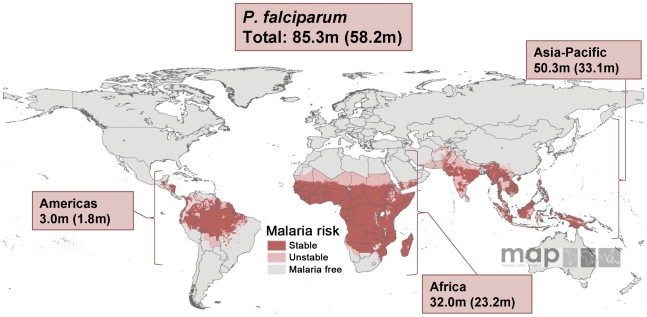
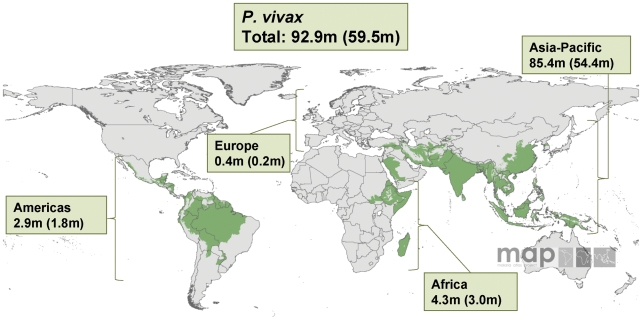
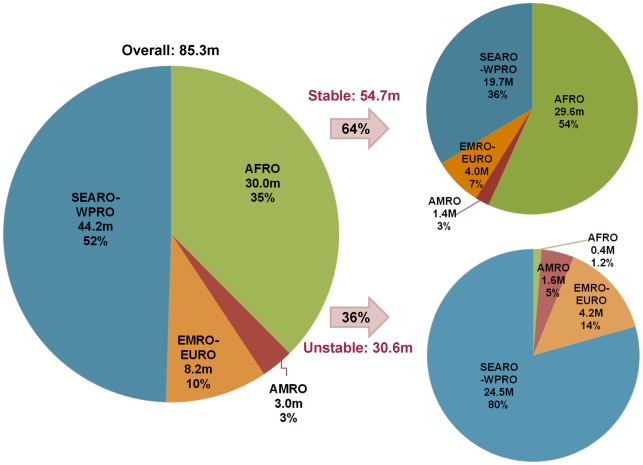
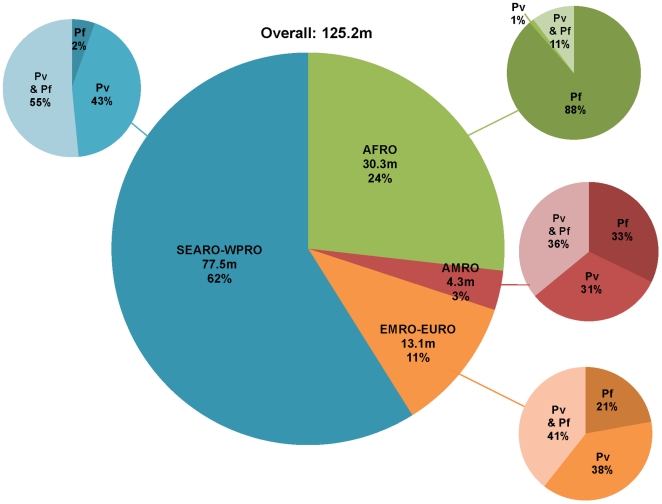
BACKGROUND: Comprehensive and contemporary estimates of the number of pregnancies at risk of malaria are not currently available, particularly for endemic areas outside of Africa. We derived global estimates of the number of women who became pregnant in 2007 in areas with Plasmodium falciparum and P. vivax transmission. METHODS AND FINDINGS: A recently published map of the global limits of P. falciparum transmission and an updated map of the limits of P. vivax transmission were combined with gridded population data and growth rates to estimate total populations at risk of malaria in 2007. Country-specific demographic data from the United Nations on age, sex, and total fertility rates were used to estimate the number of women of child-bearing age and the annual rate of live births. Subregional estimates of the number of induced abortions and country-specific stillbirths rates were obtained from recently published reviews. The number of miscarriages was estimated from the number of live births and corrected for induced abortion rates. The number of clinically recognised pregnancies at risk was then calculated as the sum of the number of live births, induced abortions, spontaneous miscarriages, and stillbirths among the population at risk in 2007. In 2007, 125.2 million pregnancies occurred in areas with P. falciparum and/or P. vivax transmission resulting in 82.6 million live births. This included 77.4, 30.3, 13.1, and 4.3 million pregnancies in the countries falling under the World Health Organization (WHO) regional offices for South-East-Asia (SEARO) and the Western-Pacific (WPRO) combined, Africa (AFRO), Europe and the Eastern Mediterranean (EURO/EMRO), and the Americas (AMRO), respectively. Of 85.3 million pregnancies in areas with P. falciparum transmission, 54.7 million occurred in areas with stable transmission and 30.6 million in areas with unstable transmission (clinical incidence <1 per 10,000 population/year); 92.9 million occurred in areas with P. vivax transmission, 53.0 million of which occurred in areas in which P. falciparum and P. vivax co-exist and 39.9 million in temperate regions with P. vivax transmission only. CONCLUSIONS: In 2007, 54.7 million pregnancies occurred in areas with stable P. falciparum malaria and a further 70.5 million in areas with exceptionally low malaria transmission or with P. vivax only. These represent the first contemporary estimates of the global distribution of the number of pregnancies at risk of P. falciparum and P. vivax malaria and provide a first step towards a more informed estimate of the geographical distribution of infection rates and the corresponding disease burden of malaria in pregnancy.
Overview
The claims and statistics of this paper haven’t been checked yet.
Free: it reads the open-access text and checks the first 5 claims that cite a source we can check. Create a free account to check every claim.
Integrity signals
Registry
Cites
Statistics
Figures
Verification
Claims the paper makes
The claims and statistics of this paper haven’t been checked yet.
Free: it reads the open-access text and checks the first 5 claims that cite a source we can check. Create a free account to check every claim.
Claims other papers make about this one
Each is checked against this paper’s own text: does it say what the citing paper says it does?
The cited source doesn’t support the claim as written.
In the citing paper
“Previous estimates of pregnancies at risk of malaria have used the same metric [20, 38]”
From Global estimates of pregnancies at risk of Plasmodium falciparum and Plasmodium vivax infection in 2020 and changes in risk patterns since 2000 (2022) · cites this paper as [20]
Checked by a reasoning model — may be wrong.
Experimental — accuracy not yet measuredThe source backs part of the claim, not all of it — or backs it for a different population, condition or comparison.
In the citing paper
“In the absence of an effective vaccine, malaria during pregnancy remains a significant public health problem [19].”
From Current update on malaria in pregnancy: a systematic review (2025) · cites this paper as [19]
Experimental — accuracy not yet measuredThe source backs part of the claim, not all of it — or backs it for a different population, condition or comparison.
In the citing paper
“In addition, the genetic diversity of P.vivax is remarkable, with the existence of different haplotypes (groups of genetic variations) and the ability to develop at lower temperatures, in contrast to the lower genetic diversity observed in P.falciparum.”
From Current update on malaria in pregnancy: a systematic review (2025) · cites this paper as [163]
Experimental — accuracy not yet measuredThe source backs part of the claim, not all of it — or backs it for a different population, condition or comparison.
In the citing paper
“A phylogenetic analysis examining the evolutionary relationships between the organisms shows that the P.vivax population is globally distributed among pregnant women [163–166].”
From Current update on malaria in pregnancy: a systematic review (2025) · cites this paper as [163]
Experimental — accuracy not yet measuredThe source backs part of the claim, not all of it — or backs it for a different population, condition or comparison.
In the citing paper
“Interestingly, P.falciparum has been linked to specific genotypes associated with asymptomatic infections at the time of delivery.”
From Current update on malaria in pregnancy: a systematic review (2025) · cites this paper as [164]
Experimental — accuracy not yet measured
15 more claims about this paper
Create a free account to see every claim other papers make about this one.
Self-check
Percentages, sums and reported differences re-computed from the paper’s own numbers.
The self-check needs the paper’s full text.
Citations
Cites
The global distribution of clinical episodes of Plasmodium falciparum malaria
Snow, R. W., Guerra, C. A., Noor, A. M., Myint, H. Y., & Hay, S. I. (2005) · Nature · doi:10.1038/nature03342 · Cited by 2,741 · cited 2×
“falciparum [12] due to its global epidemiological significance [13] and better prospects for its control and local elimination [14].”
BackgroundMethodSelf-citationDivision, U. P. (1991) · Cited by 1,434
Epidemiology and burden of malaria in pregnancy
Desai, M., ter Kuile, F. O., Nosten, F., McGready, R., Asamoa, K., Brabin, B., & Newman, R. D. (2007) · The Lancet Infectious Diseases · doi:10.1016/s1473-3099(07)70021-x · Cited by 1,432 · cited 2×
“Although malaria in pregnancy is associated with miscarriages and stillbirths [30], the majority of the health and economic burden is likely through the impact on pregnancies that result in live births by increasing the risk of preterm births and low birth-weight [30] and by modifying the susceptibility to malaria in…”
BackgroundA new world malaria map: Plasmodium falciparum endemicity in 2010
Gething, P. W., Patil, A. P., Smith, D. L., Guerra, C. A., Elyazar, I. R., Johnston, G. L., Tatem, A. J., & Hay, S. I. (2011) · Malaria Journal · doi:10.1186/1475-2875-10-378 · Cited by 1,146
Self-citationThe global distribution and population at risk of malaria: past, present, and future
Hay, S. I., Guerra, C. A., Tatem, A. J., Noor, A. M., & Snow, R. W. (2004) · The Lancet Infectious Diseases · doi:10.1016/s1473-3099(04)01043-6 · Cited by 1,001 · cited 3×
“It is the major cause of malaria in much of Asia and Latin America [6] [7], and recent evidence has shown that P. vivax infections are far from benign and can result in significant morbidity in pregnant women with serious consequences for maternal and infant health [8] [9] [10].”
BackgroundSelf-citationSnow, R. W., Craig, M., Deichmann, U., & Marsh, K. (1999) · PubMed · Cited by 735
Self-citationA World Malaria Map: Plasmodium falciparum Endemicity in 2007
Hay, S. I., Guerra, C. A., Gething, P. W., Patil, A. P., Tatem, A. J., Noor, A. M., Kabaria, C. W., Manh, B. H., Elyazar, I. R. F., Brooker, S., et al. (2009) · PLoS Medicine · doi:10.1371/journal.pmed.1000048 · Cited by 505 · cited 8×
“falciparum transmission intensity model of risk within the defined stable limits which was developed recently by the Malaria Atlas Project [31], allowing disease impact calculations across multiple transmission strata to be made.”
BackgroundInfluentialSelf-citationStillbirth rates: delivering estimates in 190 countries
Stanton, C., Lawn, J. E., Rahman, H., Wilczynska-Ketende, K., & Hill, K. (2006) · The Lancet · doi:10.1016/s0140-6736(06)68586-3 · Cited by 495 · cited 1×
“[25] that derived data from vital registration, demographic and health surveys (DHS), and data from study reports integrated into a regression model.”
MethodDetermining Global Population Distribution: Methods, Applications and Data
Balk, D. L., Deichmann, U., Yetman, G., Pozzi, F., Hay, S. I., & Nelson, A. (2006) · Advances in Parasitology · doi:10.1016/s0065-308x(05)62004-0 · Cited by 490 · cited 2×
“The Global Rural-Urban Mapping Project (GRUMP) alpha version provides gridded population counts and population density estimates for the years 1990, 1995, and 2000, both adjusted and unadjusted to the United Nations’ national population estimates [11,20].”
BackgroundMethodInduced abortion: estimated rates and trends worldwide
Sedgh, G., Henshaw, S., Singh, S., Åhman, E., & Shah, I. H. (2007) · The Lancet · doi:10.1016/s0140-6736(07)61575-x · Cited by 474
Research works printed but not linked: 3
- United Nations Children's Fund 1998 The state of the world's children New York Oxford University Press
- Leridon H 1977 Human fertility: the basic components (Table 4.20) Chicago University of Chicago Press
- Hammerslough CR 1992 Estimating the probability of spontaneous abortion in the presence of induced abortion and vice versa. Public Health Rep 107 269 277 1594736 PMC1403646
Cited by
Items 401–486 of 486
Barriers to malaria prevention services in pregnancy: a multi-methods study in rural western Uganda
Horowitz, R. A. C., Ngelese, H., Baguma, E., Nyangoma, G., Bwambale, S., Ntaro, M., Mulogo, E. M., & Boyce, R. M. (2025) · BMC Public Health · doi:10.1186/s12889-025-24314-7 · Cited by 3
“Of these, approximately 25 million women were infected with Plasmodium falciparum or Plasmodium vivax during pregnancy [2].”
Malaria immunity in the infant: progress and pitfalls
Feeney, M. E. (2026) · Current Opinion in Immunology · doi:10.1016/j.coi.2026.102756 · Cited by 1
Zafindraibe, N. J., Razafindrakoto, A. C., Zemey, C. B., Rakotozandrindrainy, R., Rasamindrakotroka, A., & Razanakolona, L. R.-S. (2026) · Malaria Journal · doi:10.1186/s12936-026-05901-4 · Cited by 1
“Several studies have also shown that placental infection significantly disrupts maternal ‒ fetal exchanges and is one of the main determinants of low birth weight [3, 4].”
Malaria in Pregnancy: Key Points for the Neonatologist
Rent, S. M., Bauserman, M., Laktabai, J., Tshefu, A. K., & Taylor, S. M. (2023) · NeoReviews · doi:10.1542/neo.24-9-e539 · Cited by 1
Jain, V., SHARMA, R. K., Shukla, M. M., KHOSLA, K. K., Singh, N., & Shanmugam, R. (2024) · The National Medical Journal of India · doi:10.25259/nmji_535_21 · Cited by 1
Squire, S. B. (2015) · BMC Proceedings · doi:10.1186/1753-6561-9-s10-s2 · Cited by 1
Strategies for the prevention of malaria in pregnancy in Indonesia in the COVID-19 pandemic era
Prawira-Putra, A., Lukito, T., & Ahmed, R. (2020) · International Journal of Community Medicine and Public Health · doi:10.18203/2394-6040.ijcmph20202572 · Cited by 1
“4 million Indonesian women every year are still risking their pregnancies to malaria exposure.(10) Infections from both Plasmodium falciparum and Plasmodium vivax, the two most prevalent malaria species in Indonesia, in”
BackgroundDantara, T. W. I., & Aritonang, D. C. (2023) · Paediatrica Indonesiana · doi:10.14238/pi63.1.2023.1-6 · Cited by 2
Wanjiku, G. W. (2011) · Cited by 1
Malaria in Pregnancy: An Unrecognized Risk Factor for Neuropsychiatric Disease in Offspring?
Tran, V., Weckman, A. M., & Kain, K. C. (2016) · Pediatric Infectious Diseases Open Access · doi:10.21767/2573-0282.100016 · Cited by 1
“Approximately 125 million pregnant women are at risk of MIP each year and over 85 million of these occur in areas with stable Plasmodium falciparum transmission [5].”
BackgroundThe Impact of Malaria in Pregnancy on Infant Susceptibility to Malaria Infection
Indrawanti, R., Wijayanti, M. A., Hakimi, M., Juffrie, M., Kenangalem, E., Burdam, F. H., Trianty, L., Noviyanti, R., Syafruddin, D., Ahmed, R., et al. (2018) · Journal of the Medical Sciences (Berkala Ilmu Kedokteran) · doi:10.19106/jmedsci005002201807 · Cited by 2
Malaria and Malnutrition during Pregnancy: An Investigation of Interactions and Interventions.
Cates, J. (2017) · Carolina Digital Repository (University of North Carolina at Chapel Hill) · doi:10.17615/yx5h-wt35 · Cited by 2
OBIMBO, M., Qureshi, Z. I., & OGENGO, A. (2017) · Journal of Obstetrics and Gynaecology of Eastern and Central Africa · doi:10.59692/jogeca.v29i1.347 · Cited by 2
The Placenta and Plasmodium Infections: a Case Study from Blue Nile State, Sudan
Omer, S. A., & Sulaiman, S. M. (2020) · Current Tropical Medicine Reports · doi:10.1007/s40475-020-00214-1 · Cited by 2
“Pregnant women are more susceptible to Plasmodium infections than the general population with 2- to 3-fold increased risk of malaria infection [1, 3, 4], due to hormonal alterations [5], pregnancy-related immune suppression, and cell sequestration in the placenta [6, 7].”
BackgroundTREATMENT AND PREVENTION OF MALARIA IN AFRICAN PREGNANCY
EL-TAWDY, A., Elnakib, M., & Morsy, T. A. (2018) · Journal of the Egyptian Society of Parasitology · doi:10.12816/0050438 · Cited by 2
“Dellicour et al. (2010) reported that 125 million women in the malaria-endemic areas become pregnant each year and require protection from infection to avoid disease and death for themselves and their offspring.”
BackgroundChallenges for the stakeholders
Engers, H. D. (2014) · doi:10.2217/fmeb2013.13.234 · Cited by 1
Madanitsa, M. (2016) · University of Liverpool · doi:10.17638/02003527 · Cited by 1
Conroy, A. L. (2012) · TSpace (University of Toronto) · Cited by 2
Yadav, V., Bairwa, M. L., Dabar, D., Goel, A. D., Palepu, S., & Joshi, A. (2020) · medRxiv · doi:10.1101/2020.07.19.20157081 · Cited by 1
Heng, S., O’Meara, W. P., Simmons, R., & Small, D. S. (2020) · arXiv (Cornell University) · doi:10.48550/arxiv.2012.00860 · Cited by 1
Mosha, D. (2014) · edoc (University of Basel) · doi:10.5451/unibas-006310194
Hristov, A. D. (2014) · Digital Library of Theses and Dissertations (Universidade de São Paulo) · doi:10.11606/d.5.2014.tde-20102014-122710
Okuma, P. O. (2012) · UvA-DARE (University of Amsterdam)
Papel dos receptores do tipo Toll (TLRs) na imunopatogênese da malária associada à gravidez.
da Silva, L. G. (2011) · Digital Library of Theses and Dissertations (Universidade de São Paulo) · doi:10.11606/d.42.2011.tde-21032012-160144
Antimalarial drug combinations for treating uncomplicated malaria in pregnancy
Tagbor, H. K., Mahama, R. P., & Antwi, G. (2015) · Cochrane Database of Systematic Reviews · doi:10.1002/14651858.cd011832
RetractedPereira, K. R. B. (2012) · Digital Library of Theses and Dissertations (Universidade de São Paulo) · doi:10.11606/d.42.2012.tde-19092012-110423
Studies on severe manifestations in experimental rodent malaria
山越, 祥. (2014) · Institutional Repositories DataBase (IRDB) · doi:10.15083/00006923
Ibitokou, A. A. A. S. (2013) · theses.fr (ABES) · doi:10.70675/b940f61dzee5dz46e1za646z2b6d29f41b9d
The potency of finding a new antimalarial drug from Indonesian sea
Murtihapsari, M., & Chasanah, E. (2010) · SQUALEN Bulletin of Marine and Fisheries Postharvest and Biotechnology · doi:10.15578/squalen.v5i3.51 · Cited by 1
Massougbodji, A. (2014) · UvA-DARE (University of Amsterdam)
Dellicour, S. (2014) · UvA-DARE (University of Amsterdam)
Self-citationControl of Malaria During Pregnancy: Treatment of Uncomplicated Malaria and Complicated Malaria
D’Alessandro, U., & Hamel, M. J. (2015) · Springer eBooks · doi:10.1007/978-1-4614-8326-7_70
Value of additional chemotherapy for malaria in pregnancy
Fernandes, S. M. S. (2015)
Development of medicines for the control and elimination of malaria
Burrows, J. N., & Wells, T. N. C. (2016) · Wiley eBooks · doi:10.1002/9781118493816.ch13 · Cited by 1
Nasir, I., Mustapha, J. O., Dangana, A., Musa, P. O., Babayo, A., Usman, Y., Ugboaja, N. B., & Zakari, M. M. (2016) · Al-Azhar Assiut Medical Journal · doi:10.4103/1687-1693.200151
Elsheikh, H., Adam, I., Elhassan, E. M., Mohammed, A. A., Khamis, A. H., & Elbashir, M. I. (2017) · F1000Research · doi:10.12688/f1000research.10641.1
“Almost one fifth of these pregnant women are at risk of malaria (Dellicour et al., 2010; Desai et al., 2007).”
BackgroundCressman, A. M. (2012) · TSpace (University of Toronto)
The Spatio-Temporal Distribution of Malaria in Samfya District
Muzyamba, C. M. (2017) · Texila international journal of academic research · doi:10.21522/tijar.2014.04.01.art002
“Consequently, the foetus was exposed to malaria in utero (Dellicour et al. 2010).”
BackgroundEvaluation of Antimalarial Drug use in Tertiary Care Teaching Hospital
Deshpande, A. S., Shalavadi, M. H., Patel, H. B., Vasoya, A. D., Kotwal, R., & Chandrashekhar, V. M. (2017) · Indian Journal of Pharmacy Practice · doi:10.5530/ijopp.10.3.41
Elgalil, E. A. E. N., Mohammed, E., Ibrahim, E., Fathelrahman, M., Idris, A. M., & Mohammed, B. (2018) · International Journal of Scientific and Research Publications · doi:10.29322/ijsrp.8.6.2018.p7874 · Cited by 1
“Over 125 million pregnancies are at risk of malaria infection every year (Dellicour et al., 2010), resulting in 10,000 maternal and 100,000-200,000 infant deaths annually (WHO; Desai et al., 2007).”
BackgroundImplications of placental malaria on neurocognition
Okojie, A., Okobi, O. E., & Iyare, E. E. (2017) · Nigerian Journal of Experimental and Clinical Biosciences · doi:10.4103/njecp.njecp_3_18
Nutritional Anemia and Its Non-Nutritional Influences in the Developing World
Shaw, J. G., Gutierrez, J., & Friedman, J. F. (2019) · Cambridge University Press eBooks · doi:10.1017/9781139023993.005
Gavina, K. (2018) · ERA: Education and Research Archive (University of Alberta) · doi:10.7939/r3w08wz46
Cintra, A. P. (2019) · Digital Library of Theses and Dissertations (Universidade de São Paulo) · doi:10.11606/d.42.2019.tde-25042019-162413
Dombrowski, J. G. (2019) · Digital Library of Theses and Dissertations (Universidade de São Paulo) · doi:10.11606/t.42.2019.tde-18042019-161119
Determinants of Sulfadoxine-Pyrimethamine Prescription During Antenatal Visits in Kenya
Tally, L. (2014) · Carolina Digital Repository (University of North Carolina at Chapel Hill) · doi:10.17615/4yhq-mv11
Anayochukwu-Ugwu, N., & Ugwu, I. A. (2020) · Journal of Gynecology and Obstetrics · doi:10.11648/j.jgo.20200801.12
Özarslan, N., & Gaw, S. L. (2021) · EBioMedicine · doi:10.1016/j.ebiom.2021.103726
“An estimated 85 million pregnancies are at risk of malaria each year [1].”
BackgroundRovira-Vallbona, E. (2011) · Dipòsit Digital de la Universitat de Barcelona (Universitat de Barcelona)
Govindan, V. P., & Purushothama, K. M. (2022) · Infectious Disorders - Drug Targets · doi:10.2174/1871526522666220110163945
Gonçalves, B. P., Fried, M., & Duffy, P. E. (2016) · Wiley eBooks · doi:10.1002/9781118493816.ch16 · Cited by 3
Maïga, B., & Ayeh-Kumi, P. F. (2017) · Infectious diseases · doi:10.1002/9781119085751.ch12
Roy, S. S. (2018) · Springer climate · doi:10.1007/978-3-319-75777-3_3 · Cited by 1
Sorvillo, F. J., Shafir, S., & Bristow, B. N. (2015) · doi:10.1093/med/9780199661756.003.0215
Malaria in Pregnancy: A Maternal and Infant Health Problem
Menéndez, C., Bardají, A., & González, R. (2015) · Springer eBooks · doi:10.1007/978-1-4614-8326-7_61
Chua, C. L. L. (2016) · Springer eBooks · doi:10.1007/978-3-662-43978-4_3493
Chua, C. L. L. (2016) · Springer eBooks · doi:10.1007/978-3-642-27769-6_3493-1
(2020) · ARC Journal of Public Health and Community Medicine · doi:10.20431/2456-0596.0502004
“up to 200,000 babies die as a result [2].”
BackgroundSilva, N. R. M. (2019) · Digital Library of Theses and Dissertations (Universidade de São Paulo) · doi:10.11606/d.42.2019.tde-13032023-182319
A caracterização do papel das células dendríticas no recrudescimento da malária na gestação.
Gomez, O. J. M. (2018) · Digital Library of Theses and Dissertations (Universidade de São Paulo) · doi:10.11606/t.42.2018.tde-17112021-125543
Chukwu, L. C., Azubuike, E. J., Olisa, C. L., OGABIDO, C. A., Ramalan, M. A., Innocent, O. C., Nwankwo, M. E., Ezeigwe, C. O., & Uzodinma, C. B. (2023) · International Journal of Research and Innovation in Applied Science · doi:10.51584/ijrias.2023.8415
(2024) · The Egyptian Journal of Hospital Medicine · doi:10.21608/ejhm.2024.338327
“Due to the increased iron needs during pregnancy, pregnant women are more vulnerable to anaemia (9) .”
BackgroundMURITALA, W. O., Atanda, O. O. A., Owonikoko, K., SULEIMAN, S. T., ADESOPE, T. P., & Adeniji, A. (2024) · Research Square · doi:10.21203/rs.3.rs-4478225/v1
Chagas disease, malaria, and less common protozoan and helminth infections
John, A. R. O. (2024) · Elsevier eBooks · doi:10.1016/b978-0-323-79525-8.00043-3
Chishimba, N. C., Phiri, C., & Mpundu, G. (2024) · International Journal of Science and Healthcare Research · doi:10.52403/ijshr.20240432
The impact of acacetin on proguanil metabolism: An in vitro and in vivo study
Fu, H., Jiang, S., Wang, P., Li, R., Wu, J., Cao, L., Yu, Y., & Jiang, Z. (2025) · Biochemical Pharmacology · doi:10.1016/j.bcp.2025.117539
Malaria in pregnancy: phagocytosis and HIV
Ataíde, R. (2011) · Portuguese National Funding Agency for Science, Research and Technology (RCAAP Project by FCT) · doi:10.34626/wjfp-5976
Unger, H. W., Bleicher, A., Ome‐Kaius, M., Aitken, E. H., & Rogerson, S. J. (2022) · Figshare · doi:10.6084/m9.figshare.19906063
Additional file 2 of How many mosquito nets are needed to maintain universal coverage: an update
Koenker, H. M., Yukich, J., Erskine, M., Opoku, R., Sternberg, E. D., & Kilian, A. (2023) · Figshare · doi:10.6084/m9.figshare.23612455
Additional file 3 of How many mosquito nets are needed to maintain universal coverage: an update
Koenker, H. M., Yukich, J., Erskine, M., Opoku, R., Sternberg, E. D., & Kilian, A. (2023) · Figshare · doi:10.6084/m9.figshare.23612458
Okoli, C. I., Hajizadeh, M., Rahman, M. M., & Khanam, R. (2021) · Figshare · doi:10.6084/m9.figshare.14905725
Additional file 1 of MAIP: a web service for predicting blood‐stage malaria inhibitors
Bosc, N., Felix, E., Arcila, R., Mendez, D., Saunders, M. R., Green, D. V. S., Ochoada, J., Shelat, A. A., Martin, É., Iyer, P., et al. (2021) · Figshare · doi:10.6084/m9.figshare.14091105
Additional file 1 of How many mosquito nets are needed to maintain universal coverage: an update
Koenker, H. M., Yukich, J., Erskine, M., Opoku, R., Sternberg, E. D., & Kilian, A. (2023) · Figshare · doi:10.6084/m9.figshare.23612452
Hill, J., Ouma, P., Oluoch, S., Bruce, J., Kariuki, S., Desai, M. R., & Webster, J. (2020) · Figshare · doi:10.6084/m9.figshare.13290995
Mutanyi, J. A., Onguru, D., Ogolla, S., & Adipo, L. B. (2021) · Figshare · doi:10.6084/m9.figshare.15128588
Manhas, P. L., Sehgal, R., Radotra, B. D., Mewara, A., & Malhotra, P. (2023) · Research Square · doi:10.21203/rs.3.rs-3327515/v1
Odediji, S. A., Busari, L. O., Olawuyi, A., Amoo, K. O., Amoo-Adeboye, B. O., Surakat, O. A., & Adeleke, M. A. (2026) · Malaria Journal · doi:10.1186/s12936-025-05752-5
“In sub ‐ Saharan Africa alone, millions of women become pregnant within malaria ‐ endemic zones, and maternal infection has been estimated to contribute to 75,000– 200,000 infant deaths annually [3].”
du Manoir, M. (2018) · theses.fr (ABES) · doi:10.70675/643840b8zbf54z4b4czaca6zde828b6bd591
Jain, V., Shanmugam, R., Singh, P. P., & Singh, V. P. (2026) · Acta Tropica · doi:10.1016/j.actatropica.2026.108164
Amoah, W. W., Manfo, S. A., Mensah, R. O., Mensah, O. N., Livingston, B., & Ansu-Frimpong, S. (2026) · African Research Reports · doi:10.65221/0311
Malaria prevalence and associated factors among pregnant women in Arua City, Northwestern Uganda
Masika, F. B., Opoke, R., Kesawat, M. S., Ddamulira, G., Caku, J., Anywar, G., & Masika, F. B. (2026) · Journal of Interventional Epidemiology and Public Health · doi:10.37432/jieph-d-26-00289
Metadata
- Authors
- Dellicour, S., Tatem, A. J., Guerra, C. A., Snow, R. W., & ter Kuile, F. O.
- Affiliations
- Liverpool School of Tropical Medicine (GB)
- Kenya Medical Research Institute (KE)
- Venue
- PLoS Medicine
- Publisher
- Public Library of Science (PLoS)
- Published
- 2010-01-26
- Volume
- 7
- Issue
- 1
- Pages
- e1000221
- ISSN
- 1549-1277 (ISSN-L)
- 1549-1676
- PMC
- PMC2811150
- OpenAlex
- W2150567785
- Cited by
- 490
- References
- 33
- Citations by year
- 2026: 6 · 2025: 11 · 2024: 16 · 2023: 12 · 2022: 19 · 2021: 20 · 2020: 36 · 2019: 45 · 2018: 38 · 2017: 37 · 2016: 37 · 2015: 56 · 2014: 45 · 2013: 37 · 2012: 39
- FWCI
- 35.63
- Type
- journal article
- Language
- en
- Open access
- gold
- doi.org
- Locations
- PLoS Medicine (publishedVersion, cc-by)
- PubMed Central (publishedVersion, cc-by)
- PubMed (publishedVersion)
- LSTM Online Archive (Liverpool School of Tropical Medicine) (acceptedVersion)
- ePrints Soton (University of Southampton) (acceptedVersion)
- Data Archiving and Networked Services (DANS) (submittedVersion)
- UvA-DARE (University of Amsterdam) (submittedVersion, other-oa)
- DOAJ (DOAJ: Directory of Open Access Journals) (submittedVersion, cc-by-sa)
- Figshare (submittedVersion, cc-by)
- Data Archiving and Networked Services (DANS) (submittedVersion, other-oa)
- Greater South Information System
- Funders
- Bill and Melinda Gates Foundation (49446)
- Wellcome Trust (079080, 079091)
- Topics
- Health Sciences › Medicine › Public Health, Environmental and Occupational Health › Malaria Research and Control
- Health Sciences › Medicine › Pediatrics, Perinatology and Child Health › Global Maternal and Child Health
- Health Sciences › Medicine › Public Health, Environmental and Occupational Health › Reproductive Health and Contraception
- Keywords
- malaria in pregnancy, Plasmodium falciparum, Plasmodium vivax, women of child-bearing age, live birth, abortion, stillbirth, miscarriage, WHO regions, Southeast Asia, western Pacific, Africa, Americas
- MeSH terms
- Abortion, Spontaneous, Abortion, Induced, Female, Humans, Malaria, Plasmodium falciparum, Plasmodium vivax, Pregnancy, Pregnancy Outcome, Risk, Pregnancy Complications, Parasitic, Incidence
About these checks
Registry, retraction, Cites and statistics results are computed, not judged, with one exception: a printed reference that no index lists is read once by a model before it counts as a citation error. Claims are extracted by a model and kept only when their quote appears verbatim in the text; each cited source is then checked, with a model’s help, for whether it says what the claim relies on. Those verdicts can be wrong — read the claim’s quote and the cited source before relying on one.
Statistics and arithmetic are recomputed, not judged.
Confidence bands are shown only for fields calibrated on our annotated test set. None is calibrated yet, so no band is shown.
What counts as a claim ›How we measure confidence ›How we check this ›
Are you an author, or do you see a problem with this page? Request a review
Data sources
Bibliographic data: Semantic Scholar, OpenAlex, Crossref.
Contains information from the Semantic Scholar Academic Graph Datasets, made available under the ODC Attribution License (ODC-BY 1.0).
Semantic Scholar’s data is described in: Kinney, R., et al. (2023). The Semantic Scholar Open Data Platform. arXiv:2301.10140.
