

The DOI matches its Crossref record; 68 of the 68 references it cites were found in a registry or an index.
Association between fatty acid metabolism in the brain and Alzheimer disease neuropathology and cognitive performance: A nontargeted metabolomic study
Open accessAbstract
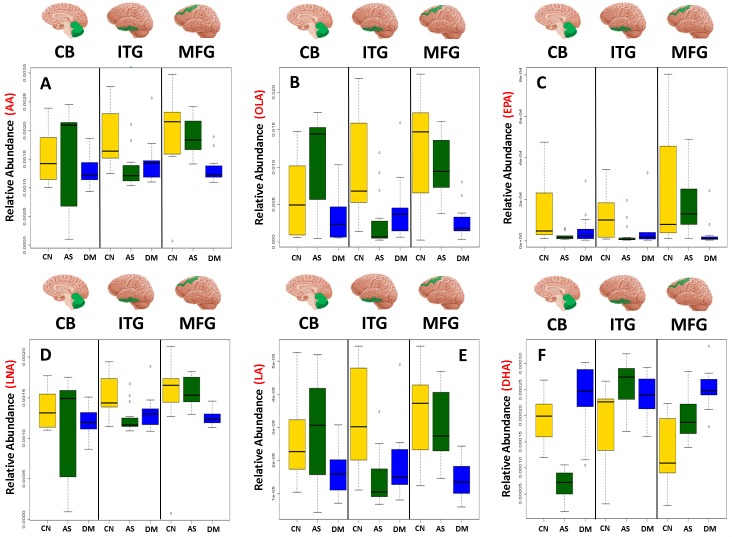
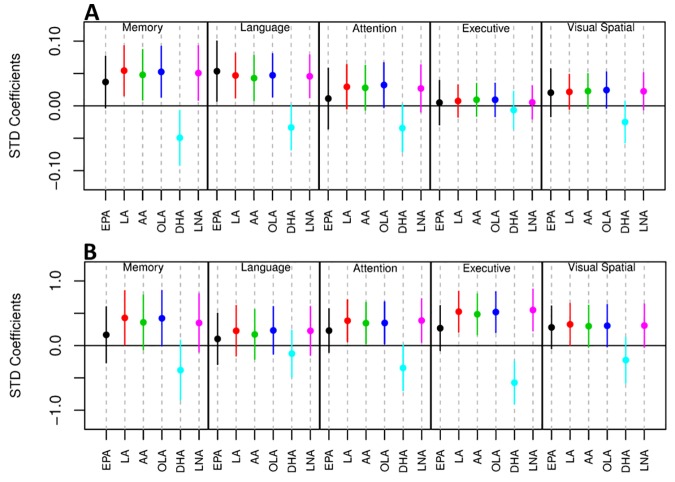
BACKGROUND: The metabolic basis of Alzheimer disease (AD) pathology and expression of AD symptoms is poorly understood. Omega-3 and -6 fatty acids have previously been linked to both protective and pathogenic effects in AD. However, to date little is known about how the abundance of these species is affected by differing levels of disease pathology in the brain. METHODS AND FINDINGS: We performed metabolic profiling on brain tissue samples from 43 individuals ranging in age from 57 to 95 y old who were stratified into three groups: AD (N = 14), controls (N = 14) and "asymptomatic Alzheimer's disease" (ASYMAD), i.e., individuals with significant AD neuropathology at death but without evidence for cognitive impairment during life (N = 15) from the autopsy sample of the Baltimore Longitudinal Study of Aging (BLSA). We measured 4,897 metabolite features in regions both vulnerable in the middle frontal and inferior temporal gyri (MFG and ITG) and resistant (cerebellum) to classical AD pathology. The levels of six unsaturated fatty acids (UFAs) in whole brain were compared in controls versus AD, and the differences were as follows: linoleic acid (p = 8.8 x 10⁻⁸, FC = 0.52, q = 1.03 x 10⁻⁶), linolenic acid (p = 2.5 x 10⁻⁴, FC = 0.84, q = 4.03 x 10⁻⁴), docosahexaenoic acid (p = 1.7 x 10⁻⁷, FC = 1.45, q = 1.24 x 10⁻⁶), eicosapentaenoic acid (p = 4.4 x 10⁻⁴, FC = 0.16, q = 6.48 x 10⁻⁴), oleic acid (p = 3.3 x 10⁻⁷, FC = 0.34, q = 1.46 x 10⁻⁶), and arachidonic acid (p = 2.98 x 10⁻⁵, FC = 0.75, q = 7.95 x 10⁻⁵). These fatty acids were strongly associated with AD when comparing the groups in the MFG and ITG, respectively: linoleic acid (p < 0.0001, p = 0.0006), linolenic acid (p < 0.0001, p = 0.002), docosahexaenoic acid (p < 0.0001, p = 0.0024), eicosapentaenoic acid (p = 0.0002, p = 0.0008), oleic acid (p < 0.0001, p = 0.0003), and arachidonic acid (p = 0.0001, p = 0.001). Significant associations were also observed between the abundance of these UFAs with neuritic plaque and neurofibrillary tangle burden as well as domain-specific cognitive performance assessed during life. Based on the regional pattern of differences in brain tissue levels of these metabolites, we propose that alterations in UFA metabolism represent both global metabolic perturbations in AD as well as those related to specific features of AD pathology. Within the middle frontal gyrus, decrements in linoleic acid, linolenic acid, and arachidonic acid (control>ASYMAD>AD) and increases in docosahexanoic acid (AD>ASYMAD>control) may represent regionally specific threshold levels of these metabolites beyond which the accumulation of AD pathology triggers the expression of clinical symptoms. The main limitation of this study is the relatively small sample size. There are few cohorts with extensive longitudinal cognitive assessments during life and detailed neuropathological assessments at death, such as the BLSA. CONCLUSIONS: The findings of this study suggest that unsaturated fatty acid metabolism is significantly dysregulated in the brains of patients with varying degrees of Alzheimer pathology.
Overview
The claims and statistics of this paper haven’t been checked yet.
Run the check — free, no account needed. It reads the open-access text and checks the sources it cites.
Integrity signals
Registry
Cites
Statistics
Figures
Verification
Claims the paper makes
The claims and statistics of this paper haven’t been checked yet.
Run the check — free, no account needed. It reads the open-access text and checks the sources it cites.
Claims other papers make about this one
Each is checked against this paper’s own text: does it say what the citing paper says it does?
The source backs part of the claim, not all of it — or backs it for a different population, condition or comparison.
In the citing paper
“It further corresponds with altered lipid metabolites and relevant gene expression in human AD. 53 , 54 , 55”
From Unique transcriptomic alterations in 5XFAD;PS19 mouse model identify glial lipid dysregulation and coordinated microglial–oligodendrocyte responses (2026) · cites this paper as [55]
Experimental — accuracy not yet measured
Self-check
Percentages, sums and reported differences re-computed from the paper’s own numbers.
The self-check needs the paper’s full text.
Citations
Cites
KEGG: Kyoto Encyclopedia of Genes and Genomes
Kanehisa, M. (2000) · Nucleic Acids Research · doi:10.1093/nar/28.1.27 · Cited by 37,077
KEGG: Kyoto Encyclopedia of Genes and Genomes
Ogata, H., Goto, S., Sato, K., Fujibuchi, W., Bono, H., & Kanehisa, M. (1999) · Nucleic Acids Research · doi:10.1093/nar/27.1.29 · Cited by 31,232
McKhann, G., Drachman, D., Folstein, M., Katzman, R., Price, D., & Stadlan, E. M. (1984) · Neurology · doi:10.1212/wnl.34.7.939 · Cited by 27,915
Alzheimer's disease: the amyloid cascade hypothesis
Hardy, J. A., & Higgins, G. A. (1992) · Science · doi:10.1126/science.1566067 · Cited by 7,484
Prostaglandins and Leukotrienes: Advances in Eicosanoid Biology
Funk, C. D. (2001) · Science · doi:10.1126/science.294.5548.1871 · Cited by 3,817
Metabolomics — the link between genotypes and phenotypes
Fiehn, O. (2002) · Springer eBooks · doi:10.1007/978-94-010-0448-0_11 · Cited by 3,168
Epidemiology of Alzheimer disease
Reitz, C., Brayne, C., & Mayeux, R. (2011) · Nature Reviews Neurology · doi:10.1038/nrneurol.2011.2 · Cited by 1,675
Serhan, C. N., Hong, S., Gronert, K., Colgan, S. P., Devchand, P. R., Mirick, G., & Moussignac, R.-L. (2002) · The Journal of Experimental Medicine · doi:10.1084/jem.20020760 · Cited by 1,650
Omega-3 fatty acids EPA and DHA: Health benefits throughout life
Swanson, D., Block, R., & Mousa, S. A. (2012) · Advances in Nutrition · doi:10.3945/an.111.000893 · Cited by 1,575
Metabolomics--the link between genotypes and phenotypes.
Fiehn, O. (2002) · PubMed · Cited by 1,517
Cited by
Sorted by citations
Items 301–310 of 310
Yedor, L. M., Chambers, K., Morán-Garrido, M., Perfetto, S. E., Lin, W. Z., Ryoo, S. W., Huang, C. H. L., Ramirez, J., Sahlas, D. J., Gao, F., et al. (2025) · Journal of Alzheimer s Disease · doi:10.1177/13872877251401572
Yang, X., Xu, W., Xie, H., Guo, X., Zhu, F., Xing, Y., & Chen, C. (2026) · Experimental Eye Research · doi:10.1016/j.exer.2026.110932
Liu, X., Ye, G., & Huang, Q. (2026) · Environmental Geochemistry and Health · doi:10.1007/s10653-026-03175-y
Genome-scale metabolic modeling uncovers cell-type specific signatures associated with APOE variants
Uzuner, D., Stephenson, R. A., Cheng, L., Yang, L. G., Narayan, P. S., Çakır, T., & Thambisetty, M. (2026) · iScience · doi:10.1016/j.isci.2026.115638
Self-citationPoulot-Becq-Giraudon, Y. (2024) · theses.fr (ABES) · doi:10.70675/0d7a8b92z8393z4d76z82a8z87efe0790346
Barros, T. G. R., Grossi, L. B., Campos, M. L. D. S., Cardoso, I. B.-H. N., Teixeira, A. L., de Miranda, A. S., & Toscano, E. C. D. B. (2026) · Neuropathology and Applied Neurobiology · doi:10.1111/nan.70077
Prediction of cognitive outcome and progression to dementia using ω6‐PUFA/ω3‐PUFA ratio
Andrade, V., Kleineidam, L., Wagner-Thelen, H., Ballarini, T., Campos-Martín, R., Adami, P. V. M., Tripathi, K. P., Guyonnet, S., Vellas, B. J., Scherer, M., et al. (2026) · Alzheimer s & Dementia · doi:10.1002/alz.71590
Hakhverdyan, S., Hansson, S., Kadej, P., Orlovsky, S. B., Hladkou, S., Viirman, B., Nilsson, A., Lord, M., Cologna, S. M., Mohr, J. T., et al. (2026) · JACS Au · doi:10.1021/jacsau.6c00649
Falahati, M., Ramezannejad, E., Vaez-Gharamaleki, Y., Radnia, P., Shahba, S., Rasoulian, P., Sara, R., Dasmeh, N., & Bemanalizadeh, M. (2026) · Research Square · doi:10.21203/rs.3.rs-10065374/v1
Meir, A. Y., Wang, X., Li, B., Wilson, R. S., Bennett, D., Louie, S. G., Yassine, H. N., & Arvanitakis, Z. (2026) · EBioMedicine · doi:10.1016/j.ebiom.2026.106421
Metadata
- Authors
- Snowden, S. G., Ebshiana, A. A., Hye, A., An, Y., Pletnikova, O., O’Brien, R., Troncoso, J., Legido-Quigley, C., & Thambisetty, M.
- Affiliations
- King's College London (GB)
- National Institute on Aging (US)
- Duke University (US)
- Johns Hopkins University (US)
- Corresponding author
- Thambisetty, Madhav
- Venue
- PLOS Medicine
- Publisher
- Public Library of Science (PLoS)
- Published
- 2017-03-21
- Volume
- 14
- Issue
- 3
- Pages
- e1002266
- ISSN
- 1549-1277 (ISSN-L)
- 1549-1676
- PMC
- PMC5360226
- OpenAlex
- W2600991905
- Cited by
- 309
- References
- 68
- Citations by year
- 2026: 21 · 2025: 39 · 2024: 33 · 2023: 32 · 2022: 30 · 2021: 42 · 2020: 42 · 2019: 35 · 2018: 22 · 2017: 12
- FWCI
- 22.47
- Type
- journal article
- Language
- en
- Open access
- gold
- doi.org
- Licence
- public-domain
- creativecommons.org/publicdomain/zero/1.0/ (vor)
- Locations
- PLoS Medicine (publishedVersion, public-domain)
- PubMed Central (publishedVersion, public-domain)
- PubMed (publishedVersion)
- DOAJ (DOAJ: Directory of Open Access Journals) (submittedVersion, cc-by-sa)
- Figshare (submittedVersion, cc-by)
- Research Portal (King's College London) (submittedVersion, public-domain)
- Funders
- Innovative Medicines Initiative. (European Medical Information Framework grant agreement no. 115372)
- Innovative Medicines Initiative (European Medical Information Framework grant agreement no. 115372)
- libyan cultural attache (7922)
- Intramural Research Program of the NIH, National Institute on Aging
- Topics
- Life Sciences › Neuroscience › Cellular and Molecular Neuroscience › Alzheimer's disease research and treatments
- Health Sciences › Nursing › Nutrition and Dietetics › Fatty Acid Research and Health
- Health Sciences › Medicine › Psychiatry and Mental health › Dementia and Cognitive Impairment Research
- Keywords
- Alzheimer's disease, brain fatty acid metabolism, unsaturated fatty acids, omega-3 fatty acids, omega-6 fatty acids, docosahexaenoic acid, eicosapentaenoic acid, linoleic acid, arachidonic acid, linolenic acid, oleic acid, Alzheimer's disease pathology, cognitive performance, middle frontal gyrus, inferior temporal gyrus, cerebellum
- MeSH terms
- Aged, Aged, 80 and over, Alzheimer Disease, Brain, Cognition, Fatty Acids, Female, Humans, Longitudinal Studies, Male, Middle Aged, Baltimore, Metabolome, Cognitive Dysfunction
About these checks
Registry, retraction, Cites and statistics results are computed, not judged, with one exception: a printed reference that no index lists is read once by a model before it counts as a citation error. Claims are extracted by a model and kept only when their quote appears verbatim in the text; each cited source is then checked, with a model’s help, for whether it says what the claim relies on. Those verdicts can be wrong — read the claim’s quote and the cited source before relying on one.
Statistics and arithmetic are recomputed, not judged.
Confidence bands are shown only for fields calibrated on our annotated test set. None is calibrated yet, so no band is shown.
What counts as a claim ›How we measure confidence ›How we check this ›
Are you an author, or do you see a problem with this page? Request a review
