

The DOI matches its Crossref record; 51 of the 54 references it cites were found in a registry or an index.
Chemical Magnetoreception: Bird Cryptochrome 1a Is Excited by Blue Light and Forms Long-Lived Radical-Pairs
Open accessAbstract
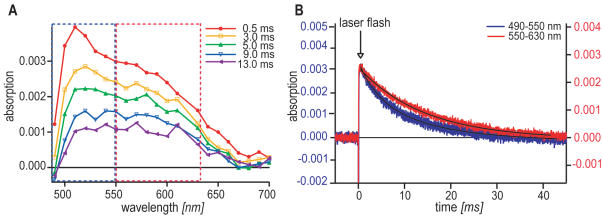
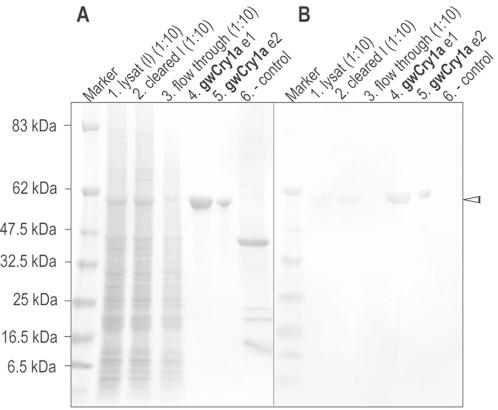
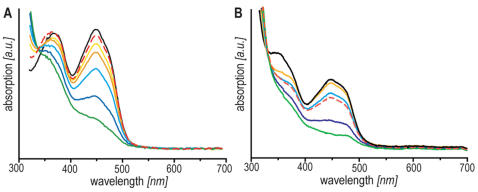
Cryptochromes (Cry) have been suggested to form the basis of light-dependent magnetic compass orientation in birds. However, to function as magnetic compass sensors, the cryptochromes of migratory birds must possess a number of key biophysical characteristics. Most importantly, absorption of blue light must produce radical pairs with lifetimes longer than about a microsecond. Cryptochrome 1a (gwCry1a) and the photolyase-homology-region of Cry1 (gwCry1-PHR) from the migratory garden warbler were recombinantly expressed and purified from a baculovirus/Sf9 cell expression system. Transient absorption measurements show that these flavoproteins are indeed excited by light in the blue spectral range leading to the formation of radicals with millisecond lifetimes. These biophysical characteristics suggest that gwCry1a is ideally suited as a primary light-mediated, radical-pair-based magnetic compass receptor.
Overview
The claims and statistics of this paper haven’t been checked yet.
Run the check — free, no account needed. It reads the open-access text and checks the sources it cites.
Integrity signals
Registry
Cites
Statistics
Figures
Verification
Claims the paper makes
The claims and statistics of this paper haven’t been checked yet.
Run the check — free, no account needed. It reads the open-access text and checks the sources it cites.
Claims other papers make about this one
Each is checked against this paper’s own text: does it say what the citing paper says it does?
In the citing paper
“It seems a logical next step to more complex living creatures, especially since four different types of cryptochrome have been confirmed in the eyes of migratory birds [103] and cryptochromes from the migratory garden warbler form radicals with millisecond lifetimes under the influence of the blue spectral range [104].”
From The future of quantum biology (2018) · cites this paper as [104]
Self-check
Percentages, sums and reported differences re-computed from the paper’s own numbers.
The self-check needs the paper’s full text.
Citations
Cites
Magnetic field effects in chemical kinetics and related phenomena
Steiner, U. E., & Ulrich, T. (1989) · Chemical Reviews · doi:10.1021/cr00091a003 · Cited by 1,660
HY4 gene of A. thaliana encodes a protein with characteristics of a blue-light photoreceptor
Ahmad, M., & Cashmore, A. R. (1993) · Nature · doi:10.1038/366162a0 · Cited by 1,279
A Model for Photoreceptor-Based Magnetoreception in Birds
Ritz, T., Adem, S., & Schulten, K. (2000) · Biophysical Journal · doi:10.1016/s0006-3495(00)76629-x · Cited by 1,176 · cited 4×
“This led to the suggestion that photochemical reactions in the birds’ eyes could produce spin-correlated radical pairs as the primary sensor in a magnetic field-dependent signalling cascade [7,8], based on the fact that the recombination reactions of spin-correlated radical pairs are known to be magnetic field-sensiti…”
BackgroundInfluentialCryptochromes: Blue Light Receptors for Plants and Animals
Cashmore, A. R., Jarillo, J. A., Wu, Y., & Liu, D. (1999) · Science · doi:10.1126/science.284.5415.760 · Cited by 1,027
Trends in the Development of Baculovirus Expression Vectors
Luckow, V. A., & Summers, M. D. (1988) · Nature Biotechnology · doi:10.1038/nbt0188-47 · Cited by 1,016
Magnetic Compass of European Robins
Wiltschko, W., & Wiltschko, R. (1972) · Science · doi:10.1126/science.176.4030.62 · Cited by 752
Structure and function of DNA photolyase
Sancar, A. (1994) · Biochemistry · doi:10.1021/bi00167a001 · Cited by 664
Resonance effects indicate a radical-pair mechanism for avian magnetic compass
Ritz, T., Thalau, P., Phillips, J. B., Wiltschko, R., & Wiltschko, W. (2004) · Nature · doi:10.1038/nature02534 · Cited by 617 · cited 1×
“The hypothesis that the avian magnetic compass is based on a radical pair mechanism is strongly supported by the observation that magnetic compass orientation of migratory birds can indeed be disturbed by weak radiofrequency magnetic fields with frequencies in the MHz range [17,18].”
BackgroundCrystal Structure of DNA Photolyase from Escherichia coli
Park, H.-W., Kim, S., Sancar, A., & Deisenhofer, J. (1995) · Science · doi:10.1126/science.7604260 · Cited by 584
Baculovirus Diversity and Molecular Biology
Blissard, G. W., & Rohrmann, G. F. (1990) · Annual Review of Entomology · doi:10.1146/annurev.en.35.010190.001015 · Cited by 535
Cited by
Sorted by citations
The cryptochromes: blue light photoreceptors in plants and animals
Chaves, I., Pokorny, R., Byrdin, M., Hoang, N., Ritz, T., Brettel, K., Essen, L.-O., van der Horst, G. T. J., Batschauer, A., & Ahmad, M. (2011) · Annual Review of Plant Biology · doi:10.1146/annurev-arplant-042110-103759 · Cited by 845
The Radical-Pair Mechanism of Magnetoreception
Hore, P. J., & Mouritsen, H. (2016) · Annual Review of Biophysics · doi:10.1146/annurev-biophys-032116-094545 · Cited by 813
Self-citationChemical magnetoreception in birds: The radical pair mechanism
Rodgers, C. T., & Hore, P. J. (2009) · Proceedings of the National Academy of Sciences · doi:10.1073/pnas.0711968106 · Cited by 542
Self-citationLong-distance navigation and magnetoreception in migratory animals
Mouritsen, H. (2018) · Nature · doi:10.1038/s41586-018-0176-1 · Cited by 547
Self-citationPlant photoreceptors: Multi-functional sensory proteins and their signaling networks
Paik, I., & Huq, E. (2019) · Seminars in Cell and Developmental Biology · doi:10.1016/j.semcdb.2019.03.007 · Cited by 379
Sustained Quantum Coherence and Entanglement in the Avian Compass
Gauger, E. M., Rieper, E., Morton, J. J. L., Benjamin, S. C., & Vedral, V. (2011) · Physical Review Letters · doi:10.1103/physrevlett.106.040503 · Cited by 357
The Cryptochrome Blue Light Receptors
Yu, X., Liu, H., Klejnot, J., & Lin, C. (2010) · The Arabidopsis Book · doi:10.1199/tab.0135 · Cited by 346
(2008) · doi:10.1371/journal.pone.0001768 · Cited by 328
Self-citationMagnetic Compass of Birds Is Based on a Molecule with Optimal Directional Sensitivity
Ritz, T., Wiltschko, R., Hore, P. J., Rodgers, C. T., Stapput, K., Thalau, P., Timmel, C. R., & Wiltschko, W. (2009) · Biophysical Journal · doi:10.1016/j.bpj.2008.11.072 · Cited by 305
Self-citationVisual but not trigeminal mediation of magnetic compass information in a migratory bird
Zapka, M., Heyers, D., Hein, C. M., Engels, S., Schneider, N.-L., Hans, J. B., Weiler, S., Dreyer, D., Kishkinev, D., Wild, J. M., et al. (2009) · Nature · doi:10.1038/nature08528 · Cited by 296
Self-citationMarais, A., Adams, B., Ringsmuth, A. K., Ferretti, M., Gruber, J. M., Hendrikx, R., Schuld, M., Smith, S. L., Sinayskiy, I., Krüger, T. P. J., et al. (2018) · Journal of The Royal Society Interface · doi:10.1098/rsif.2018.0640 · Cited by 274
Cryptochromes—a potential magnetoreceptor: what do we know and what do we want to know?
Liedvogel, M., & Mouritsen, H. (2010) · Journal of The Royal Society Interface · doi:10.1098/rsif.2009.0411.focus · Cited by 231
Self-citationMagnetic field effects in chemical systems
Rodgers, C. T. (2009) · Pure and Applied Chemistry · doi:10.1351/pac-con-08-10-18 · Cited by 215
Günther, A., Einwich, A., Sjulstok, E., Feederle, R., Bolte, P., Koch, K.-W., Solov’yov, I. A., & Mouritsen, H. (2018) · Current Biology · doi:10.1016/j.cub.2017.12.003 · Cited by 204
Self-citationMüller, P., & Ahmad, M. (2011) · Journal of Biological Chemistry · doi:10.1074/jbc.m111.228940 · Cited by 190
Avian Ultraviolet/Violet Cones Identified as Probable Magnetoreceptors
Nießner, C., Denzau, S., Gross, J. C., Peichl, L., Bischof, H., Fleissner, G., Wiltschko, W., & Wiltschko, R. (2011) · PLoS ONE · doi:10.1371/journal.pone.0020091 · Cited by 184
Beel, B., Prager, K., Spexard, M., Sasso, S., Weiss, D., Müller, N., Heinnickel, M. L., Dewez, D., Ikoma, D., Grossman, A. R., et al. (2012) · The Plant Cell · doi:10.1105/tpc.112.098947 · Cited by 193
Magnetoreception through Cryptochrome May Involve Superoxide
Solov’yov, I. A., & Schulten, K. J. (2009) · Biophysical Journal · doi:10.1016/j.bpj.2009.03.048 · Cited by 157
Bensch, S., Grahn, M., MÜLLER, N., Gay, L., & Åkesson, S. (2009) · Molecular Ecology · doi:10.1111/j.1365-294x.2009.04210.x · Cited by 156
The magnetic retina: light-dependent and trigeminal magnetoreception in migratory birds
Mouritsen, H., & Hore, P. J. (2012) · Current Opinion in Neurobiology · doi:10.1016/j.conb.2012.01.005 · Cited by 154
Self-citationDirect Observation of a Photoinduced Radical Pair in a Cryptochrome Blue‐Light Photoreceptor
Biskup, T., Schleicher, E., Okafuji, A., Link, G., Hitomi, K., Getzoff, E. D., & Weber, S. (2008) · Angewandte Chemie International Edition · doi:10.1002/anie.200803102 · Cited by 153
Self-citationThe Neural Basis of Long-Distance Navigation in Birds
Mouritsen, H., Heyers, D., & Güntürkün, O. (2015) · Annual Review of Physiology · doi:10.1146/annurev-physiol-021115-105054 · Cited by 142
Self-citationRitz, T., Ahmad, M., Mouritsen, H., Wiltschko, R., & Wiltschko, W. (2010) · Journal of The Royal Society Interface · doi:10.1098/rsif.2009.0456.focus · Cited by 135
Self-citationMagnetic-field effect on the photoactivation reaction of Escherichia coli DNA photolyase
Henbest, K. B., Maeda, K., Hore, P. J., Joshi, M., Bacher, A., Bittl, R., Weber, S., Timmel, C. R., & Schleicher, E. (2008) · Proceedings of the National Academy of Sciences · doi:10.1073/pnas.0803620105 · Cited by 130
Self-citationGehring, W. J. (2012) · Wiley Interdisciplinary Reviews Developmental Biology · doi:10.1002/wdev.96 · Cited by 134
Effects of static magnetic fields in biology: role of free radicals
Okano, H. (2008) · Frontiers in bioscience · doi:10.2741/3141 · Cited by 129
Electron spin relaxation in cryptochrome-based magnetoreception
Kattnig, D. R., Solov’yov, I. A., & Hore, P. J. (2016) · Physical Chemistry Chemical Physics · doi:10.1039/c5cp06731f · Cited by 129
Self-citationA radical sense of direction: signalling and mechanism in cryptochrome magnetoreception
Dodson, C. A., Hore, P. J., & Wallace, M. I. (2013) · Trends in Biochemical Sciences · doi:10.1016/j.tibs.2013.07.002 · Cited by 129
Self-citationDecrypting Cryptochrome: Revealing the Molecular Identity of the Photoactivation Reaction
Solov’yov, I. A., Domratcheva, T. M., Shahi, A. R. M., & Schulten, K. J. (2012) · Journal of the American Chemical Society · doi:10.1021/ja3074819 · Cited by 121
Acuity of a Cryptochrome and Vision-Based Magnetoreception System in Birds
Solov’yov, I. A., Mouritsen, H., & Schulten, K. (2010) · Biophysical Journal · doi:10.1016/j.bpj.2010.03.053 · Cited by 119
Self-citationSjulstok, E., Olsen, J. M. H., & Solov’yov, I. A. (2015) · Scientific Reports · doi:10.1038/srep18446 · Cited by 116
Hogben, H. J., Efimova, O., Wagner-Rundell, N., Timmel, C. R., & Hore, P. J. (2009) · Chemical Physics Letters · doi:10.1016/j.cplett.2009.08.051 · Cited by 114
Self-citationPhylogenetic and Functional Classification of the Photolyase/Cryptochrome Family
Öztürk, N. (2016) · Photochemistry and Photobiology · doi:10.1111/php.12676 · Cited by 111
Phillips, J. B., Jorge, P. E., & Muheim, R. (2010) · Journal of The Royal Society Interface · doi:10.1098/rsif.2009.0459.focus · Cited by 110
Magnetoreception: activated cryptochrome 1a concurs with magnetic orientation in birds
Nießner, C., Denzau, S., Stapput, K., Ahmad, M., Peichl, L., Wiltschko, W., & Wiltschko, R. (2013) · Journal of The Royal Society Interface · doi:10.1098/rsif.2013.0638 · Cited by 109
Schwarze, S., Schneider, N.-L., Reichl, T., Dreyer, D., Lefeldt, N., Engels, S., Baker, N., Hore, P. J., & Mouritsen, H. (2016) · Frontiers in Behavioral Neuroscience · doi:10.3389/fnbeh.2016.00055 · Cited by 109
Self-citationEffects of nocturnal illumination on life-history decisions and fitness in two wild songbird species
de Jong, M., Ouyang, J. Q., Silva, A. D., van Grunsven, R. H. A., Kempenaers, B., Visser, M. E., & Spoelstra, K. (2015) · Philosophical Transactions of the Royal Society B Biological Sciences · doi:10.1098/rstb.2014.0128 · Cited by 98
Vertebrate Cryptochromes are Vestigial Flavoproteins
Kutta, R. J., Archipowa, N., Johannissen, L. O., Jones, A. R., & Scrutton, N. S. (2017) · Scientific Reports · doi:10.1038/srep44906 · Cited by 98
Kirschvink, J. L., Winklhofer, M., & Walker, M. M. (2010) · Journal of The Royal Society Interface · doi:10.1098/rsif.2009.0491.focus · Cited by 100
Lüdemann, G., Solov’yov, I. A., Kubař, T., & Elstner, M. (2014) · Journal of the American Chemical Society · doi:10.1021/ja510550g · Cited by 95
Phillips, J. B., Muheim, R., & Jorge, P. E. (2010) · Journal of Experimental Biology · doi:10.1242/jeb.020792 · Cited by 94
Fillmore, C. J. (1968) · The Knowledge Bank (The Ohio State University) · Cited by 92
True navigation in birds: from quantum physics to global migration
Holland, R. A. (2014) · Journal of Zoology · doi:10.1111/jzo.12107 · Cited by 93
Effect of magnetic fields on cryptochrome-dependent responses in Arabidopsis thaliana
Harris, S.-R., Henbest, K. B., Maeda, K., Pannell, J. R., Timmel, C. R., Hore, P. J., & Okamoto, H. (2009) · Journal of The Royal Society Interface · doi:10.1098/rsif.2008.0519 · Cited by 88
Self-citationRadical-Pair-Based Magnetoreception Amplified by Radical Scavenging: Resilience to Spin Relaxation
Kattnig, D. R. (2017) · The Journal of Physical Chemistry B · doi:10.1021/acs.jpcb.7b07672 · Cited by 80
Reaction Kinetics and Mechanism of Magnetic Field Effects in Cryptochrome
Solov’yov, I. A., & Schulten, K. (2011) · The Journal of Physical Chemistry B · doi:10.1021/jp209508y · Cited by 75
Magnetoreception in birds: the effect of radio-frequency fields
Wiltschko, R., Thalau, P., Gehring, D., Nießner, C., Ritz, T., & Wiltschko, W. (2014) · Journal of The Royal Society Interface · doi:10.1098/rsif.2014.1103 · Cited by 72
Magnetic field effects in flavoproteins and related systems
Evans, E. W., Dodson, C. A., Maeda, K., Biskup, T., Wedge, C. J., & Timmel, C. R. (2013) · Interface Focus · doi:10.1098/rsfs.2013.0037 · Cited by 69
Self-citationBolte, P., Bleibaum, F., Einwich, A., Günther, A., Liedvogel, M., Heyers, D., Depping, A., Wöhlbrand, L., Rabus, R., Janssen‐Bienhold, U., et al. (2016) · PLoS ONE · doi:10.1371/journal.pone.0147819 · Cited by 74
Self-citationXu, C., Yin, X., Lv, Y., Wu, C., Zhang, Y., & Song, T. (2011) · Advances in Space Research · doi:10.1016/j.asr.2011.12.004 · Cited by 69
Quantum effects in biology: Bird navigation
Ritz, T. (2011) · Procedia Chemistry · doi:10.1016/j.proche.2011.08.034 · Cited by 67
Avian magnetite-based magnetoreception: a physiologist's perspective
Cadiou, H., & McNaughton, P. A. (2010) · Journal of The Royal Society Interface · doi:10.1098/rsif.2009.0423.focus · Cited by 71
Wu, H., Scholten, A., Einwich, A., Mouritsen, H., & Koch, K. (2020) · Scientific Reports · doi:10.1038/s41598-020-64429-y · Cited by 66
Self-citationHein, C. M., Zapka, M., Heyers, D., Kutzschbauch, S., Schneider, N.-L., & Mouritsen, H. (2009) · Journal of The Royal Society Interface · doi:10.1098/rsif.2009.0376.focus · Cited by 66
Self-citationThe Magnetic Compass of Birds: The Role of Cryptochrome
Wiltschko, R., Nießner, C., & Wiltschko, W. (2021) · Frontiers in Physiology · doi:10.3389/fphys.2021.667000 · Cited by 65
Cryptochrome 1 in Retinal Cone Photoreceptors Suggests a Novel Functional Role in Mammals
Nießner, C., Denzau, S., Malkemper, E. P., Gross, J. C., Burda, H., Winklhofer, M., & Peichl, L. (2016) · Scientific Reports · doi:10.1038/srep21848 · Cited by 65
Leberecht, B., Kobylkov, D., Karwinkel, T., Döge, S., Burnus, L., Wong, S. Y., Apte, S., Haase, K., Musielak, I., Chetverikova, R., et al. (2022) · Journal of Comparative Physiology A · doi:10.1007/s00359-021-01537-8 · Cited by 61
Self-citationNight‐time neuronal activation of Cluster N in a day‐ and night‐migrating songbird
Zapka, M., Heyers, D., Liedvogel, M., Jarvis, E. D., & Mouritsen, H. (2010) · European Journal of Neuroscience · doi:10.1111/j.1460-9568.2010.07311.x · Cited by 61
Self-citationMagnetocarcinogenesis: is there a mechanism for carcinogenic effects of weak magnetic fields?
Juutilainen, J., Herrala, M., Luukkonen, J., Naarala, J., & Hore, P. J. (2018) · Proceedings of the Royal Society B Biological Sciences · doi:10.1098/rspb.2018.0590 · Cited by 62
Self-citationHolland, R. A., & Helm, B. (2013) · Journal of The Royal Society Interface · doi:10.1098/rsif.2012.1047 · Cited by 57
Photoactivation of the cryptochrome/photolyase superfamily
Wang, J., Du, X., Pan, W., Wang, X., & Wu, W. (2014) · Journal of Photochemistry and Photobiology C Photochemistry Reviews · doi:10.1016/j.jphotochemrev.2014.12.001 · Cited by 60
Migratory bats respond to artificial green light with positive phototaxis
Voigt, C. C., Roeleke, M., Marggraf, L. C., Pētersons, G., & Voigt‐Heucke, S. L. (2017) · PLoS ONE · doi:10.1371/journal.pone.0177748 · Cited by 56
Lau, J. C. S., Rodgers, C. T., & Hore, P. J. (2012) · Journal of The Royal Society Interface · doi:10.1098/rsif.2012.0374 · Cited by 52
Self-citationNight-Migratory Songbirds Possess a Magnetic Compass in Both Eyes
Engels, S., Hein, C. M., Lefeldt, N., Prior, H., & Mouritsen, H. (2012) · PLoS ONE · doi:10.1371/journal.pone.0043271 · Cited by 52
Self-citationDifferential effects of magnetic pulses on the orientation of naturally migrating birds
Holland, R. A. (2010) · Journal of The Royal Society Interface · doi:10.1098/rsif.2010.0159 · Cited by 52
Cailliez, F., Müller, P., Firmino, T. D. R., Pernot, P., & de la Lande, A. (2016) · Journal of the American Chemical Society · doi:10.1021/jacs.5b10938 · Cited by 51
Nießner, C., Gross, J. C., Denzau, S., Peichl, L., Fleissner, G., Wiltschko, W., & Wiltschko, R. (2016) · PLoS ONE · doi:10.1371/journal.pone.0150377 · Cited by 50
A light-dependent magnetoreception mechanism insensitive to light intensity and polarization
Worster, S. B., Mouritsen, H., & Hore, P. J. (2017) · Journal of The Royal Society Interface · doi:10.1098/rsif.2017.0405 · Cited by 46
Self-citationBolte, P., Einwich, A., Seth, P. K., Chetverikova, R., Heyers, D., Wojahn, I., Janssen‐Bienhold, U., Feederle, R., Hore, P. J., Dedek, K., et al. (2021) · Ethology Ecology & Evolution · doi:10.1080/03949370.2020.1870571 · Cited by 48
Self-citationLeberecht, B., Wong, S. Y., Satish, B., Döge, S., Hindman, J., Venkatraman, L., Apte, S., Haase, K., Musielak, I., Dautaj, G., et al. (2023) · Proceedings of the National Academy of Sciences · doi:10.1073/pnas.2301153120 · Cited by 47
Self-citationTime’s arrow flies like a bird: Two paradoxes for avian circadian biology
Cassone, V. M., Paulose, J. K., Whitfield‐Rucker, M. G., & Peters, J. L. (2009) · General and Comparative Endocrinology · doi:10.1016/j.ygcen.2009.01.003 · Cited by 47
Kobylkov, D., Wynn, J., Michael Winklhofer, A., Chetverikova, R., Xu, J., Hiscock, H. G., Hore, P. J., & Mouritsen, H. (2019) · Journal of The Royal Society Interface · doi:10.1098/rsif.2019.0716 · Cited by 47
Self-citationCryptochromes: Photochemical and structural insight into magnetoreception
Karki, N., Vergish, S., & Zoltowski, B. D. (2021) · Protein Science · doi:10.1002/pro.4124 · Cited by 49
Xu, C., Lv, Y., Chen, C., Zhang, Y., & Wei, S. (2014) · Advances in Space Research · doi:10.1016/j.asr.2014.01.033 · Cited by 46
Cryptochrome: A photoreceptor with the properties of a magnetoreceptor?
Ritz, T., Yoshii, T., Foerster, C., & Ahmad, M. (2010) · Communicative & Integrative Biology · doi:10.4161/cib.3.1.9865 · Cited by 45
Burger, T., Lucová, M., Moritz, R. E., Oelschläger, H., Druga, R., Burda, H., Wiltschko, W., Wiltschko, R., & Němec, P. (2010) · Journal of The Royal Society Interface · doi:10.1098/rsif.2009.0551 · Cited by 44
Removal of the local geomagnetic field affects reproductive growth in Arabidopsis
Xu, C., Wei, S., Lü, Y., Zhang, Y., Chen, C., & Song, T. (2013) · Bioelectromagnetics · doi:10.1002/bem.21788 · Cited by 44
Very weak oscillating magnetic field disrupts the magnetic compass of songbird migrants
Pakhomov, A. Y., Bojarinova, J., Cherbunin, R. V., Chetverikova, R., Grigoryev, P. S., Kavokin, K. V., Kobylkov, D., Lubkovskaja, R., & Chernetsov, N. (2017) · Journal of The Royal Society Interface · doi:10.1098/rsif.2017.0364 · Cited by 43
Mitsui, H., Maeda, T., Chiaki, Y., Tsuji, Y., Watari, R., Kubo, Y., Okano, K., & Okano, T. (2015) · Biochemistry · doi:10.1021/bi501441u · Cited by 40
Eumetazoan Cryptochrome Phylogeny and Evolution
Haug, M. F., Gesemann, M., Lazović, V., & Neuhauss, S. C. F. (2015) · Genome Biology and Evolution · doi:10.1093/gbe/evv010 · Cited by 41
The radical pair mechanism and the avian chemical compass: Quantum coherence and entanglement
Zhang, Y., Berman, G. P., & Kais, S. (2015) · International Journal of Quantum Chemistry · doi:10.1002/qua.24943 · Cited by 41
A New Type of Radical-Pair-Based Model for Magnetoreception
Stoneham, A. M., Gauger, E. M., Porfyrakis, K., Benjamin, S. C., & Lovett, B. W. (2012) · Biophysical Journal · doi:10.1016/j.bpj.2012.01.007 · Cited by 39
Direct Interaction of Avian Cryptochrome 4 with a Cone Specific G-Protein
Görtemaker, K., Yee, C., Bartölke, R., Behrmann, H., Voß, J.-O., Schmidt, J., Xu, J., Solovyeva, V., Leberecht, B., Behrmann, E., et al. (2022) · Cells · doi:10.3390/cells11132043 · Cited by 38
Self-citationMagnetoreception systems in birds: A review of current research
Kishkinev, D., & Chernetsov, N. (2015) · Biology Bulletin Reviews · doi:10.1134/s2079086415010041 · Cited by 36
Shirdel, J., Zirak, P., Penzkofer, А., Breitkreuz, H., & Wolf, E. (2008) · Chemical Physics · doi:10.1016/j.chemphys.2008.06.006 · Cited by 36
The Only Known Jawed Vertebrate with Four Eyes and the Bauplan of the Pineal Complex
Smith, K. T., Bhullar, B.-A. S., Köhler, G., & Habersetzer, J. (2018) · Current Biology · doi:10.1016/j.cub.2018.02.021 · Cited by 35
Molecular dynamics simulations disclose early stages of the photo-activation of cryptochrome 4
Kattnig, D. R., Nielsen, C., & Solov’yov, I. A. (2018) · New Journal of Physics · doi:10.1088/1367-2630/aad70f · Cited by 35
Light-dependent magnetic compass in Iberian green frog tadpoles
Diego‐Rasilla, F. J., Luengo, R. M., & Phillips, J. B. (2010) · Die Naturwissenschaften · doi:10.1007/s00114-010-0730-7 · Cited by 34
Vieira, J., Jones, A. R., Danon, A., Sakuma, M., Hoang, N., Robles, D., Tait, S., Heyes, D. J., Picot, M., Yoshii, T., et al. (2012) · PLoS ONE · doi:10.1371/journal.pone.0031867 · Cited by 34
The Diversity of Photosensitivity and its Implications for Light Pollution
Alaasam, V., Kernbach, M. E., Miller, C. R., & Ferguson, S. M. (2021) · Integrative and Comparative Biology · doi:10.1093/icb/icab156 · Cited by 36
Sensitivity and entanglement in the avian chemical compass
Zhang, Y., Berman, G. P., & Kais, S. (2014) · Physical Review E · doi:10.1103/physreve.90.042707 · Cited by 32
Mouritsen, H. (2013) · Springer eBooks · doi:10.1007/978-3-642-10769-6_20 · Cited by 32
Self-citationMultiscale description of avian migration: from chemical compass to behaviour modeling
Pedersen, J. B., Nielsen, C., & Solov’yov, I. A. (2016) · Scientific Reports · doi:10.1038/srep36709 · Cited by 32
Yukawa, H., Kono, H., Ishiwata, H., Igarashi, R., Takakusagi, Y., Arai, S., Hirano, Y., Suhara, T., & Baba, Y. (2025) · Chemical Society Reviews · doi:10.1039/d4cs00650j · Cited by 35
Magnetoreception in birds and its use for long-distance migration
Mouritsen, H. (2021) · Elsevier eBooks · doi:10.1016/b978-0-12-819770-7.00040-2 · Cited by 31
Self-citationGrüning, G., Wong, S. Y., Gerhards, L., Schuhmann, F., Kattnig, D. R., Hore, P. J., & Solov’yov, I. A. (2022) · Journal of the American Chemical Society · doi:10.1021/jacs.2c06233 · Cited by 31
Self-citationMouritsen, H. (2014) · Elsevier eBooks · doi:10.1016/b978-0-12-407160-5.00008-7 · Cited by 29
Self-citationThe magnetic map sense and its use in fine-tuning the migration programme of birds
Heyers, D., Elbers, D., Bulte, M., Bairlein, F., & Mouritsen, H. (2017) · Journal of Comparative Physiology A · doi:10.1007/s00359-017-1164-x · Cited by 29
Self-citationInfluence of a Joining Helix on the BLUF Domain of the YcgF Photoreceptor from Escherichia coli
Schroeder, C., Werner, K., Otten, H., Krätzig, S., Schwalbe, H., & Essen, L. (2008) · ChemBioChem · doi:10.1002/cbic.200800280 · Cited by 28
Magnetic activation in the brain of the migratory northern wheatear (Oenanthe oenanthe)
Elbers, D., Bulte, M., Bairlein, F., Mouritsen, H., & Heyers, D. (2017) · Journal of Comparative Physiology A · doi:10.1007/s00359-017-1167-7 · Cited by 28
Self-citation
Metadata
- Authors
- Liedvogel, M., Maeda, K., Henbest, K., Schleicher, E., Simon, T., Timmel, C. R., Hore, P. J., & Mouritsen, H.
- Affiliations
- Carl von Ossietzky Universität Oldenburg (DE)
- University of Oxford (GB)
- Freie Universität Berlin (DE)
- Corresponding author
- Liedvogel, Miriam
- Maeda, Kiminori
- Henbest, Kevin
- Schleicher, Erik
- Simon, Thomas
- Timmel, Christiane R.
- Hore, P. J.
- Mouritsen, Henrik
- ORCID
- Venue
- PLoS ONE
- Publisher
- Public Library of Science (PLoS)
- Published
- 2007-10-31
- Volume
- 2
- Issue
- 10
- Pages
- e1106
- ISSN
- 1932-6203 (ISSN-L)
- PMC
- PMC2040520
- OpenAlex
- W2163169468
- Cited by
- 183
- References
- 54
- Citations by year
- 2026: 3 · 2025: 7 · 2024: 7 · 2023: 6 · 2022: 7 · 2021: 11 · 2020: 9 · 2019: 3 · 2018: 12 · 2017: 12 · 2016: 14 · 2015: 11 · 2014: 11 · 2013: 8 · 2012: 11
- FWCI
- 7.68
- Type
- journal article
- Language
- en
- Open access
- gold
- doi.org
- Locations
- PLoS ONE (publishedVersion, cc-by)
- PubMed Central (publishedVersion, cc-by)
- PubMed (publishedVersion)
- MPG.PuRe (Max Planck Society) (submittedVersion, other-oa)
- DOAJ (DOAJ: Directory of Open Access Journals) (submittedVersion, cc-by-sa)
- Max Planck Digital Library (submittedVersion, other-oa)
- Figshare (submittedVersion, cc-by)
- Lund University Publications (Lund University) (submittedVersion)
- Refubium (Universitätsbibliothek der Freien Universität Berlin) (submittedVersion, cc-by)
- Funders
- Carl von Ossietzky Universität Oldenburg
- Royal Society
- EMF Biological Research Trust
- Deutsche Forschungsgemeinschaft (FOR 526, MO 1408/1-2, FOR 701)
- Volkswagen Foundation
- Engineering and Physical Sciences Research Council (GR/T05424/01)
- Topics
- Life Sciences › Biochemistry, Genetics and Molecular Biology › Biophysics › Electromagnetic Fields and Biological Effects
- Physical Sciences › Chemistry › Spectroscopy › Electron Spin Resonance Studies
- Life Sciences › Neuroscience › Endocrine and Autonomic Systems › Circadian rhythm and melatonin
- Keywords
- radical pairs, blue light absorption, flavoprotein, magnetic compass orientation, bird migration, garden warbler, transient absorption spectroscopy, recombinant protein expression
- MeSH terms
- Animals, Birds, Cell Line, Cloning, Molecular, Flavoproteins, Free Radicals, Insecta, Light, Magnetics, Models, Biological, Magnetic Resonance Spectroscopy, Recombinant Proteins, Ultraviolet Rays, Protein Structure, Tertiary, Animal Migration, Cryptochromes
About these checks
Registry, retraction, Cites and statistics results are computed, not judged, with one exception: a printed reference that no index lists is read once by a model before it counts as a citation error. Claims are extracted by a model and kept only when their quote appears verbatim in the text; each cited source is then checked, with a model’s help, for whether it says what the claim relies on. Those verdicts can be wrong — read the claim’s quote and the cited source before relying on one.
Statistics and arithmetic are recomputed, not judged.
Confidence bands are shown only for fields calibrated on our annotated test set. None is calibrated yet, so no band is shown.
What counts as a claim ›How we measure confidence ›How we check this ›
Are you an author, or do you see a problem with this page? Request a review
