

The DOI matches its Crossref record; 48 of the 48 references it cites were found in a registry or an index.
A Specific and Rapid Neural Signature for Parental Instinct
Open accessAbstract
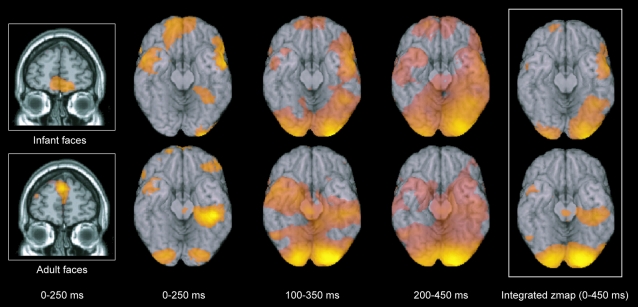
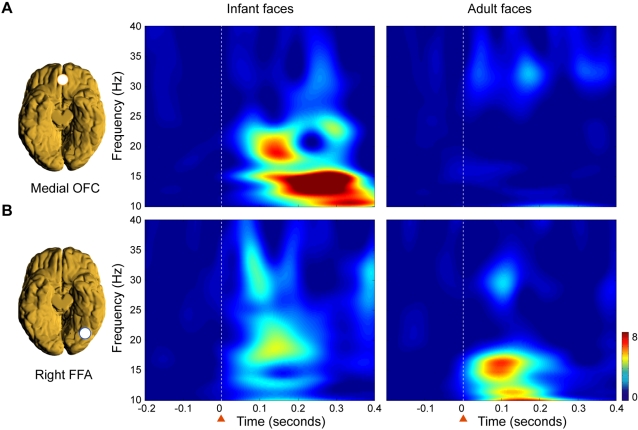
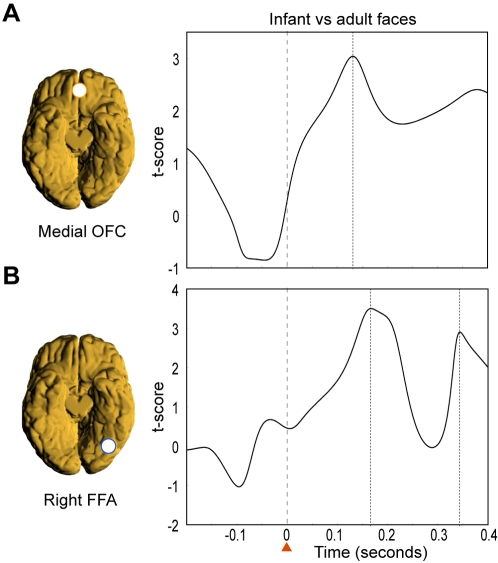
Darwin originally pointed out that there is something about infants which prompts adults to respond to and care for them, in order to increase individual fitness, i.e. reproductive success, via increased survivorship of one's own offspring. Lorenz proposed that it is the specific structure of the infant face that serves to elicit these parental responses, but the biological basis for this remains elusive. Here, we investigated whether adults show specific brain responses to unfamiliar infant faces compared to adult faces, where the infant and adult faces had been carefully matched across the two groups for emotional valence and arousal, as well as size and luminosity. The faces also matched closely in terms of attractiveness. Using magnetoencephalography (MEG) in adults, we found that highly specific brain activity occurred within a seventh of a second in response to unfamiliar infant faces but not to adult faces. This activity occurred in the medial orbitofrontal cortex (mOFC), an area implicated in reward behaviour, suggesting for the first time a neural basis for this vital evolutionary process. We found a peak in activity first in mOFC and then in the right fusiform face area (FFA). In mOFC the first significant peak (p<0.001) in differences in power between infant and adult faces was found at around 130 ms in the 10-15 Hz band. These early differences were not found in the FFA. In contrast, differences in power were found later, at around 165 ms, in a different band (20-25 Hz) in the right FFA, suggesting a feedback effect from mOFC. These findings provide evidence in humans of a potential brain basis for the "innate releasing mechanisms" described by Lorenz for affection and nurturing of young infants. This has potentially important clinical applications in relation to postnatal depression, and could provide opportunities for early identification of families at risk.
Overview
The claims and statistics of this paper haven’t been checked yet.
Run the check — free, no account needed. It reads the open-access text and checks the sources it cites.
Integrity signals
Registry
Cites
Statistics
Figures
Verification
Claims the paper makes
The claims and statistics of this paper haven’t been checked yet.
Run the check — free, no account needed. It reads the open-access text and checks the sources it cites.
Claims other papers make about this one
Each is checked against this paper’s own text: does it say what the citing paper says it does?
In the citing paper
“Again, coordinated responses in drive (amygdala) and regulation (cinglulate) figure prominently in these papers.”
From The human parental brain: In vivo neuroimaging (2011) · cites this paper as Kringelbach et al., 2008
In the citing paper
“Not only is facial recognition of one’s infant and their emotional state critical to their survival, but evidence supports human preference for the exaggerated cute/infantile features of baby faces which appear to activate reward mechanisms within the caregiver and motivate/promote mothers to caregiving, bonding and attachment.”
From Approaching the biology of human parental attachment: Brain imaging, oxytocin and coordinated assessments of mothers and fathers (2014) · cites this paper as Kringelbach et al., 2008
In the citing paper
“In addition to activation of nucleus accumbens (NAcc) in response to baby schema (Glocker et al., 2009) and medial orbitofrontal cortex (OFC) response to infant faces relative to adults (Kringelbach et al., 2008), higher levels of infantile features are preferred (Parsons et al., 2011).”
From Approaching the biology of human parental attachment: Brain imaging, oxytocin and coordinated assessments of mothers and fathers (2014) · cites this paper as Kringelbach et al., 2008
Self-check
Percentages, sums and reported differences re-computed from the paper’s own numbers.
The self-check needs the paper’s full text.
Citations
Cites
The expression of the emotions in man and animals.
Darwin, C. D. (1872) · J. Murray eBooks · doi:10.1037/10001-000 · Cited by 12,120
Attachment and Loss. Vol. 1. Attachment
Rever, G. W. (1972) · Psychosomatic Medicine · doi:10.1097/00006842-197211000-00011 · Cited by 8,446
The fusiform face area: a module in human extrastriate cortex specialized for face perception
Kanwisher, N., McDermott, J., & Chun, M. M. (1997) · The Journal of Neuroscience · doi:10.1523/jneurosci.17-11-04302.1997 · Cited by 7,738 · cited 2×
“It is still, however, controversial whether the activity in FFA represents a localized or distributed coding of faces [8,11,12].”
BackgroundA global optimisation method for robust affine registration of brain images
Jenkinson, M., & Smith, S. M. (2001) · Medical Image Analysis · doi:10.1016/s1361-8415(01)00036-6 · Cited by 7,018 · cited 2×
“The normalisation parameters were obtained using FLIRT (FMRIB’s Linear Image Registration Tool) [44] to reslice each individual’s anatomical MRI to the same orientation and position as the SAM functional volume and finding the transformation matrix from this functional space into the standard MNI space.”
MethodAttachment and Loss. Vol. I. Attachment.
Jones, N. B., & Bowlby, J. (1970) · Man · doi:10.2307/2798963 · Cited by 4,208 · cited 1×
“It is argued that these ‘‘babyish’’ features increase the infant’s chance of survival by evoking parental responses [4,5].”
BackgroundDeep Brain Stimulation for Treatment-Resistant Depression
Mayberg, H. S., Lozano, A. M., Voon, V., McNeely, H. E., Seminowicz, D., Hamani, C., Schwalb, J. M., & Kennedy, S. H. (2005) · Neuron · doi:10.1016/j.neuron.2005.02.014 · Cited by 4,059 · cited 1×
“Also, there is now evidence from deep brain stimulation linking depression to the nearby subgenual cingulate cortex which is strongly connected with the medial orbitofrontal cortex [35].”
BackgroundDistributed and overlapping representations of faces and objects in ventral temporal cortex
Haxby, J. V., Gobbini, M. I., Furey, M. L., Ishai, A., Schouten, J. L., & Pietrini, P. (2001) · Science · doi:10.1126/science.1063736 · Cited by 3,940 · cited 1×
“It is still, however, controversial whether the activity in FFA represents a localized or distributed coding of faces [8,11,12].”
BackgroundEkman, P., & Friesen, W. V. (1975) · Cited by 3,569
Speed of processing in the human visual system
Thorpe, S., Fize, D., & Marlot, C. (1996) · Nature · doi:10.1038/381520a0 · Cited by 3,538
Automatic 3D intersubject registration of MR volumetric data in standardized Talairach space
Collins, D. L., Neelin, P., Peters, T. M., & Evans, A. C. (1994) · Journal of Computer Assisted Tomography · doi:10.1097/00004728-199403000-00005 · Cited by 3,431 · cited 1×
“Group statistical maps for each frequency band were generated by first normalising the SAM functional volumes to MNI standard space [43] and then combining these volumes across participants for each time window and frequency band.”
Method
Cited by
Sorted by citations
Towards a functional neuroanatomy of pleasure and happiness
Kringelbach, M. L., & Berridge, K. C. (2009) · Trends in Cognitive Sciences · doi:10.1016/j.tics.2009.08.006 · Cited by 564
“likely to be extremely important for the survival of the species [ 98 ].”
The adaptive human parental brain: implications for children's social development
Feldman, R. (2015) · Trends in Neurosciences · doi:10.1016/j.tins.2015.04.004 · Cited by 419
Tuning the developing brain to social signals of emotions
Leppänen, J. M., & Nelson, C. A. (2008) · Nature reviews. Neuroscience · doi:10.1038/nrn2554 · Cited by 457
“Consistent with such a neuromodulatory role, recent studies have provided evidence for an early response in the orbitofrontal cortex (130 ms after stimulus onset) that precedes activity in occipitotemporal perceptual-representation areas (165 ms post-stimulus”
The origins of altruism in offspring care.
Preston, S. D. (2013) · Psychological Bulletin · doi:10.1037/a0031755 · Cited by 368
Baby schema modulates the brain reward system in nulliparous women
Glocker, M. L., Langleben, D. D., Ruparel, K., Loughead, J. W., Valdez, J. N., Griffin, M. D., Sachser, N., & Gur, R. C. (2009) · Proceedings of the National Academy of Sciences · doi:10.1073/pnas.0811620106 · Cited by 365
Metadata
- Authors
- Kringelbach, M. L., Lehtonen, A., Squire, S., Harvey, A. G., Craske, M. G., Holliday, I. E., Green, A. L., Aziz, T. Z., Hansen, P. C., Cornelissen, P. L., & Stein, A.
- Affiliations
- Aarhus University (DK)
- University of Oxford (GB)
- University of California, Berkeley (US)
- University of California, Los Angeles (US)
- Aston University (GB)
- John Radcliffe Hospital (GB)
- University of Birmingham (GB)
- University of York (GB)
- Corresponding author
- Kringelbach, Morten L.
- ORCID
- Venue
- PLoS ONE
- Publisher
- Public Library of Science (PLoS)
- Published
- 2008-02-27
- Volume
- 3
- Issue
- 2
- Pages
- e1664
- ISSN
- 1932-6203 (ISSN-L)
- PMC
- PMC2244707
- OpenAlex
- W2123848474
- Cited by
- 262
- References
- 47
- Citations by year
- 2026: 7 · 2025: 9 · 2024: 17 · 2023: 11 · 2022: 24 · 2021: 12 · 2020: 13 · 2019: 10 · 2018: 12 · 2017: 22 · 2016: 18 · 2015: 20 · 2014: 20 · 2013: 11 · 2012: 16
- FWCI
- 6.74
- Type
- journal article
- Language
- en
- Open access
- gold
- doi.org
- Locations
- PLoS ONE (publishedVersion, cc-by)
- Europe PMC (PubMed Central) (publishedVersion, cc-by)
- PubMed Central (publishedVersion, cc-by)
- PubMed (publishedVersion)
- Northumbria Research Link (Northumbria University) (acceptedVersion)
- Aston Publications Explorer (Aston University) (submittedVersion)
- DOAJ (DOAJ: Directory of Open Access Journals) (submittedVersion)
- Research Explorer (The University of Manchester) (submittedVersion, cc-by)
- University of Birmingham Research Portal (University of Birmingham) (submittedVersion, other-oa)
- Funders
- Wellcome Trust (017571, 071571)
- Lord Dowding Fund
- TrygFonden
- Topics
- Life Sciences › Neuroscience › Cognitive Neuroscience › Face Recognition and Perception
- Social Sciences › Psychology › Experimental and Cognitive Psychology › Evolutionary Psychology and Human Behavior
- Life Sciences › Neuroscience › Endocrine and Autonomic Systems › Neuroendocrine regulation and behavior
- Keywords
- infant face perception, face processing, medial orbitofrontal cortex, fusiform face area, Lorenz, infant care, reward processing, postpartum depression, magnetoencephalography
- MeSH terms
- Adult, Brain Mapping, Face, Frontal Lobe, Humans, Infant, Newborn, Pattern Recognition, Visual, Magnetoencephalography, Parenting
About these checks
Registry, retraction, Cites and statistics results are computed, not judged, with one exception: a printed reference that no index lists is read once by a model before it counts as a citation error. Claims are extracted by a model and kept only when their quote appears verbatim in the text; each cited source is then checked, with a model’s help, for whether it says what the claim relies on. Those verdicts can be wrong — read the claim’s quote and the cited source before relying on one.
Statistics and arithmetic are recomputed, not judged.
Confidence bands are shown only for fields calibrated on our annotated test set. None is calibrated yet, so no band is shown.
What counts as a claim ›How we measure confidence ›How we check this ›
Are you an author, or do you see a problem with this page? Request a review
