

Individual Attachment Style Modulates Human Amygdala and Striatum Activation during Social Appraisal
Open accessThe DOI matches its Crossref record; 54 of the 57 references it cites were found in a registry or an index.
Abstract
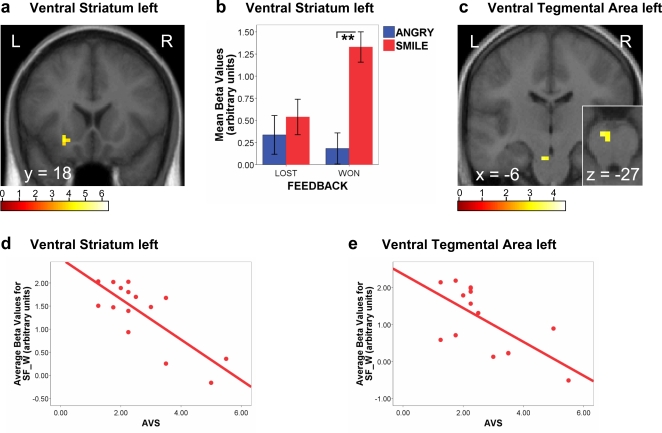
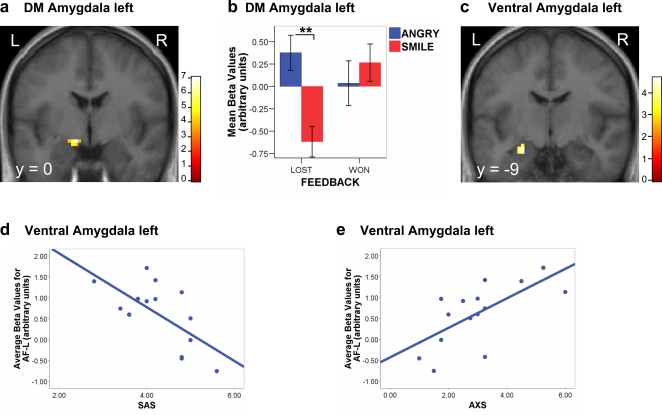
Adult attachment style refers to individual personality traits that strongly influence emotional bonds and reactions to social partners. Behavioral research has shown that adult attachment style reflects profound differences in sensitivity to social signals of support or conflict, but the neural substrates underlying such differences remain unsettled. Using functional magnetic resonance imaging (fMRI), we examined how the three classic prototypes of attachment style (secure, avoidant, anxious) modulate brain responses to facial expressions conveying either positive or negative feedback about task performance (either supportive or hostile) in a social game context. Activation of striatum and ventral tegmental area was enhanced to positive feedback signaled by a smiling face, but this was reduced in participants with avoidant attachment, indicating relative impassiveness to social reward. Conversely, a left amygdala response was evoked by angry faces associated with negative feedback, and correlated positively with anxious attachment, suggesting an increased sensitivity to social punishment. Secure attachment showed mirror effects in striatum and amygdala, but no other specific correlate. These results reveal a critical role for brain systems implicated in reward and threat processing in the biological underpinnings of adult attachment style, and provide new support to psychological models that have postulated two separate affective dimensions to explain these individual differences, centered on the ventral striatum and amygdala circuits, respectively. These findings also demonstrate that brain responses to face expressions are not driven by facial features alone but determined by the personal significance of expressions in current social context. By linking fundamental psychosocial dimensions of adult attachment with brain function, our results do not only corroborate their biological bases but also help understand their impact on behavior.
Overview
The claims and statistics of this paper haven’t been checked yet.
Free: it reads the open-access text and checks the first 5 claims that cite a source we can check. Create a free account to check every claim.
Integrity signals
Registry
Cites
Statistics
Figures
Verification
Claims the paper makes
The claims and statistics of this paper haven’t been checked yet.
Free: it reads the open-access text and checks the first 5 claims that cite a source we can check. Create a free account to check every claim.
Claims other papers make about this one
Each is checked against this paper’s own text: does it say what the citing paper says it does?
The source backs part of the claim, not all of it — or backs it for a different population, condition or comparison.
In the citing paper
“In both studies, challenges to the attachment system yielded greater ventral striatal activation in securely attached individuals, whereas in avoidant/dismissing individuals it was associated with a relative downregulation of reward-related activity.”
From A developmental, mentalization-based approach to the understanding and treatment of borderline personality disorder (2009) · cites this paper as Vrticka et al., 2008
Experimental — accuracy not yet measuredThe source backs part of the claim, not all of it — or backs it for a different population, condition or comparison.
In the citing paper
“This study reported a negative correlation between dismissing attachment scores and activation of the ventral striatum.”
From A developmental, mentalization-based approach to the understanding and treatment of borderline personality disorder (2009) · cites this paper as Vrticka et al., 2008
Experimental — accuracy not yet measuredThe source backs part of the claim, not all of it — or backs it for a different population, condition or comparison.
In the citing paper
“Individuals who use attachment deactivation strategies , typical of dismissive attached individuals, are able to keep the neural systems involved in controlled mentalization 'on-line' for longer, including neural systems involved in judging the trustworthiness of other individuals (i.e., the 'pull mechanism' associated with attachment; Vrticka et al., 2008).”
From A developmental, mentalization-based approach to the understanding and treatment of borderline personality disorder (2009) · cites this paper as Vrticka et al., 2008
Experimental — accuracy not yet measuredThe cited source says what the claim attributes to it.
In the citing paper
“Conversely, these positive responses are much weaker or even absent in individuals with an avoidant attachment style.44”
From Ventral striatum dysfunction in children and adolescents with reactive attachment disorder: functional MRI study (2015) · cites this paper as [44]
The cited source says what the claim attributes to it.
In the citing paper
“Moreover, Vrticka and colleagues also reported that secure attachment was positively related to the activation of the ventral striatum in response to positive reinforcement, but negatively with activation of the amygdala to negative reinforcement.”
From A developmental, mentalization-based approach to the understanding and treatment of borderline personality disorder (2009) · cites this paper as Vrticka et al., 2008
3 more claims about this paper
Create a free account to see every claim other papers make about this one.
Self-check
Percentages, sums and reported differences re-computed from the paper’s own numbers.
The self-check needs the paper’s full text.
Citations
Cites
Development and validation of brief measures of positive and negative affect: The PANAS scales.
Watson, D., Clark, L. A., & Tellegen, A. (1988) · Journal of Personality and Social Psychology · doi:10.1037/0022-3514.54.6.1063 · Cited by 32,433 · cited 1×
“Other personality questionnaires included STAXI [47], STAI [48], BIS-BAS [49], and PANAS [50].”
(1970) · Cited by 24,983
(1969) · Cited by 18,340
Romantic love conceptualized as an attachment process.
Hazan, C., & Shaver, P. (1987) · Journal of Personality and Social Psychology · doi:10.1037/0022-3514.52.3.511 · Cited by 11,908 · cited 4×
“Following earlier studies on children and parents, classic models have distinguished between three main prototypes of attachment style in adults: secure, anxious, and avoidant [5]; whereas subsequent work suggested the existence of four [10] or even five [11,12] distinct styles.”
InfluentialAttachment styles among young adults: A test of a four-category model.
Bartholomew, K., & Horowitz, L. M. (1991) · Journal of Personality and Social Psychology · doi:10.1037//0022-3514.61.2.226 · Cited by 8,384 · cited 8×
“However, activity in STS did not appear to subtend differences in ‘‘mental models’’ of others that are typically associated with different attachment styles [5, 10 ,25].”
InfluentialCarver, C. S., & White, T. L. (1994) · Journal of Personality and Social Psychology · doi:10.1037/0022-3514.67.2.319 · Cited by 7,306 · cited 1×
“Other personality questionnaires included STAXI [47], STAI [48], BIS-BAS [49], and PANAS [50].”
Attachment in adulthood: structure, dynamics, and change
(2008) · Choice Reviews Online · doi:10.5860/choice.45-2903 · Cited by 4,315
Does Rejection Hurt? An fMRI Study of Social Exclusion
Eisenberger, N. I., Lieberman, M. D., & Williams, K. D. (2003) · Science · doi:10.1126/science.1089134 · Cited by 3,849 · cited 4×
“SF-W), consistent with previous reports that ACC might be involved in conditions of social rejection and conflict [31–33].”
InfluentialAttachment theory and close relationships
(1998) · Choice Reviews Online · doi:10.5860/choice.35-6513 · Cited by 3,626
The amygdala: vigilance and emotion
Davis, M., & Whalen, P. J. (2001) · Molecular Psychiatry · doi:10.1038/sj.mp.4000812 · Cited by 2,882 · cited 1×
“These data reveal that processing of socially aversive situations is specifically enhanced in brain systems associated with emotional arousal and fear [41] for people with higher anxious attachment.”
Research works printed but not linked: 1
- Bouthillier D Tremblay N Hamelin F Julien D Scherzer P 1996 French translation and validation of an adult attachment styles measure. Canadian Journal of Behavioural Science-Revue Canadienne Des Sciences Du Comportement 28 74 77
Cited by
Fonagy, P., & Luyten, P. (2009) · Development and Psychopathology · doi:10.1017/s0954579409990198 · Cited by 1,146
“Individuals who use attachment deactivation strategies, typical of dismissive attached individuals, are able to keep the neural systems involved in controlled mentalization “on-line” for longer, including neural systems involved in judging the trustworthiness of other individuals (i.e., the “pull mechanism” associated…”
BackgroundAdult attachment predicts maternal brain and oxytocin response to infant cues.
Strathearn, L., Fonagy, P., Amico, J., & Montague, P. R. (2009) · Neuropsychopharmacology · doi:10.1038/npp.2009.103 · Cited by 773
“The lack of “reward” activation in mothers with insecure/dismissing attachment is consistent with a recent study of brain responses to smiling adult faces and positive task feedback (Vrticka et al, 2008), where ventral striatum activation was inversely correlated with dismissing attachment scores.”
ResultBrain basis of human social interaction: from concepts to brain imaging
Hari, R., & Kujala, M. V. (2009) · Physiological Reviews · doi:10.1152/physrev.00041.2007 · Cited by 638
“Attachment styles are fundamental personality traits and remain more or less the same throughout life: 1) persons with the secure attachment style are positive and confident, 2) persons with anxious attachment style are afraid of rejection in all possible situations, and 3) persons with avoidant attachment style prefe…”
BackgroundFunctional Neural Plasticity and Associated Changes in Positive Affect After Compassion Training
Klimecki, O. M., Leiberg, S., Lamm, C., & Singer, T. (2013) · Cerebral Cortex · doi:10.1093/cercor/bhs142 · Cited by 634
“…training would increase activity in the brain regions previously associated with love (Bartels and Zeki 2000; Aron et al. 2005) or affiliation (Vrticka et al. 2008; Strathearn et al. 2009), such as the (medial) orbitofrontal cortex (mOFC), the putamen, the middle insula, and the ventral…”
BackgroundInfluentialThe neurobiology of mentalizing.
Luyten, P., & Fonagy, P. (2015) · Personality Disorders: Theory, Research, and Treatment · doi:10.1037/per0000117 · Cited by 306
Metadata
- Authors
- Vrtička, P., Andersson, F., Grandjean, D., Sander, D., & Vuilleumier, P.
- Affiliations
- University of Geneva (CH)
- Corresponding author
- Vrtička, Pascal
- Venue
- PLoS ONE
- Publisher
- Public Library of Science (PLoS)
- Published
- 2008-08-06
- Volume
- 3
- Issue
- 8
- Pages
- e2868
- ISSN
- 1932-6203 (ISSN-L)
- PMC
- PMC2478709
- OpenAlex
- W2163551061
- Semantic Scholar
- 9567c4e0784ac2b99a086354dac4e74d1f765e13
- Cited by
- 260
- References
- 57
- Citations by year
- 2026: 10 · 2025: 19 · 2024: 8 · 2023: 6 · 2022: 13 · 2021: 10 · 2020: 14 · 2019: 11 · 2018: 15 · 2017: 16 · 2016: 17 · 2015: 29 · 2014: 19 · 2013: 22 · 2012: 27
- FWCI
- 10.70
- Type
- journal article
- Language
- en
- Open access
- gold
- doi.org
- Locations
- PLoS ONE (publishedVersion, cc-by)
- Europe PMC (PubMed Central) (publishedVersion, cc-by)
- PubMed Central (publishedVersion, cc-by)
- PubMed (publishedVersion)
- Archive ouverte UNIGE (University of Geneva) (publishedVersion, other-oa)
- HAL (submittedVersion)
- RePEc: Research Papers in Economics (submittedVersion)
- DOAJ (DOAJ: Directory of Open Access Journals) (submittedVersion, cc-by-sa)
- Max Planck Digital Library (submittedVersion)
- mediaTUM – the media and publications repository of the Technical University Munich (Technical University Munich) (submittedVersion)
- MPG.PuRe (Max Planck Society) (submittedVersion, other-oa)
- Archive ouverte UNIGE (University of Geneva) (submittedVersion, cc-by)
- Funders
- National Science Foundation (51NF40-104897)
- Schweizerischer Nationalfonds zur Förderung der Wissenschaftlichen Forschung (104897, 51NF40)
- Université de Genève (51NF40-104897)
- Topics
- Social Sciences › Psychology › Social Psychology › Attachment and Relationship Dynamics
- Life Sciences › Neuroscience › Cognitive Neuroscience › Face Recognition and Perception
- Life Sciences › Neuroscience › Endocrine and Autonomic Systems › Neuroendocrine regulation and behavior
- Keywords
- adult attachment styles, secure attachment, attachment avoidance, attachment anxiety, amygdala, ventral striatum, ventral tegmental area, social feedback, facial expressions, social reward, social danger, individual differences, social evaluation
- MeSH terms
- Amygdala, Brain Mapping, Corpus Striatum, Emotions, Facial Expression, Feedback, Humans, Functional Laterality, Magnetic Resonance Imaging, Reaction Time, Social Behavior, Social Support
About these checks
Registry, retraction, Cites and statistics results are computed, not judged, with one exception: a printed reference that no index lists is read once by a model before it counts as a citation error. Claims are extracted by a model and kept only when their quote appears verbatim in the text; each cited source is then checked, with a model’s help, for whether it says what the claim relies on. Those verdicts can be wrong — read the claim’s quote and the cited source before relying on one.
Statistics and arithmetic are recomputed, not judged.
Confidence bands are shown only for fields calibrated on our annotated test set. None is calibrated yet, so no band is shown.
What counts as a claim ›How we measure confidence ›How we check this ›
Are you an author, or do you see a problem with this page? Request a review
Data sources
Bibliographic data: Semantic Scholar, OpenAlex, Crossref.
Contains information from the Semantic Scholar Academic Graph Datasets, made available under the ODC Attribution License (ODC-BY 1.0).
Semantic Scholar’s data is described in: Kinney, R., et al. (2023). The Semantic Scholar Open Data Platform. arXiv:2301.10140.
