

Individual Attachment Style Modulates Human Amygdala and Striatum Activation during Social Appraisal
Open accessThe DOI matches its Crossref record; 54 of the 57 references it cites were found in a registry or an index.
Abstract
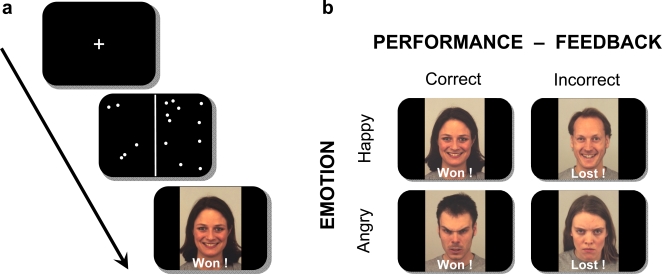
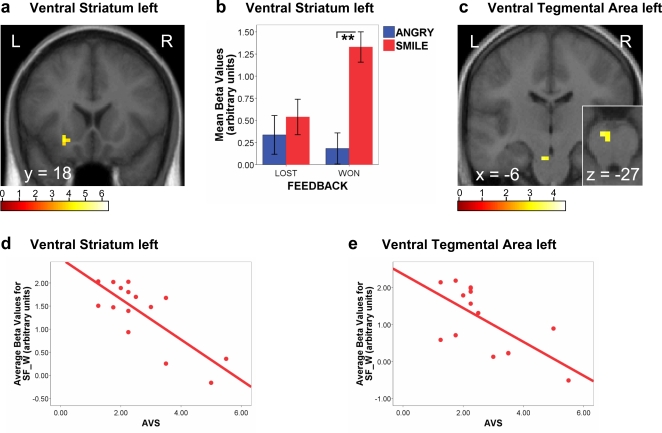
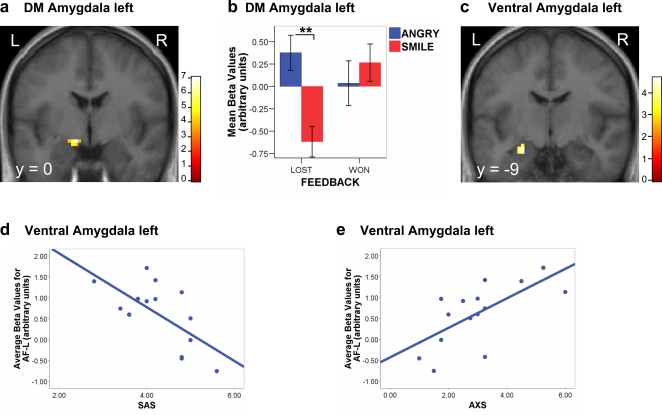
Adult attachment style refers to individual personality traits that strongly influence emotional bonds and reactions to social partners. Behavioral research has shown that adult attachment style reflects profound differences in sensitivity to social signals of support or conflict, but the neural substrates underlying such differences remain unsettled. Using functional magnetic resonance imaging (fMRI), we examined how the three classic prototypes of attachment style (secure, avoidant, anxious) modulate brain responses to facial expressions conveying either positive or negative feedback about task performance (either supportive or hostile) in a social game context. Activation of striatum and ventral tegmental area was enhanced to positive feedback signaled by a smiling face, but this was reduced in participants with avoidant attachment, indicating relative impassiveness to social reward. Conversely, a left amygdala response was evoked by angry faces associated with negative feedback, and correlated positively with anxious attachment, suggesting an increased sensitivity to social punishment. Secure attachment showed mirror effects in striatum and amygdala, but no other specific correlate. These results reveal a critical role for brain systems implicated in reward and threat processing in the biological underpinnings of adult attachment style, and provide new support to psychological models that have postulated two separate affective dimensions to explain these individual differences, centered on the ventral striatum and amygdala circuits, respectively. These findings also demonstrate that brain responses to face expressions are not driven by facial features alone but determined by the personal significance of expressions in current social context. By linking fundamental psychosocial dimensions of adult attachment with brain function, our results do not only corroborate their biological bases but also help understand their impact on behavior.
Overview
The claims and statistics of this paper haven’t been checked yet.
Free: it reads the open-access text and checks the first 5 claims that cite a source we can check. Create a free account to check every claim.
Integrity signals
Registry
Cites
Statistics
Figures
Verification
Claims the paper makes
The claims and statistics of this paper haven’t been checked yet.
Free: it reads the open-access text and checks the first 5 claims that cite a source we can check. Create a free account to check every claim.
Claims other papers make about this one
Each is checked against this paper’s own text: does it say what the citing paper says it does?
The source backs part of the claim, not all of it — or backs it for a different population, condition or comparison.
In the citing paper
“In both studies, challenges to the attachment system yielded greater ventral striatal activation in securely attached individuals, whereas in avoidant/dismissing individuals it was associated with a relative downregulation of reward-related activity.”
From A developmental, mentalization-based approach to the understanding and treatment of borderline personality disorder (2009) · cites this paper as Vrticka et al., 2008
Experimental — accuracy not yet measuredThe source backs part of the claim, not all of it — or backs it for a different population, condition or comparison.
In the citing paper
“This study reported a negative correlation between dismissing attachment scores and activation of the ventral striatum.”
From A developmental, mentalization-based approach to the understanding and treatment of borderline personality disorder (2009) · cites this paper as Vrticka et al., 2008
Experimental — accuracy not yet measuredThe source backs part of the claim, not all of it — or backs it for a different population, condition or comparison.
In the citing paper
“Individuals who use attachment deactivation strategies , typical of dismissive attached individuals, are able to keep the neural systems involved in controlled mentalization 'on-line' for longer, including neural systems involved in judging the trustworthiness of other individuals (i.e., the 'pull mechanism' associated with attachment; Vrticka et al., 2008).”
From A developmental, mentalization-based approach to the understanding and treatment of borderline personality disorder (2009) · cites this paper as Vrticka et al., 2008
Experimental — accuracy not yet measuredThe cited source says what the claim attributes to it.
In the citing paper
“Conversely, these positive responses are much weaker or even absent in individuals with an avoidant attachment style.44”
From Ventral striatum dysfunction in children and adolescents with reactive attachment disorder: functional MRI study (2015) · cites this paper as [44]
The cited source says what the claim attributes to it.
In the citing paper
“Moreover, Vrticka and colleagues also reported that secure attachment was positively related to the activation of the ventral striatum in response to positive reinforcement, but negatively with activation of the amygdala to negative reinforcement.”
From A developmental, mentalization-based approach to the understanding and treatment of borderline personality disorder (2009) · cites this paper as Vrticka et al., 2008
3 more claims about this paper
Create a free account to see every claim other papers make about this one.
Self-check
Percentages, sums and reported differences re-computed from the paper’s own numbers.
The self-check needs the paper’s full text.
Citations
Cites
Development and validation of brief measures of positive and negative affect: The PANAS scales.
Watson, D., Clark, L. A., & Tellegen, A. (1988) · Journal of Personality and Social Psychology · doi:10.1037/0022-3514.54.6.1063 · Cited by 32,433 · cited 1×
“Other personality questionnaires included STAXI [47], STAI [48], BIS-BAS [49], and PANAS [50].”
(1970) · Cited by 24,983
(1969) · Cited by 18,340
Romantic love conceptualized as an attachment process.
Hazan, C., & Shaver, P. (1987) · Journal of Personality and Social Psychology · doi:10.1037/0022-3514.52.3.511 · Cited by 11,908 · cited 4×
“Following earlier studies on children and parents, classic models have distinguished between three main prototypes of attachment style in adults: secure, anxious, and avoidant [5]; whereas subsequent work suggested the existence of four [10] or even five [11,12] distinct styles.”
InfluentialAttachment styles among young adults: A test of a four-category model.
Bartholomew, K., & Horowitz, L. M. (1991) · Journal of Personality and Social Psychology · doi:10.1037//0022-3514.61.2.226 · Cited by 8,384 · cited 8×
“However, activity in STS did not appear to subtend differences in ‘‘mental models’’ of others that are typically associated with different attachment styles [5, 10 ,25].”
InfluentialCarver, C. S., & White, T. L. (1994) · Journal of Personality and Social Psychology · doi:10.1037/0022-3514.67.2.319 · Cited by 7,306 · cited 1×
“Other personality questionnaires included STAXI [47], STAI [48], BIS-BAS [49], and PANAS [50].”
Attachment in adulthood: structure, dynamics, and change
(2008) · Choice Reviews Online · doi:10.5860/choice.45-2903 · Cited by 4,315
Does Rejection Hurt? An fMRI Study of Social Exclusion
Eisenberger, N. I., Lieberman, M. D., & Williams, K. D. (2003) · Science · doi:10.1126/science.1089134 · Cited by 3,849 · cited 4×
“SF-W), consistent with previous reports that ACC might be involved in conditions of social rejection and conflict [31–33].”
InfluentialAttachment theory and close relationships
(1998) · Choice Reviews Online · doi:10.5860/choice.35-6513 · Cited by 3,626
The amygdala: vigilance and emotion
Davis, M., & Whalen, P. J. (2001) · Molecular Psychiatry · doi:10.1038/sj.mp.4000812 · Cited by 2,882 · cited 1×
“These data reveal that processing of socially aversive situations is specifically enhanced in brain systems associated with emotional arousal and fear [41] for people with higher anxious attachment.”
Development and neurophysiology of mentalizing
Frith, U., & Frith, C. D. (2003) · Philosophical Transactions of the Royal Society of London. Series B: Biological Sciences · doi:10.1098/rstb.2002.1218 · Cited by 2,306 · cited 2×
“STS is implicated in theory of mind and perception of intentionality [27], suggesting that participants were more inclined to imagine particular mental states or intentions for faces seen with incongruent feedback information.”
Abstract reward and punishment representations in the human orbitofrontal cortex
O'Doherty, J., Kringelbach, M. L., Rolls, E. T., Hornak, J., & Andrews, C. (2001) · Nature Neuroscience · doi:10.1038/82959 · Cited by 2,003
Dalgleish, T. (2004) · Nature Reviews Neuroscience · doi:10.1038/nrn1432 · Cited by 1,849 · cited 6×
“In the congruent feedback condition of social support (SF-W), we found that higher scores on attachment avoidance (AVS) predicted lower activation in brain regions linked to dopaminergic function and reward, including both ventral striatum and VTA [22,30].”
InfluentialModels of the self and other: Fundamental dimensions underlying measures of adult attachment.
Griffin, D. W., & Bartholomew, K. (1994) · Journal of Personality and Social Psychology · doi:10.1037//0022-3514.67.3.430 · Cited by 1,756 · cited 1×
“The 13 items of the ASM (or AAQ) are also included in the Relationship Scales Questionnaire (RSQ) [46], comprising 30 items in total (with some items reversed), and a recent review [29] suggests that the best method to analyze the 30-item RSQ is to rely on these 13 items alone to create a…”
Relational schemas and the processing of social information.
Baldwin, M. W. (1992) · Psychological Bulletin · doi:10.1037//0033-2909.112.3.461 · Cited by 1,678 · cited 3×
“…this social psychological construct taps specific affective processes, with distinct neural substrates, which can influence how people automatically perceive and respond to social signals in interaction contexts, beyond relationships with intimate partners or close personal acquaintances [3,8].”
The Use of Psychological Testing for Treatment Planning and Outcome Assessment
Maruish, M. E., & Leahy, R. L. (2000) · Journal of Cognitive Psychotherapy · doi:10.1891/0889-8391.14.2.205 · Cited by 1,634
Influence of attachment styles on romantic relationships
Simpson, J. A. (1990) · Journal of Personality and Social Psychology · doi:10.1037/0022-3514.59.5.971 · Cited by 1,501 · cited 1×
“We used the Adult Attachment Questionnaire (AAQ), a validated French version [28] of the original Attachment Style Measure (ASM) [45], which includes a series of 13 statements rated along a 7-point scale (from ‘‘strongly disagree’’ to ‘‘strongly disagree’’).”
The neural correlates of maternal and romantic love
Bartels, A., & Zeki, S. (2004) · NeuroImage · doi:10.1016/j.neuroimage.2003.11.003 · Cited by 1,497 · cited 1×
“Previous neuroimaging studies concerning attachment have focused on particular relationships such as maternal and romantic love, without considering individual attachment style [19,20], and reported that pictures of loved individuals deactivate the amygdala and activate the striatum, two brain regions critical for aff…”
Reward, Motivation, and Emotion Systems Associated With Early-Stage Intense Romantic Love
Aron, A., Fisher, H., Mashek, D. J., Strong, G., Li, H., & Brown, L. L. (2005) · Journal of Neurophysiology · doi:10.1152/jn.00838.2004 · Cited by 963 · cited 1×
“…concerning attachment have focused on particular relationships such as maternal and romantic love, without considering individual attachment style [19,20], and reported that pictures of loved individuals deactivate the amygdala and activate the striatum, two brain regions critical for affective…”
The Human Amygdala: An Evolved System for Relevance Detection
Sander, D., Grafman, J., & Zalla, T. (2003) · Reviews in the Neurosciences · doi:10.1515/revneuro.2003.14.4.303 · Cited by 944 · cited 3×
“Previous neuroimaging studies concerning attachment have focused on particular relationships such as maternal and romantic love, without considering individual attachment style [19,20], and reported that pictures of loved individuals deactivate the amygdala and activate the striatum, two brain regions critical for aff…”
Self-citationBeauty in a smile: the role of medial orbitofrontal cortex in facial attractiveness
O’Doherty, J., Winston, J., Critchley, H., Perrett, D., Burt, D. M., & Dolan, R. J. (2003) · Neuropsychologia · doi:10.1016/s0028-3932(02)00145-8 · Cited by 898
Conflict in close relationships: An attachment perspective.
Simpson, J. A., Rholes, W. S., & Phillips, D. (1996) · Journal of Personality and Social Psychology · doi:10.1037/0022-3514.71.5.899 · Cited by 782 · cited 1×
“For instance, attachment styles can determine whether feedback messages given by partners are perceived as supportive or not [15], predict the experience of conflict in interpersonal contexts [16,17], and influence the perception of emotional expressions in pictures of unknown faces [6,7].”
Human Amygdala Responsivity to Masked Fearful Eye Whites
Whalen, P. J., Kagan, J., Cook, R. G., Davis, F. C., Kim, H., Polis, S., McLaren, D. G., Somerville, L. H., McLean, A. A., Maxwell, J. S., et al. (2004) · Science · doi:10.1126/science.1103617 · Cited by 766 · cited 1×
“Similarly, while several studies have reported activation of the amygdala to angry or negative facial expressions, here we show that this response may not be automatic and driven by specific facial features [36] but determined by the personal significance of perceived anger.”
Collins, N. L., & Feeney, B. C. (2004) · Journal of Personality and Social Psychology · doi:10.1037/0022-3514.87.3.363 · Cited by 733 · cited 2×
“For instance, attachment styles can determine whether feedback messages given by partners are perceived as supportive or not [15], predict the experience of conflict in interpersonal contexts [16,17], and influence the perception of emotional expressions in pictures of unknown faces [6,7].”
The etiology of social phobia: empirical evidence and an initial model
Rapee, R. M., & Spence, S. H. (2004) · Clinical Psychology Review · doi:10.1016/j.cpr.2004.06.004 · Cited by 693 · cited 1×
“More generally, our data also converge with bidimensional models of social disorders that suggest distinct contributions of negative and positive emotions in regulating social behavior and interpersonal communication in a wide range of social contexts [40,44].”
Simpson, J. A., Collins, W. A., Tran, S., & Haydon, K. C. (2007) · Journal of Personality and Social Psychology · doi:10.1037/0022-3514.92.2.355 · Cited by 486
Psychophysiology in Attachment Interviews: Converging Evidence for Deactivating Strategies
Dozier, M., & Kobak, R. R. (1992) · Child Development · doi:10.1111/j.1467-8624.1992.tb01708.x · Cited by 461
Anterior cingulate cortex responds differentially to expectancy violation and social rejection
Somerville, L. H., Heatherton, T. F., & Kelley, W. M. (2006) · Nature Neuroscience · doi:10.1038/nn1728 · Cited by 460 · cited 2×
“Moreover, activity in MPFC and vACC correlated with AVS and overlapped with similar regions activated by social rejection[32] or emotion suppression [24] in other paradigms, suggesting that affective evaluation processes responding to conflict situations might be more active in avoidant subjects in…”
Beyond threat: amygdala reactivity across multiple expressions of facial affect
Fitzgerald, D. A., Angstadt, M., Jelsone, L. M., Nathan, P. J., & Phan, K. L. (2006) · NeuroImage · doi:10.1016/j.neuroimage.2005.11.003 · Cited by 427 · cited 1×
“Because the amygdala is particularly implicated in processing self-relevant affective information [21,42], our findings support the notion that a key aspect of anxious attachment may involve enhanced vigilance towards emotionally-significant social cues [3,4,17,39].”
Social anxiety spectrum and diminished positive experiences: Theoretical synthesis and meta-analysis
Kashdan, T. B. (2007) · Clinical Psychology Review · doi:10.1016/j.cpr.2006.12.003 · Cited by 419 · cited 2×
“…also provide a plausible substrate for behavioral observations that high AVS is negatively correlated with reward dependence [11], and add support to recent proposals that some forms of social avoidance may be associated with reduced positive experiences in social and non-social contexts [40].”
Neural correlates of individual ratings of emotional salience: A trial-related fMRI study
Phan, K. L., Taylor, S. F., Welsh, R. C., Ho, S.-H., Britton, J. C., & Liberzon, I. (2004) · NeuroImage · doi:10.1016/j.neuroimage.2003.09.072 · Cited by 416 · cited 1×
“AVS) as a linear parametric factor in SPM2, allowing us to test for any voxels throughout the brain where activation in the given contrast varied as a function of this behavioral measure [52].”
MethodContextual modulation of amygdala responsivity to surprised faces
Kim, H., Somerville, L. H., Johnstone, T., Polis, S., Alexander, A. L., Shin, L. M., & Whalen, P. J. (2004) · Journal of Cognitive Neuroscience · doi:10.1162/0898929042947865 · Cited by 389 · cited 1×
“These findings provide support for the importance of appraisal of personal relevance in emotional processing [21,37].”
Stevens (2014) · doi:10.1016/j.neuroimage.2005.06.048 · Cited by 377 · cited 2×
“Moreover, activity in MPFC and vACC correlated with AVS and overlapped with similar regions activated by social rejection[32] or emotion suppression [24] in other paradigms, suggesting that affective evaluation processes responding to conflict situations might be more active in avoidant subjects in keeping with their…”
The Bowlby-Ainsworth attachment theory
Ainsworth, M. D. S. (1978) · Behavioral and Brain Sciences · doi:10.1017/s0140525x00075828 · Cited by 370
Spielberger, C. D., Sydeman, S. J., Owen, A. E., & Marsh, B. (1999) · Cited by 362
Chris Fraley, R., Niedenthal, P. M., Marks, M., Brumbaugh, C., & Vicary, A. (2006) · Journal of Personality · doi:10.1111/j.1467-6494.2006.00406.x · Cited by 332 · cited 8×
“More generally, it has been shown that attachment style may shape the way in which individuals appraise social information in a variety of conditions [6,7,13], including during interactions with strangers [8,14].”
InfluentialPsychophysiology in Attachment Interviews: Converging Evidence for Deactivating Strategies
Dozier, M., & Kobak, R. R. (1992) · Child Development · doi:10.2307/1131569 · Cited by 319
Rom, E., & Mikulincer, M. (2003) · Journal of Personality and Social Psychology · doi:10.1037/0022-3514.84.6.1220 · Cited by 267 · cited 5×
“Because attachment style is critically related to the way people evaluate signs of alliance and opposition during social interactions [17], we systematically manipulated the social significance of these facial expressions to elicit a perception of either supportive or unsupportive partners.”
InfluentialOverall, N. C., Fletcher, G. J. O., & Friesen, M. D. (2003) · Personality and Social Psychology Bulletin · doi:10.1177/0146167203251519 · Cited by 267 · cited 1×
“More generally, it has been shown that attachment style may shape the way in which individuals appraise social information in a variety of conditions [6,7,13], including during interactions with strangers [8,14].”
Working Models of Attachment, Support Giving, and Support Seeking in a Stressful Situation
Simpson, J. A., Rholes, W. S., Oriña, M. M., & Grich, J. (2002) · Personality and Social Psychology Bulletin · doi:10.1177/0146167202288004 · Cited by 261 · cited 1×
“…for the SF-W condition representing a socially rewarding interaction (but not related to reward or positive affect of faces alone), supporting the hypothesis that individuals scoring higher on AVS may show reduced activation of affective processes in response to positive social signals [6,38].”
Neural Dynamics of Rejection Sensitivity
Kross, E., Egner, T., Ochsner, K., Hirsch, J., & Downey, G. (2007) · Journal of Cognitive Neuroscience · doi:10.1162/jocn.2007.19.6.945 · Cited by 225 · cited 3×
“SF-W), consistent with previous reports that ACC might be involved in conditions of social rejection and conflict [31–33].”
On Being Insecure about the Assessment of Attachment Styles
Kurdek, L. A. (2002) · Journal of Social and Personal Relationships · doi:10.1177/0265407502196005 · Cited by 206 · cited 3×
“Combinations of the first two scores also provide a reliable measure along two separate dimensions of avoidance and anxiety [29].”
InfluentialDismissing-avoidance and the defensive organization of emotion, cognition, and behavior.
Fraley, R. C., Davis, K. E., & Shaver, P. R. (1998) · Cited by 204
Adult attachment and the perception of facial expression of emotion.
Niedenthal, P. M., Brauer, M., Robin, L., & Innes-Ker, Å. H. (2002) · Journal of Personality and Social Psychology · doi:10.1037//0022-3514.82.3.419 · Cited by 181 · cited 6×
“More generally, it has been shown that attachment style may shape the way in which individuals appraise social information in a variety of conditions [6,7,13], including during interactions with strangers [8,14].”
InfluentialFeeney, J. A., & Ryan, S. M. (1994) · Health Psychology · doi:10.1037//0278-6133.13.4.334 · Cited by 179 · cited 1×
“Following earlier studies on children and parents, classic models have distinguished between three main prototypes of attachment style in adults: secure, anxious, and avoidant [5]; whereas subsequent work suggested the existence of four [10] or even five [11,12] distinct styles.”
InfluentialNeural Coding of Reward-Prediction Error Signals During Classical Conditioning With Attractive Faces
Bray, S., & O'Doherty, J. (2007) · Journal of Neurophysiology · doi:10.1152/jn.01211.2006 · Cited by 172 · cited 1×
“While many studies have shown activation in striatum and OFC to various types of rewards such as gains or food, a few others have reported activation in the same regions to smiling or attractive faces [34,35].”
Affect Regulation as a Stylistic Process within Adult Attachment
Fuendeling, J. M. (1998) · Journal of Social and Personal Relationships · doi:10.1177/0265407598153001 · Cited by 158 · cited 1×
“Adult attachment style is also related to individual differences in cooperativeness, reward dependence, and novelty seeking [11,18].”
Lemche, E., Giampietro, V. P., Surguladze, S. A., Amaro, E. J., Andrew, C. M., Williams, S. C. R., Brammer, M. J., Lawrence, N., Maier, M. A., Russell, T. A., et al. (2006) · Human Brain Mapping · doi:10.1002/hbm.20206 · Cited by 123 · cited 2×
“Other studies found activation of amygdala [23] and medial prefrontal cortex [24] to sentences or scenarios with attachment-related meaning, but did not examine the differential effects of classic attachment styles on the perception of social cues with different affective meanings.”
RIGGS, S. A., PAULSON, A., TUNNELL, E., SAHL, G., ATKISON, H., & ROSS, C. A. (2007) · Development and Psychopathology · doi:10.1017/s0954579407070149 · Cited by 122 · cited 2×
“…between developmental aspects of attachment initially described in infancy [1,2] and attachment style in adults is still partly unclear [9], our results demonstrate that this social psychological construct taps specific affective processes, with distinct neural substrates, which can…”
VAN EMMICHOVEN, I. A. Z., VAN IJZENDOORN, M. H., DE RUITER, C., & BROSSCHOT, J. F. (2003) · Development and Psychopathology · doi:10.1017/s0954579403000129 · Cited by 119
Chotai, J., Jonasson, M., Hägglöf, B., & Adolfsson, R. (2005) · European Psychiatry · doi:10.1016/j.eurpsy.2004.11.008 · Cited by 43 · cited 3×
“Following earlier studies on children and parents, classic models have distinguished between three main prototypes of attachment style in adults: secure, anxious, and avoidant [5]; whereas subsequent work suggested the existence of four [10] or even five [11,12] distinct styles.”
InfluentialBouthillier, D., Tremblay, N., Hamelin, F., Julien, D., & Scherzer, P. (1996) · Canadian Journal of Behavioural Science/Revue canadienne des sciences du comportement · doi:10.1037/0008-400x.28.1.74 · Cited by 35
Avoiding the social death penalty: Ostracism and the 'bad apple' effect in a public good dilemma
Паолини, С., & Hewstone, M. (2003) · Australian Journal of Psychology · Cited by 3
Worsley (1996) · doi:10.1002/(sici)1097-0193(1996)4:1
Research works printed but not linked: 1
- Bouthillier D Tremblay N Hamelin F Julien D Scherzer P 1996 French translation and validation of an adult attachment styles measure. Canadian Journal of Behavioural Science-Revue Canadienne Des Sciences Du Comportement 28 74 77
Cited by
Fonagy, P., & Luyten, P. (2009) · Development and Psychopathology · doi:10.1017/s0954579409990198 · Cited by 1,146
“Individuals who use attachment deactivation strategies, typical of dismissive attached individuals, are able to keep the neural systems involved in controlled mentalization “on-line” for longer, including neural systems involved in judging the trustworthiness of other individuals (i.e., the “pull mechanism” associated…”
BackgroundAdult attachment predicts maternal brain and oxytocin response to infant cues.
Strathearn, L., Fonagy, P., Amico, J., & Montague, P. R. (2009) · Neuropsychopharmacology · doi:10.1038/npp.2009.103 · Cited by 773
“The lack of “reward” activation in mothers with insecure/dismissing attachment is consistent with a recent study of brain responses to smiling adult faces and positive task feedback (Vrticka et al, 2008), where ventral striatum activation was inversely correlated with dismissing attachment scores.”
ResultBrain basis of human social interaction: from concepts to brain imaging
Hari, R., & Kujala, M. V. (2009) · Physiological Reviews · doi:10.1152/physrev.00041.2007 · Cited by 638
“Attachment styles are fundamental personality traits and remain more or less the same throughout life: 1) persons with the secure attachment style are positive and confident, 2) persons with anxious attachment style are afraid of rejection in all possible situations, and 3) persons with avoidant attachment style prefe…”
BackgroundFunctional Neural Plasticity and Associated Changes in Positive Affect After Compassion Training
Klimecki, O. M., Leiberg, S., Lamm, C., & Singer, T. (2013) · Cerebral Cortex · doi:10.1093/cercor/bhs142 · Cited by 634
“…training would increase activity in the brain regions previously associated with love (Bartels and Zeki 2000; Aron et al. 2005) or affiliation (Vrticka et al. 2008; Strathearn et al. 2009), such as the (medial) orbitofrontal cortex (mOFC), the putamen, the middle insula, and the ventral…”
BackgroundInfluentialThe neurobiology of mentalizing.
Luyten, P., & Fonagy, P. (2015) · Personality Disorders: Theory, Research, and Treatment · doi:10.1037/per0000117 · Cited by 306
Metadata
- Authors
- Vrtička, P., Andersson, F., Grandjean, D., Sander, D., & Vuilleumier, P.
- Affiliations
- University of Geneva (CH)
- Corresponding author
- Vrtička, Pascal
- Venue
- PLoS ONE
- Publisher
- Public Library of Science (PLoS)
- Published
- 2008-08-06
- Volume
- 3
- Issue
- 8
- Pages
- e2868
- ISSN
- 1932-6203 (ISSN-L)
- PMC
- PMC2478709
- OpenAlex
- W2163551061
- Semantic Scholar
- 9567c4e0784ac2b99a086354dac4e74d1f765e13
- Cited by
- 260
- References
- 57
- Citations by year
- 2026: 10 · 2025: 19 · 2024: 8 · 2023: 6 · 2022: 13 · 2021: 10 · 2020: 14 · 2019: 11 · 2018: 15 · 2017: 16 · 2016: 17 · 2015: 29 · 2014: 19 · 2013: 22 · 2012: 27
- FWCI
- 10.70
- Type
- journal article
- Language
- en
- Open access
- gold
- doi.org
- Locations
- PLoS ONE (publishedVersion, cc-by)
- Europe PMC (PubMed Central) (publishedVersion, cc-by)
- PubMed Central (publishedVersion, cc-by)
- PubMed (publishedVersion)
- Archive ouverte UNIGE (University of Geneva) (publishedVersion, other-oa)
- HAL (submittedVersion)
- RePEc: Research Papers in Economics (submittedVersion)
- DOAJ (DOAJ: Directory of Open Access Journals) (submittedVersion, cc-by-sa)
- Max Planck Digital Library (submittedVersion)
- mediaTUM – the media and publications repository of the Technical University Munich (Technical University Munich) (submittedVersion)
- MPG.PuRe (Max Planck Society) (submittedVersion, other-oa)
- Archive ouverte UNIGE (University of Geneva) (submittedVersion, cc-by)
- Funders
- National Science Foundation (51NF40-104897)
- Schweizerischer Nationalfonds zur Förderung der Wissenschaftlichen Forschung (104897, 51NF40)
- Université de Genève (51NF40-104897)
- Topics
- Social Sciences › Psychology › Social Psychology › Attachment and Relationship Dynamics
- Life Sciences › Neuroscience › Cognitive Neuroscience › Face Recognition and Perception
- Life Sciences › Neuroscience › Endocrine and Autonomic Systems › Neuroendocrine regulation and behavior
- Keywords
- adult attachment styles, secure attachment, attachment avoidance, attachment anxiety, amygdala, ventral striatum, ventral tegmental area, social feedback, facial expressions, social reward, social danger, individual differences, social evaluation
- MeSH terms
- Amygdala, Brain Mapping, Corpus Striatum, Emotions, Facial Expression, Feedback, Humans, Functional Laterality, Magnetic Resonance Imaging, Reaction Time, Social Behavior, Social Support
About these checks
Registry, retraction, Cites and statistics results are computed, not judged, with one exception: a printed reference that no index lists is read once by a model before it counts as a citation error. Claims are extracted by a model and kept only when their quote appears verbatim in the text; each cited source is then checked, with a model’s help, for whether it says what the claim relies on. Those verdicts can be wrong — read the claim’s quote and the cited source before relying on one.
Statistics and arithmetic are recomputed, not judged.
Confidence bands are shown only for fields calibrated on our annotated test set. None is calibrated yet, so no band is shown.
What counts as a claim ›How we measure confidence ›How we check this ›
Are you an author, or do you see a problem with this page? Request a review
Data sources
Bibliographic data: Semantic Scholar, OpenAlex, Crossref.
Contains information from the Semantic Scholar Academic Graph Datasets, made available under the ODC Attribution License (ODC-BY 1.0).
Semantic Scholar’s data is described in: Kinney, R., et al. (2023). The Semantic Scholar Open Data Platform. arXiv:2301.10140.
