

Changes in Weight, Waist Circumference and Compensatory Responses with Different Doses of Exercise among Sedentary, Overweight Postmenopausal Women
Open accessThe DOI matches its Crossref record; 30 of the 32 references it cites were found in a registry or an index.
Abstract
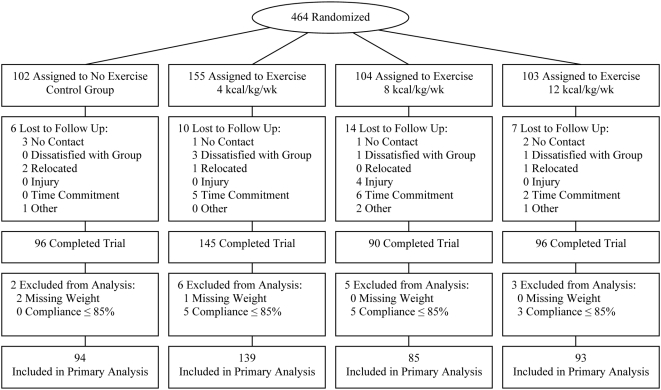
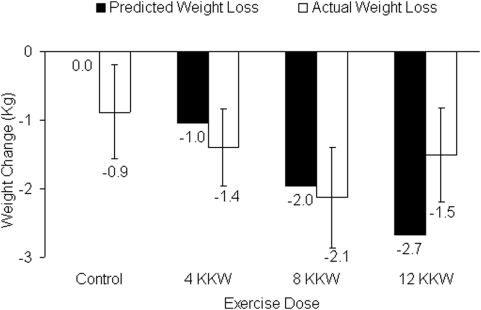
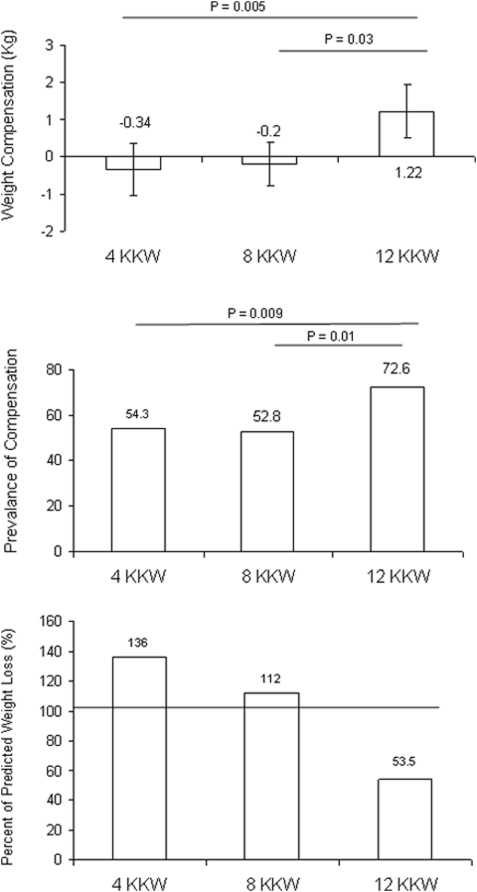
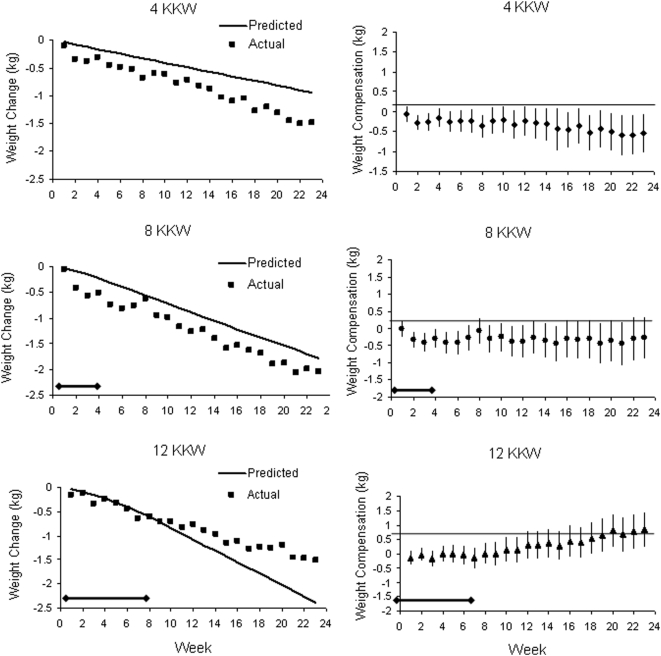
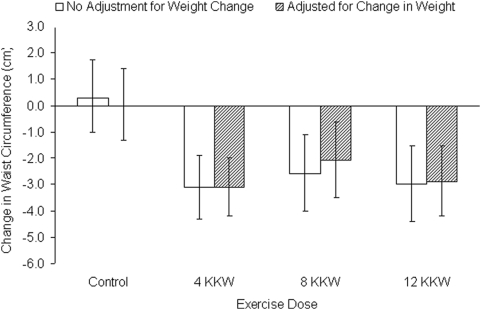
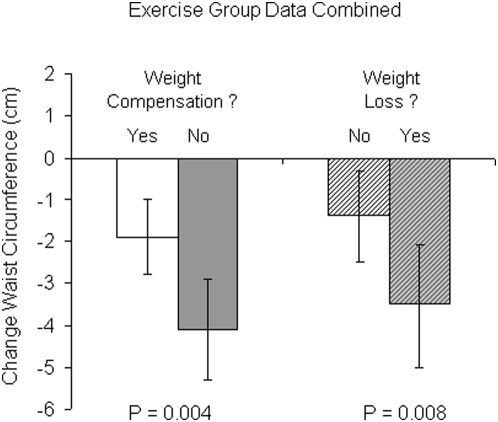
BACKGROUND: It has been suggested that exercise training results in compensatory mechanisms that attenuate weight loss. However, this has only been examined with large doses of exercise. The goal of this analysis was to examine actual weight loss compared to predicted weight loss (compensation) across different doses of exercise in a controlled trial of sedentary, overweight or obese postmenopausal women (n = 411). METHODOLOGY/PRINCIPAL FINDINGS: Participants were randomized to a non-exercise control (n = 94) or 1 of 3 exercise groups; exercise energy expenditure of 4 (n = 139), 8 (n = 85), or 12 (n = 93) kcal/kg/week (KKW). Training intensity was set at the heart rate associated with 50% of each woman's peak VO(2) and the intervention period was 6 months. All exercise was supervised. The main outcomes were actual weight loss, predicted weight loss (exercise energy expenditure/ 7700 kcal per kg), compensation (actual minus predicted weight loss) and waist circumference. The study sample had a mean (SD) age 57.2 (6.3) years, BMI of 31.7 (3.8) kg/m(2), and was 63.5% Caucasian. The adherence to the intervention was >99% in all exercise groups. The mean (95% CI) weight loss in the 4, 8 and 12 KKW groups was -1.4 (-2.0, -0.8), -2.1 (-2.9, -1.4) and -1.5 (-2.2, -0.8) kg, respectively. In the 4 and 8 KKW groups the actual weight loss closely matched the predicted weight loss of -1.0 and -2.0 kg, respectively, resulting in no significant compensation. In the 12 KKW group the actual weight loss was less than the predicted weight loss (-2.7 kg) resulting in 1.2 (0.5, 1.9) kg of compensation (P<0.05 compared to 4 and 8 KKW groups). All exercise groups had a significant reduction in waist circumference which was independent of changes in weight. CONCLUSION: In this study of previously sedentary, overweight or obese, postmenopausal women we observed no difference in the actual and predicted weight loss with 4 and 8 KKW of exercise (72 and 136 minutes respectively), while the 12 KKW (194 minutes) produced only about half of the predicted weight loss. However, all exercise groups had a significant reduction in waist circumference which was independent of changes in weight. TRIAL REGISTRATION: (ClinicalTrials.gov) NCT00011193.
Overview
The claims and statistics of this paper haven’t been checked yet.
Free: it reads the open-access text and checks the first 5 claims that cite a source we can check. Create a free account to check every claim.
Integrity signals
Registry
Cites
Statistics
Figures
Verification
Claims the paper makes
The claims and statistics of this paper haven’t been checked yet.
Free: it reads the open-access text and checks the first 5 claims that cite a source we can check. Create a free account to check every claim.
Claims other papers make about this one
Each is checked against this paper’s own text: does it say what the citing paper says it does?
The source backs part of the claim, not all of it — or backs it for a different population, condition or comparison.
In the citing paper
“This type of outcome is robust and has been demonstrated in different types of participants followed over similar time periods [14].”
From Appetite control and energy balance: Impact of exercise (2015) · cites this paper as [14]
Experimental — accuracy not yet measuredThe cited source says what the claim attributes to it.
In the citing paper
“in many cases the degree of weight lost is somewhat less than that theoretically predicted on the basis of the measured EE and its presumed relationship to tissue lost [13, 14].”
From Appetite control and energy balance: Impact of exercise (2015) · cites this paper as [14]
The check wasn’t confident either way, so it gives no verdict — never disputed.
In the citing paper
“Resistance training preserves lean body mass and slows the drop in resting metabolic rate that often follows weight loss [102].”
From Obesity: Clinical Impact, Pathophysiology, Complications, and Modern Innovations in Therapeutic Strategies (2025) · cites this paper as [102]
Experimental — accuracy not yet measuredIn the citing paper
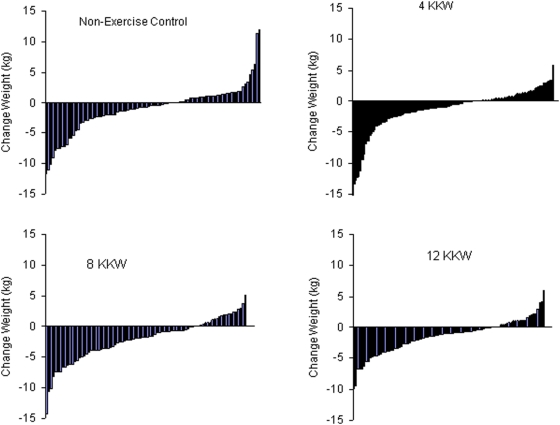
“The most significant outcome of the study by King et al. [13] - and other similar investigations [14] - is the range of individual adjustments in body weight as shown in Figure 3.”
From Appetite control and energy balance: Impact of exercise (2015) · cites this paper as [14]
Self-check
Percentages, sums and reported differences re-computed from the paper’s own numbers.
The self-check needs the paper’s full text.
Citations
Cites
Obesity : Preventing and managing the global epidemic
Akram, D. S., Astrup, A. V., Atinmo, T., Boissin, J.-L., Bray, G. A., Carroll, K. N., Chitson, P., Chen, C., Dietz, W. H., Hill, J. O., et al. (2000) · Research at the University of Copenhagen (University of Copenhagen) · Cited by 12,945
Prevalence of Overweight and Obesity in the United States, 1999-2004
Ogden, C. L., Carroll, M. D., Curtin, L. R., McDowell, M. A., Tabak, C. J., & Flegal, K. M. (2006) · JAMA · doi:10.1001/jama.295.13.1549 · Cited by 8,720
(2007) · Circulation · doi:10.1161/circulationaha.107.185649 · Cited by 6,545 · cited 1×
“[1,5–8,12,13] To our knowledge there are no studies that have examined weight compensation across different doses of exercise.”
Self-citationTrumbo, P., Schlicker, S., Yates, A. A., & Poos, M. (2002) · Journal of the American Dietetic Association · doi:10.1016/s0002-8223(02)90346-9 · Cited by 5,993
Physical Activity and Health: A Report of the Surgeon General: (525162010-001)
(1995) · PsycEXTRA Dataset · doi:10.1037/e525162010-001 · Cited by 5,479
American College of Sports Medicine position stand
Otis, C. L. (1997) · Medical Entomology and Zoology · Cited by 4,407
Prevalence of Overweight and Obesity in the United States
Crespo, C. J., & Ellen, S. (2003) · Obesity: Etiology Assessment Treatment and Prevention · doi:10.5040/9781718206601.ch-001 · Cited by 4,379
Physical Fitness and All-Cause Mortality: A Prospective Study of Healthy Men and Women
Blair, S. N. (1989) · JAMA · doi:10.1001/jama.1989.03430170057028 · Cited by 2,658 · cited 1×
“[17–20] Specifically, we estimated that the typical sedentary postmenopausal woman who started an activity program and followed the consensus public health recommendation would expend 8 kcal/kg/week (KKW) in the exercise program.”
Self-citationObesity and Diabetes in the Developing World — A Growing Challenge
Hossain, P., Kawar, B., & El Nahas, M. (2007) · New England Journal of Medicine · doi:10.1056/nejmp068177 · Cited by 2,200 · cited 1×
“[1–4] Regular exercise is considered a central component of weight loss and there are many organizations that recommend an hour or more per day of exercise to prevent weight gain, promote weight loss and/or prevent weight regain.”
Practical Assessment of Body Composition
Jackson, A. S., & Pollock, M. L. (1985) · The Physician and Sportsmedicine · doi:10.1080/00913847.1985.11708790 · Cited by 1,149 · cited 1×
“[22] To calculate predicted weight change we assumed that 1 Kg of weight represented 7700 kcal in energy.”
Research works printed but not linked: 1
- 23. The University of Texas HSoPH (1996) Food intake analysis system. Version 3.0.
Cited by
Items 201–300 of 321
Damayanti, N. A., Nusdwinuringtyas, N., Tambunan, T. F. U., & Kekalih, A. (2022) · Jurnal Profesi Medika Jurnal Kedokteran dan Kesehatan · doi:10.33533/jpm.v16i2.5104 · Cited by 4
A 3-year lifestyle intervention in primary health care
Eriksson, M. (2010) · Cited by 3
Applying behavioural insights to challenges in health policy
King, D. (2014) · Spiral (Imperial College London) · doi:10.25560/28411 · Cited by 3
Obesity: A Sociological Examination
Himes, C. L., & Episcopo, V. (2011) · Handbooks of sociology and social research · doi:10.1007/978-1-4419-7374-0_32 · Cited by 3
Exercise in the Treatment of Obesity
Sayer, R. D., & Hill, J. O. (2018) · Endocrinology · doi:10.1007/978-3-319-47685-8_29-3 · Cited by 3
Association of Exercise with Control of Eating and Energy Intake
Drenowatz, C. J., Greier, M. D. C., & Greier, K. (2019) · Current Addiction Reports · doi:10.1007/s40429-019-00255-1 · Cited by 3
Detecting Periods of Eating in Everyday Life by Tracking Wrist Motion — What is a Meal?
Sharma, S. P. (2020) · TigerPrints (Clemson University) · Cited by 3
The Effects of an Acute Bout of Aerobic or Resistance Exercise on Nonexercise Physical Activity
Thomas, J. V., Tobin, S. Y., Mifflin, M. G., Burns, R. D., Bailey, R. R., Purcell, S. A., Melanson, E. L., Cornier, M., & Halliday, T. M. (2023) · Exercise Sport and Movement · doi:10.1249/esm.0000000000000004 · Cited by 3
Quronfulah, B. S. (2019) · Queensland University of Technology · doi:10.5204/thesis.eprints.134422 · Cited by 3
Time Spent Exercising and Obesity: An Application of Lewbel’s Instrumental Variables Method
Courtemanche, C., Pinkston, J. C., & Stewart, J. (2020) · National Bureau of Economic Research · doi:10.3386/w26670 · Cited by 3
“It also cited a study of almost 500 overweight middleaged women in which the treatment groups, which were randomly assigned different amounts of exercise with a personal trainer, did not lose significantly more weight than the control group after six months (Church et al., 2009).”
BackgroundManzano, J. J., Clemente, C., Grager, A., & Olcina, G. J. (2011) · MHSALUD Revista en Ciencias del Movimiento Humano y Salud · doi:10.15359/mhs.8-1.2 · Cited by 2
La obesidad desde la perspectiva de la selección de alimentos.
Arriaga-Ramírez, J. C. P. (2019) · RESPYN Revista de Salud Pública y Nutrición · doi:10.29105/respyn18.1-4 · Cited by 2
Development and Validation of the Diet-Related Beliefs of Exercisers Scale
Dohle, S., Duncan, M. J., & Bucher, T. (2021) · Journal of Sport and Exercise Psychology · doi:10.1123/jsep.2020-0027 · Cited by 2
Hayes‐Ortiz, T., Suárez‐Reyes, M., Galgani, J. E., Zbinden‐Foncea, H., & Fernández‐Verdejo, R. (2023) · European Journal of Sport Science · doi:10.1080/17461391.2023.2193944 · Cited by 2
“The consistent observation that exercise decreases body weight less than expected supports the idea (Church et al., 2009; Flack et al., 2020; Martin et al., 2019; Turner et al., 2010).”
BackgroundRocha, J. S. B., Freitas, R. F., Vieira, D. R., Gomes, G. V., Costa, B. L., & Reis, V. M. C. P. (2013) · Revista Brasileira de Qualidade de Vida · doi:10.3895/s2175-08582013000400004 · Cited by 2
Modulations physiologiques et physiopathologiques de la lipolyse chez l’homme
Moro, C. (2012) · Cahiers de Nutrition et de Diététique · doi:10.1016/j.cnd.2012.08.001 · Cited by 2
Corporate Leanwashing and Consumer Beliefs About Obesity
Karnani, A., McFerran, B., & Mukhopadhyay, A. (2017) · Current Nutrition Reports · doi:10.1007/s13668-017-0210-1 · Cited by 2
“What is worse, we reward ourselves for exercise with an indulgent treat, and may end up consuming more calories than we had burned [17, 18].”
BackgroundMete, R., Georgousopoulou, E. N., Mellor, D. D., Khoo, J. J. C., Cheong, M., Leeds, A., Allan, K., Avery, A., Hart, K., Muir, A., et al. (2017) · Wiley eBooks · doi:10.1002/9781118857991.ch4 · Cited by 2
Buonani, C. (2013) · Aleph UCLA Undergraduate Research Journal for the Humanities and Social Sciences · Cited by 2
Exercise, Appetite Control, and Body Weight Regulation
Hopkins, M., Horner, K. M., & King, N. A. (2015) · Springer eBooks · doi:10.1007/978-4-431-55333-5_11 · Cited by 2
Teta, K., Teta, J., & Esposito, R. (2020) · Elsevier eBooks · doi:10.1016/b978-0-323-43044-9.00036-4 · Cited by 2
Tailoring Training for Obese Individuals with Case-Based Reasoning
Lorenzi, F., da Rosa, R. G., Peres, A., Dorneles, G. P., Peres, A., & Ricci⋆, F. (2017) · ACM International Conference on Bioinformatics, Computational Biology, and Health Informatics (ACM-BCB) · doi:10.1145/3107411.3107467 · Cited by 2
“3107467 (4 kcal/week, 8 kcal/week or 12 kcal/week), a discrete body weight change has occurred only after six months [3].”
BackgroundKeadle, S. K. (2012) · Scholarworks (University of Massachusetts Amherst) · doi:10.7275/xfd1-4h10 · Cited by 2
Eriksson, K. M. (2010) · DiVA at Umeå University (Umeå University) · Cited by 14
Influence of exercise training on daily physical activity and risk factors for type 2 diabetes
Wasenius, N. (2014) · Helda - University of Helsinki Institutional Repository · Cited by 2
Fix Our Food: Food Reform Begins with the Dietary Guidelines (Durham, North Carolina)
Hite, A. H. (2011) · Carolina Digital Repository (University of North Carolina at Chapel Hill) · doi:10.17615/1yzy-t575 · Cited by 2
Leclerc, J. (2017) · Corpus Université Laval (Université Laval) · Cited by 2
Veličković, D. (2025) · Exercise and Quality of Life · doi:10.31382/preprint.000110 · Cited by 1
Program Edukasi Kesehatan dan Perubahan Lingkar Pinggang pada Penderita Diabetes Melitus Tipe 2
Kirtishanti, A., Lorensia, A., Yudiarso, A., Linggani, L., Agustina, S., & Junita, L. (2013) · Kesmas National Public Health Journal · doi:10.21109/kesmas.v8i1.338 · Cited by 1
Physical Activity and Psychosocial Aspects of Arthritis
Katz, P. (2015) · Springer eBooks · doi:10.1007/978-3-319-22858-7_13 · Cited by 1
Prévention des maladies métaboliques par l’activité physique : des preuves aux mécanismes
Moro, C. (2019) · Médecine des Maladies Métaboliques · doi:10.1016/s1957-2557(19)30186-5 · Cited by 1
Hopkins, M., King, N. A., & Blundell, J. E. (2012) · QUT ePrints (Queensland University of Technology) · Cited by 1
メタボリックシンドローム改善のための運動 : ニコニコペース運動のすすめ(メタボリックシンドロームの治療の進歩,2012年,第53回日本心身医学会総会ならびに学術講演会(鹿児島))
桧垣, 靖. (2013) · 心身医学 · doi:10.15064/jjpm.53.3_237 · Cited by 1
Review on Exercise Intervention Methods for Weight Loss in Obese Individuals
Shin, Y., Choi, M.-D., & Kim, I. (2016) · Exercise Science · doi:10.15857/ksep.2016.25.4.219 · Cited by 1
Casey, K., Mailey, E. L., Rosenkranz, R. R., Swank, A., Ablah, E. A., & Rosenkranz, S. K. (2018) · BMC Nutrition · doi:10.1186/s40795-018-0223-1 · Cited by 1
“behavior impacts health, regardless of physical activity practices [4].”
BackgroundTeta, J., & Teta, K. (2013) · Elsevier eBooks · doi:10.1016/b978-1-4377-2333-5.00036-5 · Cited by 1
Exercise across the lifespan: Exercise and obesity
Friedman, D. J., & Brukner, P. D. (2022) · Elsevier eBooks · doi:10.1016/b978-0-323-89843-0.00004-0 · Cited by 1
Biological and behavioral predictors of relative energy intake after acute exercise
Höchsmann, C., Beckford, S. E., French, J. A., Boron, J. B., Stevens, J. R., & Koehler, K. (2023) · Appetite · doi:10.1016/j.appet.2023.106520 · Cited by 1
Alkahtani, S. A. (2012) · Cited by 1
Alahmadi, M. A. (2011) · Faculty of Health; Institute of Health and Biomedical Innovation · Cited by 1
Physical activity and sedentary behaviour in humans and pet dogs
Morrison, R. B. I. (2015) · Enlighten: Theses (The University of Glasgow) · Cited by 1
Dietary changes associated with an intervention to reduce sedentary behavior in women
Casey, K. (2016) · K-State Research Exchange (Kansas State University) · Cited by 1
Myers, A. (2017) · White Rose eTheses Online (University of Leeds, The University of Sheffield, University of York) · Cited by 1
Impact of physical activity and dietary programme on metabolic syndrome risk factors in Saudi women
Hajri, A., & Saleh, A. (2018) · Nottingham ePrints (University of Nottingham) · Cited by 1
Whipple, M. O. (2019) · University of Minnesota Digital Conservancy (University of Minnesota) · Cited by 1
(2012) · Movement & Sport Sciences - Science & Motricité · doi:10.3917/sm.077.0073 · Cited by 1
de Paulo, T. R. S. (2017) · Americanae (AECID Library) · Cited by 1
Huynh, E. (2023) · MacSphere (McMaster University) · doi:10.71548/15139 · Cited by 1
Carhuatanta, K., & Mallett, K. A. (2011) · OhioLink ETD Center (Ohio Library and Information Network)
Behavioural compensatory and metabolic changes in response to exercise in overweight and obese women
Manthou, E. (2010) · Enlighten: Theses (The University of Glasgow)
Brown, G. L. (2012) · Enlighten: Theses (The University of Glasgow)
Metformin and/or Exercise Training Affect Metabolic Health in Men and Women with Prediabetes
Malin, S. K. (2011) · ScholarWorks@UMassAmherst (University of Massachusetts Amherst) · doi:10.7275/2175194
Physical Activity and Exercise
Kushner, R. F., Lawrence, V., & FRCPath, S. K. M. F. (2013) · Wiley eBooks · doi:10.1002/9781118643570.ch9
Fysisk träning för personer med övervikt och fetma. En litteraturstudie.
Eriksson, S., & Persson, A. (2010) · Lund University Publications Student Papers (Lund University)
Braun, B. (2010) · Exercise and Sport Sciences Reviews · doi:10.1097/jes.0b013e3181e37419
“Well-designed human studies suggest that the addition of regular physical activity may not cause much weight/fat loss because there is a compensatory rise in energy intake that can partially or completely offset the higher energy expenditure (4,6).”
BackgroundAshem, H. N., Nagib, S. H., & Thabet, N. (2013) · Egyptian Journal of Medical Human Genetics · doi:10.1016/j.ejmhg.2013.01.003
Rosenkilde, M., Auerbach, P., Reichkendler, M. H., Ploug, T., Stallknecht, B. M., Sjödin, A. M., & Mh, R. (2012)
Effect of resistance training on body composition of persons with type II diabetes
Spickler, E. R. (2010) · Western CEDAR (Western Washington University) · doi:10.25710/demg-hg30
Pomp, D., Kelly, S. A., Nehrenberg, D. L., & Hua, K. (2011)
Shamlan, G. H. (2016) · University of Surrey Open Research repository
Surgical treatment of severe obesity with laparoscopic gastric bypass and duodenal switch
Søvik, T. T. (2012) · NVA (Nasjonalt vitenarkiv) · Cited by 1
Aure, M. (2014) · NVA (Nasjonalt vitenarkiv)
Vektreduksjon ved hjelp av Grete Roedes vektreduksjonsprogram på internett
Thu, T. (2013) · NVA (Nasjonalt vitenarkiv)
Figueroa, R. (2015) · Family Medicine & Medical Science Research · doi:10.4172/2327-4972.1000167
Fuller, A. A. (2012) · J. Willard Marriott Library · doi:10.26053/0h-068w-rxg0
Keeney, B. J. (2012) · ResearchWorks at the University of Washington (University of Washington)
Inoue, M. (2012) · CSUN ScholarWorks (California State University, Northridge)
Cowan, T. (2015) · QSpace (Queen's University Library)
Fatahi, F. (2015) · Bangor University Research Portal (Bangor University)
A Population Perspective on Physical Activity and Health
Mytton, O. T. (2017) · Apollo (University of Cambridge) · doi:10.17863/cam.9900
de Castro, E. A. (2017) · UPM Digital Archive (Technical University of Madrid) · doi:10.20868/upm.thesis.47952
The Role of Exercise Dose on Ghrelin Concentration in Postmenopausal Women
Bowyer, K. P. (2017) · Scholar Commons (University of South Carolina)
Effects of exercise on hunger, food intake and energy expenditure
Rocha, J. (2013) · SHURA (Sheffield Hallam University Research Archive) (Sheffield Hallam University)
Sweet, W. G. (2017) · Research Commons (University of Waikato)
Physical Excercise in the Treatment of Obesity
Sayer, R. D., & Hill, J. O. (2018) · Endocrinology · doi:10.1007/978-3-319-47685-8_29-1
Tjelesna aktivnost u prevenciji karcinoma dojke postmenopauzalnih žena
Sunara, I. (2017) · University of Zagreb University Computing Centre (SRCE)
Excercise in the Treatment of Obesity
Sayer, R. D., & Hill, J. O. (2018) · Endocrinology · doi:10.1007/978-3-319-47685-8_29-2
The impact of high BMI on acute changes in body composition following 90 min of running
Brayton, S. H., Bosch, T. A., Bantle, A., Hodges, J. S., Dengel, D. R., & Chow, L. S. (2018) · Cogent Medicine · doi:10.1080/2331205x.2018.1502960
“These chronic training studies in sedentary participants have found reductions in abdominal visceral fat (Irwin et al., 2003; Wilmore et al., 1999) and waist circumference (Church et al., 2009; Wilmore et al., 1999).”
BackgroundMahizir, D. (2017) · Minerva Access (University of Melbourne)
Efeitos da caminhada sobre o balanço energético em mulheres obesas
Silva, R. P. (2012) · Americanae (AECID Library)
Baugh, N. (2011) · VCU Scholars Compass (Virginia Commonwealth University) · doi:10.25772/0n11-3973
Clarke-Cornwell, A. M. (2019) · University of Salford Institutional Repository (University of Salford)
RODRÍGUEZ-BRICEÑO, F., ESPINOZA, C. M., Sotomayor, E. M., & Rodríguez‐Rodríguez, F. (2020) · Revista médica de Chile · doi:10.4067/s0034-98872020000400469
Sparks, J. R. (2020) · Scholar Commons (University of South Carolina)
Evaluation of a stepwise prevention program for cardiometabolic diseases in primary care
Badenbroek, I. F. (2020) · Utrecht University Repository (Utrecht University) · doi:10.33540/135
Martins, N. (2020) · White Rose eTheses Online (University of Leeds, The University of Sheffield, University of York)
Cost-effectiveness of selective cardiometabolic disease prevention in primary care
Stol, D. M. (2021) · Utrecht University Repository (Utrecht University) · doi:10.33540/220
Brennan, A. M. (2018) · QSpace (Queen's University Library)
(2011) · CRC Press eBooks · doi:10.1201/b10790-15
McKenzie, R. B. (2011) · Springer eBooks · doi:10.1007/978-3-642-20135-6_2
Crochiere, R. J., & Forman, E. M. (2022) · iDEA - Drexel University Institutional Repository · doi:10.17918/00001140
Time Spent Exercising and Obesity: An Application of Lewbel's Instrumental Variables MethodPreprint
Courtemanche, C., Pinkston, J. C., & Stewart, J. (2020) · RePEc: Research Papers in Economics
Kumar, M., Angela, S. J. P., & Kavitha, S. (2022) · Indian Journal of Physiotherapy and Occupational Therapy - An International Journal · doi:10.37506/ijpot.v16i4.18717
Vigorous physical activity and weight status in school-aged children: a cross-sectional study
Yu, W., Xu, S., Dai, X., & Fan, H. (2024) · Frontiers in Public Health · doi:10.3389/fpubh.2024.1402780
Arčon, M., & Cameron, A. (2024) · Research Square · doi:10.21203/rs.3.rs-4638053/v1
Demiroğlu, A. (2025) · Akademisyen Kitabevi eBooks · doi:10.37609/akya.3367
The acute effects of exercise-induced energy expenditure on physical activity energy expenditure
Arčon, M., & Cameron, A. (2025) · Exercise and Quality of Life · doi:10.31382/eqol.250606
Metadata
- Authors
- Church, T. S., Martin, C. K., Thompson, A. M., Earnest, C. P., Mikus, C. R., & Blair, S. N.
- Affiliations
- Pennington Biomedical Research Center (US)
- University of Missouri (US)
- University of South Carolina (US)
- Corresponding author
- Church, Timothy S.
- Venue
- PLoS ONE
- Publisher
- Public Library of Science (PLoS)
- Published
- 2009-02-18
- Volume
- 4
- Issue
- 2
- Pages
- e4515
- ISSN
- 1932-6203 (ISSN-L)
- PMC
- PMC2639700
- OpenAlex
- W2121467598
- Cited by
- 275
- References
- 32
- Citations by year
- 2026: 6 · 2025: 8 · 2024: 8 · 2023: 10 · 2022: 15 · 2021: 10 · 2020: 16 · 2019: 16 · 2018: 21 · 2017: 25 · 2016: 22 · 2015: 21 · 2014: 19 · 2013: 25 · 2012: 22
- FWCI
- 11.71
- Type
- journal article
- Language
- en
- Open access
- gold
- doi.org
- Locations
- PLoS ONE (publishedVersion, cc-by)
- PubMed Central (publishedVersion, cc-by)
- PubMed (publishedVersion)
- Scholar Commons (University of South Carolina) (submittedVersion)
- DOAJ (DOAJ: Directory of Open Access Journals) (submittedVersion, cc-by-sa)
- Figshare (submittedVersion, cc-by)
- Funders
- National Institutes of Health (5k23dk068052-04)
- National Heart, Lung, and Blood Institute (HL-66262, R01HL066262)
- National Institute of Diabetes and Digestive and Kidney Diseases (K23-DK-068052, K23 DK068052-01A2)
- Topics
- Health Sciences › Medicine › Public Health, Environmental and Occupational Health › Physical Activity and Health
- Health Sciences › Medicine › Physiology (medical) › Cardiovascular and exercise physiology
- Health Sciences › Medicine › Public Health, Environmental and Occupational Health › Obesity, Physical Activity, Diet
- Keywords
- weight loss prediction, waist circumference, postmenopausal women, overweight women, sedentary women, exercise energy expenditure, aerobic exercise, obesity, weight loss
- MeSH terms
- Exercise Therapy, Female, Humans, Middle Aged, Exercise, Treatment Outcome, Postmenopause, Overweight, Waist Circumference
About these checks
Registry, retraction, Cites and statistics results are computed, not judged, with one exception: a printed reference that no index lists is read once by a model before it counts as a citation error. Claims are extracted by a model and kept only when their quote appears verbatim in the text; each cited source is then checked, with a model’s help, for whether it says what the claim relies on. Those verdicts can be wrong — read the claim’s quote and the cited source before relying on one.
Statistics and arithmetic are recomputed, not judged.
Confidence bands are shown only for fields calibrated on our annotated test set. None is calibrated yet, so no band is shown.
What counts as a claim ›How we measure confidence ›How we check this ›
Are you an author, or do you see a problem with this page? Request a review
Data sources
Bibliographic data: Semantic Scholar, OpenAlex, Crossref.
Contains information from the Semantic Scholar Academic Graph Datasets, made available under the ODC Attribution License (ODC-BY 1.0).
Semantic Scholar’s data is described in: Kinney, R., et al. (2023). The Semantic Scholar Open Data Platform. arXiv:2301.10140.
