

Changes in Weight, Waist Circumference and Compensatory Responses with Different Doses of Exercise among Sedentary, Overweight Postmenopausal Women
Open accessThe DOI matches its Crossref record; 30 of the 32 references it cites were found in a registry or an index.
Abstract
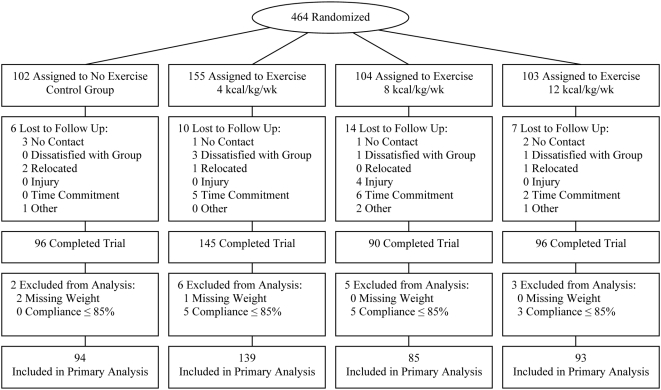
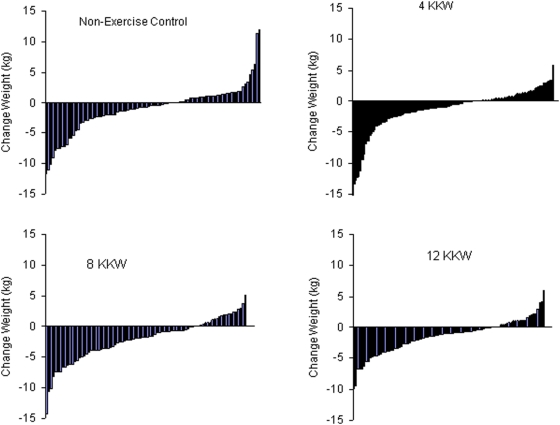
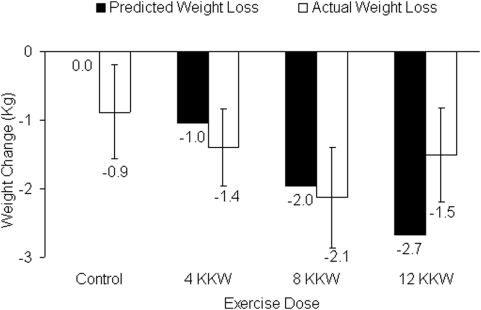
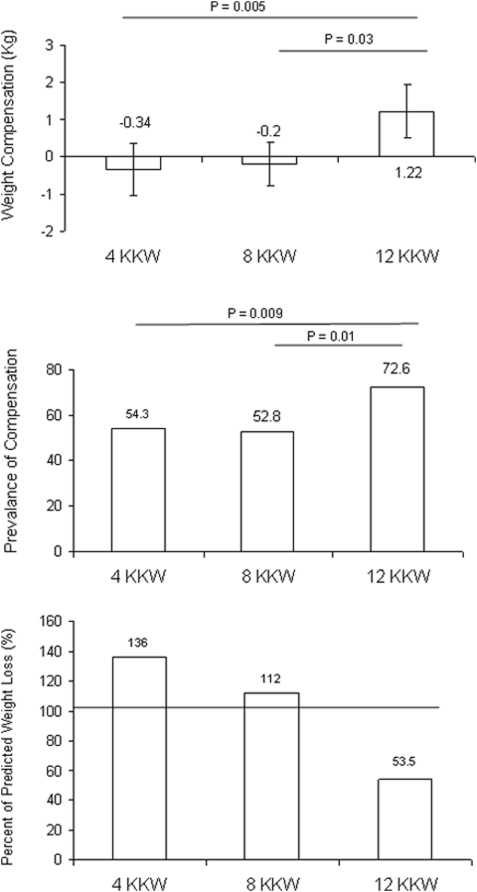
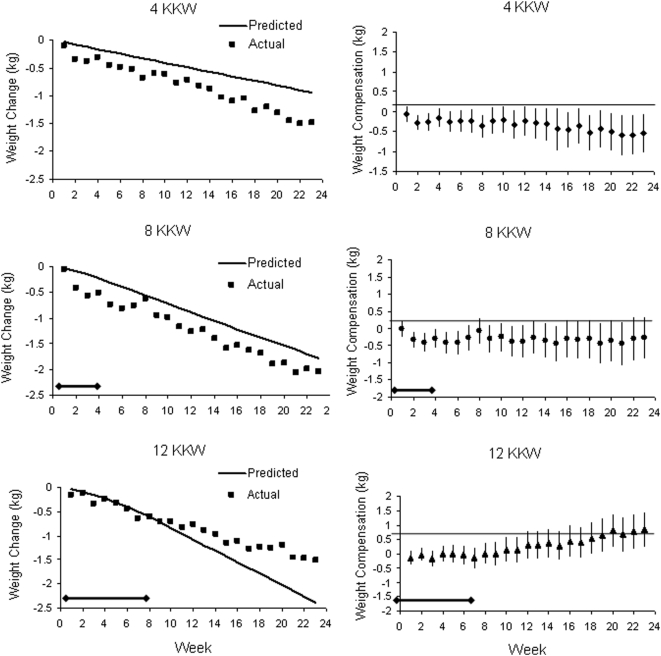
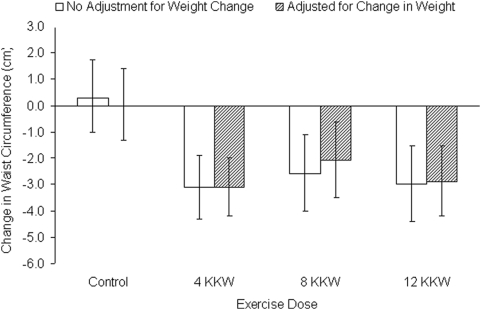
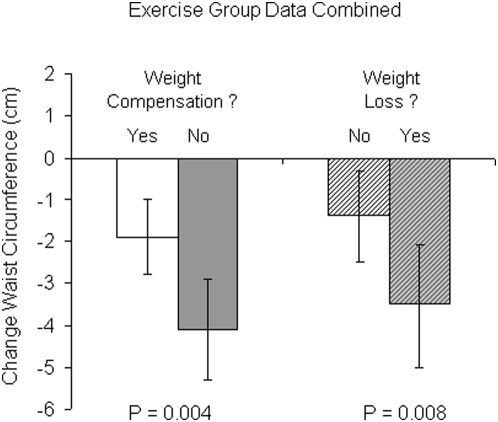
BACKGROUND: It has been suggested that exercise training results in compensatory mechanisms that attenuate weight loss. However, this has only been examined with large doses of exercise. The goal of this analysis was to examine actual weight loss compared to predicted weight loss (compensation) across different doses of exercise in a controlled trial of sedentary, overweight or obese postmenopausal women (n = 411). METHODOLOGY/PRINCIPAL FINDINGS: Participants were randomized to a non-exercise control (n = 94) or 1 of 3 exercise groups; exercise energy expenditure of 4 (n = 139), 8 (n = 85), or 12 (n = 93) kcal/kg/week (KKW). Training intensity was set at the heart rate associated with 50% of each woman's peak VO(2) and the intervention period was 6 months. All exercise was supervised. The main outcomes were actual weight loss, predicted weight loss (exercise energy expenditure/ 7700 kcal per kg), compensation (actual minus predicted weight loss) and waist circumference. The study sample had a mean (SD) age 57.2 (6.3) years, BMI of 31.7 (3.8) kg/m(2), and was 63.5% Caucasian. The adherence to the intervention was >99% in all exercise groups. The mean (95% CI) weight loss in the 4, 8 and 12 KKW groups was -1.4 (-2.0, -0.8), -2.1 (-2.9, -1.4) and -1.5 (-2.2, -0.8) kg, respectively. In the 4 and 8 KKW groups the actual weight loss closely matched the predicted weight loss of -1.0 and -2.0 kg, respectively, resulting in no significant compensation. In the 12 KKW group the actual weight loss was less than the predicted weight loss (-2.7 kg) resulting in 1.2 (0.5, 1.9) kg of compensation (P<0.05 compared to 4 and 8 KKW groups). All exercise groups had a significant reduction in waist circumference which was independent of changes in weight. CONCLUSION: In this study of previously sedentary, overweight or obese, postmenopausal women we observed no difference in the actual and predicted weight loss with 4 and 8 KKW of exercise (72 and 136 minutes respectively), while the 12 KKW (194 minutes) produced only about half of the predicted weight loss. However, all exercise groups had a significant reduction in waist circumference which was independent of changes in weight. TRIAL REGISTRATION: (ClinicalTrials.gov) NCT00011193.
Overview
The claims and statistics of this paper haven’t been checked yet.
Free: it reads the open-access text and checks the first 5 claims that cite a source we can check. Create a free account to check every claim.
Integrity signals
Registry
Cites
Statistics
Figures
Verification
Claims the paper makes
The claims and statistics of this paper haven’t been checked yet.
Free: it reads the open-access text and checks the first 5 claims that cite a source we can check. Create a free account to check every claim.
Claims other papers make about this one
Each is checked against this paper’s own text: does it say what the citing paper says it does?
The source backs part of the claim, not all of it — or backs it for a different population, condition or comparison.
In the citing paper
“This type of outcome is robust and has been demonstrated in different types of participants followed over similar time periods [14].”
From Appetite control and energy balance: Impact of exercise (2015) · cites this paper as [14]
Experimental — accuracy not yet measuredThe cited source says what the claim attributes to it.
In the citing paper
“in many cases the degree of weight lost is somewhat less than that theoretically predicted on the basis of the measured EE and its presumed relationship to tissue lost [13, 14].”
From Appetite control and energy balance: Impact of exercise (2015) · cites this paper as [14]
The check wasn’t confident either way, so it gives no verdict — never disputed.
In the citing paper
“Resistance training preserves lean body mass and slows the drop in resting metabolic rate that often follows weight loss [102].”
From Obesity: Clinical Impact, Pathophysiology, Complications, and Modern Innovations in Therapeutic Strategies (2025) · cites this paper as [102]
Experimental — accuracy not yet measuredIn the citing paper
“The most significant outcome of the study by King et al. [13] - and other similar investigations [14] - is the range of individual adjustments in body weight as shown in Figure 3.”
From Appetite control and energy balance: Impact of exercise (2015) · cites this paper as [14]
Self-check
Percentages, sums and reported differences re-computed from the paper’s own numbers.
The self-check needs the paper’s full text.
Citations
Cites
Obesity : Preventing and managing the global epidemic
Akram, D. S., Astrup, A. V., Atinmo, T., Boissin, J.-L., Bray, G. A., Carroll, K. N., Chitson, P., Chen, C., Dietz, W. H., Hill, J. O., et al. (2000) · Research at the University of Copenhagen (University of Copenhagen) · Cited by 12,945
Prevalence of Overweight and Obesity in the United States, 1999-2004
Ogden, C. L., Carroll, M. D., Curtin, L. R., McDowell, M. A., Tabak, C. J., & Flegal, K. M. (2006) · JAMA · doi:10.1001/jama.295.13.1549 · Cited by 8,720
(2007) · Circulation · doi:10.1161/circulationaha.107.185649 · Cited by 6,545 · cited 1×
“[1,5–8,12,13] To our knowledge there are no studies that have examined weight compensation across different doses of exercise.”
Self-citationTrumbo, P., Schlicker, S., Yates, A. A., & Poos, M. (2002) · Journal of the American Dietetic Association · doi:10.1016/s0002-8223(02)90346-9 · Cited by 5,993
Physical Activity and Health: A Report of the Surgeon General: (525162010-001)
(1995) · PsycEXTRA Dataset · doi:10.1037/e525162010-001 · Cited by 5,479
American College of Sports Medicine position stand
Otis, C. L. (1997) · Medical Entomology and Zoology · Cited by 4,407
Prevalence of Overweight and Obesity in the United States
Crespo, C. J., & Ellen, S. (2003) · Obesity: Etiology Assessment Treatment and Prevention · doi:10.5040/9781718206601.ch-001 · Cited by 4,379
Physical Fitness and All-Cause Mortality: A Prospective Study of Healthy Men and Women
Blair, S. N. (1989) · JAMA · doi:10.1001/jama.1989.03430170057028 · Cited by 2,658 · cited 1×
“[17–20] Specifically, we estimated that the typical sedentary postmenopausal woman who started an activity program and followed the consensus public health recommendation would expend 8 kcal/kg/week (KKW) in the exercise program.”
Self-citationObesity and Diabetes in the Developing World — A Growing Challenge
Hossain, P., Kawar, B., & El Nahas, M. (2007) · New England Journal of Medicine · doi:10.1056/nejmp068177 · Cited by 2,200 · cited 1×
“[1–4] Regular exercise is considered a central component of weight loss and there are many organizations that recommend an hour or more per day of exercise to prevent weight gain, promote weight loss and/or prevent weight regain.”
Practical Assessment of Body Composition
Jackson, A. S., & Pollock, M. L. (1985) · The Physician and Sportsmedicine · doi:10.1080/00913847.1985.11708790 · Cited by 1,149 · cited 1×
“[22] To calculate predicted weight change we assumed that 1 Kg of weight represented 7700 kcal in energy.”
Research works printed but not linked: 1
- 23. The University of Texas HSoPH (1996) Food intake analysis system. Version 3.0.
Cited by
Items 301–321 of 321
Rocha, L. R. R., Barbosa, M. H., Nunes, V. A. P., & Machado, M. D. M. B. C. (2025) · Revista fisio&terapia. · doi:10.69849/revistaft/ni10202507261546
Creasy, S. A., Oselinsky, K. M., Willis, E. A., Caldwell, A. E., Rosenberg, R. C., Ostendorf, D. M., Panter, S. L., Wayland, L. T., Bing, K., Lorentzen, J., et al. (2025) · Trials · doi:10.1186/s13063-025-09306-7
Wang, K., Mehta, R. S., Ma, W., Nguyen, L. H., Wang, D. D., Ghazi, A. R., Yan, Y., Al‐Shaar, L., Wang, Y., Hang, D., et al. (2023) · Figshare · doi:10.6084/m9.figshare.23265017
Composição corporal e aptidão cardiorespiratória em mulheres pós-menopáusicas
Ogando, B. M. A. P. (2014) · Repository of UTAD (Universidad De Tras-os Montes e Alto Douro)
Fumanal, C. B., Marco, F. G., & Rodríguez, G. V. (2019) · Zaguan (University of Zaragoza Repository)
Wagner, M. (2017) · Qucosa (Saxon State and University Library Dresden)
Ansattes helse som kostnadsdriver: litteraturstudie
Jahrmann, J. (2010) · NORA - Norwegian Open Research Archives
(2018) · Arizona State University Library Digital Repository (Arizona State University)
Exercício físico e composição corporal em mulheres pós-menopáusicas
Rocha, J. S. B. (2016) · Portuguese National Funding Agency for Science, Research and Technology (RCAAP Project by FCT)
da Silva, R. P. (2018) · LA Referencia (Red Federada de Repositorios Institucionales de Publicaciones Científicas)
Fonseca, H. V. D. C. (2024) · LA Referencia (Red Federada de Repositorios Institucionales de Publicaciones Científicas)
Stevens, E. C., Gentry, A. E., Robins, J. L. W., Kinser, P. A., & Shah, L. (2026) · Obesity Pillars · doi:10.1016/j.obpill.2026.100257
“Research focused on physical activity interventions for midlife women with obesity has included evaluation of the total time per week spent exercising [16], high intensity interval training exercise [17], and different exercise settings such as home based versus group exercise [18].”
Elshakankiry, A. M., Hunter, G. R., Martins, C., & Fisher, G. (2026) · European Journal of Applied Physiology · doi:10.1007/s00421-026-06161-5
“The practical implications of this constrained model are that higher doses of exercise lead to energy deficits and magnitudes of weight loss that are smaller than predicted, due to compensation in other components of EE, as previously shown (Rosenkilde et al. 2012 ; Church et al. 2009).”
Weight Management in Menopause
Lu, V., Tayachew, B., Chevtsov, A., & Nicklas, J. M. (2026) · Obstetrics and Gynecology Clinics of North America · doi:10.1016/j.ogc.2026.04.002
Liu, K., Hao, S., & Ashou, L. (2026) · BMC Sports Science Medicine and Rehabilitation · doi:10.1186/s13102-026-01778-7
Correlations between group fitness, cognitive performance and quality of life.
Clarke, J. (2022) · Otago University Research Archive (University of Otago)
Dorling, J. L., Apolzan, J. W., Thomas, D. M., Höchsmann, C., Johannsen, N. M., Ross, R., Church, T., & Martin, C. K. (2026) · European Journal of Applied Physiology · doi:10.1007/s00421-026-06405-4
Self-citationPicolo, M. R. (2013) · Americanae (AECID Library)
Emery, R. N. (2015) · D-Scholarship@Pitt (University of Pittsburgh)
Metadata
- Authors
- Church, T. S., Martin, C. K., Thompson, A. M., Earnest, C. P., Mikus, C. R., & Blair, S. N.
- Affiliations
- Pennington Biomedical Research Center (US)
- University of Missouri (US)
- University of South Carolina (US)
- Corresponding author
- Church, Timothy S.
- Venue
- PLoS ONE
- Publisher
- Public Library of Science (PLoS)
- Published
- 2009-02-18
- Volume
- 4
- Issue
- 2
- Pages
- e4515
- ISSN
- 1932-6203 (ISSN-L)
- PMC
- PMC2639700
- OpenAlex
- W2121467598
- Cited by
- 275
- References
- 32
- Citations by year
- 2026: 6 · 2025: 8 · 2024: 8 · 2023: 10 · 2022: 15 · 2021: 10 · 2020: 16 · 2019: 16 · 2018: 21 · 2017: 25 · 2016: 22 · 2015: 21 · 2014: 19 · 2013: 25 · 2012: 22
- FWCI
- 11.71
- Type
- journal article
- Language
- en
- Open access
- gold
- doi.org
- Locations
- PLoS ONE (publishedVersion, cc-by)
- PubMed Central (publishedVersion, cc-by)
- PubMed (publishedVersion)
- Scholar Commons (University of South Carolina) (submittedVersion)
- DOAJ (DOAJ: Directory of Open Access Journals) (submittedVersion, cc-by-sa)
- Figshare (submittedVersion, cc-by)
- Funders
- National Institutes of Health (5k23dk068052-04)
- National Heart, Lung, and Blood Institute (HL-66262, R01HL066262)
- National Institute of Diabetes and Digestive and Kidney Diseases (K23-DK-068052, K23 DK068052-01A2)
- Topics
- Health Sciences › Medicine › Public Health, Environmental and Occupational Health › Physical Activity and Health
- Health Sciences › Medicine › Physiology (medical) › Cardiovascular and exercise physiology
- Health Sciences › Medicine › Public Health, Environmental and Occupational Health › Obesity, Physical Activity, Diet
- Keywords
- weight loss prediction, waist circumference, postmenopausal women, overweight women, sedentary women, exercise energy expenditure, aerobic exercise, obesity, weight loss
- MeSH terms
- Exercise Therapy, Female, Humans, Middle Aged, Exercise, Treatment Outcome, Postmenopause, Overweight, Waist Circumference
About these checks
Registry, retraction, Cites and statistics results are computed, not judged, with one exception: a printed reference that no index lists is read once by a model before it counts as a citation error. Claims are extracted by a model and kept only when their quote appears verbatim in the text; each cited source is then checked, with a model’s help, for whether it says what the claim relies on. Those verdicts can be wrong — read the claim’s quote and the cited source before relying on one.
Statistics and arithmetic are recomputed, not judged.
Confidence bands are shown only for fields calibrated on our annotated test set. None is calibrated yet, so no band is shown.
What counts as a claim ›How we measure confidence ›How we check this ›
Are you an author, or do you see a problem with this page? Request a review
Data sources
Bibliographic data: Semantic Scholar, OpenAlex, Crossref.
Contains information from the Semantic Scholar Academic Graph Datasets, made available under the ODC Attribution License (ODC-BY 1.0).
Semantic Scholar’s data is described in: Kinney, R., et al. (2023). The Semantic Scholar Open Data Platform. arXiv:2301.10140.
