

The DOI matches its Crossref record; 51 of the 51 references it cites were found in a registry or an index.
A Normalization Model of Attentional Modulation of Single Unit Responses
Open accessAbstract
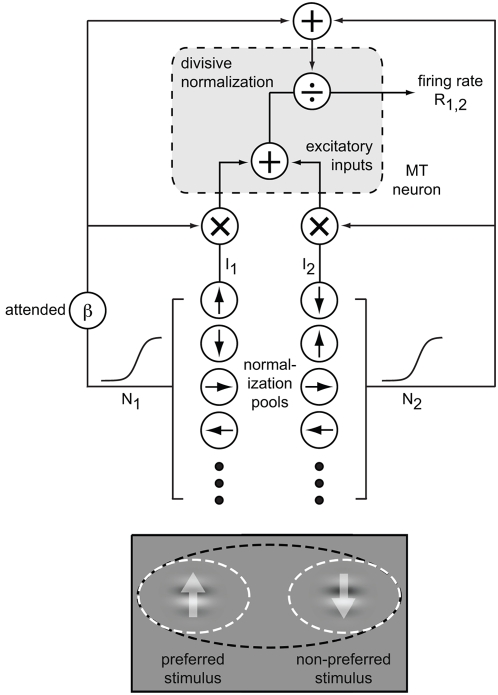
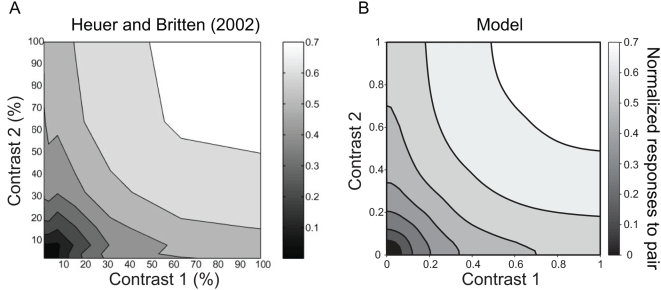
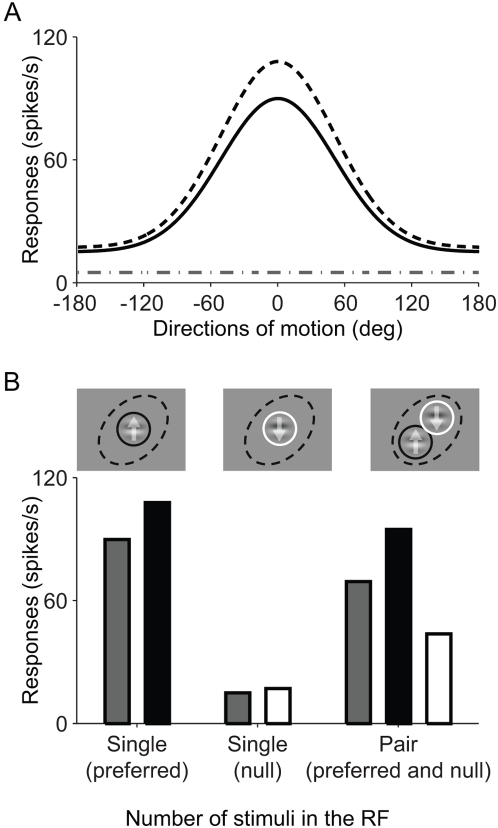
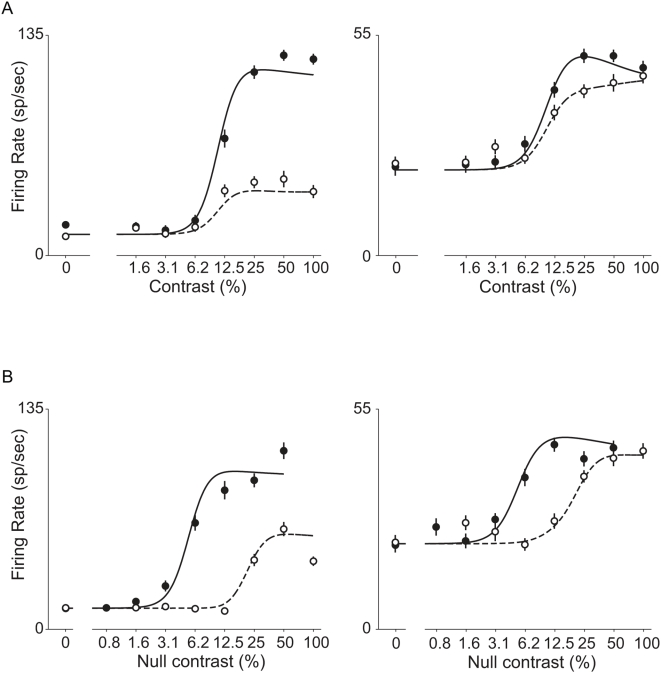
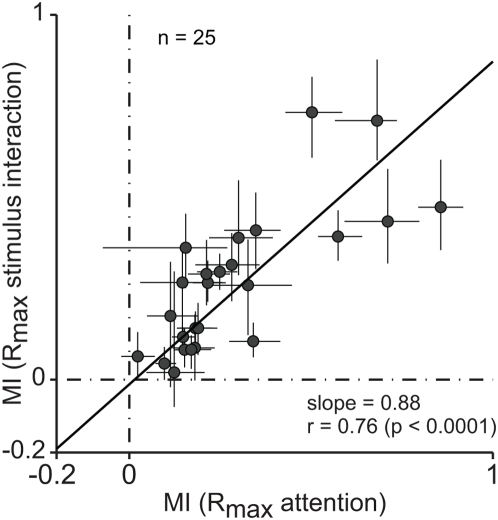
Although many studies have shown that attention to a stimulus can enhance the responses of individual cortical sensory neurons, little is known about how attention accomplishes this change in response. Here, we propose that attention-based changes in neuronal responses depend on the same response normalization mechanism that adjusts sensory responses whenever multiple stimuli are present. We have implemented a model of attention that assumes that attention works only through this normalization mechanism, and show that it can replicate key effects of attention. The model successfully explains how attention changes the gain of responses to individual stimuli and also why modulation by attention is more robust and not a simple gain change when multiple stimuli are present inside a neuron's receptive field. Additionally, the model accounts well for physiological data that measure separately attentional modulation and sensory normalization of the responses of individual neurons in area MT in visual cortex. The proposal that attention works through a normalization mechanism sheds new light a broad range of observations on how attention alters the representation of sensory information in cerebral cortex.
Overview
The claims and statistics of this paper haven’t been checked yet.
Run the check — free, no account needed. It reads the open-access text and checks the sources it cites.
Integrity signals
Registry
Cites
Statistics
Figures
Verification
Claims the paper makes
The claims and statistics of this paper haven’t been checked yet.
Run the check — free, no account needed. It reads the open-access text and checks the sources it cites.
Claims other papers make about this one
Each is checked against this paper’s own text: does it say what the citing paper says it does?
In the citing paper
“Attentional modulation of neural gain has been particularly well studied in the non-human primate visual system1,42,43, in which visual spatial attention within the receptive field of a recorded neuron enhances both contrast gain (that is, scaling of that neuron’s stimulus-response relationship along the contrast axis)43 and response gain (that is, multiplicative transformation of responses to all”
From Mechanisms underlying gain modulation in the cortex (2020) · cites this paper as [46]
Self-check
Percentages, sums and reported differences re-computed from the paper’s own numbers.
The self-check needs the paper’s full text.
Citations
Cites
Neural Mechanisms of Selective Visual Attention
Desimone, R., & Duncan, J. (1995) · Annual Review of Neuroscience · doi:10.1146/annurev.ne.18.030195.001205 · Cited by 8,388
Selective Attention Gates Visual Processing in the Extrastriate Cortex
Moran, J., & Desimone, R. (1985) · Science · doi:10.1126/science.4023713 · Cited by 2,433
Shadlen, M. N., & Newsome, W. T. (1998) · The Journal of Neuroscience · doi:10.1523/jneurosci.18-10-03870.1998 · Cited by 2,178
Selective Attention Gates Visual Processing in the Extrastriate Cortex
Moran, J., & Desimone, R. (2003) · The MIT Press eBooks · doi:10.7551/mitpress/2834.003.0024 · Cited by 2,164
Normalization of cell responses in cat striate cortex
Heeger, D. J. (1992) · Visual Neuroscience · doi:10.1017/s0952523800009640 · Cited by 1,835
Synaptic depression and cortical gain control
Abbott, L. F., Varela, J. A., Sen, K., & Nelson, S. B. (1997) · Science · doi:10.1126/science.275.5297.221 · Cited by 1,690
Neural mechanisms of spatial selective attention in areas V1, V2, and V4 of macaque visual cortex
Luck, S. J., Chelazzi, L., Hillyard, S. A., & Desimone, R. (1997) · Journal of Neurophysiology · doi:10.1152/jn.1997.77.1.24 · Cited by 1,615
The neural bases of momentary lapses in attention
Weissman, D. H., Roberts, K. C., Visscher, K. M., & Woldorff, M. G. (2006) · Nature Neuroscience · doi:10.1038/nn1727 · Cited by 1,566
Feature-based attention influences motion processing gain in macaque visual cortex
Treue, S., & Trujillo, J. C. M. (1999) · Nature · doi:10.1038/21176 · Cited by 1,465
Maunsell, J. H. R., & Essen, D. C. V. (1983) · Journal of Neurophysiology · doi:10.1152/jn.1983.49.5.1127 · Cited by 1,462
Self-citation
Cited by
Sorted by citations
Visual attention: The past 25 years
Carrasco, M. (2011) · Vision Research · doi:10.1016/j.visres.2011.04.012 · Cited by 2,660
Top-down influences on visual processing
Gilbert, C. D., & Li, W. (2013) · Nature Reviews Neuroscience · doi:10.1038/nrn3476 · Cited by 1,224
Attention improves performance primarily by reducing interneuronal correlations
Cohen, M. R., & Maunsell, J. H. R. (2009) · Nature Neuroscience · doi:10.1038/nn.2439 · Cited by 1,163
Self-citationSpatial attention decorrelates intrinsic activity fluctuations in macaque area V4
Mitchell, J. F., Sundberg, K. A., & Reynolds, J. H. (2009) · Neuron · doi:10.1016/j.neuron.2009.09.013 · Cited by 710
Divisive Normalization in Olfactory Population Codes
Olsen, S. R., Bhandawat, V., & Wilson, R. I. (2010) · Neuron · doi:10.1016/j.neuron.2010.04.009 · Cited by 500
Metadata
- Authors
- Lee, J., & Maunsell, J. H. R.
- Affiliations
- Baylor College of Medicine (US)
- Howard Hughes Medical Institute (US)
- Corresponding author
- Maunsell, John H. R.
- Venue
- PLoS ONE
- Publisher
- Public Library of Science (PLoS)
- Published
- 2009-02-27
- Volume
- 4
- Issue
- 2
- Pages
- e4651
- ISSN
- 1932-6203 (ISSN-L)
- PMC
- PMC2645695
- OpenAlex
- W2163588736
- Cited by
- 257
- References
- 51
- Citations by year
- 2026: 3 · 2025: 10 · 2024: 6 · 2023: 27 · 2022: 10 · 2021: 14 · 2020: 11 · 2019: 18 · 2018: 13 · 2017: 13 · 2016: 18 · 2015: 18 · 2014: 20 · 2013: 18 · 2012: 17
- FWCI
- 9.09
- Type
- journal article
- Language
- en
- Open access
- gold
- doi.org
- Locations
- PLoS ONE (publishedVersion, cc-by)
- PubMed Central (publishedVersion, cc-by)
- PubMed (publishedVersion)
- Digital Access to Scholarship at Harvard (DASH) (Harvard University) (submittedVersion, cc-by)
- RePEc: Research Papers in Economics (submittedVersion)
- DOAJ (DOAJ: Directory of Open Access Journals) (submittedVersion)
- Funders
- Howard Hughes Medical Institute
- National Institutes of Health
- National Eye Institute (R01EY005911)
- Topics
- Life Sciences › Neuroscience › Cognitive Neuroscience › Visual perception and processing mechanisms
- Physical Sciences › Computer Science › Computer Vision and Pattern Recognition › Visual Attention and Saliency Detection
- Life Sciences › Neuroscience › Cognitive Neuroscience › Neural dynamics and brain function
- Keywords
- attentional modulation, single-unit responses, gain modulation, multiple stimuli, receptive fields, area MT, visual cortex, computational model of attention, neuronal gain
- MeSH terms
- Attention, Cerebral Cortex, Humans, Models, Theoretical
About these checks
Registry, retraction, Cites and statistics results are computed, not judged, with one exception: a printed reference that no index lists is read once by a model before it counts as a citation error. Claims are extracted by a model and kept only when their quote appears verbatim in the text; each cited source is then checked, with a model’s help, for whether it says what the claim relies on. Those verdicts can be wrong — read the claim’s quote and the cited source before relying on one.
Statistics and arithmetic are recomputed, not judged.
Confidence bands are shown only for fields calibrated on our annotated test set. None is calibrated yet, so no band is shown.
What counts as a claim ›How we measure confidence ›How we check this ›
Are you an author, or do you see a problem with this page? Request a review
