

Key Steps in Developing a Cognitive Vaccine against Traumatic Flashbacks: Visuospatial Tetris versus Verbal Pub Quiz
Open accessThe DOI matches its Crossref record; 59 of the 60 references it cites were found in a registry or an index.
Abstract
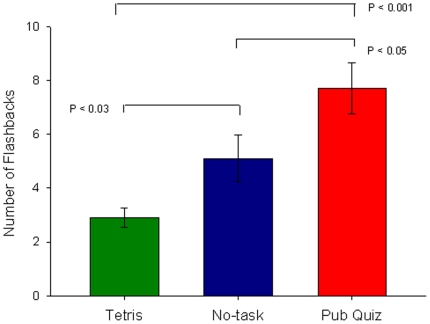
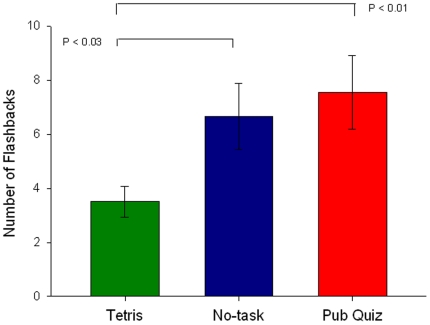
BACKGROUND: Flashbacks (intrusive memories of a traumatic event) are the hallmark feature of Post Traumatic Stress Disorder, however preventative interventions are lacking. Tetris may offer a 'cognitive vaccine' [1] against flashback development after trauma exposure. We previously reported that playing the computer game Tetris soon after viewing traumatic material reduced flashbacks compared to no-task [1]. However, two criticisms need to be addressed for clinical translation: (1) Would all games have this effect via distraction/enjoyment, or might some games even be harmful? (2) Would effects be found if administered several hours post-trauma? Accordingly, we tested Tetris versus an alternative computer game--Pub Quiz--which we hypothesized not to be helpful (Experiments 1 and 2), and extended the intervention interval to 4 hours (Experiment 2). METHODOLOGY/PRINCIPAL FINDINGS: The trauma film paradigm was used as an experimental analog for flashback development in healthy volunteers. In both experiments, participants viewed traumatic film footage of death and injury before completing one of the following: (1) no-task control condition (2) Tetris or (3) Pub Quiz. Flashbacks were monitored for 1 week. Experiment 1: 30 min after the traumatic film, playing Tetris led to a significant reduction in flashbacks compared to no-task control, whereas Pub Quiz led to a significant increase in flashbacks. Experiment 2: 4 hours post-film, playing Tetris led to a significant reduction in flashbacks compared to no-task control, whereas Pub Quiz did not. CONCLUSIONS/SIGNIFICANCE: First, computer games can have differential effects post-trauma, as predicted by a cognitive science formulation of trauma memory. In both Experiments, playing Tetris post-trauma film reduced flashbacks. Pub Quiz did not have this effect, even increasing flashbacks in Experiment 1. Thus not all computer games are beneficial or merely distracting post-trauma - some may be harmful. Second, the beneficial effects of Tetris are retained at 4 hours post-trauma. Clinically, this delivers a feasible time-window to administer a post-trauma "cognitive vaccine".
Overview
The claims and statistics of this paper haven’t been checked yet.
Free: it reads the open-access text and checks the first 5 claims that cite a source we can check. Create a free account to check every claim.
Integrity signals
Registry
Cites
Statistics
Figures


Verification
Claims the paper makes
The claims and statistics of this paper haven’t been checked yet.
Free: it reads the open-access text and checks the first 5 claims that cite a source we can check. Create a free account to check every claim.
Claims other papers make about this one
Each is checked against this paper’s own text: does it say what the citing paper says it does?
The source backs part of the claim, not all of it — or backs it for a different population, condition or comparison.
In the citing paper
“Six studies used serious games in the cognition training genre (48, 58, 59, 61, 63, 65).”
From Serious Games for Mental Health: Are They Accessible, Feasible, and Effective? A Systematic Review and Meta-analysis (2017) · cites this paper as [48]
Experimental — accuracy not yet measuredThe source backs part of the claim, not all of it — or backs it for a different population, condition or comparison.
In the citing paper
“Within both studies by Holmes et al. (48, 64), this game was played for 10 min with little instruction needed, after watching a film containing traumatic scenes.”
From Serious Games for Mental Health: Are They Accessible, Feasible, and Effective? A Systematic Review and Meta-analysis (2017) · cites this paper as [48]
Experimental — accuracy not yet measuredThe source backs part of the claim, not all of it — or backs it for a different population, condition or comparison.
In the citing paper
“the non-clinical group (34, 48, 58, 64) [g = 0.68 (95% CI 0.26–1.09, NNT = 2.70)]”
From Serious Games for Mental Health: Are They Accessible, Feasible, and Effective? A Systematic Review and Meta-analysis (2017) · cites this paper as [48]
Experimental — accuracy not yet measuredThe source backs part of the claim, not all of it — or backs it for a different population, condition or comparison.
In the citing paper
“the adult group (18+) (48, 58, 64) [g = 0.53 (95% CI 0.07–0.99, NNT = 3.42)]”
From Serious Games for Mental Health: Are They Accessible, Feasible, and Effective? A Systematic Review and Meta-analysis (2017) · cites this paper as [48]
Experimental — accuracy not yet measuredThe source backs part of the claim, not all of it — or backs it for a different population, condition or comparison.
In the citing paper
“Intrusive images over 1 week: S=2.90a (1.61) C=5.10b (3.80) V=7.70c (4.20)”
From Episodic memory, perceptual memory, and their interaction: Foundations for a theory of posttraumatic stress disorder. (2014) · cites this paper as Holmes et al. (2010) exp. 1
Experimental — accuracy not yet measured
14 more claims about this paper
Create a free account to see every claim other papers make about this one.
Self-check
Percentages, sums and reported differences re-computed from the paper’s own numbers.
The self-check needs the paper’s full text.
Citations
Cites
Diagnostic and Statistical Manual of Mental Disorders
Williams, J. B. W., & First, M. (2013) · Encyclopedia of Social Work · doi:10.1093/acrefore/9780199975839.013.104 · Cited by 109,519
Posttraumatic Stress Disorder in the National Comorbidity Survey
Kessler, R. C. (1995) · Archives of General Psychiatry · doi:10.1001/archpsyc.1995.03950240066012 · Cited by 10,379
A cognitive model of posttraumatic stress disorder
Ehlers, A., & Clark, D. M. (2000) · Behaviour Research and Therapy · doi:10.1016/s0005-7967(99)00123-0 · Cited by 6,147 · cited 2×
“Overall, the findings support established models of trauma memory processing [24,25,26,55].”
BackgroundResultThe construction of autobiographical memories in the self-memory system
Conway, M. A., & Pleydell-Pearce, C. W. (2000) · Psychological Review · doi:10.1037/0033-295x.107.2.261 · Cited by 4,089 · cited 1×
“Human memory differentiates visual and verbal components [13,14,15]”
BackgroundDiary Methods: Capturing Life as it is Lived
Bolger, N., Davis, A., & Rafaeli, E. (2003) · Annual Review of Psychology · doi:10.1146/annurev.psych.54.101601.145030 · Cited by 3,843 · cited 1×
“via PDA’s or mobile phone SMS technology; see [54] for a review).”
BackgroundThe world health report 2001 - Mental health: new understanding, new hope
Sayers, J. G. (2001) · Europe PMC (PubMed Central) · doi:10.1590/s0042-96862001001100014 · Cited by 3,123
Action video game modifies visual selective attention
Green, C. S., & Bavelier, D. (2003) · Nature · doi:10.1038/nature01647 · Cited by 2,540 · cited 1×
“Developing a safe cognitive intervention post-trauma: what are the next steps? With regards to points 1–5 above, our previous paper in PLoS ONE [1] provided the first step in developing an intervention, demonstrating under experimental conditions that intrusive flashback memories were reduced by the visuospatial task…”
Mental Health: New Understanding, New Hope
(2001) · JAMA · doi:10.1001/jama.286.19.2391 · Cited by 1,598
Psychological debriefing for preventing post traumatic stress disorder (PTSD)
Rose, S. C., Bisson, J., Churchill, R., & Wessely, S. (2002) · Cochrane Database of Systematic Reviews · doi:10.1002/14651858.cd000560 · Cited by 1,250
Preventing the return of fear in humans using reconsolidation update mechanisms
Schiller, D., Monfils, M.-H., Raio, C. M., Johnson, D. C., LeDoux, J. E., & Phelps, E. A. (2010) · Nature · doi:10.1038/nature08637 · Cited by 1,248 · cited 2×
“[42,43]), applied to the first time (to our”
Background
Cited by
Items 201–274 of 274
Jiang, C., Chen, W., Tao, L., Wang, J., Cheng, K., Zhang, Y., Qi, Z., & Zheng, X. (2023) · Frontiers in Psychiatry · doi:10.3389/fpsyt.2023.1090290 · Cited by 2
“As for visuospatial games, although it has been repeatedly reported that playing Tetris game can reduce the number of intrusions in experimental conditions (19, 31, 49, 53, 76, 77), realworld traumas (20, 21, 75, 78), and PTSD patients (22), and in either the consolidation (1920, 31, 73) or the reconsolidation time wi…”
BackgroundResultMental Imagery versus Imagination
Nánay, B. (2023) · Oxford University Press eBooks · doi:10.1093/oso/9780198809500.003.0022 · Cited by 2
Potential for use of tetris in the neonatal unit – a scoping review
Craig, V. E. M., McLaughlin, D. F., Devlin, K. P., Higgins, A., & Boyle, B. (2024) · BMC Digital Health · doi:10.1186/s44247-024-00086-9 · Cited by 2
“Studies have shown that Tetris has been successful in reducing the incidence of IMs within an experimental context [15, 38, 46, 48] and in trials with participants with established PTSD as an adjunct to EMDR treatment [39].”
BackgroundОсобливості функціонування пам’яті під час травматичних подіїв
Лагутіна, С., & Суббота, С. (2020) · DOAJ (DOAJ: Directory of Open Access Journals) · doi:10.26766/pmgp.v5i1.249 · Cited by 2
Konaç, A., & Ünal, Ç. T. (2022) · Ayna Klinik Psikoloji Dergisi · doi:10.31682/ayna.777249 · Cited by 1
Lau, H., Smit, J. H., Fleming, T. M., & Riper, H. M. (2020) · Open Access Victoria University of Wellington | Te Herenga Waka (Figshare) · doi:10.26686/wgtn.12331268.v2 · Cited by 2
Clark, I. A., Mackay, C. E., Holmes, E. A., & Bourne, C. (2016) · Psychological Medicine · doi:10.1017/s0033291716000052 · Cited by 1
Self-citationOn curiosity and passion for science: Interview with Emily Holmes
Glăveanu, V. P. (2011) · PsycEXTRA Dataset · doi:10.1037/e617512012-002 · Cited by 1
Yeung, R. C., Sokolowski, H. M., Fan, C. L., Fernandes, M. A., & Levine, B. (2024) · doi:10.31234/osf.io/6fp9w · Cited by 1
Wessel, I., Krans, J., Albers, C. J., Chauhan, N., de Sá, D. S. F., Hauck, A., Jaswetz, L., Michael, T., Nixon, R. D. V., Pearson, D., et al. (2024) · doi:10.31234/osf.io/j9trf · Cited by 1
Holmes, E. A., moulds, M., Kanstrup, M., Gamble, B., & Singh, L. (2021) · OSF Preprints (OSF Preprints) · Cited by 1
Self-citationCognitive Processes in Craving: From the Laboratory to the Real World.
Skorka-Brown, J. (2015) · PEARL (University of Plymouth) · doi:10.24382/3887
Mental Imagery: Functional Mechanisms and Clinical
Naselaris, T., & Holmes, E. A. (2015)
Self-citationCreating Silver Linings: Modifying negative mental imagery in anxiety
Landkroon, E. (2021) · Utrecht University Repository (Utrecht University) · doi:10.33540/651
Video games as a supportive tool in the therapeutic process
Granat, M. M. (2021) · Homo Ludens · doi:10.14746/hl.2021.14.4 · Cited by 1
(2018) · Mardaga eBooks · doi:10.3917/mard.picte.2018.01.0211
(2019) · Journal of Experimental Psychology General · doi:10.1037/xge0000598.supp
(2020) · Practice, progress, and proficiency in sustainability · doi:10.4018/978-1-7998-4408-2.ch006
Castilho, E. C. D. (2021) · Digital Library of Theses and Dissertations (Universidade de São Paulo) · doi:10.11606/t.22.2021.tde-12052022-124305
The Effect of Sleep on Intrusive Memories in Daily Life: A Meta-analysis of Trauma Film ExperimentsPreprint
Davidson, P., & Marcusson‐Clavertz, D. (2022) · doi:10.31234/osf.io/dwrhe
Pictet, A., & Bouchard, J. (2023) · Annales Médico-psychologiques revue psychiatrique · doi:10.1016/j.amp.2023.05.007
Visuospatial game in PTSD symptoms alleviation: intervention overview and clinical studies results
Czernecka, K. (2023) · Kwartalnik Naukowy Fides et Ratio · doi:10.34766/fetr.v55i3.1213 · Cited by 2
Nánay, B. (2023) · Oxford University Press eBooks · doi:10.1093/oso/9780198809500.003.0002 · Cited by 1
Nánay, B. (2023) · Oxford University Press eBooks · doi:10.1093/oso/9780198809500.003.0008
Mental Imagery in Psychology and Neuroscience
Nánay, B. (2023) · Oxford University Press eBooks · doi:10.1093/oso/9780198809500.003.0001
Nánay, B. (2023) · Oxford University Press eBooks · doi:10.1093/oso/9780198809500.002.0007
Top-Down Influences on Perception and Mental Imagery
Nánay, B. (2023) · Oxford University Press eBooks · doi:10.1093/oso/9780198809500.003.0011
Nánay, B. (2023) · Oxford University Press eBooks · doi:10.1093/oso/9780198809500.003.0006 · Cited by 1
Perception/Mental Imagery Mixed Cases
Nánay, B. (2023) · Oxford University Press eBooks · doi:10.1093/oso/9780198809500.003.0009
Nánay, B. (2023) · Oxford University Press eBooks · doi:10.1093/oso/9780198809500.003.0010
Nánay, B. (2023) · Oxford University Press eBooks · doi:10.1093/oso/9780198809500.003.0012
Nánay, B. (2023) · Oxford University Press eBooks · doi:10.1093/oso/9780198809500.003.0003 · Cited by 1
Nánay, B. (2023) · Oxford University Press eBooks · doi:10.1093/oso/9780198809500.003.0005
Nánay, B. (2023) · Oxford University Press eBooks · doi:10.1093/oso/9780198809500.003.0017
Nánay, B. (2023) · Oxford University Press eBooks · doi:10.1093/oso/9780198809500.003.0024
Nánay, B. (2023) · Oxford University Press eBooks · doi:10.1093/oso/9780198809500.003.0029
Sensory Substitution and Echolocation
Nánay, B. (2023) · Oxford University Press eBooks · doi:10.1093/oso/9780198809500.003.0015
Nánay, B. (2023) · Oxford University Press eBooks · doi:10.1093/oso/9780198809500.003.0018
Sense Modalities in Mental Imagery
Nánay, B. (2023) · Oxford University Press eBooks · doi:10.1093/oso/9780198809500.003.0014
Nánay, B. (2023) · Oxford University Press eBooks · doi:10.1093/oso/9780198809500.003.0028 · Cited by 1
Nánay, B. (2023) · Oxford University Press eBooks · doi:10.1093/oso/9780198809500.002.0003
Nánay, B. (2023) · Oxford University Press eBooks · doi:10.1093/oso/9780198809500.003.0020
Nánay, B. (2023) · Oxford University Press eBooks · doi:10.1093/oso/9780198809500.003.0016
Nánay, B. (2023) · Oxford University Press eBooks · doi:10.1093/oso/9780198809500.003.0025
Nánay, B. (2023) · Oxford University Press eBooks · doi:10.1093/oso/9780198809500.003.0021
Nánay, B. (2023) · Oxford University Press eBooks · doi:10.1093/oso/9780198809500.003.0027 · Cited by 1
Nánay, B. (2023) · Oxford University Press eBooks · doi:10.1093/oso/9780198809500.003.0023
Nánay, B. (2023) · Oxford University Press eBooks · doi:10.1093/oso/9780198809500.003.0026
Clinical Applications of Mental Imagery
Nánay, B. (2023) · Oxford University Press eBooks · doi:10.1093/oso/9780198809500.003.0030
Nánay, B. (2023) · Oxford University Press eBooks · doi:10.1093/oso/9780198809500.003.0007
Nánay, B. (2023) · Oxford University Press eBooks · doi:10.1093/oso/9780198809500.002.0006
Nánay, B. (2023) · Oxford University Press eBooks · doi:10.1093/oso/9780198809500.002.0005
Nánay, B. (2023) · Oxford University Press eBooks · doi:10.1093/oso/9780198809500.003.0019
Winners Improvise to Score Dirty TetrisesPreprint
Berry, J. (2024) · SSRN Electronic Journal · doi:10.2139/ssrn.4809352
Trascendiendo realidades: una tipología de la inmersividad
Hernández, J. J. B., & Wilhelm, D. (2024) · Obra digital · doi:10.25029/od.2024.439.26
Waterworth, J. A. (2025) · Palgrave Studies in Cyberpsychology. · doi:10.1007/978-3-031-99832-4_4
Ågren, T. (2012) · Uppsala University Publications (Uppsala University)
Kanstrup, M., Rudman, A., Göransson, K. E., Andersson, E., Lauri, K. O., Rapoport, E., Sunnergård, L., Bragesjö, M., Andersson, E., Iyadurai, L., et al. (2021) · Figshare · doi:10.6084/m9.figshare.16767640
Self-citationKanstrup, M., Singh, L., Leehr, E. J., Göransson, K. E., Pihlgren, S. A., Iyadurai, L., Dahl, O., Falk, A.-C., Lindström, V., Hadziosmanovic, N., et al. (2024) · Figshare · doi:10.6084/m9.figshare.27071854
Self-citationRamineni, V., Millroth, P., Iyadurai, L., Jaki, T., Kingslake, J., Highfield, J. A., Summers, C., Bonsall, M. B., & Holmes, E. A. (2023) · University of Regensburg Publication Server (University of Regensburg) · doi:10.5283/epub.75903
Self-citationReducing PTSD symptoms through unconscious intervention
Yang, Q., Wang, Y., Liu, C., Zhi, P., Chen, S., Lei, Y., Xue, F., & Zhu, Z. (2026) · Proceedings of the National Academy of Sciences · doi:10.1073/pnas.2521088123 · Cited by 1
The impact of virtual reality analog-trauma films and Tetris gameplay duration on intrusive memories
Abrams, K. B., Zhang, Y., Wang, E., Folger, I. T., Zivsak, B. C., Cullen, N. A., Smalley, I., Marvin, C. M., Ye, Y. A., & James, A. H. (2026) · Memory & Cognition · doi:10.3758/s13421-026-01872-8
“…the duration of the Tetris interference task has typically been 10–12 min (e.g., Brennen et al., 2021; Hagenaars et al., 2017; Hemi et al., 2023; Holmes et al., 2010; James et al., 2015; Wessel et al., 2025), with only a few outliers: 8 min (Asselbergs et al., 2018), 15 min (Kessler et al.,…”
InfluentialRajkumar, E., Rahul, P., Devi, R. R., Gopi, A., Shivi, & Romate, J. (2026) · Journal of Technology in Behavioral Science · doi:10.1007/s41347-026-00639-x
Mukaida, M., Bollegala, D., & Chandrasiri, N. P. (2026) · International Conference on Image Processing and Robotics (ICIPRoB) · doi:10.1109/iciprob69625.2026.11497988
“Because Tetris involves mentally visualizing and assembling the shapes of the pieces, research by Holmes et al. [2], [3] suggests playing Tetris can help suppress traumatic flashbacks.”
van Schie, K., Kessler, H., & Engelhard, I. M. (2026) · Journal of Traumatic Stress · doi:10.1002/jts.70104
“Participants then completed a standardized 10-min music filler task, rating the pleasantness of 15 fragments of classical music (Holmes et al., 2010; James et al., 2015).”
InfluentialTetrix: A novel Tetris-based paradigm for neuroimaging research and clinical applications
Grote, J., Stocker, J. E., Sommer, J., Hamm, A.-M., Kessler, H., & Jansen, A. (2026) · Behavior Research Methods · doi:10.3758/s13428-026-03150-6
“As a third option, one could use Tetrix as a predefined and highly demanding visuospatial exercise, perhaps in clinical trials to compare different interference tasks (similar to Holmes et al., 2010).”
Меркулов, М. (2026) · Visnyk Taras Shevchenko National University of Kyiv Military-Special Sciences · doi:10.17721/1728-2217.2026.67.56-66
Obukhova, N., Ahmed, N., & Huang, E. M. (2026) · Nordic Conference on Human-Computer Interaction · doi:10.1145/3829807.3829890
Meyer, T. (2015) · Research Publications (Maastricht University) · doi:10.26481/dis.20150423tm
Griffiths, E. (2014) · UCL Discovery (University College London)
The Effect of Viewpoint Dependence in Spatial Memory Tasks on Intrusive Memories in Analogue Trauma
Polack, R. E. L. R. (2014) · UCL Discovery (University College London) · Cited by 1
Metadata
- Authors
- Holmes, E. A., James, E. L., Kilford, E. J., & Deeprose, C.
- Affiliations
- University of Oxford (GB)
- Corresponding author
- Holmes, Emily A.
- Venue
- PLoS ONE
- Publisher
- Public Library of Science (PLoS)
- Published
- 2010-11-10
- Volume
- 5
- Issue
- 11
- Pages
- e13706
- ISSN
- 1932-6203 (ISSN-L)
- PMC
- PMC2978094
- OpenAlex
- W2144876777
- Cited by
- 273
- References
- 60
- Citations by year
- 2026: 9 · 2025: 10 · 2024: 19 · 2023: 56 · 2022: 14 · 2021: 22 · 2020: 18 · 2019: 16 · 2018: 20 · 2017: 14 · 2016: 13 · 2015: 18 · 2014: 10 · 2013: 12 · 2012: 14
- FWCI
- 12.27
- Type
- journal article
- Language
- en
- Update notices
- correction (2012-11-14)
- Open access
- gold
- doi.org
- Locations
- PLoS ONE (publishedVersion, cc-by)
- Europe PMC (PubMed Central) (publishedVersion, cc-by)
- PubMed Central (publishedVersion, cc-by)
- PubMed (publishedVersion)
- ePrints Soton (University of Southampton) (acceptedVersion)
- DOAJ (DOAJ: Directory of Open Access Journals) (submittedVersion)
- UCL Discovery (University College London) (submittedVersion)
- Funders
- Wellcome Trust
- Royal Society
- Topics
- Social Sciences › Psychology › Clinical Psychology › Posttraumatic Stress Disorder Research
- Life Sciences › Neuroscience › Cognitive Neuroscience › Memory Processes and Influences
- Social Sciences › Psychology › Experimental and Cognitive Psychology › Cognitive Functions and Memory
- Keywords
- post-traumatic stress disorder, Tetris, video games, post-traumatic memory, distraction, intervention timing, trauma film paradigm, intrusive memories
- MeSH terms
- Adolescent, Adult, Affect, Computers, Female, Humans, Male, Middle Aged, Motion Pictures, Surveys and Questionnaires, Mental Recall, Stress Disorders, Post-Traumatic, Task Performance and Analysis, Cognitive Science, Young Adult
About these checks
Registry, retraction, Cites and statistics results are computed, not judged, with one exception: a printed reference that no index lists is read once by a model before it counts as a citation error. Claims are extracted by a model and kept only when their quote appears verbatim in the text; each cited source is then checked, with a model’s help, for whether it says what the claim relies on. Those verdicts can be wrong — read the claim’s quote and the cited source before relying on one.
Statistics and arithmetic are recomputed, not judged.
Confidence bands are shown only for fields calibrated on our annotated test set. None is calibrated yet, so no band is shown.
What counts as a claim ›How we measure confidence ›How we check this ›
Are you an author, or do you see a problem with this page? Request a review
Data sources
Bibliographic data: Semantic Scholar, OpenAlex, Crossref.
Contains information from the Semantic Scholar Academic Graph Datasets, made available under the ODC Attribution License (ODC-BY 1.0).
Semantic Scholar’s data is described in: Kinney, R., et al. (2023). The Semantic Scholar Open Data Platform. arXiv:2301.10140.
