

Key Steps in Developing a Cognitive Vaccine against Traumatic Flashbacks: Visuospatial Tetris versus Verbal Pub Quiz
Open accessThe DOI matches its Crossref record; 59 of the 60 references it cites were found in a registry or an index.
Abstract
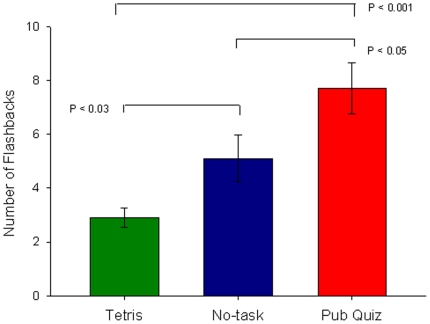
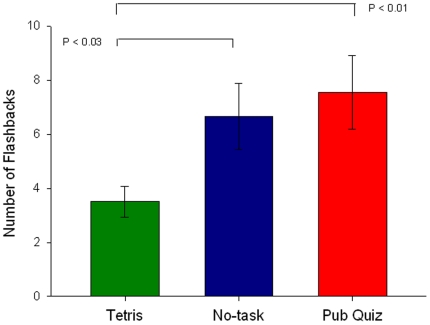
BACKGROUND: Flashbacks (intrusive memories of a traumatic event) are the hallmark feature of Post Traumatic Stress Disorder, however preventative interventions are lacking. Tetris may offer a 'cognitive vaccine' [1] against flashback development after trauma exposure. We previously reported that playing the computer game Tetris soon after viewing traumatic material reduced flashbacks compared to no-task [1]. However, two criticisms need to be addressed for clinical translation: (1) Would all games have this effect via distraction/enjoyment, or might some games even be harmful? (2) Would effects be found if administered several hours post-trauma? Accordingly, we tested Tetris versus an alternative computer game--Pub Quiz--which we hypothesized not to be helpful (Experiments 1 and 2), and extended the intervention interval to 4 hours (Experiment 2). METHODOLOGY/PRINCIPAL FINDINGS: The trauma film paradigm was used as an experimental analog for flashback development in healthy volunteers. In both experiments, participants viewed traumatic film footage of death and injury before completing one of the following: (1) no-task control condition (2) Tetris or (3) Pub Quiz. Flashbacks were monitored for 1 week. Experiment 1: 30 min after the traumatic film, playing Tetris led to a significant reduction in flashbacks compared to no-task control, whereas Pub Quiz led to a significant increase in flashbacks. Experiment 2: 4 hours post-film, playing Tetris led to a significant reduction in flashbacks compared to no-task control, whereas Pub Quiz did not. CONCLUSIONS/SIGNIFICANCE: First, computer games can have differential effects post-trauma, as predicted by a cognitive science formulation of trauma memory. In both Experiments, playing Tetris post-trauma film reduced flashbacks. Pub Quiz did not have this effect, even increasing flashbacks in Experiment 1. Thus not all computer games are beneficial or merely distracting post-trauma - some may be harmful. Second, the beneficial effects of Tetris are retained at 4 hours post-trauma. Clinically, this delivers a feasible time-window to administer a post-trauma "cognitive vaccine".
Overview
The claims and statistics of this paper haven’t been checked yet.
Free: it reads the open-access text and checks the first 5 claims that cite a source we can check. Create a free account to check every claim.
Integrity signals
Registry
Cites
Statistics
Figures


Verification
Claims the paper makes
The claims and statistics of this paper haven’t been checked yet.
Free: it reads the open-access text and checks the first 5 claims that cite a source we can check. Create a free account to check every claim.
Claims other papers make about this one
Each is checked against this paper’s own text: does it say what the citing paper says it does?
The source backs part of the claim, not all of it — or backs it for a different population, condition or comparison.
In the citing paper
“Six studies used serious games in the cognition training genre (48, 58, 59, 61, 63, 65).”
From Serious Games for Mental Health: Are They Accessible, Feasible, and Effective? A Systematic Review and Meta-analysis (2017) · cites this paper as [48]
Experimental — accuracy not yet measuredThe source backs part of the claim, not all of it — or backs it for a different population, condition or comparison.
In the citing paper
“Within both studies by Holmes et al. (48, 64), this game was played for 10 min with little instruction needed, after watching a film containing traumatic scenes.”
From Serious Games for Mental Health: Are They Accessible, Feasible, and Effective? A Systematic Review and Meta-analysis (2017) · cites this paper as [48]
Experimental — accuracy not yet measuredThe source backs part of the claim, not all of it — or backs it for a different population, condition or comparison.
In the citing paper
“the non-clinical group (34, 48, 58, 64) [g = 0.68 (95% CI 0.26–1.09, NNT = 2.70)]”
From Serious Games for Mental Health: Are They Accessible, Feasible, and Effective? A Systematic Review and Meta-analysis (2017) · cites this paper as [48]
Experimental — accuracy not yet measuredThe source backs part of the claim, not all of it — or backs it for a different population, condition or comparison.
In the citing paper
“the adult group (18+) (48, 58, 64) [g = 0.53 (95% CI 0.07–0.99, NNT = 3.42)]”
From Serious Games for Mental Health: Are They Accessible, Feasible, and Effective? A Systematic Review and Meta-analysis (2017) · cites this paper as [48]
Experimental — accuracy not yet measuredThe source backs part of the claim, not all of it — or backs it for a different population, condition or comparison.
In the citing paper
“Intrusive images over 1 week: S=2.90a (1.61) C=5.10b (3.80) V=7.70c (4.20)”
From Episodic memory, perceptual memory, and their interaction: Foundations for a theory of posttraumatic stress disorder. (2014) · cites this paper as Holmes et al. (2010) exp. 1
Experimental — accuracy not yet measured
14 more claims about this paper
Create a free account to see every claim other papers make about this one.
Self-check
Percentages, sums and reported differences re-computed from the paper’s own numbers.
The self-check needs the paper’s full text.
Citations
Cites
Diagnostic and Statistical Manual of Mental Disorders
Williams, J. B. W., & First, M. (2013) · Encyclopedia of Social Work · doi:10.1093/acrefore/9780199975839.013.104 · Cited by 109,519
Posttraumatic Stress Disorder in the National Comorbidity Survey
Kessler, R. C. (1995) · Archives of General Psychiatry · doi:10.1001/archpsyc.1995.03950240066012 · Cited by 10,379
A cognitive model of posttraumatic stress disorder
Ehlers, A., & Clark, D. M. (2000) · Behaviour Research and Therapy · doi:10.1016/s0005-7967(99)00123-0 · Cited by 6,147 · cited 2×
“Overall, the findings support established models of trauma memory processing [24,25,26,55].”
BackgroundResultThe construction of autobiographical memories in the self-memory system
Conway, M. A., & Pleydell-Pearce, C. W. (2000) · Psychological Review · doi:10.1037/0033-295x.107.2.261 · Cited by 4,089 · cited 1×
“Human memory differentiates visual and verbal components [13,14,15]”
BackgroundDiary Methods: Capturing Life as it is Lived
Bolger, N., Davis, A., & Rafaeli, E. (2003) · Annual Review of Psychology · doi:10.1146/annurev.psych.54.101601.145030 · Cited by 3,843 · cited 1×
“via PDA’s or mobile phone SMS technology; see [54] for a review).”
BackgroundThe world health report 2001 - Mental health: new understanding, new hope
Sayers, J. G. (2001) · Europe PMC (PubMed Central) · doi:10.1590/s0042-96862001001100014 · Cited by 3,123
Action video game modifies visual selective attention
Green, C. S., & Bavelier, D. (2003) · Nature · doi:10.1038/nature01647 · Cited by 2,540 · cited 1×
“Developing a safe cognitive intervention post-trauma: what are the next steps? With regards to points 1–5 above, our previous paper in PLoS ONE [1] provided the first step in developing an intervention, demonstrating under experimental conditions that intrusive flashback memories were reduced by the visuospatial task…”
Mental Health: New Understanding, New Hope
(2001) · JAMA · doi:10.1001/jama.286.19.2391 · Cited by 1,598
Psychological debriefing for preventing post traumatic stress disorder (PTSD)
Rose, S. C., Bisson, J., Churchill, R., & Wessely, S. (2002) · Cochrane Database of Systematic Reviews · doi:10.1002/14651858.cd000560 · Cited by 1,250
Preventing the return of fear in humans using reconsolidation update mechanisms
Schiller, D., Monfils, M.-H., Raio, C. M., Johnson, D. C., LeDoux, J. E., & Phelps, E. A. (2010) · Nature · doi:10.1038/nature08637 · Cited by 1,248 · cited 2×
“[42,43]), applied to the first time (to our”
BackgroundPsychological theories of posttraumatic stress disorder
Brewin, C. R., & Holmes, E. A. (2003) · Clinical Psychology Review · doi:10.1016/s0272-7358(03)00033-3 · Cited by 1,132 · cited 2×
“Overall, the findings support established models of trauma memory processing [24,25,26,55].”
BackgroundResultSelf-citationSuppressing unwanted memories by executive control
Anderson, M. C., & Green, C. (2001) · Nature · doi:10.1038/35066572 · Cited by 1,131
Neural Systems Underlying the Suppression of Unwanted Memories
Anderson, M. C., Ochsner, K. N., Kuhl, B., Cooper, J., Robertson, E., Gabrieli, S. W., Glover, G. H., & Gabrieli, J. D. E. (2004) · Science · doi:10.1126/science.1089504 · Cited by 1,082
Dissociable stages of human memory consolidation and reconsolidation
Walker, M. P., Brakefield, T., Allan Hobson, J., & Stickgold, R. (2003) · Nature · doi:10.1038/nature01930 · Cited by 1,025
Pilot study of secondary prevention of posttraumatic stress disorder with propranolol
Pitman, R. K., Sanders, K. M., Zusman, R. M., Healy, A. R., Cheema, F., Lasko, N. B., Cahill, L., & Orr, S. P. (2002) · Biological Psychiatry · doi:10.1016/s0006-3223(01)01279-3 · Cited by 964
Mind and Its Evolution: A Dual Coding Theoretical Approach
Paivio, A. (2006) · Cited by 884
Beyond extinction: erasing human fear responses and preventing the return of fear
Kindt, M., Soeter, M., & Vervliet, B. (2009) · Nature Neuroscience · doi:10.1038/nn.2271 · Cited by 826 · cited 2×
“[42,43]), applied to the first time (to our”
BackgroundThe Epidemiology of Trauma, PTSD, and Other Posttrauma Disorders
Breslau, N. (2009) · Trauma, Violence, & Abuse · doi:10.1177/1524838009334448 · Cited by 810 · cited 1×
“liable to suffer a traumatic event at some point in their life time [2], and are thus placed at risk of developing Posttraumatic Stress Disorder (PTSD) [3].”
BackgroundIntrusive re‐experiencing in post‐traumatic stress disorder: Phenomenology, theory, and therapy
Ehlers, A., Hackmann, A., & Michael, T. (2004) · Memory · doi:10.1080/09658210444000025 · Cited by 645
A cognitive neuroscience account of posttraumatic stress disorder and its treatment
Brewin, C. R. (2001) · Behaviour Research and Therapy · doi:10.1016/s0005-7967(00)00087-5 · Cited by 588
Working memory and the vividness of imagery
Baddeley, A. D., & Andrade, J. (2000) · Journal of Experimental Psychology: General · doi:10.1037/0096-3445.129.1.126 · Cited by 568
Reconsolidation: maintaining memory relevance
Lee, J. L. C. (2009) · Trends in Neurosciences · doi:10.1016/j.tins.2009.05.002 · Cited by 516 · cited 1×
“After the break, all participants were shown a brief film reminder task in which one neutral but recognizable static image from each of the 15 film clips was presented (via slides in PowerPoint) in order to ‘‘reactivate’’ memories for the trauma film [1,59,60].”
Video Games in Health Care: Closing the Gap
Kato, P. M. (2010) · Review of General Psychology · doi:10.1037/a0019441 · Cited by 502 · cited 1×
“There is increasing interest in using computer games as novel psychological interventions in healthcare [32] but our data suggest that in the field of trauma, not all computer games are beneficial or even merely distracting - some may even be harmful.”
BackgroundDalgleish, T. (2004) · Psychological Bulletin · doi:10.1037/0033-2909.130.2.228 · Cited by 498 · cited 1×
“Overall, the findings support established models of trauma memory processing [24,25,26,55].”
ResultHaier, R. J., Siegel, B. V., MacLachlan, A., Soderling, E., Lottenberg, S., & Buchsbaum, M. S. (1992) · Brain Research · doi:10.1016/0006-8993(92)90573-r · Cited by 493
Prefrontal Regions Orchestrate Suppression of Emotional Memories via a Two-Phase Process
Depue, B. E., Curran, T., & Banich, M. T. (2007) · Science · doi:10.1126/science.1139560 · Cited by 467
Trauma films, information processing, and intrusive memory development
Holmes, E. A., Brewin, C. R., & Hennessy, R. G. (2004) · Journal of Experimental Psychology: General · doi:10.1037/0096-3445.133.1.3 · Cited by 457
Self-citationHolmes, E. A., James, E. L., Coode-Bate, T., & Deeprose, C. (2009) · PLoS ONE · doi:10.1371/journal.pone.0004153 · Cited by 416
Self-citationAndrade, J., Kavanagh, D., & Baddeley, A. (1997) · British Journal of Clinical Psychology · doi:10.1111/j.2044-8260.1997.tb01408.x · Cited by 407 · cited 1×
“Cognitive science shows that visuospatial cognitive tasks compete for resources with visual images [17,18,19,20]”
BackgroundHow eye movements affect unpleasant memories: Support for a working-memory account
Gunter, R. W., & Bodner, G. E. (2008) · Behaviour Research and Therapy · doi:10.1016/j.brat.2008.04.006 · Cited by 362
Bisson, J. I., Ehlers, A., Pilling, S., Dix, P., Murphy, A. W., Johnston, J. M., Richards, D. A., Turner, S. W., Yule, W., Jones, C., et al. (2005) · ORCA Online Research @Cardiff (Cardiff University) · Cited by 352
Autobiographical memories become less vivid and emotional after eye movements
van den Hout, M., Muris, P., Salemink, E., & Kindt, M. (2001) · British Journal of Clinical Psychology · doi:10.1348/014466501163571 · Cited by 274
Wessely, S. C., Rose, S. K., & Bisson, J. I. (2000) · Research Portal (King's College London) · Cited by 264
Replaying the game: hypnagogic images in normals and amnesics
Stickgold, R., Malia, A., Maguire, D., Roddenberry, D., & O'Connor, M. (2000) · Science · doi:10.1126/science.290.5490.350 · Cited by 261 · cited 1×
“Developing a safe cognitive intervention post-trauma: what are the next steps? With regards to points 1–5 above, our previous paper in PLoS ONE [1] provided the first step in developing an intervention, demonstrating under experimental conditions that intrusive flashback memories were reduced by the visuospatial task…”
Vantage Point in Traumatic Memory
McIsaac, H. K., & Eich, E. (2004) · Psychological Science · doi:10.1111/j.0956-7976.2004.00660.x · Cited by 248
Anderson, M. C., & Levy, B. J. (2009) · Current Directions in Psychological Science · doi:10.1111/j.1467-8721.2009.01634.x · Cited by 228
Effects of visuospatial tasks on desensitization to emotive memories
Kavanagh, D. J., Freese, S., Andrade, J., & May, J. (2001) · British Journal of Clinical Psychology · doi:10.1348/014466501163689 · Cited by 226
PTSD symptom trajectories: From early to chronic response
O’Donnell, M. L., Elliott, P., Lau, W., & Creamer, M. (2007) · Behaviour Research and Therapy · doi:10.1016/j.brat.2006.03.015 · Cited by 169
Dewar, M. T., Cowan, N., & Sala, S. D. (2007) · Cortex · doi:10.1016/s0010-9452(08)70492-1 · Cited by 159
Henry, M., Fishman, J. R., & Youngner, S. J. (2007) · The American Journal of Bioethics · doi:10.1080/15265160701518474 · Cited by 156
Eye movements reduce vividness and emotionality of “flashforwards”
Engelhard, I. M., van den Hout, M. A., Janssen, W. C., & van der Beek, J. (2010) · Behaviour Research and Therapy · doi:10.1016/j.brat.2010.01.003 · Cited by 142 · cited 1×
“We note that there is a lively debate about the modality specificity of working memory [20,33,34,35,36,37,38,39,40,41] and that the current data is supportive in differentiating visual versus verbal aspects as well as holding clinical utility.”
BackgroundRona, R. J., Jones, M., Iversen, A. C., Hull, L., Greenberg, N. L., Fear, N. T., Hotopf, M. H., & Wessely, S. C. (2008) · Journal of Psychiatric Research · doi:10.1016/j.jpsychires.2008.09.006 · Cited by 131
Suppressing Unwanted Memories Reduces Their Unintended Influences
Hu, X., Bergström, Z. M., Gagnepain, P., & Anderson, M. C. (2017) · Current Directions in Psychological Science · doi:10.1177/0963721417689881 · Cited by 131
A Theory About Why We Forget What We Once Knew
Wixted, J. T. (2005) · Current Directions in Psychological Science · doi:10.1111/j.0963-7214.2005.00324.x · Cited by 127
Reconsolidation: A brief history, a retrieval view, and some recent issues
Riccio, D. C., Millin, P. M., & Bogart, A. R. (2006) · Learning & Memory · doi:10.1101/lm.290706 · Cited by 118
Kemps, E., & Tiggemann, M. (2007) · Memory · doi:10.1080/09658210701262017 · Cited by 117
“Hotspots” in trauma memories in the treatment of post-traumatic stress disorder: A replication
Grey, N., & Holmes, E. A. (2008) · Memory · doi:10.1080/09658210802266446 · Cited by 112
Self-citationVisuospatial tasks suppress craving for cigarettes
May, J., Andrade, J., Panabokke, N., & Kavanagh, D. J. (2010) · Behaviour Research and Therapy · doi:10.1016/j.brat.2010.02.001 · Cited by 102
Visuospatial working memory interference with recollections of trauma
Lilley, S. A., Andrade, J., Turpin, G., Sabin‐Farrell, R., & Holmes, E. A. (2009) · British Journal of Clinical Psychology · doi:10.1348/014466508x398943 · Cited by 101 · cited 1×
“We note that there is a lively debate about the modality specificity of working memory [20,33,34,35,36,37,38,39,40,41] and that the current data is supportive in differentiating visual versus verbal aspects as well as holding clinical utility.”
BackgroundSelf-citationShort-Term Forgetting and the Articulatory Loop
Vallar, G., & Baddeley, A. D. (1982) · The Quarterly Journal of Experimental Psychology Section A · doi:10.1080/14640748208400857 · Cited by 101
The Normativity of Memory Modification
Liao, S. M., & Sandberg, A. (2008) · Neuroethics · doi:10.1007/s12152-008-9009-5 · Cited by 93
The influence of a visuospatial grounding task on intrusive images of a traumatic film
Stuart, A. D. P., Holmes, E. A., & Brewin, C. R. (2006) · Behaviour Research and Therapy · doi:10.1016/j.brat.2005.04.004 · Cited by 88
Self-citationIntrusive images and intrusive thoughts as different phenomena: Two experimental studies
Hagenaars, M. A., Brewin, C. R., van Minnen, A., Holmes, E. A., & Hoogduin, K. A. L. (2010) · Memory · doi:10.1080/09658210903476522 · Cited by 77
Self-citationReduction of food cravings through concurrent visuospatial processing
Kemps, E., Tiggemann, M., Woods, D., & Soekov, B. (2004) · International Journal of Eating Disorders · doi:10.1002/eat.20005 · Cited by 71
Bourne, C., Frasquilho, F., Roth, A. D., & Holmes, E. A. (2010) · Journal of Behavior Therapy and Experimental Psychiatry · doi:10.1016/j.jbtep.2010.03.001 · Cited by 63
Self-citationCount out your intrusions: Effects of verbal encoding on intrusive memories
Krans, J., Näring, G., & Becker, E. S. (2009) · Memory · doi:10.1080/09658210903130780 · Cited by 49
Effects of Dual Task Interference on Memory Intrusions for Affective Images
Pearson, D., & Sawyer, T. (2011) · International Journal of Cognitive Therapy · doi:10.1521/ijct.2011.4.2.122 · Cited by 39
Memory Suppression in PTSD Treatment?
Holmes, E. A., Moulds, M. L., & Kavanagh, D. J. (2007) · Science · doi:10.1126/science.318.5857.1722a · Cited by 20
Self-citationHolmes, E. A., Sandberg, A., & Iyadurai, L. (2010) · British Journal of Psychiatry · doi:10.1192/bjp.197.5.414b · Cited by 18
Self-citation
Cited by
Mental Imagery: Functional Mechanisms and Clinical Applications
Pearson, J., Naselaris, T., Holmes, E. A., & Kosslyn, S. M. (2015) · Trends in Cognitive Sciences · doi:10.1016/j.tics.2015.08.003 · Cited by 1,087
“This finding is consistent with the fact that strategically applied visual tasks, such as the computer game Tetris, performed soon after an experimental trauma (in the time window for memory consolidation), reduce the frequency of intrusive images [96]; this technique has recently been extended to reconsolidation [97].”
Self-citationThe human imagination: the cognitive neuroscience of visual mental imagery
Pearson, J. (2019) · Nature Reviews Neuroscience · doi:10.1038/s41583-019-0202-9 · Cited by 820
Brewin, C. R. (2014) · Psychological Bulletin · doi:10.1037/a0033722 · Cited by 492
“Five other studies carried out conceptual replications employing alternative verbal concurrent tasks, including remembering a 9-digit number (Nixon, Cain, Nehmy, & Seymour, 2009; Nixon, Nehmy, & Seymour, 2007), simple counting from 1 to 6 (Krans et al., 2010a), or the computer game Pub Quiz (Holmes et al., 2010, exps.”
BackgroundResultInfluentialArntz, A. (2012) · Journal of Experimental Psychopathology · doi:10.5127/jep.024211 · Cited by 373
James, E. L., Bonsall, M. B., Hoppitt, L., Tunbridge, E. M., Geddes, J. R., Milton, A. L., & Holmes, E. A. (2015) · Psychological Science · doi:10.1177/0956797615583071 · Cited by 333
“Intrusive memories were assessed in daily life (diary methodology; e.g., Holmes et al., 2009; Holmes et al., 2010) and through a laboratory task (intrusion-provocation task, or IPT).”
BackgroundMethodInfluentialSelf-citation
Metadata
- Authors
- Holmes, E. A., James, E. L., Kilford, E. J., & Deeprose, C.
- Affiliations
- University of Oxford (GB)
- Corresponding author
- Holmes, Emily A.
- Venue
- PLoS ONE
- Publisher
- Public Library of Science (PLoS)
- Published
- 2010-11-10
- Volume
- 5
- Issue
- 11
- Pages
- e13706
- ISSN
- 1932-6203 (ISSN-L)
- PMC
- PMC2978094
- OpenAlex
- W2144876777
- Cited by
- 273
- References
- 60
- Citations by year
- 2026: 9 · 2025: 10 · 2024: 19 · 2023: 56 · 2022: 14 · 2021: 22 · 2020: 18 · 2019: 16 · 2018: 20 · 2017: 14 · 2016: 13 · 2015: 18 · 2014: 10 · 2013: 12 · 2012: 14
- FWCI
- 12.27
- Type
- journal article
- Language
- en
- Update notices
- correction (2012-11-14)
- Open access
- gold
- doi.org
- Locations
- PLoS ONE (publishedVersion, cc-by)
- Europe PMC (PubMed Central) (publishedVersion, cc-by)
- PubMed Central (publishedVersion, cc-by)
- PubMed (publishedVersion)
- ePrints Soton (University of Southampton) (acceptedVersion)
- DOAJ (DOAJ: Directory of Open Access Journals) (submittedVersion)
- UCL Discovery (University College London) (submittedVersion)
- Funders
- Wellcome Trust
- Royal Society
- Topics
- Social Sciences › Psychology › Clinical Psychology › Posttraumatic Stress Disorder Research
- Life Sciences › Neuroscience › Cognitive Neuroscience › Memory Processes and Influences
- Social Sciences › Psychology › Experimental and Cognitive Psychology › Cognitive Functions and Memory
- Keywords
- post-traumatic stress disorder, Tetris, video games, post-traumatic memory, distraction, intervention timing, trauma film paradigm, intrusive memories
- MeSH terms
- Adolescent, Adult, Affect, Computers, Female, Humans, Male, Middle Aged, Motion Pictures, Surveys and Questionnaires, Mental Recall, Stress Disorders, Post-Traumatic, Task Performance and Analysis, Cognitive Science, Young Adult
About these checks
Registry, retraction, Cites and statistics results are computed, not judged, with one exception: a printed reference that no index lists is read once by a model before it counts as a citation error. Claims are extracted by a model and kept only when their quote appears verbatim in the text; each cited source is then checked, with a model’s help, for whether it says what the claim relies on. Those verdicts can be wrong — read the claim’s quote and the cited source before relying on one.
Statistics and arithmetic are recomputed, not judged.
Confidence bands are shown only for fields calibrated on our annotated test set. None is calibrated yet, so no band is shown.
What counts as a claim ›How we measure confidence ›How we check this ›
Are you an author, or do you see a problem with this page? Request a review
Data sources
Bibliographic data: Semantic Scholar, OpenAlex, Crossref.
Contains information from the Semantic Scholar Academic Graph Datasets, made available under the ODC Attribution License (ODC-BY 1.0).
Semantic Scholar’s data is described in: Kinney, R., et al. (2023). The Semantic Scholar Open Data Platform. arXiv:2301.10140.
