

GoldenBraid: an iterative cloning system for standardized assembly of reusable genetic modules.
Open accessThe DOI matches its Crossref record; 34 of the 34 references it cites were found in a registry or an index.
Abstract
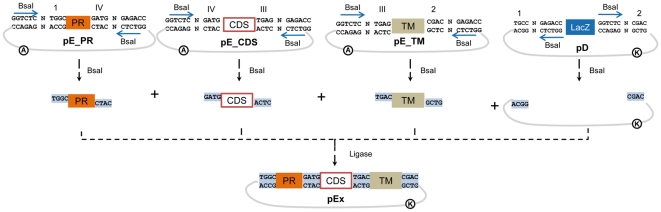
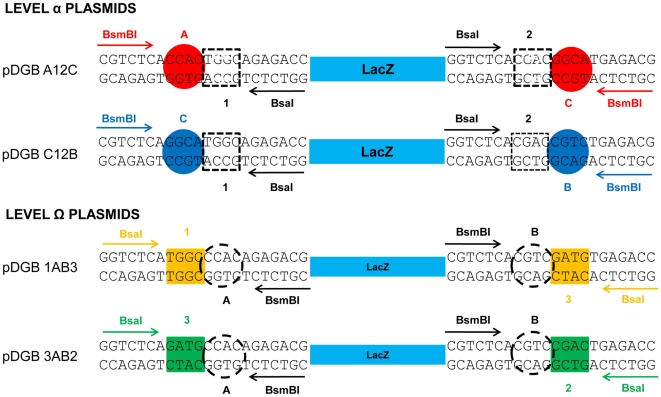
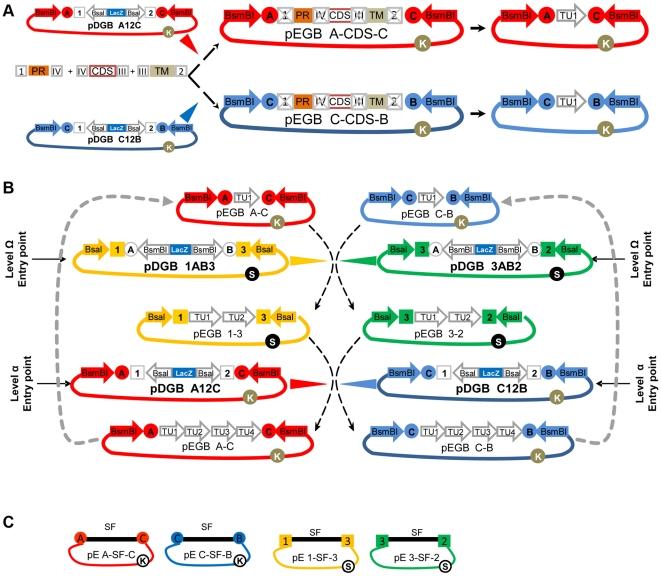
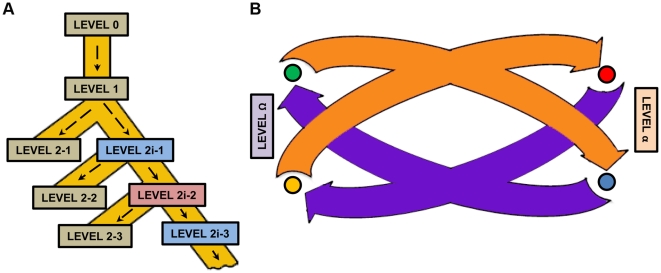
Synthetic Biology requires efficient and versatile DNA assembly systems to facilitate the building of new genetic modules/pathways from basic DNA parts in a standardized way. Here we present GoldenBraid (GB), a standardized assembly system based on type IIS restriction enzymes that allows the indefinite growth of reusable gene modules made of standardized DNA pieces. The GB system consists of a set of four destination plasmids (pDGBs) designed to incorporate multipartite assemblies made of standard DNA parts and to combine them binarily to build increasingly complex multigene constructs. The relative position of type IIS restriction sites inside pDGB vectors introduces a double loop ("braid") topology in the cloning strategy that allows the indefinite growth of composite parts through the succession of iterative assembling steps, while the overall simplicity of the system is maintained. We propose the use of GoldenBraid as an assembly standard for Plant Synthetic Biology. For this purpose we have GB-adapted a set of binary plasmids for A. tumefaciens-mediated plant transformation. Fast GB-engineering of several multigene T-DNAs, including two alternative modules made of five reusable devices each, and comprising a total of 19 basic parts are also described.
Overview
The claims and statistics of this paper haven’t been checked yet.
Free: it reads the open-access text and checks the first 5 claims that cite a source we can check. Create a free account to check every claim.
Integrity signals
Registry
Cites
Statistics
Figures
Verification
Claims the paper makes
The claims and statistics of this paper haven’t been checked yet.
Free: it reads the open-access text and checks the first 5 claims that cite a source we can check. Create a free account to check every claim.
Claims other papers make about this one
Each is checked against this paper’s own text: does it say what the citing paper says it does?
The cited source says what the claim attributes to it.
In the citing paper
“The assembly of multimodular constructs for expression in plants is no longer an insurmountable challenge, thanks to the development of methods like the Gateway-mediated cloning (reviewed by Dafny-Yelin and Tzfira, 2007), Golden Gate (Binder et al., 2014), GoldenBraid (Sarrion-Perdigones et al., 2011), to name a few.”
From Cannabis sativa: The Plant of the Thousand and One Molecules (2016) · cites this paper as Sarrion-Perdigones et al., 2011
Self-check
Percentages, sums and reported differences re-computed from the paper’s own numbers.
The self-check needs the paper’s full text.
Citations
Cites
Enzymatic assembly of DNA molecules up to several hundred kilobases
Gibson, D. G., Young, L., Chuang, R.-Y., Venter, J. C., Hutchison, C. A., & Smith, H. O. (2009) · Nature Methods · doi:10.1038/nmeth.1318 · Cited by 9,996 · cited 1×
“On the opposite side, increasingly efficient homologous recombination methods have enormously facilitated the assembly of large DNA sequences up to the genome range [6], with the synthesis of a complete bacterial genome serving as best example [7,8].”
BackgroundGATEWAY™ vectors for Agrobacterium-mediated plant transformation
Karimi, M., Inzé, D., & Depicker, A. (2002) · Trends in Plant Science · doi:10.1016/s1360-1385(02)02251-3 · Cited by 3,635 · cited 1×
“Plant genetic engineering currently relies on assembly methodologies poorly adaptable to Synthetic Biology. In an attempt to facilitate versatile cloning into plant binary vectors, we and others have developed plasmid collections based on Gateway technology”
MethodCreation of a Bacterial Cell Controlled by a Chemically Synthesized Genome
Gibson, D. G., Glass, J. I., Lartigue, C., Noskov, V. N., Chuang, R.-Y., Algire, M. A., Benders, G. A., Montague, M. G., Ma, L., Moodie, M. M., et al. (2010) · Science · doi:10.1126/science.1190719 · Cited by 2,638 · cited 1×
“On the opposite side, increasingly efficient homologous recombination methods have enormously facilitated the assembly of large DNA sequences up to the genome range [6], with the synthesis of a complete bacterial genome serving as best example [7,8].”
BackgroundA One Pot, One Step, Precision Cloning Method with High Throughput Capability
Engler, C., Kandzia, R., & Marillonnet, S. (2008) · PLoS ONE · doi:10.1371/journal.pone.0003647 · Cited by 2,389 · cited 1×
“[11] using BsaI, BsmBI and BbsI as restriction enzymes in 25 cycle digestion/ligation reactions.”
MethodCermak, T., Doyle, E. L., Christian, M., Wang, L., Zhang, Y., Schmidt, C., Baller, J. A., Somia, N. V., Bogdanove, A. J., & Voytas, D. F. (2011) · Nucleic Acids Research · doi:10.1093/nar/gkr218 · Cited by 1,787
pGreen: a versatile and flexible binary Ti vector for Agrobacterium-mediated plant transformation
Hellens, R. P., Edwards, E. A., Leyland, N. R., Bean, S., & Mullineaux, P. M. (2000) · Plant Molecular Biology · doi:10.1023/a:1006496308160 · Cited by 1,562 · cited 1×
“The original binary plasmid (pGreen II) [32] was deconstructed in four pieces involving the LacZ cassette, antibiotic resistance, and two additional pieces containing replication origins and each of the T-DNA borders.”
MethodA Modular Cloning System for Standardized Assembly of Multigene Constructs
Weber, E., Engler, C., Gruetzner, R., Werner, S., & Marillonnet, S. (2011) · PLoS ONE · doi:10.1371/journal.pone.0016765 · Cited by 1,377
Butelli, E., Titta, L., Giorgio, M., Mock, H.-P., Matros, A., Peterek, S., Schijlen, E. G. W. M., Hall, R. D., Bovy, A. G., Luo, J., et al. (2008) · Nature Biotechnology · doi:10.1038/nbt.1506 · Cited by 1,238 · cited 1×
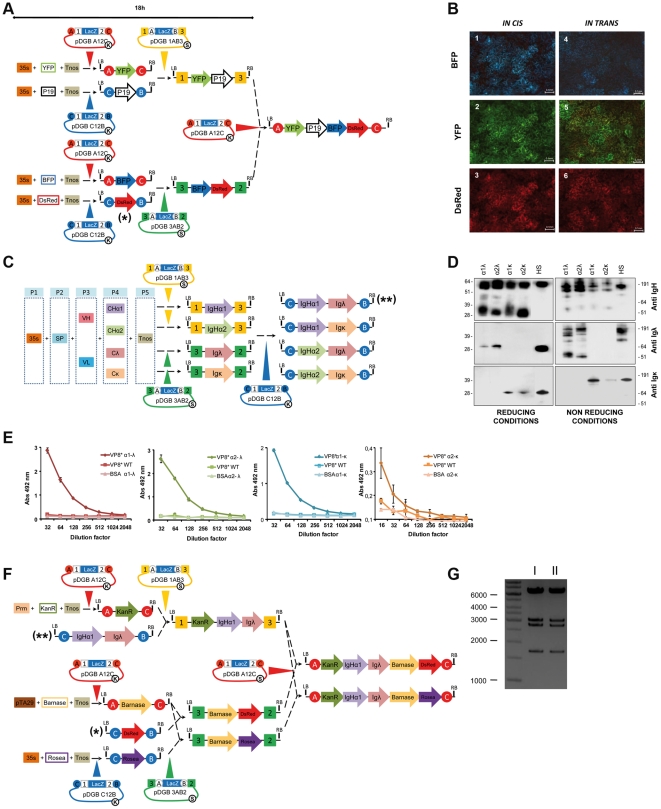
“Next, two alternative ‘‘Identity Preservation’’ devices were considered: the previously described pEGB_C-DsRed-B conferring red fluorescence to the plant, and the newly constructed Rosea1, consisting of a 35S, Nos terminator and the Antirrhinum majus Rosea1 transcription factor that confers purple color to the cells […”
BackgroundGolden Gate Shuffling: A One-Pot DNA Shuffling Method Based on Type IIs Restriction Enzymes
Engler, C., Gruetzner, R., Kandzia, R., & Marillonnet, S. (2009) · PLoS ONE · doi:10.1371/journal.pone.0005553 · Cited by 1,023 · cited 1×
“genetic devices and modules [11,12].”
Efficient construction of sequence-specific TAL effectors for modulating mammalian transcription
Zhang, F., Cong, L., Lodato, S., Kosuri, S., Church, G. M., & Arlotta, P. (2011) · Nature Biotechnology · doi:10.1038/nbt.1775 · Cited by 712 · cited 1×
“to facilitate modular assembling of TAL effectors [28–31],”
BackgroundDifferent Temporal and Spatial Gene Expression Patterns Occur during Anther Development.
Koltunow, A. M., Truettner, J., Cox, K. H., Wallroth, M., & Goldberg, R. B. (1990) · The Plant Cell · doi:10.1105/tpc.2.12.1201 · Cited by 696 · cited 1×
“Finally a male sterility ‘‘device’’ was constructed, combining barnase-barstar CDS under pTA29 anther-specific promoter [15,16].”
BackgroundBglBricks: A flexible standard for biological part assembly
Anderson, J. C., Dueber, J. E., Leguia, M., Wu, G. C., Goler, J. A., Arkin, A. P., & Keasling, J. D. (2010) · Journal of Biological Engineering · doi:10.1186/1754-1611-4-1 · Cited by 429 · cited 1×
“as those derived from the presence of assembly scars [10].”
BackgroundLi, T., Huang, S., Zhao, X., Wright, D. A., Carpenter, S., Spalding, M. H., Weeks, D. P., & Yang, B. (2011) · Nucleic Acids Research · doi:10.1093/nar/gkr188 · Cited by 416 · cited 1×
“to facilitate modular assembling of TAL effectors [28–31],”
BackgroundIdempotent Vector Design for Standard Assembly of Biobricks
Knight, T. (2003) · doi:10.21236/ada457791 · Cited by 388 · cited 15×
“Synthetic Biology adapts the general engineering principle of assembling standard components, dating back to the Industrial Revolution, to biological components.”
BackgroundInfluentialDNA assembly for synthetic biology: from parts to pathways and beyond
Ellis, T., Adie, T., & Baldwin, G. S. (2011) · Integrative Biology · doi:10.1039/c0ib00070a · Cited by 305 · cited 1×
“On the opposite side, increasingly efficient homologous recombination methods have enormously facilitated the assembly of large DNA sequences up to the genome range [6], with the synthesis of a complete bacterial genome serving as best example [7,8].”
BackgroundCermak, T., Doyle, E. L., Christian, M., Wang, L., Zhang, Y., Schmidt, C., Baller, J. A., Somia, N. V., Bogdanove, A. J., & Voytas, D. F. (2011) · Nucleic Acids Research · doi:10.1093/nar/gkr739 · Cited by 281
Scalable gene synthesis by selective amplification of DNA pools from high-fidelity microchips
Kosuri, S., Eroshenko, N., LeProust, E. M., Super, M., Way, J., Li, J. B., & Church, G. M. (2010) · Nature Biotechnology · doi:10.1038/nbt.1716 · Cited by 272 · cited 1×
“5–5 Kb) [4,5].”
In Planta Protein Sialylation through Overexpression of the Respective Mammalian Pathway
Castilho, A., Strasser, R., Stadlmann, J., Grass, J., Jez, J., Gattinger, P., Kunert, R., Quendler, H., Pabst, M., Leonard, R., et al. (2010) · Journal of Biological Chemistry · doi:10.1074/jbc.m109.088401 · Cited by 230 · cited 1×
“plant glyco-engineering or metabolic engineering, both approaches often relying on coordinated expression of the different transgenes in each cell [25].”
BackgroundWhen more is better: multigene engineering in plants
Naqvi, S., Farré, G., Sanahuja, G., Capell, T., Zhu, C., & Christou, P. (2010) · Trends in Plant Science · doi:10.1016/j.tplants.2009.09.010 · Cited by 221 · cited 1×
“Multigene engineering has an enormous potential in crop design, as for metabolic engineering, biofortification, molecular farming or for combination of traits of agronomic value via gene stacking [13].”
BackgroundA binary-BAC system for plant transformation with high-molecular-weight DNA
Hamilton, C. M. (1997) · Gene · doi:10.1016/s0378-1119(97)00388-0 · Cited by 199
Assembly of custom TALE-type DNA binding domains by modular cloning
Morbitzer, R., Elsaesser, J., Hausner, J., & Lahaye, T. (2011) · Nucleic Acids Research · doi:10.1093/nar/gkr151 · Cited by 185 · cited 1×
“to facilitate modular assembling of TAL effectors [28–31],”
BackgroundGoderis, I. J. W. M., De Bolle, M. F. C., François, I. E. J. A., Wouters, P. F. J., Broekaert, W. F., & Cammue, B. P. A. (2002) · Plant Molecular Biology · doi:10.1023/a:1016052416053 · Cited by 169 · cited 1×
“A number of additional techniques, based on site-specific recombination, the use of rare cutters or homing endonucleases have been developed [20-24], however in our opinion GoldenBraid compares favorably with most of them in terms of standardization, simplicity and reusability.”
MethodFujisawa, M., Takita, E., Harada, H., Sakurai, N., Suzuki, H., Ohyama, K., Shibata, D., & Misawa, N. (2009) · Journal of Experimental Botany · doi:10.1093/jxb/erp006 · Cited by 142 · cited 1×
“A number of additional techniques, based on site-specific recombination, the use of rare cutters or homing endonucleases have been developed [20-24], however in our opinion GoldenBraid compares favorably with most of them in terms of standardization, simplicity and reusability.”
MethodDelivery of Multiple Transgenes to Plant Cells
Dafny-Yelin, M., & Tzfira, T. (2007) · Plant Physiology · doi:10.1104/pp.107.106104 · Cited by 136
Li, L., Liu, Y., Xu, X., & Li, B. (2003) · Proceedings of the National Academy of Sciences · doi:10.1073/pnas.0931425100 · Cited by 118 · cited 1×
“A number of additional techniques, based on site-specific recombination, the use of rare cutters or homing endonucleases have been developed [20-24], however in our opinion GoldenBraid compares favorably with most of them in terms of standardization, simplicity and reusability.”
MethodMatzas, M., Stähler, P. F., Kefer, N., Siebelt, N., Boisguérin, V., Leonard, J. T., Keller, A., Stähler, C. F., Häberle, P., Gharizadeh, B., et al. (2010) · Nature Biotechnology · doi:10.1038/nbt.1710 · Cited by 96 · cited 1×
“sequences in the size range of a genetic “part” (up to 0.5–5 Kb)”
BackgroundInfluentialA Gateway-based platform for multigene plant transformation
Chen, Q., Hai‐Meng, Z. H. O. U., Chen, J., & Wang, X. (2006) · Plant Molecular Biology · doi:10.1007/s11103-006-9065-3 · Cited by 91 · cited 1×
“In an attempt to facilitate versatile cloning into plant binary vectors, we and others have developed plasmid collections based on Gateway technology [17,18,19].”
MethodEstornell, L. H., Orzáez, D., López‐Peña, L., Pineda, B., Antón, T., Moreno, V., & Granell, A. (2009) · Plant Biotechnology Journal · doi:10.1111/j.1467-7652.2009.00402.x · Cited by 46 · cited 1×
“In an attempt to facilitate versatile cloning into plant binary vectors, we and others have developed plasmid collections based on Gateway technology [17,18,19].”
MethodSelf-citationSynthetic biology: history, challenges and prospects
Haseloff, J. P., & Ajioka, J. W. (2009) · Journal of The Royal Society Interface · doi:10.1098/rsif.2009.0176.focus · Cited by 44 · cited 1×
“This discipline aims at the design of artificial living forms displaying new traits not existing in nature [1,2].”
BackgroundMISSA Is a Highly Efficient in Vivo DNA Assembly Method for Plant Multiple-Gene Transformation
Chen, Q., Xie, M., Ma, X.-X., Li, D., Chen, J., & Wang, X. (2010) · PLANT PHYSIOLOGY · doi:10.1104/pp.109.152249 · Cited by 41 · cited 1×
“A number of additional techniques, based on site-specific recombination, the use of rare cutters or homing endonucleases have been developed [20-24], however in our opinion GoldenBraid compares favorably with most of them in terms of standardization, simplicity and reusability.”
MethodPlant expression of chicken secretory antibodies derived from combinatorial libraries
Wieland, W. H., Lammers, A., Schots, A., & Orzáez, D. (2006) · Journal of Biotechnology · doi:10.1016/j.jbiotec.2005.12.020 · Cited by 39 · cited 1×
“Agroinfiltration was performed as previously described [33].”
Kobayashi, K., Munemura, I., Hinata, K., & Yamamura, S. (2006) · Plant Cell Reports · doi:10.1007/s00299-006-0206-6 · Cited by 36
Check, E. (2005) · Nature · doi:10.1038/438417a · Cited by 25
A systems-biology approach to modular genetic complexity
Carter, G. W., Rush, C. G., Uygun, F., Sakhanenko, N. A., Galas, D. J., & Galitski, T. (2010) · Chaos An Interdisciplinary Journal of Nonlinear Science · doi:10.1063/1.3455183 · Cited by 16 · cited 1×
“Modularity is not only an engineering strategy; multiple high-throughput genetic interaction studies have provided substantial evidence of modularity in the genetic organization of cellular systems [3].”
Background
Cited by
Cannabis sativa: The Plant of the Thousand and One Molecules
Andre, C. M., Hausman, J.-F., & Guerriero, G. (2016) · Frontiers in Plant Science · doi:10.3389/fpls.2016.00019 · Cited by 1,544
“Phenolic amides and lignanamides have also been described in Cannabis fruits and roots (Sakakibara et al., 1992; Lesma et al., 2014).”
BackgroundA Golden Gate Modular Cloning Toolbox for Plants
Engler, C., Youles, M., Gruetzner, R., Ehnert, T.-M., Werner, S., Jones, J. D. G., Patron, N. J., & Marillonnet, S. (2014) · ACS Synthetic Biology · doi:10.1021/sb4001504 · Cited by 928
A Highly Characterized Yeast Toolkit for Modular, Multipart Assembly
Lee, M. E., DeLoache, W. C., Cervantes, B., & Dueber, J. E. (2015) · ACS Synthetic Biology · doi:10.1021/sb500366v · Cited by 916
Advancing Crop Transformation in the Era of Genome Editing
Altpeter, F., Springer, N. M., Bartley, L. E., Blechl, A., Brutnell, T. P., Citovsky, V., Conrad, L., Gelvin, S. B., Jackson, D., Kausch, A. P., et al. (2016) · The Plant Cell · doi:10.1105/tpc.16.00196 · Cited by 679
“, 2008), GoldenBraid (Sarrion-Perdigones et al., 2011), or other modular DNA assembly methods could facilitate building standardized parts for versatile transformation and genome editing.”
GoldenBraid 2.0: A Comprehensive DNA Assembly Framework for Plant Synthetic Biology
Sarrion-Perdigones, A., Vazquez-Vilar, M., Palaci, J., Castelijns, B., Forment, J., Ziarsolo, P., Blanca, J., Granell, A., & Orzaez, D. (2013) · PLANT PHYSIOLOGY · doi:10.1104/pp.113.217661 · Cited by 461
“Restriction-Ligation reactions were set up as described elsewhere (Sarrion-Perdigones et al., 2011) using BsaI, BsmBI, BtgZI or BbsI as restriction enzymes (New England Biolabs, Ipswich, MA, USA) and T4 Ligase (Promega, Madison, WI, USA).”
MethodSelf-citation
Metadata
- Authors
- Sarrion-Perdigones, A., Falconi, E. E., Zandalinas, S. I., Juárez, P., Fernández-del-Carmen, A., Granell, A., & Orzaez, D.
- Affiliations
- Consejo Superior de Investigaciones Científicas (ES)
- Venue
- PLoS ONE
- Publisher
- Public Library of Science (PLoS)
- Published
- 2011-07-07
- Volume
- 6
- Issue
- 7
- Pages
- e21622
- ISSN
- 1932-6203 (ISSN-L)
- PMC
- PMC3131274
- OpenAlex
- W2042033410
- Semantic Scholar
- 16f57d0471f64a5a5bd8a3392484e62e36db926d
- Cited by
- 348
- References
- 34
- Citations by year
- 2026: 16 · 2025: 36 · 2024: 29 · 2023: 22 · 2022: 29 · 2021: 16 · 2020: 35 · 2019: 28 · 2018: 24 · 2017: 23 · 2016: 23 · 2015: 18 · 2014: 17 · 2013: 20 · 2012: 10
- FWCI
- 6.37
- Type
- journal article
- Language
- en
- Open access
- gold
- doi.org
- Locations
- PLoS ONE (publishedVersion, cc-by)
- PubMed Central (publishedVersion, cc-by)
- PubMed (publishedVersion)
- DIGITAL.CSIC (Spanish National Research Council (CSIC)) (submittedVersion, cc-by)
- DOAJ (DOAJ: Directory of Open Access Journals) (submittedVersion, cc-by-sa)
- RiuNet (Universitat Politècnica de València) (submittedVersion, cc-by-nc-nd)
- Funders
- Ministerio de Ciencia e Innovación
- Topics
- Life Sciences › Biochemistry, Genetics and Molecular Biology › Molecular Biology › CRISPR and Genetic Engineering
- Life Sciences › Biochemistry, Genetics and Molecular Biology › Molecular Biology › Microbial Metabolic Engineering and Bioproduction
- Life Sciences › Biochemistry, Genetics and Molecular Biology › Genetics › Bacterial Genetics and Biotechnology
- Keywords
- DNA assembly, type IIS restriction enzymes, gene modules, plant synthetic biology, Agrobacterium tumefaciens transformation, T-DNA
- MeSH terms
- Base Sequence, Cloning, Molecular, DNA, Lac Operon, Models, Genetic, Plasmids, Nicotiana, Transformation, Genetic, Reproducibility of Results, Deoxyribonucleases, Type II Site-Specific, Polymerase Chain Reaction, Agrobacterium tumefaciens, Plants, Genetically Modified
About these checks
Registry, retraction, Cites and statistics results are computed, not judged, with one exception: a printed reference that no index lists is read once by a model before it counts as a citation error. Claims are extracted by a model and kept only when their quote appears verbatim in the text; each cited source is then checked, with a model’s help, for whether it says what the claim relies on. Those verdicts can be wrong — read the claim’s quote and the cited source before relying on one.
Statistics and arithmetic are recomputed, not judged.
Confidence bands are shown only for fields calibrated on our annotated test set. None is calibrated yet, so no band is shown.
What counts as a claim ›How we measure confidence ›How we check this ›
Are you an author, or do you see a problem with this page? Request a review
Data sources
Bibliographic data: Semantic Scholar, OpenAlex, Crossref.
Contains information from the Semantic Scholar Academic Graph Datasets, made available under the ODC Attribution License (ODC-BY 1.0).
Semantic Scholar’s data is described in: Kinney, R., et al. (2023). The Semantic Scholar Open Data Platform. arXiv:2301.10140.
