

Epigenetic Silencing of Nucleolar rRNA Genes in Alzheimer's Disease
Open accessThe DOI matches its Crossref record; 38 of the 38 references it cites were found in a registry or an index.
Abstract
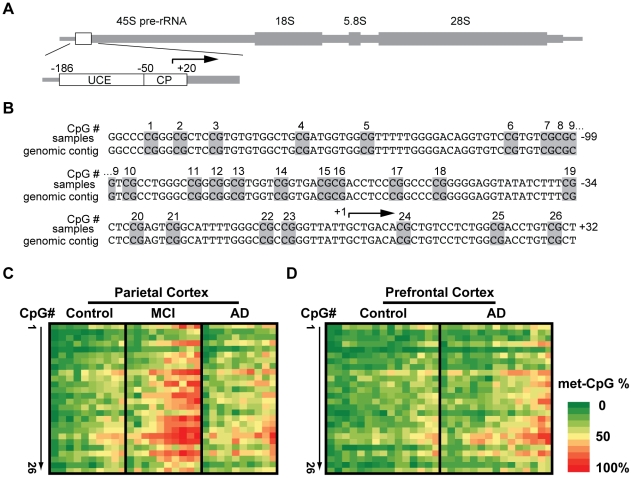
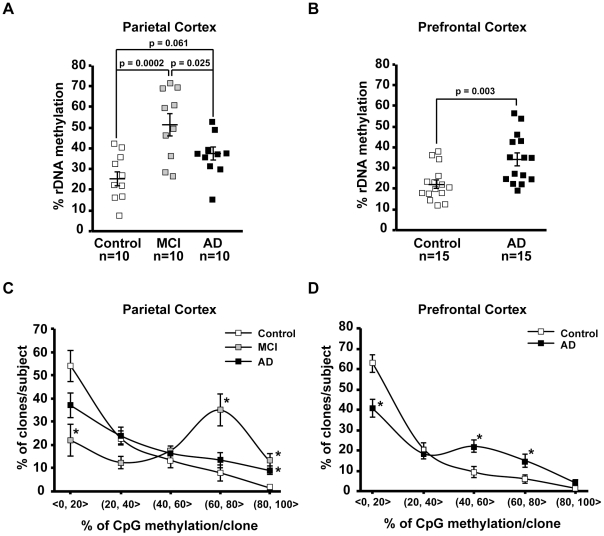
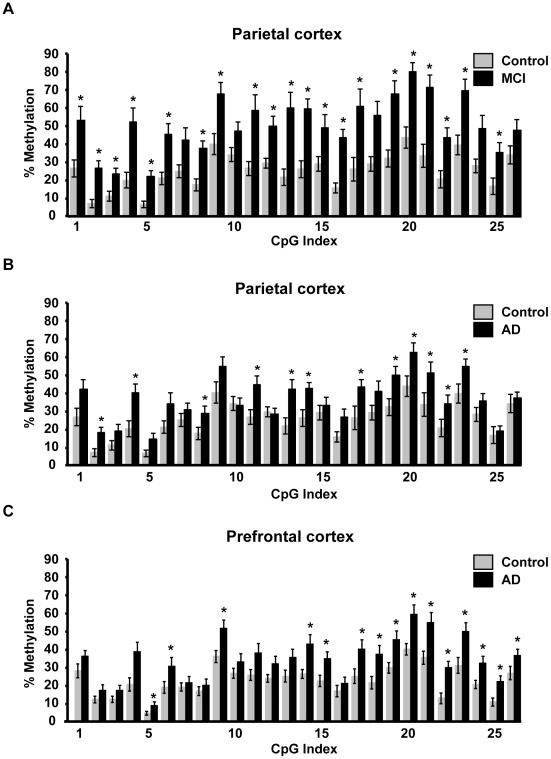
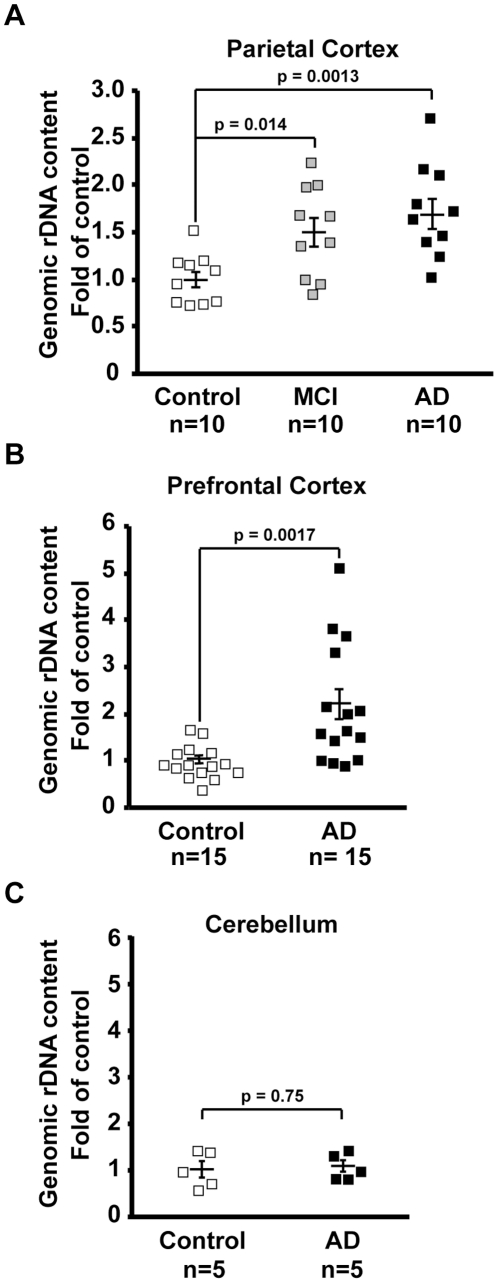
BACKGROUND: Ribosomal deficits are documented in mild cognitive impairment (MCI), which often represents an early stage Alzheimer's disease (AD), as well as in advanced AD. The nucleolar rRNA genes (rDNA), transcription of which is critical for ribosomal biogenesis, are regulated by epigenetic silencing including promoter CpG methylation. METHODOLOGY/PRINCIPAL FINDINGS: To assess whether CpG methylation of the rDNA promoter was dysregulated across the AD spectrum, we analyzed brain samples from 10 MCI-, 23 AD-, and, 24 age-matched control individuals using bisulfite mapping. The rDNA promoter became hypermethylated in cerebro-cortical samples from MCI and AD groups. In parietal cortex, the rDNA promoter was hypermethylated more in MCI than in advanced AD. The cytosine methylation of total genomic DNA was similar in AD, MCI, and control samples. Consistent with a notion that hypermethylation-mediated silencing of the nucleolar chromatin stabilizes rDNA loci, preventing their senescence-associated loss, genomic rDNA content was elevated in cerebrocortical samples from MCI and AD groups. CONCLUSIONS/SIGNIFICANCE: In conclusion, rDNA hypermethylation could be a new epigenetic marker of AD. Moreover, silencing of nucleolar chromatin may occur during early stages of AD pathology and play a role in AD-related ribosomal deficits and, ultimately, dementia.
Overview
The claims and statistics of this paper haven’t been checked yet.
Free: it reads the open-access text and checks the first 5 claims that cite a source we can check. Create a free account to check every claim.
Integrity signals
Registry
Cites
Statistics
Figures
Verification
Claims the paper makes
The claims and statistics of this paper haven’t been checked yet.
Free: it reads the open-access text and checks the first 5 claims that cite a source we can check. Create a free account to check every claim.
Claims other papers make about this one
Each is checked against this paper’s own text: does it say what the citing paper says it does?
The cited source says what the claim attributes to it.
In the citing paper
“other factors, as epigenetic regulation of rDNA 80, are probably implicated in the altered rRNA biogenesis in AD.”
From Altered Machinery of Protein Synthesis in Alzheimer's: From the Nucleolus to the Ribosome (2016) · cites this paper as [80]
Self-check
Percentages, sums and reported differences re-computed from the paper’s own numbers.
The self-check needs the paper’s full text.
Citations
Cites
In silico prediction of protein-protein interactions in human macrophages
Souiai, O., Guerfali, F., Ben Miled, S., Brun, C., & Benkahla, A. (2014) · BMC Research Notes · doi:10.1186/1756-0500-7-157 · Cited by 10,803
Significance analysis of microarrays applied to the ionizing radiation response
Tusher, V. G., Tibshirani, R., & Chu, G. (2001) · Proceedings of the National Academy of Sciences · doi:10.1073/pnas.091062498 · Cited by 10,568
Epigenetic programming by maternal behavior
Weaver, I. C. G., Cervoni, N., Champagne, F. A., D'Alessio, A. C., Sharma, S., Seckl, J. R., Dymov, S., Szyf, M., & Meaney, M. J. (2004) · Nature Neuroscience · doi:10.1038/nn1276 · Cited by 6,177 · cited 1×
“reducing methylation of the glucocorticoid receptor gene promoter in the brain [3].”
BackgroundDNA methylation landscapes: Provocative insights from epigenomics
Suzuki, M. M., & Bird, A. (2008) · Nature Reviews Genetics · doi:10.1038/nrg2341 · Cited by 3,039 · cited 1×
“. Instead, they involve chemical modifications of DNA and/or histones. Cytosine methylation at DNA CpG sites is the principal epigenetic modification of DNA that silences gene expression”
BackgroundHydroxylation of 5-Methylcytosine by TET1 Promotes Active DNA Demethylation in the Adult Brain
Guo, J. U., Su, Y., Zhong, C., Ming, G.-L., & Song, H. (2011) · Cell · doi:10.1016/j.cell.2011.03.022 · Cited by 1,360
GtRNAdb: a database of transfer RNA genes detected in genomic sequence
Chan, P. P., & Lowe, T. M. (2009) · Nucleic Acids Research · doi:10.1093/nar/gkn787 · Cited by 877 · cited 1×
“For normalization, the gene for tRNA was selected as it represents repeated DNA (17 almost identical copies per haploid) that, in contrast to rDNA, is not clustered together [23].”
BackgroundThe Epigenetics of rRNA Genes: From Molecular to Chromosome Biology
McStay, B., & Grummt, I. (2008) · Annual Review of Cell and Developmental Biology · doi:10.1146/annurev.cellbio.24.110707.175259 · Cited by 526 · cited 5×
“The rDNA promoter methylation reduces Pol1-mediated transcription of rRNA [7].”
BackgroundResultInfluentialAge-Specific Epigenetic Drift in Late-Onset Alzheimer's Disease
Wang, S.-C., Oelze, B., & Schumacher, A. (2008) · PLoS ONE · doi:10.1371/journal.pone.0002698 · Cited by 466
Ribosome Dysfunction Is an Early Event in Alzheimer's Disease
Ding, Q., Markesbery, W. R., Chen, Q., Li, F., & Keller, J. N. (2005) · The Journal of Neuroscience · doi:10.1523/jneurosci.3040-05.2005 · Cited by 433 · cited 3×
“The ribosome is the nexus for all cellular protein translation and reduced ribosomal activity has been suggested to be a major contributor to the pathology of Alzheimer’s disease (AD) [11,12,13,14].”
BackgroundResultSiegmund, K. D., Connor, C. M., Campan, M., Long, T. I., Weisenberger, D. J., Biniszkiewicz, D., Jaenisch, R., Laird, P. W., & Akbarian, S. (2007) · PLoS ONE · doi:10.1371/journal.pone.0000895 · Cited by 414 · cited 3×
“involved in AD pathogenesis appeared differentially methylated [5,6].”
BackgroundInfluential
Research works printed but not linked: 1
- Kalita K Makonchuk D Gomes C Zheng JJ Hetman M 2008 Inhibition of nucleolar transcription as a trigger for neuronal apoptosis. J Neurochem 105 2286 2299 18315559 PMC2909334 · DOI · Paper page
Cited by
Ribosome biogenesis in disease: new players and therapeutic targets
Jiao, L., Liu, Y., Yu, X.-Y., Pan, X., Zhang, Y., Tu, J., Song, Y.-H., & Li, Y. (2023) · Signal Transduction and Targeted Therapy · doi:10.1038/s41392-022-01285-4 · Cited by 313
“Of note, the level of lncRNA is elevated in the mouse model of Alzheimer’s disease and is associated with nucleolar stress and reduced rRNA production.(67,68) Ribosome biogenesis in disease: new players and therapeutic targets Jiao et al.”
BackgroundNucleolar stress with and without p53
James, A., Wang, Y., Raje, H., Rosby, R., & DiMario, P. (2014) · Nucleus · doi:10.4161/nucl.32235 · Cited by 285
Altered Machinery of Protein Synthesis in Alzheimer's: From the Nucleolus to the Ribosome
Hernández‐Ortega, K., Garcia‐Esparcia, P., Gil, L., Lucas, J. J., & Ferrer, I. (2016) · Brain Pathology · doi:10.1111/bpa.12335 · Cited by 245
Impaired ribosome biogenesis: mechanisms and relevance to cancer and aging
Turi, Z., Lacey, M., Mistrik, M., & Moudry, P. (2019) · Aging · doi:10.18632/aging.101922 · Cited by 215
“For instance, Alzheimer’s disease (AD) has been reported to associate with reduced number of the ribosomes [306], which may be the linked to the increased oxidation of rRNA [307, 308] and/or epigenetic silencing of rDNA, seen in AD patient’s brains [309, 310].”
BackgroundLong noncoding RNAs (lncRNAs) and the molecular hallmarks of aging
Grammatikakis, I., Panda, A. C., Abdelmohsen, K., & Gorospe, M. (2014) · Aging · doi:10.18632/aging.100710 · Cited by 214
“LncRNAs controlling epigenetic changes Xist DNA methylation Declines with senescence [34] H19 DNA methylation Cell division cycle Increases in some cancers Enhances proliferation [39] [37-40] Kcnq1ot1 DNA methylation, cell division Implicated in cancer and diabetes [43] Airn DNA methylation Controls IGF signaling path…”
Background
Metadata
- Authors
- Pietrzak, M., Rempala, G., Nelson, P. T., Zheng, J.-J., & Hetman, M.
- Affiliations
- University of Louisville (US)
- University of Kentucky (US)
- Corresponding author
- Hetman, Michal
- Venue
- PLoS ONE
- Publisher
- Public Library of Science (PLoS)
- Published
- 2011-07-22
- Volume
- 6
- Issue
- 7
- Pages
- e22585
- ISSN
- 1932-6203 (ISSN-L)
- PMC
- PMC3142181
- OpenAlex
- W2063969996
- Cited by
- 155
- References
- 38
- Citations by year
- 2026: 14 · 2025: 4 · 2024: 6 · 2023: 7 · 2022: 6 · 2021: 10 · 2020: 15 · 2019: 12 · 2018: 12 · 2017: 7 · 2016: 15 · 2015: 10 · 2014: 16 · 2013: 14 · 2012: 7
- FWCI
- 4.80
- Type
- journal article
- Language
- en
- Open access
- gold
- doi.org
- Locations
- PLoS ONE (publishedVersion, cc-by)
- Europe PMC (PubMed Central) (publishedVersion, cc-by)
- PubMed Central (publishedVersion, cc-by)
- PubMed (publishedVersion)
- UKnowledge (University of Kentucky) (submittedVersion, cc-by)
- DOAJ (DOAJ: Directory of Open Access Journals) (submittedVersion)
- Figshare (submittedVersion, cc-by)
- Funders
- National Science Foundation (1021860, 0840695)
- National Institutes of Health (5r01de019243-05, 5r01ca152158-06, IOS1021860, RR015576)
- National Institute on Aging (P30AG028383)
- National Cancer Institute (R01CA-152158)
- National Institute of Neurological Disorders and Stroke (R01NS047341, NS047341)
- National Institute of Dental and Craniofacial Research (R01-DE019243)
- National Center for Research Resources (RR015576, P20RR015576)
- Topics
- Life Sciences › Biochemistry, Genetics and Molecular Biology › Molecular Biology › Epigenetics and DNA Methylation
- Life Sciences › Neuroscience › Cellular and Molecular Neuroscience › Alzheimer's disease research and treatments
- Health Sciences › Medicine › Psychiatry and Mental health › Dementia and Cognitive Impairment Research
- Keywords
- Alzheimer's disease, mild cognitive impairment, DNA methylation, epigenetic silencing, ribosome biogenesis, epigenetic biomarkers, rDNA copy number
- MeSH terms
- Aged, 80 and over, Alzheimer Disease, Base Sequence, Cell Nucleolus, Cytosine, DNA, Ribosomal, Female, Humans, Male, Molecular Sequence Data, Promoter Regions, Genetic, RNA, Ribosomal, CpG Islands, DNA Methylation, Gene Silencing, Epigenesis, Genetic
About these checks
Registry, retraction, Cites and statistics results are computed, not judged, with one exception: a printed reference that no index lists is read once by a model before it counts as a citation error. Claims are extracted by a model and kept only when their quote appears verbatim in the text; each cited source is then checked, with a model’s help, for whether it says what the claim relies on. Those verdicts can be wrong — read the claim’s quote and the cited source before relying on one.
Statistics and arithmetic are recomputed, not judged.
Confidence bands are shown only for fields calibrated on our annotated test set. None is calibrated yet, so no band is shown.
What counts as a claim ›How we measure confidence ›How we check this ›
Are you an author, or do you see a problem with this page? Request a review
Data sources
Bibliographic data: Semantic Scholar, OpenAlex, Crossref.
Contains information from the Semantic Scholar Academic Graph Datasets, made available under the ODC Attribution License (ODC-BY 1.0).
Semantic Scholar’s data is described in: Kinney, R., et al. (2023). The Semantic Scholar Open Data Platform. arXiv:2301.10140.
