

Small Molecule Inhibitors of the Candida albicans Budded-to-Hyphal Transition Act through Multiple Signaling Pathways
Open accessThe DOI matches its Crossref record; 66 of the 66 references it cites were found in a registry or an index.
Abstract
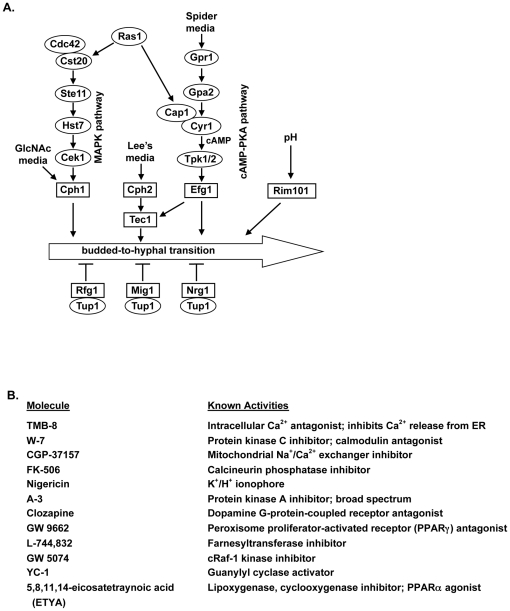
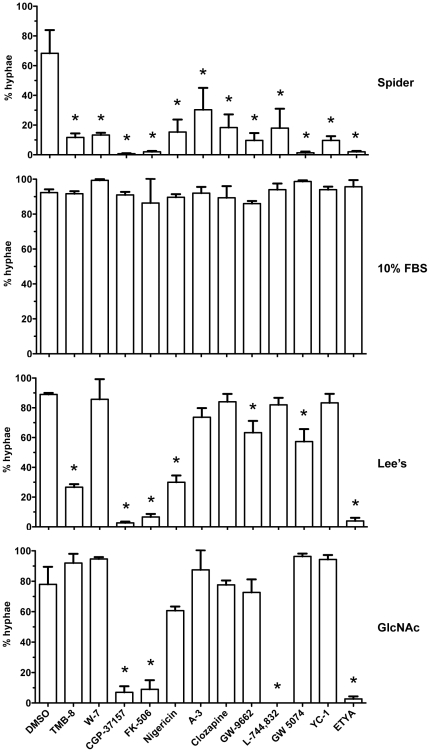
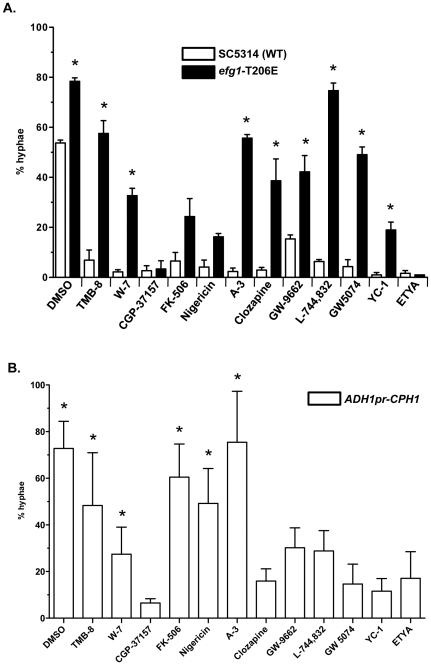
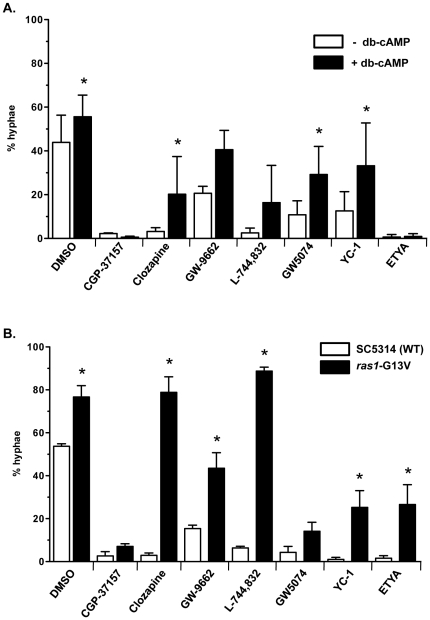
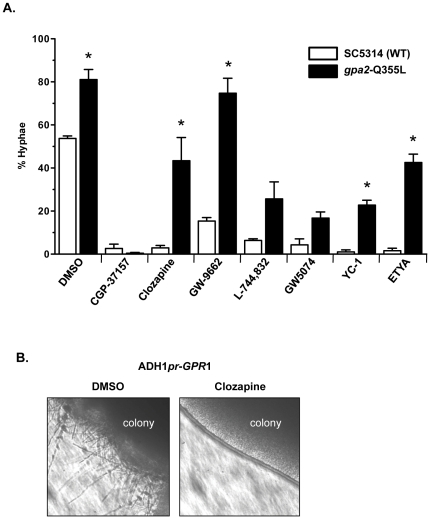
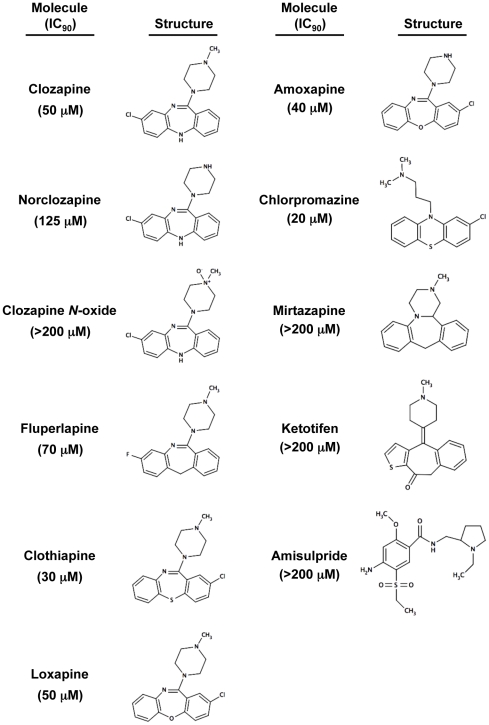
The ability of the pathogenic yeast Candida albicans to interconvert between budded and hyphal growth states, herein termed the budded-to-hyphal transition (BHT), is important for C. albicans development and virulence. The BHT is under the control of multiple cell signaling pathways that respond to external stimuli, including nutrient availability, high temperature, and pH. Previous studies identified 21 small molecules that could inhibit the C. albicans BHT in response to carbon limitation in Spider media. However, the studies herein show that the BHT inhibitors had varying efficacies in other hyphal-inducing media, reflecting their varying abilities to block signaling pathways associated with the different media. Chemical epistasis analyses suggest that most, but not all, of the BHT inhibitors were acting through either the Efg1 or Cph1 signaling pathways. Notably, the BHT inhibitor clozapine, a FDA-approved drug used to treat atypical schizophrenia by inhibiting G-protein-coupled dopamine receptors in the brain, and several of its functional analogs were shown to act at the level of the Gpr1 G-protein-coupled receptor. These studies are the first step in determining the target and mechanism of action of these BHT inhibitors, which may have therapeutic anti-fungal utility in the future.
Overview
The claims and statistics of this paper haven’t been checked yet.
Free: it reads the open-access text and checks the first 5 claims that cite a source we can check. Create a free account to check every claim.
Integrity signals
Registry
Cites
Statistics
Figures
Verification
Claims the paper makes
The claims and statistics of this paper haven’t been checked yet.
Free: it reads the open-access text and checks the first 5 claims that cite a source we can check. Create a free account to check every claim.
Claims other papers make about this one
Each is checked against this paper’s own text: does it say what the citing paper says it does?
In the citing paper
“Among the Y-H inhibitors identified in the study by Midkiff et al, the lowest MICY-H is 20 µM for 1×10⁴ cells [46], which is much higher than the SM21 MICY-H (0.98 µM for 1×10⁶ CFUs/ml).”
From In Vitro and In Vivo Activity of a Novel Antifungal Small Molecule against Candida Infections (2014) · cites this paper as [46]
Self-check
Percentages, sums and reported differences re-computed from the paper’s own numbers.
The self-check needs the paper’s full text.
Citations
Cites
The mechanisms of action of PPARs
Berger, J., & Moller, D. E. (2002) · Annual Review of Medicine · doi:10.1146/annurev.med.53.082901.104018 · Cited by 2,659
The mechanism of action of cyclosporin A and FK506
Schreiber, S. L., & Crabtree, G. R. (1992) · Immunology Today · doi:10.1016/0167-5699(92)90111-j · Cited by 2,127
Nosocomial Bloodstream Infections in United States Hospitals: A Three‐Year Analysis
Edmond, M. B., Wallace, S. E., McClish, D. K., Pfaller, M. A., Jones, R. N., & Wenzel, R. P. (1999) · Clinical Infectious Diseases · doi:10.1086/520192 · Cited by 1,387
Uncovering Molecular Mechanisms Involved in Activation of G Protein-Coupled Receptors
Gether, U. (2000) · Endocrine Reviews · doi:10.1210/edrv.21.1.0390 · Cited by 1,263
Gillum, A. M., Tsay, E. Y. H., & Kirsch, D. R. (1984) · Molecular and General Genetics MGG · doi:10.1007/bf00328721 · Cited by 1,251
Quorum Sensing in the Dimorphic Fungus Candida albicans Is Mediated by Farnesol
Hornby, J. M., Jensen, E. C., Lisec, A. D., Tasto, J. J., Jahnke, B., Shoemaker, R., Dussault, P., & Nickerson, K. W. (2001) · Applied and Environmental Microbiology · doi:10.1128/aem.67.7.2982-2992.2001 · Cited by 983
Keller, H., Dreyer, C., Medin, J., Mahfoudi, A., Ozato, K., & Wahli, W. (1993) · Proceedings of the National Academy of Sciences · doi:10.1073/pnas.90.6.2160 · Cited by 948
Signal Transduction Cascades Regulating Fungal Development and Virulence
Lengeler, K. B., Davidson, R. C., D'souza, C., Harashima, T., Shen, W.-C., Wang, P., Pan, X., Waugh, M., & Heitman, J. (2000) · Microbiology and Molecular Biology Reviews · doi:10.1128/mmbr.64.4.746-785.2000 · Cited by 915
Lee, K. L., Buckley, H. R., & Campbell, C. C. (1975) · Medical Mycology · doi:10.1080/00362177585190271 · Cited by 788
Suppression of Hyphal Formation in Candida albicans by Mutation of a STE12 Homolog
Liu, H., Köhler, J., & Fink, G. R. (1994) · Science · doi:10.1126/science.7992058 · Cited by 786
Methods in yeast genetics, laboratory manual
(1987) · Gene · doi:10.1016/0378-1119(87)90435-5 · Cited by 720
Stoldt, V. R. (1997) · The EMBO Journal · doi:10.1093/emboj/16.8.1982 · Cited by 598
Biswas, S., Van Dijck, P., & Datta, A. (2007) · Microbiology and Molecular Biology Reviews · doi:10.1128/mmbr.00009-06 · Cited by 516
NRG1 represses yeast–hypha morphogenesis and hypha‐specific gene expression in Candida albicans
Murad, A. M. A., Leng, P., Straffon, M., Wishart, J., Macaskill, S., MacCallum, D., Schnell, N., Talibi, D., Marechal, D., Tekaia, F., et al. (2001) · The EMBO Journal · doi:10.1093/emboj/20.17.4742 · Cited by 452
Kawamoto, S., & Hidaka, H. (1984) · Biochemical and Biophysical Research Communications · doi:10.1016/s0006-291x(84)80362-9 · Cited by 429
CHIOU, C. Y., & MALAGODI, M. H. (1975) · British Journal of Pharmacology · doi:10.1111/j.1476-5381.1975.tb07359.x · Cited by 346
Ras Signaling Is Required for Serum-Induced Hyphal Differentiation in Candida albicans
Feng, Q., Summers, E., Guo, B., & Fink, G. (1999) · Journal of Bacteriology · doi:10.1128/jb.181.20.6339-6346.1999 · Cited by 346
NRG1, a repressor of filamentous growth in C.albicans, is down-regulated during filament induction
Braun, B. R. (2001) · The EMBO Journal · doi:10.1093/emboj/20.17.4753 · Cited by 344
Csank, C., Schröppel, K., Leberer, E., Harcus, D., Mohamed, O., Meloche, S., Thomas, D. Y., & Whiteway, M. (1998) · Infection and Immunity · doi:10.1128/iai.66.6.2713-2721.1998 · Cited by 328
Uncovering Molecular Mechanisms Involved in Activation of G Protein-Coupled Receptors
Gether, U. (2000) · Endocrine Reviews · doi:10.1210/er.21.1.90 · Cited by 325
Hsp90 Orchestrates Temperature-Dependent Candida albicans Morphogenesis via Ras1-PKA Signaling
Shapiro, R. S., Uppuluri, P., Zaas, A. K., Collins, C., Senn, H., Perfect, J. R., Heitman, J., & Cowen, L. E. (2009) · Current Biology · doi:10.1016/j.cub.2009.03.017 · Cited by 311
Leberer, E., Harcus, D., Broadbent, I. D., Clark, K. L., Dignard, D., Ziegelbauer, K., Schmidt, A., Gow, N. A. R., Brown, A. J. P., & Thomas, D. Y. (1996) · Proceedings of the National Academy of Sciences · doi:10.1073/pnas.93.23.13217 · Cited by 311
Sur, C., Mallorga, P. J., Wittmann, M., Jacobson, M. A., Pascarella, D., Williams, J. B., Brandish, P. E., Pettibone, D. J., Scolnick, E. M., & Conn, P. J. (2003) · Proceedings of the National Academy of Sciences · doi:10.1073/pnas.1835612100 · Cited by 294
RIM101-Dependent and -Independent Pathways Govern pH Responses in Candida albicans
Davis, D., Wilson, R. B., & Mitchell, A. P. (2000) · Molecular and Cellular Biology · doi:10.1128/mcb.20.3.971-978.2000 · Cited by 285
Dreyer, C., Keller, H., Mahfoudi, A., Laudet, V., Krey, G., & Wahli, W. (1993) · Biology of the Cell · doi:10.1016/s0248-4900(05)80176-5 · Cited by 284
Köhler, J. R., & Fink, G. R. (1996) · Proceedings of the National Academy of Sciences · doi:10.1073/pnas.93.23.13223 · Cited by 283
Candida albicans RIM101 pH Response Pathway Is Required for Host-Pathogen Interactions
Davis, D., Edwards, J. E., Mitchell, A. P., & Ibrahim, A. S. (2000) · Infection and Immunity · doi:10.1128/iai.68.10.5953-5959.2000 · Cited by 274
TUP1, CPH1 and EFG1 Make Independent Contributions to Filamentation in Candida albicans
Braun, B. R., & Johnson, A. D. (2000) · Genetics · doi:10.1093/genetics/155.1.57 · Cited by 257
Davis‐Hanna, A., Piispanen, A. E., Stateva, L. I., & Hogan, D. A. (2008) · Molecular Microbiology · doi:10.1111/j.1365-2958.2007.06013.x · Cited by 250
Birse, C. E., Irwin, M. Y., Fonzi, W. A., & Sypherd, P. S. (1993) · Infection and Immunity · doi:10.1128/iai.61.9.3648-3655.1993 · Cited by 248
Production of Eicosanoids and Other Oxylipins by Pathogenic Eukaryotic Microbes
Noverr, M. C., Erb-Downward, J. R., & Huffnagle, G. B. (2003) · Clinical Microbiology Reviews · doi:10.1128/cmr.16.3.517-533.2003 · Cited by 243
Schweizer, A., Rupp, S., Taylor, B. N., Röllinghoff, M., & Schröppel, K. (2000) · Molecular Microbiology · doi:10.1046/j.1365-2958.2000.02132.x · Cited by 232
Trends in the Epidemiology of Invasive Fungal Infections
Warnock, D. W. (2007) · Nippon Ishinkin Gakkai Zasshi · doi:10.3314/jjmm.48.1 · Cited by 226
Lane, S., Birse, C., Zhou, S., Matson, R., & Liu, H. (2001) · Journal of Biological Chemistry · doi:10.1074/jbc.m104484200 · Cited by 220
The discovery of potent cRaf1 kinase inhibitors
Lackey, K., Cory, M., Davis, R., Frye, S. V., Harris, P. A., Hunter, R. N., Jung, D. K., McDonald, O. B., McNutt, R. W., Peel, M. R., et al. (2000) · Bioorganic & Medicinal Chemistry Letters · doi:10.1016/s0960-894x(99)00668-x · Cited by 206
Brodhun, F., & Feussner, I. (2011) · The FEBS Journal · doi:10.1111/j.1742-4658.2011.08027.x · Cited by 205
Maidan, M. M., De Rop, L., Serneels, J., Exler, S., Rupp, S., Tournu, H., Thevelein, J. M., & Van Dijck, P. (2005) · Molecular Biology of the Cell · doi:10.1091/mbc.e04-09-0780 · Cited by 201
Bockmühl, D. P., Krishnamurthy, S., Gerads, M., Sonneborn, A., & Ernst, J. F. (2001) · Molecular Microbiology · doi:10.1046/j.1365-2958.2001.02688.x · Cited by 193
Protein kinase A encoded by TPK2 regulates dimorphism of Candida albicans
Sonneborn, A., Bockmühl, D. P., Gerads, M., Kurpanek, K., Sanglard, D., & Ernst, J. F. (2000) · Molecular Microbiology · doi:10.1046/j.1365-2958.2000.01705.x · Cited by 187
Selectivity of Inhibition of Na+-Ca2+ Exchange of Heart Mitochondria by Benzothiazepine CGP-37157
Cox, D. A., Conforti, L., Sperelakis, N., & Matlib, M. A. (1993) · Journal of Cardiovascular Pharmacology · doi:10.1097/00005344-199304000-00013 · Cited by 186
The metabolic basis of Candida albicans morphogenesis and quorum sensing.
Han, T.-L., Cannon, R. D., & Villas-Bôas, S. G. (2011) · Fungal Genetics and Biology · doi:10.1016/j.fgb.2011.04.002 · Cited by 173
Barrington, R. E., Subler, M. A., Rands, E., Omer, C. A., Miller, P. J., Hundley, J. E., Koester, S. K., Troyer, D. A., Bearss, D. J., Conner, M. W., et al. (1998) · Molecular and Cellular Biology · doi:10.1128/mcb.18.1.85 · Cited by 171
Bockmühl, D. P., & Ernst, J. F. (2001) · Genetics · doi:10.1093/genetics/157.4.1523 · Cited by 170
Sharkey, L. L., McNemar, M. D., Saporito-Irwin, S. M., Sypherd, P. S., & Fonzi, W. A. (1999) · Journal of Bacteriology · doi:10.1128/jb.181.17.5273-5279.1999 · Cited by 168
Kadosh, D., & Johnson, A. D. (2001) · Molecular and Cellular Biology · doi:10.1128/mcb.21.7.2496-2505.2001 · Cited by 166
Alvarez, F. J., & Konopka, J. B. (2007) · Molecular Biology of the Cell · doi:10.1091/mbc.e06-10-0931 · Cited by 140
Miwa, T., Takagi, Y., Shinozaki, M., Yun, C.-W., Schell, W. A., Perfect, J. R., Kumagai, H., & Tamaki, H. (2004) · Eukaryotic Cell · doi:10.1128/ec.3.4.919-931.2004 · Cited by 125
Maidan, M. M., Thevelein, J. M., & Van Dijck, P. (2005) · Biochemical Society Transactions · doi:10.1042/bst0330291 · Cited by 123
Lane, S., Zhou, S., Pan, T., Dai, Q., & Liu, H. (2001) · Molecular and Cellular Biology · doi:10.1128/mcb.21.19.6418-6428.2001 · Cited by 119
Novel caffeic acid derivatives: extremely potent inhibitors of 12-lipoxygenase
Cho, H., Ueda, M., Tamaoka, M., HAMAGUCHI, M., Aisaka, K., Kiso, Y., Inoue, T., Ogino, R., & Tatsuoka, T. (1991) · Journal of Medicinal Chemistry · doi:10.1021/jm00108a039 · Cited by 112
Lipid signaling in pathogenic fungi
Shea, J. M., & Poeta, M. D. (2006) · Current Opinion in Microbiology · doi:10.1016/j.mib.2006.06.003 · Cited by 102
Prostaglandin production during growth of Candida albicans biofilms
Alem, M. A., & Douglas, L. J. (2005) · Journal of Medical Microbiology · doi:10.1099/jmm.0.46172-0 · Cited by 91
Lipid signalling in pathogenic fungi
Singh, A., & Del Poeta, M. (2011) · Cellular Microbiology · doi:10.1111/j.1462-5822.2010.01550.x · Cited by 89
Naphthalenesulfonamides as calmodulin antagonists and protein kinase inhibitors.
Inagaki, M., Kawamoto, S., Itoh, H., Saitoh, M., Hagiwara, M., Takahashi, J., & Hidaka, H. (1986) · Molecular Pharmacology · doi:10.1016/s0026-895x(25)10284-8 · Cited by 77
Toenjes, K. A., Munsee, S. M., Ibrahim, A. S., Jeffrey, R., Edwards, J. E., & Johnson, D. I. (2005) · Antimicrobial Agents and Chemotherapy · doi:10.1128/aac.49.3.963-972.2005 · Cited by 72
Self-citationMaccarrone, M., Van Zadelhoff, G., Veldink, G. A., Vliegenthart, J. F. G., & Finazzi‐Agrò, A. (2000) · European Journal of Biochemistry · doi:10.1046/j.1432-1327.2000.01564.x · Cited by 68
Vercesi, A. E., Moreno, S. N. J., Bernardes, C. F., Meinicke, A., Fernandes, E. C., & Docampo, R. (1993) · Journal of Biological Chemistry · doi:10.1016/s0021-9258(18)52912-4 · Cited by 67
Singh, P., Ghosh, S., & Datta, A. (2001) · Infection and Immunity · doi:10.1128/iai.69.12.7898-7903.2001 · Cited by 66
Sensing the environment: Response of Candida albicans âto the X factor
Cottier, F., & Mühlschlegel, F. A. (2009) · FEMS Microbiology Letters · doi:10.1111/j.1574-6968.2009.01564.x · Cited by 55
Gpa2, a G-Protein α Subunit Required for Hyphal Development in Candida albicans
Sánchez-Martínez, C., & Pérez-Martín, J. (2002) · Eukaryotic Cell · doi:10.1128/ec.1.6.865-874.2002 · Cited by 53
Niche-specific gene expression during C. albicans infection
Kumamoto, C. A. (2008) · Current Opinion in Microbiology · doi:10.1016/j.mib.2008.05.008 · Cited by 52
Staab, J. F., Bahn, Y.-S., & Sundstrom, P. (2003) · Microbiology · doi:10.1099/mic.0.26445-0 · Cited by 47
Biswas, S., Roy, M., & Datta, A. (2003) · Microbiology · doi:10.1099/mic.0.26215-0 · Cited by 42
Toenjes, K. A., Stark, B. C., Brooks, K. M., & Johnson, D. I. (2009) · Journal of Medical Microbiology · doi:10.1099/jmm.0.006841-0 · Cited by 37
Self-citationTakami, M., Preston, S. L., & Behrman, H. R. (2000) · American Journal of Physiology-Cell Physiology · doi:10.1152/ajpcell.2000.278.4.c646 · Cited by 36
Yecies, L. D., Johnson, S. M., Wedner, H. J., & Parker, C. W. (1979) · PubMed · Cited by 12
Research works printed but not linked: 2
- [3]Brown AJP 2002 Expression of growth form-specific factors during morphogenesis in Candida albicans. 87 93 Candida and Candidiasis, ed Calderone RA (ASM Press, Washington, D.C.)
- [8]Brown AJP 2002 Morphogenetic signaling pathways in Candida albicans. 95 106 Candida and Candidiasis, ed Calderone RA (ASM Press, Washington, D.C.)
Cited by
Mechanistic Understanding of Candida albicans Biofilm Formation and Approaches for Its Inhibition
Atriwal, T., Azeem, K., Husain, F. M., Hussain, A., Khan, M. N., Alajmi, M. F., & Abid, M. (2021) · Frontiers in Microbiology · doi:10.3389/fmicb.2021.638609 · Cited by 201
Targeting Candida albicans filamentation for antifungal drug development
Vila, T., Romo, J. A., Pierce, C. G., McHardy, S. F., Saville, S. P., & Lopez-Ribot, J. L. (2017) · Virulence · doi:10.1080/21505594.2016.1197444 · Cited by 174
“subsequent evaluation of their activity in different hyphal-inducing media indicated that some of the inhibitors may act through multiple signaling pathways.(63) The group also performed chemical epistasis analyses to pro-”
BackgroundPierce, C. G., & Lopez-Ribot, J. L. (2013) · Expert Opinion on Drug Discovery · doi:10.1517/17460441.2013.807245 · Cited by 158
“albicans filamentation and subsequently demonstrated that some of these inhibitors act through different signaling pathways [59,60].”
Tackling Fungal Resistance by Biofilm Inhibitors
Wu, S., Wang, Y., Liu, N., Dong, G., & Sheng, C. (2017) · Journal of Medicinal Chemistry · doi:10.1021/acs.jmedchem.6b01203 · Cited by 132
Membrane of Candida albicans as a target of berberine
Zorić, N., Kosalec, I., Tomić, S., Bobnjarić, I., Jug, M., Vlainić, T., & Vlainić, J. (2017) · BMC Complementary and Alternative Medicine · doi:10.1186/s12906-017-1773-5 · Cited by 130
“Morphogenetic transition is a phenomenon which occurs in response to external stimuli including elevated temperature or pH, nitrogen and/or carbon starvation, and the presence of the host macrophages [20].”
Background
Metadata
- Authors
- Midkiff, J., Borochoff-Porte, N., White, D., & Johnson, D. I.
- Affiliations
- University of Vermont (US)
- Corresponding author
- Johnson, Douglas I.
- Venue
- PLoS ONE
- Publisher
- Public Library of Science (PLoS)
- Published
- 2011-09-26
- Volume
- 6
- Issue
- 9
- Pages
- e25395
- ISSN
- 1932-6203 (ISSN-L)
- PMC
- PMC3180447
- OpenAlex
- W2142795151
- Cited by
- 44
- References
- 65
- Citations by year
- 2026: 2 · 2025: 1 · 2024: 1 · 2023: 1 · 2022: 5 · 2021: 4 · 2020: 4 · 2019: 2 · 2018: 2 · 2017: 9 · 2016: 2 · 2015: 4 · 2014: 2 · 2013: 5
- FWCI
- 0.91
- Type
- journal article
- Language
- en
- Open access
- gold
- doi.org
- Locations
- PLoS ONE (publishedVersion, cc-by)
- PubMed Central (publishedVersion, cc-by)
- PubMed (publishedVersion)
- DOAJ (DOAJ: Directory of Open Access Journals) (submittedVersion, cc-by-sa)
- Funders
- U.S. Department of Agriculture
- Topics
- Life Sciences › Biochemistry, Genetics and Molecular Biology › Molecular Biology › Fungal and yeast genetics research
- Health Sciences › Medicine › Infectious Diseases › Antifungal resistance and susceptibility
- Health Sciences › Medicine › Infectious Diseases › Fungal Infections and Studies
- Keywords
- Candida albicans, hyphal growth, small molecule inhibitors, clozapine, carbon limitation, antifungal drug targets, virulence
- MeSH terms
- Antifungal Agents, Candida albicans, Clozapine, Methionine, Signal Transduction, Gene Expression Regulation, Fungal, Hyphae
About these checks
Registry, retraction, Cites and statistics results are computed, not judged, with one exception: a printed reference that no index lists is read once by a model before it counts as a citation error. Claims are extracted by a model and kept only when their quote appears verbatim in the text; each cited source is then checked, with a model’s help, for whether it says what the claim relies on. Those verdicts can be wrong — read the claim’s quote and the cited source before relying on one.
Statistics and arithmetic are recomputed, not judged.
Confidence bands are shown only for fields calibrated on our annotated test set. None is calibrated yet, so no band is shown.
What counts as a claim ›How we measure confidence ›How we check this ›
Are you an author, or do you see a problem with this page? Request a review
Data sources
Bibliographic data: Semantic Scholar, OpenAlex, Crossref.
Contains information from the Semantic Scholar Academic Graph Datasets, made available under the ODC Attribution License (ODC-BY 1.0).
Semantic Scholar’s data is described in: Kinney, R., et al. (2023). The Semantic Scholar Open Data Platform. arXiv:2301.10140.
