

Sequence Analysis of the Human Virome in Febrile and Afebrile Children
Open accessThe DOI matches its Crossref record; 30 of the 30 references it cites were found in a registry or an index.
Abstract
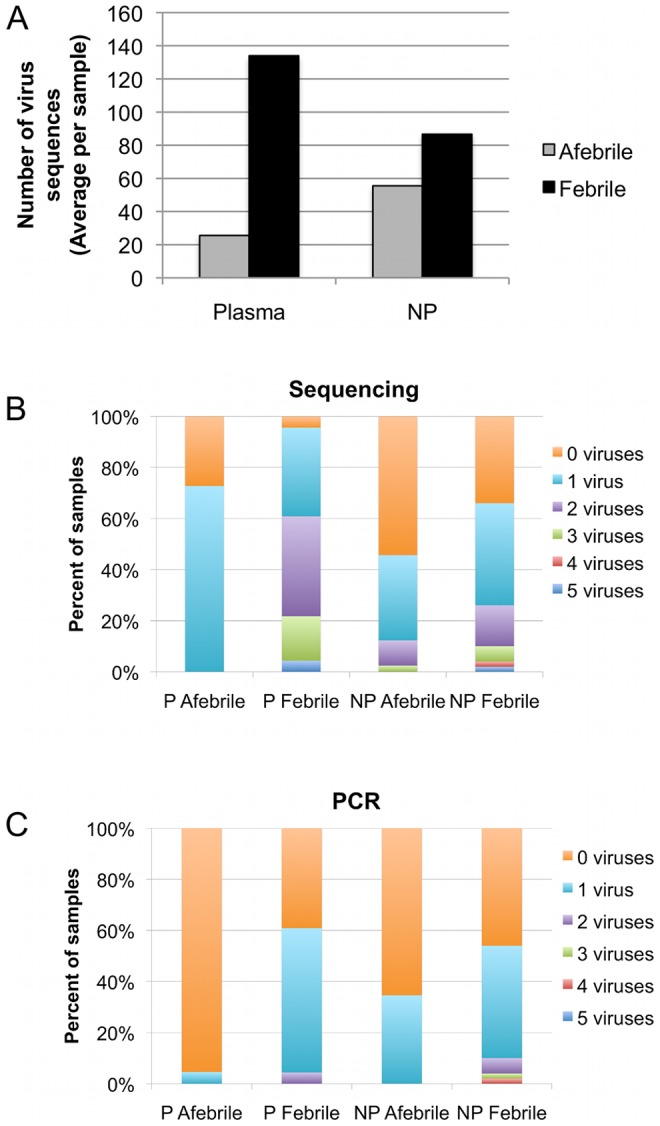
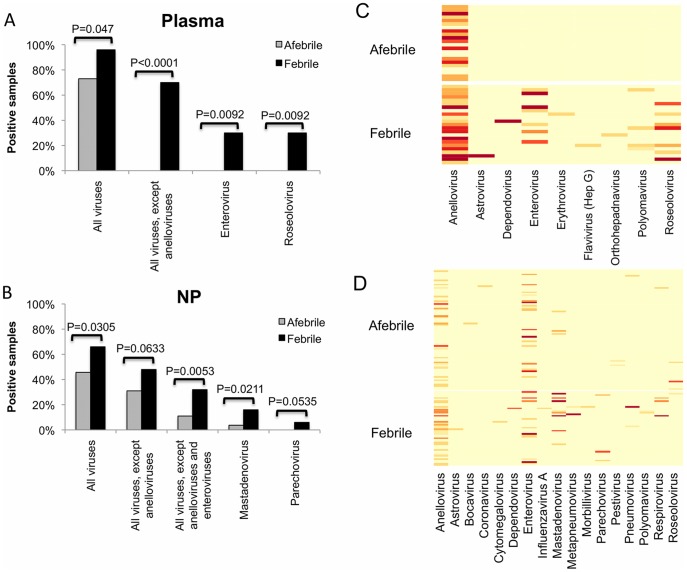
Unexplained fever (UF) is a common problem in children under 3 years old. Although virus infection is suspected to be the cause of most of these fevers, a comprehensive analysis of viruses in samples from children with fever and healthy controls is important for establishing a relationship between viruses and UF. We used unbiased, deep sequencing to analyze 176 nasopharyngeal swabs (NP) and plasma samples from children with UF and afebrile controls, generating an average of 4.6 million sequences per sample. An analysis pipeline was developed to detect viral sequences, which resulted in the identification of sequences from 25 viral genera. These genera included expected pathogens, such as adenoviruses, enteroviruses, and roseoloviruses, plus viruses with unknown pathogenicity. Viruses that were unexpected in NP and plasma samples, such as the astrovirus MLB-2, were also detected. Sequencing allowed identification of virus subtype for some viruses, including roseoloviruses. Highly sensitive PCR assays detected low levels of viruses that were not detected in approximately 5 million sequences, but greater sequencing depth improved sensitivity. On average NP and plasma samples from febrile children contained 1.5- to 5-fold more viral sequences, respectively, than samples from afebrile children. Samples from febrile children contained a broader range of viral genera and contained multiple viral genera more frequently than samples from children without fever. Differences between febrile and afebrile groups were most striking in the plasma samples, where detection of viral sequence may be associated with a disseminated infection. These data indicate that virus infection is associated with UF. Further studies are important in order to establish the range of viral pathogens associated with fever and to understand of the role of viral infection in fever. Ultimately these studies may improve the medical treatment of children with UF by helping avoid antibiotic therapy for children with viral infections.
Overview
The claims and statistics of this paper haven’t been checked yet.
Free: it reads the open-access text and checks the first 5 claims that cite a source we can check. Create a free account to check every claim.
Integrity signals
Registry
Cites
Statistics
Figures
Verification
Claims the paper makes
The claims and statistics of this paper haven’t been checked yet.
Free: it reads the open-access text and checks the first 5 claims that cite a source we can check. Create a free account to check every claim.
Claims other papers make about this one
Each is checked against this paper’s own text: does it say what the citing paper says it does?
The cited source says what the claim attributes to it.
In the citing paper
“For example, the recently discovered Anelloviridae family was identified as the most prevalent virus family in the virome of the URT54,55.”
From The microbiota of the respiratory tract: gatekeeper to respiratory health (2017) · cites this paper as [55]
The cited source says what the claim attributes to it.
In the citing paper
“However, recent advances in metagenomics have revealed that the entire respiratory virome contains many other viruses.”
From The microbiota of the respiratory tract: gatekeeper to respiratory health (2017) · cites this paper as [55]
Self-check
Percentages, sums and reported differences re-computed from the paper’s own numbers.
The self-check needs the paper’s full text.
Citations
Cites
Basic local alignment search tool
Altschul, S. F., Gish, W., Miller, W., Myers, E. W., & Lipman, D. J. (1990) · Journal of Molecular Biology · doi:10.1006/jmbi.1990.9999 · Cited by 98,669 · cited 1×
“gov/blast/db/) using WU-BLAST (BlastX) [31] with the following parameters: filter seg, W 6, WINK 6, nogap.”
Gapped BLAST and PSI-BLAST: a new generation of protein database search programs
Altschul, S. (1997) · Nucleic Acids Research · doi:10.1093/nar/25.17.3389 · Cited by 73,302 · cited 1×
“This was adapted from that used for the analysis of 454 sequences, which used BLASTn and tBLASTx [28] to align sequences to references in the NT database (ftp://ftp.”
Viruses in the faecal microbiota of monozygotic twins and their mothers
Reyes, A., Haynes, M., Hanson, N., Angly, F. E., Heath, A. C., Rohwer, F., & Gordon, J. I. (2010) · Nature · doi:10.1038/nature09199 · Cited by 1,194
The Marine Viromes of Four Oceanic Regions
Angly, F. E., Felts, B., Breitbart, M., Salamon, P., Edwards, R. A., Carlson, C., Chan, A. M., Haynes, M., Kelley, S., Liu, H., et al. (2006) · PLoS Biology · doi:10.1371/journal.pbio.0040368 · Cited by 952 · cited 1×
“Next generation sequencing technologies have been used successfully for viral metagenomic analyses [7–11] and discovery of novel viruses [13–15].”
Microarray-based detection and genotyping of viral pathogens
Wang, D., Coscoy, L., Zylberberg, M., Avila, P. C., Boushey, H. A., Ganem, D., & DeRisi, J. L. (2002) · Proceedings of the National Academy of Sciences · doi:10.1073/pnas.242579699 · Cited by 810 · cited 1×
“For samples from afebrile and febrile children, sequencing libraries were prepared to look for DNA and RNA viruses. DNA and RNA were prepared as previously described”
A Fast and Symmetric DUST Implementation to Mask Low-Complexity DNA Sequences
Morgulis, A., Gertz, E. M., Schäffer, A. A., & Agarwala, R. (2006) · Journal of Computational Biology · doi:10.1089/cmb.2006.13.1028 · Cited by 496 · cited 1×
“Low complexity sequences were then masked using Dust [29].”
Briese, T., Paweska, J. T., McMullan, L. K., Hutchison, S. K., Street, C., Palacios, G., Khristova, M. L., Weyer, J., Swanepoel, R., Egholm, M., et al. (2009) · PLoS Pathogens · doi:10.1371/journal.ppat.1000455 · Cited by 493 · cited 1×
“Virus discovery using high-throughput sequencing methods has been very productive in recent years”
MethodViral Discovery and Sequence Recovery Using DNA Microarrays
Wang, D., Urisman, A., Liu, Y.-T., Springer, M., Ksiazek, T. G., Erdman, D. D., Mardis, E. R., Hickenbotham, M., Magrini, V., Eldred, J., et al. (2003) · PLoS Biology · doi:10.1371/journal.pbio.0000002 · Cited by 465 · cited 1×
“DNA and RNA were prepared as previously described [26–27].”
Willner, D., Furlan, M., Haynes, M., Schmieder, R., Angly, F. E., Silva, J., Tammadoni, S., Nosrat, B., Conrad, D., & Rohwer, F. (2009) · PLoS ONE · doi:10.1371/journal.pone.0007370 · Cited by 441 · cited 1×
“Next generation sequencing technologies have been used successfully for viral metagenomic analyses [7–11] and discovery of novel viruses [13–15].”
Félix, M.-A., Ashe, A., Piffaretti, J., Wu, G., Nuez, I., Bélicard, T., Jiang, Y., Zhao, G., Franz, C. J., Goldstein, L. D., et al. (2011) · PLoS Biology · doi:10.1371/journal.pbio.1000586 · Cited by 416 · cited 1×
“Next generation sequencing technologies have been used successfully for viral metagenomic analyses [7–11] and discovery of novel viruses [13–15].”
Metagenomic Analyses of Viruses in Stool Samples from Children with Acute Flaccid Paralysis
Victoria, J. G., Kapoor, A., Li, L., Blinkova, O., Slikas, B., Wang, C., Naeem, A., Zaidi, S., & Delwart, E. (2009) · Journal of Virology · doi:10.1128/jvi.02301-08 · Cited by 375 · cited 1×
“Previous studies demonstrated improved virus detection using deeper sequencing on the 454 pyrosequencing platform compared to Sanger sequencing [16] and we sought to determine whether the greater sampling depth possible with the Illumina GAIIX platform would provide a further improvement.”
Metagenomic Analysis of Human Diarrhea: Viral Detection and Discovery
Finkbeiner, S. R., Allred, A. F., Tarr, P. I., Klein, E. J., Kirkwood, C. D., & Wang, D. (2008) · PLoS Pathogens · doi:10.1371/journal.ppat.1000011 · Cited by 361 · cited 1×
“Virus discovery using high-throughput sequencing methods has been very productive in recent years [12–14 , 23– 25 An important outcome of this study is to show that deep, Illumina-based sequencing has at least two advantages over targeted, PCR-based assays for the assessment of viruses in clinical…”
Management of fever without source in infants and children
Baraff, L. J. (2000) · Annals of Emergency Medicine · doi:10.1067/mem.2000.110820 · Cited by 307 · cited 1×
“Viruses are thought to be the primary cause of unexplained fever in children under 3 years old, a common problem that results in medical visits and in some cases hospitalization [1,2].”
Nakamura, S., Yang, C.-S., Sakon, N., Ueda, M., Tougan, T., Yamashita, A., Goto, N., Takahashi, K., Yasunaga, T., Ikuta, K., et al. (2009) · PLoS ONE · doi:10.1371/journal.pone.0004219 · Cited by 266 · cited 1×
“Next generation sequencing technologies have been used successfully for viral metagenomic analyses [7–11] and discovery of novel viruses [13–15].”
McErlean, P., Shackelton, L. A., Lambert, S. B., Nissen, M. D., Sloots, T. P., & Mackay, I. M. (2007) · Journal of Clinical Virology · doi:10.1016/j.jcv.2007.03.012 · Cited by 212 · cited 1×
“Likewise, we were able to determine that one of the rhinoviruses we detected was most similar to the recently discovered group C rhinovirus QPM [20].”
Human stool contains a previously unrecognized diversity of novel astroviruses
Finkbeiner, S. R., Holtz, L. R., Jiang, Y., Rajendran, P., Franz, C. J., Zhao, G., Kang, G., & Wang, D. (2009) · Virology Journal · doi:10.1186/1743-422x-6-161 · Cited by 198 · cited 1×
“Virus discovery using high-throughput sequencing methods has been very productive in recent years [12–14,23–25].”
Breitbart, M., & Rohwer, F. (2005) · BioTechniques · doi:10.2144/000112019 · Cited by 167 · cited 2×
“Next generation sequencing technologies have been used successfully for viral metagenomic analyses [7–11] and discovery of novel viruses [13–15].”
The spectrum and frequency of illness presenting to a pediatric emergency department
KRAUSS, B. S., HARAKAL, T., & FLEISHER, G. R. (1991) · Pediatric Emergency Care · doi:10.1097/00006565-199104000-00001 · Cited by 147 · cited 1×
“Viruses are thought to be the primary cause of unexplained fever in children under 3 years old, a common problem that results in medical visits and in some cases hospitalization [1,2].”
Ninomiya, M., Takahashi, M., Nishizawa, T., Shimosegawa, T., & Okamoto, H. (2008) · Journal of Clinical Microbiology · doi:10.1128/jcm.01703-07 · Cited by 143 · cited 1×
“The presence of anelloviruses is not surprising, as they infect the majority of children by 1 year of age and establish chronic infections that are detectable in the blood of healthy individuals [15,21–22].”
Metagenomic detection of phage-encoded platelet-binding factors in the human oral cavity
Willner, D., Furlan, M., Schmieder, R., Grasis, J. A., Pride, D. T., Relman, D. A., Angly, F. E., McDole, T., Mariella, R. P., Rohwer, F., et al. (2011) · Proceedings of the National Academy of Sciences · doi:10.1073/pnas.1000089107 · Cited by 142 · cited 1×
“Next generation sequencing technologies have been used successfully for viral metagenomic analyses [7–11] and discovery of novel viruses [13–15].”
Changing Epidemiology of Serious Bacterial Infections in Febrile Infants without Localizing Signs
Watt, K., Waddle, E., & Jhaveri, R. R. (2010) · PLoS ONE · doi:10.1371/journal.pone.0012448 · Cited by 105 · cited 1×
“With the implementation of several vaccines against bacterial infections, the frequency of bacterial infections is low [3–6].”
Identification of a novel picornavirus related to cosaviruses in a child with acute diarrhea
Holtz, L. R., Finkbeiner, S. R., Kirkwood, C. D., & Wang, D. (2008) · Virology Journal · doi:10.1186/1743-422x-5-159 · Cited by 100 · cited 1×
“Virus discovery using high-throughput sequencing methods has been very productive in recent years [12–14 , 23– 25 An important outcome of this study is to show that deep, Illumina-based sequencing has at least two advantages over targeted, PCR-based assays for the assessment of viruses in clinical…”
Torque Teno Virus (TTV) distribution in healthy Russian population
Vasilyev, E., Trofimov, D. Y., Tonevitsky, A., Ilinsky, V. V., Korostin, D. O., & Rebrikov, D. V. (2009) · Virology Journal · doi:10.1186/1743-422x-6-134 · Cited by 98 · cited 1×
“The presence of anelloviruses is not surprising, as they infect the majority of children by 1 year of age and establish chronic infections that are detectable in the blood of healthy individuals [15,21–22].”
Wilkinson, M. H., Bulloch, B., & Smith, M. (2009) · Academic Emergency Medicine · doi:10.1111/j.1553-2712.2008.00328.x · Cited by 97 · cited 1×
“With the implementation of several vaccines against bacterial infections, the frequency of bacterial infections is low [3–6].”
Serious Bacterial Infections in Febrile Infants in the Post–Pneumococcal Conjugate Vaccine Era
Rudinsky, S. L., Carstairs, K. L., Reardon, J. M., Simon, L. V., Riffenburgh, R. H., & Tanen, D. A. (2009) · Academic Emergency Medicine · doi:10.1111/j.1553-2712.2009.00444.x · Cited by 73
Outcomes of febrile children without localising signs after pneumococcal conjugate vaccine
Waddle, E., & Jhaveri, R. R. (2008) · Archives of Disease in Childhood · doi:10.1136/adc.2007.130583 · Cited by 64 · cited 1×
“With the implementation of several vaccines against bacterial infections, the frequency of bacterial infections is low [3–6].”
Detection of Novel Sequences Related to African Swine Fever Virus in Human Serum and Sewage
Loh, J., Zhao, G., Presti, R. M., Holtz, L. R., Finkbeiner, S. R., Droit, L., Villasana, Z., Todd, C., Pipas, J. M., Calgua, B., et al. (2009) · Journal of Virology · doi:10.1128/jvi.00638-09 · Cited by 46 · cited 1×
“Virus discovery using high-throughput sequencing methods has been very productive in recent years [12–14 , 23– 25 An important outcome of this study is to show that deep, Illumina-based sequencing has at least two advantages over targeted, PCR-based assays for the assessment of viruses in clinical…”
Sumino, K. C., Walter, M. J., Mikols, C. L., Thompson, S. A., Gaudreault-Keener, M., Arens, M. Q., Agapov, E., Hormozdi, D., Gaynor, A. M., Holtzman, M. J., et al. (2010) · Thorax · doi:10.1136/thx.2009.132480 · Cited by 42 · cited 1×
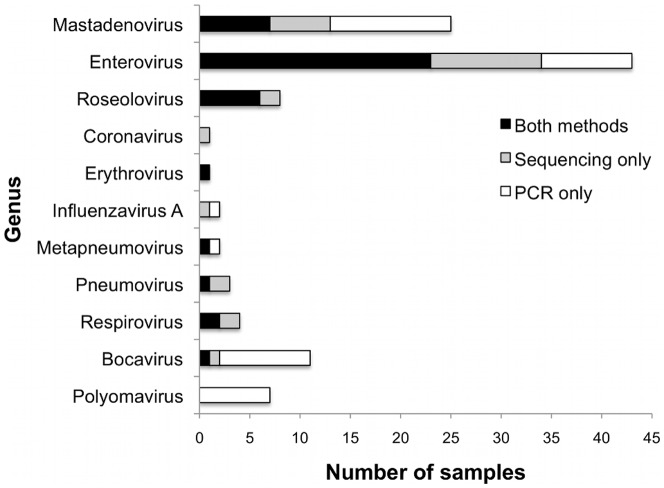
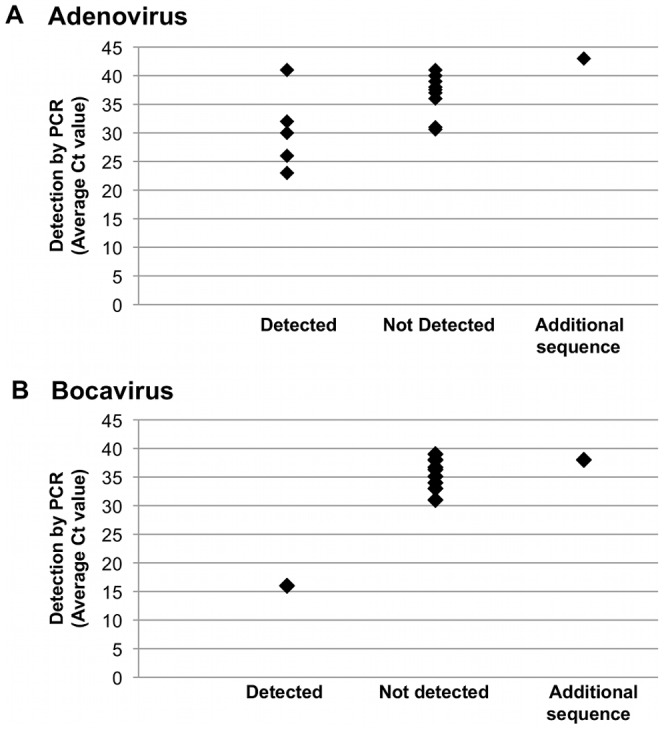
“Bocavirus was detected 10 samples by a sensitive PCR assay that can detect as few as 5 plasmid copies of the target [18] (Figure 1).”
Self-citationKI Polyomavirus Detected in Respiratory Tract Specimens From Patients in St. Louis, Missouri
Hormozdi, D. J., Arens, M. Q., Le, B.-M., Buller, R. S., Agapov, E. V., & Storch, G. A. (2010) · The Pediatric Infectious Disease Journal · doi:10.1097/inf.0b013e3181c1795c · Cited by 20 · cited 1×
“The sensitivity of the WU PCR assay is 7 plasmid copies per reaction and that of the KI assay is 50 plasmid copies [17].”
Self-citationAstrovirus MLB2 Viremia in Febrile Child
Holtz, L. R., Wylie, K., Sodergren, E., Jiang, Y.-F., Franz, C. J., Weinstock, G. M., Storch, G., & Wang, D. (2011) · Emerging Infectious Diseases · doi:10.3201/eid1711.110496 · Cited by 4
Self-citation
Cited by
Clinical Metagenomic Next-Generation Sequencing for Pathogen Detection
Gu, W., Miller, S., & Chiu, C. Y. (2019) · Annual Review of Pathology: Mechanisms of Disease · doi:10.1146/annurev-pathmechdis-012418-012751 · Cited by 1,458
The microbiota of the respiratory tract: gatekeeper to respiratory health
Man, W. H., de Steenhuijsen Piters, W. A. A., & Bogaert, D. (2017) · Nature Reviews Microbiology · doi:10.1038/nrmicro.2017.14 · Cited by 1,384
The Integrative Human Microbiome Project
The Integrative HMP (iHMP) Research Network Consortium, Proctor, L. M., Creasy, H. H., Fettweis, J. M., Lloyd-Price, J., Mahurkar, A., Zhou, W., Buck, G. A., Snyder, M. P., Strauss, J. F., et al. (2019) · Nature · doi:10.1038/s41586-019-1238-8 · Cited by 1,381
Self-citationThe human virome: assembly, composition and host interactions
Liang, G., & Bushman, F. D. (2021) · Nature Reviews Microbiology · doi:10.1038/s41579-021-00536-5 · Cited by 624
The Role of Lung and Gut Microbiota in the Pathology of Asthma
Barcik, W., Boutin, R. C. T., Sokolowska, M., & Finlay, B. B. (2020) · Immunity · doi:10.1016/j.immuni.2020.01.007 · Cited by 613
“Human rhinovirus (RV), bocavirus, adenovirus, coronavirus, polymavirus, and Anneloviridae family viruses have been identified in the URT of large proportions of healthy asymptomatic children using PCR-based methods and metagenomics, even in geographically isolated locations (van den Bergh et al., 2012; Bogaert et al.,…”
Metadata
- Authors
- Wylie, K. M., Mihindukulasuriya, K. A., Sodergren, E., Weinstock, G. M., & Storch, G. A.
- Affiliations
- Washington University in St. Louis (US)
- Corresponding author
- Wylie, Kristine M.
- ORCID
- Venue
- PLoS ONE
- Publisher
- Public Library of Science (PLoS)
- Published
- 2012-06-13
- Volume
- 7
- Issue
- 6
- Pages
- e27735
- ISSN
- 1932-6203 (ISSN-L)
- PMC
- PMC3374612
- OpenAlex
- W2130734615
- Cited by
- 193
- References
- 30
- Citations by year
- 2026: 8 · 2025: 10 · 2024: 5 · 2023: 6 · 2022: 9 · 2021: 18 · 2020: 14 · 2019: 14 · 2018: 25 · 2017: 17 · 2016: 15 · 2015: 12 · 2014: 16 · 2013: 20 · 2012: 4
- FWCI
- 12.35
- Type
- journal article
- Language
- en
- Open access
- gold
- doi.org
- Locations
- PLoS ONE (publishedVersion, cc-by)
- PubMed Central (publishedVersion, cc-by)
- PubMed (publishedVersion)
- Digital Commons@Becker (Washington University School of Medicine) (submittedVersion)
- DOAJ (DOAJ: Directory of Open Access Journals) (submittedVersion)
- Figshare (submittedVersion, cc-by)
- Funders
- National Institutes of Health (UL1TR000448)
- National Human Genome Research Institute (U54HG003079, U54HG004968)
- National Institute of Allergy and Infectious Diseases (1UAH2AI083266-01, UH2AI083266)
- National Center for Research Resources (UL1RR024992)
- National Center for Advancing Translational Sciences
- Topics
- Health Sciences › Medicine › Epidemiology › Respiratory viral infections research
- Health Sciences › Medicine › Pediatrics, Perinatology and Child Health › Literature Analysis and Criticism
- Health Sciences › Medicine › Infectious Diseases › Viral Infections and Immunology Research
- Keywords
- fever of unknown origin, virome, viral infection, children, nasopharyngeal swab, plasma viral RNA, adenovirus, enterovirus, disseminated infection, viral subtyping
- MeSH terms
- Child, DNA, Viral, Fever, Humans, Viruses, Case-Control Studies, Polymerase Chain Reaction, Sequence Analysis, DNA
About these checks
Registry, retraction, Cites and statistics results are computed, not judged, with one exception: a printed reference that no index lists is read once by a model before it counts as a citation error. Claims are extracted by a model and kept only when their quote appears verbatim in the text; each cited source is then checked, with a model’s help, for whether it says what the claim relies on. Those verdicts can be wrong — read the claim’s quote and the cited source before relying on one.
Statistics and arithmetic are recomputed, not judged.
Confidence bands are shown only for fields calibrated on our annotated test set. None is calibrated yet, so no band is shown.
What counts as a claim ›How we measure confidence ›How we check this ›
Are you an author, or do you see a problem with this page? Request a review
Data sources
Bibliographic data: Semantic Scholar, OpenAlex, Crossref.
Contains information from the Semantic Scholar Academic Graph Datasets, made available under the ODC Attribution License (ODC-BY 1.0).
Semantic Scholar’s data is described in: Kinney, R., et al. (2023). The Semantic Scholar Open Data Platform. arXiv:2301.10140.
