

Conserved and Divergent Roles of Bcr1 and CFEM Proteins in Candida parapsilosis and Candida albicans
Open accessThe DOI matches its Crossref record; 69 of the 70 references it cites were found in a registry or an index.
Abstract
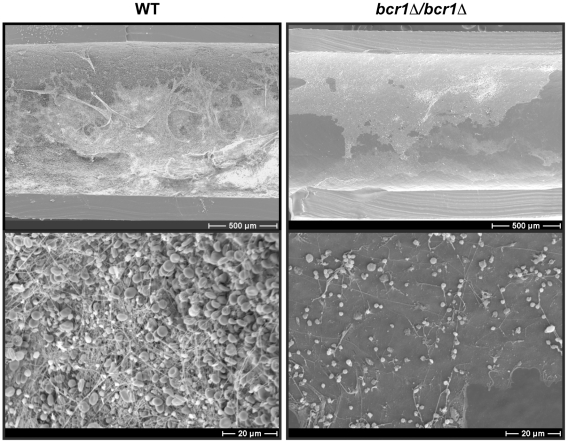
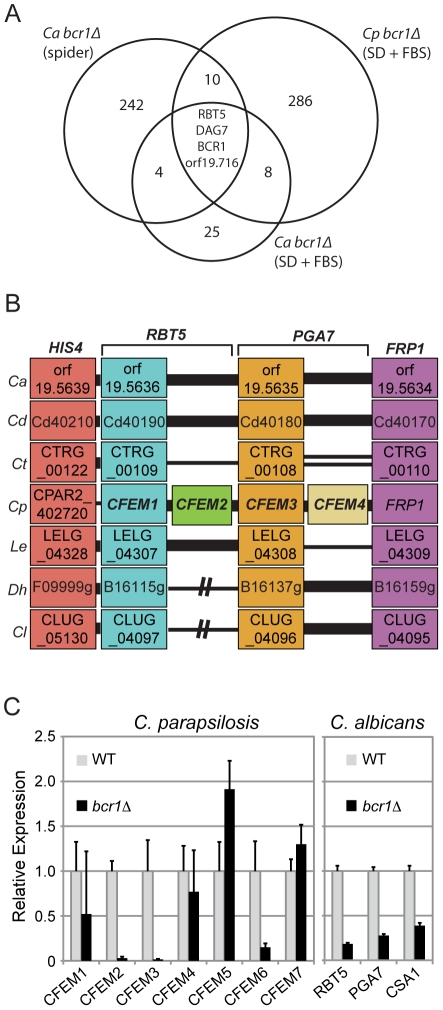
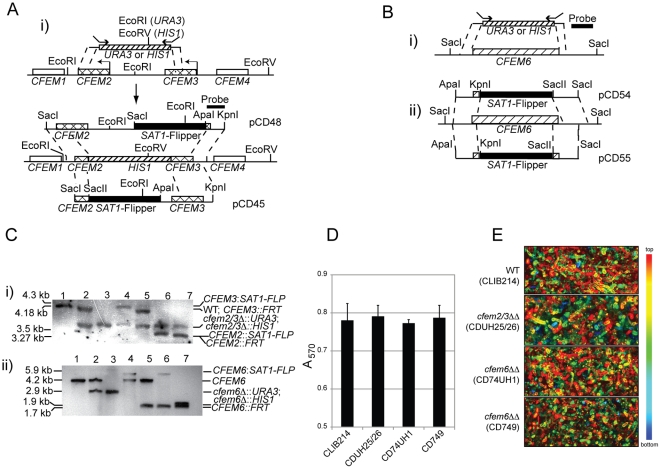
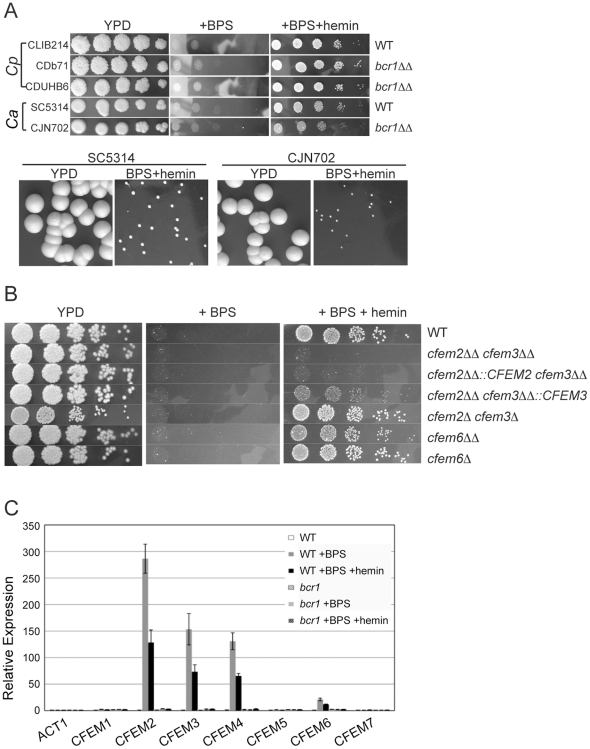
Candida parapsilosis is a pathogenic fungus that is major cause of hospital-acquired infection, predominantly due to growth as biofilms on indwelling medical devices. It is related to Candida albicans, which remains the most common cause of candidiasis disease in humans. The transcription factor Bcr1 is an important regulator of biofilm formation in vitro in both C. parapsilosis and C. albicans. We show here that C. parapsilosis Bcr1 is required for in vivo biofilm development in a rat catheter model, like C. albicans. By comparing the transcription profiles of a bcr1 deletion in both species we found that regulation of expression of the CFEM family is conserved. In C. albicans, three of the five CFEM cell wall proteins (Rbt5, Pga7 and Csa1) are associated with both biofilm formation and acquisition of iron from heme, which is an important virulence characteristic. In C. parapsilosis, the CFEM family has undergone an expansion to 7 members. Expression of three genes (CFEM2, CFEM3, and CFEM6) is dependent on Bcr1, and is induced in low iron conditions. All three are involved in the acquisition of iron from heme. However, deletion of the three CFEM genes has no effect on biofilm formation in C. parapsilosis. Our data suggest that the role of the CFEM family in iron acquisition is conserved between C. albicans and C. parapsilosis, but their role in biofilm formation is not.
Overview
The claims and statistics of this paper haven’t been checked yet.
Free: it reads the open-access text and checks the first 5 claims that cite a source we can check. Create a free account to check every claim.
Integrity signals
Registry
Cites
Statistics
Figures
Verification
Claims the paper makes
The claims and statistics of this paper haven’t been checked yet.
Free: it reads the open-access text and checks the first 5 claims that cite a source we can check. Create a free account to check every claim.
Self-check
Percentages, sums and reported differences re-computed from the paper’s own numbers.
The self-check needs the paper’s full text.
Citations
Cites
Epidemiology of Invasive Candidiasis: a Persistent Public Health Problem
Pfaller, M. A., & Diekema, D. J. (2007) · Clinical Microbiology Reviews · doi:10.1128/cmr.00029-06 · Cited by 4,174 · cited 1×
“Candida species are among the most common causes of nosocomial bloodstream infection, and have associated mortality rates ranging from 28–59% [1,2].”
BackgroundNormalization of cDNA microarray data
Smyth, G. K., & Speed, T. (2003) · Methods · doi:10.1016/s1046-2023(03)00155-5 · Cited by 1,871
Segal, E., Shapira, M., Regev, A., Pe'er, D., Botstein, D., Koller, D., & Friedman, N. (2003) · Nature Genetics · doi:10.1038/ng1165 · Cited by 1,670 · cited 1×
“cerevisiae is Usv1which regulates genes involved in non-fermentative growth and salt stress [51], and has been predicted to regulate genes important for protein folding during stationary phase [52].”
BackgroundChandra, J., Kuhn, D. M., Mukherjee, P. K., Hoyer, L. L., McCormick, T., & Ghannoum, M. A. (2001) · Journal of Bacteriology · doi:10.1128/jb.183.18.5385-5394.2001 · Cited by 1,578 · cited 1×
“densely packed hyphae and yeast cells surrounded by the extracellular matrix, consisting mostly of polysaccharides [14].”
BackgroundCandida biofilms and their role in infection
Douglas, L. J. (2003) · Trends in Microbiology · doi:10.1016/s0966-842x(02)00002-1 · Cited by 1,150 · cited 1×
“albicans, biofilms are multilayered and contain yeast cells, pseudohyphae and hyphae [12].”
BackgroundEvolution of pathogenicity and sexual reproduction in eight Candida genomes
Butler, G., Rasmussen, M. D., Lin, M. F., Santos, M. A. S., Sakthikumar, S., Munro, C. A., Rheinbay, E., Grabherr, M., Forche, A., Reedy, J. L., et al. (2009) · Nature · doi:10.1038/nature08064 · Cited by 1,065 · cited 1×
“substantial differences between the species [21].”
Self-citationHow to build a biofilm: a fungal perspective
Blankenship, J. R., & Mitchell, A. P. (2006) · Current Opinion in Microbiology · doi:10.1016/j.mib.2006.10.003 · Cited by 530 · cited 1×
“(reviewed in [10,13]).”
Critical Role of Bcr1-Dependent Adhesins in C. albicans Biofilm Formation In Vitro and In Vivo
Nobile, C. J., Andes, D. R., Nett, J. E., Smith, F. J., Yue, F., Phan, Q.-T., Edwards, J. E., Filler, S. G., & Mitchell, A. P. (2006) · PLoS Pathogens · doi:10.1371/journal.ppat.0020063 · Cited by 507 · cited 3×
“Our analysis shows that the Bcr1 transcription factor is an important regulator of biofilm development in vitro and in vivo in the two species, and that regulation of expression of some members of the CFEM family is conserved [16,17,18].”
BackgroundSelf-citationComparison of Biofilms Formed by Candidaalbicans and Candidaparapsilosis on Bioprosthetic Surfaces
Kuhn, D. M., Chandra, J., Mukherjee, P. K., & Ghannoum, M. A. (2002) · Infection and Immunity · doi:10.1128/iai.70.2.878-888.2002 · Cited by 485 · cited 1×
“carbohydrate [11,15].”
A fungal phylogeny based on 42 complete genomes derived from supertree and combined gene analysis.
(2006) · BMC Evolutionary Biology · doi:10.1186/1471-2148-6-99 · Cited by 475
Self-citation
Cited by
Candida Biofilms: Threats, Challenges, and Promising Strategies
Cavalheiro, M., & Teixeira, M. C. (2018) · Frontiers in Medicine · doi:10.3389/fmed.2018.00028 · Cited by 690
“parapsilosis, a homolog of Bcr1 was identified as one of the most important transcription factors regulating biofilm formation (68, 69, 81, 82).”
BackgroundThe Candida Pathogenic Species Complex
Turner, S. A., & Butler, G. (2014) · Cold Spring Harbor Perspectives in Medicine · doi:10.1101/cshperspect.a019778 · Cited by 336
“However, the functions and/ or targets may be different; whereas Bcr1 regulates expression of the CFEM cell wall family in both species, the family is required for biofilm development only in C. albicans (Ding et al. 2011).”
BackgroundSelf-citationCandida parapsilosis: from genes to the bedside
Tóth, R., Nosek, J., Mora-Montes, H. M., Gabaldon, T., Bliss, J. M., Nosanchuk, J. D., Turner, S. A., Butler, G., Vágvölgyi, C., & Gácser, A. (2019) · Clinical Microbiology Reviews · doi:10.1128/cmr.00111-18 · Cited by 327
“genome, although their exact role in adhesion is not yet known (160, 161).”
BackgroundSelf-citationCandida Species Biofilms’ Antifungal Resistance
Silva, S., Rodrigues, C., Araújo, D., Rodrigues, M., & Henriques, M. (2017) · Journal of Fungi · doi:10.3390/jof3010008 · Cited by 302
Fungal Biofilms, Drug Resistance, and Recurrent Infection
Desai, J. V., Mitchell, A. P., & Andes, D. R. (2014) · Cold Spring Harbor Perspectives in Medicine · doi:10.1101/cshperspect.a019729 · Cited by 252
Self-citation
Metadata
- Authors
- Ding, C., Vidanes, G. M., Maguire, S. L., Guida, A., Synnott, J. M., Andes, D. R., & Butler, G.
- Affiliations
- University College Dublin (IE)
- University of Wisconsin–Madison (US)
- Corresponding author
- Butler, Geraldine
- ORCID
- Venue
- PLoS ONE
- Publisher
- Public Library of Science (PLoS)
- Published
- 2011-12-01
- Volume
- 6
- Issue
- 12
- Pages
- e28151
- ISSN
- 1932-6203 (ISSN-L)
- PMC
- PMC3228736
- OpenAlex
- W2170803314
- Cited by
- 93
- References
- 70
- Citations by year
- 2026: 2 · 2025: 7 · 2024: 5 · 2023: 8 · 2022: 6 · 2021: 6 · 2020: 5 · 2019: 5 · 2018: 6 · 2017: 9 · 2016: 6 · 2015: 5 · 2014: 8 · 2013: 13 · 2012: 2
- FWCI
- 4.99
- Type
- journal article
- Language
- en
- Open access
- gold
- doi.org
- Locations
- PLoS ONE (publishedVersion, cc-by)
- Europe PMC (PubMed Central) (publishedVersion, cc-by)
- PubMed Central (publishedVersion, cc-by)
- PubMed (publishedVersion)
- DOAJ (DOAJ: Directory of Open Access Journals) (submittedVersion, cc-by-sa)
- Figshare (submittedVersion, cc-by)
- Research Portal (Queen's University Belfast) (submittedVersion)
- Funders
- Health Research Board
- Irish Research Council for Science, Engineering and Technology
- Science Foundation Ireland (08/IN.1/B1865)
- Irish Research Council
- National Institute of Allergy and Infectious Diseases (R01AI073289)
- Topics
- Health Sciences › Medicine › Infectious Diseases › Antifungal resistance and susceptibility
- Life Sciences › Biochemistry, Genetics and Molecular Biology › Molecular Biology › Fungal and yeast genetics research
- Health Sciences › Medicine › Infectious Diseases › Fungal Infections and Studies
- Keywords
- Candida parapsilosis, Candida albicans, biofilm formation, gene family expansion, transcriptional regulation, fungal virulence, nosocomial infections
- MeSH terms
- Animals, Candida, Candidiasis, Fungal Proteins, Iron, RNA, Messenger, Species Specificity, Signal Transduction, Biomarkers, Biofilms, Oligonucleotide Array Sequence Analysis, Gene Expression Profiling, Rats, Real-Time Polymerase Chain Reaction
About these checks
Registry, retraction, Cites and statistics results are computed, not judged, with one exception: a printed reference that no index lists is read once by a model before it counts as a citation error. Claims are extracted by a model and kept only when their quote appears verbatim in the text; each cited source is then checked, with a model’s help, for whether it says what the claim relies on. Those verdicts can be wrong — read the claim’s quote and the cited source before relying on one.
Statistics and arithmetic are recomputed, not judged.
Confidence bands are shown only for fields calibrated on our annotated test set. None is calibrated yet, so no band is shown.
What counts as a claim ›How we measure confidence ›How we check this ›
Are you an author, or do you see a problem with this page? Request a review
How to cite
Cite CoChat for the checks on this page, and the paper for its own findings.
- This page
- CoChat. (2026). Citation check: Conserved and Divergent Roles of Bcr1 and CFEM Proteins in Candida parapsilosis and Candida albicans. https://app.cochat.ai/papers/10.1371/journal.pone.0028151
- The paper
- Ding, C., Vidanes, G. M., Maguire, S. L., Guida, A., Synnott, J. M., Andes, D. R., & Butler, G. (2011). Conserved and Divergent Roles of Bcr1 and CFEM Proteins in Candida parapsilosis and Candida albicans. PLoS ONE. https://doi.org/10.1371/journal.pone.0028151
Data sources
Bibliographic data: Semantic Scholar, OpenAlex, Crossref.
Contains information from the Semantic Scholar Academic Graph Datasets, made available under the ODC Attribution License (ODC-BY 1.0).
Semantic Scholar’s data is described in: Kinney, R., et al. (2023). The Semantic Scholar Open Data Platform. arXiv:2301.10140.
