

The DOI matches its Crossref record; 36 of the 36 references it cites were found in a registry or an index.
Giving Leads to Happiness in Young Children
Open accessAbstract
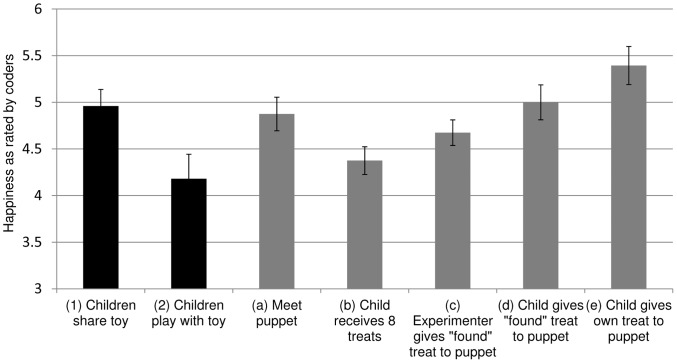
Evolutionary models of cooperation require proximate mechanisms that sustain prosociality despite inherent costs to individuals. The "warm glow" that often follows prosocial acts could provide one such mechanism; if so, these emotional benefits may be observable very early in development. Consistent with this hypothesis, the present study finds that before the age of two, toddlers exhibit greater happiness when giving treats to others than receiving treats themselves. Further, children are happier after engaging in costly giving--forfeiting their own resources--than when giving the same treat at no cost. By documenting the emotionally rewarding properties of costly prosocial behavior among toddlers, this research provides initial support for the claim that experiencing positive emotions when giving to others is a proximate mechanism for human cooperation.
Overview
The claims and statistics of this paper haven’t been checked yet.
Run the check — free, no account needed. It reads the open-access text and checks the sources it cites.
Integrity signals
Registry
Cites
Statistics
Figures

Verification
Claims the paper makes
The claims and statistics of this paper haven’t been checked yet.
Run the check — free, no account needed. It reads the open-access text and checks the sources it cites.
Claims other papers make about this one
Each is checked against this paper’s own text: does it say what the citing paper says it does?
The source backs part of the claim, not all of it — or backs it for a different population, condition or comparison.
In the citing paper
“Likewise, toddlers and preschoolers display positive emotions when acting prosocially (Aknin, Hamlin, & Dunn, 2012; Ross, 2017).”
From Emotion understanding and the moral self-concept as motivators of prosocial behavior in middle childhood (2020) · cites this paper as Aknin et al., 2012
Experimental — accuracy not yet measured
Self-check
Percentages, sums and reported differences re-computed from the paper’s own numbers.
The self-check needs the paper’s full text.
Citations
Cites
Axelrod, R., & Hamilton, W. D. (1981) · Science · doi:10.1126/science.7466396 · Cited by 20,065
Fredrickson, B. L. (2001) · American Psychologist · doi:10.1037//0003-066x.56.3.218 · Cited by 18,025
The benefits of frequent positive affect: Does happiness lead to success?
Lyubomirsky, S., King, L., & Diener, E. (2005) · Psychological Bulletin · doi:10.1037/0033-2909.131.6.803 · Cited by 7,143
Five Rules for the Evolution of Cooperation
Nowak, M. A. (2006) · Science · doi:10.1126/science.1133755 · Cited by 5,894
Altruistic punishment in humans
Fehr, E., & Gächter, S. (2002) · Nature · doi:10.1038/415137a · Cited by 5,616
Skinner, B. F. (1938) · Cited by 3,571
Fehr, E., & Fischbacher, U. (2003) · Nature · doi:10.1038/nature02043 · Cited by 3,475 · cited 1×
“Indeed, human survival and flourishing have depended on our species’ ability to work together to achieve feats that could not be achieved alone, such as hunting large prey and building shelter in inhospitable regions [1].”
BackgroundPositive affect facilitates creative problem solving.
Isen, A. M., Daubman, K. A., & Nowicki, G. P. (1987) · Journal of Personality and Social Psychology · doi:10.1037/0022-3514.52.6.1122 · Cited by 2,986
Evolution of indirect reciprocity
Nowak, M. A., & Sigmund, K. (2005) · Nature · doi:10.1038/nature04131 · Cited by 2,762
Altruistic Helping in Human Infants and Young Chimpanzees
Warneken, F., & Tomasello, M. (2006) · Science · doi:10.1126/science.1121448 · Cited by 1,743
Cited by
Sorted by citations
Items 201–300 of 309
The Heterogeneity of Empathy: Possible Treatment for Anhedonia?
Light, S. N. (2019) · Frontiers in Psychiatry · doi:10.3389/fpsyt.2019.00185 · Cited by 4
Maintaining our edge and training the next generation of dermatologists
Elston, D. M. (2020) · Clinics in Dermatology · doi:10.1016/j.clindermatol.2020.05.011 · Cited by 4
İplikçi, A. B., Günaydın, G., Selçuk, E., Eren, Y., & Krasniqi, L. (2022) · International Journal of Human-Computer Interaction · doi:10.1080/10447318.2022.2150746 · Cited by 4
The Roots of Moral Reasoning and Behavior in Infants
Hamlin, J. K., & Steckler, C. M. (2015) · Wiley eBooks · doi:10.1002/9781118900772.etrds0344 · Cited by 4
Self-citationZhao, X., & Nicholas Epley, A. (2022) · doi:10.31234/osf.io/sgxay · Cited by 4
Happiness Research from the Psychological Perspective: Thoughts of an Optimist
Krishnan, L. (2023) · Springer eBooks · doi:10.1007/978-981-99-2637-4_1 · Cited by 4
The role of social motivation in sharing and fairness: insights from Williams syndrome
Foti, F., Costanzo, F., Fabrizio, C., Termine, A., Menghini, D., Iaquinta, T., Vicari, S., Petrosini, L., & Blake, P. R. (2024) · Journal of Neurodevelopmental Disorders · doi:10.1186/s11689-024-09568-3 · Cited by 3
Choosing to help others at a cost to oneself elevates preschoolers' body posture
Sivertsen, S. S., Haun, D. B. M., & Hepach, R. (2024) · Evolution and Human Behavior · doi:10.1016/j.evolhumbehav.2024.02.001 · Cited by 3
Gibhardt, S., Hepach, R., & Henderson, A. M. E. (2024) · Frontiers in Psychology · doi:10.3389/fpsyg.2024.1392331 · Cited by 3
The Unintended Negative Consequences of Help in Childhood
Sierksma, J., & Shutts, K. (2025) · Current Directions in Psychological Science · doi:10.1177/09637214251323594 · Cited by 3
Izzidien, A., & Chennu, S. (2018) · Kent Academic Repository (University of Kent) · Cited by 3
Funções executivas, habilidades sociais e comportamento distributivo na infância
Sampaio, L. R., & Reis, R. M. A. (2018) · Dialnet (Universidad de la Rioja) · Cited by 3
For you and for me: harvesting the benefits of prosocial spending in romantic relationships
Li, S., Ng, J. C. K., & Hui, C. M. (2020) · The Journal of Positive Psychology · doi:10.1080/17439760.2020.1832244 · Cited by 3
Salonen, A. O. (2014) · Sosiaalipedagoginen aikakauskirja · doi:10.30675/sa.122634 · Cited by 3
Kil, H., & Grusec, J. E. (2022) · Wiley eBooks · doi:10.1002/9781119679028.ch35 · Cited by 3
Prosociality increases under stress: Evidence from different types of prosocial preferences
Qun, Y. A. N. G., Bing, Z. H. U., Yiming, Y. U., ZHANG, J., & Mengmeng, X. U. E. (2022) · Advances in Psychological Science · doi:10.3724/sp.j.1042.2022.02809 · Cited by 2
Happy Normativists: Do Children Express Happiness When Following Conventional Norms?
Riggs, A. E., & Fast, A. A. (2024) · Developmental Science · doi:10.1111/desc.13596 · Cited by 2
Children consider others’ need and reputation in costly sharing decisions
Blakey, K. H. (2025) · Scientific Reports · doi:10.1038/s41598-025-91648-y · Cited by 3
Toddlers Are Happier Giving to Others Than to Themselves
Tan, E., de Vondervoort, J. W. V., Dhaliwal, J., Aknin, L. B., & Hamlin, J. K. (2026) · Developmental Science · doi:10.1111/desc.70171 · Cited by 2
Self-citationTuna, E., Evren, A., Şahinbaşoğlu, Z. Z., & Veznikli, M. (2023) · Sustainability · doi:10.3390/su15118569 · Cited by 2
Sharghi, M. J. (2023) · Journal of European Psychology Students · doi:10.59477/jeps.537 · Cited by 2
Starting and sustaining fruitful collaborations in psychology
Park, L. E., Aknin, L. B., Gaither, S. E., Impett, E. A., & Whillans, A. V. (2024) · Social and Personality Psychology Compass · doi:10.1111/spc3.12950 · Cited by 2
Self-citationLi, S., & Zhao, X. (2024) · Cognitive Science · doi:10.1111/cogs.13441 · Cited by 2
Chen, R., & Zhu, H. (2024) · Frontiers in Psychology · doi:10.3389/fpsyg.2024.1368224 · Cited by 2
Getting outside of ourselves: Towards an other-oriented model of psychological health
Rosset, E., El-Jor, C., Kotsou, I., & Shankland, R. (2024) · International Journal of Wellbeing · doi:10.5502/ijw.v14i2.3561 · Cited by 2
The effect of time pressure and ego depletion on young children’s helping behavior
Zha, Z., Chen, C.-E., Zhang, R., & Zhang, W. (2025) · Frontiers in Psychology · doi:10.3389/fpsyg.2025.1584248 · Cited by 3
Sierksma, J., & Poorthuis, A. M. G. (2025) · Developmental Science · doi:10.1111/desc.70071 · Cited by 2
Försterling, M., Hepach, R., & Rottman, J. (2023) · Global Discourse · doi:10.1332/20437897y2023d000000015 · Cited by 2
Social Decision-Making in Nonhuman Primates
Jazayari, M., Ballesta, S., & Duhamel, J. (2016) · Elsevier eBooks · doi:10.1016/b978-0-12-805308-9.00014-2 · Cited by 2
Decety, J. (2017) · Érès eBooks · doi:10.3917/eres.candi.2017.01.0089 · Cited by 2
Sellen, C. (2019) · Social indicators research series · doi:10.1007/978-3-030-05535-6_12 · Cited by 2
Petkova, A. V., & Brownell, C. A. (2022) · Oxford University Press eBooks · doi:10.1093/oxfordhb/9780198855903.013.43 · Cited by 1
Prosocial development throughout the toddlerhood: A person‐centred approach
Song, Y., Broekhuizen, M. L., & Dubas, J. S. (2023) · Infant and Child Development · doi:10.1002/icd.2457 · Cited by 1
The Social Brain and How It Links Social Intelligence and Well-Being
Sul, S., & Cho, I. (2023) · Cambridge University Press eBooks · doi:10.1017/9781108974325.006 · Cited by 1
Gibhardt, S., & Henderson, A. M. E. (2025) · Royal Society Open Science · doi:10.1098/rsos.242082 · Cited by 1
Paola, J. D., Hakoköngäs, E. J., Martikainen, J., & Pyy, I. (2026) · Children & Society · doi:10.1111/chso.70017 · Cited by 1
Universal moral certainties and the goodness of cooperation
Fairhurst, J. (2026) · Synthese · doi:10.1007/s11229-026-05514-z · Cited by 1
Elnagar, A. K., Khalifa, G. S. A., Alogaily, R. S., & Salama, A. (2026) · Sustainability · doi:10.3390/su181910217 · Cited by 1
The Strategic Influence of Social Factors on Self-Perceived Happiness of Spanish University Students
(2023) · European Journal of Contemporary Education · doi:10.13187/ejced.2023.2.517 · Cited by 1
Eryılmaz, A., KURTULUŞ, H. Y., & Yıldırım, M. (2024) · Youth & Society · doi:10.1177/0044118x241301068 · Cited by 1
Liu, H., Ma, Z., Chen, S., Zhang, L., & Wang, L. (2025) · Behavioral Sciences · doi:10.3390/bs15030254 · Cited by 1
UNICEF Kid Power: Empowering Kids to Get Active and Save Lives
Gudaitis, E. L. (2016) · USF Scholarship Repository (University of San Francisco) · Cited by 1
Erwerbsarbeit von Müttern und frühkindliche Fremdbetreuung
Schrader, S. M. (2021) · BesMasters · doi:10.1007/978-3-658-36287-4
Siegler, R. S., Saffran, J. R., Gershoff, E. T., & Eisenberg, N. (2021) · Springer eBooks · doi:10.1007/978-3-662-62772-3_14 · Cited by 1
Freed, W. J. (2022) · Springer eBooks · doi:10.1007/978-3-031-10477-0_9 · Cited by 1
The Emotional Consequences of Donation Opportunities
Aknin, L. B., Mayraz, G., & Helliwell, J. F. (2014) · National Bureau of Economic Research · doi:10.3386/w20696 · Cited by 2
Self-citationAn Introspection Intervention for Perceived Inefficacy in Charitable Giving
Mayorga, M. W. (2019) · Scholars' Bank (University of Oregon) · Cited by 1
Happy planet, happy people? The impact of pro-environmental behaviour on psychological well-being
van Ginkel, S. (2020) · Carleton University's Institutional Repository (MacOdrum Library, Carleton University) · doi:10.22215/etd/2020-14079 · Cited by 1
Pulickal, A., & Chakravarty, S. (2022) · SSRN Electronic Journal · doi:10.2139/ssrn.4184279 · Cited by 1
Undervaluing the Positive Impact of Kindness Starts EarlyPreprint
Echelbarger, M., & Nicholas Epley, A. (2023) · doi:10.31234/osf.io/phmn5 · Cited by 1
Putilin, D. (2015) · DukeSpace (Duke University)
Self-implemented human responsibilities : from a forced need for money to an intrinsic will to help
Sjöstedt, A. E. (2014) · Lund University Publications Student Papers (Lund University)
Simulating personal future events: Contributions from episodic memory and beyond
Gaesser, B. (2014) · Digital Access to Scholarship at Harvard (DASH) (Harvard University)
Prosociaal nieuws en prosociaal gedrag in kinderen
de Leeuw, R. N. H., Rozendaal, E., Kleemans, M., Anschütz, D. J., & Buijzen, M. (2014) · Tijdschrift voor Communicatiewetenschappen · doi:10.5117/2014.042.004.003
Carter, A. L. (2013) · UC Research Repository (University of Canterbury) · doi:10.26021/4222
Salonen, A. O. (2015) · Dialnet (Universidad de la Rioja)
“EFFECTIVE VOLUNTEERISM:” HELPING CHILD CAREGIVERS IN DEVELOPING COUNTRIES
Harrison, A. M. (2016) · Infant Mental Health Journal · doi:10.1002/imhj.21604
What "Intended Giving Benefit" is: A Socio-Economic Perspective 27
Kaewmanee, P. (2015)
Bates, D. (2017) · Revistes Científiques de la University of Barcelona (University of Barcelona)
Prosocial activity in a Montessori primary classroom: a case study
Long, R. F. (2017) · Summit (Simon Fraser University)
Pelham, B. W. (2018) · doi:10.1057/978-1-352-00295-9_9
van Woerden, A. N. (2018) · Journal of Public Mental Health · doi:10.1108/jpmh-08-2016-0038
Early-Life Contributors to Child Well-Being
Lifschitz, C. H., & Lin, W. (2019) · Annals of Nutrition and Metabolism · doi:10.1159/000499153
Prosocial Behaviors in Children
Miller, J. G., & Hastings, P. D. (2020) · The Encyclopedia of Child and Adolescent Development · doi:10.1002/9781119171492.wecad277
Holder, M. D., & Graydon, K. (2020) · The Encyclopedia of Child and Adolescent Development · doi:10.1002/9781119171492.wecad175
Kell, J. T. (2020) · Advances in medical education, research, and ethics (AMERE) book series · doi:10.4018/978-1-7998-2940-9.ch002
Proulx, J., de Vondervoort, J. W. V., Hamlin, J. K., Helliwell, J. F., & Aknin, L. B. (2021) · doi:10.31234/osf.io/z7fra
Self-citationThe neurobiological bases of infants’ sensitivity to sociomoral scenarios
Tan, E. (2021) · cIRcle (University of British Columbia) · doi:10.14288/1.0401372
Cáceres, R. G. A. (2021) · Revista Guillermo de Ockham · doi:10.21500/22563202.4799
de Azambuja, G. P., & Rodríguez-Peña, G. (2021) · Studies in Rhythm Engineering · doi:10.1007/978-981-33-6374-8_4
Developmental Social Neuroscience of Morality
Elison, J. T., & Sera, M. D. (2018) · Wiley eBooks · doi:10.1002/9781119461746.ch5
Empathie autour de la naissance
Decety, J. (2016) · Érès eBooks · doi:10.3917/eres.dugna.2016.01.0043
Pelham, B. W., & Boninger, D. S. (2020) · Routledge eBooks · doi:10.4324/9780367816360-29
Editorial.Una revista en crecimiento
Servicio, R. R. I. D. A. (2019) · RIDAS Revista Iberoamericana de Aprendizaje y Servicio · doi:10.1344/ridas2017.3.16
Erginer, A., Erginer, E., & Eranıl, A. K. (2022) · Participatory Educational Research · doi:10.17275/per.22.123.9.5
Saifah, Y. (2022) · Journal of Education and Community Health · doi:10.34172/jech.2022.22
Revising Policy to Reflect Our Better Nature
Aknin, L. B. (2022) · Springer eBooks · doi:10.1007/978-3-031-09786-7_5
Self-citationReflections of Emotions on Daily Life: Functionality of Positive Emotions
Kartol, A. (2023) · Psikiyatride Guncel Yaklasimlar - Current Approaches in Psychiatry · doi:10.18863/pgy.1172504 · Cited by 2
Approaches to Society within the Brain
Chey, J. (2023) · Cambridge University Press eBooks · doi:10.1017/9781108974325.003
Bridge Role of Social Norm Consciousness between Pride and Prosocial BehaviorPreprint
Zhang, Y., Yin, H., Li, D., & Mai, X. (2023) · SSRN Electronic Journal · doi:10.2139/ssrn.4656711
Prosociality as a pedagogical challenge
Szafran, J. (2023) · Family Upbringing · doi:10.61905/wwr/175489
Xiao, F., Eli, B., Chen, Y., Gong, P., Huang, Y., Lv, M., & Liu, Z. (2024) · Research Square · doi:10.21203/rs.3.rs-3806223/v1
Motives of dentistry students for gift-giving
Maderazo, J., Pena, A. D., Bicol, S. M. G., & Pesigan, E. (2024) · International Journal of Research Studies in Education · doi:10.5861/ijrse.2024.24606
Gibhardt, S., Hepach, R., & Henderson, A. M. E. (2024) · doi:10.31234/osf.io/na9vz
A Contextual Study of Paul's Teaching on Giving in Ethiope Delta Baptist Conference
OMOSOMUOFA, O., & Enuwosa, J. (2023) · NIU journal of humanities. · doi:10.58709/niujhu.v8i1.1576
Being Good and Feeling Good: What Happiness Means to ChildrenPreprint
Yang, F. (2024) · doi:10.31234/osf.io/gtnhb
Zhou, Q., & Palaroan, R. M. (2023) · GLS KALP: Journal of Multidisciplinary Studies. · doi:10.69974/glskalp.03.01.07
The Neuroscience of Philanthropic Behavior
Tudor, M. C., Sooter, N. M., & Ugazio, G. (2025) · Routledge eBooks · doi:10.4324/9781003546986-8
Pentz, W. (2025) · Positive Psychologie kompakt. · doi:10.1007/978-3-662-70117-1_2
Chen, H., Zheng, X., & Fu, A. (2025) · Journal of Psychology in Africa · doi:10.32604/jpa.2025.066392
How helping others during major life transitions could be a path to greater well-being
Aknin, L. B., & Cash, T. A. (2022) · doi:10.64628/aam.gr4pgfrjd
Self-citationKindness in Children and Adolescents: Conceptualization and Interventions
Jiang, X., Wang, Y., & Green, A. B. (2025) · Encyclopedia · doi:10.3390/encyclopedia5040213 · Cited by 2
Foti, F., Costanzo, F., Fabrizio, C., Termine, A., Menghini, D., Iaquinta, T., Vicari, S., Petrosini, L., & Blake, P. R. (2024) · Figshare · doi:10.6084/m9.figshare.26944596
Foti, F., Costanzo, F., Fabrizio, C., Termine, A., Menghini, D., Iaquinta, T., Vicari, S., Petrosini, L., & Blake, P. R. (2024) · Figshare · doi:10.6084/m9.figshare.26944608
Foti, F., Costanzo, F., Fabrizio, C., Termine, A., Menghini, D., Iaquinta, T., Vicari, S., Petrosini, L., & Blake, P. R. (2024) · Figshare · doi:10.6084/m9.figshare.26944602
Foti, F., Costanzo, F., Fabrizio, C., Termine, A., Menghini, D., Iaquinta, T., Vicari, S., Petrosini, L., & Blake, P. R. (2024) · Figshare · doi:10.6084/m9.figshare.26944599
Foti, F., Costanzo, F., Fabrizio, C., Termine, A., Menghini, D., Iaquinta, T., Vicari, S., Petrosini, L., & Blake, P. R. (2024) · Figshare · doi:10.6084/m9.figshare.26944605
The role of social comparison and emotion in children’s fairness judgments
Stowe, L. M., Wilson, Z. H., Yu, E., Peretz‐Lange, R., & Blake, P. R. (2026) · Journal of Experimental Child Psychology · doi:10.1016/j.jecp.2026.106449
Experimental Design in Developmental Science
Hepach, R. (2026) · Wiley eBooks · doi:10.1002/9781119880851.ch2
Metadata
- Authors
- Aknin, L. B., Hamlin, J. K., & Dunn, E. W.
- Affiliations
- University of British Columbia (CA)
- Corresponding author
- Aknin, Lara B.
- Venue
- PLoS ONE
- Publisher
- Public Library of Science (PLoS)
- Published
- 2012-06-14
- Volume
- 7
- Issue
- 6
- Pages
- e39211
- ISSN
- 1932-6203 (ISSN-L)
- PMC
- PMC3375233
- OpenAlex
- W2081113617
- Cited by
- 304
- References
- 36
- Citations by year
- 2026: 14 · 2025: 14 · 2024: 16 · 2023: 22 · 2022: 43 · 2021: 28 · 2020: 30 · 2019: 23 · 2018: 14 · 2017: 32 · 2016: 19 · 2015: 23 · 2014: 18 · 2013: 5 · 2012: 3
- FWCI
- 31.56
- Type
- journal article
- Language
- en
- Open access
- gold
- doi.org
- Locations
- PLoS ONE (publishedVersion, cc-by)
- PubMed Central (publishedVersion, cc-by)
- PubMed (publishedVersion)
- DOAJ (DOAJ: Directory of Open Access Journals) (submittedVersion, cc-by-sa)
- Funders
- Social Sciences and Humanities Research Council of Canada
- Topics
- Social Sciences › Psychology › Developmental and Educational Psychology › Child and Animal Learning Development
- Social Sciences › Sociology and Political Science › Evolutionary Game Theory and Cooperation
- Social Sciences › Economics, Econometrics and Finance › Economics and Econometrics › Experimental Behavioral Economics Studies
- Keywords
- warm glow giving, prosocial behavior, happiness, toddlers, cooperation, early childhood development
- MeSH terms
- Altruism, Analysis of Variance, Child, Preschool, Female, Happiness, Humans, Male
About these checks
Registry, retraction, Cites and statistics results are computed, not judged, with one exception: a printed reference that no index lists is read once by a model before it counts as a citation error. Claims are extracted by a model and kept only when their quote appears verbatim in the text; each cited source is then checked, with a model’s help, for whether it says what the claim relies on. Those verdicts can be wrong — read the claim’s quote and the cited source before relying on one.
Statistics and arithmetic are recomputed, not judged.
Confidence bands are shown only for fields calibrated on our annotated test set. None is calibrated yet, so no band is shown.
What counts as a claim ›How we measure confidence ›How we check this ›
Are you an author, or do you see a problem with this page? Request a review
