

The DOI matches its Crossref record; 78 of the 78 references it cites were found in a registry or an index.
Male-Biased Autosomal Effect of 16p13.11 Copy Number Variation in Neurodevelopmental Disorders
Open accessAbstract
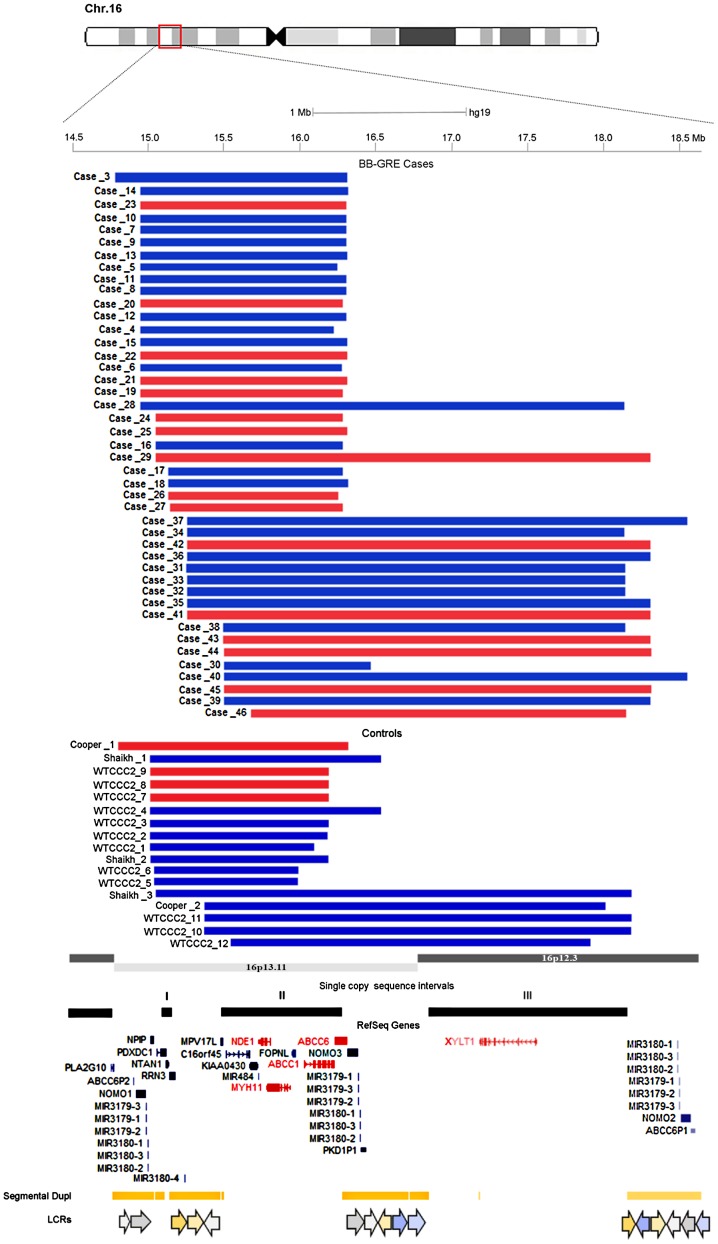
Copy number variants (CNVs) at chromosome 16p13.11 have been associated with a range of neurodevelopmental disorders including autism, ADHD, intellectual disability and schizophrenia. Significant sex differences in prevalence, course and severity have been described for a number of these conditions but the biological and environmental factors underlying such sex-specific features remain unclear. We tested the burden and the possible sex-biased effect of CNVs at 16p13.11 in a sample of 10,397 individuals with a range of neurodevelopmental conditions, clinically referred for array comparative genomic hybridisation (aCGH); cases were compared with 11,277 controls. In order to identify candidate phenotype-associated genes, we performed an interval-based analysis and investigated the presence of ohnologs at 16p13.11; finally, we searched the DECIPHER database for previously identified 16p13.11 copy number variants. In the clinical referral series, we identified 46 cases with CNVs of variable size at 16p13.11, including 28 duplications and 18 deletions. Patients were referred for various phenotypes, including developmental delay, autism, speech delay, learning difficulties, behavioural problems, epilepsy, microcephaly and physical dysmorphisms. CNVs at 16p13.11 were also present in 17 controls. Association analysis revealed an excess of CNVs in cases compared with controls (OR = 2.59; p = 0.0005), and a sex-biased effect, with a significant enrichment of CNVs only in the male subgroup of cases (OR = 5.62; p = 0.0002), but not in females (OR = 1.19, p = 0.673). The same pattern of results was also observed in the DECIPHER sample. Interval-based analysis showed a significant enrichment of case CNVs containing interval II (OR = 2.59; p = 0.0005), located in the 0.83 Mb genomic region between 15.49-16.32 Mb, and encompassing the four ohnologs NDE1, MYH11, ABCC1 and ABCC6. Our data confirm that duplications and deletions at 16p13.11 represent incompletely penetrant pathogenic mutations that predispose to a range of neurodevelopmental disorders, and suggest a sex-limited effect on the penetrance of the pathological phenotypes at the 16p13.11 locus.
Overview
The claims and statistics of this paper haven’t been checked yet.
Run the check — free, no account needed. It reads the open-access text and checks the sources it cites.
Integrity signals
Registry
Cites
Statistics
Figures
Verification
Claims the paper makes
The claims and statistics of this paper haven’t been checked yet.
Run the check — free, no account needed. It reads the open-access text and checks the sources it cites.
Claims other papers make about this one
Each is checked against this paper’s own text: does it say what the citing paper says it does?
In the citing paper
“This same phenomenon has recently been shown for SHANK157 and the 16p13.11 CNV.58”
From Convergence of genes and cellular pathways dysregulated in autism spectrum disorders (2014) · cites this paper as [58]
Self-check
Percentages, sums and reported differences re-computed from the paper’s own numbers.
The self-check needs the paper’s full text.
Citations
Cites
Detection of large-scale variation in the human genome
Iafrate, A. J., Feuk, L., Rivera, M. N., Listewnik, M. L., Donahoe, P. K., Qi, Y., Scherer, S. W., & Lee, C. (2004) · Nature Genetics · doi:10.1038/ng1416 · Cited by 2,892
Strong association of de novo copy number mutations with autism
Sebat, J., Lakshmi, B., Malhotra, D., Troge, J., Lese-Martin, C., Walsh, T., Yamrom, B., Yoon, S., Krasnitz, A., Kendall, J., et al. (2007) · Science · doi:10.1126/science.1138659 · Cited by 2,795
Large-scale copy number polymorphism in the human genome
Sebat, J., Lakshmi, B., Troge, J., Alexander, J., Young, J., Lundin, P., Månér, S., Massa, H., Walker, M., Chi, M., et al. (2004) · Science · doi:10.1126/science.1098918 · Cited by 2,557
Schizophrenia: A Concise Overview of Incidence, Prevalence, and Mortality
McGrath, J., Saha, S., Chant, D., & Welham, J. (2008) · Epidemiologic Reviews · doi:10.1093/epirev/mxn001 · Cited by 2,280
Structural variation in the human genome
Feuk, L., Carson, A. R., & Scherer, S. W. (2006) · Nature Reviews Genetics · doi:10.1038/nrg1767 · Cited by 2,111
DECIPHER: Database of Chromosomal Imbalance and Phenotype in Humans Using Ensembl Resources
Firth, H. V., Richards, S. M., Bevan, A. P., Clayton, S., Corpas, M., Rajan, D., Vooren, S. V., Moreau, Y., Pettett, R. M., & Carter, N. P. (2009) · The American Journal of Human Genetics · doi:10.1016/j.ajhg.2009.03.010 · Cited by 1,990
Large recurrent microdeletions associated with schizophrenia.
GROUP, Stefansson, H., Rujescu, D., Cichon, S., Pietiläinen, O. P. H., Ingason, A., Steinberg, S., Fossdal, R., Sigurdsson, E., Sigmundsson, T., et al. (2008) · Nature · doi:10.1038/nature07229 · Cited by 1,745
Self-citationRare chromosomal deletions and duplications increase risk of schizophrenia
The International Schizophrenia Consortium (2008) · Nature · doi:10.1038/nature07239 · Cited by 1,475
A copy number variation morbidity map of developmental delay
Cooper, G. M., Coe, B. P., Girirajan, S., Rosenfeld, J. A., Vu, T. H., Baker, C., Williams, C., Stalker, H., Hamid, R., Hannig, V., et al. (2011) · Nature Genetics · doi:10.1038/ng.909 · Cited by 1,351
Sanders, S. J., Ercan-Sencicek, A. G., Hus, V., Luo, R., Murtha, M. T., Moreno-De-Luca, D., Chu, S. H., Moreau, M. P., Gupta, A. R., Thomson, S. A., et al. (2011) · Neuron · doi:10.1016/j.neuron.2011.05.002 · Cited by 1,263
Cited by
Sorted by citations
Sex/Gender Differences and Autism: Setting the Scene for Future Research
Lai, M.-C., Lombardo, M. V., Auyeung, B., Chakrabarti, B., & Baron-Cohen, S. (2015) · Journal of the American Academy of Child & Adolescent Psychiatry · doi:10.1016/j.jaac.2014.10.003 · Cited by 1,120
Convergence of genes and cellular pathways dysregulated in autism spectrum disorders
Pinto, D., Delaby, E., Merico, D., Barbosa, M., Merikangas, A., Klei, L., Thiruvahindrapuram, B., Xu, X., Ziman, R., Wang, Z., et al. (2014) · The American Journal of Human Genetics · doi:10.1016/j.ajhg.2014.03.018 · Cited by 969
Cooper, D. N., Krawczak, M., Polychronakos, C., Tyler‐Smith, C., & Kehrer‐Sawatzki, H. (2013) · Human Genetics · doi:10.1007/s00439-013-1331-2 · Cited by 671
Sex differences in autism spectrum disorder: a review
Ferri, S. L., Abel, T., & Brodkin, E. S. (2018) · Current Psychiatry Reports · doi:10.1007/s11920-018-0874-2 · Cited by 392
An update on the comorbidity of ADHD and ASD: a focus on clinical management
Antshel, K. M., Zhang‐James, Y., Wagner, K. E., Ledesma, A., & Faraone, S. V. (2016) · Expert Review of Neurotherapeutics · doi:10.1586/14737175.2016.1146591 · Cited by 276
Metadata
- Authors
- Tropeano, M., Ahn, J. W., Dobson, R. J. B., Breen, G., Rucker, J., Dixit, A., Pal, D. K., McGuffin, P., Farmer, A., White, P. S., Andrieux, J., Vassos, E., Ogilvie, C. M., Curran, S., & Collier, D. A.
- Affiliations
- King's College London (GB)
- Guy's Hospital (GB)
- Children's Hospital of Philadelphia (US)
- Centre Hospitalier Universitaire de Lille (FR)
- Corresponding author
- Tropeano, Maria
- Collier, David A
- ORCID
- Venue
- PLoS ONE
- Publisher
- Public Library of Science (PLoS)
- Published
- 2013-04-18
- Volume
- 8
- Issue
- 4
- Pages
- e61365
- ISSN
- 1932-6203 (ISSN-L)
- PMC
- PMC3630198
- OpenAlex
- W2054217796
- Cited by
- 154
- References
- 78
- Citations by year
- 2026: 1 · 2025: 13 · 2024: 8 · 2023: 3 · 2022: 11 · 2021: 6 · 2020: 9 · 2019: 9 · 2018: 41 · 2017: 4 · 2016: 12 · 2015: 15 · 2014: 16 · 2013: 6
- FWCI
- 10.83
- Type
- journal article
- Language
- en
- Open access
- gold
- doi.org
- Locations
- PLoS ONE (publishedVersion, cc-by)
- Europe PMC (PubMed Central) (publishedVersion, other-oa)
- PubMed Central (publishedVersion, cc-by)
- PubMed (publishedVersion)
- Research Portal (King's College London) (publishedVersion, other-oa)
- DOAJ (DOAJ: Directory of Open Access Journals) (submittedVersion, cc-by-sa)
- UCL Discovery (University College London) (submittedVersion)
- Figshare (submittedVersion, cc-by)
- Hirsla (Landspítali University Hospital) (submittedVersion, other-oa)
- Funders
- Wellcome Trust (WTCCC2)
- National Institute for Health and Care Research
- European Commission (223423)
- Topics
- Life Sciences › Biochemistry, Genetics and Molecular Biology › Genetics › Genomic variations and chromosomal abnormalities
- Life Sciences › Biochemistry, Genetics and Molecular Biology › Genetics › Genetics and Neurodevelopmental Disorders
- Life Sciences › Biochemistry, Genetics and Molecular Biology › Genetics › Genome Rearrangement Algorithms
- Keywords
- copy number variation, neurodevelopmental disorders, sex differences, male bias, ohnologs, NDE1, MYH11, MRP1, ABCC6, autism spectrum disorder, intellectual disability, schizophrenia, attention deficit hyperactivity disorder, developmental delay, epilepsy, microcephaly, penetrance, DECIPHER, array comparative genomic hybridization
- MeSH terms
- Child, Developmental Disabilities, Chromosome Deletion, Chromosomes, Human, Pair 16, Female, Humans, Male, Phenotype, Cohort Studies, Comparative Genomic Hybridization, DNA Copy Number Variations, Chromosome Duplication
About these checks
Registry, retraction, Cites and statistics results are computed, not judged, with one exception: a printed reference that no index lists is read once by a model before it counts as a citation error. Claims are extracted by a model and kept only when their quote appears verbatim in the text; each cited source is then checked, with a model’s help, for whether it says what the claim relies on. Those verdicts can be wrong — read the claim’s quote and the cited source before relying on one.
Statistics and arithmetic are recomputed, not judged.
Confidence bands are shown only for fields calibrated on our annotated test set. None is calibrated yet, so no band is shown.
What counts as a claim ›How we measure confidence ›How we check this ›
Are you an author, or do you see a problem with this page? Request a review
