

Community Health Workers and Mobile Technology: A Systematic Review of the Literature
Open accessThe DOI matches its Crossref record; 25 of the 25 references it cites were found in a registry or an index.
Abstract
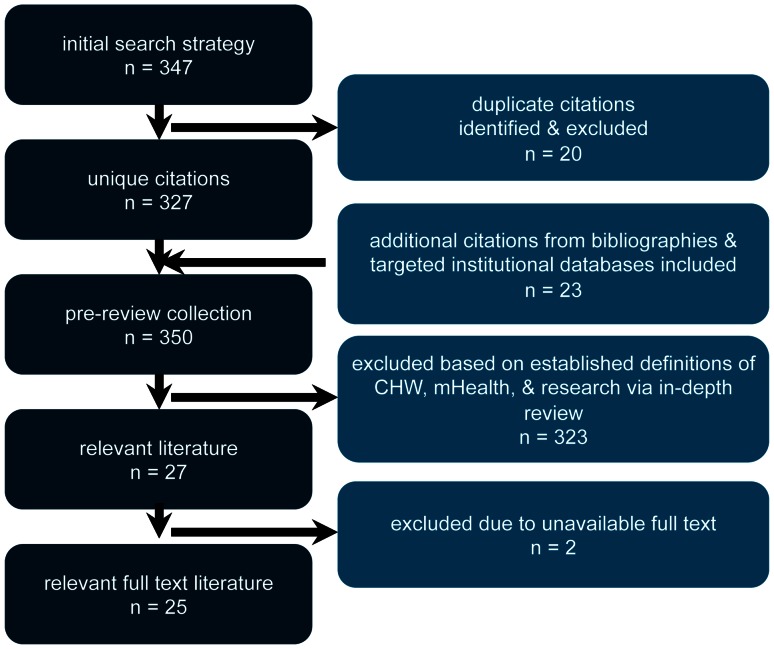
INTRODUCTION: In low-resource settings, community health workers are frontline providers who shoulder the health service delivery burden. Increasingly, mobile technologies are developed, tested, and deployed with community health workers to facilitate tasks and improve outcomes. We reviewed the evidence for the use of mobile technology by community health workers to identify opportunities and challenges for strengthening health systems in resource-constrained settings. METHODS: We conducted a systematic review of peer-reviewed literature from health, medical, social science, and engineering databases, using PRISMA guidelines. We identified a total of 25 unique full-text research articles on community health workers and their use of mobile technology for the delivery of health services. RESULTS: Community health workers have used mobile tools to advance a broad range of health aims throughout the globe, particularly maternal and child health, HIV/AIDS, and sexual and reproductive health. Most commonly, community health workers use mobile technology to collect field-based health data, receive alerts and reminders, facilitate health education sessions, and conduct person-to-person communication. Programmatic efforts to strengthen health service delivery focus on improving adherence to standards and guidelines, community education and training, and programmatic leadership and management practices. Those studies that evaluated program outcomes provided some evidence that mobile tools help community health workers to improve the quality of care provided, efficiency of services, and capacity for program monitoring. DISCUSSION: Evidence suggests mobile technology presents promising opportunities to improve the range and quality of services provided by community health workers. Small-scale efforts, pilot projects, and preliminary descriptive studies are increasing, and there is a trend toward using feasible and acceptable interventions that lead to positive program outcomes through operational improvements and rigorous study designs. Programmatic and scientific gaps will need to be addressed by global leaders as they advance the use and assessment of mobile technology tools for community health workers.
Overview
The claims and statistics of this paper haven’t been checked yet.
Free: it reads the open-access text and checks the first 5 claims that cite a source we can check. Create a free account to check every claim.
Integrity signals
Registry
Cites
Statistics
Figures
Verification
Claims the paper makes
The claims and statistics of this paper haven’t been checked yet.
Free: it reads the open-access text and checks the first 5 claims that cite a source we can check. Create a free account to check every claim.
Claims other papers make about this one
Each is checked against this paper’s own text: does it say what the citing paper says it does?
The source backs part of the claim, not all of it — or backs it for a different population, condition or comparison.
In the citing paper
“However, few studies have captured end-user experiences with a mobile-based app [18,19].”
From Operability, Usefulness, and Task-Technology Fit of an mHealth App for Delivering Primary Health Care Services by Community Health Workers in Underserved Areas of Pakistan and Afghanistan: Qualitative Study (2020) · cites this paper as [18]
Experimental — accuracy not yet measuredThe source backs part of the claim, not all of it — or backs it for a different population, condition or comparison.
In the citing paper
“In LMICs, the mobile technology has been used by CHWs to address a range of health issues related to maternal and child health, sexual and reproductive health, family planning, HIV/AIDS, general health, acute respiratory infections, infectious diseases and injury and trauma [22].”
From Using mobile phones to improve community health workers performance in low-and-middle-income countries (2020) · cites this paper as [22]
Experimental — accuracy not yet measured
Self-check
Percentages, sums and reported differences re-computed from the paper’s own numbers.
The self-check needs the paper’s full text.
Citations
Cites
Preferred Reporting Items for Systematic Reviews and Meta-Analyses: the PRISMA statement
Moher, D., Liberati, A., Tetzlaff, J., Altman, D. G., & for the PRISMA Group (2009) · BMJ · doi:10.1136/bmj.b2535 · Cited by 83,823
Preferred Reporting Items for Systematic Reviews and Meta-Analyses: The PRISMA Statement
Moher, D., Liberati, A., Tetzlaff, J., Altman, D. G., & The PRISMA Group (2009) · PLoS Medicine · doi:10.1371/journal.pmed.1000097 · Cited by 64,042
Preferred reporting items for systematic reviews and meta-analyses: The PRISMA statement
Moher, D., Liberati, A., Tetzlaff, J., Altman, D. G., & the PRISMA Group* (2009) · Annals of Internal Medicine · doi:10.7326/0003-4819-151-4-200908180-00135 · Cited by 37,554
Prentice, T. (2013) · Res Medica · doi:10.2218/resmedica.v21i1.510 · Cited by 1,707
Human resources for health: overcoming the crisis
Chen, L., Evans, T., Anand, S., Boufford, J. I., Brown, H., Chowdhury, M., Cueto, M., Dare, L., Dussault, G., Elzinga, G., et al. (2004) · The Lancet · doi:10.1016/s0140-6736(04)17482-5 · Cited by 1,552 · cited 2×
“Proponents argue engaging CHWs expands the pool of human resources for health, improves the productivity of health systems, and lowers the cost of providing services by shifting tasks from highly trained physicians and nurses to less specialized community members [2,3,5].”
BackgroundConway, M. E. (1967) · Cited by 812
How to bridge the gap in human resources for health
Hongoro, C., & McPake, B. (2004) · The Lancet · doi:10.1016/s0140-6736(04)17229-2 · Cited by 440 · cited 2×
“Proponents argue engaging CHWs expands the pool of human resources for health, improves the productivity of health systems, and lowers the cost of providing services by shifting tasks from highly trained physicians and nurses to less specialized community members [2,3,5].”
BackgroundZurovac, D., Sudoi, R. K., Akhwale, W. S., Ndiritu, M., Hamer, D. H., Rowe, A. K., & Snow, R. W. (2011) · The Lancet · doi:10.1016/s0140-6736(11)60783-6 · Cited by 403 · cited 1×
“These include a description of a clusterrandomized controlled trial with CHWs to evaluate effects of a health data collection and decision support system on health outcomes of mothers living with HIV [14], a cluster randomized controlled trial to evaluate effects of alerts and reminders on CHWs adherence to malaria tr…”
The use of mobile phones as a data collection tool: A report from a household survey in South Africa
Tomlinson, M., Solomon, W., Singh, Y., Doherty, T., Chopra, M., Ijumba, P., Tsai, A. C., & Jackson, D. (2009) · BMC Medical Informatics and Decision Making · doi:10.1186/1472-6947-9-51 · Cited by 340 · cited 2×
“Further, these mobile tools can enable real-time quality review and analysis for decision-making [11], as well as rapid response to cited health issues [20].”
BackgroundResultResponding to the global human resources crisis
Narasimhan, V., Brown, H., Pablos-Mendez, A., Adams, O., Dussault, G., Elzinga, G., Nordstrom, A., Habte, D., Jacobs, M., Solimano, G., et al. (2004) · The Lancet · doi:10.1016/s0140-6736(04)16108-4 · Cited by 284 · cited 1×
“Nearly all countries are challenged by shortages of health workers [1].”
Cited by
Items 201–300 of 525
Comulada, W. S., Tang, W., Swendeman, D. T., Cooper, A., Wacksman, J., & Adolescent Medicine Trials Network (ATN) CARES Team (2018) · JMIR Research Protocols · doi:10.2196/10777 · Cited by 17
“Most mobile EDC systems utilized in the past did not have multiple functions [21].”
BackgroundSmaghi, B., Collins, J., Dagina, R., Hiawalyer, G., Vaccher, S. J., Flint, J. A., & Housen, T. (2021) · International Journal of Infectious Diseases · doi:10.1016/j.ijid.2021.04.077 · Cited by 19
Referral Patterns of Outpatient Palliative Care among the Head and Neck Cancer Population
Saravia, A., Kong, K. A., Roy, R., Barry, R., Guidry, C., McDaniel, L. S., Raven, M. C., Pou, A. M., & Mays, A. C. (2022) · International Archives of Otorhinolaryngology · doi:10.1055/s-0041-1741436 · Cited by 20
“58,62,63 Patient-navigator programs for cancer patients have demonstrated their ability to immensely reduce health care costs and lead to better outcomes.”
BackgroundRosenberg, N. E., Tembo, T. A., Simon, K., Mollan, K. R., Rutstein, S. E., Mwapasa, V., MASIANO, S. P., Huffstetler, H. E., Go, V. F.-L., & Kim, M. H. (2022) · JMIR Formative Research · doi:10.2196/32899 · Cited by 16
Galindo, M. S., Lambert, Y., Mutricy, L., Garancher, L., Miller, J. B., Gomes, J. H., Sanna, A., Peterka, C., Cairo, H., Hiwat, H., et al. (2022) · BMC Public Health · doi:10.1186/s12889-022-12801-0 · Cited by 17
“In low and middle income countries, they are increasingly seen as an opportunity to better train and improve worker performance remotely [51, 52].”
BackgroundThe state of community health information systems in West and Central Africa
Russpatrick, S., Sæbø, J. I., Romedenne, M., & Dubent, L. (2019) · Journal of Global Health Reports · doi:10.29392/joghr.3.e2019047 · Cited by 16
“It has been cited that more than 95% of the global population have access to mobile phones, therefor, mHealth specifically is increasingly utilized to support CHW data collection, decision support, alerts and reminders, and information access (5).”
BackgroundViljoen, A., Klinker, K., Wiesche, M., Uebernickel, F., & Krcmar, H. (2021) · IEEE Transactions on Engineering Management · doi:10.1109/tem.2021.3072601 · Cited by 18
“Second, most mHealth applications for CHWs, including the ones in Kenya, do not target NCDs [18], [19] or related measurements pertaining to NCDs to better keep track of patients’ health.”
BackgroundGouse, H., Robbins, R. N., Mellins, C. A., Kingon, A., Rowe, J., Henry, M., Remien, R. H., Pearson, A., Victor, F., & Joska, J. A. (2018) · AIDS and Behavior · doi:10.1007/s10461-018-2145-y · Cited by 15
“Research shows that lay health workers in Sub-Saharan Africa largely have had positive experiences with mHealth application use and that they feel more supported and supervised when using these applications [15].”
InfluentialAldosery, A., Musah, A., Birjovanu, G., Moreno, G. M. M., Boscor, A., Dutra, L. M. M., Santos, G., Nunes, V., Oliveira, R., Ambrizzi, T., et al. (2021) · Frontiers in Public Health · doi:10.3389/fpubh.2021.754072 · Cited by 15
“Using mobile technology is therefore considered an effective way to support health agents in collecting and reporting data in real time (4).”
BackgroundRethinking how development assistance for health can catalyse progress on primary health care
Kasper, T., Yamey, G., Dwyer, S., McDade, K. K., Lidén, J., Lüdemann, C., Diab, M. M., Ogbuoji, O., Poodla, P., Schrade, C., et al. (2023) · The Lancet · doi:10.1016/s0140-6736(23)01813-5 · Cited by 18
“46 However, expanding the CHW service package will require increasing the number of CHWs to established density standards.”
BackgroundPrioritizing Competencies for “Research” Promotores and Community Health Workers
Nebeker, C., Giacinto, R. E., Pacheco, B. A., López-Arenas, A., & KALICHMAN, M. W. (2020) · Health Promotion Practice · doi:10.1177/1524839920913548 · Cited by 15
“, 2010), CHWs are increasingly contributing to the design, implementation, and dissemination of biomedical and behavioral health research (Braun et al., 2013; Hohl et al., 2016; O’Brien et al., 2009).”
BackgroundKalyesubula, R., Pardo, J. M., Yeh, S., Munana, R., Weswa, I., Adducci, J. E., Nassali, F., Tefferi, M., Mundaka, J., & Burrowes, S. (2021) · BMC Public Health · doi:10.1186/s12889-021-10695-y · Cited by 19
“Such applications have been widely used in FP, HIV, and maternal and child health programs [78].”
Methodvan Pelt, S., Massar, K., Shields‐Zeeman, L., de Wit, J. B. F., van der Eem, L., Lughata, A. S., & Ruiter, R. A. C. (2021) · Frontiers in Public Health · doi:10.3389/fpubh.2021.645521 · Cited by 15
“To our knowledge, this knowledge gap persists and available evidence focuses on the outcomes of digital health interventions and much less on process optimization in the development or implementation phase (32, 33), which is critical to a digital tool having an impact on health outcomes.”
BackgroundLambert, Y., Galindo, M. S., Suárez-Mútis, M. C., Mutricy, L., Sanna, A., Garancher, L., Cairo, H., Hiwat, H., Miller, J. B., Gomes, J. H., et al. (2022) · JMIR Formative Research · doi:10.2196/29856 · Cited by 15
“Our experience is another contribution to the evidence reported in the literature, in that health mediators can successfully collect complex data using MDC tools when provided with adequate training and supervision [51].”
Fitriani, S., Zahra, A. S., & Rahmat, A. (2022) · Jurnal PROMKES · doi:10.20473/jpk.v10.i1.2022.24-29 · Cited by 15
Ward, V. C., Abdalla, S. I. A., Raheel, H., Weng, Y., Godfrey, A., Dutt, P., Mitra, R., Sastry, P., Chamberlain, S., Shannon, M., et al. (2021) · BMJ Global Health · doi:10.1136/bmjgh-2021-005538 · Cited by 17
Jahir, T., WINCH, P. J., Leontsini, E., Hwang, S. T., Yeasmin, F., Hossain, K., Das, J. B., Amin, R., Huda, T. M. N., Sultana, J., et al. (2021) · International Journal of Environmental Research and Public Health · doi:10.3390/ijerph18157891 · Cited by 14
“Similarly, a systematic review found that tablet computers and other mobile technologies improved the range and quality of services provided by CHWs and can contribute to positive program outcomes [28].”
BackgroundDECENT: A sociotechnical approach for developing mobile health apps in underserved settings
Ikwunne, T. A., Hederman, L., & Wall, P. J. (2023) · Digital Health · doi:10.1177/20552076231203595 · Cited by 15
Hailemariam, T., Atnafu, A., Gezie, L. D., Kaasbøll, J., Klein, J., & Tilahun, B. C. (2024) · JMIR Human Factors · doi:10.2196/47081 · Cited by 15
“Community health digitization using mobile apps support the services delivered by CHWs [77].”
BackgroundSaha, S., & Zahiruddin, Q. S. (2022) · Frontiers in Public Health · doi:10.3389/fpubh.2022.856561 · Cited by 18
Schneider, L., Ollila, S., & Mutanen, M. L. (2022) · Maternal and Child Nutrition · doi:10.1111/mcn.13322 · Cited by 15
“Consequently, increases in the usage of mobile phones among CHWs (Agarwal et al., 2015, Braun et al., 2013, Feroz et al., 2020, Källander et al., 2013) and videos in IYCF education (Coetzee et al., 2018; Desta et al., 2014; Dougherty et al., 2016; Mutanda et al., 2016; Schneider et al., 2021) have…”
BackgroundMwendwa, P. (2017) · Development Policy Review · doi:10.1111/dpr.12275 · Cited by 15
Johansson, P. L., Rowland, S. A., Schulz, P., Struwe, L. A., Hebert, L. E., Brueggemann, G., & Zimmerman, L. M. (2022) · The Journal of Cardiovascular Nursing · doi:10.1097/jcn.0000000000000928 · Cited by 17
Manfaat Penggunaan Mobile Health (m-Health) Dalam Pencatatan dan Pelaporan Kesehatan Ibu
Permatasari, A. D., Trihandini, I., BaharuddinNur, R., & Kurniawan, R. (2021) · Jurnal Biostatistik Kependudukan dan Informatika Kesehatan · doi:10.51181/bikfokes.v1i2.4810 · Cited by 13
Tembo, T. A., Simon, K. R., Kim, M. H., Chikoti, C., Huffstetler, H. E., Ahmed, S., Mang'anda, C., Chu, S. Q., Manyeki, R., Kavuta, E., et al. (2021) · JAIDS Journal of Acquired Immune Deficiency Syndromes · doi:10.1097/qai.0000000000002796 · Cited by 13
Straw, C., Antelo, V. S., Kohler, R. E., Paolino, M., Viswanath, K., & Arrossi, S. (2023) · BMC Health Services Research · doi:10.1186/s12913-023-09022-5 · Cited by 17
Mobile phone coverage and infant mortality in sub-Saharan Africa
Flückiger, M., & Ludwig, M. (2023) · Journal of Economic Behavior & Organization · doi:10.1016/j.jebo.2023.05.013 · Cited by 17
Wong, L.-Y., Espinoza, F., Mojica, K., Molter, D., & Saunders, J. E. (2017) · Otolaryngology · doi:10.1177/0194599817696306 · Cited by 13
Desai, S., Mahal, A. S., Sinha, T., Schellenberg, J., & Cousens, S. (2017) · Journal of Global Health · doi:10.7189/jogh.07.020404 · Cited by 14
Feroz, A. S., Valliani, K., Khwaja, H., & Karim, S. (2021) · BMJ Open · doi:10.1136/bmjopen-2021-053871 · Cited by 15
Elson, W. H. D., Kawiecki, A. B., Donnelly, M. A. P., Noriega, A. O., Simpson, J. K., Syafruddin, D., Rozi, I. E., Lobo, N. F., Barker, C. M., Scott, T. W., et al. (2022) · BMC Public Health · doi:10.1186/s12889-022-14301-7 · Cited by 13
Downs, S., Gueye, D., Sall, M., Ndoye, B., Sarr, N. N., Sarr, M., Mboup, S., Alam, N. A., Diouf, A., Merchant, E. V., et al. (2023) · Frontiers in Public Health · doi:10.3389/fpubh.2023.1258963 · Cited by 12
“However, pilot studies or interventions carried out provided little or no information on the effectiveness or impact of the use of mobile technologies (60).”
BackgroundTicha, J. M., Akpan, G. U., Paige, L. M., Senouci, K., Stein, A., Briand, P., Tuma, J. N., Oyaole, D. R., Ngofa, R. O., Maleghemi, S., et al. (2020) · JMIR Public Health and Surveillance · doi:10.2196/18950 · Cited by 14
“This is partly due to the removal of reporting barriers and the monitoring and peer review role of technology for improving data quality and reporting [15,16].”
BackgroundWillems, A., Iyamuremye, J. D., Misago, C. N., Smith‐Swintosky, V. L., & Kayiteshonga, Y. (2021) · Frontiers in Public Health · doi:10.3389/fpubh.2021.632793 · Cited by 14
“Our findings are consistent with other research that has shown thatmobile technology interventions to improve the range and quality of services provided by CHWs can be feasible and acceptable (15).”
ResultMiyashita, A., Nakamura, K., Ohnishi, M., Bintabara, D., Shayo, F. K., Maro, I. I., Sato, H., Seino, K., & Kibusi, S. M. (2022) · JMIR mhealth and uhealth · doi:10.2196/29407 · Cited by 14
Soremekun, S., Källander, K., Lingam, R., Branco, A.-C. C., Batura, N., Strachan, D. L., Muiambo, A., Salomao, N., Condoane, J., Benhane, F., et al. (2023) · PLOS Digital Health · doi:10.1371/journal.pdig.0000235 · Cited by 12
“Digital technologies, and specifically mHealth (the use of mobile technologies in medical and public health practice [11]) is an area of growing interest for the delivery of health services in sub-Saharan Africa [12,13] particularly given the rapid expansion of mobile phone networks and usage in this setting [14].”
BackgroundInfluentialIs the Phone Mightier than the Virus? Cell Phone Access and Epidemic Containment Efforts
Gonzalez, R. M., & Maffioli, E. M. (2020) · Journal of Development Economics · doi:10.1016/j.jdeveco.2023.103228 · Cited by 14
Davis, E. C., Arana, E. T., Creel, J. S., Ibarra, S. C., Lechuga, J., Norman, R. A., Parks, H. R., Qasim, A., Watkins, D. Y., & Kash, B. A. (2018) · European journal of training and development · doi:10.1108/ejtd-06-2016-0042 · Cited by 15
“An important aspect of the CHWs role in the community is the use of mobile health, or mHealth (Kallander et al., 2013; Braun et al., 2013).”
BackgroundMobile phones and patient referral in Thai rural healthcare: a structuration view
Ling, R., Poorisat, T., & Chib, A. I. (2018) · Information Communication & Society · doi:10.1080/1369118x.2018.1503698 · Cited by 13
“This view is supported in the 63 mHealth studies reviewed by Chib, van Velthoven, and Car (2015) as well as the analysis of 25 studies by Braun et al. (2013), which revealed that the preponderance of studies described small pilot projects without addressing the broader socio-structural dimensions…”
ResultFerla, J. P., Gill, M. M., Komba, T., Abubakar, A. A., Remes, P., Jahanpour, O. F., Mariki, M., Mang’enya, M. A., van de Ven, R., & Antelman, G. (2023) · PLOS Global Public Health · doi:10.1371/journal.pgph.0001152 · Cited by 13
“…can make to improved health outcomes, especially in low-and middle-income countries [1,2], such as reducing maternal mortality, reducing postnatal depression, and improving child growth [4] or mitigating effects of malaria, and promoting community-integrated management of childhood illnesses [5].”
BackgroundRabbani, F., Nafis, J., Akhtar, S., Khan, M. S., Sayani, S., Siddiqui, A., Siddiqi, S., & Merali, Z. (2024) · JMIR Research Protocols · doi:10.2196/54272 · Cited by 15
“These innovations use the ubiquity of mobile phones to enhance the functionality of health systems [19].”
BackgroundSujarwoto, S., Yumarni, T., Saputri, R. A. M., Holipah, H., & Maharani, A. (2025) · Digital Health · doi:10.1177/20552076251390314 · Cited by 11
A Conceptual Framework to Establish and Operate a Global Logistics Energy Hub
Hammad, M. A., Elgazzar, S. H., & Sternad, M. (2021) · Sustainability · doi:10.3390/su131910976 · Cited by 11
“The search strategy also included English language research papers published in journals only and within all available time span [34,35].”
BackgroundTshikomana, R. S., & Ramukumba, M. M. (2022) · PLoS ONE · doi:10.1371/journal.pone.0262842 · Cited by 13
“range and quality of services provided by CHWs [29].”
BackgroundDigital Health–Enabled Clinical Trials in Stroke: Ready for Prime Time?
Berwanger, O. B., & Machline-Carrion, M. J. (2022) · Stroke · doi:10.1161/strokeaha.122.037378 · Cited by 11
“In this sense, there is a growing body of evidence for the use of digital health tools not only to improve effectiveness of CHWs especially in such circumstances 38 but also as valuable contributors in health services research and likely clinical trials.”
BackgroundAdvocacy for patients with headache disorders
Gouider, R., Lorenz, D. H., Craven, A., Grisold, W., & Dodick, D. W. (2023) · eNeurologicalSci · doi:10.1016/j.ensci.2023.100466 · Cited by 11
Ali, S. A., & Ali, S. A. (2014) · El Mednifico Journal · doi:10.18035/emj.v2i3.242 · Cited by 11
“This can be achieved by investing in programs aimed at providing contraceptive services at the door step of women [51].”
BackgroundLichtveld, M. Y., Shankar, A., Mundorf, C., Hassan, A., & Drury, S. S. (2016) · Journal of Community Health · doi:10.1007/s10900-016-0198-2 · Cited by 12
“Community health workers (CHWs) often act as frontline health navigators in these programs by providing additional services to pregnant and postpartum women [1, 19, 29].”
Osei, E., Kuupiel, D., & Mashamba-Thompson, T. P. (2020) · BMJ Open · doi:10.1136/bmjopen-2019-036641 · Cited by 12
Naidoo, N., Matlakala, N., Railton, J. P., Khosa, S. P., Marincowitz, G. J. O., Igumbor, J. O., McIntyre, J. A., Struthers, H. E., & Peters, R. P. H. (2019) · Tropical Medicine & International Health · doi:10.1111/tmi.13204 · Cited by 12
“The use of mobile technology should be considered to strengthen the CBHP as studies show its potential value in collecting health data, facilitating health education and conducting person-to-person communication, thus resulting in improved quality of care and services and programme monitoring [34, 35].”
BackgroundA Community-driven Research Framework: Integrating Promotores as Co-Researchers
Manzo, R. D., Yepez, M., Preciado, B., & Merin, L. S. (2023) · Progress in community health partnerships · doi:10.1353/cpr.2023.a914125 · Cited by 13
Thio, S., Tesema, A. G., Patel, B. N., Vakaloloma, U., Wilson, C., & Joshi, R. (2024) · BMC Family Practice · doi:10.1186/s12875-024-02480-8 · Cited by 10
“This is further evidenced by Braun et al.’s (2013) systematic review and Li et al.’s (2023) study showing that mobile technology and social media can help improvement of CHW services through virtual communications [25, 26].”
BackgroundWill an App Fill the Gap? Innovative Technology to Provide Point-of-Care Information
Codyre, P. (2014) · Frontiers in Public Health · doi:10.3389/fpubh.2014.00009 · Cited by 10
Meagley, K. L., Schriver, B., Geary, R. S., Fielding-Miller, R. K., Stein, A. D., Dunkle, K., & Norris, S. A. (2016) · Global Health Action · doi:10.3402/gha.v9.31138 · Cited by 13
Webber, G. C., Chirangi, B., & Magatti, N. (2020) · Women s Health · doi:10.1177/1745506520969617 · Cited by 12
Interventions Using Technologies for Older Adults in Long-term Care Facilities: A Systematic Review
Kim, D. E., Kim, H., Hyun, J. H., Lee, H., Sung, H., Bae, S., Tak, S. H., Park, Y., & Yoon, J. Y. (2018) · Research in Community and Public Health Nursing · doi:10.12799/jkachn.2018.29.2.170 · Cited by 10
Ramathebane, M. M., Makatjane, T. J., Thetsane, R. M., & Mokhethi, M. C. (2019) · African Journal of Primary Health Care & Family Medicine · doi:10.4102/phcfm.v11i1.1944 · Cited by 10
Young, M. F., Bootwala, A., Kachwaha, S., Avula, R., Ghosh, S., Sharma, P. K., Shastri, V. D., Forissier, T., Menon, P., & Nguyen, P. H. (2021) · Current Developments in Nutrition · doi:10.1093/cdn/nzab081 · Cited by 10
“communication between workers, and program-monitoring data collection (28).”
BackgroundRamirez, M., Wu, S., Ryan, G., Towfighi, A., & Vickrey, B. G. (2017) · JMIR Research Protocols · doi:10.2196/resprot.7106 · Cited by 9
“A systematic review found that mobile technologies are most commonly used by CHWs to collect health data [18].”
Cossio, A., Bautista-Gómez, M. M., Alexander, N. D. E., del Castillo, A. M., Castro, M. D. M., Castaño-Grajales, P. Y., Gutiérrez-Poloche, Y. H., Zuluaga, L. S., Vargas-Bernal, L., Andres Navarro, C., et al. (2023) · American Journal of Tropical Medicine and Hygiene · doi:10.4269/ajtmh.22-0805 · Cited by 10
“The most common mobile apps are focused on ensuring community health workers’ compliance with standards for health services, emergency referrals, receiving alerts and reminders by community health workers and caregivers, collecting patient data through mobile phones, and community education and training.(10,62,63) Sev…”
BackgroundTembo, T. A., Mollan, K. R., Simon, K., Rutstein, S. E., Chitani, M., Saha, P. T., Munkhondya, T. E. M., Jean‐Baptiste, M., Meek, C. J., Mwapasa, V., et al. (2024) · BMJ Open · doi:10.1136/bmjopen-2023-077706 · Cited by 9
Thakur, A., Reshmi, B., Mithra, P., Sekaran, V. C., & Kumar, S. (2025) · Healthcare · doi:10.3390/healthcare13172223 · Cited by 20
Silwanah, A. S., Suriah, S., Jafar, N., Areni, I. S., & Yusuf, R. A. (2024) · Nutrition and Health · doi:10.1177/02601060241265550 · Cited by 9
“Mobile Health (mHealth) has emerged as a powerful tool to deliver healthcare services in low-and middle-income countries (LMICs) (Braun et al., 2013; Tamrat & Kachnowski, 2012).”
Chraish, M., Oyama, C., Aoki, Y., Andrew, D. M. D., Nishio, M., Shi, S., & Yakura, H. (2025) · PLOS Digital Health · doi:10.1371/journal.pdig.0001099 · Cited by 10
Adoption and Continued use of Mobile Technology: An Analysis of CommCare Data
Dayalu, R., Wacksman, J., Chen, M., Loudon, M., & Lesh, N. B. (2015) · Procedia Engineering · doi:10.1016/j.proeng.2015.06.079 · Cited by 9
A Mobile Application System for Community Health Workers-A Review
Emmanuel, G., Hungilo, G. G., & Emanuel, A. W. R. (2019) · International Conference on Computing and Artificial Intelligence (ICCAI) · doi:10.1145/3330482.3330485 · Cited by 12
Relyea, B., Wringe, A., Afaneh, O., Malamas, I., Teodoro, N. S., Ghafour, M. A., & Scott, J. A. (2021) · Frontiers in Global Women s Health · doi:10.3389/fgwh.2021.662256 · Cited by 10
“Other mHealth research among community health workers has suggested similar implications particularly with regards to creating better tools and workflow systems that enabled them to make fewer human errors, better decision making and rapid response (42).”
BackgroundAusaf, A., Yuan, H., & Nasir, S. A. (2023) · Kybernetes · doi:10.1108/k-12-2022-1684 · Cited by 9
Brazendale, K., Beets, M. W., Weaver, R. G., Turner-McGrievy, B. M., Brazendale, A. B., Chandler, J., Moore, J. B., Huberty, J., Lemley, J., & Brownson, R. C. (2018) · Global Health Promotion · doi:10.1177/1757975918768442 · Cited by 9
Zeleke, A. A., Naziyok, T. P., Fritz, F., & Röhrig, R. (2018) · JMIR Research Protocols · doi:10.2196/10678 · Cited by 9
“This embedding may compromise the self-standing effect the device for the data collection methods [9, 22, 23].”
BackgroundMethodA Review of eHealth Initiatives: Implications for Improving Health Service Delivery in Nepal
Ashish, K. C., Sunny, A. K., Poudel, R. P., & Basnet, O. (2019) · Journal of Nepal Health Research Council · doi:10.33314/jnhrc.v17i3.1787 · Cited by 9
Improving the Well-Being of Adolescent Girls in Developing Countries
Bergstrom, K., & Özler, B. (2021) · World Bank, Washington, DC eBooks · doi:10.1596/1813-9450-9827 · Cited by 15
Cunningham, M., Cunningham, P. M., van Greunen, D., Veldsman, A., Kanjo, C., Kweyu, E., & Tilahun, B. (2017) · 2017 IEEE Global Humanitarian Technology Conference (GHTC) · doi:10.1109/ghtc.2017.8239347 · Cited by 8
“[7]; [9], [10]), and palliative care services (e.”
BackgroundTemporal orientations in human agency: a case of homecare practitioners as mobile phone users
Saari, E., Koskela, I., & Känsälä, M. (2024) · Information Technology and People · doi:10.1108/itp-12-2023-1291 · Cited by 9
Mobile health evaluation: Taxonomy development and cluster analysis
Yang, A., & Varshney, U. (2022) · Healthcare Analytics · doi:10.1016/j.health.2022.100022 · Cited by 9
Rabbani, F., Nafis, J., Akhtar, S., Siddiqui, A. R., & Merali, Z. (2025) · BMC Public Health · doi:10.1186/s12889-025-23665-5 · Cited by 10
“These innovations utilize the ubiquity of cell phones to enhance the functionality of the health systems [46]. mHealth is cost-effective and offers extensive population-based outreach given its higher penetration and accessibility [41, 44, 47].”
Skinner, N. A., Job, N., Krause, J., Frankel, A., Ward, V. C., & Johnston, J. S. (2023) · JMIR Medical Education · doi:10.2196/42412 · Cited by 8
Geldsetzer, P., Flores, S., Flores, B. E. I., Rogers, A. B., & Chang, A. Y. (2023) · PLOS Digital Health · doi:10.1371/journal.pdig.0000156 · Cited by 9
Sinclair, L. B., Taft, K. E., Sloan, M. L., Stevens, A. C., & Krahn, G. L. (2014) · Maternal and Child Health Journal · doi:10.1007/s10995-014-1627-4 · Cited by 9
“However, (2) integrated or mobile checklists, and prompts and reminder systems for clinicians [26– 28], (3) consensus practice guidelines within health plans and their provider base to ensure coverage [29], and (4) surveillance to monitor CPS receipt, evaluate health system performance and health…”
Intergenerational Strategies for Sustaining Families and Family Life
Kaplan, M. S., Sánchez, M., & Hoffman, J. (2016) · Perspectives on sustainable growth · doi:10.1007/978-3-319-47019-1_4 · Cited by 8
Mwanza, M., Zulu, J., Topp, S. M., Musonda, P., Mutale, W., & Chilengi, R. (2017) · BMC Health Services Research · doi:10.1186/s12913-017-2229-9 · Cited by 9
“This approach is not unique to Zambia as many other low-middle income countries are also heavily dependent on CHWs to provide health services, especially in rural areas [6, 7].”
BackgroundArnaert, A., Ponzoni, N., Debe, Z., Meda, M. M., Nana, N. G., & Arnaert, S. (2019) · Journal of Nursing Education and Practice · doi:10.5430/jnep.v10n3p57 · Cited by 9
“[12, 13] Overall, CHWs perceived these applications to be easy to use and useful as they helped them to overcome field-related barriers such as the challenge of balancing multiple priorities, lacking appropriate tools to provide clinical services and collect data, and limited access to training and supervision.[14] In…”
BackgroundmHealth Innovation in Asia: Grassroots Challenges and Practical Interventions
Baulch, E., Watkins, J., & Tariq, A. (2017) · Mobile communication in Asia · doi:10.1007/978-94-024-1251-2 · Cited by 11
Thomas, D. S. K., Bull, S. S., Nyanza, E. C., Hampanda, K., Liedtke, M., & Ngallaba, S. E. (2019) · PLoS ONE · doi:10.1371/journal.pone.0212305 · Cited by 10
COVIDier: A Deep-learning Tool For Coronaviruses Genome And Virulence Proteins ClassificationPreprint
Habib, P. T., Alsamman, A. M., Saber-Ayad, M. M., Hassanein, S. E., & Hamwieh, A. (2020) · bioRxiv (Cold Spring Harbor Laboratory) · doi:10.1101/2020.05.03.075549 · Cited by 9
“In the health data collection, the use of smartphones (Ballivian et al. 2015; Braun et al. 2013; Bastawrous and Armstrong 2013; Paolotti et al. 2014) and web-based portals (Fabic et al., 2012) (Metsky et al. 2020) were efficiently examined.”
MethodNg, D., McMurray, J., Wallace, J., & Morita, P. (2019) · JMIR Formative Research · doi:10.2196/formative.9922 · Cited by 8
Johnston, J. S., Skinner, N. A., Tokar, A., Arabi, E., Ndiaye, N. Y., Strehlow, M. C., & Utunen, H. (2025) · Journal of Medical Internet Research · doi:10.2196/52591 · Cited by 49
Cadmus, E., Awosanya, E., Adesokan, H. K., Akinseye, V. O., Olaleye, F., Morenikeji, O. A., Fawole, E. O., Ansumana, R., Ayinmode, A. B., Oluwayelu, D. O., et al. (2024) · PLoS ONE · doi:10.1371/journal.pone.0300237 · Cited by 9
Pakarinen, A., Flemmich, M., Parisod, H., Selänne, L., Hamari, L., Aromaa, M. E., Leppänen, V., Löyttyniemi, E., Smed, J., & Salanterä, S. (2018) · Journal of Advanced Nursing · doi:10.1111/jan.13561 · Cited by 11
Visibility in community health work mediated by mobile health systems: A case of Malawi
Namatovu, E., & Kanjo, C. (2019) · The Electronic Journal of Information Systems in Developing Countries · doi:10.1002/isd2.12071 · Cited by 7
“Braun et al. (2013) argue that CHWs performance can be compromised by unsupportive organizational resources like stringent power control (our emphasis).”
BackgroundKachimanga, C., Divala, T. H., Ket, J. C. F., Kulinkina, A. V., Zaniku, H. R., Murkherjee, J., Palazuelos, D., Abejirinde, I. O., & van den Akker, T. (2023) · JMIR Research Protocols · doi:10.2196/44066 · Cited by 11
“Additional social factors also affect the use of mHealth including low literacy [22], insufficient training [23], cultural unacceptability [24,25], apps designed in languages other than the language of the users [24], and lack of integration into national health systems [10].”
BackgroundShannon, B., Batt, A. M., Eaton, G., Leyenaar, M. S., O'Meara, P. F., Barry, T., Lanos, C., Wingrove, G., Williams, B. A., Nolan, M. J., et al. (2023) · Paramedicine · doi:10.1177/27536386231188595 · Cited by 7
“49 Similarly, gathering data and evaluating the improvement in quality-adjusted life years for programmes can demonstrate not only individual-level outcomes but also contribute to a robust economic evaluation.”
BackgroundPerceptions of adult patients with cancer towards telemedicine: A qualitative meta-synthesis
Ren, L., Chen, M., Jiang, H., Wang, Y., Lin, X., & Dong, C. (2023) · Asia-Pacific Journal of Oncology Nursing · doi:10.1016/j.apjon.2023.100360 · Cited by 8
Opinião dos profissionais de saúde sobre os serviços de controle da tuberculose
Cecílio, H. P. M., Higarashi, I. H., & Marcon, S. S. (2015) · Acta Paulista de Enfermagem · doi:10.1590/1982-0194201500005 · Cited by 17
“Não obstante, o trabalho desempenhado por eles tem recebido reconhecimento em muitos países que convivem com altas taxas da doença, mesmo naqueles em que há escassez de profissionais, já que tornam os serviços de saúde acessíveis aos pacientes que comumente são alvos de estigma e discriminação.(14) Ademais, é importan…”
BackgroundInfluentialVillalba, C., Jaiprakash, A. T., Donovan, J. W., Roberts, J. M., & Crawford, R. (2018) · Patient · doi:10.1007/s40271-018-0315-7 · Cited by 8
Wang, G. H., Nesbit, C., & Rankin, S. H. (2020) · Progress in Palliative Care · doi:10.1080/09699260.2020.1760533 · Cited by 7
Digitalizing Community Health Work: A Struggle over the Values of Global Health Policy
Hanrieder, T., & Montt-Maray, E. (2021) · EconStor Open Access Articles and Book Chapters · doi:10.12759/hsr.46.2021.1.136-159 · Cited by 13
Sari, A. N., Susanti, A. I., & Rinawan, F. R. (2021) · Jurnal Bidan Cerdas · doi:10.33860/jbc.v3i2.390 · Cited by 7
Venkataraghavan, M., Rani, P., Ashok, L., Rao, C. R., Sekaran, V. C., & Krishnapriya, T. K. (2021) · Health Education · doi:10.1108/he-12-2020-0123 · Cited by 7
Gupta, A., Agrawal, R., Gupt, A., Guleri, R., Bajpayee, D., Joshi, N., Sarin, E., Gupta, S. K., & Kumar, H. (2021) · Journal of Family Medicine and Primary Care · doi:10.4103/jfmpc.jfmpc_466_21 · Cited by 14
“, 2011).[7,8] Complex geography, caste or creed, education, economic status, intellectual capabilities, and unprecedented situations like the Coronavirus Disease 2019 (COVID‐19) pandemic does not limit its reach (Varadraj et al.”
Background
Metadata
- Authors
- Braun, R., Catalani, C., Wimbush, J., & Israelski, D.
- Affiliations
- University of California, Berkeley (US)
- Stanford University (US)
- Corresponding author
- Braun, Rebecca
- Venue
- PLoS ONE
- Publisher
- Public Library of Science (PLoS)
- Published
- 2013-06-12
- Volume
- 8
- Issue
- 6
- Pages
- e65772
- ISSN
- 1932-6203 (ISSN-L)
- PMC
- PMC3680423
- OpenAlex
- W2025634432
- Semantic Scholar
- 8a9a74f6e8dbd5631be3df9bc5183849ea5e4177
- Cited by
- 493
- References
- 25
- Citations by year
- 2026: 22 · 2025: 25 · 2024: 36 · 2023: 39 · 2022: 45 · 2021: 52 · 2020: 54 · 2019: 50 · 2018: 41 · 2017: 45 · 2016: 33 · 2015: 25 · 2014: 23 · 2013: 3
- FWCI
- 3.36
- Type
- journal article
- Language
- en
- Open access
- gold
- doi.org
- Locations
- PLoS ONE (publishedVersion, cc-by)
- Europe PMC (PubMed Central) (publishedVersion, cc-by)
- PubMed Central (publishedVersion, cc-by)
- PubMed (publishedVersion)
- RePEc: Research Papers in Economics (acceptedVersion)
- DOAJ (DOAJ: Directory of Open Access Journals) (submittedVersion, cc-by-sa)
- eScholarship (California Digital Library) (submittedVersion)
- Funders
- United States Agency for International Development
- U.S. President’s Emergency Plan for AIDS Relief
- Centers for Disease Control and Prevention
- Topics
- Health Sciences › Health Professions › General Health Professions › Mobile Health and mHealth Applications
- Physical Sciences › Computer Science › Information Systems › ICT in Developing Communities
- Health Sciences › Medicine › Public Health, Environmental and Occupational Health › Global Health Workforce Issues
- Keywords
- community health workers, mobile technology, mobile health, health care delivery, resource-limited settings, maternal and child health, HIV/AIDS, sexual and reproductive health, health data collection, health education, quality of care, program monitoring, health system strengthening
- MeSH terms
- Community Health Workers, Data Collection, Delivery of Health Care, Humans, Public Health, Cell Phone, Mobile Applications
About these checks
Registry, retraction, Cites and statistics results are computed, not judged, with one exception: a printed reference that no index lists is read once by a model before it counts as a citation error. Claims are extracted by a model and kept only when their quote appears verbatim in the text; each cited source is then checked, with a model’s help, for whether it says what the claim relies on. Those verdicts can be wrong — read the claim’s quote and the cited source before relying on one.
Statistics and arithmetic are recomputed, not judged.
Confidence bands are shown only for fields calibrated on our annotated test set. None is calibrated yet, so no band is shown.
What counts as a claim ›How we measure confidence ›How we check this ›
Are you an author, or do you see a problem with this page? Request a review
Data sources
Bibliographic data: Semantic Scholar, OpenAlex, Crossref.
Contains information from the Semantic Scholar Academic Graph Datasets, made available under the ODC Attribution License (ODC-BY 1.0).
Semantic Scholar’s data is described in: Kinney, R., et al. (2023). The Semantic Scholar Open Data Platform. arXiv:2301.10140.
