

Community Health Workers and Mobile Technology: A Systematic Review of the Literature
Open accessThe DOI matches its Crossref record; 25 of the 25 references it cites were found in a registry or an index.
Abstract
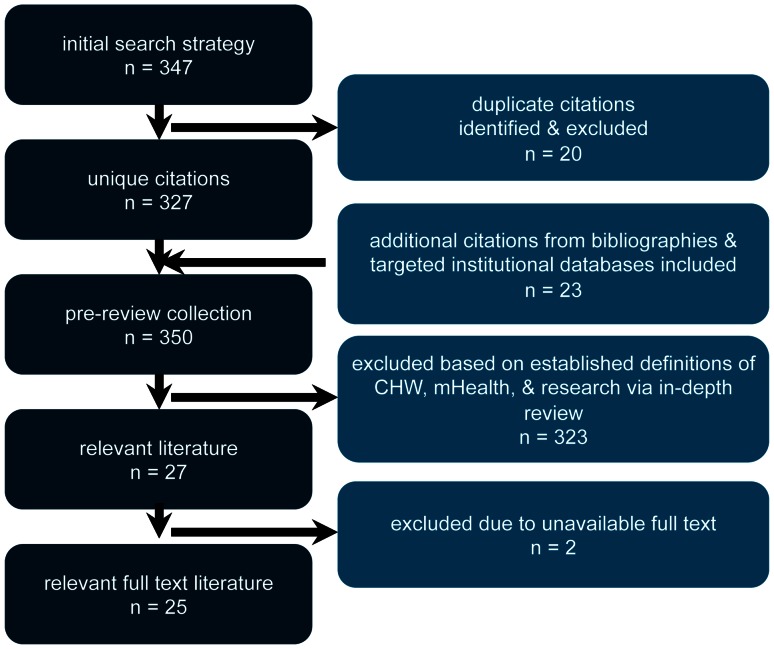
INTRODUCTION: In low-resource settings, community health workers are frontline providers who shoulder the health service delivery burden. Increasingly, mobile technologies are developed, tested, and deployed with community health workers to facilitate tasks and improve outcomes. We reviewed the evidence for the use of mobile technology by community health workers to identify opportunities and challenges for strengthening health systems in resource-constrained settings. METHODS: We conducted a systematic review of peer-reviewed literature from health, medical, social science, and engineering databases, using PRISMA guidelines. We identified a total of 25 unique full-text research articles on community health workers and their use of mobile technology for the delivery of health services. RESULTS: Community health workers have used mobile tools to advance a broad range of health aims throughout the globe, particularly maternal and child health, HIV/AIDS, and sexual and reproductive health. Most commonly, community health workers use mobile technology to collect field-based health data, receive alerts and reminders, facilitate health education sessions, and conduct person-to-person communication. Programmatic efforts to strengthen health service delivery focus on improving adherence to standards and guidelines, community education and training, and programmatic leadership and management practices. Those studies that evaluated program outcomes provided some evidence that mobile tools help community health workers to improve the quality of care provided, efficiency of services, and capacity for program monitoring. DISCUSSION: Evidence suggests mobile technology presents promising opportunities to improve the range and quality of services provided by community health workers. Small-scale efforts, pilot projects, and preliminary descriptive studies are increasing, and there is a trend toward using feasible and acceptable interventions that lead to positive program outcomes through operational improvements and rigorous study designs. Programmatic and scientific gaps will need to be addressed by global leaders as they advance the use and assessment of mobile technology tools for community health workers.
Overview
The claims and statistics of this paper haven’t been checked yet.
Free: it reads the open-access text and checks the first 5 claims that cite a source we can check. Create a free account to check every claim.
Integrity signals
Registry
Cites
Statistics
Figures
Verification
Claims the paper makes
The claims and statistics of this paper haven’t been checked yet.
Free: it reads the open-access text and checks the first 5 claims that cite a source we can check. Create a free account to check every claim.
Claims other papers make about this one
Each is checked against this paper’s own text: does it say what the citing paper says it does?
The source backs part of the claim, not all of it — or backs it for a different population, condition or comparison.
In the citing paper
“However, few studies have captured end-user experiences with a mobile-based app [18,19].”
From Operability, Usefulness, and Task-Technology Fit of an mHealth App for Delivering Primary Health Care Services by Community Health Workers in Underserved Areas of Pakistan and Afghanistan: Qualitative Study (2020) · cites this paper as [18]
Experimental — accuracy not yet measuredThe source backs part of the claim, not all of it — or backs it for a different population, condition or comparison.
In the citing paper
“In LMICs, the mobile technology has been used by CHWs to address a range of health issues related to maternal and child health, sexual and reproductive health, family planning, HIV/AIDS, general health, acute respiratory infections, infectious diseases and injury and trauma [22].”
From Using mobile phones to improve community health workers performance in low-and-middle-income countries (2020) · cites this paper as [22]
Experimental — accuracy not yet measured
Self-check
Percentages, sums and reported differences re-computed from the paper’s own numbers.
The self-check needs the paper’s full text.
Citations
Cites
Preferred Reporting Items for Systematic Reviews and Meta-Analyses: the PRISMA statement
Moher, D., Liberati, A., Tetzlaff, J., Altman, D. G., & for the PRISMA Group (2009) · BMJ · doi:10.1136/bmj.b2535 · Cited by 83,823
Preferred Reporting Items for Systematic Reviews and Meta-Analyses: The PRISMA Statement
Moher, D., Liberati, A., Tetzlaff, J., Altman, D. G., & The PRISMA Group (2009) · PLoS Medicine · doi:10.1371/journal.pmed.1000097 · Cited by 64,042
Preferred reporting items for systematic reviews and meta-analyses: The PRISMA statement
Moher, D., Liberati, A., Tetzlaff, J., Altman, D. G., & the PRISMA Group* (2009) · Annals of Internal Medicine · doi:10.7326/0003-4819-151-4-200908180-00135 · Cited by 37,554
Prentice, T. (2013) · Res Medica · doi:10.2218/resmedica.v21i1.510 · Cited by 1,707
Human resources for health: overcoming the crisis
Chen, L., Evans, T., Anand, S., Boufford, J. I., Brown, H., Chowdhury, M., Cueto, M., Dare, L., Dussault, G., Elzinga, G., et al. (2004) · The Lancet · doi:10.1016/s0140-6736(04)17482-5 · Cited by 1,552 · cited 2×
“Proponents argue engaging CHWs expands the pool of human resources for health, improves the productivity of health systems, and lowers the cost of providing services by shifting tasks from highly trained physicians and nurses to less specialized community members [2,3,5].”
BackgroundConway, M. E. (1967) · Cited by 812
How to bridge the gap in human resources for health
Hongoro, C., & McPake, B. (2004) · The Lancet · doi:10.1016/s0140-6736(04)17229-2 · Cited by 440 · cited 2×
“Proponents argue engaging CHWs expands the pool of human resources for health, improves the productivity of health systems, and lowers the cost of providing services by shifting tasks from highly trained physicians and nurses to less specialized community members [2,3,5].”
BackgroundZurovac, D., Sudoi, R. K., Akhwale, W. S., Ndiritu, M., Hamer, D. H., Rowe, A. K., & Snow, R. W. (2011) · The Lancet · doi:10.1016/s0140-6736(11)60783-6 · Cited by 403 · cited 1×
“These include a description of a clusterrandomized controlled trial with CHWs to evaluate effects of a health data collection and decision support system on health outcomes of mothers living with HIV [14], a cluster randomized controlled trial to evaluate effects of alerts and reminders on CHWs adherence to malaria tr…”
The use of mobile phones as a data collection tool: A report from a household survey in South Africa
Tomlinson, M., Solomon, W., Singh, Y., Doherty, T., Chopra, M., Ijumba, P., Tsai, A. C., & Jackson, D. (2009) · BMC Medical Informatics and Decision Making · doi:10.1186/1472-6947-9-51 · Cited by 340 · cited 2×
“Further, these mobile tools can enable real-time quality review and analysis for decision-making [11], as well as rapid response to cited health issues [20].”
BackgroundResultResponding to the global human resources crisis
Narasimhan, V., Brown, H., Pablos-Mendez, A., Adams, O., Dussault, G., Elzinga, G., Nordstrom, A., Habte, D., Jacobs, M., Solimano, G., et al. (2004) · The Lancet · doi:10.1016/s0140-6736(04)16108-4 · Cited by 284 · cited 1×
“Nearly all countries are challenged by shortages of health workers [1].”
Cited by
Items 401–500 of 525
The Role of Electronic Health in the Coronavirus Disease Crisis: A Systematic Review of Documents
Amiri, P., & Bahaadinbeigy, K. (2020) · Frontiers in Health Informatics · doi:10.30699/fhi.v9i1.223 · Cited by 1
ROOT CAUSE AND ERROR ANALYSIS (REVIEW ARTICLE)
Abdollahi, A. (2014) · Cited by 1
Mobile health for community participation: Research patterns and directions
Kim, D. H., Hong, J., Ha, E., & Yoo, S. (2015) · 보건교육·건강증진학회지 · doi:10.14367/kjhep.2015.32.4.67 · Cited by 1
“72 보건교육건강증진학회지 제32권 제4호 Research topic Authors (Year) Research design Sample Data collection method Evaluation Setting Size Country Primary health care quality enhancement to empower the capacity of community health workers Blanas et al. (2014) Non-Experimental Rural District 83 Senegal Interview +Survey - Tsai et al.…”
BackgroundPrentiss, T. C., Tamler, I., Plum, A., Parke, D. M., Zervos, J., Tanniru, M. R., Sears, M. H., White, M., Wisdom, K., & Kaljee, L. (2017) · Hawaii International Conference on System Sciences (HICSS) · doi:10.24251/hicss.2017.396 · Cited by 1
“workers (CHWs) to use in their daily practices [1, 2], on health topics ranging from maternal health [3], TB and HIV/AIDS treatment [4], and cardiovascular disease [5].”
BackgroundPrentiss, T. C., Zervos, J., Tanniru, M. R., & Tan, J. (2017) · International Journal of Healthcare Information Systems and Informatics · doi:10.4018/ijhisi.2018010102 · Cited by 1
Schoeman, F. (2019) · Open University of Cape Town (University of Cape Town) · Cited by 5
Shapiro, R. M. (2020) · UKnowledge (University of Kentucky) · doi:10.13023/etd.2020.114 · Cited by 1
“Braun and colleagues report the most common uses of mobile technology among community health workers include: collecting field-based health data, receiving alerts and reminders, facilitating health education sessions, and conducting person-to-person communication (Braun et al., 2013).”
BackgroundKinoti, S. N., Mbogo, C. M., Raclaw, H., Ferro, S., Hirji, Z., Yeung, E., Zwingerman, N., Kinyari, T., Schiff, M., & Ndungu, J. (2020) · East African Journal of Science Technology and Innovation · doi:10.37425/eajsti.v1i3.154 · Cited by 1
Henry, J. V. (2021) · Oxford University Press eBooks · doi:10.1093/oso/9780198866244.003.0007 · Cited by 1
Singh, R. M., Sharma, H. K., & Choudhary, B. (2022) · International Conference on Computational Intelligence and Sustainable Engineering Solutions (CISES) · doi:10.1109/cises54857.2022.9844349 · Cited by 1
The Impact of the COVID-19 Pandemic on Global Health Education
Skinner, N. A., Job, N., & Johnston, J. S. (2023) · International perspectives on education and society · doi:10.1108/s1479-367920230000044015 · Cited by 2
ARTIFICIAL INTELLIGENCE IN TACKLING CORONAVIRUS AND FUTURE PANDEMICS
Quazi, S., Singh, S. K., Saha, R. P., Das, A., & Singh, M. K. (2024) · Journal of Experimental Biology and Agricultural Sciences · doi:10.18006/2024.12(1).124.137 · Cited by 1
Power, Technology and Empowerment: A Case Study of Community Health Workers in India
Pandey, P., & Zheng, Y. (2020) · IFIP advances in information and communication technology · doi:10.1007/978-3-030-64697-4_13 · Cited by 1
Morris, D. L. (2013) · ScholarWorks (Walden University) · Cited by 4
Makanga, P. T. (2016) · Summit (Simon Fraser University) · Cited by 1
Isaksen, H. (2017) · NVA (Nasjonalt vitenarkiv) · Cited by 2
Xu, D. R. (2017) · ResearchWorks at the University of Washington (University of Washington) · Cited by 2
MHealth systems, Transformations in Work and Implications for Sustainability
Namatovu, E. (2019) · NVA (Nasjonalt vitenarkiv) · Cited by 2
Rinawan, F. R., Susanti, A. I., Amelia, I., Ardisasmita, M. N., -, W., Dewi, R. K., Ferdian, D., Purnama, W. G., & Purbasari, A. (2020) · Research Square · doi:10.21203/rs.3.rs-15584/v2 · Cited by 1
“There are ve pillars of intervention, namely (1) commitment and vision of leadership, (2) national campaigns and behavior change, (3) convergence of central, regional and village programs, (4) food and nutrition security, and (5) monitoring and evaluation.”
BackgroundInfluentialMiranda, I. D. S., Cardoso, G. S., Pahar, M., Oliveira, G., & Niesler, T. (2021) · doi:10.36227/techrxiv.13736698.v1 · Cited by 1
“In this regard, smartphone-based diagnostic and data collection tools have particular appeal [6]–[8].”
BackgroundThakur, A., Reshmi, B., Mithra, P., Sekaran, V. C., & Kumar, S. (2026) · Digital Health · doi:10.20944/preprints202507.0873.v1 · Cited by 1
Combating Malaria: The Potential of mHealth
Thomas, A. G. (2014)
lessons from 18 countries in sub-Saharan Africa
Guenther, T., Laínez, Y. B., Oliphant, N. P., Dale, M., Raharison, S., Miller, L. J., Namara, G., & Diaz, T. (2014)
Developing Policies and Guidelines to Prevent Medication Errors and ADEs in Nursing Homes
Johnson, M. R. (2016) · ScholarWorks (Walden University) · Cited by 1
Smartphone technology in mental health
Loubir, D. B., Housbane, S., & Serhier, Z. (2014)
D-Tree : examining the efficiency of a community case management mobile medical diagnostic tool
Schramm, K. T. (2016) · Open University of Cape Town (University of Cape Town)
Kativu, K. T., & Pottas, D. (2016) · IFIP advances in information and communication technology · doi:10.1007/978-3-319-44447-5_10
“The benefits of mobility in the rural context are further supported by Braun, Catalani, Wimbush, and Israelski [3] who suggest mobile technology can potentially enhance the capacity of community health workers to innovate, improve accuracy and productivity while achieving higher levels of protocol…”
Where There Are No Landlines: Mobile Technology, Community Health Workers and Family Planning
Braun, R. (2013) · eScholarship (California Digital Library)
Self-citationCaldwell, K. (2017) · University Library - University of Saskatchewan (University of Saskatchewan)
López, A. B. (2016) · OakTrust (Texas A&M University Libraries)
Perceptions Among Women on Education for Health Information Management Career Advancement
Williams, M. S. (2018) · ScholarWorks (Walden University)
Classification And Analysis Of Mobile Health Evaluation Through Taxonomy and Method Development
Yang, A. (2018) · Digital Archive @ GSU · doi:10.57709/12438902
Realising the value of information collected by community health workers
Alberts, R., Fogwill, T., & Tolmay, J. P. (2016)
Molapo, M. (2018) · Open University of Cape Town (University of Cape Town) · Cited by 4
Nurses? use of smartphones for work purposes in the Philippines : predictors, outcomes, and issues
Bautista, J. R. (2019) · doi:10.32657/10220/48111 · Cited by 3
Chaudhry, A. (2019) · Queen Margaret University Publications Repository (Queen Margaret University) · Cited by 6
Maternal Healthcare Service Transformation: Exploring Opportunities for IT Use in Task Shifting
Nyende, H. (2020) · Hawaii International Conference on System Sciences (HICSS) · doi:10.24251/hicss.2020.446 · Cited by 1
“Expanding access to maternal healthcare services through the task shifting strategy requires an interplay of different components including policy and regulatory support, determination of roles and responsibilities, determination of qualifications, education and training and service delivery support [8] [9].”
BackgroundTuyisenge, G. (2020) · Summit (Simon Fraser University)
Fresh eyes: A human-centred design approach to diabetic retinopathy screening in primary care
Villalba, C. (2020) · Queensland University of Technology · doi:10.5204/thesis.eprints.201836
Sutherns, T. (2020) · Open University of Cape Town (University of Cape Town) · Cited by 4
The Challenge of “Informal mHealth” and Community Health Worker Practices
Wolff-Piggott, B. (2020) · International Conference on Human-Computer Interaction with Mobile Devices and Services (MobileHCI) · doi:10.1145/3406324.3424595 · Cited by 1
“der improved service to people in need of health services [1], [2].”
BackgroundYadav, D., & Singh, P. P. (2021)
Apraku, E. A., Sulemana, A., Dzabeng, F., Dadzie, A. Q., World Vision Ghana, A., Nettey, O. E. A., Nuamah, G. F., Abukari, M., Afari-Asiedu, S., Mahama, E., et al. (2021) · International Journal of Management and Humanities · doi:10.35940/ijmh.a1387.126421
Tahir, H. N., Zaidi, S. A., Riaz, A., Sadia, A., Najmi, R., & Sayani, S. (2021) · doi:10.2196/preprints.34943
Duval, L., Sicuri, E., Scott, S., Traoré‐Coulibaly, M., Tinto, H., Grietens, K. P., d’Alessando, U., Nahum, A., Schallig, H. D. F. H., Mens, P. F., et al. (2020) · doi:10.21203/rs.3.rs-40535/v1
“These frustrations may be mitigated both by better transportation and the use of mobile phones to remind pregnant women about their IPTp-SP visits [42, 43].”
Backgroundvan Pelt, S. (2021) · Research Publications (Maastricht University) · doi:10.26481/dis.20210917sp
Improving the Well-Being of Adolescent Girls in Developing Countries
Bank, W. (2021) · World Bank, Washington, DC eBooks · doi:10.1596/36792
Miranda, I. D. S., Cardoso, G. S., Pahar, M., de Oliveira, G. H. H., & Niesler, T. (2021) · doi:10.36227/techrxiv.13736698
Gandhi, P., & Pahwa, S. (2023) · Lecture notes in electrical engineering · doi:10.1007/978-981-99-5358-5_3
Ramathebane, M. M., Maja, L. J., Lets’olo, M., & Montsi, S. (2024) · Journal of the Colleges of Medicine of South Africa · doi:10.4102/jcmsa.v2i1.3
Design and Implementation of a Standardised Clinical Decision Support Algorithm for Fever
Ana, P. O., Edim, A. E., Ekah, U. J., Inyang, G. A., & Ana, F. P. (2024) · Advances in Research · doi:10.9734/air/2024/v25i41084
Agarwal, N., & Sharma, H. (2024) · Texila international journal of public health · doi:10.21522/tijph.2013.12.03.art023
Dieteren, C., Milimo, E., Siteyi, A., van Duijn, S., Stijvers, L., Dayo, L., Ganda, G., & de Wit, T. F. R. (2024) · Journal of Public Health in Africa · doi:10.4102/jphia.v15i1.653
“10 The promise of digital diagnostics is huge and can lead to disruptive changes in the health system landscape in LMICs, while adequate scientific evidence of its effects remains essential.”
Matewere, F., & Kaasbøll, J. (2025) · The Electronic Journal of Information Systems in Developing Countries · doi:10.1002/isd2.70000
“mHealth is increasingly being used to facilitate CHWs' activities with anticipation of improving the quality of services that they provide (Braun et al. 2013). mHealth is a medical and public health practice supported by mobile devices such as mobile phones, personal digital assistants (PDAs) and…”
Tomlinson, M., Rotheram‐Borus, M. J., Katzen, L. S., Gertsch, W., le Roux, I., Dippenaar, E., & le Roux, K. (2025) · Journal of Global Health · doi:10.7189/jogh.15.04094 · Cited by 2
“Mothers reported visits by a CHW at each assessment, while CHWs recorded their visits with a GPS finder and a paper-based report, as well as having a mobile phone which allowed tracking of the visit and communication with supervisors, similar to recommendations regarding optimal practice [ 31 ].”
E-book Avanços em Saúde: inovações e práticas
Lago, E. C., & Mesquita, G. V. (2025) · Amplamente Cursos e Formação Continuada eBooks · doi:10.47538/ac-2025.01
Guimarães, V. D. S., Silva, E., Martins, G. P. C., Cunha, R. N. B., Mesquita, G. V., & Tapety, F. I. (2025) · Amplamente Cursos e Formação Continuada eBooks · doi:10.47538/ac-2025.01-01
Soares, D. G., Teixeira, N. A., & Rocha, J. S. B. (2025) · Amplamente Cursos e Formação Continuada eBooks · doi:10.47538/ac-2025.01-06
LASERTERAPIA APLICADA AO REJUVENESCIMENTO FACIAL
Nunes, I. M. D. B., Rocha, A. D. O., Albuquerque, M. C. P., & Santos, A. C. (2025) · Amplamente Cursos e Formação Continuada eBooks · doi:10.47538/ac-2025.01-05
SAÚDE DO IDOSO: A IMPORTÂNCIA DAS ATIVIDADES FÍSICAS NA TERCEIRA IDADE
Esplindo, L. C. T., Nascimento, M. H. A. D., Carmo, N. T. D., Oliveira, V. S. D., Ribeiro, C. R., & Souza, J. S. D. O. (2025) · Amplamente Cursos e Formação Continuada eBooks · doi:10.47538/ac-2025.01-09
Gualberto, A. L. C., Medeiro, M. L. M. D., Silva, A. L. D., Coutinho, L. S., Araújo, L. D. S., Kayath, S. G., Cardoso, E. F. D. S., Walfredo, J. V. F., Terasawa, M. C. P., & Medeiros, L. B. (2025) · Amplamente Cursos e Formação Continuada eBooks · doi:10.47538/ac-2025.01-07
Mobile Health (mHealth) in Infectious Disease Control: A Review of Global Innovations and Outcomes
Ahmed, R. (2025) · Premier journal of public health. · doi:10.70389/pjph.100024
ANÁLISE DE CUSTOS DO TRATAMENTO DE PACIENTES COM LESÃO POR PRESSÃO: UMA REVISÃO INTEGRATIVA
Damascena, L. C. L., Leal, M. L. E., Soares, H. D. S., & da Silva, V. C. V. (2025) · Amplamente Cursos e Formação Continuada eBooks · doi:10.47538/ac-2025.01-10
Nyangacha, Z., Mogere, D. M., & Mbugua, R. G. (2025) · International Journal of Community Medicine and Public Health · doi:10.18203/2394-6040.ijcmph20253222
Damayanti, M., Saputri, N. A. S., & Darwitri, D. (2025) · International Journal of Social Science · doi:10.53625/ijss.v5i1.10783
Nsai, F. S., Ngunde, P. J., Longdoh, N. A., Tendongfor, N., Anye, C. S., Nabyonga‐Orem, J., & Njajou, O. (2025) · Digital Health · doi:10.1177/20552076251382818
“1,2 As access to mobile phones and internet services continues to increase in the region, mHealth-related services will also increase.”
Webber, G. C., Chirangi, B., Magatti, N., Mallick, R., & Taljaard, M. (2022) · Figshare · doi:10.6084/m9.figshare.19085170
Webber, G. C., Chirangi, B., Magatti, N., Mallick, R., & Taljaard, M. (2022) · Figshare · doi:10.6084/m9.figshare.19085167
Pérez, M. C., Chandra, D., Koné, G. K., Singh, R., Ridde, V., Sylvestre, M., Seth, A., & Johri, M. (2020) · Figshare · doi:10.6084/m9.figshare.13070803
Obi‐Jeff, C., Garcia, C., Onuoha, O., Adewumi, F., David, W., Bamiduro, T., Aliyu, A. B., Labrique, A., & Wonodi, C. B. (2021) · Figshare · doi:10.6084/m9.figshare.15982459
Galindo, M. S., Lambert, Y., Mutricy, L., Garancher, L., Miller, J. B., Gomes, J. H., Sanna, A., Peterka, C., Cairo, H., Hiwat, H., et al. (2022) · Figshare · doi:10.6084/m9.figshare.19607421
Pérez, M. C., Chandra, D., Koné, G. K., Singh, R., Ridde, V., Sylvestre, M., Seth, A., & Johri, M. (2020) · Figshare · doi:10.6084/m9.figshare.13070806
Hemlock, C., Galasso, E., Weber, A. M., Randriamiarisoa, T. C., Col, M., Dieci, M., Ratsifandrihamanana, L., & Fernald, L. C. H. (2024) · Figshare · doi:10.6084/m9.figshare.27124270
Obi‐Jeff, C., Garcia, C., Onuoha, O., Adewumi, F., David, W., Bamiduro, T., Aliyu, A. B., Labrique, A., & Wonodi, C. B. (2021) · Figshare · doi:10.6084/m9.figshare.15982450
Obi‐Jeff, C., Garcia, C., Onuoha, O., Adewumi, F., David, W., Bamiduro, T., Aliyu, A. B., Labrique, A., & Wonodi, C. B. (2021) · Figshare · doi:10.6084/m9.figshare.15982444
Elson, W. H., Kawiecki, A. B., Donnelly, M. A. P., Noriega, A. O., Simpson, J. K., Syafruddin, D., Rozi, I. E., Lobo, N. F., Barker, C. M., Scott, T. W., et al. (2022) · Figshare · doi:10.6084/m9.figshare.21343145
Choudhury, N., Tiwari, A., Wu, W., Bhandari, V. P., Bhatta, L., Bogati, B., Citrin, D., Halliday, S., Khadka, S., Marasini, N., et al. (2022) · Figshare · doi:10.6084/m9.figshare.20390949
Choudhury, N., Tiwari, A., Wu, W., Bhandari, V. P., Bhatta, L., Bogati, B., Citrin, D., Halliday, S., Khadka, S., Marasini, N., et al. (2022) · Figshare · doi:10.6084/m9.figshare.20390946
Pérez, M. C., Chandra, D., Koné, G. K., Singh, R., Ridde, V., Sylvestre, M., Seth, A., & Johri, M. (2020) · Figshare · doi:10.6084/m9.figshare.13070809
Straw, C., Antelo, V. S., Kohler, R. E., Paolino, M., Viswanath, K., & Arrossi, S. (2024) · Figshare · doi:10.6084/m9.figshare.26562286
Obi‐Jeff, C., Garcia, C., Onuoha, O., Adewumi, F., David, W., Bamiduro, T., Aliyu, A. B., Labrique, A., & Wonodi, C. B. (2021) · Figshare · doi:10.6084/m9.figshare.15982447
Hailemariam, T., Atnafu, A., Gezie, L. D., Kaasbøll, J., Klein, J., & Tilahun, B. (2024) · Figshare · doi:10.6084/m9.figshare.26597672
Bakibinga, P., Kamande, E. W., Kisia, L., Omuya, M., Matanda, D. J., & Kyobutungi, C. K. (2020) · Figshare · doi:10.6084/m9.figshare.12986875
Pérez, M. C., Chandra, D., Koné, G. K., Singh, R., Ridde, V., Sylvestre, M., Seth, A., & Johri, M. (2020) · Figshare · doi:10.6084/m9.figshare.13070800
Galindo, M. S., Lambert, Y., Mutricy, L., Garancher, L., Miller, J. B., Gomes, J. H., Sanna, A., Peterka, C., Cairo, H., Hiwat, H., et al. (2022) · Figshare · doi:10.6084/m9.figshare.19607418
Straw, C., Antelo, V. S., Kohler, R. E., Paolino, M., Viswanath, K., & Arrossi, S. (2024) · Figshare · doi:10.6084/m9.figshare.26562292
Galindo, M. S., Lambert, Y., Mutricy, L., Garancher, L., Miller, J. B., Gomes, J. H., Sanna, A., Peterka, C., Cairo, H., Hiwat, H., et al. (2022) · Figshare · doi:10.6084/m9.figshare.19607424
Hailemariam, T., Atnafu, A., Gezie, L. D., Kaasbøll, J., Klein, J., & Tilahun, B. C. (2024) · Figshare · doi:10.6084/m9.figshare.26597666
Straw, C., Antelo, V. S., Kohler, R. E., Paolino, M., Viswanath, K., & Arrossi, S. (2024) · Figshare · doi:10.6084/m9.figshare.26562289
Hailemariam, T., Atnafu, A., Gezie, L. D., Kaasbøll, J., Klein, J., & Tilahun, B. (2024) · Figshare · doi:10.6084/m9.figshare.26597669
Pérez, M. C., Chandra, D., Koné, G. K., Singh, R., Ridde, V., Sylvestre, M., Seth, A., & Johri, M. (2020) · Figshare · doi:10.6084/m9.figshare.13070812
Saad, N. A. (2024) · University of Maribor digital library (University of Maribor)
Community Health Worker Program Characteristics and Population Health Outcomes: A Scoping ReviewPreprint
Khaerunnisa, I., Makhfudli, M., Indarwati, R., Mariyanti, H., Pradipta, R. O., Has, E. M. M., chan, C. M., Mundakir, M., Saifudin, I. M. M. Y., Afrina, V., et al. (2026) · Research Square · doi:10.21203/rs.3.rs-8327009/v1
Al-Qahtani, S. N. S., Alqahtani, A. J. E., Alkhathami, M. M. M., Alharbi, Y. M. S., Al-Harbi, S. A.-H., Alharbi, M. M., Alotaibi, F. F. H., Alsulayih, A. S., Almutairi, F. S. D., Al-Mutairi, M. S. D. A., et al. (2024) · Saudi Journal of Medicine and Public Health · doi:10.64483/202412490
“The core innovation lies in positioning the CHA not merely as a health promoter, but as a bi-directional sensor and interventionist—a foundational node in a wider health intelligence system (Braun et al., 2013).”
Gwalani, R., Chaudhary, S., & Yadav, A. (2026) · NMO journal · doi:10.4103/jnmo.jnmo_24_25
Mzimkulu, O., Fairall, L. R., Bachmann, M. O., Kredo, T., Velapi, L., Curran, R., Petersen, I., Simelane, M. L. S., Georgeu-Pepper, D., & Levitt, N. S. (2026) · NIHR Open Research · doi:10.3310/nihropenres.14233.1
Jama, A. A., Issak, A. D., Abdilatif, A. I., Mohamud, A. A., & Gedi, A. M. (2026) · International Journal of Community Medicine and Public Health · doi:10.18203/2394-6040.ijcmph20260746
Metadata
- Authors
- Braun, R., Catalani, C., Wimbush, J., & Israelski, D.
- Affiliations
- University of California, Berkeley (US)
- Stanford University (US)
- Corresponding author
- Braun, Rebecca
- Venue
- PLoS ONE
- Publisher
- Public Library of Science (PLoS)
- Published
- 2013-06-12
- Volume
- 8
- Issue
- 6
- Pages
- e65772
- ISSN
- 1932-6203 (ISSN-L)
- PMC
- PMC3680423
- OpenAlex
- W2025634432
- Semantic Scholar
- 8a9a74f6e8dbd5631be3df9bc5183849ea5e4177
- Cited by
- 493
- References
- 25
- Citations by year
- 2026: 22 · 2025: 25 · 2024: 36 · 2023: 39 · 2022: 45 · 2021: 52 · 2020: 54 · 2019: 50 · 2018: 41 · 2017: 45 · 2016: 33 · 2015: 25 · 2014: 23 · 2013: 3
- FWCI
- 3.36
- Type
- journal article
- Language
- en
- Open access
- gold
- doi.org
- Locations
- PLoS ONE (publishedVersion, cc-by)
- Europe PMC (PubMed Central) (publishedVersion, cc-by)
- PubMed Central (publishedVersion, cc-by)
- PubMed (publishedVersion)
- RePEc: Research Papers in Economics (acceptedVersion)
- DOAJ (DOAJ: Directory of Open Access Journals) (submittedVersion, cc-by-sa)
- eScholarship (California Digital Library) (submittedVersion)
- Funders
- United States Agency for International Development
- U.S. President’s Emergency Plan for AIDS Relief
- Centers for Disease Control and Prevention
- Topics
- Health Sciences › Health Professions › General Health Professions › Mobile Health and mHealth Applications
- Physical Sciences › Computer Science › Information Systems › ICT in Developing Communities
- Health Sciences › Medicine › Public Health, Environmental and Occupational Health › Global Health Workforce Issues
- Keywords
- community health workers, mobile technology, mobile health, health care delivery, resource-limited settings, maternal and child health, HIV/AIDS, sexual and reproductive health, health data collection, health education, quality of care, program monitoring, health system strengthening
- MeSH terms
- Community Health Workers, Data Collection, Delivery of Health Care, Humans, Public Health, Cell Phone, Mobile Applications
About these checks
Registry, retraction, Cites and statistics results are computed, not judged, with one exception: a printed reference that no index lists is read once by a model before it counts as a citation error. Claims are extracted by a model and kept only when their quote appears verbatim in the text; each cited source is then checked, with a model’s help, for whether it says what the claim relies on. Those verdicts can be wrong — read the claim’s quote and the cited source before relying on one.
Statistics and arithmetic are recomputed, not judged.
Confidence bands are shown only for fields calibrated on our annotated test set. None is calibrated yet, so no band is shown.
What counts as a claim ›How we measure confidence ›How we check this ›
Are you an author, or do you see a problem with this page? Request a review
Data sources
Bibliographic data: Semantic Scholar, OpenAlex, Crossref.
Contains information from the Semantic Scholar Academic Graph Datasets, made available under the ODC Attribution License (ODC-BY 1.0).
Semantic Scholar’s data is described in: Kinney, R., et al. (2023). The Semantic Scholar Open Data Platform. arXiv:2301.10140.
