

Community Health Workers and Mobile Technology: A Systematic Review of the Literature
Open accessThe DOI matches its Crossref record; 25 of the 25 references it cites were found in a registry or an index.
Abstract
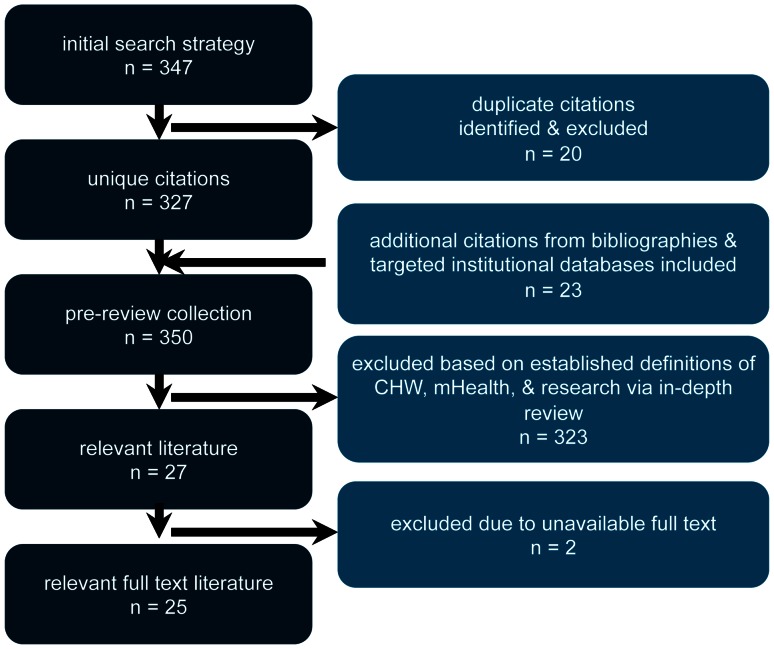
INTRODUCTION: In low-resource settings, community health workers are frontline providers who shoulder the health service delivery burden. Increasingly, mobile technologies are developed, tested, and deployed with community health workers to facilitate tasks and improve outcomes. We reviewed the evidence for the use of mobile technology by community health workers to identify opportunities and challenges for strengthening health systems in resource-constrained settings. METHODS: We conducted a systematic review of peer-reviewed literature from health, medical, social science, and engineering databases, using PRISMA guidelines. We identified a total of 25 unique full-text research articles on community health workers and their use of mobile technology for the delivery of health services. RESULTS: Community health workers have used mobile tools to advance a broad range of health aims throughout the globe, particularly maternal and child health, HIV/AIDS, and sexual and reproductive health. Most commonly, community health workers use mobile technology to collect field-based health data, receive alerts and reminders, facilitate health education sessions, and conduct person-to-person communication. Programmatic efforts to strengthen health service delivery focus on improving adherence to standards and guidelines, community education and training, and programmatic leadership and management practices. Those studies that evaluated program outcomes provided some evidence that mobile tools help community health workers to improve the quality of care provided, efficiency of services, and capacity for program monitoring. DISCUSSION: Evidence suggests mobile technology presents promising opportunities to improve the range and quality of services provided by community health workers. Small-scale efforts, pilot projects, and preliminary descriptive studies are increasing, and there is a trend toward using feasible and acceptable interventions that lead to positive program outcomes through operational improvements and rigorous study designs. Programmatic and scientific gaps will need to be addressed by global leaders as they advance the use and assessment of mobile technology tools for community health workers.
Overview
The claims and statistics of this paper haven’t been checked yet.
Free: it reads the open-access text and checks the first 5 claims that cite a source we can check. Create a free account to check every claim.
Integrity signals
Registry
Cites
Statistics
Figures
Verification
Claims the paper makes
The claims and statistics of this paper haven’t been checked yet.
Free: it reads the open-access text and checks the first 5 claims that cite a source we can check. Create a free account to check every claim.
Claims other papers make about this one
Each is checked against this paper’s own text: does it say what the citing paper says it does?
The source backs part of the claim, not all of it — or backs it for a different population, condition or comparison.
In the citing paper
“However, few studies have captured end-user experiences with a mobile-based app [18,19].”
From Operability, Usefulness, and Task-Technology Fit of an mHealth App for Delivering Primary Health Care Services by Community Health Workers in Underserved Areas of Pakistan and Afghanistan: Qualitative Study (2020) · cites this paper as [18]
Experimental — accuracy not yet measuredThe source backs part of the claim, not all of it — or backs it for a different population, condition or comparison.
In the citing paper
“In LMICs, the mobile technology has been used by CHWs to address a range of health issues related to maternal and child health, sexual and reproductive health, family planning, HIV/AIDS, general health, acute respiratory infections, infectious diseases and injury and trauma [22].”
From Using mobile phones to improve community health workers performance in low-and-middle-income countries (2020) · cites this paper as [22]
Experimental — accuracy not yet measured
Self-check
Percentages, sums and reported differences re-computed from the paper’s own numbers.
The self-check needs the paper’s full text.
Citations
Cites
Preferred Reporting Items for Systematic Reviews and Meta-Analyses: the PRISMA statement
Moher, D., Liberati, A., Tetzlaff, J., Altman, D. G., & for the PRISMA Group (2009) · BMJ · doi:10.1136/bmj.b2535 · Cited by 83,823
Preferred Reporting Items for Systematic Reviews and Meta-Analyses: The PRISMA Statement
Moher, D., Liberati, A., Tetzlaff, J., Altman, D. G., & The PRISMA Group (2009) · PLoS Medicine · doi:10.1371/journal.pmed.1000097 · Cited by 64,042
Preferred reporting items for systematic reviews and meta-analyses: The PRISMA statement
Moher, D., Liberati, A., Tetzlaff, J., Altman, D. G., & the PRISMA Group* (2009) · Annals of Internal Medicine · doi:10.7326/0003-4819-151-4-200908180-00135 · Cited by 37,554
Prentice, T. (2013) · Res Medica · doi:10.2218/resmedica.v21i1.510 · Cited by 1,707
Human resources for health: overcoming the crisis
Chen, L., Evans, T., Anand, S., Boufford, J. I., Brown, H., Chowdhury, M., Cueto, M., Dare, L., Dussault, G., Elzinga, G., et al. (2004) · The Lancet · doi:10.1016/s0140-6736(04)17482-5 · Cited by 1,552 · cited 2×
“Proponents argue engaging CHWs expands the pool of human resources for health, improves the productivity of health systems, and lowers the cost of providing services by shifting tasks from highly trained physicians and nurses to less specialized community members [2,3,5].”
BackgroundConway, M. E. (1967) · Cited by 812
How to bridge the gap in human resources for health
Hongoro, C., & McPake, B. (2004) · The Lancet · doi:10.1016/s0140-6736(04)17229-2 · Cited by 440 · cited 2×
“Proponents argue engaging CHWs expands the pool of human resources for health, improves the productivity of health systems, and lowers the cost of providing services by shifting tasks from highly trained physicians and nurses to less specialized community members [2,3,5].”
BackgroundZurovac, D., Sudoi, R. K., Akhwale, W. S., Ndiritu, M., Hamer, D. H., Rowe, A. K., & Snow, R. W. (2011) · The Lancet · doi:10.1016/s0140-6736(11)60783-6 · Cited by 403 · cited 1×
“These include a description of a clusterrandomized controlled trial with CHWs to evaluate effects of a health data collection and decision support system on health outcomes of mothers living with HIV [14], a cluster randomized controlled trial to evaluate effects of alerts and reminders on CHWs adherence to malaria tr…”
The use of mobile phones as a data collection tool: A report from a household survey in South Africa
Tomlinson, M., Solomon, W., Singh, Y., Doherty, T., Chopra, M., Ijumba, P., Tsai, A. C., & Jackson, D. (2009) · BMC Medical Informatics and Decision Making · doi:10.1186/1472-6947-9-51 · Cited by 340 · cited 2×
“Further, these mobile tools can enable real-time quality review and analysis for decision-making [11], as well as rapid response to cited health issues [20].”
BackgroundResultResponding to the global human resources crisis
Narasimhan, V., Brown, H., Pablos-Mendez, A., Adams, O., Dussault, G., Elzinga, G., Nordstrom, A., Habte, D., Jacobs, M., Solimano, G., et al. (2004) · The Lancet · doi:10.1016/s0140-6736(04)16108-4 · Cited by 284 · cited 1×
“Nearly all countries are challenged by shortages of health workers [1].”
Cited by
Richter, L. M., Daelmans, B., Lombardi, J., Heymann, J., Boo, F. L., Behrman, J. R., Lu, C., Lucas, J. E., Perez-Escamilla, R., Dua, T., et al. (2017) · The Lancet · doi:10.1016/s0140-6736(16)31698-1 · Cited by 892
Barriers and facilitators to utilizing digital health technologies by healthcare professionals
Borges do Nascimento, I. J., Abdulazeem, H., Vasanthan, L. T., Martinez, E. Z., Zucoloto, M. L., Østengaard, L., Azzopardi-Muscat, N., Zapata, T., & Novillo-Ortiz, D. (2023) · npj Digital Medicine · doi:10.1038/s41746-023-00899-4 · Cited by 673
“…19,22,31,32,46,93,101,123 , pregnancy, childbirth, or puerperium (e.g., maternal health, postpartum hemorrhage, and reproductive health) 19,22,23,26,31,35,46,56,61,77,94 , certain infectious or parasitic diseases (e.g., malaria, human immunode fi ciency virus infection, and in fl uenza)…”
BackgroundScott, K., Beckham, S. W., Gross, M., Pariyo, G., Rao, K. D., Cometto, G., & Perry, H. B. (2018) · Human Resources for Health · doi:10.1186/s12960-018-0304-x · Cited by 732
“Collect and record data Perform general clerical duties [70] and data collection (including using mHealth tools [101, 102]), identify and report on malaria outbreaks [44], monitor medicine stocks and notify government agencies when stocks are low [44, 76]”
MethodAgarwal, S., Perry, H. B., Long, L., & Labrique, A. B. (2015) · Tropical Medicine & International Health · doi:10.1111/tmi.12525 · Cited by 498
“published a systematic review of mHealth tools being employed by community health workers [51].”
BackgroundSrinivasa Rao, A. S. R., & Vazquez, J. A. (2020) · Infection Control & Hospital Epidemiology · doi:10.1017/ice.2020.61 · Cited by 394
“[12] [13] [14] [15] The use of mobile phones [16] [17] [18] [19] and web-based portals 20, 21 have been tested successfully in health-related data collection.”
BackgroundRole and outcomes of community health workers in HIV care in sub-saharan Africa: a systematic review
Mwai, G. W., Mburu, G., Torpey, K., Frost, P., Ford, N., & Seeley, J. (2013) · Journal of the International AIDS Society · doi:10.7448/ias.16.1.18586 · Cited by 372
“The use of mobile technology by CHWs in this review and more generally [74] could also contribute to better efficiency of community-based programs.”
Patients’ Perceptions of mHealth Apps: Meta-Ethnographic Review of Qualitative Studies
Vo, V., Auroy, L., & Sarradon-Eck, A. (2019) · JMIR mHealth and uHealth · doi:10.2196/13817 · Cited by 294
Odendaal, W. A., Anstey Watkins, J., Leon, N., Goudge, J., Griffiths, F., Tomlinson, M., & Daniels, K. (2020) · Cochrane Database of Systematic Reviews · doi:10.1002/14651858.cd011942.pub2 · Cited by 289
“…review might inform or supplement what is already known in this area The Cochrane and non-Cochrane e#ectiveness reviews (Agarwal 2018a; Agarwal 2018b; Agarwal 2018c; Braun 2013; GonçalvesBradley 2018a; Gonçalves-Bradley 2018b; Vasudevan 2018; Vervloet 2012), showed mixed or inconclusive results.”
BackgroundFeroz, A., Jabeen, R., & Saleem, S. (2020) · BMC Public Health · doi:10.1186/s12889-020-8173-3 · Cited by 178
“spiratory infections, infectious diseases and injury and trauma [22].”
Backgrounddo Nascimento, I. J. B., Abdulazeem, H. M., Vasanthan, L., Martínez, E. Z., Zucoloto, M. L., Østengaard, L., Muscat, N. A., Zapata, T., & Novillo-Ortiz, D. (2023) · The Lancet Digital Health · doi:10.1016/s2589-7500(23)00092-4 · Cited by 211
Odendaal, W. A., Goudge, J., Griffiths, F., Tomlinson, M., Leon, N., & Daniels, K. (2015) · Cochrane Database of Systematic Reviews · doi:10.1002/14651858.cd011942 · Cited by 173
Peiris, D., Praveen, D., Johnson, C., & Mogulluru, K. (2014) · Journal of Cardiovascular Translational Research · doi:10.1007/s12265-014-9581-5 · Cited by 177
“identified 25 studies exploring community health workers’ use of mobile technology [14].”
BackgroundIntroduction of Mobile Health Tools to Support Ebola Surveillance and Contact Tracing in Guinea
Sacks, J. A., Zehe, E., Redick, C., Bah, A., Cowger, K., Camara, M., Diallo, A., Gigo, A. N. I., Dhillon, R. S., & Liu, A. (2015) · Global Health: Science and Practice · doi:10.9745/ghsp-d-15-00207 · Cited by 142
“Numbers at the top depict the numbers of contacts for the day that: (1) received a household visit from the contact tracer; (2) were visited by the contact tracer but were unavailable; (3) were last visited by the contact tracer 1 day ago; (4) were last visited by the contact tracer 2 days ago; (5) were last visited b…”
BackgroundTiffin, N., George, A. S., & LeFevre, A. E. (2019) · BMJ Global Health · doi:10.1136/bmjgh-2019-001395 · Cited by 150
Praveen, D., Patel, A., Raghu, A., Clifford, G. D., Maulik, P. K., Mohammad Abdul, A., Mogulluru, K., Tarassenko, L., MacMahon, S., & Peiris, D. (2014) · JMIR mHealth and uHealth · doi:10.2196/mhealth.3568 · Cited by 131
Smartphone hearing screening in mHealth assisted community-based primary care
Yousuf Hussein, S., Wet Swanepoel, D., Biagio de Jager, L., Myburgh, H. C., Eikelboom, R. H., & Hugo, J. (2016) · Journal of Telemedicine and Telecare · doi:10.1177/1357633x15610721 · Cited by 125
“This study investigated community-based identification of hearing loss using smartphone hearing screening (hearScreenTM) operated by community health workers (CHWs) in terms of clinical efficacy and the reported experiences of CHWs. Method: The study comprised two phases.”
BackgroundInfluentialMakanga, P. T., Schuurman, N., Sacoor, C. N., Boene, H. E., Vilanculo, F. C., Vidler, M., Magee, L. A., von Dadelszen, P., Sevene, E., Munguambe, K., et al. (2017) · International Journal of Health Geographics · doi:10.1186/s12942-016-0074-4 · Cited by 132
“The increased recognition of community level health surveillance, including pregnancy surveillance and mobile health technologies [52, 53] will set the context where these daily pictures of access could inform decisions by community health workers as they link communities to formal health services.”
BackgroundEarly, J., Gonzalez, C., Gordon-Dseagu, V., & Robles-Calderon, L. (2019) · Health Promotion Practice · doi:10.1177/1524839919855391 · Cited by 122
“Braun et al. (2013) found that the majority of programs utilizing mHealth technology use by CHWs addressed issues related to maternal, sexual, and reproductive health, with more than half of this group specifically focused on HIV/AIDS.”
BackgroundInfluentialModi, D. K., Dholakia, N. B., Gopalan, R., Venkatraman, S., Dave, K., Shah, S., Desai, G., Qazi, S., Sinha, A., Pandey, R. M., et al. (2019) · PLoS Medicine · doi:10.1371/journal.pmed.1002939 · Cited by 129
Health Worker mHealth Utilization: A Systematic Review
White, A., Thomas, D. S. K., Ezeanochie, N., & Bull, S. (2016) · CIN: Computers, Informatics, Nursing · doi:10.1097/cin.0000000000000231 · Cited by 110
“The success of programs that target this diverse group providing care is dependent on resources, training and education, and supervision.(7) Evidence shows that mHealth improves communication, decreases transportation time,”
BackgroundOliver, M., Geniets, A., Winters, N., Rega, I., & Mbae, S. M. (2015) · Global Health Action · doi:10.3402/gha.v8.27168 · Cited by 105
“(12), for example, undertook a systematic review of the use of mobile technologies to support CHWs.”
BackgroundmHealth Interventions in Low-Income Countries to Address Maternal Health: A Systematic Review
Colaci, D., Chaudhri, S., & Vasan, A. (2017) · Annals of Global Health · doi:10.1016/j.aogh.2016.09.001 · Cited by 115
Mtema, Z. J., Changalucha, J. J., Cleaveland, S., Elias, M., Ferguson, H. M., Halliday, J. E. B., Haydon, D. T., Jaswant, G., Kazwala, R. R., Killeen, G. F., et al. (2016) · PLoS Medicine · doi:10.1371/journal.pmed.1002002 · Cited by 126
“Data reported by phone were validated on entry, with error message prompts to ensure quality, and were more complete than paper records (97%–100% versus 70%–96% for paper), which frequently lack age, gender, locations, and dates and require several manual processing steps that are prone to human error and data loss [1…”
BackgroundHuang, W., Long, H., Li, J., Tao, S., Zheng, P., Tang, S., & Abdullah, A. S. M. (2018) · Global Health Research and Policy · doi:10.1186/s41256-018-0072-0 · Cited by 109
“It could be an effective approach to improve the consistency and efficiency of health services delivery by CHWs [92, 93].”
BackgroundResultNaimoli, J. F., Perry, H. B., Townsend, J., Frymus, D. E., & McCaffery, J. A. (2015) · Human Resources for Health · doi:10.1186/s12960-015-0041-3 · Cited by 105
“A recent systematic review of the literature on CHWs and mobile technology found some promising evidence that mobile tools can help CHWs to improve both the quality and efficiency of the services they provide [62].”
BackgroundOkesene-Gafa, K. A. M., Li, M., McKinlay, C. J. D., Taylor, R. S., Rush, E. C., Wall, C. R., Wilson, J., Murphy, R., Taylor, R., Thompson, J. M. D., et al. (2019) · American Journal of Obstetrics and Gynecology · doi:10.1016/j.ajog.2019.03.003 · Cited by 82
Whidden, C., Kayentao, K., Liu, J. X., Lee, S., Keita, Y., Diakité, D., Keita, A., Diarra, S., Edwards, J., Yembrick, A., et al. (2018) · Journal of Global Health · doi:10.7189/jogh.08.020418 · Cited by 88
Lodhia, V., Karanja, S., Lees, S., & Bastawrous, A. (2016) · JMIR mHealth and uHealth · doi:10.2196/mhealth.4746 · Cited by 86
“Other studies of mHealth in developing countries have demonstrated the value of MPs in tackling the current barriers to service provision and improving the range and quality of services offered by CHVs [34,39,40].”
Maciazeki-Gomes, R. D. C., de Souza, C. D., Baggio, L., & Wachs, F. (2016) · Ciência & Saúde Coletiva · doi:10.1590/1413-81232015215.17112015 · Cited by 85
Catalani, C., Green, E. P., Owiti, P., Keny, A., Diero, L. O., Yeung, A., Israelski, D. M., & Biondich, P. (2014) · PLoS ONE · doi:10.1371/journal.pone.0103205 · Cited by 92
Self-citationXu, D. (., Xiao, S., He, H., Caine, E. D., Gloyd, S., Simoni, J., Hughes, J. P., Nie, J., Lin, M., He, W., et al. (2019) · PLOS Medicine · doi:10.1371/journal.pmed.1002785 · Cited by 79
Mangwi Ayiasi, R., Kolsteren, P., Batwala, V., Criel, B., & Orach, C. G. (2016) · PLOS ONE · doi:10.1371/journal.pone.0153051 · Cited by 84
“We overcame these potential problems by providing mobile phones to an intermediary group, the VHTs and professional health workers who were based at the HCs. Interaction between VHTs and pregnant women with the possibility of consulting a professional health worker extends the hopes of applying voice mobile phone cons…”
BackgroundInfluentialPrinja, S., Nimesh, R., Gupta, A., Bahuguna, P., Gupta, M., & Thakur, J. S. (2017) · Tropical Medicine & International Health · doi:10.1111/tmi.12895 · Cited by 81
“This new mode of health communication is being employed for providing community education and trainings, facilitation of health education sessions and as a job aid for improving the counselling skills of community health workers [4].”
BackgroundMethodOtu, A., Ebenso, B., Okuzu, O., & Osifo-Dawodu, E. (2016) · Human Resources for Health · doi:10.1186/s12960-016-0100-4 · Cited by 78
“Recent reviews show the explosive innovation in technology has inspired a proliferation of mHealth pilot initiatives, many of which have demonstrated that mHealth can alleviate specific health system barriers such as balancing multiple priorities, lack of appropriate tools to provide services and collect data, and lim…”
BackgroundRole of community health worker in a mobile health program for early detection of oral cancer
Birur, P. N., Gurushanth, K., Patrick, S., Sunny, S. P., Raghavan, S. A., Gurudath, S., Hegde, U., Tiwari, V., Jain, V. K., Imran, M., et al. (2019) · Indian Journal of Cancer · doi:10.4103/ijc.ijc_232_18 · Cited by 81
A systematic review of mobile learning in social studies
Diacopoulos, M. M., & Crompton, H. (2020) · Computers & Education · doi:10.1016/j.compedu.2020.103911 · Cited by 74
Usability and Feasibility of PIERS on the Move: An mHealth App for Pre-Eclampsia Triage
Lim, J., Cloete, G., Dunsmuir, D. T., Payne, B. A., Scheffer, C., von Dadelszen, P., Dumont, G. A., & Ansermino, J. M. (2015) · JMIR mHealth and uHealth · doi:10.2196/mhealth.3942 · Cited by 73
Winters, N., Langer, L., & Geniets, A. (2018) · BMJ Open · doi:10.1136/bmjopen-2017-019827 · Cited by 71
“Consequently, there is a pressing need to understand: (1) if and how educational theories are being incorporated into mHealth platforms currently? (2) How the adoption of a novel educational lens can inform the future development of mHealth technology for use by CHWs? While multiple reviews of mHealth in LMICs have re…”
MethodInfluentialMishra, S. R., Lygidakis, C., Neupane, D., Gyawali, B., Uwizihiwe, J. P., Virani, S. S., Kallestrup, P., & Miranda, J. J. (2019) · Health Policy and Planning · doi:10.1093/heapol/czy099 · Cited by 71
“Digital solutions have also been able to support peer communication in the form of virtual informal groups and learning networks that are able to create educational opportunities from the daily practice (Braun et al., 2013; Lygidakis et al., 2016).”
BackgroundUse of Mobile Health Applications in Low-Income Populations
(2020) · doi:10.1161/circoutcomes.120.007031 · Cited by 70
Willcox, M., Moorthy, A., Mohan, D., Romano, K., Hutchful, D., Mehl, G. L., Labrique, A. B., & LeFevre, A. E. (2018) · Journal of Medical Internet Research · doi:10.2196/11268 · Cited by 75
Mobile instant messaging for rural community health workers: a case from Malawi
Pimmer, C., Mhango, S., Mzumara, A., & Mbvundula, F. (2017) · Global Health Action · doi:10.1080/16549716.2017.1368236 · Cited by 69
Abdel-All, M., Thrift, A. G., Riddell, M. A., Thankappan, K. R., Mini, G., Chow, C. K., Maulik, P. K., Mahal, A. S., Guggilla, R. K., Kalyanram, K., et al. (2018) · BMC Health Services Research · doi:10.1186/s12913-018-3140-8 · Cited by 73
“Use of these devices could also reduce the cost and time of training [40] and improve the overall performance and quality of care provided [41].”
BackgroundImplementing mHealth Interventions in a Resource-Constrained Setting: Case Study From Uganda
Meyer, A. J., Armstrong-Hough, M., Babirye, D., Mark, D., Turimumahoro, P., Ayakaka, I., Haberer, J. E., Katamba, A., & Davis, J. L. (2020) · JMIR mHealth and uHealth · doi:10.2196/19552 · Cited by 62
Musinguzi, L. K., Turinawe, E. B., Rwemisisi, J. T., de Vries, D. H., Mafigiri, D. K., Muhangi, D., de Groot, M., Katamba, A., & Pool, R. (2017) · Human Resources for Health · doi:10.1186/s12960-016-0177-9 · Cited by 75
“Studies elsewhere equally demonstrate that CHWs have positive effects on health because they act as “ entry points ” , “ links ” , “ bridges ” or “ connectors ” between communities and formal health care services, systems and resources [4, 5, 18 – 21].”
Abejirinde, I. O., Ilozumba, O., Marchal, B., Zweekhorst, M. B. M., & Dieleman, M. A. (2018) · International Journal of Care Coordination · doi:10.1177/2053434518779491 · Cited by 73
“Information and communication technologies (ICTs) such as mobile health technology are increasingly recommended as a means to bridge the know-do gap and by extension improve health worker performance and quality of maternal health.(13,14) Mobile health (mHealth), specifically, is defined as medical and public health p…”
Ngcobo, S., Scheepers, S., Mbatha, N., Grobler, E., & Rossouw, T. (2022) · AIDS Patient Care and STDs · doi:10.1089/apc.2022.0020 · Cited by 64
Ilozumba, O., Dieleman, M., Kraamwinkel, N., Van Belle, S., Chaudoury, M., & Broerse, J. E. W. (2018) · PLOS ONE · doi:10.1371/journal.pone.0194927 · Cited by 64
“the software designed to run on a mobile phone [10].”
MethodMabunda, D., Oliveira, D., Sidat, M., Cavalcanti, M. T., Cumbe, V., Mandlate, F., Wainberg, M. L., Cournos, F., & Mari, J. D. J. (2022) · International Journal of Mental Health Systems · doi:10.1186/s13033-022-00526-x · Cited by 68
“can improves LHWs effectiveness, the quality of care and adherence to protocol of the interventions [49, 50].”
Background(2020) · doi:10.1186/s12913-020-05711-7 · Cited by 60
Rinawan, F. R., Susanti, A. I., Amelia, I., Ardisasmita, M. N., Widarti, Dewi, R. K., Ferdian, D., Purnama, W. G., & Purbasari, A. (2021) · BMC Public Health · doi:10.1186/s12889-021-11035-w · Cited by 70
“However, recent systematic reviews provide little information on how mHealth apps are designed using a qualitative approach to enhance CHWs ’ performance in community-based MCH services [6 – 10].”
BackgroundMcConnell, M., Ettenger, A., Rothschild, C. W., Muigai, F., & Cohen, J. (2016) · BMC Pregnancy and Childbirth · doi:10.1186/s12884-016-0914-z · Cited by 60
Mobile health applications for HIV prevention and care in Africa
Forrest, J. I., Wiens, M., Kanters, S., Nsanzimana, S., Lester, R. T., & Mills, E. J. (2015) · Current Opinion in HIV and AIDS · doi:10.1097/coh.0000000000000198 · Cited by 59
“A recent systematic review of mobile health applications for community health workers found that these interventions can improve both the range and the quality of health provision at this level, which addresses a critical public heath gap [26].”
BackgroundKrah, E. F., & de Kruijf, J. G. (2016) · DIGITAL HEALTH · doi:10.1177/2055207616679264 · Cited by 56
“Braun et al. ‘13 Community health workers Evidence base is weak, more research needed 100.”
BackgroundMoosa, S., Derese, A., & Peersman, W. (2017) · Human Resources for Health · doi:10.1186/s12960-017-0183-6 · Cited by 66
Thumbi, S. M., Njenga, M. K., Otiang, E., Otieno, L., Munyua, P. M., Eichler, S., Widdowson, M., McElwain, T. F., & Palmer, G. H. (2019) · Philosophical Transactions of the Royal Society B Biological Sciences · doi:10.1098/rstb.2019.0020 · Cited by 58
De, P., & Pradhan, M. R. (2023) · BMC Women s Health · doi:10.1186/s12905-023-02825-y · Cited by 68
“The need for this review is determined after confirming that the most recent literature from other systematic reviews has been taken on a vast scope while attempting to establish a relationship between mobile phone use and MNH, particularly in developing countries and LMICs [17, 19].”
BackgroundZaidi, S., Kazi, A. M., Riaz, A., Ali, A., Najmi, R., Jabeen, R., Khudadad, U., & Sayani, S. (2020) · Journal of Medical Internet Research · doi:10.2196/18414 · Cited by 55
Biemba, G., Chiluba, B., Yeboah-Antwi, K., Silavwe, V., Lunze, K., Mwale, R. K., Russpatrick, S., & Hamer, D. H. (2017) · Global Health: Science and Practice · doi:10.9745/ghsp-d-16-00275 · Cited by 55
“and adapted into the existing MOH’s HMIS, (2) the MOH also already possesses the technical knowledge to integrate and maintain the C-DHIS2, and (3) the DHIS2 works well with data entry Java applications, particularly DHIS2 mobile.”
BackgroundMethodvan Wyk, T., Mahomed‐Asmail, F., & Swanepoel, D. W. (2019) · International Journal of Audiology · doi:10.1080/14992027.2019.1649478 · Cited by 55
“Empowering underserved communities through the use of mHealth solutions is a novel approach presenting promising opportunities for improved access to primary care services such as ear and hearing health care (Braun et al. 2013).”
BackgroundCommunity Health Worker Use of Smart Devices for Health Promotion: Scoping Review
Greuel, M., Sy, F., Bärnighausen, T., Adam, M., Vandormael, A. M., Gates, J., & Harling, G. (2023) · JMIR mhealth and uhealth · doi:10.2196/42023 · Cited by 60
“Braun and colleagues’ [20] review of CHW mHealth use concentrated on how mHealth improved intra-CHW communication and learning.”
BackgroundThondoo, M., Strachan, D. L., Nakirunda, M., Ndima, S., Muiambo, A., Källander, K., Hill, Z., & The InSCALE Study Group (2015) · JMIR mHealth and uHealth · doi:10.2196/mhealth.4208 · Cited by 54
Hearing care across the life course provided in the community
Suen, J. J., Bhatnagar, K., Emmett, S. D., Marrone, N. L., Robler, S. K., Swanepoel, D. W., Wong, A. A., & Nieman, C. L. (2019) · Bulletin of the World Health Organization · doi:10.2471/blt.18.227371 · Cited by 60
Pendse, S. R., Lalani, F. M., De Choudhury, M., Sharma, A., & Kumar, N. (2020) · Proceedings of the 2020 CHI Conference on Human Factors in Computing Systems · doi:10.1145/3313831.3376465 · Cited by 53
“, [16, 37, 60]) Although these FHWs may not have the same type of formal training that medical professionals do, the care they provide can sometimes be more valuable and accessible than the formal care often found in a clinic-based setting from health professionals [9, 15, 57].”
BackgroundAn evaluation of a family planning mobile job aid for community health workers in Tanzania
Braun, R., Lasway, C., Agarwal, S., L’Engle, K. L., Layer, E. H., Silas, L., Mwakibete, A., & Kudrati, M. (2016) · Contraception · doi:10.1016/j.contraception.2016.03.016 · Cited by 58
Self-citationRegeru, R. N., Chikaphupha, K. R., Kumar, M. B., Otiso, L., & Taegtmeyer, M. (2020) · Health Policy and Planning · doi:10.1093/heapol/czz163 · Cited by 62
Schneider, H. M. (2018) · International Journal of Health Policy and Management · doi:10.15171/ijhpm.2018.92 · Cited by 57
Decker, M. R., Wood, S. N., Kennedy, S. R., Hameeduddin, Z., Tallam, C., Akumu, I., Wanjiru, I., Asira, B., Omondi, B., Case, J., et al. (2020) · BMC Public Health · doi:10.1186/s12889-020-08901-4 · Cited by 54
Palmer-Wackerly, A. L., Chaidez, V., Wayment, C., Baker, J., Adams, A., & Wheeler, L. A. (2019) · Qualitative Health Research · doi:10.1177/1049732319855963 · Cited by 53
Verhagen, L. M., Groot, R. D., Lawrence, C., Taljaard, J., Cotton, M. F., & Rabie, H. (2020) · International Journal of Infectious Diseases · doi:10.1016/j.ijid.2020.07.069 · Cited by 52
“Previous studies have shown that the successful use of mobile phone interaction between community health workers and hospital-based physicians can address health issues related to maternal and child health, family planning, infectious diseases, and trauma (Braun et al., 2013; Anstey Watkins et al., 2018; Feroz et al.,…”
BackgroundMahmood, H., McKinstry, B., Luz, S. F., Fairhurst, K., Nasim, S., & Hazir, T. (2020) · Journal of Global Health · doi:10.7189/jogh.10.020438 · Cited by 55
“has not focused on management of under five children in particular [28].”
BackgroundZeleke, A. A., Worku, A. G., Bogale, A. D., Otto‐Sobotka, F., Wilken, M., Lipprandt, M., Tilahun, B. C., & Röhrig, R. (2019) · JMIR mhealth and uhealth · doi:10.2196/10995 · Cited by 53
Schoen, J., Mallett, J. W., Grossman-Kahn, R., Brentani, A., Kaselitz, E., & Heisler, M. (2017) · Human Resources for Health · doi:10.1186/s12960-017-0245-9 · Cited by 45
“education, improve communication [12], and facilitate emergency referrals [11].”
BackgroundZaidi, S., Shaikh, S. A., Sayani, S., Kazi, A. M., Khoja, A., Hussain, S. S., & Najmi, R. (2020) · JMIR mHealth and uHealth · doi:10.2196/16081 · Cited by 45
(2022) · doi:10.2196/29535 · Cited by 45
“Digital platforms that support CHW-CHW communication and collaboration (eg, informal groups and learning networks [48-52]) may provide positive psychological benefits to care workers [50] as well as enable CHWs to exchange information and pose questions to peers [11,53].”
Background(2021) · doi:10.2196/preprints.29535 · Cited by 45
Samudio, J. L. P., Brant, L. C., Martins, A. C. D. F. D. C., Vieira, M. A., & Sampaio, C. A. (2017) · Trabalho Educação e Saúde · doi:10.1590/1981-7746-sol00075 · Cited by 84
Simen-Kapeu, A., Seale, A. C., Wall, S. N., Nyange, C., Qazi, S., Moxon, S. G., Young, M., Liu, G., Darmstadt, G. L., Dickson, K., et al. (2015) · BMC Pregnancy and Childbirth · doi:10.1186/1471-2393-15-s2-s6 · Cited by 49
“Data collection through health workers using mobile phone technologies could improve quality data compilation and reporting at the health facility [48,49].”
BackgroundLessons on mobile apps for COVID-19 from China
Zhou, S., Jia, X., Skinner, S. P., Yang, W. E., & Claude, I. (2021) · Journal of Safety Science and Resilience · doi:10.1016/j.jnlssr.2021.04.002 · Cited by 50
“In these regions, healthcare workers are often required to take responsibility for more patients than they can reasonably attend to, while working with significantly fewer resources than healthcare workers in wealthier countries [12] .”
InfluentialMenon, J. C., Joseph, J., Thachil, A., Attacheril, T. V., & Banerjee, A. (2014) · Global Heart · doi:10.1016/j.gheart.2014.07.003 · Cited by 49
Shahabuddin, A., Delvaux, T., Nöstlinger, C., Sarker, M., Bardají, A., Sharkey, A., Adhikari, R., Koirala, S., Rahman, M. A., Mridha, T., et al. (2019) · PLoS ONE · doi:10.1371/journal.pone.0217968 · Cited by 43
Pimmer, C., & Tulenko, K. (2015) · Mobile Media & Communication · doi:10.1177/2050157915622657 · Cited by 48
“This improvement, in turn, results in enhanced opportunities for the tracking of diseases, especially when compared with the opportunities arising from paper-based formats (Braun et al., 2013; Källander et al., 2013; Leon, Schneider, & Daviaud, 2012).”
InfluentialBakibinga, P., Kamande, E., Omuya, M., Ziraba, A. K., & Kyobutungi, C. (2017) · BMJ Open · doi:10.1136/bmjopen-2016-014896 · Cited by 40
“Furthermore, a top to bottom approach that does not incorporate the ideas of the CHVs in the development of the tools is a major impediment as successful projects use the CHVs as experts in the design and management of their interventions.(22) The African Population and Health Research Center (APHRC) has implemented a…”
BackgroundMethodInfluentialWiwatkunupakarn, N., Aramrat, C., Pliannuom, S., Buawangpong, N., Pinyopornpanish, K., Nantsupawat, N., Mallinson, P. A. C., Kinra, S., & Angkurawaranon, C. (2023) · Journal of Medical Internet Research · doi:10.2196/45944 · Cited by 44
“This is relevant for managing multimorbidity, as evidence-based and real-time data and algorithms can improve decision-making for community health workers and primary care providers, helping them to make more accurate decisions across the multitude of situations they encounter [44].”
Shumba, C. S., Kimani, R. W., Shaibu, S., Mbuthia, G., Maina, R., Mbugua, S., Shah, S., Ndirangu, E. W., Abubakar, A. A., & Luchters, S. (2020) · International Journal of Environmental Research and Public Health · doi:10.3390/ijerph17197028 · Cited by 52
“However, for a very long time, ECD was associated with child survival only, without a strong focus on promoting thriving and transforming [29].”
BackgroundNeupane, S., Odendaal, W., Friedman, I., Jassat, W., Schneider, H., & Doherty, T. (2014) · BMC Medical Informatics and Decision Making · doi:10.1186/1472-6947-14-69 · Cited by 41
“Thus, CHWs can produce accurate data, better record keeping and also use mHealth to save time to provide quality care [4,35,36].”
BackgroundAsweto, C. O., Alzain, M. A., Andrea, S., Alexander, R., & Wang, W. (2016) · Family Medicine and Community Health · doi:10.15212/fmch.2016.0102 · Cited by 46
“Integration Integration of CHW into health care team [17–19] Important facilitators of CHW integration [20, 21] Motivation Financial and nonfinancial incentives for CHWs [4, 22, 23] Nonfinancial incentives for CHWs [18, 24–26] Family motivation [27] Supervision Health system supervision of CHWs [28–30] Community invol…”
BackgroundMusyimi, C. W., Mutiso, V., Ndetei, D. M., Henderson, D. C., & Bunders, J. (2017) · Culture Medicine and Psychiatry · doi:10.1007/s11013-017-9527-x · Cited by 43
Community health workers’ experiences of using video teaching tools during home visits—a pilot study
Coetzee, B., Kohrman, H., Tomlinson, M., Mbewu, N., Le Roux, I., & Adam, M. (2018) · Health & Social Care in the Community · doi:10.1111/hsc.12488 · Cited by 40
“Efforts to maximise the impact of CHWs in the absence of this support has led to the application of new technologies to enhance the quality of care and broaden the scope of services that CHWs provide (Braun et al., 2013; Labrique, Kirk, Westergaard, & Merritt, 2013).”
BackgroundTuyisenge, G., Crooks, V. A., & Berry, N. S. (2019) · International Journal for Equity in Health · doi:10.1186/s12939-019-1065-4 · Cited by 48
Teng, J. E., Thomson, D. R., Lascher, J. S., Raymond, M., & Ivers, L. C. (2014) · PLoS neglected tropical diseases · doi:10.1371/journal.pntd.0003050 · Cited by 45
“expanding mobile networks [4,5], mobile health (mHealth) solutions are an increasingly attractive and acceptable way to collect, manage, and analyze information [6,7].”
BackgroundLaktabai, J., Platt, A., Menya, D., Turner, E. L., Aswa, D., Kinoti, S., & O’Meara, W. P. (2018) · PLOS ONE · doi:10.1371/journal.pone.0191968 · Cited by 39
When financial incentives backfire: Evidence from a community health worker experiment in Uganda
Wagner, Z., Asiimwe, J. B., & Levine, D. I. (2019) · Journal of Development Economics · doi:10.1016/j.jdeveco.2019.102437 · Cited by 43
Phiri, S. C., Prust, M. L., Chibawe, C. P., Misapa, R., van den Broek, J. W., & Wilmink, N. (2017) · Human Resources for Health · doi:10.1186/s12960-017-0214-3 · Cited by 44
Gbadamosi, S. O., Eze, C., Olawepo, J. O., Iwelunmor, J., Sarpong, D. F., Ogidi, A. G., Patel, D. V., Oko, J. O., Onoka, C. A., & Ezeanolue, E. E. (2018) · Journal of Medical Internet Research · doi:10.2196/jmir.8716 · Cited by 39
m-Health Applications for Hearing Loss: A Scoping Review
Frisby, C., Eikelboom, R. H., Mahomed‐Asmail, F., Kuper, H., & Swanepoel, D. W. (2021) · Telemedicine Journal and e-Health · doi:10.1089/tmj.2021.0460 · Cited by 40
“25,26 Considering that > 80% of persons with hearing loss reside in LMICs with severely limited access to care 4 m-health applications could support services across a continuum of hearing health care, including advocacy, promotion and awareness, detection, diagnosis, treatment, support, and…”
Barriers and Benefits of Information Communication Technologies Used by Health Care Aides
Perez, H., Neubauer, N., Marshall, S. D., Philip, S., Cruz, A. M., & Liu, L. (2022) · Applied Clinical Informatics · doi:10.1055/s-0042-1743238 · Cited by 43
Ward, V. C., Raheel, H., Weng, Y., Mehta, K. M., Dutt, P., Mitra, R., Sastry, P., Godfrey, A., Shannon, M., Chamberlain, S., et al. (2020) · Journal of Global Health · doi:10.7189/jogh.10.0201005 · Cited by 50
Chipps, J. A., Pimmer, C., Brysiewicz, P., Walters, F., Linxen, S., Ndebele, T., & Gröhbiel, U. (2015) · Curationis · doi:10.4102/curationis.v38i2.1500 · Cited by 43
“There is still little solid knowledge available about how to use mobile media to effectively support health workers in disadvantaged areas in low- and middle-income countries (Braun et al. 2013; Deglise, Suggs & Odermatt 2012; Mechael et al. 2010; Tomlinson et al. 2013).”
BackgroundFeasibility of Training Community Health Workers in the Detection of Oral Cancer
Thampi, V., Hariprasad, R., John, A., Nethan, S. T., Dhanasekaran, K., Kumar, V., Birur, P. N., Thakur, J. S., Lilford, R. J., Rajpoot, N., et al. (2022) · JAMA Network Open · doi:10.1001/jamanetworkopen.2021.44022 · Cited by 38
Metadata
- Authors
- Braun, R., Catalani, C., Wimbush, J., & Israelski, D.
- Affiliations
- University of California, Berkeley (US)
- Stanford University (US)
- Corresponding author
- Braun, Rebecca
- Venue
- PLoS ONE
- Publisher
- Public Library of Science (PLoS)
- Published
- 2013-06-12
- Volume
- 8
- Issue
- 6
- Pages
- e65772
- ISSN
- 1932-6203 (ISSN-L)
- PMC
- PMC3680423
- OpenAlex
- W2025634432
- Cited by
- 493
- References
- 25
- Citations by year
- 2026: 22 · 2025: 25 · 2024: 36 · 2023: 39 · 2022: 45 · 2021: 52 · 2020: 54 · 2019: 50 · 2018: 41 · 2017: 45 · 2016: 33 · 2015: 25 · 2014: 23 · 2013: 3
- FWCI
- 3.36
- Type
- journal article
- Language
- en
- Open access
- gold
- doi.org
- Locations
- PLoS ONE (publishedVersion, cc-by)
- Europe PMC (PubMed Central) (publishedVersion, cc-by)
- PubMed Central (publishedVersion, cc-by)
- PubMed (publishedVersion)
- RePEc: Research Papers in Economics (acceptedVersion)
- DOAJ (DOAJ: Directory of Open Access Journals) (submittedVersion, cc-by-sa)
- eScholarship (California Digital Library) (submittedVersion)
- Funders
- United States Agency for International Development
- U.S. President’s Emergency Plan for AIDS Relief
- Centers for Disease Control and Prevention
- Topics
- Health Sciences › Health Professions › General Health Professions › Mobile Health and mHealth Applications
- Physical Sciences › Computer Science › Information Systems › ICT in Developing Communities
- Health Sciences › Medicine › Public Health, Environmental and Occupational Health › Global Health Workforce Issues
- Keywords
- community health workers, mobile technology, mobile health, health care delivery, resource-limited settings, maternal and child health, HIV/AIDS, sexual and reproductive health, health data collection, health education, quality of care, program monitoring, health system strengthening
- MeSH terms
- Community Health Workers, Data Collection, Delivery of Health Care, Humans, Public Health, Cell Phone, Mobile Applications
About these checks
Registry, retraction, Cites and statistics results are computed, not judged, with one exception: a printed reference that no index lists is read once by a model before it counts as a citation error. Claims are extracted by a model and kept only when their quote appears verbatim in the text; each cited source is then checked, with a model’s help, for whether it says what the claim relies on. Those verdicts can be wrong — read the claim’s quote and the cited source before relying on one.
Statistics and arithmetic are recomputed, not judged.
Confidence bands are shown only for fields calibrated on our annotated test set. None is calibrated yet, so no band is shown.
What counts as a claim ›How we measure confidence ›How we check this ›
Are you an author, or do you see a problem with this page? Request a review
Data sources
Bibliographic data: Semantic Scholar, OpenAlex, Crossref.
Contains information from the Semantic Scholar Academic Graph Datasets, made available under the ODC Attribution License (ODC-BY 1.0).
Semantic Scholar’s data is described in: Kinney, R., et al. (2023). The Semantic Scholar Open Data Platform. arXiv:2301.10140.
