

Community Health Workers and Mobile Technology: A Systematic Review of the Literature
Open accessThe DOI matches its Crossref record; 25 of the 25 references it cites were found in a registry or an index.
Abstract
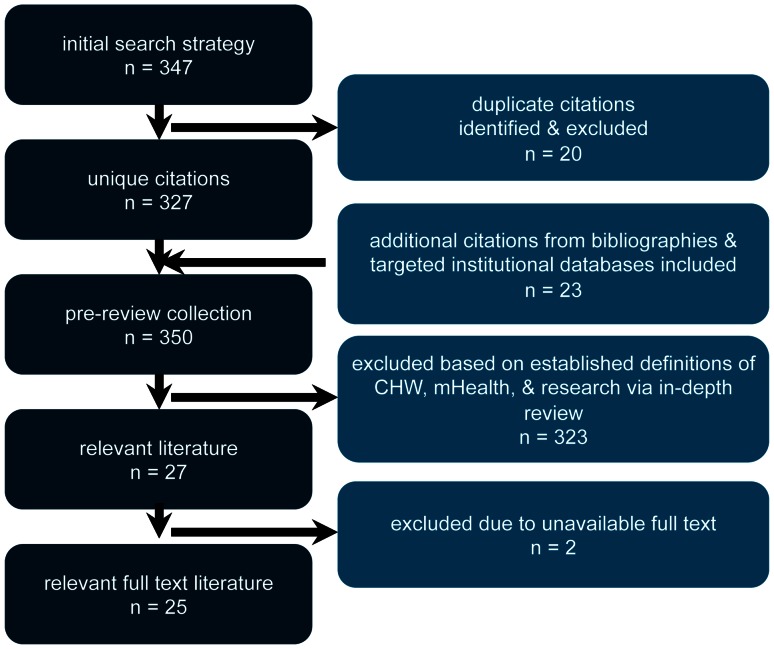
INTRODUCTION: In low-resource settings, community health workers are frontline providers who shoulder the health service delivery burden. Increasingly, mobile technologies are developed, tested, and deployed with community health workers to facilitate tasks and improve outcomes. We reviewed the evidence for the use of mobile technology by community health workers to identify opportunities and challenges for strengthening health systems in resource-constrained settings. METHODS: We conducted a systematic review of peer-reviewed literature from health, medical, social science, and engineering databases, using PRISMA guidelines. We identified a total of 25 unique full-text research articles on community health workers and their use of mobile technology for the delivery of health services. RESULTS: Community health workers have used mobile tools to advance a broad range of health aims throughout the globe, particularly maternal and child health, HIV/AIDS, and sexual and reproductive health. Most commonly, community health workers use mobile technology to collect field-based health data, receive alerts and reminders, facilitate health education sessions, and conduct person-to-person communication. Programmatic efforts to strengthen health service delivery focus on improving adherence to standards and guidelines, community education and training, and programmatic leadership and management practices. Those studies that evaluated program outcomes provided some evidence that mobile tools help community health workers to improve the quality of care provided, efficiency of services, and capacity for program monitoring. DISCUSSION: Evidence suggests mobile technology presents promising opportunities to improve the range and quality of services provided by community health workers. Small-scale efforts, pilot projects, and preliminary descriptive studies are increasing, and there is a trend toward using feasible and acceptable interventions that lead to positive program outcomes through operational improvements and rigorous study designs. Programmatic and scientific gaps will need to be addressed by global leaders as they advance the use and assessment of mobile technology tools for community health workers.
Overview
The claims and statistics of this paper haven’t been checked yet.
Free: it reads the open-access text and checks the first 5 claims that cite a source we can check. Create a free account to check every claim.
Integrity signals
Registry
Cites
Statistics
Figures
Verification
Claims the paper makes
The claims and statistics of this paper haven’t been checked yet.
Free: it reads the open-access text and checks the first 5 claims that cite a source we can check. Create a free account to check every claim.
Claims other papers make about this one
Each is checked against this paper’s own text: does it say what the citing paper says it does?
The source backs part of the claim, not all of it — or backs it for a different population, condition or comparison.
In the citing paper
“However, few studies have captured end-user experiences with a mobile-based app [18,19].”
From Operability, Usefulness, and Task-Technology Fit of an mHealth App for Delivering Primary Health Care Services by Community Health Workers in Underserved Areas of Pakistan and Afghanistan: Qualitative Study (2020) · cites this paper as [18]
Experimental — accuracy not yet measuredThe source backs part of the claim, not all of it — or backs it for a different population, condition or comparison.
In the citing paper
“In LMICs, the mobile technology has been used by CHWs to address a range of health issues related to maternal and child health, sexual and reproductive health, family planning, HIV/AIDS, general health, acute respiratory infections, infectious diseases and injury and trauma [22].”
From Using mobile phones to improve community health workers performance in low-and-middle-income countries (2020) · cites this paper as [22]
Experimental — accuracy not yet measured
Self-check
Percentages, sums and reported differences re-computed from the paper’s own numbers.
The self-check needs the paper’s full text.
Citations
Cites
Preferred Reporting Items for Systematic Reviews and Meta-Analyses: the PRISMA statement
Moher, D., Liberati, A., Tetzlaff, J., Altman, D. G., & for the PRISMA Group (2009) · BMJ · doi:10.1136/bmj.b2535 · Cited by 83,823
Preferred Reporting Items for Systematic Reviews and Meta-Analyses: The PRISMA Statement
Moher, D., Liberati, A., Tetzlaff, J., Altman, D. G., & The PRISMA Group (2009) · PLoS Medicine · doi:10.1371/journal.pmed.1000097 · Cited by 64,042
Preferred reporting items for systematic reviews and meta-analyses: The PRISMA statement
Moher, D., Liberati, A., Tetzlaff, J., Altman, D. G., & the PRISMA Group* (2009) · Annals of Internal Medicine · doi:10.7326/0003-4819-151-4-200908180-00135 · Cited by 37,554
Prentice, T. (2013) · Res Medica · doi:10.2218/resmedica.v21i1.510 · Cited by 1,707
Human resources for health: overcoming the crisis
Chen, L., Evans, T., Anand, S., Boufford, J. I., Brown, H., Chowdhury, M., Cueto, M., Dare, L., Dussault, G., Elzinga, G., et al. (2004) · The Lancet · doi:10.1016/s0140-6736(04)17482-5 · Cited by 1,552 · cited 2×
“Proponents argue engaging CHWs expands the pool of human resources for health, improves the productivity of health systems, and lowers the cost of providing services by shifting tasks from highly trained physicians and nurses to less specialized community members [2,3,5].”
BackgroundConway, M. E. (1967) · Cited by 812
How to bridge the gap in human resources for health
Hongoro, C., & McPake, B. (2004) · The Lancet · doi:10.1016/s0140-6736(04)17229-2 · Cited by 440 · cited 2×
“Proponents argue engaging CHWs expands the pool of human resources for health, improves the productivity of health systems, and lowers the cost of providing services by shifting tasks from highly trained physicians and nurses to less specialized community members [2,3,5].”
BackgroundZurovac, D., Sudoi, R. K., Akhwale, W. S., Ndiritu, M., Hamer, D. H., Rowe, A. K., & Snow, R. W. (2011) · The Lancet · doi:10.1016/s0140-6736(11)60783-6 · Cited by 403 · cited 1×
“These include a description of a clusterrandomized controlled trial with CHWs to evaluate effects of a health data collection and decision support system on health outcomes of mothers living with HIV [14], a cluster randomized controlled trial to evaluate effects of alerts and reminders on CHWs adherence to malaria tr…”
The use of mobile phones as a data collection tool: A report from a household survey in South Africa
Tomlinson, M., Solomon, W., Singh, Y., Doherty, T., Chopra, M., Ijumba, P., Tsai, A. C., & Jackson, D. (2009) · BMC Medical Informatics and Decision Making · doi:10.1186/1472-6947-9-51 · Cited by 340 · cited 2×
“Further, these mobile tools can enable real-time quality review and analysis for decision-making [11], as well as rapid response to cited health issues [20].”
BackgroundResultResponding to the global human resources crisis
Narasimhan, V., Brown, H., Pablos-Mendez, A., Adams, O., Dussault, G., Elzinga, G., Nordstrom, A., Habte, D., Jacobs, M., Solimano, G., et al. (2004) · The Lancet · doi:10.1016/s0140-6736(04)16108-4 · Cited by 284 · cited 1×
“Nearly all countries are challenged by shortages of health workers [1].”
Cited by
Items 301–400 of 525
Hentschel, E., Russell, A. L., Said, S., Tibaijuka, J., Hedt‐Gauthier, B., & Fulcher, I. (2022) · Maternal and Child Health Journal · doi:10.1007/s10995-022-03432-3 · Cited by 7
“Incorporating digital tools within CHW programs provides an opportunity to close this gap by aiding CHWs in their provision of quality, timely healthcare (Braun et al., 2013; Mangwi Ayiasi et al., 2015) meanwhile improving the monitoring and evaluation of programs due to the promptness and ease of data collection (Mis…”
BackgroundInfluentialLeBaron, V. T., Horton, B. J., Adhikari, A., Chapagain, S., Dhakal, M., Gongal, R. N., Kattel, R., Koirala, G., Kutcher, A. M., Hass, B., et al. (2022) · Frontiers in Pain Research · doi:10.3389/fpain.2022.910995 · Cited by 7
“There is growing evidence that mHealth in LMICs can increase access to care (30, 33), support frontline healthcare workers (37, 39, 42, 43), enhance data collection (31, 44), and improve patient outcomes (45–47), but finding ways to evaluate effectiveness can be challenging (48, 49).”
BackgroundMartinez, P. R. S. (2015) · Digital Access to Scholarship at Harvard (DASH) (Harvard University) · Cited by 19
Owoputi, I., Hoddinott, J. F., Kayanda, R., Kerr, R. B., & Dickin, K. (2024) · Current Developments in Nutrition · doi:10.1016/j.cdnut.2024.103780 · Cited by 6
“Mobile health interventions or applications have the potential to reduce the need for travel, which can expand CHW reach and improve their quality of care [52,53].”
BackgroundHemlock, C., Galasso, E., Weber, A. M., Randriamiarisoa, T. C., Col, M., Dieci, M., Ratsifandrihamanana, L., & Fernald, L. C. H. (2024) · BMC Public Health · doi:10.1186/s12889-024-20149-w · Cited by 6
“Aspects of future scale-up efforts, from training on new data modules, to continued program evaluation and improvement, can leverage these technological systems [28].”
BackgroundSitorukmi, G., Rusadi, C. P., Lazuardi, L., Prasetyo, S., & Putri, L. P. (2025) · Global Health Action · doi:10.1080/16549716.2025.2548083 · Cited by 7
“This finding aligns with those of previous studies highlighting several challenges, such as varying literacy levels among CHVs and community members, inadequate training on digital use, and the need to use various mobile applications for different health programs [52,53].”
Choudhury, N., Tiwari, A., Wu, W., Bhandari, V. P., Bhatt, L. D., Bogati, B., Citrin, D., Halliday, S., Khadka, S., Marasini, N., et al. (2022) · Population Health Metrics · doi:10.1186/s12963-022-00293-4 · Cited by 6
“Mobile technologies assist CHWs in delivering quality services and collecting data in remote and rural areas [12].”
BackgroundO’Connor, Y., Heavin, C., Gallagher, J., & O’Donoghue, J. (2017) · Behaviour and Information Technology · doi:10.1080/0144929x.2017.1280537 · Cited by 6
“They are responsible for delivering a number of healthcare services such as disease management to maternal care (Braun et al. 2013).”
BackgroundLorenzetti, L., Tharaldson, J., Pradhan, S., Rastagar, S. H., Hemat, S., Ahmadzai, S. A. H., Dulli, L., Weissman, A., & Todd, C. S. (2020) · Human Resources for Health · doi:10.1186/s12960-020-00477-9 · Cited by 6
Santo, L. D., Rastagar, S. H., Hemat, S., Alami, S. O., Pradhan, S., Tharaldson, J., Dulli, L., & Todd, C. S. (2020) · Conflict and Health · doi:10.1186/s13031-020-00302-z · Cited by 6
Improving health care facility birth rates in Rorya District, Tanzania: a multiple baseline trial
Webber, G. C., Chirangi, B., Magatti, N., Mallick, R., & Taljaard, M. (2022) · BMC Pregnancy and Childbirth · doi:10.1186/s12884-022-04408-5 · Cited by 6
“In fact, in their review of m-health programs using CHWs, Braun and colleagues determined that while there is significant potential for CHWs to collect data and provide health services using m-health applications, more research needs to be done on scaleup of these projects to measure their impact on program implementa…”
BackgroundCompiling a prioritized list of health data quality challenges in public healthcare systems
Botha, M., Botha, A., & Herselman, M. E. (2014) · IST-Africa Conference (IST-Africa) · doi:10.1109/istafrica.2014.6880649 · Cited by 6
Castell, E. (2017) · Aloma: revista de psicologia, ciències de l'educació i de l'esport Blanquerna · doi:10.51698/aloma.2017.35.2.23-37 · Cited by 7
Mwape, L., Wahila, R., Makukula, M. K., Lyambai, K., & Christoph, P. (2018) · Creative Education · doi:10.4236/ce.2018.93028 · Cited by 7
Margaret, R. M., & Hägglund, M. (2019) · Studies in health technology and informatics · doi:10.3233/shti190163 · Cited by 7
“Braun et al agree that technologies need to be a better fit for CHWs tasks to optimize performance [12].”
BackgroundGupta, E., & Kanu, N. J. (2020) · American Journal of Infectious Diseases · doi:10.3844/ajidsp.2020.89.108 · Cited by 6
“…(2020) studied the novel COVID-19 outbreak in India using the modified agestructured Susceptible-Infected-Recovered (SIR) model (Pontryagin, 1985; Box, 1976) by considering the initiative of the Indian government to implement mitigatory measures such as lockdown across the nation and social…”
BackgroundMethodMiranda, I. D. S., Cardoso, G. S., Pahar, M., de Oliveira, G. G., & Niesler, T. (2021) · IEEE-EMBS International Conference on Biomedical and Health Informatics (BHI ...) · doi:10.1109/bhi50953.2021.9508548 · Cited by 6
Networking community health workers for service integration: role of social media
Li, L., Lin, C., Pham, L. Q., Nguyen, D. B., & Le, T. A. (2022) · AIDS Care · doi:10.1080/09540121.2021.2019668 · Cited by 8
“Mobile-based strategies have become promising to strengthen CHW’s capacity and quality of care (Agarwal et al., 2015; Braun et al., 2013).”
BackgroundCunningham, M., Cunningham, P. M., van Greunen, D., Kanjo, C., Kweyu, E., & Tilahun, B. C. (2018) · IEEE Global Humanitarian Technology Conference (GHTC) · doi:10.1109/ghtc.2018.8601681 · Cited by 8
Castle, S., & Silva, M. (2019) · doi:10.31899/rh14.1115 · Cited by 14
Individual and Systemic Barriers Blocking Community Health Workers from Helping the Seriously Ill
Rowe, J. T., Parrillo, E., Stanford, O., Wenzel, J. A., & Johnston, F. M. (2023) · Journal of Palliative Medicine · doi:10.1089/jpm.2022.0516 · Cited by 6
Desmond, N., Henrion, M., Gondwe, M. J., O’Byrne, T., Tam, P. I., Nyirenda, D., Pollock, L., Majamanda, M. D., Makwero, M., Geldof, M., et al. (2024) · PLOS Global Public Health · doi:10.1371/journal.pgph.0002786 · Cited by 5
“…clinical updates, to feedback on practice, learning materials, reminders, decision-making, and adherence to standards and guidelines in care [17]. mHealth has been increasingly recognised as a health systems strengthening tool [18], but there has been comparatively less progress in the…”
Goh, H., Dary, C., Ung, M., Oy, S., Lee, Y. L., Mam, S., Chhorn, S., Ny, C., Chhay, S. C. A., Khim, C., et al. (2025) · Human Resources for Health · doi:10.1186/s12960-025-01002-6 · Cited by 6
Adam, M., Job, N., Mabaso, B. P., Bärnighausen, T., Kuhnert, K.-L., Johnston, J. S., Mqungwana, N., Roux, I. L., Mbewu, N., Gates, J., et al. (2022) · Qualitative Health Research · doi:10.1177/10497323221091504 · Cited by 6
“( Braun et al., 2013; Early et al., 2019; Ward et al., 2020) Much of the existing research has examined maternal child health interventions delivered through short messaging services (i.e., text messages) on feature phones.”
BackgroundNeural network models selection scheme for health mobile app development
Triana, Y. S., Osman, M. A., Pratomo, A., Pasha, M. F., Stiawan, D., & Budiarto, R. (2023) · IAES International Journal of Artificial Intelligence · doi:10.11591/ijai.v12.i3.pp1191-1203 · Cited by 7
GRAVID: an indigenous m-health tool for smart and connected communities
Akinseinde, A. S., Badejo, J. A., & Malgwi, R. L. (2016) · 2016 Future Technologies Conference (FTC) · doi:10.1109/ftc.2016.7821776 · Cited by 5
“GRAVID can be used by community health workers to collect field-based health data, send alerts and reminders, facilitate health education sessions, and conduct person-to-person communication as indicated in [7].”
BackgroundAhmed, J., Nothem, A., Mostel, J. L., Ciceron, A. C., Nuñez, L., Raobela, O., Raoiliarison, A. P., Lankhulani, S., Munthali, J., Cissoko, M., et al. (2024) · American Journal of Tropical Medicine and Hygiene · doi:10.4269/ajtmh.23-0488 · Cited by 7
Obeysekare, E., Mehta, K., & Maitland, C. F. (2017) · The Journal of Community Informatics · doi:10.15353/joci.v13i3.3329 · Cited by 5
Spindler, H. H., Dyer, J., Bagchi, K., Ranjan, V., Christmas, A., Cohen, S. R., Sterling, M., Shah, M. B., Das, A., Mahapatra, T., et al. (2018) · Nursing Open · doi:10.1002/nop2.134 · Cited by 5
PREVALENCE OF UNINTENDED PREGNANCY AND ASSOCIATED FACTORS IN PORT-SAID CITY
Nor, S. A., Amasha, H. A. –. R., salama, N. S. S., & Abdel-haleem, S. A. R. O. (2019) · Port Said Scientific Journal of Nursing · doi:10.21608/pssjn.2019.34039 · Cited by 5
Cunningham, P. M., & Cunningham, M. (2019) · Annual International Conference of the IEEE Engineering in Medicine and Biology Society (EMBC) · doi:10.1109/embc.2019.8856860 · Cited by 5
“Interoperability and underlying standards are critical components of the WHO and ITU National eHealth Strategy Toolkit [9, 22].”
BackgroundPolicy recommendations on nurses’ use of smartphones in the Philippines
Bautista, J. R. (2020) · International Journal of Medical Informatics · doi:10.1016/j.ijmedinf.2020.104250 · Cited by 6
“and traditional birth attendants) in the community setting [11,12], nurses’ use of smartphones for work purposes in hospital settings is still under scrutiny due to various issues, such as work distraction and privacy concerns [10,13].”
BackgroundEvaluation of a Home Visiting Program: Perspectives of Mothers
Lowe, K., Cartagena, D. C., & Gudger, K. (2021) · Home Healthcare Now · doi:10.1097/nhh.0000000000000948 · Cited by 5
Lower Prevalence Countries Outside of South-Eastern Africa Now Have the Fastest Growing HIV Epidemic
Pepperrell, T., Hill, A. M., & Cross, S. (2024) · Open Forum Infectious Diseases · doi:10.1093/ofid/ofae318 · Cited by 5
de Melo, L. D. R., Ribeiro, A. L. P., Oliveira, J. A. D. Q., Maia, J. X., de Sá, T. Q. V., Pinto, V. S. D. O. E. A., Lima, M. M. O., Enlich, P. W., Ribeiro, L. B., Cimini, C. C. R., et al. (2024) · International Journal of Cardiovascular Sciences · doi:10.36660/ijcs.20230085 · Cited by 4
“39,40 In total, 7,660 patients were screened for hypertension and 12,236 for DM, using a strategy carried out in an integrative field study between community activities at health events and individualized activities at PCUs, facilitated by using the CDSS.”
MethodChen, A. Z., McCray, G. G., Akintobi, T. H., & Best, M. L. (2025) · ACM SIGCAS/SIGCHI Conference on Computing and Sustainable Societies (COMPASS) · doi:10.1145/3715335.3735491 · Cited by 6
“Computing researchers as well as public health researchers and practitioners have long engaged CHWs to conduct technology-based interventions to improve community health [9], largely in the Global South across South Asia, Africa, and Latin America.”
Njoroge, J. K., Gitau, T. M., Yegon, E. K., Mwita, N., Koimur, A., Ochieng, M., Omondi, R., & Amihanda, R. (2025) · Frontiers in Public Health · doi:10.3389/fpubh.2025.1612973 · Cited by 4
“These findings reinforce a growing body of evidence demonstrating how digitally enabled CHWs that are consistently supervised are more efficient and consistent (38, 39).”
Sujatmiko, B., Fitria, N., Fathania, D., Salindri, A. D., & Alisjahbana, B. (2017) · International Conference on Instrumentation, Communications, Information Technology, and Biomedical Engineering · doi:10.1109/icici-bme.2017.8537774 · Cited by 4
Harvey, J., & powell, J. A. (2019) · BMC Medical Informatics and Decision Making · doi:10.1186/s12911-019-0869-x · Cited by 8
Advancing Access to Healthcare through Telehealth: A Brownsville Community Assessment
Ledesma, E., & Champagne‐Langabeer, T. (2022) · Healthcare · doi:10.3390/healthcare10122509 · Cited by 5
“Indeed, promotoras have been the catalysts in many public health initiatives where new technologies were successfully implemented in technology-naïve population [54,55].”
BackgroundNepal, P., Subedee, A., Shakya, H., Poudel, S., Joshi, S., Karki, K., Bajracharya, D. C., Prentiss, T. C., Kaljee, L., & Acharya, Y. (2023) · Contemporary Clinical Trials Communications · doi:10.1016/j.conctc.2023.101177 · Cited by 6
Chaudry, B., Faust, L. J., & Chawla, N. V. (2018) · International Conference on Pervasive Computing Technologies for Healthcare · doi:10.1145/3240925.3240938 · Cited by 4
“Evidence suggests that, across the globe, mHealth (mobile health) has helped community health workers improve the range and quality of services, particularly maternal and child health education [8].”
BackgroundMobile Health Technology Evaluation: Innovativeness and Efficacy vs. Cost Effectiveness
Idrish, S., Rifat, A., Iqbal, M., & Nisha, N. (2017) · IGI Global eBooks · doi:10.4018/978-1-5225-3168-5.ch002 · Cited by 5
Hlongwane, M. V. (2016) · Cited by 6
Sathiyamoorthy, R., Chandra, A., Poudel, S., Kumar, R., Salve, H. R., Yadav, K., & Kant, S. (2022) · Journal of Education and Health Promotion · doi:10.4103/jehp.jehp_406_22 · Cited by 3
“Among the YouTube users, 66.1% of them (n = 39) used YouTube every day [Table 2].”
BackgroundInfluentialMustamin1, S. (2020) · Indian Journal of Forensic Medicine & Toxicology · doi:10.37506/ijfmt.v14i3.10733 · Cited by 3
Social realities in remote villages: Infant and young child feeding in Kirewa, Uganda
Schneider, L., Korhonen, K., Ollila, S., & Mutanen, M. L. (2024) · PLOS Global Public Health · doi:10.1371/journal.pgph.0003016 · Cited by 5
“The role of CHWs in nutrition, hygiene, and health education has consequently been emphasized [67, 68] especially in remote locations, where CHWs are often the only information source in addition to family and friends [69].”
Yang, Z., Wang, Q., Yi, F., Zhang, L., Li, Y., Rong, L., & Wan, S. (2025) · BMC Health Services Research · doi:10.1186/s12913-024-11835-x · Cited by 4
“However, online health education was primarily tailored for young inhabitants who were busy and proficient in online tools [55].”
Okanmelu, E. C., Sekgala, M. D., Delobelle, P., Alaba, O. A., Holliday, N. M., Hill, J., Lembani, M., & Mchiza, Z. J. (2025) · BMC Nutrition · doi:10.1186/s40795-025-01124-z · Cited by 4
“CHWs play a pivotal role in bridging the gap between healthcare services and communities, making them ideal agents for disseminating nutrition information and fostering behaviour change [23–25].”
Bass, M., Rosen, K. D., Gerend, M. A., Wakschlag, L. S., Madkins, K., Crosby, S. T., Alshurafa, N. I., King, Z. D., Ghaffari, R., & Smith, J. D. (2021) · Families Systems & Health · doi:10.1037/fsh0000592 · Cited by 3
“…phone features, text messaging, is particularly well-suited for health information exchange between patient and provider (e.g., interventions) (Braun, Catalani, Wimbush, & Israelski, 2013; Hall, Cole-Lewis, & Bernhardt, 2015; Head, Noar, Iannarino, & Harrington, 2013; Pew Research Center,…”
Development of a Digital Case Management Tool for Community Based Inclusive Development Program
Marella, M., Koolmees, D., Vongvilay, C., Frank, B., Pryor, W., & Smith, F. M. (2021) · International Journal of Environmental Research and Public Health · doi:10.3390/ijerph182011000 · Cited by 4
“Further, real-time data collection assists instantaneous data review, analysis and decision making; and timely management of health issues [25,26].”
BackgroundModels of Diabetes Care Across Different Resource Settings
Levitt, N. S., Surka, S., Farmer, A. A., & Mash, R. J. (2016) · Wiley eBooks · doi:10.1002/9781118924853.ch65 · Cited by 3
Savai, S. M., Kamano, J. H., Misoi, L., Wakholi, P., Hasan, M. K., & Were, M. C. (2022) · PLOS Digital Health · doi:10.1371/journal.pdig.0000096 · Cited by 3
Patel, K., Nayak, B., Behera, T. R., Mandal, N., Rana, S., Gupta, N., Malik, A., Patil, S., & Palo, S. K. (2022) · International Journal of Community Medicine and Public Health · doi:10.18203/2394-6040.ijcmph20222901 · Cited by 3
Barbosa, G. L., Gomes, A. H. A., & de Camargo-Neves, V. L. F. (2023) · Insects · doi:10.3390/insects14040380 · Cited by 3
Challenges and Opportunities of Telemedicine for Women's Sexual Satisfaction: A Systematic Review
Joneidi, E., Najmabadi, K. M., & Aalaei, S. (2024) · Journal of Nursing and Midwifery Sciences · doi:10.5812/jnms-142751 · Cited by 3
Ferguson, A., Erwin, E., Sleeth, J., Symonds, N., Chard, S., Yuma, S., Oneko, O., Macheku, G. S., Andrews, L., West, N., et al. (2024) · International Journal of Environmental Research and Public Health · doi:10.3390/ijerph21070878 · Cited by 3
Prado, P. V., Arechiga, C., Marson, K. G., Oviedo, Y., Vizcaíno, T., Gómez, M., Álvarez, A., Jimenez-Diecks, L., Guevara, S., Nava, A., et al. (2024) · JAMIA Open · doi:10.1093/jamiaopen/ooae115 · Cited by 3
“27,28 31 Despite this need, there has been limited literature on evaluating CHW self-reported digital literacy in the United States, and capacity building in response to training.”
BackgroundMunyai, O., Mudau, A. G., & Mashau, N. S. (2024) · African Journal of Primary Health Care & Family Medicine · doi:10.4102/phcfm.v16i1.4554 · Cited by 3
The Contribution of Digital Technologies to Service Delivery: An Evidence Review
Sharmin, S., Faith, B., Martín, P. P., & Ramalingam, B. (2017) · Figshare · Cited by 4
Stiles, C. E., O’Neil, E., Kabali, K., & O’Donovan, J. (2021) · African Health Sciences · doi:10.4314/ahs.v21i3.60 · Cited by 5
Suparni, S., Fatkhudin, A., & Zuhana, N. (2021) · Jurnal Litbang Kota Pekalongan · doi:10.54911/litbang.v21i1.163 · Cited by 3
Kagiri, M., Waiganjo, P., & Ngechu, R. (2015) · University of Nairobi Research Archive (University of Nairobi) · Cited by 7
Factors Impacting Older Adults' Adoption of Mobile Technology in Emergency Communications
Scerra, W. A. (2016) · ScholarWorks (Walden University) · Cited by 3
Rinawan, F. R., Susanti, A. I., Amelia, I., Ardisasmita, M. N., Widarti, Dewi, R. K., Ferdian, D., Purnama, W. G., & Purbasari, A. (2020) · Research Square · doi:10.21203/rs.3.rs-15584/v1 · Cited by 3
“Any feedback is correction for step 2, then proceed to step 3, (4) Designing the prototype, (5) Creating a dynamic design prototype or a dynamic design that is a programmed with planned features but still not in the executed form, (6) Evaluating design with the users to decrease miscommunication, (7) Evaluating the ex…”
BackgroundMethodHodges, E. U., Crissman, K., Chang, Z., Ekeigwe, K., Vissoci, J. R. N., & Udayakumar, K. (2025) · medRxiv · doi:10.64898/2025.12.29.25343175 · Cited by 3
Nkurunziza, J., Nuss, S., Estrada, E. H., Kubwimana, M., Boatin, A. A., Bikorimana, L., Fletcher, R. R., Byiringiro, N., Hedt-Gauthier, B., & Cubaka, V. K. (2026) · JMIR mHealth and uHealth · doi:10.2196/64916 · Cited by 2
“Over the past 2 decades, an increasing number of mHealth solutions have been developed to assist community health workers (CHWs) in performing critical tasks across a range of health interventions [1,2].”
Brown, S., & Hussain, F. (2017) · IFIP advances in information and communication technology · doi:10.1007/978-3-319-59111-7_65 · Cited by 2
“A review of literature [7] on CHWs and mobile technology finds that CHWs have used mobile tools for maternal and child health, HIV/AIDS, and reproductive health.”
Dawud, M. A., Kalayou, M. H., Wasihun, Y., Yasine, T., Ayalew, T., & Kasaye, M. D. (2025) · Computer Methods and Programs in Biomedicine Update · doi:10.1016/j.cmpbup.2025.100215 · Cited by 2
Dozie, U. W., Daniel, G. U., Raphael, C. O., Dozie, K. C. N., Nnadede, C. J., Igwe, C. N., Anthony, A., & Dozie, I. N. S. (2025) · BMC Public Health · doi:10.1186/s12889-025-23935-2 · Cited by 2
Bhojani, A., Wright, K., Rosenhan, J., Besana, G. V. R., Kweka, H., Kagaruki, G. B., Mohammed, A., Khamis, H., Li, T., Slim, S., et al. (2026) · BMC Digital Health · doi:10.1186/s44247-026-00252-1 · Cited by 2
Carrasquillo, O., Young, B., Dang, S., Fontan, O., Ferras, N., Romano, J. G., Dong, C., & Kenya, S. (2018) · JMIR Research Protocols · doi:10.2196/11083 · Cited by 2
“Although there are increasing reports of mHealth-focused CHW project evaluations, the majority of studies are not randomized and provide limited information on the impact of the intervention [26].”
BackgroundLeveraging intrinsic resources for the protection of health information assets
Kativu, K. T., & Pottas, D. (2019) · South African Computer Journal · doi:10.18489/sacj.v31i2.536 · Cited by 2
Role of Technology in Decision Making
Gupta, R., & Pal, S. K. (2021) · Springer eBooks · doi:10.1007/978-981-16-0282-5_1 · Cited by 2
Angeles, K. J. C. D., Storey, S., Nordberg, B., Kaguiri, E., Dusabe-Richards, J., Ekström, A. M., Were, E. O., Skovdal, M., & Kågesten, A. (2025) · SSM - Health Systems · doi:10.1016/j.ssmhs.2025.100075 · Cited by 2
Brin, M., Michaels, C. L., Veihman, P. R., Wood, O. R., Abua, J., Kay, E. S., Batey, D. S., & Schnall, R. (2025) · International Journal of Medical Informatics · doi:10.1016/j.ijmedinf.2025.105959 · Cited by 3
Gupta, S., Chatterjee, A., Singhal, K., Pakhare, A. P., & Joshi, A. (2025) · Cureus · doi:10.7759/cureus.86648 · Cited by 3
Nursing during an era of change: A challenge and opportunity
Martin, M. (2013) · Journal of Nursing Education and Practice · doi:10.5430/jnep.v4n1p189 · Cited by 2
Bringing Visibility to Community Health Work with mHealth Systems: A Case of Malawi
Namatovu, E., & Kanjo, C. (2017) · IFIP advances in information and communication technology · doi:10.1007/978-3-319-59111-7_51 · Cited by 4
L’évaluation psychologique par le biais des applications mobiles.
East‐Richard, C., Laplante, L., Vézina, J., & Cellard, C. (2017) · Canadian Psychology/Psychologie canadienne · doi:10.1037/cap0000113 · Cited by 2
“Une revue systématique portant sur l’usage des applications mobiles auprès des professionnels de la santé a révélé que celles-ci permettaient d’améliorer la qualité des soins donnés, l’efficacité des services de même que la capacité des programmes de suivi (Braun et al., 2013).”
BackgroundMobile health monitoring system for community health workers
Sibiya, G., Makitla, I., Ogunleye, G. S., Fogwill, T., & Alberts, R. (2014) · Cited by 2
'Community engagement: the ‘C’ at the heart of CMAM'
Gray, N., & Bedford, J. (2014) · Cited by 5
Watkins, J., & Baulch, E. (2017) · Mobile communication in Asia · doi:10.1007/978-94-024-1251-2_5 · Cited by 3
Mobilities of the Community Health Work Practice: Mobile Health system Mediated Work
Namatovu, E., Sæbø, J. I., & Kaasbøll, J. (2017) · The Journal of Community Informatics · doi:10.15353/joci.v13i3.3364 · Cited by 2
“CHWs were studied to learn and identify work practices and how they are interpreted to give meaning to shared action.”
BackgroundInfluentialKnowledge and Attitude towards Childhood Vaccination of Indigenous Peoples in Cagayan, Philippines
Capili, J. T., Chua, J. M. T., & Calubaquib, L. A. C. M. J. B. (2022) · International Journal of Biosciences (IJB) · doi:10.12692/ijb/21.6.151-159 · Cited by 2
Technology and Data Collection in Chronic Disease Epidemiology
Holt, J. B. (2015) · Preventing Chronic Disease · doi:10.5888/pcd12.150400 · Cited by 2
John, A. (2018) · Sussex Research Online (University of Sussex) · Cited by 5
Rinawan, F. R., Susanti, A. I., Amelia, I., Ardisasmita, M. N., -, W., Dewi, R. K., Ferdian, D., Purnama, W. G., & Purbasari, A. (2020) · Research Square · doi:10.21203/rs.3.rs-15584/v3 · Cited by 2
“Studies that have evaluated the program results nd some evidence that mobile health application (mHealth) assisted CHWs in enhancing the provided treatment quality, services e ciency, and program monitoring capacity (5).”
BackgroundMethodInfluentialNawaz, H., Zaidi, S. A., Rashid, A., Sadia, A., Muzammil, M., Riaz, A., & Sayani, S. (2023) · Research Square · doi:10.21203/rs.3.rs-3532032/v1 · Cited by 2
Program Evaluation of a Home Visiting Program: Perspectives of Home Visitors
Gudger, K., Cartagena, D. C., & Lowe, K. (2020) · Home Healthcare Now · doi:10.1097/nhh.0000000000000914 · Cited by 1
Rodrigues, D. A., Plácido, A. I., Mateos-Campos, R., Figueiras, A., Herdeiro, M. T., & Roque, F. (2024) · Acta Médica Portuguesa · doi:10.20344/amp.21537 · Cited by 1
“The overall evaluation of the developed tool was positive, and this study validated the research for the next phase.”
MethodSchubel, L., Barac, A., Magee, M. F., Méte, M., Peeples, M., Shomali, M. E., Miller, K., Bangerter, L. R., Fong, A., Gallagher, C., et al. (2024) · Contemporary Clinical Trials Communications · doi:10.1016/j.conctc.2024.101387 · Cited by 1
“It is also possible that regular engagement with the CHWs in our work, in combination with an initial study referral from the patient ’ s oncology provider, may have increased trust or connection, resulting in lasting engagement among participants [74 – 76].”
Kasaya, G., Kariuki, J., & Muchiri, J. M. (2025) · African Journal of Empirical Research · doi:10.51867/ajernet.6.1.32 · Cited by 1
Damayanti, M., Saputri, N. A. S., & Darwitri, D. (2025) · International Journal of Social Science · doi:10.53625/ijss.v5i2.10999 · Cited by 1
“This principle is reinforced by the studies of Braun et al. (2013) and White et al. (2016), which found that mHealth applications consistently improve the productivity of community health workers in carrying out community-based tasks such as data collection and home visits, particularly in low-and…”
Effective Strategies in Disease Control and Prevention: A Systematic Review
Daneshi, S., Nikvarz, M., Raesi, R., Kamali, A., Barfar, E., & Hushmandi, K. (2025) · Infectious Disorders - Drug Targets · doi:10.2174/0118715265380960250726161521 · Cited by 1
Li, Q., Zeng, G., Chen, S., Li, K., & Hu, Z. (2026) · Computers and Electronics in Agriculture · doi:10.1016/j.compag.2026.111678 · Cited by 1
Getahun, G. K., Wondimagegne, Y. A., DERESSA, A. D., Tamiru, B., Berhe, T. T., Mekonen, M., Hadgu, T., Kahsay, Z. H., Alemayehu, M., Gebrekurstos, G., et al. (2026) · Vaccine X · doi:10.1016/j.jvacx.2026.100843 · Cited by 1
Mekuria, L. A., Likasa, G., Sintayehu, T., Mekonen, L., Tekeste, A., Seid, E., Alemayehu, W. A., Negash, A., Shewarega, A., Tilaye, M., et al. (2026) · Global Health Science and Practice · doi:10.9745/ghsp-d-24-00353 · Cited by 2
Implementing mHealth in Lowand Middle-Income Countries: What Should Program Implementers Consider?
Hull, T. D. (2014) · CRC Press eBooks · doi:10.1201/b17724-16 · Cited by 2
Chavira, M., & Durá, L. (2019) · SpringerBriefs in psychology · doi:10.1007/978-3-030-29112-9_7 · Cited by 1
Metadata
- Authors
- Braun, R., Catalani, C., Wimbush, J., & Israelski, D.
- Affiliations
- University of California, Berkeley (US)
- Stanford University (US)
- Corresponding author
- Braun, Rebecca
- Venue
- PLoS ONE
- Publisher
- Public Library of Science (PLoS)
- Published
- 2013-06-12
- Volume
- 8
- Issue
- 6
- Pages
- e65772
- ISSN
- 1932-6203 (ISSN-L)
- PMC
- PMC3680423
- OpenAlex
- W2025634432
- Semantic Scholar
- 8a9a74f6e8dbd5631be3df9bc5183849ea5e4177
- Cited by
- 493
- References
- 25
- Citations by year
- 2026: 22 · 2025: 25 · 2024: 36 · 2023: 39 · 2022: 45 · 2021: 52 · 2020: 54 · 2019: 50 · 2018: 41 · 2017: 45 · 2016: 33 · 2015: 25 · 2014: 23 · 2013: 3
- FWCI
- 3.36
- Type
- journal article
- Language
- en
- Open access
- gold
- doi.org
- Locations
- PLoS ONE (publishedVersion, cc-by)
- Europe PMC (PubMed Central) (publishedVersion, cc-by)
- PubMed Central (publishedVersion, cc-by)
- PubMed (publishedVersion)
- RePEc: Research Papers in Economics (acceptedVersion)
- DOAJ (DOAJ: Directory of Open Access Journals) (submittedVersion, cc-by-sa)
- eScholarship (California Digital Library) (submittedVersion)
- Funders
- United States Agency for International Development
- U.S. President’s Emergency Plan for AIDS Relief
- Centers for Disease Control and Prevention
- Topics
- Health Sciences › Health Professions › General Health Professions › Mobile Health and mHealth Applications
- Physical Sciences › Computer Science › Information Systems › ICT in Developing Communities
- Health Sciences › Medicine › Public Health, Environmental and Occupational Health › Global Health Workforce Issues
- Keywords
- community health workers, mobile technology, mobile health, health care delivery, resource-limited settings, maternal and child health, HIV/AIDS, sexual and reproductive health, health data collection, health education, quality of care, program monitoring, health system strengthening
- MeSH terms
- Community Health Workers, Data Collection, Delivery of Health Care, Humans, Public Health, Cell Phone, Mobile Applications
About these checks
Registry, retraction, Cites and statistics results are computed, not judged, with one exception: a printed reference that no index lists is read once by a model before it counts as a citation error. Claims are extracted by a model and kept only when their quote appears verbatim in the text; each cited source is then checked, with a model’s help, for whether it says what the claim relies on. Those verdicts can be wrong — read the claim’s quote and the cited source before relying on one.
Statistics and arithmetic are recomputed, not judged.
Confidence bands are shown only for fields calibrated on our annotated test set. None is calibrated yet, so no band is shown.
What counts as a claim ›How we measure confidence ›How we check this ›
Are you an author, or do you see a problem with this page? Request a review
Data sources
Bibliographic data: Semantic Scholar, OpenAlex, Crossref.
Contains information from the Semantic Scholar Academic Graph Datasets, made available under the ODC Attribution License (ODC-BY 1.0).
Semantic Scholar’s data is described in: Kinney, R., et al. (2023). The Semantic Scholar Open Data Platform. arXiv:2301.10140.
