

The DOI matches its Crossref record; 52 of the 53 references it cites were found in a registry or an index, and 1 are not checked yet.
Creatine Supplementation Associated or Not with Strength Training upon Emotional and Cognitive Measures in Older Women: A Randomized Double-Blind Study
Open accessAbstract
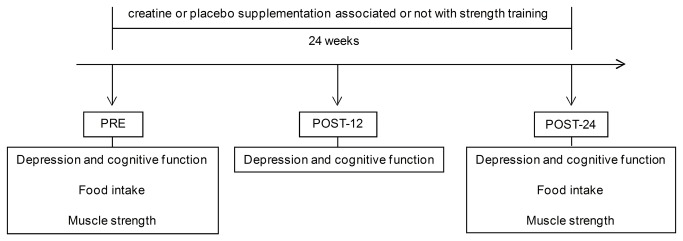
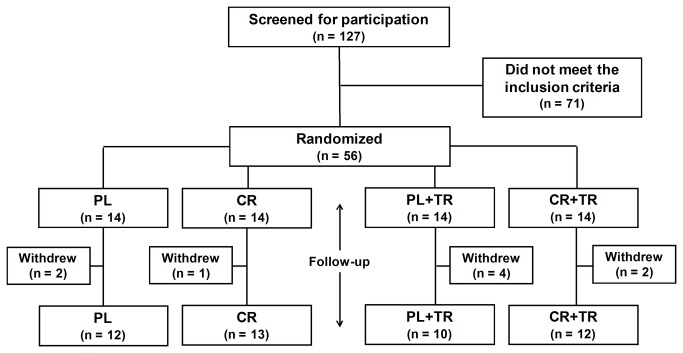
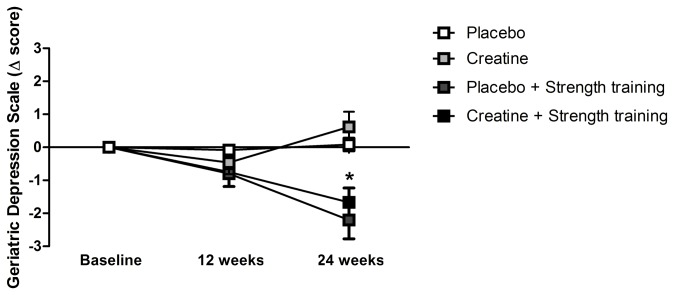
PURPOSE: To assess the effects of creatine supplementation, associated or not with strength training, upon emotional and cognitive measures in older woman. METHODS: This is a 24-week, parallel-group, double-blind, randomized, placebo-controlled trial. The individuals were randomly allocated into one of the following groups (n=14 each): 1) placebo, 2) creatine supplementation, 3) placebo associated with strength training or 4) creatine supplementation associated with strength training. According to their allocation, the participants were given creatine (4 x 5 g/d for 5 days followed by 5 g/d) or placebo (dextrose at the same dosage) and were strength trained or not. Cognitive function, assessed by a comprehensive battery of tests involving memory, selective attention, and inhibitory control, and emotional measures, assessed by the Geriatric Depression Scale, were evaluated at baseline, after 12 and 24 weeks of the intervention. Muscle strength and food intake were evaluated at baseline and after 24 weeks. RESULTS: After the 24-week intervention, both training groups (ingesting creatine supplementation and placebo) had significant reductions on the Geriatric Depression Scale scores when compared with the non-trained placebo group (p = 0.001 and p = 0.01, respectively) and the non-trained creatine group (p < 0.001 for both comparison). However, no significant differences were observed between the non-trained placebo and creatine (p = 0.60) groups, or between the trained placebo and creatine groups (p = 0.83). Both trained groups, irrespective of creatine supplementation, had better muscle strength performance than the non-trained groups. Neither strength training nor creatine supplementation altered any parameter of cognitive performance. Food intake remained unchanged. CONCLUSION: Creatine supplementation did not promote any significant change in cognitive function and emotional parameters in apparently healthy older individuals. In addition, strength training per se improved emotional state and muscle strength, but not cognition, with no additive effects of creatine supplementation. TRIAL REGISTRATION: Clinicaltrials.gov NCT01164020.
Overview
The claims and statistics of this paper haven’t been checked yet.
Run the check — free, no account needed. It reads the open-access text and checks the sources it cites.
Integrity signals
Registry
Cites
Statistics
Figures
Verification
Claims the paper makes
The claims and statistics of this paper haven’t been checked yet.
Run the check — free, no account needed. It reads the open-access text and checks the sources it cites.
Claims other papers make about this one
Each is checked against this paper’s own text: does it say what the citing paper says it does?
In the citing paper
“Our negative finding for the trail-making task, which tests task switching, is in line with the same two studies [21, 61].”
From The effects of creatine supplementation on cognitive performance—a randomised controlled study (2023) · cites this paper as [61]
In the citing paper
“while other studies with omnivore participants [21, 59, 60] or unspecified and presumably omnivore participants [61] failed to find a creatine effect2,3”
From The effects of creatine supplementation on cognitive performance—a randomised controlled study (2023) · cites this paper as [61]
In the citing paper
“Three further studies tested the effect of creatine supplementation on BDS in a different population than healthy young adults. In two of these studies, participants were healthy and elderly [55, 61] and in one study sleep-deprived [64]. In these three studies, there was no creatine effect.”
From The effects of creatine supplementation on cognitive performance—a randomised controlled study (2023) · cites this paper as [61]
Self-check
Percentages, sums and reported differences re-computed from the paper’s own numbers.
The self-check needs the paper’s full text.
Citations
Cites
Folstein, M. F., Folstein, S. E., & McHugh, P. R. (1975) · Journal of Psychiatric Research · doi:10.1016/0022-3956(75)90026-6 · Cited by 88,282
Fitness Effects on the Cognitive Function of Older Adults: A Meta-Analytic Study
Colcombe, S., & Kramer, A. F. (2003) · Psychological Science · doi:10.1111/1467-9280.t01-1-01430 · Cited by 3,782
Be smart, exercise your heart: Exercise effects on brain and cognition
Hillman, C. H., Erickson, K. I., & Kramer, A. F. (2008) · Nature Reviews Neuroscience · doi:10.1038/nrn2298 · Cited by 3,563
Creatine and Creatinine Metabolism
Wyss, M., & Kaddurah-Daouk, R. (2000) · Physiological Reviews · doi:10.1152/physrev.2000.80.3.1107 · Cited by 2,950
A Compendium of Neuropsychological Tests
Selnes, O. A. (1991) · Neurology · doi:10.1212/wnl.41.11.1856-a · Cited by 2,278
Sugestões para o uso do mini-exame do estado mental no Brasil
Brucki, S. M. D., Nitríni, R., Caramelli, P., Bertolucci, P. H. F., & Okamoto, I. H. (2003) · Arquivos de Neuro-Psiquiatria · doi:10.1590/s0004-282x2003000500014 · Cited by 2,236
Self-citationLautenschlager, N. T., Cox, K. L., Flicker, L., Foster, J. K., van Bockxmeer, F. M., Xiao, J., Greenop, K. R., & Almeida, O. P. (2008) · JAMA · doi:10.1001/jama.300.9.1027 · Cited by 1,637
Larson, E. B., Wang, L., Bowen, J. D., McCormick, W. C., Teri, L., Crane, P., & Kukull, W. (2006) · Annals of Internal Medicine · doi:10.7326/0003-4819-144-2-200601170-00004 · Cited by 1,463
Heyn, P., Abreu, B. C., & Ottenbacher, K. J. (2004) · Archives of Physical Medicine and Rehabilitation · doi:10.1016/j.apmr.2004.03.019 · Cited by 1,223
Physical activity and risk of cognitive decline: a meta-analysis of prospective studies
Sofi, F., Valecchi, D., Bacci, D., Abbate, R., Gensini, G. F., Casini, A., & Macchi, C. (2011) · Journal of Internal Medicine · doi:10.1111/j.1365-2796.2010.02281.x · Cited by 1,210
The cellular neurobiology of depression
Manji, H. K., Drevets, W. C., & Charney, D. S. (2001) · Nature Medicine · doi:10.1038/87865 · Cited by 1,182
Czéh, B., Michaelis, T., Watanabe, T., Frahm, J., de Biurrun, G., van Kampen, M., Bartolomucci, A., & Fuchs, E. (2001) · Proceedings of the National Academy of Sciences · doi:10.1073/pnas.211427898 · Cited by 1,114
Arbuthnott, K., & Frank, J. (2000) · Journal of Clinical and Experimental Neuropsychology · doi:10.1076/1380-3395(200008)22:4;1-0;ft518 · Cited by 1,087 · cited 1×
“, “A” and “B”), where condition “A” reflects both motor and visual control and condition “B” condition reflects the additional executive control needed to switch between number and letter sequences [38].”
BackgroundResistance Training and Executive Functions: A 12-Month Randomized Controlled Trial
Liu-Ambrose, T. (2010) · Archives of Internal Medicine · doi:10.1001/archinternmed.2009.494 · Cited by 775
The Impact of Resistance Exercise on the Cognitive Function of the Elderly
CASSILHAS, R. C., VIANA, V. A. R., GRASSMANN, V., SANTOS, R. T., SANTOS, R. F., TUFIK, S., & MELLO, M. T. (2007) · Medicine & Science in Sports & Exercise · doi:10.1249/mss.0b013e318060111f · Cited by 770
A meta-regression to examine the relationship between aerobic fitness and cognitive performance
Etnier, J. L., Nowell, P. M., Landers, D. M., & Sibley, B. A. (2006) · Brain Research Reviews · doi:10.1016/j.brainresrev.2006.01.002 · Cited by 749
Glucocorticoids, depression, and mood disorders: Structural remodeling in the brain
McEwen, B. S. (2005) · Metabolism · doi:10.1016/j.metabol.2005.01.008 · Cited by 687
Neural plasticity to stress and antidepressant treatment
Duman, R. S., Malberg, J. E., & Thome, J. (1999) · Biological Psychiatry · doi:10.1016/s0006-3223(99)00177-8 · Cited by 648
Functions and effects of creatine in the central nervous system
Andres, R. H., Ducray, A., Schlattner, U., Wallimann, T., & Widmer, H. R. (2008) · Brain Research Bulletin · doi:10.1016/j.brainresbull.2008.02.035 · Cited by 389
A Compendium of Neuropsychological Tests, 2nd ed
(2000) · Archives of Neurology · doi:10.1001/archneur.57.2.278 · Cited by 378
Neuroplasticity and cellular resilience in mood disorders
Manji, H. K., Moore, G. J., Rajkowska, G., & Chen, G. (2000) · Molecular Psychiatry · doi:10.1038/sj.mp.4000811 · Cited by 340
Reaction and Movement Time as a Function of age and Physical Activity Level
Spirduso, W. W. (1975) · Journal of Gerontology · doi:10.1093/geronj/30.4.435 · Cited by 328
Performance of illiterate and literate nondemented elderly subjects in two tests of long-term memory
Nitríni, R., Caramelli, P., Herrera, E., Porto, C. S., Charchat‐Fichman, H., Carthery‐Goulart, M. T., Takada, L. T., & Lima, E. P. (2004) · Journal of the International Neuropsychological Society · doi:10.1017/s1355617704104062 · Cited by 284
Rae, C., Digney, A. L., McEwan, S. R., & Bates, T. C. (2003) · Proceedings of the Royal Society of London. Series B: Biological Sciences · doi:10.1098/rspb.2003.2492 · Cited by 283
Stöckler, S., Hanefeld, F., & Frahm, J. (1996) · The Lancet · doi:10.1016/s0140-6736(96)04116-5 · Cited by 240
Kato, T., Takahashi, S., Shioiri, T., Murashita, J., Hamakawa, H., & Inubushi, T. (1994) · Journal of Affective Disorders · doi:10.1016/0165-0327(94)90116-3 · Cited by 223
Increase of total creatine in human brain after oral supplementation of creatine-monohydrate
Dechent, P., Pouwels, P. J. W., Wilken, B., Hanefeld, F., & Frahm, J. (1999) · American Journal of Physiology-Regulatory, Integrative and Comparative Physiology · doi:10.1152/ajpregu.1999.277.3.r698 · Cited by 221
van Gool, C. H. (2003) · Age and Ageing · doi:10.1093/ageing/32.1.81 · Cited by 215
Neurobiological basis of depression: an update
Kalia, M. (2005) · Metabolism · doi:10.1016/j.metabol.2005.01.009 · Cited by 202
Effects of creatine on mental fatigue and cerebral hemoglobin oxygenation
Watanabe, A., Kato, N., & Kato, T. (2002) · Neuroscience Research · doi:10.1016/s0168-0102(02)00007-x · Cited by 196
Brain Bioenergetics and Response to Triiodothyronine Augmentation in Major Depressive Disorder
Iosifescu, D. V., Bolo, N. R., Nierenberg, A. A., Jensen, J. E., D, M. F. M., & Renshaw, P. F. (2008) · Biological Psychiatry · doi:10.1016/j.biopsych.2007.11.020 · Cited by 181
Effect of pioglitazone on body composition and energy expenditure: a randomized controlled trial
Smith, S. R., de Jonge, L., Volaufova, J., Li, Y., Xie, H., & Bray, G. A. (2005) · Metabolism · doi:10.1016/j.metabol.2004.07.008 · Cited by 176
X‐linked creatine transporter defect: An overview
Salomons, G. S., van Dooren, S. J. M., Verhoeven‐Duif, N. M., Marsden, D., Schwartz, C. E., Cecil, K. M., deGrauw, T. J., & Jakobs, C. (2003) · Journal of Inherited Metabolic Disease · doi:10.1023/a:1024405821638 · Cited by 173
The effects of resistance training on well-being and memory in elderly volunteers
Perrig‐Chiello, P., Perrig, W. J., Ehrsam, R., Staehelin, H. B., & Krings, F. (1998) · Age and Ageing · doi:10.1093/ageing/27.4.469 · Cited by 171
Moore, C. M., Christensen, J. D., Lafer, B., D, M. F. M., & Renshaw, P. F. (1997) · American Journal of Psychiatry · doi:10.1176/ajp.154.1.116 · Cited by 168
31 P magnetic resonance spectroscopy in the frontal lobe of major depressed patients
Volz, H., Rzanny, R., Riehemann, S., May, S., Hegewald, H., Preussler, B., Hübner, G., Kaiser, W. A., & Sauer, H. (1998) · European Archives of Psychiatry and Clinical Neuroscience · doi:10.1007/s004060050052 · Cited by 161
Mood, Anxiety, and Serum IGF-1 in Elderly Men Given 24 Weeks of High Resistance Exercise
Cassilhas, R. C., Antunes, H. K. M., Tufik, S., & de Mello, M. T. (2010) · Perceptual and Motor Skills · doi:10.2466/pms.110.1.265-276 · Cited by 146
Parkin, A. J., & Java, R. I. (1999) · Neuropsychology · doi:10.1037/0894-4105.13.4.539 · Cited by 140
Lyoo, I. K., Kong, S. W., Sung, S. M., Hirashima, F., Parow, A., Hennen, J., Cohen, B. M., & Renshaw, P. F. (2003) · Psychiatry Research: Neuroimaging · doi:10.1016/s0925-4927(03)00046-5 · Cited by 140
van Gool, C. H., Kempen, G. I. J. M., Bosma, H., van Boxtel, M. P. J., Jolles, J., & van Eijk, J. T. M. (2007) · American Journal of Public Health · doi:10.2105/ajph.2004.053199 · Cited by 135
Creatine Supplementation and Cognitive Performance in Elderly Individuals
McMorris, T., Mielcarz, G., Harris, R. C., Swain, J. P., & Howard, A. (2007) · Aging, Neuropsychology, and Cognition · doi:10.1080/13825580600788100 · Cited by 134
Use of creatine in the elderly and evidence for effects on cognitive function in young and old
Rawson, E. S., & Venezia, A. C. (2011) · Amino Acids · doi:10.1007/s00726-011-0855-9 · Cited by 127
Creatine monohydrate in resistant depression: A preliminary study
Roitman, S., Green, T., Osher, Y., Karni, N., & Levine, J. (2007) · Bipolar Disorders · doi:10.1111/j.1399-5618.2007.00532.x · Cited by 118
Creatine supplementation, sleep deprivation, cortisol, melatonin and behavior
McMorris, T., Harris, R. C., Howard, A. N., Langridge, G., Hall, B., Corbett, J., Dicks, M., & Hodgson, C. (2007) · Physiology & Behavior · doi:10.1016/j.physbeh.2006.08.024 · Cited by 115
Affective disorders, antidepressant drugs and brain metabolism
Moretti, A., Gorini, A., & Villa, R. F. (2003) · Molecular Psychiatry · doi:10.1038/sj.mp.4001353 · Cited by 114
Gabbay, V., Hess, D. A., Liu, S., Babb, J. S., Klein, R. G., & Gonen, O. (2007) · American Journal of Psychiatry · doi:10.1176/appi.ajp.2007.06122032 · Cited by 102
The influence of creatine supplementation on the cognitive functioning of vegetarians and omnivores
Benton, D., & Donohoe, R. (2011) · British Journal of Nutrition · doi:10.1017/s0007114510004733 · Cited by 101
‘Hot spots’ of creatine kinase localization in brain: cerebellum, hippocampus and choroid plexus
Kaldis, P., Hemmer, W., Zanolla, E., Holtzman, D., & Wallimann, T. (2009) · Developmental Neuroscience · doi:10.1159/000111452 · Cited by 99 · cited 1×
“There is high-quality evidence showing that creatine exerts a vital role in cerebral energetic provision, corroborated by i) the presence of creatine kinase (PCK) isoforms in both the brain and spinal cord [7]; ii) the association between brain creatine depletion and mental retardation, autism, speech delay, and brain…”
BackgroundCreatinine and creatine in CSF: indices of brain energy metabolism in depression
�gren, H., & Niklasson, F. (1988) · Journal of Neural Transmission · doi:10.1007/bf01243575 · Cited by 49
Open Study of Creatine Monohydrate in Treatment-Resistant Posttraumatic Stress Disorder
Amital, D., Vishne, T. H., Roitman, S., Kotler, M., & Levine, J. (2006) · The Journal of Clinical Psychiatry · doi:10.4088/jcp.v67n0521c · Cited by 39
Depression and anxiety: Role of mitochondria
Burroughs, S. L., & French, D. (2007) · Current Anaesthesia and Critical Care · doi:10.1016/j.cacc.2007.01.007 · Cited by 29
Dechent, P., Pouwels, P. J. W., & Frahm, J. (1999) · Biological Psychiatry · doi:10.1016/s0006-3223(98)00346-1 · Cited by 24
[Digit span as a test of immediate memory].
Cronholm, B., & Viding, G. (1956) · PubMed · Cited by 5
Research works printed but not linked: 3
- P Heyn, 2004, The effects of exercise training on elderly persons with cognitive impairment and dementia: a meta-analysis, Arch Phys Med Rehabil, 84, 1694
- OP Almeida, 2003, Reliability of the Brazilian version of the abbreviated form of Geriatric Depression Scale (GDS) short form, Arq Neuropsiquiat, 57, 421
- SM Brucki, 2003, Suggestions for utilization of the mini-mental state examination in Brazil, Arq Neuro Psiquiatr, 61, 777
Cited by
Sorted by citations
Gordon, B. R., McDowell, C. P., Hallgren, M., Meyer, J. D., Lyons, M., & Herring, M. P. (2018) · JAMA Psychiatry · doi:10.1001/jamapsychiatry.2018.0572 · Cited by 498
Barha, C. K., Davis, J. C., Falck, R. S., Nagamatsu, L. S., & Liu-Ambrose, T. (2017) · Frontiers in Neuroendocrinology · doi:10.1016/j.yfrne.2017.04.002 · Cited by 432
Chilibeck, P., Kaviani, M., Candow, D., & Zello, G. A. (2017) · Open Access Journal of Sports Medicine · doi:10.2147/oajsm.s123529 · Cited by 235
Creatine Supplementation and Brain Health
Roschel, H., Gualano, B., Ostojic, S. M., & Rawson, E. S. (2021) · Nutrients · doi:10.3390/nu13020586 · Cited by 174
Self-citationDolan, E., Gualano, B., & Rawson, E. S. (2019) · European Journal of Sport Science · doi:10.1080/17461391.2018.1500644 · Cited by 171
Self-citation
Metadata
- Authors
- Alves, C. R. R., Merege Filho, C. A. A., Benatti, F. B., Brucki, S., Pereira, R. M. R., de Sá Pinto, A. L., Lima, F. R., Roschel, H., & Gualano, B.
- Affiliations
- Universidade de São Paulo (BR)
- Corresponding author
- Gualano, Bruno
- ORCID
- Venue
- PLoS ONE
- Publisher
- Public Library of Science (PLoS)
- Published
- 2013-10-03
- Volume
- 8
- Issue
- 10
- Pages
- e76301
- ISSN
- 1932-6203 (ISSN-L)
- PMC
- PMC3789718
- OpenAlex
- W2072529815
- Cited by
- 109
- References
- 53
- Citations by year
- 2026: 15 · 2025: 8 · 2024: 11 · 2023: 7 · 2022: 6 · 2021: 27 · 2020: 4 · 2019: 5 · 2018: 7 · 2017: 4 · 2016: 8 · 2015: 5 · 2014: 2
- FWCI
- 2.90
- Type
- journal article
- Language
- en
- Open access
- gold
- doi.org
- Locations
- PLoS ONE (publishedVersion, cc-by)
- Europe PMC (PubMed Central) (publishedVersion, cc-by)
- PubMed Central (publishedVersion, cc-by)
- PubMed (publishedVersion)
- DOAJ (DOAJ: Directory of Open Access Journals) (submittedVersion, cc-by-sa)
- Figshare (submittedVersion, cc-by)
- Funders
- Fundação de Amparo à Pesquisa do Estado de São Paulo
- Conselho Nacional de Desenvolvimento Científico e Tecnológico
- Topics
- Health Sciences › Nursing › Nutrition and Dietetics › Muscle metabolism and nutrition
- Health Sciences › Medicine › Physiology (medical) › Nutrition and Health in Aging
- Health Sciences › Medicine › Physiology (medical) › Biochemical effects in animals
- Keywords
- creatine supplementation, resistance training, older women, cognitive function, emotional state, depression, muscle strength, dietary intake, memory, selective attention, inhibitory control
- MeSH terms
- Age Factors, Aged, Aged, 80 and over, Cognition, Creatine, Diet, Double-Blind Method, Emotions, Female, Humans, Middle Aged, Neuropsychological Tests, Treatment Outcome, Dietary Supplements, Muscle Strength, Resistance Training, Medication Adherence, Self Report
About these checks
Registry, retraction, Cites and statistics results are computed, not judged, with one exception: a printed reference that no index lists is read once by a model before it counts as a citation error. Claims are extracted by a model and kept only when their quote appears verbatim in the text; each cited source is then checked, with a model’s help, for whether it says what the claim relies on. Those verdicts can be wrong — read the claim’s quote and the cited source before relying on one.
Statistics and arithmetic are recomputed, not judged.
Confidence bands are shown only for fields calibrated on our annotated test set. None is calibrated yet, so no band is shown.
What counts as a claim ›How we measure confidence ›How we check this ›
Are you an author, or do you see a problem with this page? Request a review
