

The DOI matches its Crossref record; 25 of the 25 references it cites were found in a registry or an index.
Intake of Fruit Juice and Incidence of Type 2 Diabetes: A Systematic Review and Meta-Analysis
Open accessAbstract
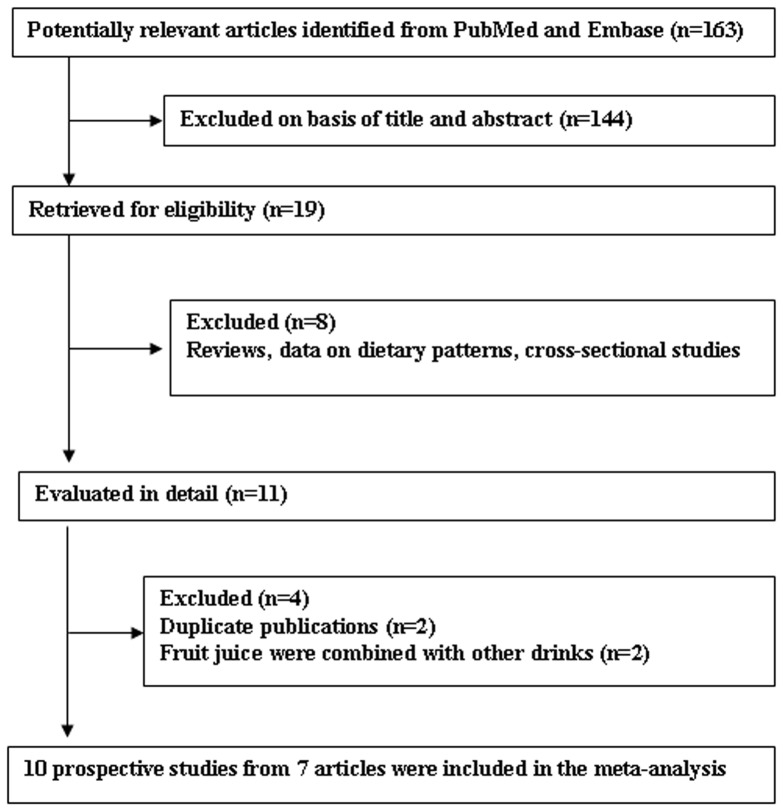
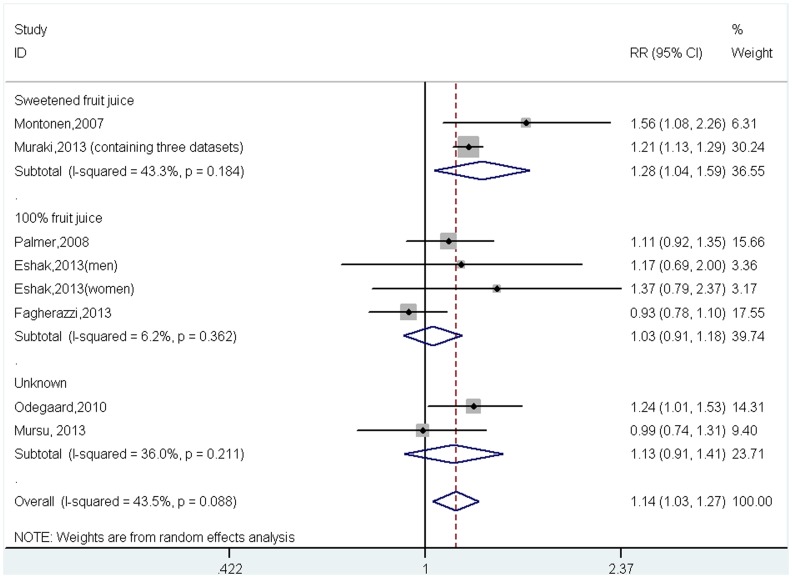
BACKGROUND: Several prospective studies have been conducted to examine the relationship between fruit juice intake and risk of incident type 2 diabetes, but results have been mixed. In the present study, we aimed to estimate the association between fruit juice intake and risk of type 2 diabetes. METHODS: PubMed and Embase databases were searched up to December 2013. All prospective cohort studies of fruit juice intake with risk of type 2 diabetes were included. The pooled relative risks (RRs) with 95% confidence intervals (CIs) for highest vs. lowest category of fruit juice intake were estimated using a random-effects model. RESULTS: A total of four studies (191,686 participants, including 12,375 with type 2 diabetes) investigated the association between sugar-sweetened fruit juice and risk of incident type 2 diabetes, and four studies (137,663 participants and 4,906 cases) investigated the association between 100% fruit juice and risk of incident type 2 diabetes. A higher intake of sugar-sweetened fruit juice was significantly associated with risk of type 2 diabetes (RR = 1.28, 95%CI = 1.04-1.59, p = 0.02), while intake of 100% fruit juice was not associated with risk of developing type 2 diabetes (RR = 1.03, 95% CI = 0.91-1.18, p = 0.62). CONCLUSIONS: Our findings support dietary recommendations to limit sugar-sweetened beverages, such as fruit juice with added sugar, to prevent the development of type 2 diabetes.
Overview
The claims and statistics of this paper haven’t been checked yet.
Run the check — free, no account needed. It reads the open-access text and checks the sources it cites.
Integrity signals
Registry
Cites
Statistics
Figures
Verification
Claims the paper makes
The claims and statistics of this paper haven’t been checked yet.
Run the check — free, no account needed. It reads the open-access text and checks the sources it cites.
Claims other papers make about this one
Each is checked against this paper’s own text: does it say what the citing paper says it does?
In the citing paper
“Further, intake of sugar-sweetened fruit juice, but not 100% fruit juice, is associated with incident diabetes in longitudinal studies (Figure 6).257, 266”
From Dietary and Policy Priorities for Cardiovascular Disease, Diabetes, and Obesity: A Comprehensive Review (2016) · cites this paper as [266]
Self-check
Percentages, sums and reported differences re-computed from the paper’s own numbers.
The self-check needs the paper’s full text.
Citations
Cites
Measuring inconsistency in meta-analyses
Higgins, J. P. T., Thompson, S. G., Deeks, J. J., & Altman, D. G. (2003) · BMJ · doi:10.1136/bmj.327.7414.557 · Cited by 63,139
Bias in meta-analysis detected by a simple, graphical test
Egger, M., Smith, G. D., Schneider, M., & Minder, C. (1997) · BMJ · doi:10.1136/bmj.315.7109.629 · Cited by 56,722
Meta-analysis of Observational Studies in Epidemiology<SUBTITLE>A Proposal for Reporting</SUBTITLE>
Stroup, D. F. (2000) · JAMA · doi:10.1001/jama.283.15.2008 · Cited by 20,623
(2014) · Medical Entomology and Zoology · Cited by 17,633
Operating characteristics of a rank correlation test for publication bias
Begg, C. B., & Mazumdar, M. (1994) · Biometrics · doi:10.2307/2533446 · Cited by 16,955
Statistical Aspects of the Analysis of Data From Retrospective Studies of Disease
(1959) · JNCI: Journal of the National Cancer Institute · doi:10.1093/jnci/22.4.719 · Cited by 14,689 · cited 1×
“Statistical analysis A random effects model [14] was used to calculate pooled RRs with 95% CIs for highest vs.”
MethodSugar-Sweetened Beverages and Risk of Metabolic Syndrome and Type 2 Diabetes
Malik, V. S., Popkin, B. M., Bray, G. A., Després, J.-P., Willett, W. C., & Hu, F. B. (2010) · Diabetes Care · doi:10.2337/dc10-1079 · Cited by 2,116
Schulze, M. B. (2004) · JAMA · doi:10.1001/jama.292.8.927 · Cited by 1,639
Carter, P., Gray, L. J., Troughton, J., Khunti, K., & Davies, M. J. (2010) · BMJ · doi:10.1136/bmj.c4229 · Cited by 728
Muraki, I., Imamura, F., Manson, J. E., Hu, F. B., Willett, W. C., van Dam, R. M., & Sun, Q. (2013) · BMJ · doi:10.1136/bmj.f5001 · Cited by 544
Cited by
Sorted by citations
Mozaffarian, D. (2016) · Circulation · doi:10.1161/circulationaha.115.018585 · Cited by 2,216
“Furthermore, the intake of sugar-sweetened fruit juice, but not 100% fruit juice, is associated with incident diabetes mellitus in longitudinal studies (Figure 6).(257,266) These findings suggest that 100% fruit juice may have other beneficial components, eg, dietary fiber, vitamins, and phytochemicals, that at least…”
Imamura, F., O’Connor, L., Ye, Z., Mursu, J., Hayashino, Y., Bhupathiraju, S. N., & Forouhi, N. G. (2015) · BMJ · doi:10.1136/bmj.h3576 · Cited by 977
Imamura, F., O’Connor, L., Ye, Z., Mursu, J., Hayashino, Y., Bhupathiraju, S. N., & Forouhi, N. G. (2016) · British Journal of Sports Medicine · doi:10.1136/bjsports-2016-h3576rep · Cited by 968
Sweetening of the global diet, particularly beverages: patterns, trends, and policy responses
Popkin, B. M., & Hawkes, C. (2016) · The Lancet Diabetes & Endocrinology · doi:10.1016/s2213-8587(15)00419-2 · Cited by 737
Risk factors for type 2 diabetes mellitus: An exposure-wide umbrella review of meta-analyses
Bellou, V., Belbasis, L., Tzoulaki, I., & Evangelou, E. (2018) · PLOS ONE · doi:10.1371/journal.pone.0194127 · Cited by 713
Wallace, T. C., Bailey, R. L., Blumberg, J. B., Burton-Freeman, B., Chen, C.-Y. O., Crowe-White, K. M., Drewnowski, A., Hooshmand, S., Johnson, E., Lewis, R., et al. (2020) · Critical Reviews in Food Science and Nutrition · doi:10.1080/10408398.2019.1632258 · Cited by 638
Neuenschwander, M., Ballon, A., Weber, K. S., Norat, T., Aune, D., Schwingshackl, L., & Schlesinger, S. (2019) · BMJ · doi:10.1136/bmj.l2368 · Cited by 531
The 2015 Dutch food-based dietary guidelines
Kromhout, D., Spaaij, C. J. K., de Goede, J., & Weggemans, R. M. (2016) · European Journal of Clinical Nutrition · doi:10.1038/ejcn.2016.52 · Cited by 416
Mooradian, A. D., Smith, M., & Tokuda, M. (2017) · Clinical Nutrition ESPEN · doi:10.1016/j.clnesp.2017.01.004 · Cited by 312
Rippe, J. M., & Angelopoulos, T. J. (2016) · Nutrients · doi:10.3390/nu8110697 · Cited by 256
Khan, T. A., & Sievenpiper, J. L. (2016) · Zeitschrift für Ernährungswissenschaft · doi:10.1007/s00394-016-1345-3 · Cited by 232
O’Connor, L., Imamura, F., Lentjes, M. A. H., Khaw, K., Wareham, N. J., & Forouhi, N. G. (2015) · Diabetologia · doi:10.1007/s00125-015-3572-1 · Cited by 179
Mohamed, S. F., Mwangi, M., Mutua, M. K., Kibachio, J. M., Abubakar, H., Ndegwa, Z., Owondo, S., Asiki, G., & Kyobutungi, C. K. (2018) · BMC Public Health · doi:10.1186/s12889-018-6053-x · Cited by 137
Intestinal Fructose and Glucose Metabolism in Health and Disease
Merino, B., Fernández-Díaz, C. M., Cózar‐Castellano, I., & Perdomo, G. (2019) · Nutrients · doi:10.3390/nu12010094 · Cited by 147
Characterization of the Degree of Food Processing in Relation With Its Health Potential and Effects
Fardet, A. (2018) · Advances in Food and Nutrition Research · doi:10.1016/bs.afnr.2018.02.002 · Cited by 93
Wu, Y., Zhang, D., Jiang, X., & Jiang, W. (2014) · Nutrition Metabolism and Cardiovascular Diseases · doi:10.1016/j.numecd.2014.10.004 · Cited by 138
Halvorsen, R. E., Elvestad, M., Molin, M., & Aune, D. (2021) · BMJ Nutrition Prevention & Health · doi:10.1136/bmjnph-2020-000218 · Cited by 134
Leung, C. W., Laraia, B. A., Needham, B. L., Rehkopf, D. H., Adler, N. E., Lin, J., Blackburn, E. H., & Epel, E. S. (2014) · American Journal of Public Health · doi:10.2105/ajph.2014.302151 · Cited by 119
The Impact of Free Sugar on Human Health—A Narrative Review
Gillespie, K. M., Kemps, E., White, M. J., & Bartlett, S. E. (2023) · Nutrients · doi:10.3390/nu15040889 · Cited by 139
Perspective: Total, Added, or Free? What Kind of Sugars Should We Be Talking About?
Mela, D. J., & Woolner, E. M. (2018) · Advances in Nutrition · doi:10.1093/advances/nmx020 · Cited by 121
Tsilas, C. S., de Souza, R. J., Mejia, S. B., Mirrahimi, A., Cozma, A. I., Jayalath, V. H., Ha, V., Tawfik, R., Di Buono, M., Jenkins, A. L., et al. (2017) · Canadian Medical Association Journal · doi:10.1503/cmaj.160706 · Cited by 109
Are Liquid Sugars Different from Solid Sugar in Their Ability to Cause Metabolic Syndrome?
Sundborn, G., Thornley, S., Merriman, T. R., Lang, B., King, C., Lanaspa, M. A., & Johnson, R. J. (2019) · Obesity · doi:10.1002/oby.22472 · Cited by 103
Petersen, K. E. N., Johnsen, N. F., Olsen, A., Albieri, V., Olsen, L. K. H., Dragsted, L. O., Overvad, K., Tjønneland, A. M., & Egeberg, R. (2015) · British Journal Of Nutrition · doi:10.1017/s0007114515000070 · Cited by 114
Total and Added Sugar Intake: Assessment in Eight Latin American Countries
Fisberg, M., Kovalskys, I., Gómez, G., Rigotti, A., Sanabria, L., García, M. C. Y., Torres, R., Herrera‐Cuenca, M., Zimberg, I. Z., Koletzko, B. V., et al. (2018) · Nutrients · doi:10.3390/nu10040389 · Cited by 109
Miller, C. L., Ettridge, K. A., Wakefield, M. A., Pettigrew, S., Coveney, J., Roder, D. M., Durkin, S. J., Wittert, G., Martin, J. E., & Dono, J. (2020) · Nutrients · doi:10.3390/nu12030817 · Cited by 113
Are Fruit Juices Healthier Than Sugar-Sweetened Beverages? A Review
Pepin, A., Stanhope, K. L., & Imbeault, P. (2019) · Nutrients · doi:10.3390/nu11051006 · Cited by 98
Fruit Juices: Are They Helpful or Harmful? An Evidence Review
Ruxton, C. H. S., & Myers, M. (2021) · Nutrients · doi:10.3390/nu13061815 · Cited by 100
Stanhope, K. L., Goran, M. I., Bosy‐Westphal, A., King, J. C., Schmidt, L. A., Schwarz, J., Stice, E. M., Sylvetsky, A. C., Turnbaugh, P. J., Bray, G. A., et al. (2018) · Obesity Reviews · doi:10.1111/obr.12699 · Cited by 90
The role of dietary sugars in health: molecular composition or just calories?
Prinz, P. (2019) · European Journal of Clinical Nutrition · doi:10.1038/s41430-019-0407-z · Cited by 89
Role of fruit juice in achieving the 5-a-day recommendation for fruit and vegetable intake
Benton, D., & Young, H. A. (2019) · Nutrition Reviews · doi:10.1093/nutrit/nuz031 · Cited by 90
D’Elia, L., Dinu, M., Sofi, F., Volpe, M., Strazzullo, P., The SINU Working Group, E. B. S., Bordoni, A., Strazzullo, P., Cairella, G., Casiraghi, M. C., et al. (2020) · European Journal of Nutrition · doi:10.1007/s00394-020-02426-7 · Cited by 88
Potential health benefits of (poly)phenols derived from fruit and 100% fruit juice
Ho, K. K. H. Y., Ferruzzi, M. G., & Wightman, J. D. (2019) · Nutrition Reviews · doi:10.1093/nutrit/nuz041 · Cited by 81
Auerbach, B. J., Dibey, S., Vallila-Buchman, P., Kratz, M., & Krieger, J. W. (2018) · Advances in Nutrition · doi:10.1093/advances/nmx006 · Cited by 80
de Gavelle, E., de Lauzon‐Guillain, B., Charles, M.-A. A., Chevrier, C., Flamant‐Hulin, M., Sirot, V., Merlo, M., & Nougadère, A. (2016) · Environment International · doi:10.1016/j.envint.2016.04.007 · Cited by 74
Sweet liker status in children and adults: Consequences for beverage intake in adults
Garneau, N. L., Nuessle, T. M., Mendelsberg, B. J., Shepard, S., & Tucker, R. M. (2017) · Food Quality and Preference · doi:10.1016/j.foodqual.2017.10.005 · Cited by 79
Jackson, P. P. J., Wijeyesekera, A., & Rastall, R. A. (2022) · Food Science & Nutrition · doi:10.1002/fsn3.3040 · Cited by 73
Liu, Q., Ayoub‐Charette, S., Khan, T. A., Au‐Yeung, F., Blanco Mejia, S., de Souza, R. J., Wolever, T. M. S., Leiter, L. A., Kendall, C. W. C., & Sievenpiper, J. L. (2019) · Journal of the American Heart Association · doi:10.1161/jaha.118.010977 · Cited by 65
Fardet, A., & Rock, E. (2022) · European Journal of Nutrition · doi:10.1007/s00394-021-02786-8 · Cited by 65
Guo, X., Yang, B., Tang, J., Jiang, J., & Li, D. (2017) · Food & Function · doi:10.1039/c6fo01378c · Cited by 67
Li, B., Yan, N., Jiang, H. F., Cui, M., Wu, M., Wang, L., Mi, B., Li, Z., Shi, J., Fan, Y., et al. (2023) · Frontiers in Nutrition · doi:10.3389/fnut.2023.1019534 · Cited by 77
Fu, T., Chen, H., Chen, X., Sun, Y., Xie, Y. M., Deng, M., Hesketh, T. M., Wang, X., & Chen, J. (2022) · Alimentary Pharmacology & Therapeutics · doi:10.1111/apt.17149 · Cited by 63
Mamluk, L., O’Doherty, M. G., Orfanos, P., Saitakis, G., Woodside, J. V., Liao, L. M., Sinha, R. R., Boffetta, P., Trichopoulou, A., & Kee, F. (2016) · European Journal of Clinical Nutrition · doi:10.1038/ejcn.2016.143 · Cited by 62
Chi, D. L., Hopkins, S., O’Brien, D., Mancl, L., Orr, E., & Lenaker, D. (2015) · BMC Oral Health · doi:10.1186/s12903-015-0101-z · Cited by 52
Low, D. Y., Lefèvre‐Arbogast, S., González‐Domínguez, R., Urpí-Sardà, M., Micheau, P., Pétéra, M., Centeno, D., Durand, S., Pujos‐Guillot, E., Kőrösi, A., et al. (2019) · Molecular Nutrition & Food Research · doi:10.1002/mnfr.201900177 · Cited by 63
Effects of product reformulation on sugar intake and health—a systematic review and meta-analysis
Hashem, K. M., He, F. J., & MacGregor, G. A. (2018) · Nutrition Reviews · doi:10.1093/nutrit/nuy015 · Cited by 59
Zhang, W., Ohira, T., Abe, M., Kamiya, K., Yamashita, S., Yasumura, S., Ohtsuru, A., Maeda, M., Harigane, M., Horikoshi, N., et al. (2016) · Journal of Epidemiology · doi:10.1016/j.je.2016.08.002 · Cited by 58
Perspective: Refined Grains and Health: Genuine Risk, or Guilt by Association?
Gaesser, G. A. (2018) · Advances in Nutrition · doi:10.1093/advances/nmy104 · Cited by 62
Satisfying America's Fruit Gap: Summary of an Expert Roundtable on the Role of 100% Fruit Juice
Byrd‐Bredbenner, C., Ferruzzi, M. G., Fulgoni, V. L. I., Murray, R. D., Pivonka, E., & Wallace, T. C. (2017) · Journal of Food Science · doi:10.1111/1750-3841.13754 · Cited by 58
What is the appropriate upper limit for added sugars consumption?
Rippe, J. M., Sievenpiper, J. L., Lê, K., White, J. S., Clemens, R., & Angelopoulos, T. J. (2016) · Nutrition Reviews · doi:10.1093/nutrit/nuw046 · Cited by 54
Tappy, L., & Lê, K. (2015) · Current Diabetes Reports · doi:10.1007/s11892-015-0627-0 · Cited by 50
Salt and sugars content of breakfast cereals in the UK from 1992 to 2015
Pombo-Rodrigues, S., Hashem, K. M., He, F. J., & MacGregor, G. A. (2017) · Public Health Nutrition · doi:10.1017/s1368980016003463 · Cited by 49
Fardet, A., Richonnet, C., & Mazur, A. (2019) · Nutrition Reviews · doi:10.1093/nutrit/nuz004 · Cited by 50
Saxe-Custack, A., LaChance, J., & Hanna‐Attisha, M. (2019) · Nutrients · doi:10.3390/nu12010025 · Cited by 50
Murphy, M. M., Barrett, E. C., Bresnahan, K. A., & Barraj, L. M. (2017) · Journal of Nutritional Science · doi:10.1017/jns.2017.63 · Cited by 52
Modifiable Risk Factors for Periodontitis and Diabetes
Borgnakke, W. S. (2016) · Current Oral Health Reports · doi:10.1007/s40496-016-0099-6 · Cited by 45
“Non-modifiable” Risk Factors for Periodontitis and Diabetes
Borgnakke, W. S. (2016) · Current Oral Health Reports · doi:10.1007/s40496-016-0098-7 · Cited by 44
Li, Z., Zhu, Y., Zhang, W., Xu, C., Pan, Y., & Zhao, Y. (2016) · Food Analytical Methods · doi:10.1007/s12161-016-0626-z · Cited by 37
French Recommendations for Sugar Intake in Adults: A Novel Approach Chosen by ANSES
Tappy, L., Morio, B., Azzout‐Marniche, D., Champ, M. M. J., Gerber, M., Houdart, S., Mas, E., Rizkalla, S. W., Slama, G., Mariotti, F., et al. (2018) · Nutrients · doi:10.3390/nu10080989 · Cited by 41
Auerbach, B. J., Littman, A. J., Tinker, L. F., Larson, J. C., Krieger, J. W., Young, B. A., & Neuhouser, M. L. (2017) · Preventive Medicine · doi:10.1016/j.ypmed.2017.08.031 · Cited by 35
Hashem, K. M., He, F. J., & MacGregor, G. A. (2017) · BMJ Open · doi:10.1136/bmjopen-2017-018136 · Cited by 39
Ponce, O., Benassi, R., & Cesar, T. B. (2019) · Journal of Nutrition & Intermediary Metabolism · doi:10.1016/j.jnim.2019.100101 · Cited by 33
Fructose as a Driver of Diabetes: An Incomplete View of the Evidence
Sievenpiper, J. L., Tappy, L., & Brouns, F. J. P. H. (2015) · Mayo Clinic Proceedings · doi:10.1016/j.mayocp.2015.04.017 · Cited by 30
Cara, K. C., Beauchesne, A. R., Wallace, T. C., & Chung, M. (2022) · Advances in Nutrition · doi:10.1093/advances/nmab101 · Cited by 26
Fernandes, A. C., Rieger, D. K., & Proença, R. P. D. C. (2019) · Advances in Nutrition · doi:10.1093/advances/nmz025 · Cited by 28
Added sugars: Definitions, classifications, metabolism and health implications
Scapin, T., Fernandes, A. C., & Proença, R. P. D. C. (2017) · Revista de Nutrição · doi:10.1590/1678-98652017000500011 · Cited by 28
Zhang, L., Wang, Y., Niu, M., Wang, C., & Wang, Z. (2021) · IEEE Journal of Biomedical and Health Informatics · doi:10.1109/jbhi.2021.3077114 · Cited by 26
Hashem, K. M., He, F. J., Jenner, K. H., & MacGregor, G. A. (2016) · BMJ Open · doi:10.1136/bmjopen-2015-010874 · Cited by 25
Su, K., Xiang, G., Cui, C., Jiang, X., Sun, Y., Zhao, W., & He, L. (2023) · Arabian Journal of Chemistry · doi:10.1016/j.arabjc.2022.104538 · Cited by 23
Liao, Y.-P., Zheng, Q., Jiang, X., Chen, X.-Q., Gao, X.-X., & Pan, Y. (2023) · Nutrition Journal · doi:10.1186/s12937-023-00855-8 · Cited by 27
den Biggelaar, L. J. C. J., Sep, S. J. S., Mari, A., Ferrannini, E., DONGEN, M. C. J. M. V., Wijckmans, N. E. G., Schram, M. T., Kallen, C., Schaper, N. C., Henry, R. M. A., et al. (2019) · European Journal of Nutrition · doi:10.1007/s00394-019-02026-0 · Cited by 25
Hashem, K. M., He, F. J., & MacGregor, G. A. (2019) · Bulletin of the World Health Organization · doi:10.2471/blt.19.234542 · Cited by 23
Mavadiya, H. B., Roh, D., Ly, A., & Lu, Y. (2025) · Nutrition Bulletin · doi:10.1111/nbu.70009 · Cited by 23
Papandreou, D., Magriplis, E., Abboud, M., Taha, Z., Karavolia, E., Karavolias, C., & Zampelas, A. (2019) · Nutrients · doi:10.3390/nu11092171 · Cited by 23
Fruit Intake to Prevent and Control Hypertension and Diabetes
Park, H. A. (2021) · Korean Journal of Family Medicine · doi:10.4082/kjfm.20.0225 · Cited by 20
Soda Intake Is Directly Associated with Serum C-Reactive Protein Concentration in Mexican Women
Taméz, M., Monge, A., López‐Ridaura, R., Fagherazzi, G., Rinaldi, S., Ortiz‐Panozo, E., Yunes, E. M., Romieu, I., & Lajous, M. (2018) · Journal of Nutrition · doi:10.1093/jn/nxx021 · Cited by 20
Protocol for the scientific opinion on the Tolerable Upper Intake Level of dietary sugars
(EFSA), E. F. S. A. (2018) · EFSA Journal · doi:10.2903/j.efsa.2018.5393 · Cited by 21
Huang, H., Li, M., Wang, Y., Wu, X., Wang, Q., Shen, J., Xiao, Z., 赵曰水, Du, F., Li, J., et al. (2022) · Food Frontiers · doi:10.1002/fft2.185 · Cited by 18
Comparison of food and nutrient intakes between cohorts of the HAPIEE and Whitehall II studies
Stefler, D., Pająk, A., Malyutina, S. K., Kubínová, R., Bobák, M., & Brunner, E. J. (2015) · European Journal of Public Health · doi:10.1093/eurpub/ckv216 · Cited by 19
Scheffers, F. R., Wijga, A. H., Verschuren, W. M. M., van der Schouw, Y. T., Sluijs, I., Smit, H. A., & Boer, J. M. A. (2019) · Journal of Nutrition · doi:10.1093/jn/nxz340 · Cited by 19
Zhang, H., Li, X., Qian, Z., Wang, S., & Yang, F. Q. (2021) · Enzyme and Microbial Technology · doi:10.1016/j.enzmictec.2021.109805 · Cited by 18
Gonzalez, J. T. (2024) · European Journal of Nutrition · doi:10.1007/s00394-024-03365-3 · Cited by 24
Leermakers, E. T. M., Felix, J. F., Jaddoe, V. W. V., Raat, H., Franco, O. H., & Jong, J. C. K. (2015) · International Journal of Behavioral Nutrition and Physical Activity · doi:10.1186/s12966-015-0278-1 · Cited by 23
Ruxton, C. H. S., Derbyshire, E. J., & Sievenpiper, J. L. (2021) · Nutrition Bulletin · doi:10.1111/nbu.12526 · Cited by 19
Sickeningly Sweet: Does Sugar Cause Chronic Disease? No
Sievenpiper, J. L. (2016) · Canadian Journal of Diabetes · doi:10.1016/j.jcjd.2016.05.006 · Cited by 19
Rural Latino caregivers' beliefs and behaviors around their children's salt consumption
Hoeft, K. S., Guerra, C., Gonzalez-Vargas, M. J., & Barker, J. C. (2014) · Appetite · doi:10.1016/j.appet.2014.11.031 · Cited by 15
Xue, M., Su, Y., Li, C., Wang, S., & Yao, H. (2020) · Journal of Diabetes Research · doi:10.1155/2020/6873891 · Cited by 17
Banjarnahor, R. L., Arjmand, E. J., Onni, A. T., Thomassen, L. M., Perillo, M., Balakrishna, R., Sletten, I. S. K., Lorenzini, A., Plastina, P., & Fadnes, L. T. (2025) · Journal of Nutrition · doi:10.1016/j.tjnut.2025.03.021 · Cited by 23
Hashem, K. M., He, F. J., Alderton, S., & MacGregor, G. A. (2019) · Nutrients · doi:10.3390/nu11081798 · Cited by 14
Li, L., Yang, H., Ma, Y., Liang, X., Xu, M., Zhang, J., Huang, Z., Meng, L., Zhou, J., Xian, J., et al. (2022) · European Journal of Nutrition · doi:10.1007/s00394-022-02998-6 · Cited by 14
Differential associations between diet and prediabetes or diabetes in the KORA FF4 study
Breuninger, T. A., Riedl, A., Wawro, N., Rathmann, W., Strauch, K., Quante, A. S., Peters, A., Thorand, B., Meisinger, C., & Linseisen, J. (2018) · Journal of Nutritional Science · doi:10.1017/jns.2018.25 · Cited by 14
100 % Fruit juice: perspectives amid the sugar debate
Rampersaud, G. C. (2015) · Public Health Nutrition · doi:10.1017/s1368980015001135 · Cited by 17
Fruit Juice, Organic Anion Transporting Polypeptides, and Drug Interactions in Psychiatry
Andrade, C. (2014) · The Journal of Clinical Psychiatry · doi:10.4088/jcp.14f09572 · Cited by 13
Peluso, I., & Palmery, M. (2014) · Gastroenterology Research and Practice · doi:10.1155/2014/870547 · Cited by 14
Diel, F., Diel, F., Khanferyan, R. A., & Khanferyan, R. A. (2018) · Foods and raw materials · doi:10.21603/2308-4057-2018-2-379-391 · Cited by 14
Corte, K. W. D., Penczynski, K. J., Kuhnle, G., Perrar, I., Herder, C., Roden, M., Wudy, S. A., Remer, T., Alexy, U., & Buyken, A. E. (2021) · Frontiers in Nutrition · doi:10.3389/fnut.2020.615684 · Cited by 15
Machado, P. P., McNaughton, S. A., Wingrove, K., Stephens, L. D., Baker, P., & Lawrence, M. A. (2024) · Current Nutrition Reports · doi:10.1007/s13668-024-00591-3 · Cited by 13
O’Connor, L., Walton, J., & Flynn, A. (2016) · British Journal Of Nutrition · doi:10.1017/s0007114516001422 · Cited by 11
Hosseinpour‐Niazi, S., Aghayan, M., Mirmiran, P., & Azizi, F. (2021) · Clinical Nutrition · doi:10.1016/j.clnu.2021.08.017 · Cited by 16
Health effects of fruit juices and beverages with varying degrees of processing
Zhang, X., Liao, X., Wang, Y., Rao, L., & Zhao, L. (2023) · Food Science and Human Wellness · doi:10.26599/fshw.2022.9250202 · Cited by 12
Boachie, M. K., Hofman, K. J., Goldstein, S., & Thsehla, E. (2024) · BMC Nutrition · doi:10.1186/s40795-024-00941-y · Cited by 12
Metadata
- Authors
- Xi, B., Li, S., Liu, Z., Tian, H., Yin, X., Huai, P., Tang, W., Zhou, D., & Steffen, L. M.
- Affiliations
- Shandong University (CN)
- University of Minnesota (US)
- Linyi People's Hospital (CN)
- Corresponding author
- Zhou, Donghao
- Steffen, Lyn M.
- ORCID
- Venue
- PLoS ONE
- Publisher
- Public Library of Science (PLoS)
- Published
- 2014-03-28
- Volume
- 9
- Issue
- 3
- Pages
- e93471
- ISSN
- 1932-6203 (ISSN-L)
- PMC
- PMC3969361
- OpenAlex
- W2043939834
- Cited by
- 161
- References
- 25
- Citations by year
- 2026: 4 · 2025: 6 · 2024: 11 · 2023: 12 · 2022: 9 · 2021: 14 · 2020: 8 · 2019: 25 · 2018: 21 · 2017: 11 · 2016: 22 · 2015: 11 · 2014: 7
- FWCI
- 2.71
- Type
- journal article
- Language
- en
- Open access
- gold
- doi.org
- Locations
- PLoS ONE (publishedVersion, cc-by)
- Europe PMC (PubMed Central) (publishedVersion, other-oa)
- PubMed Central (publishedVersion, cc-by)
- PubMed (publishedVersion)
- RePEc: Research Papers in Economics (submittedVersion)
- DOAJ (DOAJ: Directory of Open Access Journals) (submittedVersion, cc-by-sa)
- Topics
- Health Sciences › Medicine › Endocrinology, Diabetes and Metabolism › Diet, Metabolism, and Disease
- Health Sciences › Medicine › Public Health, Environmental and Occupational Health › Nutritional Studies and Diet
- Health Sciences › Medicine › Endocrinology, Diabetes and Metabolism › Diabetes, Cardiovascular Risks, and Lipoproteins
- Keywords
- fruit juice, type 2 diabetes, 100% fruit juice, sugar-sweetened beverages, dietary intake, diabetes risk, prospective cohort
- MeSH terms
- Adult, Beverages, Diabetes Mellitus, Type 2, Diet, Fruit, Humans, Middle Aged, Prospective Studies, Risk, Risk Factors, Sweetening Agents, Incidence, Dietary Sucrose
About these checks
Registry, retraction, Cites and statistics results are computed, not judged, with one exception: a printed reference that no index lists is read once by a model before it counts as a citation error. Claims are extracted by a model and kept only when their quote appears verbatim in the text; each cited source is then checked, with a model’s help, for whether it says what the claim relies on. Those verdicts can be wrong — read the claim’s quote and the cited source before relying on one.
Statistics and arithmetic are recomputed, not judged.
Confidence bands are shown only for fields calibrated on our annotated test set. None is calibrated yet, so no band is shown.
What counts as a claim ›How we measure confidence ›How we check this ›
Are you an author, or do you see a problem with this page? Request a review
