

The DOI matches its Crossref record; 25 of the 25 references it cites were found in a registry or an index.
Intake of Fruit Juice and Incidence of Type 2 Diabetes: A Systematic Review and Meta-Analysis
Open accessAbstract
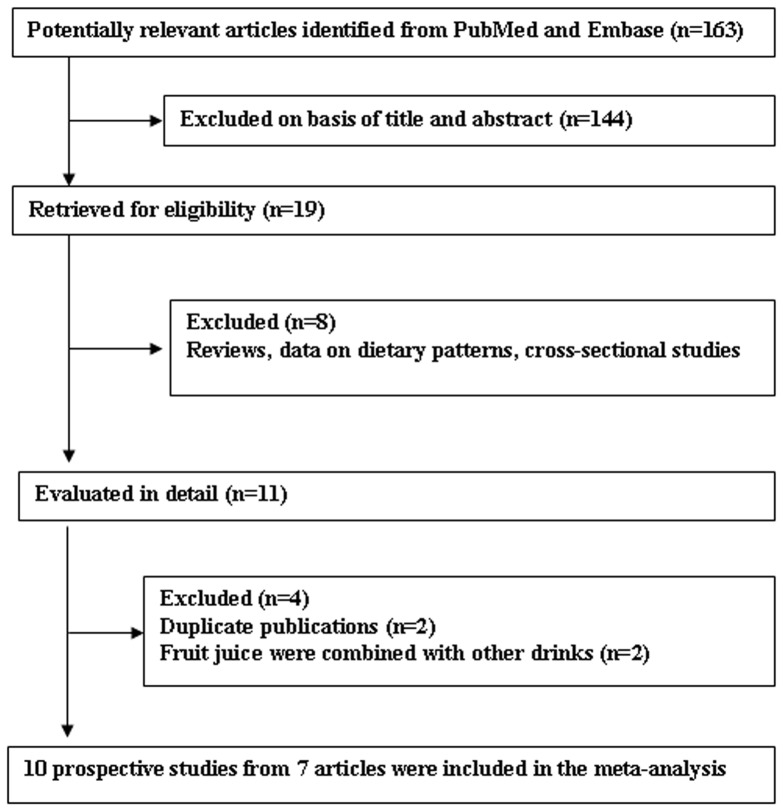
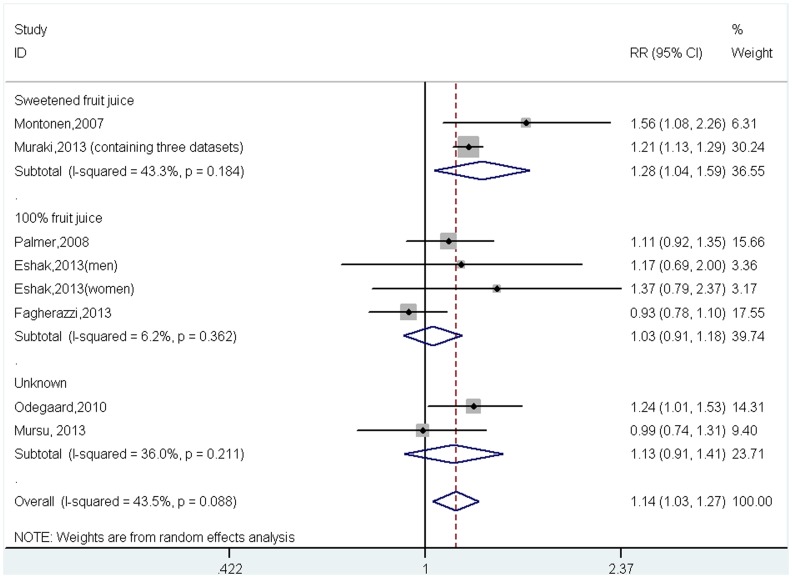
BACKGROUND: Several prospective studies have been conducted to examine the relationship between fruit juice intake and risk of incident type 2 diabetes, but results have been mixed. In the present study, we aimed to estimate the association between fruit juice intake and risk of type 2 diabetes. METHODS: PubMed and Embase databases were searched up to December 2013. All prospective cohort studies of fruit juice intake with risk of type 2 diabetes were included. The pooled relative risks (RRs) with 95% confidence intervals (CIs) for highest vs. lowest category of fruit juice intake were estimated using a random-effects model. RESULTS: A total of four studies (191,686 participants, including 12,375 with type 2 diabetes) investigated the association between sugar-sweetened fruit juice and risk of incident type 2 diabetes, and four studies (137,663 participants and 4,906 cases) investigated the association between 100% fruit juice and risk of incident type 2 diabetes. A higher intake of sugar-sweetened fruit juice was significantly associated with risk of type 2 diabetes (RR = 1.28, 95%CI = 1.04-1.59, p = 0.02), while intake of 100% fruit juice was not associated with risk of developing type 2 diabetes (RR = 1.03, 95% CI = 0.91-1.18, p = 0.62). CONCLUSIONS: Our findings support dietary recommendations to limit sugar-sweetened beverages, such as fruit juice with added sugar, to prevent the development of type 2 diabetes.
Overview
The claims and statistics of this paper haven’t been checked yet.
Run the check — free, no account needed. It reads the open-access text and checks the sources it cites.
Integrity signals
Registry
Cites
Statistics
Figures
Verification
Claims the paper makes
The claims and statistics of this paper haven’t been checked yet.
Run the check — free, no account needed. It reads the open-access text and checks the sources it cites.
Claims other papers make about this one
Each is checked against this paper’s own text: does it say what the citing paper says it does?
In the citing paper
“Further, intake of sugar-sweetened fruit juice, but not 100% fruit juice, is associated with incident diabetes in longitudinal studies (Figure 6).257, 266”
From Dietary and Policy Priorities for Cardiovascular Disease, Diabetes, and Obesity: A Comprehensive Review (2016) · cites this paper as [266]
Self-check
Percentages, sums and reported differences re-computed from the paper’s own numbers.
The self-check needs the paper’s full text.
Citations
Cites
Measuring inconsistency in meta-analyses
Higgins, J. P. T., Thompson, S. G., Deeks, J. J., & Altman, D. G. (2003) · BMJ · doi:10.1136/bmj.327.7414.557 · Cited by 63,139
Bias in meta-analysis detected by a simple, graphical test
Egger, M., Smith, G. D., Schneider, M., & Minder, C. (1997) · BMJ · doi:10.1136/bmj.315.7109.629 · Cited by 56,722
Meta-analysis of Observational Studies in Epidemiology<SUBTITLE>A Proposal for Reporting</SUBTITLE>
Stroup, D. F. (2000) · JAMA · doi:10.1001/jama.283.15.2008 · Cited by 20,623
(2014) · Medical Entomology and Zoology · Cited by 17,633
Operating characteristics of a rank correlation test for publication bias
Begg, C. B., & Mazumdar, M. (1994) · Biometrics · doi:10.2307/2533446 · Cited by 16,955
Statistical Aspects of the Analysis of Data From Retrospective Studies of Disease
(1959) · JNCI: Journal of the National Cancer Institute · doi:10.1093/jnci/22.4.719 · Cited by 14,689 · cited 1×
“Statistical analysis A random effects model [14] was used to calculate pooled RRs with 95% CIs for highest vs.”
MethodSugar-Sweetened Beverages and Risk of Metabolic Syndrome and Type 2 Diabetes
Malik, V. S., Popkin, B. M., Bray, G. A., Després, J.-P., Willett, W. C., & Hu, F. B. (2010) · Diabetes Care · doi:10.2337/dc10-1079 · Cited by 2,116
Schulze, M. B. (2004) · JAMA · doi:10.1001/jama.292.8.927 · Cited by 1,639
Carter, P., Gray, L. J., Troughton, J., Khunti, K., & Davies, M. J. (2010) · BMJ · doi:10.1136/bmj.c4229 · Cited by 728
Muraki, I., Imamura, F., Manson, J. E., Hu, F. B., Willett, W. C., van Dam, R. M., & Sun, Q. (2013) · BMJ · doi:10.1136/bmj.f5001 · Cited by 544
Recommendations for Prevention of Childhood Obesity
Davis, M. M., Gance‐Cleveland, B., Hassink, S. G., Johnson, R. M., Paradis, G., & Resnicow, K. (2007) · PEDIATRICS · doi:10.1542/peds.2007-2329e · Cited by 462
Kit, B. K., Fakhouri, T. H. I., Park, S., Nielsen, S. J., & Ogden, C. L. (2013) · American Journal of Clinical Nutrition · doi:10.3945/ajcn.112.057943 · Cited by 441
Intake of Fruit, Vegetables, and Fruit Juices and Risk of Diabetes in Women
Bazzano, L. A., Li, T. Y., Joshipura, K. J., & Hu, F. B. (2008) · Diabetes Care · doi:10.2337/dc08-0080 · Cited by 437
Sugar-Sweetened Beverages and Incidence of Type 2 Diabetes Mellitus in African American Women
Palmer, J. R. (2008) · Archives of Internal Medicine · doi:10.1001/archinte.168.14.1487 · Cited by 350
The InterAct Consortium (614230) (2013) · Diabetologia · doi:10.1007/s00125-013-2899-8 · Cited by 300
Montonen, J., Järvinen, R., Knekt, P., Heliövaara, M., & Reunanen, A. (2007) · Journal of Nutrition · doi:10.1093/jn/137.6.1447 · Cited by 264
Fagherazzi, G., Vilier, A., Sartorelli, D. S., Lajous, M., Balkau, B., & Clavel‐Chapelon, F. (2013) · American Journal of Clinical Nutrition · doi:10.3945/ajcn.112.050997 · Cited by 260
Hamer, M., & Chida, Y. (2007) · Journal of Hypertension · doi:10.1097/hjh.0b013e3282efc214 · Cited by 253
Livesey, G., Taylor, R., Livesey, H. F., & Liu, S. (2013) · American Journal of Clinical Nutrition · doi:10.3945/ajcn.112.041467 · Cited by 213
Mursu, J., Virtanen, J. K., Tuomainen, T., Nurmi, T., & Voutilainen, S. (2013) · American Journal of Clinical Nutrition · doi:10.3945/ajcn.113.069641 · Cited by 176
Odegaard, A. O., Koh, W.-P., Arakawa, K., Yu, M. C., & Pereira, M. A. (2010) · American Journal of Epidemiology · doi:10.1093/aje/kwp452 · Cited by 168 · cited 4×
“Four studies were from the USA [6,10], three from Europe [5,9], and three from Asia [7,8]; and the duration of follow-up ranged from 5.”
BackgroundInfluentialKaiser, K. A., Shikany, J. M., Keating, K. D., & Allison, D. B. (2013) · Obesity Reviews · doi:10.1111/obr.12048 · Cited by 156
Paynter, N. P., Yeh, H., Voutilainen, S., Schmidt, M. I., HEISS, G. M., Folsom, A. R., Brancati, F. L., & Kao, W. H. L. (2006) · American Journal of Epidemiology · doi:10.1093/aje/kwj323 · Cited by 156
Soft drink, 100% fruit juice, and vegetable juice intakes and risk of diabetes mellitus
Eshak, E. S., Iso, H., Mizoue, T., Inoue, M., Noda, M., & Tsugane, S. (2012) · Clinical Nutrition · doi:10.1016/j.clnu.2012.08.003 · Cited by 121
O’Neil, C. E., & Nicklas, T. A. (2008) · American Journal of Lifestyle Medicine · doi:10.1177/1559827608317277 · Cited by 74
Cited by
Sorted by citations
Mozaffarian, D. (2016) · Circulation · doi:10.1161/circulationaha.115.018585 · Cited by 2,216
“Furthermore, the intake of sugar-sweetened fruit juice, but not 100% fruit juice, is associated with incident diabetes mellitus in longitudinal studies (Figure 6).(257,266) These findings suggest that 100% fruit juice may have other beneficial components, eg, dietary fiber, vitamins, and phytochemicals, that at least…”
Imamura, F., O’Connor, L., Ye, Z., Mursu, J., Hayashino, Y., Bhupathiraju, S. N., & Forouhi, N. G. (2015) · BMJ · doi:10.1136/bmj.h3576 · Cited by 977
Imamura, F., O’Connor, L., Ye, Z., Mursu, J., Hayashino, Y., Bhupathiraju, S. N., & Forouhi, N. G. (2016) · British Journal of Sports Medicine · doi:10.1136/bjsports-2016-h3576rep · Cited by 968
Sweetening of the global diet, particularly beverages: patterns, trends, and policy responses
Popkin, B. M., & Hawkes, C. (2016) · The Lancet Diabetes & Endocrinology · doi:10.1016/s2213-8587(15)00419-2 · Cited by 737
Risk factors for type 2 diabetes mellitus: An exposure-wide umbrella review of meta-analyses
Bellou, V., Belbasis, L., Tzoulaki, I., & Evangelou, E. (2018) · PLOS ONE · doi:10.1371/journal.pone.0194127 · Cited by 713
Metadata
- Authors
- Xi, B., Li, S., Liu, Z., Tian, H., Yin, X., Huai, P., Tang, W., Zhou, D., & Steffen, L. M.
- Affiliations
- Shandong University (CN)
- University of Minnesota (US)
- Linyi People's Hospital (CN)
- Corresponding author
- Zhou, Donghao
- Steffen, Lyn M.
- ORCID
- Venue
- PLoS ONE
- Publisher
- Public Library of Science (PLoS)
- Published
- 2014-03-28
- Volume
- 9
- Issue
- 3
- Pages
- e93471
- ISSN
- 1932-6203 (ISSN-L)
- PMC
- PMC3969361
- OpenAlex
- W2043939834
- Cited by
- 161
- References
- 25
- Citations by year
- 2026: 4 · 2025: 6 · 2024: 11 · 2023: 12 · 2022: 9 · 2021: 14 · 2020: 8 · 2019: 25 · 2018: 21 · 2017: 11 · 2016: 22 · 2015: 11 · 2014: 7
- FWCI
- 2.71
- Type
- journal article
- Language
- en
- Open access
- gold
- doi.org
- Locations
- PLoS ONE (publishedVersion, cc-by)
- Europe PMC (PubMed Central) (publishedVersion, other-oa)
- PubMed Central (publishedVersion, cc-by)
- PubMed (publishedVersion)
- RePEc: Research Papers in Economics (submittedVersion)
- DOAJ (DOAJ: Directory of Open Access Journals) (submittedVersion, cc-by-sa)
- Topics
- Health Sciences › Medicine › Endocrinology, Diabetes and Metabolism › Diet, Metabolism, and Disease
- Health Sciences › Medicine › Public Health, Environmental and Occupational Health › Nutritional Studies and Diet
- Health Sciences › Medicine › Endocrinology, Diabetes and Metabolism › Diabetes, Cardiovascular Risks, and Lipoproteins
- Keywords
- fruit juice, type 2 diabetes, 100% fruit juice, sugar-sweetened beverages, dietary intake, diabetes risk, prospective cohort
- MeSH terms
- Adult, Beverages, Diabetes Mellitus, Type 2, Diet, Fruit, Humans, Middle Aged, Prospective Studies, Risk, Risk Factors, Sweetening Agents, Incidence, Dietary Sucrose
About these checks
Registry, retraction, Cites and statistics results are computed, not judged, with one exception: a printed reference that no index lists is read once by a model before it counts as a citation error. Claims are extracted by a model and kept only when their quote appears verbatim in the text; each cited source is then checked, with a model’s help, for whether it says what the claim relies on. Those verdicts can be wrong — read the claim’s quote and the cited source before relying on one.
Statistics and arithmetic are recomputed, not judged.
Confidence bands are shown only for fields calibrated on our annotated test set. None is calibrated yet, so no band is shown.
What counts as a claim ›How we measure confidence ›How we check this ›
Are you an author, or do you see a problem with this page? Request a review
