

A Gain-of-Function Mutation in Adenylate Cyclase 3 Protects Mice from Diet-Induced Obesity
Open accessThe DOI matches its Crossref record; 37 of the 37 references it cites were found in a registry or an index.
Abstract
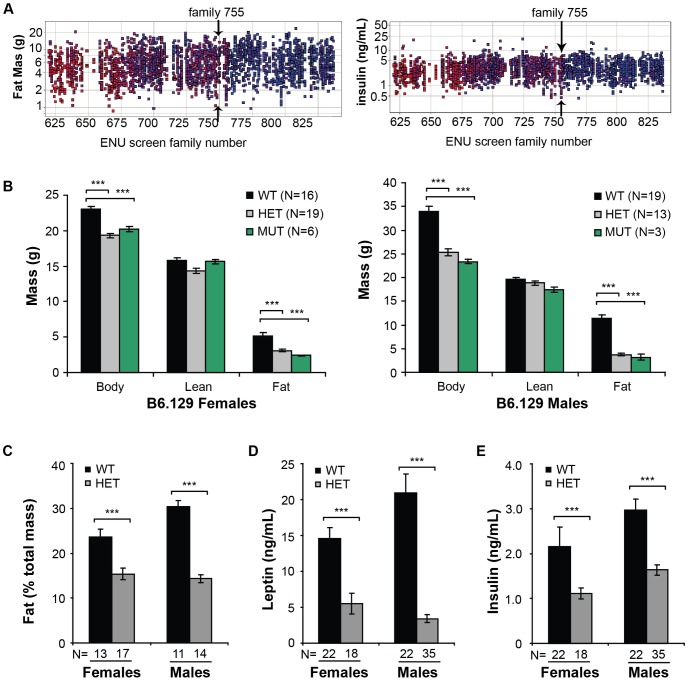
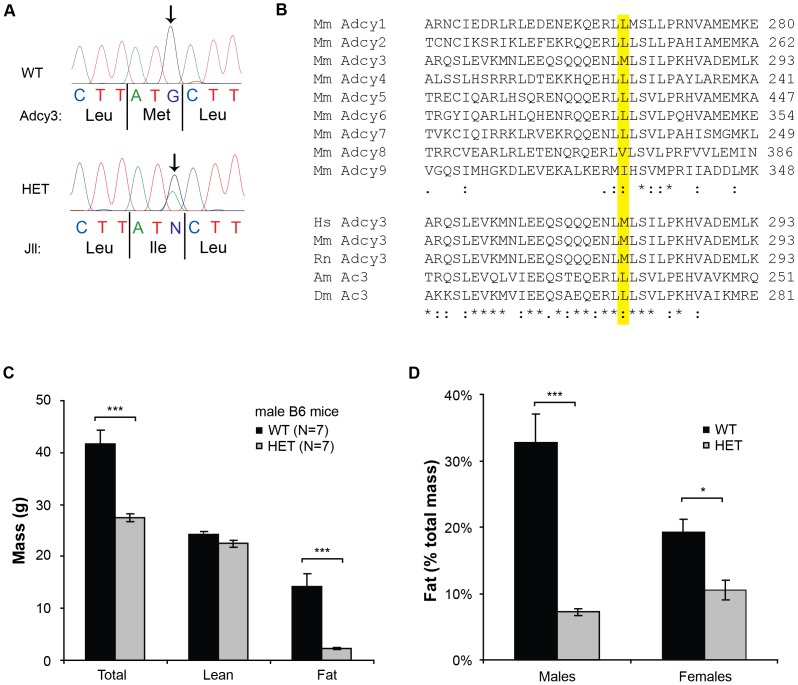
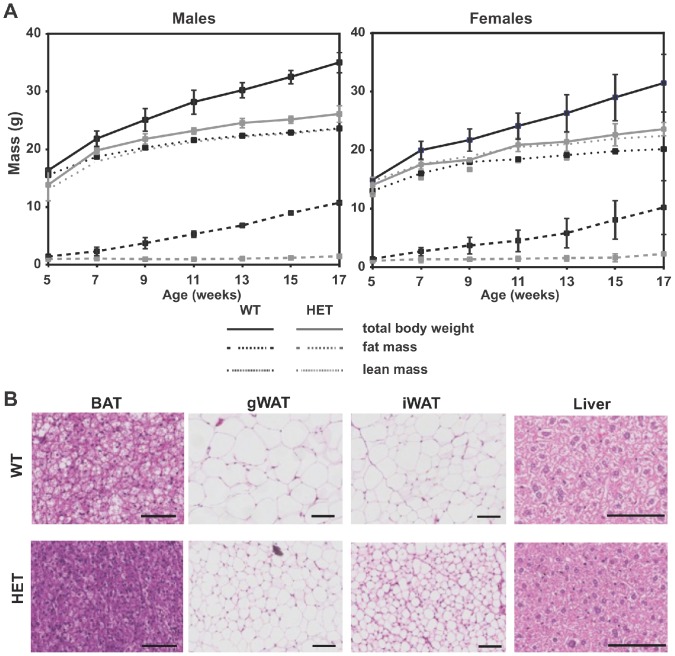
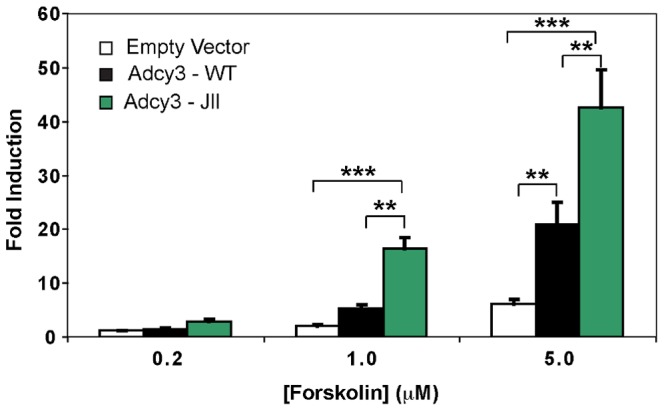
In a screen for genes that affect the metabolic response to high-fat diet (HFD), we selected one line of N-ethyl-N-nitrosourea (ENU)-mutagenized mice, Jll, with dominantly inherited resistance to diet-induced obesity (DIO). Mutant animals had dramatically reduced body weight and fat mass, and low basal insulin and glucose levels relative to unaffected controls. Both white adipose tissue (WAT) and brown adipose tissue (BAT) depots were smaller in mutant animals. Mutant animals fed a HFD gained only slightly more weight than animals fed regular chow, and were protected from hepatic lipid accumulation. The phenotype was genetically linked to a 5.7-Mb interval on chromosome 12, and sequencing of the entire interval identified a single coding mutation, predicted to cause a methionine-to-isoleucine substitution at position 279 of the Adcy3 protein (Adcy3M279I, henceforth referred to as Adcy3Jll). The mutant protein is hyperactive, possibly constitutively so, producing elevated levels of cyclic AMP in a cell-based assay. These mice demonstrate that increased Adcy3 activity robustly protect animals from diet-induced metabolic derangements.
Overview
The claims and statistics of this paper haven’t been checked yet.
Free: it reads the open-access text and checks the first 5 claims that cite a source we can check. Create a free account to check every claim.
Integrity signals
Registry
Cites
Statistics
Figures
Verification
Claims the paper makes
The claims and statistics of this paper haven’t been checked yet.
Free: it reads the open-access text and checks the first 5 claims that cite a source we can check. Create a free account to check every claim.
Claims other papers make about this one
Each is checked against this paper’s own text: does it say what the citing paper says it does?
In the citing paper
“Conversely, mice with a gain-of-function mutant in AC3 display resistance to diet-induced increases in body weight, leptin content, and insulin content (304).”
From Physiological roles of mammalian transmembrane adenylyl cyclase isoforms (2022) · cites this paper as [304]
Self-check
Percentages, sums and reported differences re-computed from the paper’s own numbers.
The self-check needs the paper’s full text.
Citations
Cites
Genome sequencing in microfabricated high-density picolitre reactors
Margulies, M., Egholm, M., Altman, W. E., Attiya, S., Bader, J. S., Bemben, L. A., Berka, J., Braverman, M. S., Chen, Y.-J., Chen, Z., et al. (2005) · Nature · doi:10.1038/nature03959 · Cited by 7,693
Association analyses of 249,796 individuals reveal 18 new loci associated with body mass index
MAGIC, Speliotes, E. K., on behalf of Procardis Consortium, Willer, C. J., Berndt, S. I., Monda, K. L., Thorleifsson, G., Jackson, A. U., Allen, H. L., Lindgren, C. M., et al. (2010) · Nature Genetics · doi:10.1038/ng.686 · Cited by 2,912
Impact of Overweight on the Risk of Developing Common Chronic Diseases During a 10-Year Period
Field, A. E., Coakley, E. H., Must, A., Spadano, J. L., Laird, N., Dietz, W. H., Rimm, E., & Colditz, G. A. (2001) · Archives of Internal Medicine · doi:10.1001/archinte.161.13.1581 · Cited by 1,694 · cited 1×
“Obesity increases the risk of heart disease, type 2 diabetes, hypertension, stroke, colon cancer, and early mortality [2,3].”
BackgroundGenetic diagnosis by whole exome capture and massively parallel DNA sequencing
Choi, M., Scholl, U. I., Ji, W., Liu, T., Tikhonova, I. R., Zumbo, P., Nayir, A., Bakkaloğlu, A., Özen, S., Sanjad, S., et al. (2009) · Proceedings of the National Academy of Sciences · doi:10.1073/pnas.0910672106 · Cited by 1,329
Jackson, R. S., Creemers, J. W. M., Ohagi, S., Raffin-Sanson, M.-L., Sanders, L., Montague, C. T., Hutton, J. C., & O'Rahilly, S. (1997) · Nature Genetics · doi:10.1038/ng0797-303 · Cited by 1,153 · cited 1×
“In the case of prohormone convertase 1 (PC1), monogenic obesity was identified in humans before a corresponding, obesity-causing mutation was identified in mice [7,8].”
BackgroundCrystal Structure of the Catalytic Domains of Adenylyl Cyclase in a Complex with G sα ·GTPγS
Tesmer, J. J. G., Sunahara, R. K., Gilman, A. G., & Sprang, S. R. (1997) · Science · doi:10.1126/science.278.5345.1907 · Cited by 796
βAR Signaling Required for Diet-Induced Thermogenesis and Obesity Resistance
Bachman, E. S., Dhillon, H., Zhang, C.-Y., Cinti, S., Bianco, A. C., Kobilka, B. K., & Lowell, B. B. (2002) · Science · doi:10.1126/science.1073160 · Cited by 783
Regulation and Role of Adenylyl Cyclase Isoforms
Hanoune, J., & Defer, N. (2001) · Annual Review of Pharmacology and Toxicology · doi:10.1146/annurev.pharmtox.41.1.145 · Cited by 691
McGee, D. L. (2005) · Annals of Epidemiology · doi:10.1016/j.annepidem.2004.05.012 · Cited by 582
Nguyen, D. M., & El-Serag, H. B. (2010) · Gastroenterology Clinics of North America · doi:10.1016/j.gtc.2009.12.014 · Cited by 531
Genetically lean mice result from targeted disruption of the RIIβ subunit of protein kinase A
Cummings, D. E., Brandon, E. P., Planas, J. V., Motamed, K., Idzerda, R. L., & McKnight, G. S. (1996) · Nature · doi:10.1038/382622a0 · Cited by 418
Meta-analysis identifies common variants associated with body mass index in east Asians
The Genetic Investigation of ANthropometric Traits (GIANT) Consortium, Wen, W., Cho, Y.-S., Zheng, W., Dorajoo, R., Kato, N., Qi, L., Chen, C.-H., Delahanty, R. J., Okada, Y., et al. (2012) · Nature Genetics · doi:10.1038/ng.1087 · Cited by 395
Human genetics illuminates the paths to metabolic disease
O’Rahilly, S. (2009) · Nature · doi:10.1038/nature08532 · Cited by 324
The Molecular Genetics of Rodent Single Gene Obesities
Leibel, R. L., Chung, W. K., & Chua, S. C. (1997) · Journal of Biological Chemistry · doi:10.1074/jbc.272.51.31937 · Cited by 286
Leptin at 14 y of age: an ongoing story
Friedman, J. M. (2009) · The American Journal of Clinical Nutrition · doi:10.3945/ajcn.2008.26788b · Cited by 272 · cited 1×
“Central among these is Leptin, which is produced by adipose tissue in proportion to total body fat and acts in the hypothalamus to regulate energy intake and expenditure [5].”
BackgroundNABEC Consortium, Monda, K. L., UKBEC Consortium, BioBank Japan Project, AGEN Consortium, Chen, G. K., Taylor, K. C., Palmer, C., Edwards, T. L., Lange, L. A., et al. (2013) · Nature Genetics · doi:10.1038/ng.2608 · Cited by 255
Conkright, M. D., Guzmán, E., Flechner, L., Su, A. I., Hogenesch, J. B., & Montminy, M. (2003) · Molecular Cell · doi:10.1016/s1097-2765(03)00134-5 · Cited by 250
Structure, Mechanism, and Regulation of Mammalian Adenylyl Cyclase
Hurley, J. H. (1999) · Journal of Biological Chemistry · doi:10.1074/jbc.274.12.7599 · Cited by 241
Wheeler, M. B., Lu, M., Dillon, J. S., Leng, X. H., Chen, C., & Boyd, A. E. (1993) · Endocrinology · doi:10.1210/endo.133.1.8391428 · Cited by 225
Self-citationCousminer, D. L., Berry, D. J., Timpson, N. J., Ang, W., Thiering, E., Byrne, E. M., Taal, H. R., Huikari, V., Bradfield, J. P., Kerkhof, M., et al. (2013) · Human Molecular Genetics · doi:10.1093/hmg/ddt104 · Cited by 209
Nagase, I., Yoshida, T., Kumamoto, K., Umekawa, T., Sakane, N., Nikami, H., Kawada, T., & Saito, M. (1996) · Journal of Clinical Investigation · doi:10.1172/jci118748 · Cited by 207
The Creb1 coactivator Crtc1 is required for energy balance and fertility
Altarejos, J. Y., Goebel, N., Conkright, M. D., Inoue, H., Xie, J., Arias, C. M., Sawchenko, P. E., & Montminy, M. (2008) · Nature Medicine · doi:10.1038/nm.1866 · Cited by 199
Alternative Gnas gene products have opposite effects on glucose and lipid metabolism
Chen, M., Gavrilova, O., Liu, J., Xie, T., Deng, C., Nguyen, A. T., Nackers, L. M., Lorenzo, J., Shen, L., & Weinstein, L. S. (2005) · Proceedings of the National Academy of Sciences · doi:10.1073/pnas.0408268102 · Cited by 177
Xia, Q., & Grant, S. F. A. (2013) · Annals of the New York Academy of Sciences · doi:10.1111/nyas.12020 · Cited by 174
Xu, T., Yang, Y., Ward, R. J., Gao, L., & Liu, Y. (2013) · Cellular Signalling · doi:10.1016/j.cellsig.2013.07.025 · Cited by 174
Adult Type 3 Adenylyl Cyclase–Deficient Mice Are Obese
Wang, Z., Li, V., Chan, G. C. K., Phan, T., Nudelman, A. S., Xia, Z., & Storm, D. R. (2009) · PLoS ONE · doi:10.1371/journal.pone.0006979 · Cited by 159 · cited 4×
“In the ventral medial hypothalamus, AC is expressed in primary cilia and its absence may be the reason for a lack of response to leptin [17].”
BackgroundInfluentialCRTC3 links catecholamine signalling to energy balance
Song, Y., Altarejos, J., Goodarzi, M. O., Inoue, H., Guo, X., Berdeaux, R., Kim, J.-H., Goode, J., Igata, M., Paz, J. C., et al. (2010) · Nature · doi:10.1038/nature09564 · Cited by 152
Obesity, hyperphagia and increased metabolic efficiency in Pc1 mutant mice
Lloyd, D. J., Bohan, S., & Gekakis, N. (2006) · Human Molecular Genetics · doi:10.1093/hmg/ddl111 · Cited by 142
Self-citationA Point Mutation in Sec61α1 Leads to Diabetes and Hepatosteatosis in Mice
Lloyd, D. J., Wheeler, M. C., & Gekakis, N. (2009) · Diabetes · doi:10.2337/db08-1362 · Cited by 78
Self-citationNordman, S., Abulaiti, A., Hilding, A., Langberg, E.-C., Humphreys, K., Östenson, C.-G., Efendić, S., & Gu, H. F. (2007) · International Journal of Obesity · doi:10.1038/sj.ijo.0803742 · Cited by 73
Diabetes Insipidus in Mice with a Mutation in Aquaporin-2
Lloyd, D. J., Hall, F. W., Tarantino, L. M., & Gekakis, N. (2005) · PLoS Genetics · doi:10.1371/journal.pgen.0010020 · Cited by 71
Self-citationConley, J. M., Brand, C. S., Bogard, A. S., Pratt, E. P. S., Xu, R., Hockerman, G. H., Ostrom, R. S., Dessauer, C. W., & Watts, V. J. (2013) · The Journal of Pharmacology and Experimental Therapeutics · doi:10.1124/jpet.113.207449 · Cited by 41
Zheng, R., Yang, L., Sikorski, M. A., Enns, L. C., Czyzyk, T. A., Ladiges, W., & McKnight, G. S. (2013) · Proceedings of the National Academy of Sciences · doi:10.1073/pnas.1219542110 · Cited by 40
Nolan, M. A., Sikorski, M. A., & McKnight, G. S. (2004) · Molecular Endocrinology · doi:10.1210/me.2004-0194 · Cited by 40
Newhall, K. J., Cummings, D. E., Nolan, M. A., & McKnight, G. S. (2004) · Molecular Endocrinology · doi:10.1210/me.2004-0343 · Cited by 39
Wang, H., Wu, M., Zhu, W., Shen, J., Shi, X., Yang, J., Zhao, Q., Ni, C., Xu, Y., Shen, H., et al. (2010) · PLoS ONE · doi:10.1371/journal.pone.0013851 · Cited by 37 · cited 1×
“Additional genetic evidence supports an association between ADCY3 variation and obesity in both Swedish and Han Chinese populations [15,16].”
BackgroundAllosteric Regulation of Nucleotidyl Cyclases: An Emerging Pharmacological Target
Seifert, R., & Beste, K. Y. (2012) · Science Signaling · doi:10.1126/scisignal.2003466 · Cited by 18
Cited by
Loss-of-function variants in ADCY3 increase risk of obesity and type 2 diabetes
Grarup, N., Moltke, I., Andersen, M. K., Dalby, M., Vitting-Seerup, K., Kern, T., Mahendran, Y., Jørsboe, E., Larsen, C. V. L., Dahl-Petersen, I. K., et al. (2018) · Nature Genetics · doi:10.1038/s41588-017-0022-7 · Cited by 216
Loss-of-function mutations in ADCY3 cause monogenic severe obesity
Saeed, S., Bonnefond, A., Tamanini, F., Mirza, M. U., Manzoor, J., Janjua, Q. M., Din, S. M., Gaitan, J., Milochau, A., Durand, E., et al. (2018) · Nature Genetics · doi:10.1038/s41588-017-0023-6 · Cited by 187
Physiological roles of mammalian transmembrane adenylyl cyclase isoforms
Ostrom, K. F., LaVigne, J. E., Brust, T. F., Seifert, R., Dessauer, C. W., Watts, V. J., & Ostrom, R. S. (2022) · Physiological Reviews · doi:10.1152/physrev.00013.2021 · Cited by 131
Vaisse, C., Reiter, J. F., & Berbari, N. F. (2017) · Cold Spring Harbor Perspectives in Biology · doi:10.1101/cshperspect.a028217 · Cited by 112
“Conversely, a gain-of-function mutation in Adcy3 confers protection from diet-induced obesity (Pitman et al. 2014).”
BackgroundTong, T., Shen, Y., Lee, H.-W., Yu, R., & Park, T. (2016) · Scientific Reports · doi:10.1038/srep34179 · Cited by 82
Metadata
- Authors
- Pitman, J. L., Wheeler, M. C., Lloyd, D. J., Walker, J. R., Glynne, R. J., & Gekakis, N.
- Affiliations
- Scripps Research Institute (US)
- Genomics Institute of the Novartis Research Foundation (US)
- San Diego State University (US)
- Corresponding author
- Gekakis, Nicholas
- Venue
- PLoS ONE
- Publisher
- Public Library of Science (PLoS)
- Published
- 2014-10-16
- Volume
- 9
- Issue
- 10
- Pages
- e110226
- ISSN
- 1932-6203 (ISSN-L)
- PMC
- PMC4199629
- OpenAlex
- W2046035265
- Cited by
- 63
- References
- 37
- Citations by year
- 2026: 4 · 2025: 4 · 2024: 7 · 2023: 5 · 2022: 5 · 2021: 12 · 2020: 4 · 2019: 1 · 2018: 10 · 2017: 5 · 2016: 5 · 2015: 1
- FWCI
- 1.79
- Type
- journal article
- Language
- en
- Open access
- gold
- doi.org
- Locations
- PLoS ONE (publishedVersion, cc-by)
- Europe PMC (PubMed Central) (publishedVersion, cc-by)
- PubMed Central (publishedVersion, cc-by)
- PubMed (publishedVersion)
- DOAJ (DOAJ: Directory of Open Access Journals) (submittedVersion, cc-by-sa)
- Figshare (submittedVersion, cc-by)
- Funders
- National Institutes of Health
- University of North Carolina at Chapel Hill
- National Heart, Lung, and Blood Institute (R21HL113696)
- National Institute of Diabetes and Digestive and Kidney Diseases (R01DK079925, K01DK090185)
- Topics
- Life Sciences › Neuroscience › Endocrine and Autonomic Systems › Regulation of Appetite and Obesity
- Health Sciences › Medicine › Physiology (medical) › Adipose Tissue and Metabolism
- Health Sciences › Medicine › Endocrinology, Diabetes and Metabolism › Adipokines, Inflammation, and Metabolic Diseases
- Keywords
- ADCY3, diet-induced obesity, high-fat diet, obesity resistance, gain-of-function mutations, cyclic AMP, white adipose tissue, brown adipose tissue, hepatic lipid accumulation, insulin, glucose, N-ethyl-N-nitrosourea mutagenesis, genetic screen, mouse model
- MeSH terms
- Cyclic AMP, Adenylyl Cyclases, Alleles, Animals, Adipose Tissue, Brown, Energy Metabolism, Female, Colforsin, Male, Mutation, Obesity, Mice, Adipose Tissue, White, Diet, High-Fat
About these checks
Registry, retraction, Cites and statistics results are computed, not judged, with one exception: a printed reference that no index lists is read once by a model before it counts as a citation error. Claims are extracted by a model and kept only when their quote appears verbatim in the text; each cited source is then checked, with a model’s help, for whether it says what the claim relies on. Those verdicts can be wrong — read the claim’s quote and the cited source before relying on one.
Statistics and arithmetic are recomputed, not judged.
Confidence bands are shown only for fields calibrated on our annotated test set. None is calibrated yet, so no band is shown.
What counts as a claim ›How we measure confidence ›How we check this ›
Are you an author, or do you see a problem with this page? Request a review
Data sources
Bibliographic data: Semantic Scholar, OpenAlex, Crossref.
Contains information from the Semantic Scholar Academic Graph Datasets, made available under the ODC Attribution License (ODC-BY 1.0).
Semantic Scholar’s data is described in: Kinney, R., et al. (2023). The Semantic Scholar Open Data Platform. arXiv:2301.10140.
