

Long-Lasting Effects of Early-Life Antibiotic Treatment and Routine Animal Handling on Gut Microbiota Composition and Immune System in Pigs
Open accessThe DOI matches its Crossref record; 48 of the 48 references it cites were found in a registry or an index.
Abstract
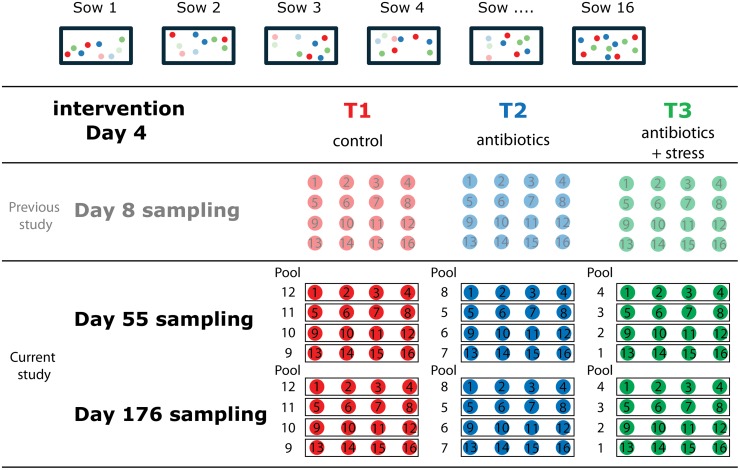
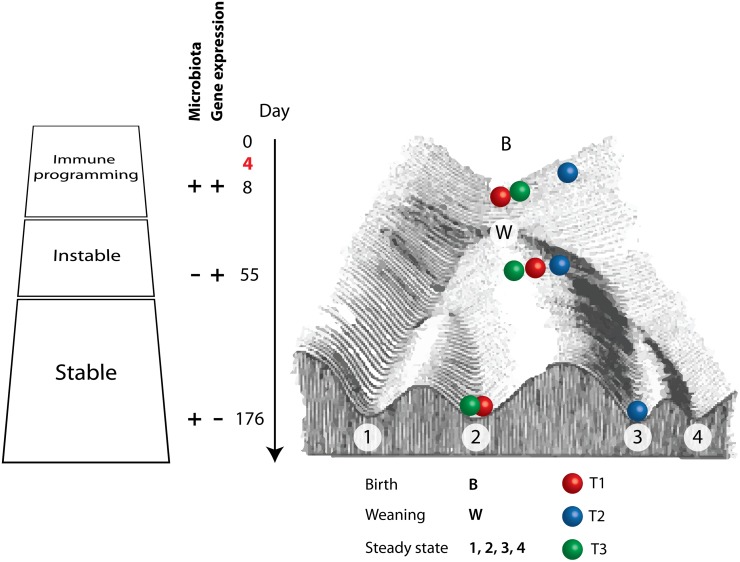
BACKGROUND: In intensive pig husbandry systems, antibiotics are frequently administrated during early life stages to prevent respiratory and gastro-intestinal tract infections, often in combination with stressful handlings. The immediate effects of these treatments on microbial colonization and immune development have been described recently. Here we studied whether the early life administration of antibiotics has long-lasting effects on the pig's intestinal microbial community and on gut functionality. METHODOLOGY/PRINCIPAL FINDINGS: To investigate the long-lasting effect of early-life treatment, piglets were divided into three different groups receiving the following treatments: 1) no antibiotics and no stress, 2) antibiotics and no stress, and 3) antibiotics and stress. All treatments were applied at day four after birth. Sampling of jejunal content for community scale microbiota analysis, and jejunal and ileal tissue for genome-wide transcription profiling, was performed at day 55 (~8 weeks) and day 176 (~25 weeks) after birth. Antibiotic treatment in combination with or without exposure to stress was found to have long-lasting effects on host intestinal gene expression involved in a multitude of processes, including immune related processes. CONCLUSIONS/SIGNIFICANCE: The results obtained in this study indicate that early life (day 4 after birth) perturbations have long-lasting effects on the gut system, both in gene expression (day 55) as well as on microbiota composition (day 176). At day 55 high variance was observed in the microbiota data, but no significant differences between treatment groups, which is most probably due to the newly acquired microbiota during and right after weaning (day 28). Based on the observed difference in gene expression at day 55, it is hypothesized that due to the difference in immune programming during early life, the systems respond differently to the post-weaning newly acquired microbiota. As a consequence, the gut systems of the treatment groups develop into different homeostasis.
Overview
The claims and statistics of this paper haven’t been checked yet.
Free: it reads the open-access text and checks the first 5 claims that cite a source we can check. Create a free account to check every claim.
Integrity signals
Registry
Cites
Statistics
Figures
Verification
Claims the paper makes
The claims and statistics of this paper haven’t been checked yet.
Free: it reads the open-access text and checks the first 5 claims that cite a source we can check. Create a free account to check every claim.
Claims other papers make about this one
Each is checked against this paper’s own text: does it say what the citing paper says it does?
The source backs part of the claim, not all of it — or backs it for a different population, condition or comparison.
In the citing paper
“Animal-to-animal variability in gene expression patterns has been observed for decades and is expected in many tissues, especially in immune cells, of animals that encounter different stressors or pathogens (Boedigheimer et al, 2008; Schokker et al, 2015; Paunovska et al, 2018; Reid et al, 2018).”
From Evaluation of genetic demultiplexing of single-cell sequencing data from model species (2023) · cites this paper as Schokker et al, 2015
Experimental — accuracy not yet measured
Self-check
Percentages, sums and reported differences re-computed from the paper’s own numbers.
The self-check needs the paper’s full text.
Citations
Cites
Subramanian, A., Tamayo, P., Mootha, V. K., Mukherjee, S., Ebert, B. L., Gillette, M. A., Paulovich, A., Pomeroy, S. L., Golub, T. R., Lander, E. S., et al. (2005) · Proceedings of the National Academy of Sciences · doi:10.1073/pnas.0506580102 · Cited by 53,625 · cited 9×
“In contrast, the GSEA for pigs of day 176 resulted in multiple significantly enriched gene sets, indicating that despite the more pronounced differences in microbial composition in adult life (176 vs. 55 days), host gene expression is not always changing accordingly.”
MethodInfluentialSystematic and integrative analysis of large gene lists using DAVID bioinformatics resources
Huang, D. W., Sherman, B. T., & Lempicki, R. A. (2009) · Nature Protocols · doi:10.1038/nprot.2008.211 · Cited by 35,890
Huang, D. W., Sherman, B. T., & Lempicki, R. A. (2009) · Nucleic Acids Research · doi:10.1093/nar/gkn923 · Cited by 14,108
Mootha, V. K., Lindgren, C. M., Eriksson, K.-F., Subramanian, A., Sihag, S., Lehar, J., Puigserver, P., Carlsson, E., Ridderstråle, M., Laurila, E., et al. (2003) · Nature Genetics · doi:10.1038/ng1180 · Cited by 10,197
Human gut microbes associated with obesity
Ley, R. E., Turnbaugh, P. J., Klein, S., & Gordon, J. I. (2006) · Nature · doi:10.1038/4441022a · Cited by 8,785
Catastrophic shifts in ecosystems
Scheffer, M., Carpenter, S., Foley, J. A., Folke, C., & Walker, B. (2001) · Nature · doi:10.1038/35098000 · Cited by 7,510 · cited 1×
“[47] by generating stability landscape(s), where hills depict unstable states and valleys steady states.”
BackgroundChanges of Intestinal Functions in Liver Cirrhosis
Fukui, H., & Wiest, R. (2016) · Inflammatory Intestinal Diseases · doi:10.1159/000444436 · Cited by 6,808
ter Braak, C. J. F. (1986) · Ecology · doi:10.2307/1938672 · Cited by 5,943 · cited 1×
“RDA was performed focusing on inter-sample correlation, and the Monte Carlo Permutation test was applied [25] to decide whether treatment had statistically significant influence on the microbial composition.”
MethodHost-Bacterial Mutualism in the Human Intestine
Bäckhed, F., Ley, R. E., Sonnenburg, J. L., Peterson, D. A., & Gordon, J. I. (2005) · Science · doi:10.1126/science.1104816 · Cited by 5,277
The gut microbiota shapes intestinal immune responses during health and disease
Round, J. L., & Mazmanian, S. K. (2009) · Nature Reviews Immunology · doi:10.1038/nri2515 · Cited by 5,029 · cited 1×
“Since at this stage the necessary regulatory and epigenetic processes underlying gut immune homeostasis have probably not been fully programmed yet, the composition and diversity of the colonizing microbiota is highly susceptible to environmental variations [5–9].”
Background
Research works printed but not linked: 2
- Haenen D, Zhang J, da Silva CS, Bosch G, van der Meer IM, et al (2013) A Diet High in Resistant Starch Modulates Microbiota Composition, SCFA Concentrations, and Gene Expression in Pig Intestine. The Journal of nutrition 143: 274– 283. 10.3945/jn.112.169672 23325922 · DOI · Paper page
- Salonen A, Nikkilä J, Jalanka-Tuovinen J, Immonen O, Rajilić-Stojanović M, et al (2010) Comparative analysis of fecal DNA extraction methods with phylogenetic microarray: effective recovery of bacterial and archaeal DNA using mechanical cell lysis. Journal of microbiological methods 81: 127– 134. 10.1016/j.mimet.2010.02.007 20171997 · DOI · Paper page
Cited by
Items 101–141 of 141
Cross-fostering alters the post-weaning pig behavioral stress response in a sex-specific manner
Byrd, C. J., Young, J. M., & Sommer, D. M. (2022) · Applied Animal Behaviour Science · doi:10.1016/j.applanim.2022.105593 · Cited by 5
PAS, M. F. W. T., Kluivers-Poodt, M., van Riel, J. W., Schokker, D., & Rebel, J. M. J. (2025) · Journal of Animal Science · doi:10.1093/jas/skaf118 · Cited by 2
“The microbiome composition was studied as described previously (Schokker et al., 2015a).”
Self-citationThe impact of early-life rearing conditions on the porcine gut microbiota and immune system
Comer, L., Akram, M. Z., Zhao, H., Huo, P., Sureda, E. A., Xiao, C., Usman, H. U. K., Siegien, P., Wavreille, J., Aerts, J., et al. (2025) · Animal Microbiome · doi:10.1186/s42523-025-00492-y · Cited by 2
“Nonetheless, the current study does corroborate previous work on the immunological impacts of early-life changes, such as Schokker et al.’s work on antibiotic-induced disruption of the microbiota [28, 29].”
Improving feed efficiency in pigs : bridging genetics and nutrition
Verschuren, L. (2021) · doi:10.18174/549769 · Cited by 5
Geervliet, M. (2021) · doi:10.18174/553257 · Cited by 2
Schokker, D., van den Esker, M. H., Bossers, A., Allaart, J. G., van Hees, H. M. J., de Greeff, A., & Rebel, J. M. J. (2025) · Scientific Reports · doi:10.1038/s41598-025-90781-y · Cited by 2
Self-citationProbiotics and oilseed cakes as feed additives in piglets nutrition
Dumitru, M., Râmbu, D. T., & Ciurescu, G. (2025) · Archiva zootechnica · doi:10.2478/azibna-2025-0001 · Cited by 1
Shahbazi, R., Yasavoli‐Sharahi, H., Hebbo, M. J., Alsadi, N., Ibrahim, N., & Matar, C. (2025) · Scientific Reports · doi:10.1038/s41598-025-33160-x · Cited by 2
“Growing evidence indicates that microbiota disturbance in early life is associated with altered programming of the immune system due to enduring changes in the expression of genes involved in immunological processes 3 .”
Sall, K. K., Foldager, L., Delf, C., Christensen, S. J., Agerley, M., Havn, K., & Pedersen, C. B. (2025) · Veterinary Sciences · doi:10.3390/vetsci12010042 · Cited by 3
Ferreres-Serafini, L., Castillejos, L., Martín, M., Bourgot, C. L., & Martín-Orúe, S. M. (2023) · Animals · doi:10.3390/ani13030526 · Cited by 3
“As the intestine plays a primordial role in protecting the animal from harmful microorganisms, post-weaning piglets become more susceptible to opportunistic pathogens [3].”
BackgroundSampling intestinal microbiota in growing pigs: evaluation of CapSa, an ingestible capsule
Viñado, I. G., Correa, F., Trevisi, P., Bee, G., & Ollagnier, C. (2024) · Italian Journal of Animal Science · doi:10.1080/1828051x.2024.2427758 · Cited by 1
“In recent years, significant research has highlighted the intricate relationship between gut microbiota and pig health (Schokker et al. 2015; Jang et al. 2020).”
Early-life feeding in piglets: the impact on intestinal microbiota and mucosal development
Choudhury, R. (2021) · doi:10.18174/533912 · Cited by 1
Healthy and resilient livestock
Rebel, J. M. J. (2022) · doi:10.18174/566942 · Cited by 1
“After his PhD he studied the interaction of the microbiome and intestinal development (Schokker et al., 2015 & 2021).”
MethodSelf-citationLemaire, M. (2018) · theses.fr (ABES) · doi:10.70675/d4a3481fzc7f5z40b0zba41z08905cdd9ce8 · Cited by 2
Colostrum quality, intestinal microbiota and implications for health in young dairy calves
Hang, B. P. T. (2019) · Epsilon Open Archive (Sveriges lantbruksuniversitet biblioteket (Swedish University of Agricultural Sciences)) · Cited by 3
Ontwikkeling van een meetlat voor immuuncompetentie in varkens, vleeskuikens en vleeskalveren
Jansman, A. J. M., Schokker, D., de Greeff, A., van Krinpen, M., Hulst, M. S. D., Rebel, J. M. J., Smits, M. A., Kies, A. K., den Hil, P. J. R.-V., Willems, E., et al. (2017) · doi:10.18174/444537
“Het bekendste voorbeeld van deze relatie komt uit onderzoek naar transgenerationele effecten van prenatale blootstelling aan de Nederlandse hongerwinter [28], maar ook onderzoek in varkens geeft aan dat vroege blootstelling aan antibiotica langdurige gezondheidseffecten kan hebben [11, 29-31].”
BackgroundSelf-citationThe pig gut microbiota analysis techniques, a comparison
Grosu, I. A., Marin, D. E., & Țăranu, I. (2022) · Archiva zootechnica · doi:10.2478/azibna-2022-0007
Nutrition and Immunology in Swine
Rodrigues, L. A., Wellington, M. O., Kessel, A. G. V., & Columbus, D. A. (2022) · Wiley eBooks · doi:10.1002/9781119583998.ch9
Step-by-step methodology for building a capsule to sample small intestine contentPreprint
Ollagnier, C., Tretola, M., Viñado, I. G., & Morel, B. (2024) · bioRxiv (Cold Spring Harbor Laboratory) · doi:10.1101/2024.10.10.617430
VIDA ÚTIL Y BENEFICIOS DE LOS NUTRACÉUTICOS COMO ALTERNATIVAS AL ÓXIDO DE ZINC
Martín, A. T., Jara, D. S., Pablo, M. J. C., Bueso, M. J. J., Conesa, C. M., & Rivera-Gomis, J. (2024) · Anales de Veterinaria de Murcia · doi:10.6018/analesvet.628541
“Estos factores provocan disbiosis intestinal con pro-liferación de bacterias patógenas e inflamación de las mucosas, que evolucionan hacia diarrea (Schokker et al., 2015).”
BackgroundEffects of Fish Palm Rice and Coconut Palm Rice Oil Mixture on Intestinal Health of Weaned Piglets
Yang, K., Yang, W., Jiang, F., Yu, B., Huang, Z., Luo, Y., Wu, A., Zheng, P., Mao, X., Yu, J., et al. (2025) · Agriculture · doi:10.3390/agriculture15040384 · Cited by 1
Zhong, Y., Pan, Q., Wang, Y., Yu, J., Li, Y., Gu, L., Hou, M., Liang, S., Guo, J., Jiao, X., et al. (2025) · Microorganisms · doi:10.3390/microorganisms13040777
Das, M., Santra, S., Lalsangi, S. B., Khamaru, D., Chakraborty, A., Jayaseelan, P., & Banerjee, R. (2025) · Livestock diseases and management · doi:10.1007/978-981-96-1885-9_22
Puig, A., Faria, G. P., Baratelli, M., Guedes, R. M. C., Silva, R. O. S., Boix-Mas, O., & Gibert, X. (2025) · Animals · doi:10.3390/ani15091200 · Cited by 1
“In this regard, some studies have shown that antibiotic exposure in suckling piglets altered the intestinal tract in terms of gene expression and microbiota composition, leading to an unhealthy gut environment [28–30].”
Kiernan, D. P., O’Doherty, J. V., Ryan, M. T., & Sweeney, T. (2025) · Microorganisms · doi:10.3390/microorganisms13061264 · Cited by 1
“Furthermore, microbial exposure and colonization in early life has a fundamental role in the development of the GIT and the immune system [11–14].”
Impact of gestational antibiotics on maternal and offspring gut microbiota and growth in pigsPreprint
Mahmud, M. R., Orro, T., Munsterhjelm, C., Pessa‐Morikawa, T., Ahlqvist, K., Junnikkala, S., König, E., Pujolassos, M., Calle, M. L., Kwon, H. N., et al. (2025) · bioRxiv (Cold Spring Harbor Laboratory) · doi:10.1101/2025.11.08.687112
“Such changes may affect the early priming of the piglet immune system and the subsequent microbial colonization (Mueller et al., 2015; Schokker et al., 2015).”
Schokker, D., Kar, S. K., Willems, E., Bossers, A., Dekker, R. A., & Jansman, A. J. M. (2023) · Figshare · doi:10.6084/m9.figshare.24240135
Self-citationKim, K., Jinno, C. N., Ji, P., & Liu, Y. (2022) · Figshare · doi:10.6084/m9.figshare.19731803
Saladrigas-García, M., Durán, M., D’Angelo, M., Coma, J., Pérez, J. F., & Martín-Orúe, S. M. (2024) · Figshare · doi:10.6084/m9.figshare.26557526
Trevisi, P., Luise, D., Correa, F., Messori, S., Mazzoni, M., Lallès, J. P., & Bosi, P. (2021) · Figshare · doi:10.6084/m9.figshare.14234548
Tams, K. W., Larsen, I., Hansen, J. E., Spiegelhauer, H., Strøm-Hansen, A. D., Rasmussen, S., Ingham, A. C., Kalmár, L., Kean, I. R. L., Angen, Ø., et al. (2024) · Figshare · doi:10.6084/m9.figshare.26611742
Dynamic picture of the pig gut’s microbiota under normal and pathological conditions
Viñado, I. G., Correa, F., Trevisi, P., Bee, G., & Ollagnier, C. (2025) · Animal Microbiome · doi:10.1186/s42523-025-00424-w
“Manipulating the intestinal microbiota can have both immediate and long-term effects on pig intestinal health [13, 14].”
Antibiotic exposure during weaning disrupts oral microbiota assembly in piglets
Zhu, C., Hu, P., Yuan, P., Yu, J., Zhu, M., Ogamune, K. J., Huang, H., Kim, I. H., Manyelo, T. G., Ahmed, A. A., et al. (2026) · Journal of Animal Science and Biotechnology/Journal of animal science and biotechnology · doi:10.1186/s40104-026-01483-y
“Although effective, early-life antibiotic exposure in piglets can cause collateral damage to commensal microbiota, resulting in long-term health consequences such as chronic disease and impaired immune function [8, 9].”
In Vivo Digestion of Pectin Emulsion for Colon-Targeted Delivery of Short-Chain Fatty Acids
Le, H. D., Loveday, S. M., Montoya, C. A., Stroebinger, N., Hodgkinson, S. M., & Singh, H. (2026) · ACS Nutrition Science · doi:10.1021/acsnutrsci.6c00071
Metadata
- Authors
- Schokker, D., Zhang, J., Vastenhouw, S. A., Heilig, H. G. H. J., Smidt, H., Rebel, J. M. J., & Smits, M. A.
- Affiliations
- Wageningen University & Research (NL)
- Corresponding author
- Schokker, Dirkjan
- ORCID
- Venue
- PLOS ONE
- Publisher
- Public Library of Science (PLoS)
- Published
- 2015-02-06
- Volume
- 10
- Issue
- 2
- Pages
- e0116523
- ISSN
- 1932-6203 (ISSN-L)
- PMC
- PMC4319779
- OpenAlex
- W2120718555
- Semantic Scholar
- 1d13a06588510b198fe177867264d5f961075987
- Cited by
- 142
- References
- 48
- Citations by year
- 2026: 3 · 2025: 18 · 2024: 11 · 2023: 10 · 2022: 21 · 2021: 16 · 2020: 16 · 2019: 16 · 2018: 8 · 2017: 12 · 2016: 7 · 2015: 4
- FWCI
- 14.61
- Type
- journal article
- Language
- en
- Open access
- gold
- doi.org
- Licence
- Locations
- PLoS ONE (publishedVersion, cc-by)
- PubMed Central (publishedVersion, cc-by)
- PubMed (publishedVersion)
- Socio-Environmental Systems Modeling (acceptedVersion, cc-by)
- DOAJ (DOAJ: Directory of Open Access Journals) (submittedVersion, cc-by-sa)
- Figshare (submittedVersion, cc-by)
- Data Archiving and Networked Services (DANS) (submittedVersion, cc-by)
- Funders
- European Commission (227549)
- Topics
- Life Sciences › Agricultural and Biological Sciences › Animal Science and Zoology › Animal Nutrition and Physiology
- Life Sciences › Biochemistry, Genetics and Molecular Biology › Molecular Biology › Gut microbiota and health
- Health Sciences › Veterinary › Small Animals › Veterinary medicine and infectious diseases
- Keywords
- animal handling stress, gut microbiota, immune programming, intestinal gene expression, piglets, weaning, long-lasting effects, jejunal microbiota, intestinal homeostasis
- MeSH terms
- Gastrointestinal Microbiome, Animals, Animals, Newborn, Anti-Bacterial Agents, Disaccharides, DNA, Bacterial, Heterocyclic Compounds, Intestinal Mucosa, Stress, Physiological, Gene Expression Regulation, Developmental, Macrolides, Gene Expression Profiling, Sus scrofa, Biodiversity
About these checks
Registry, retraction, Cites and statistics results are computed, not judged, with one exception: a printed reference that no index lists is read once by a model before it counts as a citation error. Claims are extracted by a model and kept only when their quote appears verbatim in the text; each cited source is then checked, with a model’s help, for whether it says what the claim relies on. Those verdicts can be wrong — read the claim’s quote and the cited source before relying on one.
Statistics and arithmetic are recomputed, not judged.
Confidence bands are shown only for fields calibrated on our annotated test set. None is calibrated yet, so no band is shown.
What counts as a claim ›How we measure confidence ›How we check this ›
Are you an author, or do you see a problem with this page? Request a review
Data sources
Bibliographic data: Semantic Scholar, OpenAlex, Crossref.
Contains information from the Semantic Scholar Academic Graph Datasets, made available under the ODC Attribution License (ODC-BY 1.0).
Semantic Scholar’s data is described in: Kinney, R., et al. (2023). The Semantic Scholar Open Data Platform. arXiv:2301.10140.
