

The DOI matches its Crossref record; 36 of the 37 references it cites were found in a registry or an index.
CCTop: An Intuitive, Flexible and Reliable CRISPR/Cas9 Target Prediction Tool
Open accessAbstract
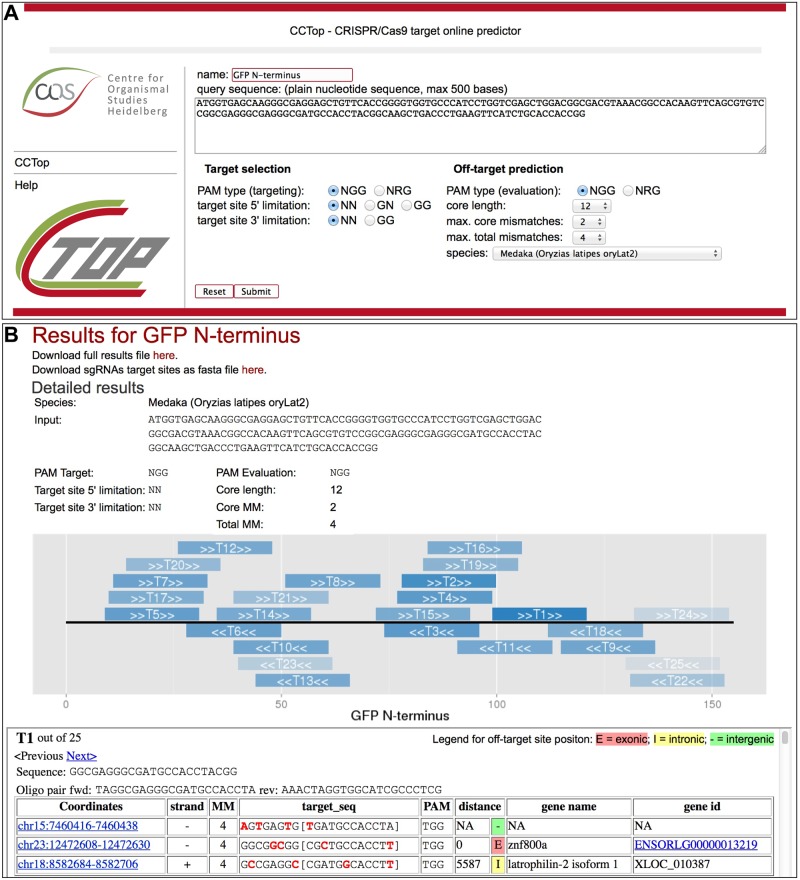
Engineering of the CRISPR/Cas9 system has opened a plethora of new opportunities for site-directed mutagenesis and targeted genome modification. Fundamental to this is a stretch of twenty nucleotides at the 5' end of a guide RNA that provides specificity to the bound Cas9 endonuclease. Since a sequence of twenty nucleotides can occur multiple times in a given genome and some mismatches seem to be accepted by the CRISPR/Cas9 complex, an efficient and reliable in silico selection and evaluation of the targeting site is key prerequisite for the experimental success. Here we present the CRISPR/Cas9 target online predictor (CCTop, http://crispr.cos.uni-heidelberg.de) to overcome limitations of already available tools. CCTop provides an intuitive user interface with reasonable default parameters that can easily be tuned by the user. From a given query sequence, CCTop identifies and ranks all candidate sgRNA target sites according to their off-target quality and displays full documentation. CCTop was experimentally validated for gene inactivation, non-homologous end-joining as well as homology directed repair. Thus, CCTop provides the bench biologist with a tool for the rapid and efficient identification of high quality target sites.
Overview
The claims and statistics of this paper haven’t been checked yet.
Run the check — free, no account needed. It reads the open-access text and checks the sources it cites.
Integrity signals
Registry
Cites
Statistics
Figures
Verification
Claims the paper makes
The claims and statistics of this paper haven’t been checked yet.
Run the check — free, no account needed. It reads the open-access text and checks the sources it cites.
Claims other papers make about this one
Each is checked against this paper’s own text: does it say what the citing paper says it does?
The cited source says what the claim attributes to it.
In the citing paper
“CCTop and CROP-IT generate scores based on the distances of the mismatches to the PAM (Singh et al., 2015; Stemmer et al., 2015).”
From Off-target effects in CRISPR/Cas9 gene editing (2023) · cites this paper as Stemmer et al., 2015
Self-check
Percentages, sums and reported differences re-computed from the paper’s own numbers.
The self-check needs the paper’s full text.
Citations
Cites
Fiji: an open-source platform for biological-image analysis
Schindelin, J., Arganda-Carreras, I., Frise, E., Kaynig, V., Longair, M., Pietzsch, T., Preibisch, S., Rueden, C., Saalfeld, S., Schmid, B., et al. (2012) · Nature Methods · doi:10.1038/nmeth.2019 · Cited by 66,890
Ultrafast and memory-efficient alignment of short DNA sequences to the human genome.
Langmead, B., Trapnell, C., Pop, M., & Salzberg, S. L. (2009) · Genome Biology · doi:10.1186/gb-2009-10-3-r25 · Cited by 21,849
A Programmable Dual-RNA–Guided DNA Endonuclease in Adaptive Bacterial Immunity
Jinek, M., Chylinski, K., Fonfara, I., Hauer, M., Doudna, J. A., & Charpentier, E. (2012) · Science · doi:10.1126/science.1225829 · Cited by 17,116
Multiplex Genome Engineering Using CRISPR/Cas Systems
Cong, L., Ran, F. A., Cox, D., Lin, S., Barretto, R., Habib, N., Hsu, P. D., Wu, X., Jiang, W., Marraffini, L. A., et al. (2013) · Science · doi:10.1126/science.1231143 · Cited by 15,339
The Human Genome Browser at UCSC
Kent, W. J., Sugnet, C. W., Furey, T. S., Roskin, K. M., Pringle, T. H., Zahler, A. M., & Haussler, A. D. (2002) · Genome Research · doi:10.1101/gr.229102 · Cited by 10,400
RNA-Guided Human Genome Engineering via Cas9
Mali, P., Yang, L., Esvelt, K. M., Aach, J., Guell, M., DiCarlo, J. E., Norville, J. E., & Church, G. M. (2013) · Science · doi:10.1126/science.1232033 · Cited by 9,210
DNA targeting specificity of RNA-guided Cas9 nucleases
Hsu, P. D., Scott, D. A., Weinstein, J. A., Ran, F. A., Konermann, S., Agarwala, V., Li, Y., Fine, E. J., Wu, X., Shalem, O., et al. (2013) · Nature Biotechnology · doi:10.1038/nbt.2647 · Cited by 4,741
Efficient genome editing in zebrafish using a CRISPR-Cas system
Hwang, W. Y., Fu, Y., Reyon, D., Maeder, M. L., Tsai, S. Q., Sander, J. D., Peterson, R. T., Yeh, J.-R. J., & Joung, J. K. (2013) · Nature Biotechnology · doi:10.1038/nbt.2501 · Cited by 2,937
Genome editing with engineered zinc finger nucleases
Urnov, F. D., Rebar, E. J., Holmes, M. C., Zhang, H. S., & Gregory, P. D. (2010) · Nature Reviews Genetics · doi:10.1038/nrg2842 · Cited by 2,285
A TALE nuclease architecture for efficient genome editing
Miller, J. C., Tan, S., Qiao, G., Barlow, K. A., Wang, J., Xia, D. F., Meng, X., Paschon, D. E., Leung, E., Hinkley, S. J., et al. (2011) · Nature Biotechnology · doi:10.1038/nbt.1755 · Cited by 2,098
Cited by
Sorted by citations
Items 901–1,000 of 1,000
Сложность обнаружения гомологичной рекомбинации, опосредованной CRISPR/Cas9, у Danio rerio
Pi, Y., He, K. Z., Zhang, W. Q., Dong, Z., Jiang, F., Jiang, K., & Guo, S. (2020) · Molecular Biology · doi:10.31857/s0026898420030131
Optimization of de novo 10-hydroxygeraniol production in Saccharomyces cerevisiae
Davies, M. E. (2019) · Spectrum Research Repository (Concordia University)
Padilla, L. F. A., Castañeda-Cortés, D. C., da Rosa, I. F., Nóbrega, R. H., & Fernandino, J. I. (2020) · bioRxiv (Cold Spring Harbor Laboratory) · doi:10.1101/2020.08.30.274480
IFN-λ4 may contribute to HCV persistence by increasing ER stress and enhancing IRF1 signalingPreprint
Onabajo, O. O., Wang, F., Lee, M., Flórez-Vargas, O., Obajemu, A. A., Castro, M. A. A., Tanikawa, C., Vargas, J. M., Liao, S.-F., Song, C., et al. (2020) · bioRxiv (Cold Spring Harbor Laboratory) · doi:10.1101/2020.10.28.359398
Template-independent genome editing and repairing correct frameshift disease in vivoPreprint
Liu, L., Li, K., Zou, L., Hou, H., Hu, Q., Liu, S., Wang, S., Wang, Y., Li, J., Song, C., et al. (2020) · bioRxiv (Cold Spring Harbor Laboratory) · doi:10.1101/2020.11.13.381160
Translational Research Using CRISPR/Cas
Tyagi, A., Sharma, S. B., Vats, S., Ali, S., Kumar, S., Gulzar, N., & Deshmukh, R. (2020) · Concepts and strategies in plant sciences · doi:10.1007/978-3-030-42022-2_8
Myeloid leukemia vulnerabilities at CTCF-enriched long noncoding RNA lociPreprint
Ng, M. S. W., Verboon, L., Issa, H., Bhayadia, R., Alejo-Valle, O., Borchert, D., Schuschel, K., Regényi, E., Reinhardt, D., Yaspo, M., et al. (2021) · Research Square · doi:10.21203/rs.3.rs-727909/v1
Adar-mediated A-to-I editing is required for establishment of embryonic body axes in zebrafishPreprint
Nieścierowicz, K., Pryszcz, L. P., Navarrete, C., Tralle, E., Kasprzyk, M. E., Nahia, K. A., Misztal, K., Bochtler, M., & Winata, C. L. (2021) · bioRxiv (Cold Spring Harbor Laboratory) · doi:10.1101/2021.08.26.457081
Genetic causes and stem-cell-based therapeutic strategies in neuromuscular diseases
Guo, L. (2021) · Research Publications (Maastricht University) · doi:10.26481/dis.20210623lg
Cromer, M. K., Barsan, V. V., Jaeger, E. B., Wang, M., Hampton, J. P., Chen, F., Kennedy, D., Khrebtukova, I., Granat, A., Truong, T., et al. (2021) · bioRxiv (Cold Spring Harbor Laboratory) · doi:10.1101/2021.10.27.466166
Cutts, J., Kostes, W., & Brafman, D. A. (2021) · Stem Cell Research · doi:10.1016/j.scr.2021.102586
Lemaire, F. (1990) · OpenGrey (Institut de l'Information Scientifique et Technique)
Suh, Y. (2020) · Faculty Opinions – Post-Publication Peer Review of the Biomedical Literature · doi:10.3410/f.736464519.793579914
Höcker, S., Akan, I. S., Simon, A. M., Yildirim, K., Kenéz, L. A., Lohmann, I., & Erhardt, S. (2022) · bioRxiv (Cold Spring Harbor Laboratory) · doi:10.1101/2022.02.05.479222
Application of CRISPR-Based Technology in Plant Gene Editing and Agricultural Engineering
Zhang, Z., Wang, P., & Liu, J. (2022) · Springer eBooks · doi:10.1007/978-981-16-8504-0_5
Imaging tools generated by CRISPR/Cas9 tagging reveal cytokinetic diversity in mammalian cellsPreprint
Husser, M. C., Ozugergin, I., Resta, T., Martin, V. J. J., & Piekny, A. J. (2022) · bioRxiv (Cold Spring Harbor Laboratory) · doi:10.1101/2022.03.14.484313
Computational Tools for Target Design and Analysis
Hwang, G., & Bae, S. (2022) · Wiley eBooks · doi:10.1002/9781119671404.ch5 · Cited by 1
FCHO controls AP2’s critical endocytic roles through a PtdIns4,5P 2 membrane-dependent switchPreprint
Zaccai, N. R., Kadlecová, Z., Dickson, V. K., Korobchevskaya, K., Kamenický, J., Kovtun, O., Umasankar, P. K., Wrobel, A. G., Kaufman, J. G. G., Gray, S. R., et al. (2022) · bioRxiv (Cold Spring Harbor Laboratory) · doi:10.1101/2022.04.02.486817
Lan, J., Cui, Y., Wang, X., Song, G., & Lou, J. (2020) · bioRxiv (Cold Spring Harbor Laboratory) · doi:10.1101/2020.03.04.976340
Mês Nacional de Conscientização da Fibrose Cística no Brasil
. (2019) · Visão Acadêmica · doi:10.5380/acd.v20i3.1.69506
Chiang, C. (2019) · Faculty Opinions – Post-Publication Peer Review of the Biomedical Literature · doi:10.3410/f.734885407.793555754
Cayouette, M. (2019) · Faculty Opinions – Post-Publication Peer Review of the Biomedical Literature · doi:10.3410/f.735399153.793558375
Faculty Opinions recommendation of DeepCRISPR: optimized CRISPR guide RNA design by deep learning.
Conboy, I. M. (2018) · Faculty Opinions – Post-Publication Peer Review of the Biomedical Literature · doi:10.3410/f.733509871.793553954
4 CRISPR-Based Genome Engineering in Human Stem Cells
Garcia, T. Y., & Lamba, D. A. (2017) · CRC Press eBooks · doi:10.1201/9781315402185-5
Complexity of Detecting CRISPR/Cas9-Mediated Homologous Recombination in Zebrafish
Pi, Y., He, K. Z., Zhang, W. Q., Dong, Z., Jiang, F., Jiang, K., & Guo, S. (2020) · Molecular Biology · doi:10.1134/s0026893320030139
Wang, H. (2019) · Faculty Opinions – Post-Publication Peer Review of the Biomedical Literature · doi:10.3410/f.726081204.793558122
Murata, K., Kinoshita, M., Naruse, K., Tanaka, M., & Kamei, Y. (2019) · doi:10.1002/9781119575399.ch7
CRISPR/Cas9 Genome Editing: Future Treatment of Duane Retraction Syndrome
Zulfikar, M. R., Renesteen, E., & Wardhani, B. W. K. (2022) · Pharmaceutical Sciences and Research · doi:10.7454/psr.v9i1.1231
Epigenetic-focused CRISPR/Cas9 screen identifies ASH2L as a regulator of glioblastoma cell survivalPreprint
Ozyerli‐Goknar, E., Kala, E. Y., Aksu, A. C., Bulut, İ., Cingöz, A., Nizamuddin, S., Biniossek, M. L., Seker-Polat, F., Morova, T., Aztekin, C., et al. (2022) · bioRxiv (Cold Spring Harbor Laboratory) · doi:10.1101/2022.08.17.504245
Targeted Manipulation of Histone Modification in Medaka Embryos
Fukushima, H. S., Takeda, H., & Nakamura, R. (2022) · Methods in molecular biology · doi:10.1007/978-1-0716-2724-2_20
Early eye and forebrain development are facilitated by Bone Morphogenetic Protein antagonismPreprint
Bulk, J., Kyrychenko, V., Rensinghoff, P., & Heermann, S. (2022) · bioRxiv (Cold Spring Harbor Laboratory) · doi:10.1101/2022.12.01.518698
Gil-Durán, C., Palma, D., Marcano, Y., Levicán, G. J., Vaca, I., & Chávez, R. (2023) · Research Square · doi:10.21203/rs.3.rs-2420194/v1
Jones, M. (2022) · Publication Server of Goethe University Frankfurt am Main (Goethe University Frankfurt) · doi:10.21248/gups.71574
Tukuli, A. R. (2022) · MOspace Institutional Repository (University of Missouri) · doi:10.32469/10355/93992
Temporal and clonal characterization of neural stem cell niche recruitment in the medaka neuromast
Onistschenko, J., Kaminsky, S., Vázquez-Marín, J., Groß, K., Wang, T., Seleit, A., Dörr, M., & Centanin, L. (2023) · Cells and Development · doi:10.1016/j.cdev.2023.203837
The involvement of RS2Z proteins in tomato heat stress response and thermotolerance
Rosenkranz, R. R. E. (2023) · doi:10.21248/gups.73855
Cui, W., Huang, Z., Jin, S., Johnson, J. S., Lau, K. H., Hostetter, G. H., & Pfeifer, G. P. (2023) · doi:10.1158/0008-5472.c.6769325
Sunil, S., Beeh, S., Stöbbe, E., Fischer, K., Wilhelm, F., Meral, A., Paris, C., Teasdale, L. C., Jiang, Z., Zhang, L., et al. (2023) · bioRxiv (Cold Spring Harbor Laboratory) · doi:10.1101/2023.09.04.556214
Mavrommatis, L., Jeong, H., Kindler, U., Gomez‐Giro, G., Kienitz, M., Stehling, M., Psathaki, O. E., Zeuschner, D., Bixel, M. G., Han, D., et al. (2023) · eLife · doi:10.7554/elife.87081.2
Characterization of a Novel LncRNA(LincRNA-Abcc10) in Northern Pike( Esox Lucius)Preprint
Shunzhe, W., Wang, S., Yang, Q., Liu, Y., Liu, Y., Wang, Y., Sun, H., Zhang, J., Li, J., & Wanlong, L. (2023) · SSRN Electronic Journal · doi:10.2139/ssrn.4579001
Streamlined generation of CRISPR/Cas9-mediated single-cell knockout clones in murine cell linesPreprint
Hub, T., Cornean, A., Kellen, R., Thomas, F., Freichel, M., & Rebekka, M. W. (2023) · bioRxiv (Cold Spring Harbor Laboratory) · doi:10.1101/2023.10.20.563250
Mao, R., Yu, J., Deng, B., Dai, X., Du, Y., Du, S., Zhang, W., & Rao, Y. (2023) · eLife · doi:10.7554/elife.91927.1
Data Visualization of CRISPR-Cas9 Guide RNA Design Tools
Jain, Y., Izzath, F. A. M., Wilson, L. O. W., & Bauer, D. C. (2024) · Studies in health technology and informatics · doi:10.3233/shti231069
Cereal crop genome editing tools and their applications to sustainable agriculture
Elarabi, N. I., Hesham, A. E., EL-BELTAGI, H. S., Adel Abdel-Sabour, R. E. Z. K., Shalaby, T., Al-Saikhan, M. S., Mohamed, A. A., & Abdelhadi, A. A. (2024) · Notulae Botanicae Horti Agrobotanici Cluj-Napoca · doi:10.15835/nbha52113494
Inoue, Y., Suzuki, Y., Kunishima, Y., Washio, T., Morishita, S., & Takeda, H. (2023) · Figshare · doi:10.6084/m9.figshare.24002880
Inoue, Y., Suzuki, Y., Kunishima, Y., Washio, T., Morishita, S., & Takeda, H. (2023) · Figshare · doi:10.6084/m9.figshare.24002877
Brookhouser, N., Nguyen, T., Tekel, S. J., Standage-Beier, K., Wang, X., & Brafman, D. A. (2020) · Figshare · doi:10.6084/m9.figshare.13467915
Eduardo, M. B., Keller, I., Schuster, N., Aebi, S. P., & Jaggi, R. B. (2023) · Figshare · doi:10.6084/m9.figshare.23902893
Inoue, Y., Suzuki, Y., Kunishima, Y., Washio, T., Morishita, S., & Takeda, H. (2023) · Figshare · doi:10.6084/m9.figshare.24002859
Balke‐Want, H., Keerthi, V., Gkitsas-Long, N., Mancini, A. G., Kurgan, G., Fowler, C., Xu, P., Liu, X., Asano, K., Patel, S., et al. (2023) · Figshare · doi:10.6084/m9.figshare.23583513
Guo, X., Zhao, K., Zhang, Y., Zhou, T., & Pan, G. (2024) · Stem Cell Research · doi:10.1016/j.scr.2024.103420
Prime Editing in vivo: Correcting the Leptin Receptor of db/db MicePreprint
Lee, K., Xu, Y., Geng, B., Kim, J. S., Kellon, N., He, M., Zhang, Z., Li, D., Gouchoe, D. A., & Hua Zhu, C. (2024) · doi:10.22541/au.171507305.55377808/v1
Prime editing‐mediated correction of the leptin receptor in muscle cells of db/db mice
Lee, K. E., Xu, Y., Geng, B., Kim, J. S., Kellon, N., He, Z., Zhang, Z., Li, D., Gouchoe, D. A., & Hua Zhu, C. (2024) · Biotechnology Journal · doi:10.1002/biot.202300676
May, N. H., Schmid, A., Meiser, E., & Beneke, T. (2024) · eLife · doi:10.7554/elife.97437.1
Altered thymic niche synergistically drives the massive proliferation of malignant thymocytes
Tsingos, E., Dick, A. M., & Bajoghli, B. (2025) · eLife · doi:10.7554/elife.101137.3
Ni, J., Gong, J., Ran, Y., Bai, R., Huang, P., Zheng, Z., Zhou, M. R., You, Y., Lan, F., & Liu, X. (2024) · bioRxiv (Cold Spring Harbor Laboratory) · doi:10.1101/2024.07.09.602644
Generation of Knockout Human PSCs Using CRISPR/Cas9 Editing with a Donor Template
Shan, Y., Ma, N., & Liao, B. (2024) · Neuromethods · doi:10.1007/978-1-0716-3999-3_6
He, S., Xiong, W., Huo, J.-P., Lin, J., Li, J., & Zhu, H. (2024) · bioRxiv (Cold Spring Harbor Laboratory) · doi:10.1101/2024.07.13.603398
Progress and Prospects in CRISPR Genome Engineering Nucleases
Surendranath, K., Akram, K., Kanagaraj, R., Savash, M., Khan, S., Pantuzcek, J., Karri, M., Guha, S., Rangan, S. L., Kour, E., et al. (2024) · Springer eBooks · doi:10.1007/978-981-97-1777-4_4
Codon usage and expression-based features significantly improve prediction of CRISPR efficiency
Bergman, S., & Tuller, T. (2024) · npj Systems Biology and Applications · doi:10.1038/s41540-024-00431-8 · Cited by 2
Generation of RAB4A homozygous knockout induced pluripotent stem cell (iPSC) line
wang, R., & Shen, Q. X. (2024) · Stem Cell Research · doi:10.1016/j.scr.2024.103556
Positional information drives distinct traits in transcriptomically identified neuronal typesPreprint
Shainer, I., Kappel, J. M., Laurell, E., Donovan, J. C., Schneider, M., Kuehn, E., Arnold-Ammer, I., Stemmer, M., Larsch, J., & Baier, H. (2024) · bioRxiv (Cold Spring Harbor Laboratory) · doi:10.1101/2024.09.15.613138
Self-citationHoisington, Z. W., Gangal, H., Phamluong, K., Shukla, C., Ehinger, Y., Moffat, J. J., Homanics, G. E., Wang, J., & Dorit Ron, A. (2024) · eLife · doi:10.7554/elife.100653.1
Altered thymic niche synergistically drives the massive proliferation of malignant thymocytesPreprint
Tsingos, E., Dick, A. M., & Bajoghli, B. (2024) · eLife · doi:10.7554/elife.101137
Altered thymic niche synergistically drives the massive proliferation of malignant thymocytesPreprint
Tsingos, E., Dick, A. M., & Bajoghli, B. (2024) · eLife · doi:10.7554/elife.101137.1
Choudhury, H., Sharma, M. D., Gangwar, U., Siddiqui, N., & Bansal, A. (2024) · Journal of Visualized Experiments · doi:10.3791/67079
Dad, R., Wang, Y., Fang, C., Chen, Y., Zhang, Y., Zhang, Y., Pan, X., Zhang, X., Swanekamp, E., Patel, K., et al. (2024) · eLife · doi:10.1101/2024.12.30.630763
CRISPR/Cas9-mediated generation of a homozygous CRB2 knockout H1 human embryonic stem cell line
Zhang, L., Zhang, F., & Yao, M. (2025) · Stem Cell Research · doi:10.1016/j.scr.2025.103677
May, N. H., Cao, N. A., Schmid, A., Link, F., Arias-del-Angel, J. A., Meiser, E., & Beneke, T. (2025) · eLife · doi:10.7554/elife.97437.2
Dad, R., Wang, Y., Fang, C., Chen, Y., Zhang, Y., Zhang, Y., Pan, X., Zhang, X., Swanekamp, E., Patel, K., et al. (2025) · eLife · doi:10.7554/elife.105577
Dad, R., Wang, Y., Fang, C., Chen, Y., Zhang, Y., Pan, X., Zhang, X., Swanekamp, E., Patel, K., Wolf, M. T. F., et al. (2025) · eLife · doi:10.7554/elife.105577.1
Targeted Base Editing in Rice Using Target-AID
Nguyen, S. M., Taoka, K.-I., & Nishida, K. (2025) · Springer protocols handbooks/Springer protocols · doi:10.1007/978-1-0716-4358-7_1
Hoisington, Z. W., Gangal, H., Phamluong, K., Shukla, C., Ehinger, Y., Moffat, J. J., Homanics, G. E., Wang, J., & Dorit Ron, A. (2025) · eLife · doi:10.7554/elife.100653.2 · Cited by 1
CRISPR/Cas-mediated mRNA knockdown in the embryos of Xenopus tropicalis
Lin, X., Zhou, Y., Meng, K., Yang, J., Zhang, H., Lin, J.-H., Wu, H., Wang, X., Zhao, H., Feng, S., et al. (2025) · Cell & Bioscience · doi:10.1186/s13578-025-01397-8
Powierża, M., Łaczmański, Ł., & Huk, M. (2025) · Lecture notes in computer science · doi:10.1007/978-981-96-6008-7_17
Rhode, J. M., Edwards, S., Tzvetkova, A., Jensen, L. R., Hossain, M. F., Nowack, B., Hagenau, L., & Kuss, A. W. (2025) · Stem Cell Research · doi:10.1016/j.scr.2025.103730
Sousa, P. D., Houbron, É., Seitz, H., & Busseau, I. (2025) · bioRxiv (Cold Spring Harbor Laboratory) · doi:10.1101/2025.05.29.656857
Altered thymic niche synergistically drives the massive proliferation of malignant thymocytesPreprint
Tsingos, E., Dick, A. M., & Bajoghli, B. (2025) · eLife · doi:10.7554/elife.101137.2
Krishna, Y. K. Y. (2025) · bioRxiv (Cold Spring Harbor Laboratory) · doi:10.1101/2025.08.13.670047
Estrada, M. D., Gebhardt, C. J., Salem, M. A., Rau, C. N., Sharma, K., Glynn, R. A., Bassing, C. H., Oltz, E. M., & Collins, P. L. (2025) · Genes and Immunity · doi:10.1038/s41435-025-00353-3 · Cited by 1
High-Throughput Generation of Pichia pastoris Knock-Out Strains by Using CRISPR/Cas9
Smirnov, K., Rieder, L., & Glieder, A. (2025) · Methods in molecular biology · doi:10.1007/978-1-0716-4779-0_24
An Ehrlich-inspired retrobiosynthesis of pharmaceutical scaffoldsPreprint
Rumpl, A. E. C., Kowalski, D., Goodhew, J. R., Hirano, M., Bogucki, L., Rosa, C. A., Lachance, M., & Pyne, M. E. (2025) · bioRxiv (Cold Spring Harbor Laboratory) · doi:10.1101/2025.11.10.687684
Optimization of gene knockout approaches and sgRNA selection in hPSCs with inducible Cas9 expression
Ni, J., Gong, J., Ran, Y., Bai, R., Huang, P., Zheng, Z., Zhou, M. R., Lan, F., Gu, W., & Liu, X. (2025) · Scientific Reports · doi:10.1038/s41598-025-24184-4
Serotonin receptor 4 in the ventral CA3 regulates agomelatine-induced anxiolytic-like behaviors.
Liu, X.-H., Naveed, M., Hu, X.-Y., Zhu, L.-L., Meng, F., Zhou, Q.-G., & Zhang, J. (2025) · Acta Pharmacologica Sinica · doi:10.1038/s41401-025-01692-7
Designing of guide RNA for CRISPR gene editing: A web-based foundational approach
Okemo, P., & Henry, R. J. (2025) · Elsevier eBooks · doi:10.1016/b978-0-443-29281-1.00012-5
Brookhouser, N., Nguyen, T., Tekel, S. J., Standage-Beier, K., Wang, X., & Brafman, D. A. (2020) · Figshare · doi:10.6084/m9.figshare.13467917
Brookhouser, N., Nguyen, T., Tekel, S. J., Standage-Beier, K., Wang, X., & Brafman, D. A. (2020) · Figshare · doi:10.6084/m9.figshare.13467891
Brookhouser, N., Nguyen, T., Tekel, S. J., Standage-Beier, K., Wang, X., & Brafman, D. A. (2020) · Figshare · doi:10.6084/m9.figshare.13467897
Inoue, Y., Suzuki, Y., Kunishima, Y., Washio, T., Morishita, S., & Takeda, H. (2023) · Figshare · doi:10.6084/m9.figshare.24002856
Metadata
- Authors
- Stemmer, M., Thumberger, T., del Sol Keyer, M., Wittbrodt, J., & Mateo, J. L.
- Affiliations
- Heidelberg University (DE)
- Corresponding author
- Thumberger, Thomas
- Wittbrodt, Joachim
- Mateo, Juan L.
- Venue
- PLoS ONE
- Publisher
- Public Library of Science (PLoS)
- Published
- 2015-04-24
- Volume
- 10
- Issue
- 4
- Pages
- e0124633
- ISSN
- 1932-6203 (ISSN-L)
- PMC
- PMC4409221
- OpenAlex
- W1990149668
- Cited by
- 1,088
- References
- 37
- Citations by year
- 2026: 87 · 2025: 99 · 2024: 106 · 2023: 140 · 2022: 129 · 2021: 114 · 2020: 139 · 2019: 96 · 2018: 72 · 2017: 53 · 2016: 39 · 2015: 13
- FWCI
- 25.61
- Type
- journal article
- Language
- en
- Update notices
- correction (2017-04-20)
- Open access
- gold
- doi.org
- Licence
- Locations
- PLoS ONE (publishedVersion, cc-by)
- Europe PMC (PubMed Central) (publishedVersion, cc-by)
- PubMed Central (publishedVersion, cc-by)
- PubMed (publishedVersion)
- DOAJ (DOAJ: Directory of Open Access Journals) (submittedVersion)
- Figshare (submittedVersion, cc-by)
- Funders
- Deutsche Forschungsgemeinschaft (SFB873)
- Universität Heidelberg
- Topics
- Life Sciences › Biochemistry, Genetics and Molecular Biology › Molecular Biology › CRISPR and Genetic Engineering
- Life Sciences › Biochemistry, Genetics and Molecular Biology › Molecular Biology › RNA regulation and disease
- Life Sciences › Biochemistry, Genetics and Molecular Biology › Molecular Biology › RNA Interference and Gene Delivery
- Keywords
- CRISPR/Cas9, sgRNA design, off-target prediction, genome editing, gene inactivation, non-homologous end joining, homology-directed repair, web-based prediction tool
- MeSH terms
- Animals, Binding Sites, Humans, RNA, Messenger, Software, User-Computer Interface, Reproducibility of Results, Gene Targeting, Computational Biology, Internet, Genomics, CRISPR-Cas Systems, Web Browser
About these checks
Registry, retraction, Cites and statistics results are computed, not judged, with one exception: a printed reference that no index lists is read once by a model before it counts as a citation error. Claims are extracted by a model and kept only when their quote appears verbatim in the text; each cited source is then checked, with a model’s help, for whether it says what the claim relies on. Those verdicts can be wrong — read the claim’s quote and the cited source before relying on one.
Statistics and arithmetic are recomputed, not judged.
Confidence bands are shown only for fields calibrated on our annotated test set. None is calibrated yet, so no band is shown.
What counts as a claim ›How we measure confidence ›How we check this ›
Are you an author, or do you see a problem with this page? Request a review
