

The DOI matches its Crossref record; 36 of the 66 references it cites were found in a registry or an index.
The Oligopoly of Academic Publishers in the Digital Era
Open accessAbstract
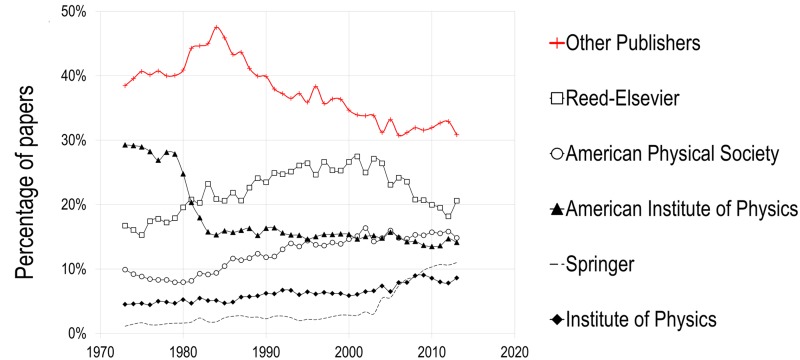
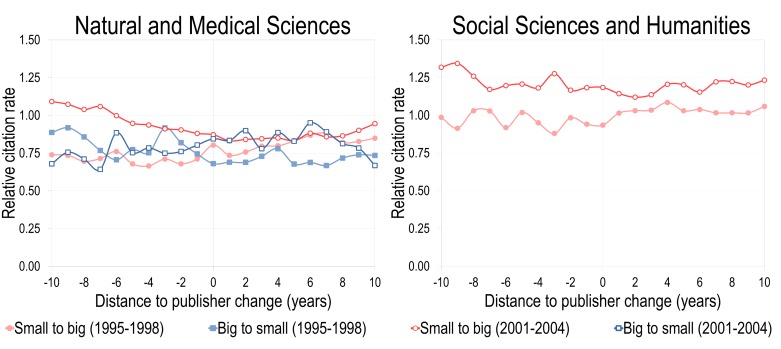
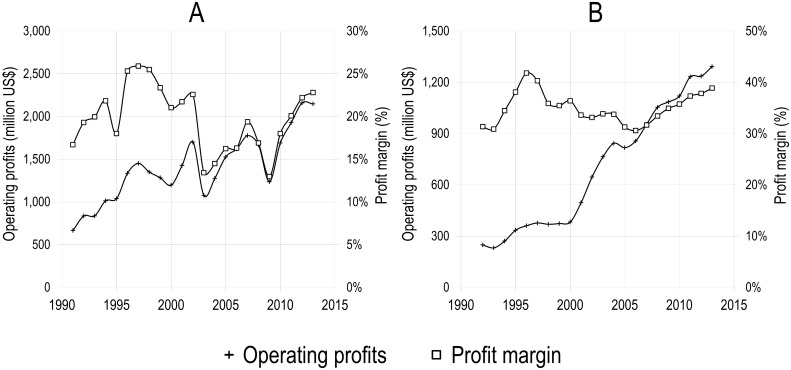
The consolidation of the scientific publishing industry has been the topic of much debate within and outside the scientific community, especially in relation to major publishers' high profit margins. However, the share of scientific output published in the journals of these major publishers, as well as its evolution over time and across various disciplines, has not yet been analyzed. This paper provides such analysis, based on 45 million documents indexed in the Web of Science over the period 1973-2013. It shows that in both natural and medical sciences (NMS) and social sciences and humanities (SSH), Reed-Elsevier, Wiley-Blackwell, Springer, and Taylor & Francis increased their share of the published output, especially since the advent of the digital era (mid-1990s). Combined, the top five most prolific publishers account for more than 50% of all papers published in 2013. Disciplines of the social sciences have the highest level of concentration (70% of papers from the top five publishers), while the humanities have remained relatively independent (20% from top five publishers). NMS disciplines are in between, mainly because of the strength of their scientific societies, such as the ACS in chemistry or APS in physics. The paper also examines the migration of journals between small and big publishing houses and explores the effect of publisher change on citation impact. It concludes with a discussion on the economics of scholarly publishing.
Overview
The claims and statistics of this paper haven’t been checked yet.
Run the check — free, no account needed. It reads the open-access text and checks the sources it cites.
Integrity signals
Registry
Cites
Statistics
Figures
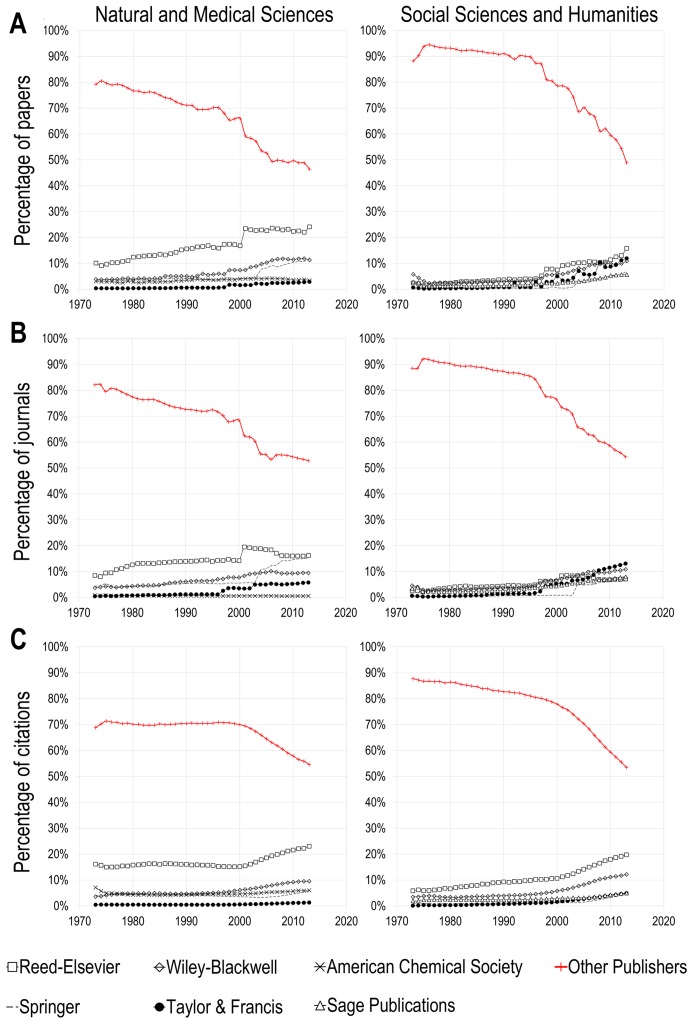
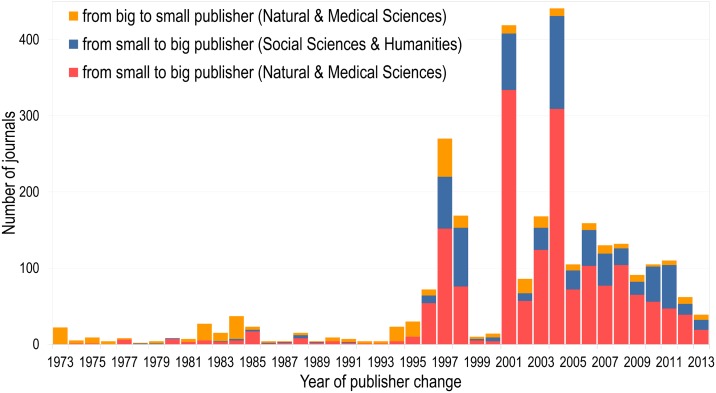
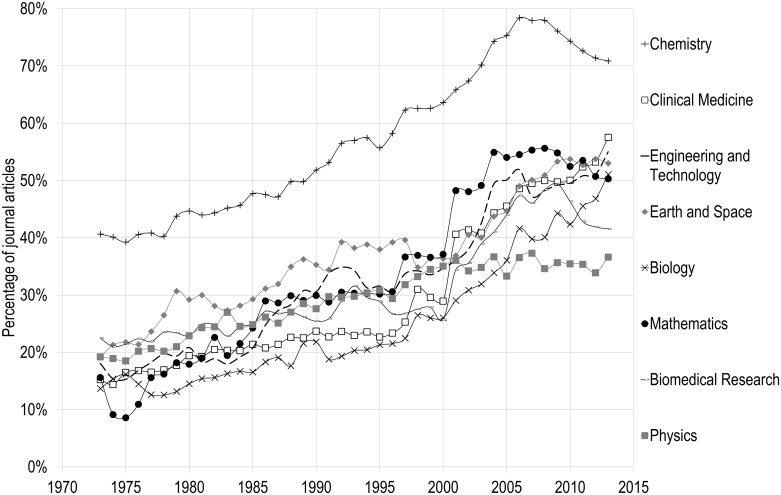
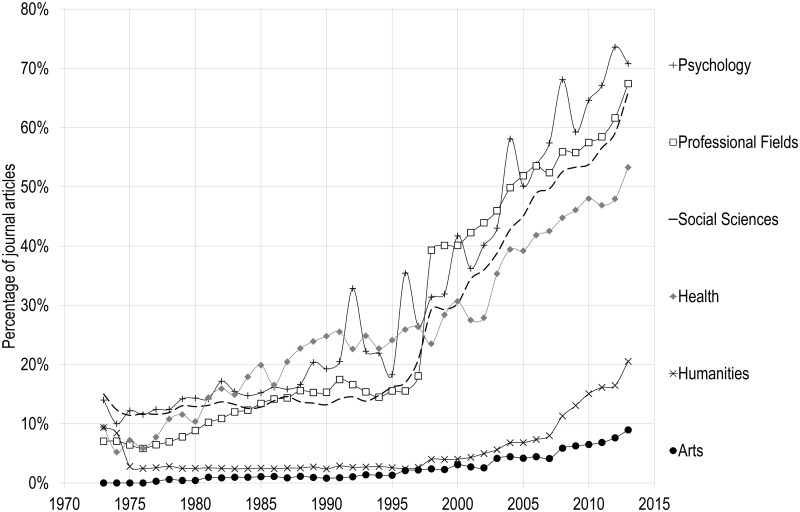
Verification
Claims the paper makes
The claims and statistics of this paper haven’t been checked yet.
Run the check — free, no account needed. It reads the open-access text and checks the sources it cites.
Claims other papers make about this one
Each is checked against this paper’s own text: does it say what the citing paper says it does?
The cited source says what the claim attributes to it.
In the citing paper
“Global influence and market dominance show that these publishers represent a significant proportion of global scholarly output (Larivière et al., 2015).”
From Use of artificial intelligence tools in the publishing process: expectations from publishers through author guidelines (2026) · cites this paper as Larivière et al., 2015
Self-check
Percentages, sums and reported differences re-computed from the paper’s own numbers.
The self-check needs the paper’s full text.
Citations
Cites
Information rules - a strategic guide to the network economy
Shapiro, C., & Varian, H. (1999) · The Journal of Economic Education · doi:10.2307/1183273 · Cited by 5,225 · cited 1×
“Scholarly publications themselves can be considered information goods with high fixed and low variable costs [35,36].”
BackgroundStirling, D. (2003) · SGMD · doi:10.1145/776985.776997 · Cited by 1,563
Zuckerman, H., & Merton, R. (1971) · Minerva · doi:10.1007/bf01553188 · Cited by 789
Scholarship in the Digital Age: Information, Infrastructure, and the Internet
Borgman, C. L. (2007) · doi:10.7551/mitpress/7434.001.0001 · Cited by 512
Archambault, É., Vignola-Gagné, É., Côté, G., Larivière, V., & Gingrasb, Y. (2006) · Scientometrics · doi:10.1007/s11192-006-0115-z · Cited by 507 · cited 1×
“Moreover, these disciplines make a much more important use of books [9] and generally rely on local journals [29], all of which are factors that make it much less interesting for big publishers to buy journals or found new ones in the arts and humanities.”
BackgroundSelf-citationWhat you didn't know that you needed to know.
Holtermann, M. K. (2017) · Tidsskrift for Den Norske Laegeforening · doi:10.4045/tidsskr.17.0540 · Cited by 492 · cited 2×
“4 billion US dollars in 2011 [31], the majority of which were generated by a few publishing houses, the scientific journal publishing market faces oligopolistic conditions, where big players such as Elsevier, Springer, Taylor & Francis, Wiley-Blackwell and Wolters Kluwer determine annually increasing subscription rate…”
BackgroundTragic Loss or Good Riddance? The Impending Demise of Traditional Scholary Journals
Odlyzko, A. (1996) · Journal of universal computer science (Online) · doi:10.3217/jucs-000-00-0003 · Cited by 303 · cited 1×
“Indeed, many authors have discussed the various transformations of the scholarly communication landscape brought by the digital era (see, among others, Borgman [14–15]; Kling and Callahan [16]; Tenopir & King [17]; Odlyzko [18]).”
BackgroundLarivière, V., Archambault, É., Gingras, Y., & Vignola-Gagné, É. (2006) · J. Assoc. Inf. Sci. Technol. · doi:10.1002/asi.20349 · Cited by 294 · cited 2×
“During the 20 century they consolidated their position as the main media for diffusing research [6], especially in the natural and medical sciences [9].”
BackgroundSelf-citationCalvert, P. (2001) · doi:10.1108/oir.2001.25.3.214.2 · Cited by 215
Larivière, V., Archambault, É., & Gingras, Y. (2008) · J. Assoc. Inf. Sci. Technol. · doi:10.1002/asi.20744 · Cited by 188 · cited 1×
“Also, the transition from print to electronic—a strong argument for journals to convert to commercial publishers—has happened at a much slower pace in those disciplines as the use for recent scientific information is less pressing [28].”
BackgroundSelf-citation
Research works printed but not linked: 3
- AJ Meadows, 1979, The Scientific Journal
- BI Mierzejewska, 2008, Doctoral dissertation, University of St. Gallen, Graduate School of Business Administration, Economics, Law and Social Sciences
- M Ware, 2012, An overview of scientific and scholarly journal publishing
Cited by
Sorted by citations
Items 801–897 of 897
Taking Back Control over Academic PublicationsPreprint
Coelho, F. C., & Codeço, C. (2024) · Qeios · doi:10.32388/7z95xb.3
Trust in open publishing practices
Kalmár, É., Elzer, T., Nastase, N., Bolhuis, T., Germain, N., Rietveld, M., Tao, Y.-W., & de Wolff, S. (2024) · F1000Research · doi:10.12688/f1000research.152168.1
“Therefore, researchers in some fields depend on prestigious publishers (through prestigious journals) (Larivière, Haustein, & Mongeon, 2015), however, the trustworthiness of these journals is also questioned (Brembs, 2018).”
Hernández-Socha, Y. (2024) · Signo y Pensamiento · doi:10.11144/javeriana.syp43.cncr
Rhodes, D., & Krenzer, W. (2024) · The Cognitive Psychology Bulletin · doi:10.53841/bpscog.2024.1.9.45
Tanaś, M., Duda, E., Galanciak, S., Jankowska, D. M., & Fila, M. (2023) · International Journal of Pedagogy, Innovation and New Technologies · doi:10.5604/01.3001.0054.2784
Prestige: Blockchain al servicio de la investigación
Tarruella, Á. C. (2023) · Universitas Tarraconensis Revista de Ciències de l Educació · doi:10.17345/ute.2023.3690
“Sin embargo, en la actualidad, existen varios problemas asociados a esta actividad que pueden afectar negativamente la calidad de las publicaciones y el avance del conocimiento (Larivière et al., 2015).”
BackgroundConceição, G. D. S., & Vogel, M. J. M. (2023) · Revista EDICIC · doi:10.62758/re.v3i2.227
da Silva, F. C. C. (2023) · RDBCI: Revista Digital de Biblioteconomia e Ciência da Informação · doi:10.20396/rdbci.v21i00.8673159
Research report on anti-monopoly of Chinese academic database
Zhang, S.-T., Hu, S., & Hao, L. (2023) · Advances in Education, Humanities and Social Science Research · doi:10.56028/aehssr.8.1.370.2023
“…cost of academic database increases year by year, many universities and academic institutions are overwhelmed, and an Open-Access model is gradually formed in the international academic community [17] , which provides readers with free reading documents for the purpose of economic sharing.”
BackgroundStreetlight Effect in Post-Publication Peer Review: Are Open Access Publications More Scrutinized?
Maddi, A., Monneau, E., Gaspare, C., Gargiulo, F., & Dubois, M. (2023) · arXiv.org · doi:10.48550/arxiv.2311.04909
“This pattern is indicative of a highly centralized landscape, where a limited number of publishing entities wield substantial control over the dissemination of academic knowledge (Larivière, Haustein, et Mongeon 2015; Roy et Yami 2006).”
BackgroundHeterodoxy Needs Institutional Backing
Frey, B. S., & Briviba, A. (2023) · Journal of Philosophical Economics · doi:10.46298/jpe.10889
“In the year 2013, more than 50% of journal articles published all over the world can be attributed to the five largest editing houses (Larivière et al. 2015).”
BackgroundGómez, P. A. M., Minchón-Medina, C. A., Rodríguez-Salazar, D. Y., Delgado-Caramutti, J. G. A., & Valencia-Arías, A. (2023) · F1000Research · doi:10.12688/f1000research.141422.1 · Cited by 1
Daumann, F., & Follert, F. (2023) · ORDO · doi:10.1515/ordo-2024-2001
D'Souza, S., Downs, G. S., Hendrikx, S., Fazelzad, R., Boldt, G., Burns, K. L., Chapman, D., Dawes, D., Giannarakos, A., Oja, L. A., et al. (2023) · Journal of the Medical Library Association · doi:10.5195/jmla.2023.1572
“’s 2015 paper [31], suggesting that the publications used for clinical interpretation are likely not disproportionally from large or small publishers.”
BackgroundInnovating the scenario of scientific publishing in design: designing “living publications”
Lupo, E. (2023) · Strategic Design Research Journal · doi:10.4013/sdrj.2022.152.09
Goldenberg, G. (2023) · Nursery World · doi:10.12968/nuwa.2023.3.22
Garcia, M. L., Spolander, G., Adefila, A., Delboni, T., & Teixeira, R. V. (2023) · Revista de Políticas Públicas · doi:10.18764/2178-2865.v26n2p725-741
Saillant, F., & Kilani, M. (2022) · Revue des Sciences Sociales · doi:10.17184/eac.anthropen
PANLAR, G. R. B., & Fajardo, E. (2022) · Global Rheumatology · doi:10.46856/grp.26.e144
Artigo de reflexão | Publicações científicas: Conhecimento como mercado ou como bem comum?
Caballero, C. V., & Fajardo, E. (2022) · Global Rheumatology · doi:10.46856/grp.26.ept144
Reflection article | Scientific publications: Knowledge A market or a common good?
Caballero, C. V., & Fajardo, E. (2022) · Global Rheumatology · doi:10.46856/grp.26.et144
Aux abonnés absents ? Les sciences infirmières et le libre accès
Larivière, V. (2022) · Science of Nursing and Health Practices · doi:10.7202/1090527ar
“As with most fields (Larivière et al., 2015), the dissemination of knowledge in nursing is, for the most part, in the hands of a sub-set of publishing houses, which are primarily for profit.”
BackgroundSelf-citationCossette, S., & Bernier, M. (2022) · Science of Nursing and Health Practices · doi:10.7202/1090526ar
Il ruolo formativo dell'editoria
de Fiore, L. (2022) · RIVISTA SPERIMENTALE DI FRENIATRIA · doi:10.3280/rsf2022-001009
De la Tecnociencia a la Tecnociencia Geoestratégica
Ochoa-Rojas, L. F. (2022) · Eikasia. Revista de filosofía · doi:10.57027/eikasia.98.246
Open access—is it the way forward?
Yadava, O. (2021) · Indian Journal of Thoracic and Cardiovascular Surgery · doi:10.1007/s12055-021-01282-2
Phipps, D., Bayley, J., Roche, T., & Lodge, S. (2021) · Scholarly and Research Communication · doi:10.22230/src.2021v12n1a391
Shooting Spitballs at Tanks: Some Thoughts on the Limits of Open Access
Allen, C. (2021) · InterActions : UCLA Journal of Education and Information Studies · doi:10.5070/d417150283
“…some way in explaining exactly why it is that the top five conglomerate publishers (Elsevier, Wiley-Blackwell, Springer, Taylor & Francis, and Sage Pub) control enough of the market that they were responsible for publishing 50 percent of all academic papers in 2013 (Larivière et al., 2015, p. 3).”
Quantifying Publisher’s Competence Through Scholarly Engagement
Al-Abbas, M., & Saab, S. (2021) · Publishing research quarterly · doi:10.1007/s12109-021-09813-w
“In 2013, 50% of all published works were in journals managed by four publishers, namely, Elsevier, Wiley-Blackwell, Springer, and Taylor & Francis [14].”
BackgroundCéspedes, L., Dávila, L., & Guzmán, V. H. (2021) · Palabra Clave [La Plata] · doi:10.24215/18539912e125
“Tanto para las ciencias naturales y biomédicas como para las sociales y humanas, estas cinco editoriales dan cuenta de más de la mitad de las revistas académicas en la actualidad (Larivière et al., 2015).”
BackgroundAn open web-based platform for enhancing the visibility of Brazilian research
da Cruz, Á. M. N., Santos, A. B., de Souza, R. C. G., & Parolin, T. L. (2020) · 2020 International Conference on Computational Science and Computational Intelligence (CSCI) · doi:10.1109/csci51800.2020.00328
“On the other side, some recent strategies aligned with the Open Access Movement (OAM) are becoming relevant drivers for improving the visibility of research developed inside the universities like a form to highlight the researchers’ efforts [3]–[5].”
BackgroundSarradon-Eck, A., Beaudevin, C., Greco, C., Héjoaka, F., & Lémonon-Waxin, I. (2020) · Anthropologie et Santé · doi:10.4000/anthropologiesante.8708
Going to Business or Intending in Science?
Rogulin, R. (2020) · The Economics of Science · doi:10.22394/2410-132x-2020-6-3-169-179
Hansen, D. R., & Jakubs, D. (2020) · The Academic's Handbook, Fourth Edition · doi:10.1215/9780822388203-032
How Can We Use Social Media Data Related to OA Monographs
Ozaygen, A., Montgomery, L., Neylon, C., Wilson, K. S., Hosking, R., & Huang, K. (2020) · International Conference on Electronic Publishing · doi:10.4000/proceedings.elpub.2020.18
“Monographs remain an area of scholarly communication that is dominated by many smaller players, rather than a few big publishers (Larivière et al. 2015).”
BackgroundAnalysis of typography in papers from open access Brazilian scientific journals
Woloszyn, M., Rodrigues, R., & Gonçalves, B. S. (2020) · International Conference on Electronic Publishing · doi:10.4000/proceedings.elpub.2020.2
Knowledge as a fictitious commodity: a Polanyian reading of the 'digital economy'
Palumbo, A. (2020) · International Journal of Political Theory · doi:10.22609/1.4.1.1
Paper Online Rating Platforms: An Emerging Publishing System
Wang, L.-F., & Tang, B.-Q. (2020) · Journal of Scholarly Publishing · doi:10.3138/jsp.51.3.03
International disparities in open access practices of the Earth Sciences community
Pourret, O., Hedding, D., Irawan, D. E., Liu, H., & Tennant, J. (2020) · doi:10.31223/osf.io/cpxmy
“Some journals have remained independently-run by scholarly communities, while some commercial publication houses slowly enveloped most journals (Larivière et al., 2015).”
Comunicación y evaluación del conocimiento académico: tecnocracia y mercado
Valdunciel, M. E. M. (2020) · Conference on Computer and Communications Security · doi:10.7203/con-cienciasocial.3.16789
Open and Shut: Open Access in Hybrid Educational Technology Journals 2010 – 2017
Costello, E., Farrelly, T., & Murphy, T. (2020) · International Review of Research in Open and Distance Learning · doi:10.19173/irrodl.v20i5.4383
“However, this is not widespread and if anything serves to highlight how complex this topic is, and the subsequent difficulty academics and institutions face in attempting to negotiate with what have been termed “oligopolistic publishers” (Larivière et al., 2015).”
FCJ-222 Introduction: Incalculable Experience
Bertelsen, L. (2019) · doi:10.15307/fcj.30.222.2019
Digitale Transformation und Open Access von Forschungsresultaten in der Schweiz
Verdicchio, D., & Kissling-Näf, I. (2019) · Digitale Transformation und Unternehmensführung · doi:10.1007/978-3-658-26960-9_2
From the Editors: Keeping Scholarship Accessible
Luehrmann, S., & Boudreault-Fournier, A. (2019) · Anthropologica · doi:10.3138/anth.61.1.01.en
“…have long rung alarm bells about exponentially rising costs of journal subscriptions, and small university presses are under pressure from big commercial publishers that, according to 2013 data, account for 70% of all social science articles published (Larivière, Haustein, and Mongeon 2015).”
BackgroundNote des rédactrices: Préserver l'accès à la recherche
Luehrmann, S., & Boudreault-fournier, A. (2019) · Anthropologica · doi:10.3138/anth.61.1.01.fr
Hanes, W. F. (2019) · Target · doi:10.1075/target.19092.han
Open Access Publishing Trends in the Forest Sciences
O'Hara, K. (2019) · Forests · doi:10.3390/f10030238
“Under this “oligopoly”, subscription costs have risen dramatically and the scientific communities, including the libraries that serve these communities, are objecting [1,3,7].”
BackgroundResultInfluentialUnderstanding Pseudo-Profound Statements
Rižnar, I., & Suklan, J. (2019) · Management · doi:10.26493/1854-4231.14.34-57
“We agree with Larivière, Haustein, and Mongeon (2015, 13) that ‘it is up to the scientific community to change the system in a similar fashion and in parallel to the open access and open science move-ments’ and add that this will not only save a large proportion of our universities money but also…”
ResultLe libre accès : nouveau paradigme de diffusion des savoirs
Levasseur, V. (2018) · Revue Organisations & territoires · doi:10.1522/revueot.v27n2.875
“En effet, l'essor d’un quasi-monopole au sein de l’édition scientifique fait en sorte qu’aujourd’hui 50 % des revues savantes sont déte-nues par cinq grandes maisons d’édition (Larivière, Haustein et Mongeon, 2015).”
BackgroundThe politics after postmodernism begins with the political economy of our own work
Willinsky, J. (2018) · What Comes After Postmodernism in Educational Theory? · doi:10.1080/00131857.2018.1461408
Álvarez-Muñoz, P., Hernández-Domínguez, C., & Ramírez-Gallegos, R. (2018) · Información, Cultura y Sociedad · doi:10.34096/ics.i39.4268
Silva, R. D. C., & Nunes, M. A. D. A. (2018) · Violência contra a mulher e o sistema de justiça: epistemologia feminista em um estudo de caso · doi:10.2307/j.ctt201mp5b.13
Cartographies of action research: searching for displacements of the epistemology of the South
de Sousa, L. S., & Oliveira, T. (2018) · Comunicação e Sociedade · doi:10.17231/comsoc.33(2018).2908
“…the largest number of citations, which correspond to books and chapters, not counted by the large companies that dominate the “scientific oligopoly” (Larivière et al., 2015), which disfavor the measurement of the scientific impact of productions in action research, rendering invisible the…”
BackgroundInfluentialClement, G. P., Agate, N., Searle, S., Kingsley, D., & Vandegrift, M. (2018) · Journal of Librarianship and Scholarly Communication · doi:10.7710/2162-3309.2261
Balancing Interests of Science, Scientists, and the Publishing Business
Balogh, L. (2018) · Precision Nanomedicine · doi:10.29016/180418.1
“The computer revolution and the OA movement decreased the dominance of the six major academic publishers [20] and gave rise to thousands of smaller publishers and their journals.”
BackgroundUmwandlung wissenschaftlicher Journale in Gold Open Access
Hanekop, H. (2017) · doi:10.14512/tatup.26.1-2.49
“Aufgrund der wachsenden Konzentration unter wissenschaftlichen Verlagen erscheinen über 50 % der Auf-sätze in den Naturwissenschaften bei den fünf größten Verlagen: Elsevier, Springer, Wiley, Tayler & Francis, American Chemical Society (Larivière et al. 2015).”
BackgroundInteractive Image Segmentation Method of Eye Movement Data and EEG Data
Zhang, J.-C., Liu, S., & Li, J. (2017) · Interacción · doi:10.1007/978-3-319-58628-1_10
Designing Research Infrastructure for Open-access Publishing
Ball, C. E. (2017) · Nordes · doi:10.21606/nordes.2017.035
Implicated in the Indicator Game: A Response to the Debate
McNeil, M. (2017) · Engaging Science Technology and Society · doi:10.17351/ests2017.158
“But beyond this, she unravels the consequences of JIF centrism with reference to the political economy of the oligopolistic publishing industry (Larivière et al., 2015).”
BackgroundSerials Spoken Here–Reports of Conferences, Institutes and Seminars
Blythe, K. C., Aghazarian, M., Bhatt, A. H., Becker, R., Coleman, G., DePope, L. A., DeRosa, K., Ford, D., Galey, M., Kimbrough, J., et al. (2017) · doi:10.1080/00987913.2017.1282289
“A study by Larivière, Haustein, and Mongeon (2015) in Canada found that journal costs had increased over 400% from 1986 to 2013—more than four times the rate of inflation—while mergers and acquisitions have led to a situation where more than 50% of journal articles were published under the…”
"Space of physics journals": in search of journals of quality
Katchanov, Y. L., & Markova, Y. V. (2016) · arXiv.org · doi:10.48550/arxiv.1611.10357
Duffy, B., & Pooley, J. (2016) · doi:10.31235/osf.io/brxpq
Intellectual disobedience: Resistances to the privatization of knowledge
Darat, N., & Tello, A. (2016) · doi:10.4067/s0718-65682016000100015
Pricing bei wissenschaftlichen Zeitschriften
Dettwiler, R. (2016) · doi:10.12685/027.7-4-1-101
Caglayan, E., & Çağlayan, M. (2026) · Orthopedic Surgery and Trauma Journal · doi:10.14744/ortst.2026.06646
“[7] The publishing ecosystem has not only transitioned to digital formats but also entered an era where generative artificial intelligence (AI) is challenging ethical boundaries.”
Class, B., Bourguet, D., & Guillemaud, T. (2026) · Insights the UKSG journal · doi:10.1629/uksg.744 · Cited by 2
Appel, A. L., Trinca, T. P., Alves, L. D. A., Rocha, N. C. L., & Albagli, S. (2026) · Dados · doi:10.1590/dados.2026.69.1.404
Music performance research: A bibliometric analysis of trends, themes, and knowledge structures
Rumiantsev, T. (2026) · Social Sciences & Humanities Open · doi:10.1016/j.ssaho.2026.103189
Plataformas, métricas e fragmentação: o regime neoliberal da ciência no contexto pós-pandêmico
Neves, F., & Normando, P. (2026) · Sociedade e Estado · doi:10.1590/s0102-6992-20264101e61431
Platforms, Metrics, and Fragmentation: The Neoliberal Regime of Science in the Post-Pandemic Context
Neves, F., & Normando, P. (2026) · Sociedade e Estado · doi:10.1590/s0102-6992-20264101e63153
Developing Countries Face Falling Circulation Rates and Rising Migration Losses in Science
Herman, A., Andersen, J., & Nielsen, M. M. (2026) · Sociological Science · doi:10.15195/v13.a43
“…funding and research infrastructure (Miao et al. 2023), the concentration of scientific publishing and editorial gatekeeping in HI countries (Larivière et al. 2015), the growing dominance of English in scientific publishing (Amano et al. 2016), and the influence of core countries over…”
Anais da Academia Brasileira de Ciências: past, present, and future.
McManus, C., Neves, A. A. B., Pimentel, F., Pimentel, D., Peripolli, V., & Junqueira, V. (2026) · Anais da Academia Brasileira de Ciências · doi:10.1590/0001-3765202620260079
Gómez-Botero, M. (2025) · Revista Facultad De Ingenieria-universidad De Antioquia · doi:10.17533/udea.redin.20250777
Papa, F. A., & Cardoso, M. A. T. (2025) · Revista Interamericana de Bibliotecología · doi:10.17533/udea.rib.v48n3e356753
Azzam, A. H. A., Hasanah, M., Widiyandari, H., Mahardiani, L., Amandita, F. Y., Zulfi, A., & Rezeki, Y. A. (2025) · E3S Web of Conferences · doi:10.1051/e3sconf/202566406001
STS Between Centers and Peripheries: How Transnational are Leading STS Journals?
Invernizzi, N., Kreimer, P., Davyt, A., & Rodriguez-Medina, L. (2025) · Social Science Research Network · doi:10.2139/ssrn.5615470
“First, an oligopolization of journals (Larivière, Haustein, and Mongeon 2015); second, an exponential increase in the costs of accessing scholarly literature, whether through subscriptions or article publication charges (Budzinski et al. 2020); and third, an increasing marginalization of regions…”
Acordos de leitura e publicação: estudo da área de Física no Brasil e a Editora Springer/Nature
Brito, C. D. C., Rodrigues, R. S., Café, L. C., & Vieira, A. C. (2025) · Transinformação · doi:10.1590/2318-0889202537e2515115pt
Brito, C. D. C., Rodrigues, R. S., Café, L. C., & Vieira, A. C. (2025) · Transinformação · doi:10.1590/2318-0889202537e2515115en
Pulickal, P. B. (2025) · Social Science Research Network · doi:10.35542/osf.io/6ts9z_v1
“Consequently, the profit margins of major academic publishers are notoriously high, often exceeding 35-40%, rivaling those of tech giants like Google or Apple [5].”
A mercantilização anunciada da Pesquisa na Espanha dos anos 2000
do Nascimento, C. M., & Marí, V. (2024) · Serviço Social & Sociedade · doi:10.1590/0101-6628.356
Using R to Apply Open Science Principles in Second Language Acquisition and Didactics
Jouannaud, M.-P. (2024) · Alsic · doi:10.4000/12a6r
Ahmad, A., Azeem, A., & Aslam, S. (2024) · Revista de Administração de Empresas · doi:10.1590/s0034-759020240602x
Collective, A. (2023) · ACME · doi:10.7202/1098034ar · Cited by 1
Social and Human Sciences Journals in Argentina: Between Regional Circulation and Local Roots
Beigel, F. (2023) · Biens Symboliques / Symbolic Goods · doi:10.4000/164s8
Publicação de videoartigos como estratégia para impulsionar o consumo de Ciência
Santos, A. B. (2022) · Transinformação · doi:10.1590/2318-0889202234e200011
Kollöffel, J. (2021) · Advances in data mining and database management book series · doi:10.4018/978-1-7998-5589-7.ch002
Anheim, É., & Foraison, L. (2020) · L’édition en sciences humaines et sociales · doi:10.4000/books.editionsehess.29213
The Evolving Role of Commercial Publishers and the Future of Online Access Repositories
(2020) · Advances in Library and Information Science · doi:10.4018/978-1-7998-1131-2.ch006
Anheim, É., & Foraison, L. (2020) · L’édition en sciences humaines et sociales · doi:10.4000/books.editionsehess.28993
Rethinking Openness: Challenges and New Approaches to Open Scholarly Journals
Appel, A., Albagli, S., & Maciel, M. L. (2017) · International Conference on Electronic Publishing · doi:10.3233/978-1-61499-769-6-129
“[16], only a few publishers – namely Reed-Elsevier, Wiley-Blackwell, Springer, and Taylor & Francis – are responsible for the publication of almost 50 percent of all papers.”
Background
Metadata
- Authors
- Larivière, V., Haustein, S., & Mongeon, P.
- Affiliations
- Université du Québec à Montréal (CA)
- Université de Montréal (CA)
- Corresponding author
- Larivière, Vincent
- Venue
- PLOS ONE
- Publisher
- Public Library of Science (PLoS)
- Published
- 2015-06-10
- Volume
- 10
- Issue
- 6
- Pages
- e0127502
- ISSN
- 1932-6203 (ISSN-L)
- PMC
- PMC4465327
- OpenAlex
- W1655306493
- Cited by
- 1,240
- References
- 66
- Citations by year
- 2026: 104 · 2025: 132 · 2024: 97 · 2023: 115 · 2022: 146 · 2021: 128 · 2020: 125 · 2019: 124 · 2018: 97 · 2017: 90 · 2016: 64 · 2015: 15
- FWCI
- 80.89
- Type
- journal article
- Language
- en
- Open access
- gold
- doi.org
- Licence
- Locations
- PLoS ONE (publishedVersion, cc-by)
- Europe PMC (PubMed Central) (publishedVersion, cc-by)
- PubMed Central (publishedVersion, cc-by)
- PubMed (publishedVersion)
- Lincoln (University of Nebraska) (submittedVersion, cc-by)
- RePEc: Research Papers in Economics (submittedVersion)
- DOAJ (DOAJ: Directory of Open Access Journals) (submittedVersion, cc-by-sa)
- Papyrus : Institutional Repository (Université de Montréal) (submittedVersion, cc-by)
- Funders
- Canada Research Chairs
- Topics
- Social Sciences › Library and Information Sciences › scientometrics and bibliometrics research
- Social Sciences › Library and Information Sciences › Publishing and Scholarly Communication
- Social Sciences › Library and Information Sciences › Academic Publishing and Open Access
- Keywords
- scholarly publishing, scientific publishing industry, oligopoly, digital era, journal migration, publisher change, citation impact, humanities and social sciences, Web of Science, Reed Elsevier, Springer, Taylor & Francis
- MeSH terms
- Publishing, Journal Impact Factor
About these checks
Registry, retraction, Cites and statistics results are computed, not judged, with one exception: a printed reference that no index lists is read once by a model before it counts as a citation error. Claims are extracted by a model and kept only when their quote appears verbatim in the text; each cited source is then checked, with a model’s help, for whether it says what the claim relies on. Those verdicts can be wrong — read the claim’s quote and the cited source before relying on one.
Statistics and arithmetic are recomputed, not judged.
Confidence bands are shown only for fields calibrated on our annotated test set. None is calibrated yet, so no band is shown.
What counts as a claim ›How we measure confidence ›How we check this ›
Are you an author, or do you see a problem with this page? Request a review
