

Aging and Sensory Substitution in a Virtual Navigation Task
Open accessThe DOI matches its Crossref record; 42 of the 44 references it cites were found in a registry or an index.
Abstract
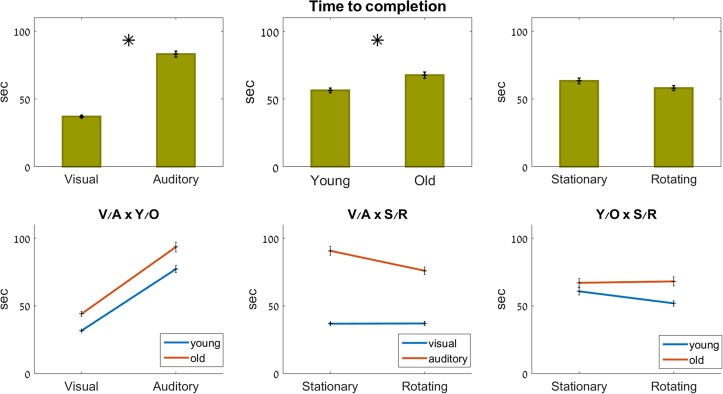
Virtual environments are becoming ubiquitous, and used in a variety of contexts-from entertainment to training and rehabilitation. Recently, technology for making them more accessible to blind or visually impaired users has been developed, by using sound to represent visual information. The ability of older individuals to interpret these cues has not yet been studied. In this experiment, we studied the effects of age and sensory modality (visual or auditory) on navigation through a virtual maze. We added a layer of complexity by conducting the experiment in a rotating room, in order to test the effect of the spatial bias induced by the rotation on performance. Results from 29 participants showed that with the auditory cues, it took participants a longer time to complete the mazes, they took a longer path length through the maze, they paused more, and had more collisions with the walls, compared to navigation with the visual cues. The older group took a longer time to complete the mazes, they paused more, and had more collisions with the walls, compared to the younger group. There was no effect of room rotation on the performance, nor were there any significant interactions among age, feedback modality and room rotation. We conclude that there is a decline in performance with age, and that while navigation with auditory cues is possible even at an old age, it presents more challenges than visual navigation.
Overview
The claims and statistics of this paper haven’t been checked yet.
Free: it reads the open-access text and checks the first 5 claims that cite a source we can check. Create a free account to check every claim.
Integrity signals
Registry
Cites
Statistics
Figures




Verification
Claims the paper makes
The claims and statistics of this paper haven’t been checked yet.
Free: it reads the open-access text and checks the first 5 claims that cite a source we can check. Create a free account to check every claim.
Claims other papers make about this one
Each is checked against this paper’s own text: does it say what the citing paper says it does?
The source backs part of the claim, not all of it — or backs it for a different population, condition or comparison.
In the citing paper
“there is some evidence that, when learning to navigate a virtual environment using a sensory substitution device, older people do not learn as well as younger people do [35]”
From Human click-based echolocation: Effects of blindness and age, and real-life implications in a 10-week training program (2021) · cites this paper as [35]
Experimental — accuracy not yet measuredThe cited source says what the claim attributes to it.
In the citing paper
“This is consistent with evidence that younger adults learn a computer-based navigation task using a sensory substitution device better than older adults [35], possibly due to experience with computer game-like tasks (e.g. for review see [43]).”
From Human click-based echolocation: Effects of blindness and age, and real-life implications in a 10-week training program (2021) · cites this paper as [35]
Self-check
Percentages, sums and reported differences re-computed from the paper’s own numbers.
The self-check needs the paper’s full text.
Citations
Cites
An Analysis of Transformations
Box, G. E. P., & Cox, D. R. (1964) · Journal of the Royal Statistical Society Series B: Statistical Methodology · doi:10.1111/j.2517-6161.1964.tb00553.x · Cited by 15,052 · cited 1×
“transformation was selected based on a Box & Cox procedure [23].”
MethodControl strategies for active lower extremity prosthetics and orthotics: a review
Tucker, M. R., Olivier, J., Pagel, A., Bleuler, H., Bouri, M., Lambercy, O., Millán, J. D. R., Riener, R., Vallery, H., & Gassert, R. (2015) · Journal of NeuroEngineering and Rehabilitation · doi:10.1186/1743-0003-12-1 · Cited by 1,047
Remembering the past and imagining the future: A neural model of spatial memory and imagery.
Byrne, P., Becker, S., & Burgess, N. (2007) · Psychological Review · doi:10.1037/0033-295x.114.2.340 · Cited by 1,011 · cited 2×
“In this theoretical framework, on a short time scale (*20 seconds), the egocentric representation is more pronounced, whereas on a long time scale (> 5 minutes), the allocentric representation is more active [28].”
BackgroundAging cognition: from neuromodulation to representation
Li, S.-C., Lindenberger, U., & Sikström, S. (2001) · Trends in Cognitive Sciences · doi:10.1016/s1364-6613(00)01769-1 · Cited by 890 · cited 2×
“And so, while aging is associated with a decline in auditory function (both peripheral and central losses [30]), and a decline in several cognitive functions [5], including spatial cognition, and in it, a decline in some navigational skills [10], there are also cognitive functions that improve with age [6, 7], and whi…”
BackgroundHearing Loss Prevalence and Risk Factors Among Older Adults in the United States
Lin, F. R., Thorpe, R., Gordon-Salant, S., & Ferrucci, L. (2011) · The Journals of Gerontology Series A: Biological Sciences and Medical Sciences · doi:10.1093/gerona/glr002 · Cited by 890
Hartshorne, J. K., & Germine, L. T. (2015) · Psychological Science · doi:10.1177/0956797614567339 · Cited by 788 · cited 1×
“And so, while aging is associated with a decline in auditory function (both peripheral and central losses [30]), and a decline in several cognitive functions [5], including spatial cognition, and in it, a decline in some navigational skills [10], there are also cognitive functions that improve with age [6, 7], and whi…”
BackgroundAge-related changes in speed of walking
HIMANN, J. E., CUNNINGHAM, D. A., RECHNITZER, P. A., & PATERSON, D. H. (1988) · Medicine & Science in Sports & Exercise · doi:10.1249/00005768-198820020-00010 · Cited by 512
Video Games and Spatial Cognition
Spence, I., & Feng, J. (2010) · Review of General Psychology · doi:10.1037/a0019491 · Cited by 504
Do Action Video Games Improve Perception and Cognition?
Boot, W. R., Blakely, D. P., & Simons, D. J. (2011) · Frontiers in Psychology · doi:10.3389/fpsyg.2011.00226 · Cited by 472
Modality-specific frontal and parietal areas for auditory and visual spatial localization in humans
Bushara, K. O., Weeks, R. A., Ishii, K., Catalan, M.-J., Tian, B., Rauschecker, J. P., & Hallett, M. (1999) · Nature Neuroscience · doi:10.1038/11239 · Cited by 419 · cited 1×
“Though auditory cuing has been found to be more effective than visual cuing in certain situations, such as when driving in a simulator [36], spatial processing of auditory cues is done in separate neural structures than visuo-spatial information [37], and may take a different time course to process [38].”
Background
Cited by
Designing sensory-substitution devices: Principles, pitfalls and potential1
Kristjánsson, Á., Moldoveanu, A., Jóhannesson, Ó. I., Balan, O., Spagnol, S., Valgeirsdóttir, V. V., & Unnthorsson, R. (2016) · Restorative Neurology and Neuroscience · doi:10.3233/rnn-160647 · Cited by 116
“And there is indeed promising evidence regarding the use of virtual training environments such as virtual mazes or video-games in sensory substitution (Lahav, Schloerb, & Srinivasan; 2012; Merabet et al., 2012; Levy-Tzedek et al., 2016; Maidenbaum et al., 2014c; Maidenbaum & Amedi, 2015).”
BackgroundBeyeler, M., Rokem, A., Boynton, G. M., & Fine, I. (2017) · Journal of Neural Engineering · doi:10.1088/1741-2552/aa795e · Cited by 102
Magnetosensitive E‐Skins for Interactive Devices
Bermúdez, G. S. C., & Makarov, D. (2021) · Advanced Functional Materials · doi:10.1002/adfm.202007788 · Cited by 85
Navigation and perception of spatial layout in virtual echo-acoustic space
Dodsworth, C., Norman, L. J., & Thaler, L. (2020) · Cognition · doi:10.1016/j.cognition.2020.104185 · Cited by 67
Norman, L. J., Dodsworth, C., Foresteire, D., & Thaler, L. (2021) · PLOS ONE · doi:10.1371/journal.pone.0252330 · Cited by 59
“[35], suggesting merit of further investigation of the effect of age in research on neuroplasticity.”
BackgroundMethodKolarik, A. J., Scarfe, A. C., Moore, B. C. J., & Pardhan, S. (2017) · PLOS ONE · doi:10.1371/journal.pone.0175750 · Cited by 59
Cohavi, O., & Levy‐Tzedek, S. (2022) · International Journal of Human-Computer Studies · doi:10.1016/j.ijhcs.2022.102775 · Cited by 55
Self-citationEizicovits, D., Edan, Y., Tabak, I., & Levy‐Tzedek, S. (2018) · Restorative Neurology and Neuroscience · doi:10.3233/rnn-170802 · Cited by 43
“Some of the participants in the young group expressed impatience with the time it took the robot to make its moves, while the participants in the senior group, who themselves often perform slower movements (Levy-Tzedek et al., 2016), did not express dissatisfaction with the slower reaction time of the robotic system,…”
BackgroundResultInfluentialSelf-citationIndividual Differences in Sensory Substitution
Arnold, G., Lerousseau, J. P., & Auvray, M. (2017) · Multisensory Research · doi:10.1163/22134808-00002561 · Cited by 32
“The only study conducted thus far investigating age-related differences when using a sensory-substitution device, found that older adults were less successful in completing a navigation task than younger adults (Levy-Tzedek et al., 2016).”
InfluentialSpatial navigation with horizontally spatialized sounds in early and late blind individuals
Paré, S., Bleau, M., Djerourou, I., Malotaux, V., Kupers, R., & Ptito, M. (2021) · PLOS ONE · doi:10.1371/journal.pone.0247448 · Cited by 20
“This is consistent with what is known about the effect of age on sensory substitution navigation and sound localization [34,35].”
BackgroundEchoic Sensory Substitution Information in a Single Obstacle Circumvention Task
Kolarik, A. J., Scarfe, A. C., Moore, B. C. J., & Pardhan, S. (2016) · PLoS ONE · doi:10.1371/journal.pone.0160872 · Cited by 16
“The finding that movement times and velocity corrections were greater under SSD guidance than under vision is consistent with results from a recent study [27] which showed that the number of pauses and time taken to complete a trial when navigating through virtual mazes were greater when using an SSD than when using v…”
MethodResultMotor errors lead to enhanced performance in older adults
Levy‐Tzedek, S. (2017) · Scientific Reports · doi:10.1038/s41598-017-03430-4 · Cited by 14
Self-citationPriming and Timing in Human-Robot Interactions
Langer, A., & Levy‐Tzedek, S. (2020) · Springer eBooks · doi:10.1007/978-3-030-46732-6_16 · Cited by 8
Self-citationSensory Substitution: Visual Information via Haptics
Brooks, J., Kristjansson, A. K., & Unnþórsson, R. (2023) · Neuromethods · doi:10.1007/978-1-0716-3068-6_14 · Cited by 8
Acoustically driven orientation and navigation in enclosed spaces
Steffens, H., Schütte, M., & Ewert, S. D. (2022) · The Journal of the Acoustical Society of America · doi:10.1121/10.0013702 · Cited by 10
Improvement in upper-limb UPDRS motor scores following fast-paced arm exercise: A pilot study
Levy‐Tzedek, S., Arbelle, D., Forman, D., & Zlotnik, Y. (2018) · Restorative Neurology and Neuroscience · doi:10.3233/rnn-180818 · Cited by 5
“For each reaching movement, we calculated the time it took to complete the movement, the path length (Levy-Tzedek et al., 2012; Levy-Tzedek et al., 2007; Levy-Tzedek et al., 2016) of the hand, the average and the peak speed in the direction of the movement.”
MethodSelf-citationIsaksson, J., Jansson, T. T., & Nilsson, J. (2024) · IEEE Access · doi:10.1109/access.2024.3471177 · Cited by 5
Mühlinghaus, S., Schmidt, V., & Peter König, B. (2024) · bioRxiv (Cold Spring Harbor Laboratory) · doi:10.1101/2024.07.17.603884 · Cited by 1
“More-over, Levy-Tzedek and colleagues (22) emphasized that including younger participants might be desirable as it has been shown that children are better at learning an augmented sense.”
BackgroundPersonal Digital Signage for Shared Spaces
Tarkkanen, K., Tuomola, T., Pohjola, M., & Paavola, J. (2019) · Lecture notes in computer science · doi:10.1007/978-3-030-29387-1_13
Geometrically Curved Magnetic Field Sensors for Interactive Electronics
Bermúdez, G. S. C., & Makarov, D. (2022) · Topics in applied physics · doi:10.1007/978-3-031-09086-8_9 · Cited by 1
Structured light detection and delineation of tripping hazards for people with impaired vision
Stahl, M. (2022) · Digital Repository Service (Northeastern University) · doi:10.17760/d20474748 · Cited by 1
Metadata
- Authors
- Levy-Tzedek, S., Maidenbaum, S., Amedi, A., & Lackner, J.
- Affiliations
- Hebrew University of Jerusalem (IL)
- Institut de la Vision (FR)
- Brandeis University (US)
- Venue
- PLOS ONE
- Publisher
- Public Library of Science (PLoS)
- Published
- 2016-03-23
- Volume
- 11
- Issue
- 3
- Pages
- e0151593
- ISSN
- 1932-6203 (ISSN-L)
- PMC
- PMC4805187
- OpenAlex
- W2311858495
- Cited by
- 22
- References
- 44
- Citations by year
- 2024: 2 · 2023: 1 · 2022: 4 · 2021: 3 · 2020: 2 · 2019: 1 · 2018: 2 · 2017: 5 · 2016: 2
- FWCI
- 2.12
- Type
- journal article
- Language
- en
- Open access
- gold
- doi.org
- Licence
- Locations
- PLoS ONE (publishedVersion, cc-by)
- Europe PMC (PubMed Central) (publishedVersion, cc-by)
- PubMed Central (publishedVersion, cc-by)
- PubMed (publishedVersion)
- HAL (submittedVersion, cc-by)
- Brandeis Institutional Repository (submittedVersion)
- Brandeis Institutional Repository (submittedVersion, cc-by)
- DOAJ (DOAJ: Directory of Open Access Journals) (submittedVersion, cc-by-sa)
- Funders
- Leona M. and Harry B. Helmsley Charitable Trust
- Brandeis University
- Stiftelsen Promobilia
- Leir Foundation
- Ben-Gurion University of the Negev
- Topics
- Life Sciences › Neuroscience › Cognitive Neuroscience › Tactile and Sensory Interactions
- Social Sciences › Psychology › Experimental and Cognitive Psychology › Spatial Cognition and Navigation
- Physical Sciences › Computer Science › Human-Computer Interaction › Virtual Reality Applications and Impacts
- Keywords
- aging, sensory substitution, auditory navigation, visual navigation, virtual worlds, maze navigation, spatial rotation, older adults, age-related decline, visually impaired users, assistive technology
- MeSH terms
- Adult, Aging, Female, Hearing, Humans, Male, User-Computer Interface, Vision, Ocular, Young Adult
About these checks
Registry, retraction, Cites and statistics results are computed, not judged, with one exception: a printed reference that no index lists is read once by a model before it counts as a citation error. Claims are extracted by a model and kept only when their quote appears verbatim in the text; each cited source is then checked, with a model’s help, for whether it says what the claim relies on. Those verdicts can be wrong — read the claim’s quote and the cited source before relying on one.
Statistics and arithmetic are recomputed, not judged.
Confidence bands are shown only for fields calibrated on our annotated test set. None is calibrated yet, so no band is shown.
What counts as a claim ›How we measure confidence ›How we check this ›
Are you an author, or do you see a problem with this page? Request a review
Data sources
Bibliographic data: Semantic Scholar, OpenAlex, Crossref.
Contains information from the Semantic Scholar Academic Graph Datasets, made available under the ODC Attribution License (ODC-BY 1.0).
Semantic Scholar’s data is described in: Kinney, R., et al. (2023). The Semantic Scholar Open Data Platform. arXiv:2301.10140.
