

Aging and Sensory Substitution in a Virtual Navigation Task
Open accessThe DOI matches its Crossref record; 42 of the 44 references it cites were found in a registry or an index.
Abstract
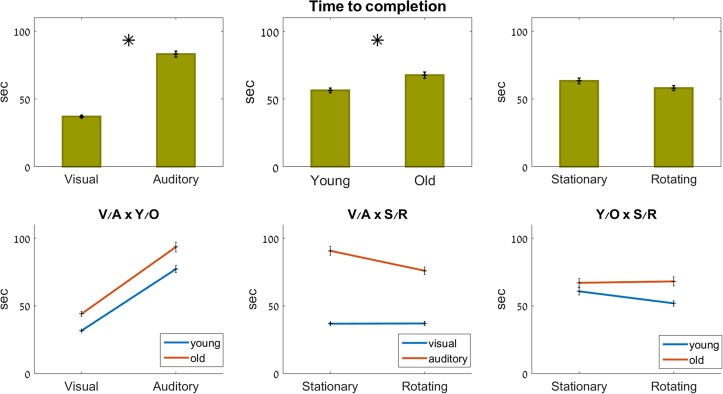
Virtual environments are becoming ubiquitous, and used in a variety of contexts-from entertainment to training and rehabilitation. Recently, technology for making them more accessible to blind or visually impaired users has been developed, by using sound to represent visual information. The ability of older individuals to interpret these cues has not yet been studied. In this experiment, we studied the effects of age and sensory modality (visual or auditory) on navigation through a virtual maze. We added a layer of complexity by conducting the experiment in a rotating room, in order to test the effect of the spatial bias induced by the rotation on performance. Results from 29 participants showed that with the auditory cues, it took participants a longer time to complete the mazes, they took a longer path length through the maze, they paused more, and had more collisions with the walls, compared to navigation with the visual cues. The older group took a longer time to complete the mazes, they paused more, and had more collisions with the walls, compared to the younger group. There was no effect of room rotation on the performance, nor were there any significant interactions among age, feedback modality and room rotation. We conclude that there is a decline in performance with age, and that while navigation with auditory cues is possible even at an old age, it presents more challenges than visual navigation.
Overview
The claims and statistics of this paper haven’t been checked yet.
Free: it reads the open-access text and checks the first 5 claims that cite a source we can check. Create a free account to check every claim.
Integrity signals
Registry
Cites
Statistics
Figures




Verification
Claims the paper makes
The claims and statistics of this paper haven’t been checked yet.
Free: it reads the open-access text and checks the first 5 claims that cite a source we can check. Create a free account to check every claim.
Claims other papers make about this one
Each is checked against this paper’s own text: does it say what the citing paper says it does?
The source backs part of the claim, not all of it — or backs it for a different population, condition or comparison.
In the citing paper
“there is some evidence that, when learning to navigate a virtual environment using a sensory substitution device, older people do not learn as well as younger people do [35]”
From Human click-based echolocation: Effects of blindness and age, and real-life implications in a 10-week training program (2021) · cites this paper as [35]
Experimental — accuracy not yet measuredThe cited source says what the claim attributes to it.
In the citing paper
“This is consistent with evidence that younger adults learn a computer-based navigation task using a sensory substitution device better than older adults [35], possibly due to experience with computer game-like tasks (e.g. for review see [43]).”
From Human click-based echolocation: Effects of blindness and age, and real-life implications in a 10-week training program (2021) · cites this paper as [35]
Self-check
Percentages, sums and reported differences re-computed from the paper’s own numbers.
The self-check needs the paper’s full text.
Citations
Cites
An Analysis of Transformations
Box, G. E. P., & Cox, D. R. (1964) · Journal of the Royal Statistical Society Series B: Statistical Methodology · doi:10.1111/j.2517-6161.1964.tb00553.x · Cited by 15,052 · cited 1×
“transformation was selected based on a Box & Cox procedure [23].”
MethodControl strategies for active lower extremity prosthetics and orthotics: a review
Tucker, M. R., Olivier, J., Pagel, A., Bleuler, H., Bouri, M., Lambercy, O., Millán, J. D. R., Riener, R., Vallery, H., & Gassert, R. (2015) · Journal of NeuroEngineering and Rehabilitation · doi:10.1186/1743-0003-12-1 · Cited by 1,047
Remembering the past and imagining the future: A neural model of spatial memory and imagery.
Byrne, P., Becker, S., & Burgess, N. (2007) · Psychological Review · doi:10.1037/0033-295x.114.2.340 · Cited by 1,011 · cited 2×
“In this theoretical framework, on a short time scale (*20 seconds), the egocentric representation is more pronounced, whereas on a long time scale (> 5 minutes), the allocentric representation is more active [28].”
BackgroundAging cognition: from neuromodulation to representation
Li, S.-C., Lindenberger, U., & Sikström, S. (2001) · Trends in Cognitive Sciences · doi:10.1016/s1364-6613(00)01769-1 · Cited by 890 · cited 2×
“And so, while aging is associated with a decline in auditory function (both peripheral and central losses [30]), and a decline in several cognitive functions [5], including spatial cognition, and in it, a decline in some navigational skills [10], there are also cognitive functions that improve with age [6, 7], and whi…”
BackgroundHearing Loss Prevalence and Risk Factors Among Older Adults in the United States
Lin, F. R., Thorpe, R., Gordon-Salant, S., & Ferrucci, L. (2011) · The Journals of Gerontology Series A: Biological Sciences and Medical Sciences · doi:10.1093/gerona/glr002 · Cited by 890
Hartshorne, J. K., & Germine, L. T. (2015) · Psychological Science · doi:10.1177/0956797614567339 · Cited by 788 · cited 1×
“And so, while aging is associated with a decline in auditory function (both peripheral and central losses [30]), and a decline in several cognitive functions [5], including spatial cognition, and in it, a decline in some navigational skills [10], there are also cognitive functions that improve with age [6, 7], and whi…”
BackgroundAge-related changes in speed of walking
HIMANN, J. E., CUNNINGHAM, D. A., RECHNITZER, P. A., & PATERSON, D. H. (1988) · Medicine & Science in Sports & Exercise · doi:10.1249/00005768-198820020-00010 · Cited by 512
Video Games and Spatial Cognition
Spence, I., & Feng, J. (2010) · Review of General Psychology · doi:10.1037/a0019491 · Cited by 504
Do Action Video Games Improve Perception and Cognition?
Boot, W. R., Blakely, D. P., & Simons, D. J. (2011) · Frontiers in Psychology · doi:10.3389/fpsyg.2011.00226 · Cited by 472
Modality-specific frontal and parietal areas for auditory and visual spatial localization in humans
Bushara, K. O., Weeks, R. A., Ishii, K., Catalan, M.-J., Tian, B., Rauschecker, J. P., & Hallett, M. (1999) · Nature Neuroscience · doi:10.1038/11239 · Cited by 419 · cited 1×
“Though auditory cuing has been found to be more effective than visual cuing in certain situations, such as when driving in a simulator [36], spatial processing of auditory cues is done in separate neural structures than visuo-spatial information [37], and may take a different time course to process [38].”
BackgroundAge differences in spatial memory in a virtual environment navigation task
Moffat, S. D., Zonderman, A. B., & Resnick, S. M. (2001) · Neurobiology of Aging · doi:10.1016/s0197-4580(01)00251-2 · Cited by 366
Aging and Spatial Navigation: What Do We Know and Where Do We Go?
Moffat, S. D. (2009) · Neuropsychology Review · doi:10.1007/s11065-009-9120-3 · Cited by 364
Age differences in the neural systems supporting human allocentric spatial navigation
Moffat, S. D., Elkins, W., & Resnick, S. M. (2006) · Neurobiology of Aging · doi:10.1016/j.neurobiolaging.2005.05.011 · Cited by 270 · cited 1×
“Moffat and colleagues [33] reported that navigation through a virtual environment was associated with activation in the hippocampus, the parahippocampal gyrus, retrosplenial cortex, right and left lateral parietal cortex, medial parietal lobe and the cerebellum.”
BackgroundAuvray, M., Hanneton, S., & O'Regan, J. K. (2007) · Perception · doi:10.1068/p5631 · Cited by 268
Effects of age on navigation strategy
Rodgers, M. K., Sindone, J. A., & Moffat, S. D. (2012) · Neurobiology of Aging · doi:10.1016/j.neurobiolaging.2010.07.021 · Cited by 261 · cited 2×
“The tendency of young adults to prefer an allocentric navigation strategy, compared with an egocentric navigation strategy preferred by older adults [24] may explain the increased ability of the older group to navigate within the virtual environment in the absence of visual cues, compared with the younger group.”
BackgroundRosenbaum, R. S., Ziegler, M., Winocur, G., Grady, C. L., & Moscovitch, M. (2004) · Hippocampus · doi:10.1002/hipo.10218 · Cited by 258
Liu, Y.-C. (2001) · Ergonomics · doi:10.1080/00140130010011369 · Cited by 246
Haptic wearables as sensory replacement, sensory augmentation and trainer – a review
Shull, P. B., & Damian, D. D. (2015) · Journal of NeuroEngineering and Rehabilitation · doi:10.1186/s12984-015-0055-z · Cited by 245
Age differences in the formation and use of cognitive maps
Iaria, G., Palermo, L., Committeri, G., & Barton, J. J. S. (2009) · Behavioural Brain Research · doi:10.1016/j.bbr.2008.08.040 · Cited by 231
Age-related differences in an ecologically based study of route learning.
Wilkniss, S. M., Jones, M. G., Korol, D. L., Gold, P. E., & Manning, C. A. (1997) · Psychology and Aging · doi:10.1037/0882-7974.12.2.372 · Cited by 187 · cited 3×
“, [8]), there is evidence of reduced movement planning, and more reliance on visual feedback during movement execution [9].”
BackgroundResultAge-related changes in the central auditory system
Ouda, L., Profant, O., & Syka, J. (2015) · Cell and Tissue Research · doi:10.1007/s00441-014-2107-2 · Cited by 166 · cited 2×
“And so, while aging is associated with a decline in auditory function (both peripheral and central losses [30]), and a decline in several cognitive functions [5], including spatial cognition, and in it, a decline in some navigational skills [10], there are also cognitive functions that improve with age [6, 7], and whi…”
BackgroundDehaene, S., Nakamura, K., Jobert, A., Kuroki, C., Ogawa, S., & Cohen, L. (2010) · NeuroImage · doi:10.1016/j.neuroimage.2009.09.024 · Cited by 166
Stenfelt, S. P. Y., & Rönnberg, J. (2009) · Scandinavian Journal of Psychology · doi:10.1111/j.1467-9450.2009.00748.x · Cited by 140 · cited 1×
“Deciphering the meaning of complex auditory signals, such as speech, draws on the function of brain structures outside the auditory cortex [31].”
BackgroundThe “EyeCane”, a new electronic travel aid for the blind: Technology, behavior & swift learning
Maidenbaum, S., Hanassy, S., Abboud, S., Buchs, G., Chebat, D.-R., Levy-Tzedek, S., & Amedi, A. (2014) · Restorative Neurology and Neuroscience · doi:10.3233/rnn-130351 · Cited by 132 · cited 9×
“Thus, the auditory output from the Virtual-EyeCane at one 'virtual meter' is the same as the output from the real-world EyeCane at a distance of one meter.”
MethodSelf-citationAging and Rapid Aiming Arm Movement Control
H. Yan Jerry R. Thomas George E. St, J. (1998) · Experimental Aging Research · doi:10.1080/036107398244292 · Cited by 112 · cited 1×
“, [8]), there is evidence of reduced movement planning, and more reliance on visual feedback during movement execution [9].”
BackgroundTeaching the blind to find their way by playing video games
Merabet, L. B., Connors, E. C., Halko, M. A., & Sánchez, J. (2012) · PLoS ONE · doi:10.1371/journal.pone.0044958 · Cited by 109 · cited 1×
“It has been demonstrated that learning of new environments in the virtual realm transfers to the corresponding real-world setting [11, 15, 20].”
BackgroundAge differences in visual path integration
Mahmood, O., Adamo, D. E., Briceño, E. M., & Moffat, S. D. (2009) · Behavioural Brain Research · doi:10.1016/j.bbr.2009.08.001 · Cited by 96 · cited 1×
“This result is consistent with findings from a study suggesting that path integration in the older population is not as good as in younger adults [39] and with findings from an experiment studying recall errors in route memorization [8].”
ResultToward accessible 3D virtual environments for the blind and visually impaired
White, G. R., Fitzpatrick, G., & McAllister, G. (2008) · Proceedings of the 3rd international conference on Digital Interactive Media in Entertainment and Arts · doi:10.1145/1413634.1413663 · Cited by 86 · cited 1×
“It has been demonstrated that learning of new environments in the virtual realm transfers to the corresponding real-world setting [11, 15, 20].”
BackgroundMaidenbaum, S., Levy-Tzedek, S., Chebat, D.-R., & Amedi, A. (2013) · PLoS ONE · doi:10.1371/journal.pone.0072555 · Cited by 84 · cited 1×
“Auditory cues were provided using the "virtual EyeCane" [14].”
MethodSelf-citationFast, accurate reaching movements with a visual-to-auditory sensory substitution device
Levy-Tzedek, S., Hanassy, S., Abboud, S., Maidenbaum, S., & Amedi, A. (2012) · Restorative Neurology and Neuroscience · doi:10.3233/rnn-2012-110219 · Cited by 79
Self-citationCultural background shapes spatial reference frame proclivity
Goeke, C., Kornpetpanee, S., Köster, M., Fernández-Revelles, A. B., Gramann, K., & König, P. (2015) · Scientific Reports · doi:10.1038/srep11426 · Cited by 66 · cited 1×
“It should be noted that a recent study on virtual navigation failed to find an effect of age on navigation strategy [27], and that we did not explicitly test the navigation strategy employed in the current study by the two age groups.”
MethodEffects of aging on gait patterns in the healthy elderly
Kimura, T., Kobayashi, H., Nakayama, E., & Hanaoka, M. (2007) · Anthropological Science · doi:10.1537/ase.060309 · Cited by 57
Levy-Tzedek, S., Novick, I., Arbel, R., Abboud, S., Maidenbaum, S., Vaadia, E., & Amedi, A. (2012) · Scientific Reports · doi:10.1038/srep00949 · Cited by 51 · cited 1×
“Though spatial information is shared across the senses [19], sighted individuals rely more on visual information for creating mental maps, and so the difference in performance between the two modalities may be a result of lack of sufficient training with the auditory cues.”
BackgroundSelf-citationLahav, O., Schloerb, D. W., Kumar, S., & Srinivasan, M. A. (2008) · International Conference on Virtual Rehabilitation · doi:10.1109/icvr.2008.4625159 · Cited by 39 · cited 1×
“It has been demonstrated that learning of new environments in the virtual realm transfers to the corresponding real-world setting [11, 15, 20].”
BackgroundProulx, M. J., Gwinnutt, J., Dell’Erba, S., Levy-Tzedek, S., de Sousa, A. A., & Brown, D. J. (2015) · Restorative Neurology and Neuroscience · doi:10.3233/rnn-150541 · Cited by 36
Self-citationLoomis, J. M., Klatzky, R. L., McHugh, B., & Giudice, N. A. (2012) · Attention Perception & Psychophysics · doi:10.3758/s13414-012-0311-2 · Cited by 31 · cited 1×
“Though auditory cuing has been found to be more effective than visual cuing in certain situations, such as when driving in a simulator [36], spatial processing of auditory cues is done in separate neural structures than visuo-spatial information [37], and may take a different time course to process [38].”
BackgroundColor improves “visual†acuity via sound
Levy-Tzedek, S., Riemer, D., & Amedi, A. (2014) · Frontiers in Neuroscience · doi:10.3389/fnins.2014.00358 · Cited by 30 · cited 1×
“Sensory substitution devices (SSDs) convey information that is usually perceived by one sense, using an alternative sense [1].”
BackgroundSelf-citationMaidenbaum, S., Levy‐Tzedek, S., Chebat, D., Namer-Furstenberg, R., & Amedi, A. (2014) · Multisensory Research · doi:10.1163/22134808-00002463 · Cited by 29
Self-citationThe oculogyral illusion: retinal and oculomotor factors
Carriot, J., Bryan, A. S., DiZio, P. A., & Lackner, J. R. (2011) · Experimental Brain Research · doi:10.1007/s00221-011-2567-5 · Cited by 20 · cited 3×
“Based on previous studies [21, 22], we expected the perceptual bias that results from room rotation to interfere with task performance.”
BackgroundResultSelf-citationUniversal Access in Human-Computer Interaction. Users Diversity
Zhu, D., Molina, G. G., Mihajlovic, V., Aarts, R. M., & Stephnidis, C. (2011) · Lecture notes in computer science · doi:10.1007/978-3-642-21663-3 · Cited by 17
Universal life: the use of virtual worlds among people with disabilities
Smith, K. (2011) · Universal Access in the Information Society · doi:10.1007/s10209-011-0254-8 · Cited by 15
Audiogravic and oculogravic illusions represent a unified spatial remapping
Lackner, J. R., & DiZio, P. A. (2010) · Experimental Brain Research · doi:10.1007/s00221-009-2149-y · Cited by 10 · cited 2×
“Based on previous studies [21, 22], we expected the perceptual bias that results from room rotation to interfere with task performance.”
BackgroundResultSelf-citation
Cited by
Designing sensory-substitution devices: Principles, pitfalls and potential1
Kristjánsson, Á., Moldoveanu, A., Jóhannesson, Ó. I., Balan, O., Spagnol, S., Valgeirsdóttir, V. V., & Unnthorsson, R. (2016) · Restorative Neurology and Neuroscience · doi:10.3233/rnn-160647 · Cited by 116
“And there is indeed promising evidence regarding the use of virtual training environments such as virtual mazes or video-games in sensory substitution (Lahav, Schloerb, & Srinivasan; 2012; Merabet et al., 2012; Levy-Tzedek et al., 2016; Maidenbaum et al., 2014c; Maidenbaum & Amedi, 2015).”
BackgroundBeyeler, M., Rokem, A., Boynton, G. M., & Fine, I. (2017) · Journal of Neural Engineering · doi:10.1088/1741-2552/aa795e · Cited by 102
Magnetosensitive E‐Skins for Interactive Devices
Bermúdez, G. S. C., & Makarov, D. (2021) · Advanced Functional Materials · doi:10.1002/adfm.202007788 · Cited by 85
Navigation and perception of spatial layout in virtual echo-acoustic space
Dodsworth, C., Norman, L. J., & Thaler, L. (2020) · Cognition · doi:10.1016/j.cognition.2020.104185 · Cited by 67
Norman, L. J., Dodsworth, C., Foresteire, D., & Thaler, L. (2021) · PLOS ONE · doi:10.1371/journal.pone.0252330 · Cited by 59
“[35], suggesting merit of further investigation of the effect of age in research on neuroplasticity.”
BackgroundMethod
Metadata
- Authors
- Levy-Tzedek, S., Maidenbaum, S., Amedi, A., & Lackner, J.
- Affiliations
- Hebrew University of Jerusalem (IL)
- Institut de la Vision (FR)
- Brandeis University (US)
- Venue
- PLOS ONE
- Publisher
- Public Library of Science (PLoS)
- Published
- 2016-03-23
- Volume
- 11
- Issue
- 3
- Pages
- e0151593
- ISSN
- 1932-6203 (ISSN-L)
- PMC
- PMC4805187
- OpenAlex
- W2311858495
- Cited by
- 22
- References
- 44
- Citations by year
- 2024: 2 · 2023: 1 · 2022: 4 · 2021: 3 · 2020: 2 · 2019: 1 · 2018: 2 · 2017: 5 · 2016: 2
- FWCI
- 2.12
- Type
- journal article
- Language
- en
- Open access
- gold
- doi.org
- Licence
- Locations
- PLoS ONE (publishedVersion, cc-by)
- Europe PMC (PubMed Central) (publishedVersion, cc-by)
- PubMed Central (publishedVersion, cc-by)
- PubMed (publishedVersion)
- HAL (submittedVersion, cc-by)
- Brandeis Institutional Repository (submittedVersion)
- Brandeis Institutional Repository (submittedVersion, cc-by)
- DOAJ (DOAJ: Directory of Open Access Journals) (submittedVersion, cc-by-sa)
- Funders
- Leona M. and Harry B. Helmsley Charitable Trust
- Brandeis University
- Stiftelsen Promobilia
- Leir Foundation
- Ben-Gurion University of the Negev
- Topics
- Life Sciences › Neuroscience › Cognitive Neuroscience › Tactile and Sensory Interactions
- Social Sciences › Psychology › Experimental and Cognitive Psychology › Spatial Cognition and Navigation
- Physical Sciences › Computer Science › Human-Computer Interaction › Virtual Reality Applications and Impacts
- Keywords
- aging, sensory substitution, auditory navigation, visual navigation, virtual worlds, maze navigation, spatial rotation, older adults, age-related decline, visually impaired users, assistive technology
- MeSH terms
- Adult, Aging, Female, Hearing, Humans, Male, User-Computer Interface, Vision, Ocular, Young Adult
About these checks
Registry, retraction, Cites and statistics results are computed, not judged, with one exception: a printed reference that no index lists is read once by a model before it counts as a citation error. Claims are extracted by a model and kept only when their quote appears verbatim in the text; each cited source is then checked, with a model’s help, for whether it says what the claim relies on. Those verdicts can be wrong — read the claim’s quote and the cited source before relying on one.
Statistics and arithmetic are recomputed, not judged.
Confidence bands are shown only for fields calibrated on our annotated test set. None is calibrated yet, so no band is shown.
What counts as a claim ›How we measure confidence ›How we check this ›
Are you an author, or do you see a problem with this page? Request a review
Data sources
Bibliographic data: Semantic Scholar, OpenAlex, Crossref.
Contains information from the Semantic Scholar Academic Graph Datasets, made available under the ODC Attribution License (ODC-BY 1.0).
Semantic Scholar’s data is described in: Kinney, R., et al. (2023). The Semantic Scholar Open Data Platform. arXiv:2301.10140.
