

The DOI matches its Crossref record; 72 of the 74 references it cites were found in a registry or an index; none of the 29 sources its claims cite is checked for support yet.
A Systematic Review of Cognitive Behavioral Therapy and Behavioral Activation Apps for Depression
Open accessAbstract
Depression is a common mental health condition for which many mobile apps aim to provide support. This review aims to identify self-help apps available exclusively for people with depression and evaluate those that offer cognitive behavioural therapy (CBT) or behavioural activation (BA). One hundred and seventeen apps have been identified after searching both the scientific literature and the commercial market. 10.26% (n = 12) of these apps identified through our search offer support that seems to be consistent with evidence-based principles of CBT or BA. Taking into account the non existence of effectiveness/efficacy studies, and the low level of adherence to the core ingredients of the CBT/BA models, the utility of these CBT/BA apps are questionable. The usability of reviewed apps is highly variable and they rarely are accompanied by explicit privacy or safety policies. Despite the growing public demand, there is a concerning lack of appropiate CBT or BA apps, especially from a clinical and legal point of view. The application of superior scientific, technological, and legal knowledge is needed to improve the development, testing, and accessibility of apps for people with depression.
Overview
AI snapshot
Written from the paper’s full text.
TL;DR
This systematic review identified 117 depression self-help apps, but only 12 (10.26%) appeared consistent with CBT or BA principles. The authors conclude that these CBT/BA apps have no published efficacy/effectiveness evidence, low fidelity to core CBT/BA ingredients, variable usability, and rarely include privacy or safety policies.
Key findings
- Of 117 apps, 12 (10.26%) were classified as CBT/BA; no studies reported in the scientific literature determined benefits for any of these CBT/BA apps.
- Median adherence to CBT principles was 15% (range 0–75%) and to BA principles was 18.75% (range 6.25–25%); the best CBT apps were Depression CBT Self-Help Guide (75%) and eCBT Mood (55%).
- Usability heuristic adherence had a median of 83% (range 42–98%); highest scorers were MoodTools–Depression Aid (98%), Activity Diary (98%), and Depression Cure–The Free 12 Week Course (92%).
- Only eCBT Mood and Depression CBT Self-Help Guide offered a privacy policy, and 5 of 12 apps (41.66%) provided safety information during crisis; no relationship was found between CBT/BA adherence and usability or popularity indicators.
Methods
- Systematic review searching scientific databases (IEEE, ACM Digital Library, EMBASE, PubMed/Medline, PsychINFO, Web of Science) in November 2015 and the Canadian Apple App Store and Android Market/Google Play in November 2015 using “depression”; inclusion required native smartphone apps exclusively for depression, publicly available in Canada in December 2015, and in English.
- Two reviewers screened and categorized apps with Cohen’s kappa reported at 0.69, 0.85, 0.92, and 0.89 across stages; CBT/BA apps were downloaded and evaluated on usefulness (expert-rated fidelity to CBT/BA core ingredients on a 0–2 scale and literature-based effectiveness), usability (Nielsen heuristics rated 1–5), and integration/infrastructure (privacy policy and safety).
- Analysis used counts and percentages plus Spearman correlations between CBT/BA adherence, usability adherence, and popularity/acceptability indicators.
Limitations
- Stated: the review was limited to English downloadable apps in Canada and only the two most popular platforms; apps on less prevalent platforms, in other languages/countries, or developed and tested in academic settings were excluded.
- Stated: CBT/BA app evaluation was based on one expert’s opinion, and an expert panel could have increased credibility; lack of common constructs, outcome measures, definitions, and standards for other app types made cross-case comparison impossible.
- Evident from the text: the included CBT/BA apps had no published efficacy/effectiveness studies, the CBT/BA sample was only 12 apps, and usability, privacy, and safety assessments each relied on single expert evaluators.
Model-written summary. Check it against the paper before relying on it.
Integrity signals
Registry
Cites
Statistics
Figures
Verification
Claims the paper makes
46 Own result · 22 Not checked yet · 10 Own interpretation · 8 No basis given · 4 Own method
A result the paper reports from its own data — it cites no other source for it, so there is none to check. The quote shows it is in the paper.
In the paper
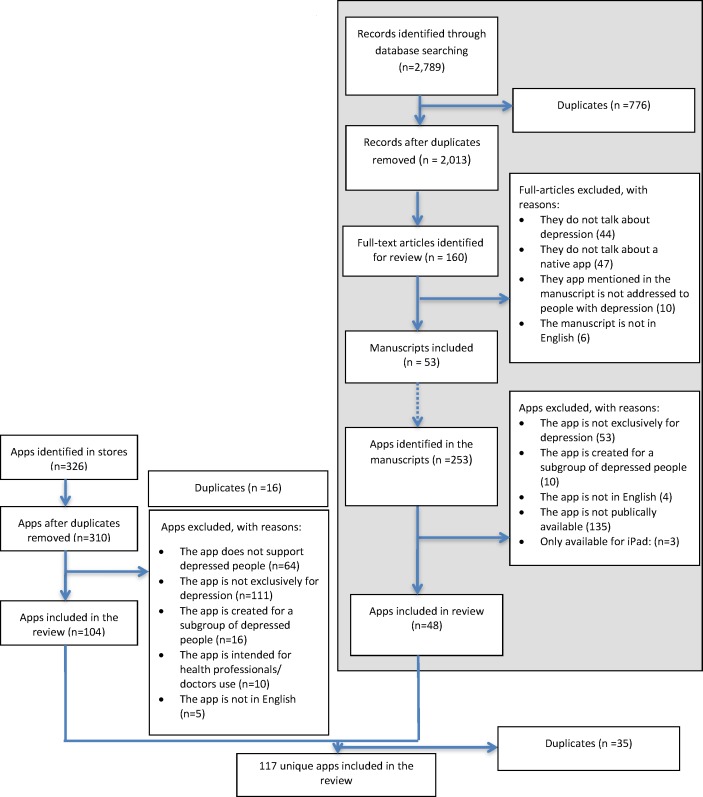
“Our search of commercial marketplace identified a total of 310 unique apps.”
§ A Systematic Review of Cognitive Behavioral Therapy and Behavioral Activation Apps for Depression > Results > Search
plain- Asserted: passes — The authors put it forward as true.
- Checkable: passes — It can be checked against evidence.
- Load-bearing: unclear — It is unclear whether the paper’s conclusions depend on it.
- Based: passes — The paper gives a reason why it holds.
- Rests on an assumption: The search query 'depression' and the two app stores (Canadian Apple App Store and Android Market) capture the relevant available apps for depression.
A result the paper reports from its own data — it cites no other source for it, so there is none to check. The quote shows it is in the paper.
In the paper
“The 53 manuscripts [9,14,15,22,23,24,25,26,27,28,29,30,31,32,33,34,35,36,37,38,39,40,41,42,43,44,45,46,47,48, 49,50,51,52,53,54,55,56,57,58,59,60,61,62,63,64,65, 66,67,68,69,70,71] identified as relevant to the review made mention of a total of 48 unique apps that met our inclusion/exclusion criteria.”
§ A Systematic Review of Cognitive Behavioral Therapy and Behavioral Activation Apps for Depression > Results > Search
plain- Asserted: passes — The authors put it forward as true.
- Checkable: passes — It can be checked against evidence.
- Load-bearing: unclear — It is unclear whether the paper’s conclusions depend on it.
- Based: passes — The paper gives a reason why it holds.
- Rests on an assumption: The search query 'depression' and the two app stores (Canadian Apple App Store and Android Market) capture the relevant available apps for depression.
A result the paper reports from its own data — it cites no other source for it, so there is none to check. The quote shows it is in the paper.
In the paper
“One hundred and four of these apps identified in the commercial marketplace meet our inclusion/exclusion criteria.”
§ A Systematic Review of Cognitive Behavioral Therapy and Behavioral Activation Apps for Depression > Results > Search
plain- Asserted: passes — The authors put it forward as true.
- Checkable: passes — It can be checked against evidence.
- Load-bearing: passes — The paper’s conclusions depend on it.
- Based: passes — The paper gives a reason why it holds.
- Rests on an assumption: The search query 'depression' and the two app stores (Canadian Apple App Store and Android Market) capture the relevant available apps for depression.
A result the paper reports from its own data — it cites no other source for it, so there is none to check. The quote shows it is in the paper.
In the paper
“10.26% (n = 12) of these apps identified through our search offer support that seems to be consistent with evidence-based principles of CBT or BA.”
- Also stated in: § App characteristics · plain
“Twelve of these 117 apps (10.26%) were classified by the reviewers as delivering CBT or BA; these CBT/BA apps were identified in the description by their developers as CBT or BA apps or they seemed to offer CBT or BA based on their general description (Table 3).”
§ A Systematic Review of Cognitive Behavioral Therapy and Behavioral Activation Apps for Depression > Abstract
plainn = 12- Asserted: passes — The authors put it forward as true.
- Checkable: passes — It can be checked against evidence.
- Load-bearing: passes — The paper’s conclusions depend on it.
- Based: passes — The paper gives a reason why it holds.
- Rests on an assumption: App store descriptions and manuscript descriptions accurately represent the type of support an app offers.
- Also stated in: § App characteristics · plain
A result the paper reports from its own data — it cites no other source for it, so there is none to check. The quote shows it is in the paper.
In the paper
“Fifty-three out of 160 were relevant for our review because all them mention at least one native app addressed to people for depression.”
§ A Systematic Review of Cognitive Behavioral Therapy and Behavioral Activation Apps for Depression > Results > Search
plain- Asserted: passes — The authors put it forward as true.
- Checkable: passes — It can be checked against evidence.
- Load-bearing: passes — The paper’s conclusions depend on it.
- Based: passes — The paper gives a reason why it holds.
- Rests on an assumption: The search query 'depression' and the two app stores (Canadian Apple App Store and Android Market) capture the relevant available apps for depression.
A result the paper reports from its own data — it cites no other source for it, so there is none to check. The quote shows it is in the paper.
In the paper
“One hundred and seventeen apps have been identified after searching both the scientific literature and the commercial market.”
§ A Systematic Review of Cognitive Behavioral Therapy and Behavioral Activation Apps for Depression > Abstract
plain- Asserted: passes — The authors put it forward as true.
- Checkable: passes — It can be checked against evidence.
- Load-bearing: passes — The paper’s conclusions depend on it.
- Based: passes — The paper gives a reason why it holds.
The paper states this without a source or data behind it here, so there is nothing to check it against. The quote shows it is in the paper.
In the paper
“The usability of reviewed apps is highly variable”
§ A Systematic Review of Cognitive Behavioral Therapy and Behavioral Activation Apps for Depression > Abstract
plain- Asserted: passes — The authors put it forward as true.
- Checkable: passes — It can be checked against evidence.
- Load-bearing: unclear — It is unclear whether the paper’s conclusions depend on it.
- Based: passes — The paper gives a reason why it holds.
- Rests on an assumption: The usability expert's ratings are valid.
The paper states this without a source or data behind it here, so there is nothing to check it against. The quote shows it is in the paper.
In the paper
“they rarely are accompanied by explicit privacy or safety policies.”
§ A Systematic Review of Cognitive Behavioral Therapy and Behavioral Activation Apps for Depression > Abstract
plain- Asserted: passes — The authors put it forward as true.
- Checkable: passes — It can be checked against evidence.
- Load-bearing: passes — The paper’s conclusions depend on it.
- Based: passes — The paper gives a reason why it holds.
A result the paper reports from its own data — it cites no other source for it, so there is none to check. The quote shows it is in the paper.
In the paper
“No relationship was found between the level of adherence of the app to the theoretical CBT or BA model and the level of adherence with the heuristics usability (rs = -0.45, p = 0.13 and rs = 0.30, p = 0.33, respectively).”
§ A Systematic Review of Cognitive Behavioral Therapy and Behavioral Activation Apps for Depression > Results > CBT/BA apps characteristics
plain- Asserted: passes — The authors put it forward as true.
- Checkable: passes — It can be checked against evidence.
- Load-bearing: unclear — It is unclear whether the paper’s conclusions depend on it.
- Based: passes — The paper gives a reason why it holds.
The paper states this without a source or data behind it here, so there is nothing to check it against. The quote shows it is in the paper.
In the paper
“For instance, the Depression CBT Self-Help Guide app has the highest fidely to CBT models, but the low usability score could complicate its use.”
§ A Systematic Review of Cognitive Behavioral Therapy and Behavioral Activation Apps for Depression > Discussion
plain- Asserted: passes — The authors put it forward as true.
- Checkable: passes — It can be checked against evidence.
- Load-bearing: unclear — It is unclear whether the paper’s conclusions depend on it.
- Based: passes — The paper gives a reason why it holds.
- Rests on an assumption: The evaluation of CBT/BA content by one expert is a valid measure of the apps' fidelity to CBT/BA models.
- Probably not a substantial claim. 23
- It may state two separate claims as one. 15
A result the paper reports from its own data — it cites no other source for it, so there is none to check. The quote shows it is in the paper.
In the paper
“The literature search yielded 2,789 abstracts”
§ A Systematic Review of Cognitive Behavioral Therapy and Behavioral Activation Apps for Depression > Results > Search
plain- Asserted: passes — The authors put it forward as true.
- Checkable: passes — It can be checked against evidence.
- Load-bearing: fails — The paper’s conclusions may not depend on it.
- Based: passes — The paper gives a reason why it holds.
Probably not a substantial claim. The paper’s conclusions may not depend on it.
- Rests on an assumption: The search query 'depression' and the two app stores (Canadian Apple App Store and Android Market) capture the relevant available apps for depression.
A result the paper reports from its own data — it cites no other source for it, so there is none to check. The quote shows it is in the paper.
In the paper
“160 full text manuscripts were reviewed at the full-text level.”
§ A Systematic Review of Cognitive Behavioral Therapy and Behavioral Activation Apps for Depression > Results > Search
plain- Asserted: passes — The authors put it forward as true.
- Checkable: passes — It can be checked against evidence.
- Load-bearing: fails — The paper’s conclusions may not depend on it.
- Based: passes — The paper gives a reason why it holds.
Probably not a substantial claim. The paper’s conclusions may not depend on it.
- Rests on an assumption: The search query 'depression' and the two app stores (Canadian Apple App Store and Android Market) capture the relevant available apps for depression.
A result the paper reports from its own data — it cites no other source for it, so there is none to check. The quote shows it is in the paper.
In the paper
“The 53 manuscripts included at this stage mentioned a total of 253 native apps for people with depression.”
§ A Systematic Review of Cognitive Behavioral Therapy and Behavioral Activation Apps for Depression > Methods > Search strategy
plainn = 253- Asserted: passes — The authors put it forward as true.
- Checkable: passes — It can be checked against evidence.
- Load-bearing: fails — The paper’s conclusions may not depend on it.
- Based: passes — The paper gives a reason why it holds.
Probably not a substantial claim. The paper’s conclusions may not depend on it.
In the paper
“All the apps identified through searching the scientific literature were simply cited in reviews [14]; they were not evaluated in primary research studies.”
§ A Systematic Review of Cognitive Behavioral Therapy and Behavioral Activation Apps for Depression > Discussion
What the sources say
- Not checked yetcites [14] N Shen, 2015, Finding a depression App: A review and content analysis of the depression app marketplace, J Med Internet Res
plain- Asserted: passes — The authors put it forward as true.
- Checkable: passes — It can be checked against evidence.
- Load-bearing: passes — The paper’s conclusions depend on it.
- Based: passes — The paper gives a reason why it holds.
It may state two separate claims as one.
A result the paper reports from its own data — it cites no other source for it, so there is none to check. The quote shows it is in the paper.
In the paper
“The cost of these CBT/BA apps ranged from $0.00 to $8.99.”
§ A Systematic Review of Cognitive Behavioral Therapy and Behavioral Activation Apps for Depression > Results > CBT/BA apps characteristics
plain- Asserted: passes — The authors put it forward as true.
- Checkable: passes — It can be checked against evidence.
- Load-bearing: fails — The paper’s conclusions may not depend on it.
- Based: passes — The paper gives a reason why it holds.
Probably not a substantial claim. The paper’s conclusions may not depend on it.
- Rests on an assumption: App store descriptions and manuscript descriptions accurately represent the type of support an app offers.
A result the paper reports from its own data — it cites no other source for it, so there is none to check. The quote shows it is in the paper.
In the paper
“However, this app was not the one that received the highest number of reviews.”
§ A Systematic Review of Cognitive Behavioral Therapy and Behavioral Activation Apps for Depression > Results > CBT/BA apps characteristics
plain- Asserted: passes — The authors put it forward as true.
- Checkable: passes — It can be checked against evidence.
- Load-bearing: fails — The paper’s conclusions may not depend on it.
- Based: passes — The paper gives a reason why it holds.
Probably not a substantial claim. The paper’s conclusions may not depend on it.
- Rests on an assumption: App store descriptions and manuscript descriptions accurately represent the type of support an app offers.
A result the paper reports from its own data — it cites no other source for it, so there is none to check. The quote shows it is in the paper.
In the paper
“The iPhone apps that received the highest number of reviews were the Anti-depression and MoodTools–Depression Aid apps, both of them also available for download in the Google Play store.”
§ A Systematic Review of Cognitive Behavioral Therapy and Behavioral Activation Apps for Depression > Results > CBT/BA apps characteristics
plain- Asserted: passes — The authors put it forward as true.
- Checkable: passes — It can be checked against evidence.
- Load-bearing: fails — The paper’s conclusions may not depend on it.
- Based: passes — The paper gives a reason why it holds.
Probably not a substantial claim. The paper’s conclusions may not depend on it. It may state two separate claims as one.
- Rests on an assumption: App store descriptions and manuscript descriptions accurately represent the type of support an app offers.
A result the paper reports from its own data — it cites no other source for it, so there is none to check. The quote shows it is in the paper.
In the paper
“Its privacy policy indicates what information is collected and for what purpose, whether this information is shared with others but it does not address users control.”
§ A Systematic Review of Cognitive Behavioral Therapy and Behavioral Activation Apps for Depression > Results > CBT/BA apps characteristics
hedged- Asserted: passes — The authors put it forward as true.
- Checkable: passes — It can be checked against evidence.
- Load-bearing: unclear — It is unclear whether the paper’s conclusions depend on it.
- Based: passes — The paper gives a reason why it holds.
It may state two separate claims as one.
The paper states this without a source or data behind it here, so there is nothing to check it against. The quote shows it is in the paper.
In the paper
“The few available apps that offer CBT or BA have either not been tested or the results derived from these tests have not been reported in the scientific literature.”
§ A Systematic Review of Cognitive Behavioral Therapy and Behavioral Activation Apps for Depression > Discussion
plain- Asserted: passes — The authors put it forward as true.
- Checkable: passes — It can be checked against evidence.
- Load-bearing: passes — The paper’s conclusions depend on it.
- Based: passes — The paper gives a reason why it holds.
It may state two separate claims as one.
A result the paper reports from its own data — it cites no other source for it, so there is none to check. The quote shows it is in the paper.
In the paper
“The most typical type of self-help support delivered through these 117 apps was education (n = 32, 27.35%) and diagnostic/screening support (n = 30, 25.64%), followed by state induction (n = 18, 15.38%).”
§ A Systematic Review of Cognitive Behavioral Therapy and Behavioral Activation Apps for Depression > Results > App characteristics
plainn = 18- Asserted: passes — The authors put it forward as true.
- Checkable: passes — It can be checked against evidence.
- Load-bearing: unclear — It is unclear whether the paper’s conclusions depend on it.
- Based: passes — The paper gives a reason why it holds.
It may state two separate claims as one.
- Rests on an assumption: App store descriptions and manuscript descriptions accurately represent the type of support an app offers.
A result the paper reports from its own data — it cites no other source for it, so there is none to check. The quote shows it is in the paper.
In the paper
“This policy is available on the developer’s homepage but is also available to users after they have downloaded the app.”
§ A Systematic Review of Cognitive Behavioral Therapy and Behavioral Activation Apps for Depression > Results > CBT/BA apps characteristics
plain- Asserted: passes — The authors put it forward as true.
- Checkable: passes — It can be checked against evidence.
- Load-bearing: fails — The paper’s conclusions may not depend on it.
- Based: passes — The paper gives a reason why it holds.
Probably not a substantial claim. The paper’s conclusions may not depend on it. It may state two separate claims as one.
A result the paper reports from its own data — it cites no other source for it, so there is none to check. The quote shows it is in the paper.
In the paper
“Five of the 12 CBT/BA apps (41.67%) were available on iOS only and 5 (41.67%) on Android only.”
§ A Systematic Review of Cognitive Behavioral Therapy and Behavioral Activation Apps for Depression > Results > CBT/BA apps characteristics
plain- Asserted: passes — The authors put it forward as true.
- Checkable: passes — It can be checked against evidence.
- Load-bearing: unclear — It is unclear whether the paper’s conclusions depend on it.
- Based: passes — The paper gives a reason why it holds.
It may state two separate claims as one.
- Rests on an assumption: App store descriptions and manuscript descriptions accurately represent the type of support an app offers.
A result the paper reports from its own data — it cites no other source for it, so there is none to check. The quote shows it is in the paper.
In the paper
“The Depression CBT Self-Help Guide and The Mood Tools–Depression Aid were those Android apps with the highest number of downloads (i.e., between 100,000 and 500,000 downloads, and between 50,000 and 100,000, respectively) and received high user satisfaction ratings (average satisfaction rates were 4.2 and 4.3, respectively).”
§ A Systematic Review of Cognitive Behavioral Therapy and Behavioral Activation Apps for Depression > Results > CBT/BA apps characteristics
plain- Asserted: passes — The authors put it forward as true.
- Checkable: passes — It can be checked against evidence.
- Load-bearing: unclear — It is unclear whether the paper’s conclusions depend on it.
- Based: passes — The paper gives a reason why it holds.
It may state two separate claims as one.
- Rests on an assumption: App store descriptions and manuscript descriptions accurately represent the type of support an app offers.
A result the paper reports from its own data — it cites no other source for it, so there is none to check. The quote shows it is in the paper.
In the paper
“The iPhone app that received the highest user satisfaction rating was The Depression Cure: The Free 12 Week Course app (average satisfaction rating = 4.5).”
§ A Systematic Review of Cognitive Behavioral Therapy and Behavioral Activation Apps for Depression > Results > CBT/BA apps characteristics
plain- Asserted: passes — The authors put it forward as true.
- Checkable: passes — It can be checked against evidence.
- Load-bearing: fails — The paper’s conclusions may not depend on it.
- Based: passes — The paper gives a reason why it holds.
Probably not a substantial claim. The paper’s conclusions may not depend on it.
- Rests on an assumption: App store descriptions and manuscript descriptions accurately represent the type of support an app offers.
A result the paper reports from its own data — it cites no other source for it, so there is none to check. The quote shows it is in the paper.
In the paper
“Out of the total 117 apps, 36 apps (30.77%) were available on iOS only, 74 (63.25%) were available on Android only, and 7 (5.98%) were available across both platforms.”
§ A Systematic Review of Cognitive Behavioral Therapy and Behavioral Activation Apps for Depression > Results > App characteristics
plain- Asserted: passes — The authors put it forward as true.
- Checkable: passes — It can be checked against evidence.
- Load-bearing: unclear — It is unclear whether the paper’s conclusions depend on it.
- Based: passes — The paper gives a reason why it holds.
It may state two separate claims as one.
- Rests on an assumption: App store descriptions and manuscript descriptions accurately represent the type of support an app offers.
A result the paper reports from its own data — it cites no other source for it, so there is none to check. The quote shows it is in the paper.
In the paper
“The eCBTapp has a brief privacy policy that states that the information collected in the app is only accessed by the application on the device and they do not collect any information about the user or the use of the app.”
§ A Systematic Review of Cognitive Behavioral Therapy and Behavioral Activation Apps for Depression > Results > CBT/BA apps characteristics
plain- Asserted: passes — The authors put it forward as true.
- Checkable: passes — It can be checked against evidence.
- Load-bearing: unclear — It is unclear whether the paper’s conclusions depend on it.
- Based: passes — The paper gives a reason why it holds.
It may state two separate claims as one.
A result the paper reports from its own data — it cites no other source for it, so there is none to check. The quote shows it is in the paper.
In the paper
“The Depression CBT Self-Help Guide app’s privacy policy applies to this app in particular, but also other products of its developer (other apps and its homepage).”
§ A Systematic Review of Cognitive Behavioral Therapy and Behavioral Activation Apps for Depression > Results > CBT/BA apps characteristics
plain- Asserted: passes — The authors put it forward as true.
- Checkable: passes — It can be checked against evidence.
- Load-bearing: fails — The paper’s conclusions may not depend on it.
- Based: passes — The paper gives a reason why it holds.
Probably not a substantial claim. The paper’s conclusions may not depend on it.
A result the paper reports from its own data — it cites no other source for it, so there is none to check. The quote shows it is in the paper.
In the paper
“The Depression CBT Self-Help Guide and The Mood Tools–Depression Aid were those Android apps with the highest number of downloads (i.e., between 100,000 and 500,000 downloads, and between 50,000 and 100,000, respectively) and received high user satisfaction ratings (average satisfaction rates were 4.2 and 4.3, respectively).”
§ A Systematic Review of Cognitive Behavioral Therapy and Behavioral Activation Apps for Depression > Results > CBT/BA apps characteristics
plain- Asserted: passes — The authors put it forward as true.
- Checkable: passes — It can be checked against evidence.
- Load-bearing: unclear — It is unclear whether the paper’s conclusions depend on it.
- Based: passes — The paper gives a reason why it holds.
It may state two separate claims as one.
- Rests on an assumption: App store descriptions and manuscript descriptions accurately represent the type of support an app offers.
In the paper
“Smartphones have been used to facilitate the delivery of healthcare interventions including treatment of mental health conditions [13].”
§ A Systematic Review of Cognitive Behavioral Therapy and Behavioral Activation Apps for Depression > Introduction
What the sources say
- Not checked yetcites [13] Michael S. Application of smartphone technology in the management and treatment of mental illnesses. MPH. Thesis, University of Pittsburgh. 2011. Available: http://d-scholarship.pitt.edu/6783/
plaindirect- Asserted: passes — The authors put it forward as true.
- Checkable: passes — It can be checked against evidence.
- Load-bearing: passes — The paper’s conclusions depend on it.
- Based: passes — The paper gives a reason why it holds.
Probably not a substantial claim.
In the paper
“The level of agreement between the two reviewers when categorizing the apps, using the Cohen’s kappa, was 0.92, indicating almost perfect agreement [17].”
§ A Systematic Review of Cognitive Behavioral Therapy and Behavioral Activation Apps for Depression > Methods > Data extraction
What the sources say
- Not checked yetcites [17] JR Landis, 1977, The measurement of observer agreement for categorical data, Biometrics source
hedged- Asserted: passes — The authors put it forward as true.
- Checkable: passes — It can be checked against evidence.
- Load-bearing: fails — The paper’s conclusions may not depend on it.
- Based: passes — The paper gives a reason why it holds.
Probably not a substantial claim. The paper’s conclusions may not depend on it.
None of the sources cited for this claim have been checked yet.
In the paper
“Both CBT and BA have meta-analytic level of evidence in the treatment of depression[6,7].”
§ A Systematic Review of Cognitive Behavioral Therapy and Behavioral Activation Apps for Depression > Introduction
What the sources say
plaindirect- Asserted: passes — The authors put it forward as true.
- Checkable: passes — It can be checked against evidence.
- Load-bearing: passes — The paper’s conclusions depend on it.
- Based: passes — The paper gives a reason why it holds.
It may state two separate claims as one.
A conclusion the paper draws from its own results — it cites no other source for it, so there is none to check. The quote shows it is in the paper.
In the paper
“Taking into account the non existence of effectiveness/efficacy studies, and the low level of adherence to the core ingredients of the CBT/BA models, the utility of these CBT/BA apps are questionable.”
§ A Systematic Review of Cognitive Behavioral Therapy and Behavioral Activation Apps for Depression > Abstract
plainn = 12- Asserted: passes — The authors put it forward as true.
- Checkable: passes — It can be checked against evidence.
- Load-bearing: passes — The paper’s conclusions depend on it.
- Based: passes — The paper gives a reason why it holds.
It may state two separate claims as one.
- Rests on an assumption: Cross-referencing with apps identified in the scientific literature is sufficient to determine whether any efficacy or effectiveness study exists for the included CBT/BA apps.
In the paper
“If a privacy policy was available the evaluator assessesed the scope and the level of transparency of the policy as done by Sunyaev et al. [21].”
§ A Systematic Review of Cognitive Behavioral Therapy and Behavioral Activation Apps for Depression > Methods > Data extraction
What the sources say
- Not checked yetcites [21] A Sunyaev, 2015, Availability and quality of mobile mental health app privacy policies, J Am Med Inform Assoc source
plain- Asserted: passes — The authors put it forward as true.
- Checkable: passes — It can be checked against evidence.
- Load-bearing: fails — The paper’s conclusions may not depend on it.
- Based: passes — The paper gives a reason why it holds.
Probably not a substantial claim. The paper’s conclusions may not depend on it.
In the paper
“He evaluated the user interface of each app using a common list of usability heuristics proposed by Nielsen & Mack [20].”
§ A Systematic Review of Cognitive Behavioral Therapy and Behavioral Activation Apps for Depression > Methods > Data extraction
What the sources say
- Not checked yetcites [20] J Nielsen, 1994
plain- Asserted: passes — The authors put it forward as true.
- Checkable: passes — It can be checked against evidence.
- Load-bearing: fails — The paper’s conclusions may not depend on it.
- Based: passes — The paper gives a reason why it holds.
Probably not a substantial claim. The paper’s conclusions may not depend on it.
In the paper
“With almost perfect agreement observed at this third level of screening (kappa = 0.92) [17], the remaining apps were reviewed by only one reviewer (SR).”
§ A Systematic Review of Cognitive Behavioral Therapy and Behavioral Activation Apps for Depression > Methods > Search strategy
What the sources say
- Not checked yetcites [17] JR Landis, 1977, The measurement of observer agreement for categorical data, Biometrics source
plainn = 125- Asserted: passes — The authors put it forward as true.
- Checkable: passes — It can be checked against evidence.
- Load-bearing: fails — The paper’s conclusions may not depend on it.
- Based: passes — The paper gives a reason why it holds.
Probably not a substantial claim. The paper’s conclusions may not depend on it.
What the paper did — it cites no source for this, so there is none to check. The quote shows it is in the paper.
In the paper
“The level of agreement between both independent reviewers using the Cohen’s Kappa was 0.89.”
§ A Systematic Review of Cognitive Behavioral Therapy and Behavioral Activation Apps for Depression > Methods > Search strategy
plain- Asserted: passes — The authors put it forward as true.
- Checkable: passes — It can be checked against evidence.
- Load-bearing: fails — The paper’s conclusions may not depend on it.
- Based: passes — The paper gives a reason why it holds.
Probably not a substantial claim. The paper’s conclusions may not depend on it.
In the paper
“Cognitive Behavioural Therapy (CBT) and Behavioural Activation (BA) are now an accepted evidence-based first-line treatment for depression [5].”
§ A Systematic Review of Cognitive Behavioral Therapy and Behavioral Activation Apps for Depression > Introduction
What the sources say
- Not checked yetcites [5] National Collaborating Centre for Mental Health. Depression: The treatment and management of depression in adults. 2010. Available: https://www.nice.org.uk/guidance/cg90/evidence/cg90-depression-in-adults-full-guidance2
plain- Asserted: passes — The authors put it forward as true.
- Checkable: passes — It can be checked against evidence.
- Load-bearing: passes — The paper’s conclusions depend on it.
- Based: passes — The paper gives a reason why it holds.
It may state two separate claims as one.
A conclusion the paper draws from its own results — it cites no other source for it, so there is none to check. The quote shows it is in the paper.
In the paper
“Although expert opinion plays an important role when no research evidence exists, the use of an expert panel instead of only one expert could have increased the credibility of the conclusions.”
§ A Systematic Review of Cognitive Behavioral Therapy and Behavioral Activation Apps for Depression > Discussion
hedgedconditional- Asserted: passes — The authors put it forward as true.
- Checkable: fails — It may be too vague to check against evidence.
- Load-bearing: fails — The paper’s conclusions may not depend on it.
- Based: passes — The paper gives a reason why it holds.
Probably not a substantial claim. It may be too vague to check against evidence. The paper’s conclusions may not depend on it.
None of the sources cited for this claim have been checked yet.
In the paper
“This finding is not surprising; previous reviews have found no relationship between the quality of the apps and consumers reviews or ratings [73,74].”
§ A Systematic Review of Cognitive Behavioral Therapy and Behavioral Activation Apps for Depression > Discussion
What the sources say
- Not checked yetcites [73] NF BinDhim, 2015, A systematic review of quality assessment methods for smartphone health apps
- Not checked yetcites [74] Kuehnhausen M, Frost VS. Trusting smartphone apps? To install or not to install, that is the question. Cognitive Methods in Situation Awareness and Decision Support; IEEE International Multi-Disciplinary Conference; 2013 Feb 25–28; San Diego, CA, USA. IEEE; 2013. pp. 30–37. source
plain- Asserted: passes — The authors put it forward as true.
- Checkable: passes — It can be checked against evidence.
- Load-bearing: fails — The paper’s conclusions may not depend on it.
- Based: passes — The paper gives a reason why it holds.
Probably not a substantial claim. The paper’s conclusions may not depend on it.
What the paper did — it cites no source for this, so there is none to check. The quote shows it is in the paper.
In the paper
“First, this review was limited to English downloadable apps in Canada and only looked at the two most popular platforms when exploring the commercial market.”
§ A Systematic Review of Cognitive Behavioral Therapy and Behavioral Activation Apps for Depression > Discussion
plain- Asserted: passes — The authors put it forward as true.
- Checkable: passes — It can be checked against evidence.
- Load-bearing: fails — The paper’s conclusions may not depend on it.
- Based: passes — The paper gives a reason why it holds.
Probably not a substantial claim. The paper’s conclusions may not depend on it. It may state two separate claims as one.
What the paper did — it cites no source for this, so there is none to check. The quote shows it is in the paper.
In the paper
“Second, the evaluation of the CBT and BA apps was based on the opinion of one expert.”
§ A Systematic Review of Cognitive Behavioral Therapy and Behavioral Activation Apps for Depression > Discussion
plain- Asserted: passes — The authors put it forward as true.
- Checkable: passes — It can be checked against evidence.
- Load-bearing: fails — The paper’s conclusions may not depend on it.
- Based: passes — The paper gives a reason why it holds.
Probably not a substantial claim. The paper’s conclusions may not depend on it.
A conclusion the paper draws from its own results — it cites no other source for it, so there is none to check. The quote shows it is in the paper.
In the paper
“Therefore, users should be careful when using the information available on the app download page to judge the app, since this information can be misleading.”
§ A Systematic Review of Cognitive Behavioral Therapy and Behavioral Activation Apps for Depression > Discussion
plaindirect- Asserted: passes — The authors put it forward as true.
- Checkable: passes — It can be checked against evidence.
- Load-bearing: passes — The paper’s conclusions depend on it.
- Based: passes — The paper gives a reason why it holds.
Probably not a substantial claim.
- Rests on an assumption: The number of downloads, user ratings, and reviews are valid indicators of an app's popularity.
In the paper
“Chan et al. [16] suggest evaluating apps on three broad dimensions: usefulness, usability, and integration/infrastructure.”
§ A Systematic Review of Cognitive Behavioral Therapy and Behavioral Activation Apps for Depression > Discussion
What the sources say
- Not checked yetcites [16] S Chan, 2015, Towards a framework for evaluating mobile mental health apps, Telemed J E Health source
hedged- Asserted: passes — The authors put it forward as true.
- Checkable: passes — It can be checked against evidence.
- Load-bearing: fails — The paper’s conclusions may not depend on it.
- Based: passes — The paper gives a reason why it holds.
Probably not a substantial claim. The paper’s conclusions may not depend on it.
A conclusion the paper draws from its own results — it cites no other source for it, so there is none to check. The quote shows it is in the paper.
In the paper
“Finally, although it was not the primary goal of this review, the lack of common constructs, outcome measures, definitions and/or standards for tracking, state induction, diagnostic/screening, and education apps make cross-case comparison of these different types of self-help apps impossible.”
§ A Systematic Review of Cognitive Behavioral Therapy and Behavioral Activation Apps for Depression > Discussion
plaindirect- Asserted: passes — The authors put it forward as true.
- Checkable: passes — It can be checked against evidence.
- Load-bearing: fails — The paper’s conclusions may not depend on it.
- Based: fails — The paper may give no reason why it holds.
Probably not a substantial claim. The paper’s conclusions may not depend on it. The paper may give no reason why it holds.
In the paper
“Chan et al. [16] have recently proposed a framework that can be used for patients and health care providers to evaluate existing mental health mobile apps and help them make informed choices about their use.”
§ A Systematic Review of Cognitive Behavioral Therapy and Behavioral Activation Apps for Depression > Discussion
What the sources say
- Not checked yetcites [16] S Chan, 2015, Towards a framework for evaluating mobile mental health apps, Telemed J E Health source
plain- Asserted: passes — The authors put it forward as true.
- Checkable: passes — It can be checked against evidence.
- Load-bearing: fails — The paper’s conclusions may not depend on it.
- Based: passes — The paper gives a reason why it holds.
Probably not a substantial claim. The paper’s conclusions may not depend on it.
The paper relies on this without support.
App store descriptions and manuscript descriptions accurately represent the type of support an app offers.
“The app description displayed in the stores and any available description provided in the manuscript was the only information used by the reviewers to base their decisions on which category each app fell into.”
The paper relies on this without support.
The development process, usability, feasibility, and efficacy of apps developed in the commercial marketplace are rarely assessed or reported.
“however the development process, usability, feasibility, and efficacy of these apps developed in the commercial marketplace are rarely assessed or reported.”
The paper relies on this without support.
The quality of available apps for depression had not been the subject of any systematic reviews before this review.
“The quality of the available apps has not been the subject of any systematic reviews, until now.”
The paper relies on this without support.
The search query 'depression' and the two app stores (Canadian Apple App Store and Android Market) capture the relevant available apps for depression.
“The search was restricted to apps available through the two most popular mobile phone platforms, The Canadian Apple App Store and Android Market (Google Play). The search was made in November 2015 using ‘depression’ as the search query.”
The paper relies on this without support.
Cross-referencing with apps identified in the scientific literature is sufficient to determine whether any efficacy or effectiveness study exists for the included CBT/BA apps.
“To evaluate the effectiveness of the apps, we cross-referenced with apps identified in the scientific literature to see whether there was any efficacy or effectiveness study on apps included in the review.”
The paper relies on this without support.
The expert's ratings of adherence to CBT/BA core ingredients are valid.
“an experienced academic CBT clinician (SR) evaluated the apps for their level of fidelity to theoretical CBT and BA principles by exploring what extent the apps included the core ingredients of these models.”
The paper relies on this without support.
The usability expert's ratings are valid.
“a user experience designer (MW), who regulary performs expert reviews on mobile apps and websites, where he applies heuristics and professional experience to evaluate user interfaces and suggest design improvements, evaluated the usability of the apps.”
The paper relies on this without support.
The number of downloads, user ratings, and reviews are valid indicators of an app's popularity.
“Also, no relationship was found between level of adherence of the app to the theoretical models and the indicators of popularity (range = rs = -0.02, p = 0.96 and rs = 0.57, p = 0.18), or between level of adherence of the app with the heuristic usability with the indicators of popularity (range = rs = 0.15, p = 0.68 and rs = 0.59, p = 0.07).”
The paper relies on this without support.
The core ingredients of CBT and BA used in the evaluation are the necessary components for a CBT or BA program to be effective.
“Of those apps which do use CBT or BA, some apps may provide benefits by partially applying CBT or BA principles, but the majority do not come close to including the core ingredients of a CBT or BA program.”
The paper relies on this without support.
The usability heuristics used are appropriate for evaluating the usability of CBT/BA apps.
“The usability heuristic evaluation found that the median level of adherence with the heuristics was 83% (range = 42–98%).”
The paper relies on this without support.
The evaluation of CBT/BA content by one expert is a valid measure of the apps' fidelity to CBT/BA models.
“Second, the evaluation of the CBT and BA apps was based on the opinion of one expert.”
Claims other papers make about this one
Each is checked against this paper’s own text: does it say what the citing paper says it does?
The source backs part of the claim, not all of it — or backs it for a different population, condition or comparison.
In the citing paper
“However, a meta-analysis of 117 CBT-based applications revealed that only 12 of them provided support aligned with the evidence-based tenets of CBT.46”
From Mixed-methods feasibility outcomes for a novel ACT-based video game ‘ACTing Minds’ to support mental health (2024) · cites this paper as [46]
Experimental — accuracy not yet measuredThe cited source says what the claim attributes to it.
In the citing paper
“Even among those purporting to be drawn from evidence-based therapies such as cognitive behavioural therapy, only a small percentage actually contain the core principles of those therapeutic traditions (19).”
From What Works and What Doesn’t Work? A Systematic Review of Digital Mental Health Interventions for Depression and Anxiety in Young People (2019) · cites this paper as [19]
The check wasn’t confident either way, so it gives no verdict — never disputed.
In the citing paper
“This finding suggests that the observed effectiveness in earlier studies could potentially stem from participants’ interaction with a DHI (perhaps as a form of distraction) rather than their proficient implementation of CBT principles.”
From Mixed-methods feasibility outcomes for a novel ACT-based video game ‘ACTing Minds’ to support mental health (2024) · cites this paper as [46]
Experimental — accuracy not yet measuredIn the citing paper
“For iCBT, very few of the products that claim to be based on cognitive-behavioral therapy (CBT) actually contain the CBT core elements (56).”
From Banbury forum consensus statement on the path forward for digital mental health treatment (2021) · cites this paper as [56]
In the citing paper
“In the past 5 years, a number of literature reviews have highlighted the increase in research and development activities for eMental healthcare technologies for children and adolescents [18-22].”
From eMental Healthcare Technologies for Anxiety and Depression in Childhood and Adolescence: Systematic Review of Studies Reporting Implementation Outcomes (2018) · cites this paper as [20]
Self-check
Percentages, sums and reported differences re-computed from the paper’s own numbers.
Each contradiction between two passages listed here was confirmed by an independent check.
Rated minor: it would not touch a result — a value no result rests on, a p-value that stays on the same side of the significance level, or a conflict that is clerical, resolved elsewhere in the paper, or outside its own findings.
In the paper
§ A Systematic Review of Cognitive Behavioral Therapy and Behavioral Activation Apps for Depression > Results > CBT/BA apps characteristics
“it does not address users control.”
§ A Systematic Review of Cognitive Behavioral Therapy and Behavioral Activation Apps for Depression > Results > CBT/BA apps characteristics
“| Depression CBT Self-Help Guide | ✓ | This app plus other apps created by the developer, and the homepage | ✓ | ✓ | ✓ | ✓ | ✗ | |”
Citations
Cites
The Measurement of Observer Agreement for Categorical Data
Landis, J. R., & Koch, G. G. (1977) · Biometrics · doi:10.2307/2529310 · Cited by 81,148
Kessler, R. C., Chiu, W. T., Demler, O., & Walters, E. E. (2005) · Archives of General Psychiatry · doi:10.1001/archpsyc.62.6.617 · Cited by 12,052
The empirical status of cognitive-behavioral therapy: A review of meta-analyses
Butler, A. C., Chapman, J. E., Forman, E. M., & Beck, A. T. (2006) · Clinical Psychology Review · doi:10.1016/j.cpr.2005.07.003 · Cited by 3,215
Mood disorders in children and adolescents: an epidemiologic perspective
Kessler, R. C., Avenevoli, S., & Ries Merikangas, K. (2001) · Biological Psychiatry · doi:10.1016/s0006-3223(01)01129-5 · Cited by 1,181
Behavioral activation treatments of depression: a meta-analysis.
Cuijpers, P., van Straten, A., & Warmerdam, L. (2007) · Clinical Psychology Review · doi:10.1016/j.cpr.2006.11.001 · Cited by 1,144
Smartphones for smarter delivery of mental health programs: A systematic review
Donker, T., Petrie, K., Proudfoot, J., Clarke, J., Birch, M.-R., & Christensen, H. (2013) · Journal of Medical Internet Research · doi:10.2196/jmir.2791 · Cited by 1,136 · cited 2×
“The lack of empirically tested apps identified during this review is consistent with observations in other health fields [36] and raises concerns about relying on these tools to support treatment for depression.”
BackgroundResultNational Collaborating Centre for Mental Health
Veale, D. M. (2006) · Research Portal (King's College London) · Cited by 941
Kessler, R. C. (2012) · Psychiatric Clinics of North America · doi:10.1016/j.psc.2011.11.005 · Cited by 871
The National Collaborating Centre for Mental Health
Kendall, T., & Pilling, S. (2004) · UCL Discovery (University College London) · Cited by 840
The Current State of Cognitive Therapy: A 40-Year Retrospective
Beck, A. T. (2005) · Archives of General Psychiatry · doi:10.1001/archpsyc.62.9.953 · Cited by 816
Research works printed but not linked: 3
- J.A. Callan, CBT mobilework: A technological solution to improve depression outcomes, Clinical and Translational Science, 4, 120
- M Murugan, Mobile phone based supportive patient care, Indian Journal of Psychiatry, 55, S72
- 2004, Depression: management of depression in primary and secondary care, Clinical Guideline, 23
Cited by
Sorted by citations
Hollis, C., Falconer, C. J., Martin, J. L., Whittington, C., Stockton, S., Glazebrook, C., & Davies, E. B. (2017) · Journal of Child Psychology and Psychiatry · doi:10.1111/jcpp.12663 · Cited by 846
Mental Health Mobile Apps for Preadolescents and Adolescents: A Systematic Review.
Grist, R., Porter, J., & Stallard, P. (2017) · Journal of Medical Internet Research · doi:10.2196/jmir.7332 · Cited by 518
An overview of and recommendations for more accessible digital mental health services
Lattie, E. G., Stiles-Shields, C., & Graham, A. K. (2022) · Nature Reviews Psychology · doi:10.1038/s44159-021-00003-1 · Cited by 446
The Use and Effectiveness of Mobile Apps for Depression: Results From a Fully Remote Clinical Trial
Arean, P. A., Hallgren, K. A., Jordan, J. T., Gazzaley, A., Atkins, D. C., Heagerty, P. J., & Anguera, J. A. (2016) · Journal of Medical Internet Research · doi:10.2196/jmir.6482 · Cited by 376
Garrido, S., Millington, C., Cheers, D., Boydell, K., Schubert, E., Meade, T., & Nguyen, Q. V. (2019) · Frontiers in Psychiatry · doi:10.3389/fpsyt.2019.00759 · Cited by 400
“Even among those purporting to be drawn from evidence-based therapies such as cognitive behavioural therapy, only a small percentage actually contain the core principles of those therapeutic traditions (19).”
BackgroundPhilippe, T. J., Sikder, N., Jackson, A., Koblanski, M. E., Liow, E., Pilarinos, A., & Vasarhelyi, K. (2022) · JMIR Mental Health · doi:10.2196/35159 · Cited by 436
Consumer Mobile Health Apps: Current State, Barriers, and Future Directions
Kao, C., & Liebovitz, D. M. (2017) · PM&R · doi:10.1016/j.pmrj.2017.02.018 · Cited by 350
Mental health monitoring with multimodal sensing and machine learning: A survey
Garcia-Ceja, E., Riegler, M., Nordgreen, T., Jakobsen, P., Oedegaard, K. J., & Tørresen, J. (2018) · Pervasive and Mobile Computing · doi:10.1016/j.pmcj.2018.09.003 · Cited by 356
IntelliCare: An Eclectic, Skills-Based App Suite for the Treatment of Depression and Anxiety
Mohr, D. C., Tomasino, K. N., Lattie, E. G., Palac, H. L., Kwasny, M. J., Weingardt, K., Karr, C. J., Kaiser, S. M., Rossom, R. C., Bardsley, L. R., et al. (2017) · Journal of Medical Internet Research · doi:10.2196/jmir.6645 · Cited by 301
Using science to sell apps: Evaluation of mental health app store quality claims
Larsen, M. E., Huckvale, K., Nicholas, J., Torous, J., Birrell, L., Li, E., & Reda, B. (2019) · npj Digital Medicine · doi:10.1038/s41746-019-0093-1 · Cited by 334
Wang, K., Varma, D. S., & Prosperi, M. (2018) · Journal of Psychiatric Research · doi:10.1016/j.jpsychires.2018.10.006 · Cited by 308
A randomized trial of online single-session interventions for adolescent depression during COVID-19
Schleider, J. L., Mullarkey, M. C., Fox, K. R., Dobias, M. L., Shroff, A., Hart, E. A., & Roulston, C. A. (2021) · Nature Human Behaviour · doi:10.1038/s41562-021-01235-0 · Cited by 289
Van Ameringen, M., Turna, J., Khalesi, Z., Pullia, K., & Patterson, B. (2017) · Depression and Anxiety · doi:10.1002/da.22657 · Cited by 234
“While the mHealth app literature is limited, several review papers have been published on the topic (Donker et al., 2013; Gee, Griffiths, & Gulliver, 2016; Huguet et al., 2016; Olff, 2015; Singh et al., 2016; Torous & Powell, 2015; Turvey & Roberts, 2015).”
BackgroundBakker, D., & Rickard, N. (2018) · Journal of Affective Disorders · doi:10.1016/j.jad.2017.11.016 · Cited by 231
Hollis, C., Sampson, S., Simons, L., Davies, E. B., Churchill, R., Betton, V., Butler, D., Chapman, K., Easton, K., Gronlund, T. A., et al. (2018) · The Lancet Psychiatry · doi:10.1016/s2215-0366(18)30296-7 · Cited by 186
Lipschitz, J., Miller, C. J., Hogan, T. P., Burdick, K. E., Lippin-Foster, R., Simon, S. R., & Burgess, J. (2019) · JMIR Mental Health · doi:10.2196/11334 · Cited by 183
Reviewing the data security and privacy policies of mobile apps for depression
O'Loughlin, K., Neary, M., Adkins, E. C., & Schueller, S. M. (2019) · Internet Interventions · doi:10.1016/j.invent.2018.12.001 · Cited by 179
Stawarz, K., Preist, C., Tallon, D., Wiles, N., & Coyle, D. (2018) · Journal of Medical Internet Research · doi:10.2196/10120 · Cited by 198
Rohani, D. A., Faurholt-Jepsen, M., Kessing, L. V., & Bardram, J. E. (2017) · doi:10.2196/preprints.9691 · Cited by 195
Lindner, P., Miloff, A., Hamilton, W., Reuterskiöld, L., Andersson, G., Powers, M. B., & Carlbring, P. (2017) · Cognitive Behaviour Therapy · doi:10.1080/16506073.2017.1280843 · Cited by 187
Batra, S., Baker, R., Wang, T., Forma, F., DiBiasi, F., & Peters-Strickland, T. (2017) · Medical Devices: Evidence and Research · doi:10.2147/mder.s144158 · Cited by 169
Pocket Skills: A Conversational Mobile Web App To Support Dialectical Behavioral Therapy
Schroeder, J., Wilkes, C., Rowan, K., Toledo, A., Paradiso, A., Czerwinski, M., Mark, G., & Linehan, M. M. (2018) · Proceedings of the 2018 CHI Conference on Human Factors in Computing Systems · doi:10.1145/3173574.3173972 · Cited by 175
Bauer, M., Glenn, T., Geddes, J., Gitlin, M., Grof, P., Kessing, L. V., Monteith, S., Faurholt-Jepsen, M., Severus, E., & Whybrow, P. C. (2020) · International Journal of Bipolar Disorders · doi:10.1186/s40345-019-0164-x · Cited by 163
Scaling evidence-based treatments through digital mental health.
Schueller, S. M., & Torous, J. B. (2020) · American Psychologist · doi:10.1037/amp0000654 · Cited by 191
Smartphone apps for the self-management of low back pain: A systematic review
Machado, G. C., Pinheiro, M. B., Lee, H., Ahmed, O. H., Hendrick, P. A., Williams, C. M., & Kamper, S. J. (2016) · Best Practice & Research Clinical Rheumatology · doi:10.1016/j.berh.2017.04.002 · Cited by 171
Wasil, A. R., Venturo-Conerly, K. E., Shingleton, R. M., & Weisz, J. R. (2019) · Behaviour Research and Therapy · doi:10.1016/j.brat.2019.103498 · Cited by 160
Methods for Evaluating the Content, Usability, and Efficacy of Commercial Mobile Health Apps
Jake-Schoffman, D. E., Silfee, V. J., Waring, M. E., Boudreaux, E. D., Sadasivam, R. S., Mullen, S. P., Carey, J. L., Hayes, R. B., Ding, E. Y., Bennett, G. G., et al. (2017) · JMIR mHealth and uHealth · doi:10.2196/mhealth.8758 · Cited by 165
Kerst, A., Zielasek, J., & Gäebel, W. (2019) · European Archives of Psychiatry and Clinical Neuroscience · doi:10.1007/s00406-018-0974-3 · Cited by 158
Rathnayaka, P., Mills, N., Burnett, D., Silva, D. D., Alahakoon, D., & Gray, R. J. (2022) · Sensors · doi:10.3390/s22103653 · Cited by 169
Ramos, G., & Chavira, D. A. (2022) · Cognitive and Behavioral Practice · doi:10.1016/j.cbpra.2019.10.004 · Cited by 143
Security and Privacy of mHealth Applications: A Scoping Review
Nurgalieva, L., O'Callaghan, D., & Doherty, G. (2020) · IEEE Access · doi:10.1109/access.2020.2999934 · Cited by 132
“Studies covered a wide range of mental health conditions , which included stress [3], depression [55], [60], [71], sleep disorders [88], smoking cessation [55], [98], psychosis [4], anxiety [53], and cognitive decline such as dementia [58], [65].”
BackgroundSmartphone apps for the treatment of mental health conditions: status and considerations
Huckvale, K., Nicholas, J., Torous, J. B., & Larsen, M. E. (2020) · Current Opinion in Psychology · doi:10.1016/j.copsyc.2020.04.008 · Cited by 148
Ethical perspectives on recommending digital technology for patients with mental illness
Bauer, M., Glenn, T., Monteith, S., Bauer, R., Whybrow, P. C., & Geddes, J. R. (2017) · International Journal of Bipolar Disorders · doi:10.1186/s40345-017-0073-9 · Cited by 137
Banbury forum consensus statement on the path forward for digital mental health treatment
Mohr, D. C., Azocar, F., Bertagnolli, A., Choudhury, T., Chrisp, P., Frank, R., Harbin, H., Histon, T., Kaysen, D., Nebeker, C., et al. (2021) · Psychiatric Services · doi:10.1176/appi.ps.202000561 · Cited by 115
Suganuma, S., Sakamoto, D., & Shimoyama, H. (2018) · JMIR Mental Health · doi:10.2196/10454 · Cited by 112
Mohr, D. C., Schueller, S. M., Tomasino, K. N., Kaiser, S. M., Alam, N., Karr, C., Vergara, J. L., Gray, E. L., Kwasny, M. J., & Lattie, E. G. (2019) · Journal of Medical Internet Research · doi:10.2196/13609 · Cited by 116
Scott, I. A., Scuffham, P., Gupta, D., Harch, T. M., Borchi, J., & Richards, B. (2018) · Australian Health Review · doi:10.1071/ah18064 · Cited by 129
Stawarz, K., Preist, C., & Coyle, D. (2019) · JMIR Mental Health · doi:10.2196/12546 · Cited by 107
Mobile health app usability and quality rating scales: a systematic review
Azad‐Khaneghah, P., Neubauer, N., Cruz, A. M., & Liu, L. (2020) · Disability and Rehabilitation Assistive Technology · doi:10.1080/17483107.2019.1701103 · Cited by 119
Najm, A., Nikiphorou, E., Kostine, M., Richez, C., Pauling, J. D., Finckh, A., Ritschl, V., Prior, Y., Balážová, P., Stones, S. R., et al. (2019) · RMD Open · doi:10.1136/rmdopen-2019-001014 · Cited by 114
Gamification and serious games in depression care: A systematic mapping study
Dias, L. P. S., Barbosa, J. L. V., & Vianna, H. D. (2018) · Telematics and Informatics · doi:10.1016/j.tele.2017.11.002 · Cited by 112
Understanding People’s Use of and Perspectives on Mood-Tracking Apps: Interview Study
Schueller, S. M., Neary, M., Lai, J., & Epstein, D. A. (2021) · JMIR Mental Health · doi:10.2196/29368 · Cited by 102
Leech, T., Dorstyn, D., Taylor, A., & Li, W. (2021) · Children and Youth Services Review · doi:10.1016/j.childyouth.2021.106073 · Cited by 100
Drissi, N., Ouhbi, S., Marques, G., Díez, I. D. L. T., Ghogho, M., & Idrissi, M. A. J. (2020) · Telemedicine Journal and e-Health · doi:10.1089/tmj.2020.0287 · Cited by 110
Mental health apps in a college setting: openness, usage, and attitudes.
Kern, A., Hong, V., Song, J., Lipson, S., & Eisenberg, D. (2018) · mHealth · doi:10.21037/mhealth.2018.06.01 · Cited by 96
Computer-Assisted Cognitive-Behavior Therapy and Mobile Apps for Depression and Anxiety
Wright, J. H., Mishkind, M., Eells, T. D., & Chan, S. R. (2019) · Current Psychiatry Reports · doi:10.1007/s11920-019-1031-2 · Cited by 93
Porras-Segovia, A., Molina-Madueño, R. M., Berrouiguet, S., López-Castroman, J., Barrigón, M. L., Pérez-Rodríguez, M. S., Marco, J. H., Díaz-Oliván, I., de León, S., Courtet, P., et al. (2020) · Journal of Affective Disorders · doi:10.1016/j.jad.2020.05.067 · Cited by 85
Hwang, W. J., & Jo, H. H. (2019) · International Journal of Environmental Research and Public Health · doi:10.3390/ijerph16214270 · Cited by 86
eHealth in Treatment of Offenders in Forensic Mental Health: A Review of the Current State
Kip, H., Bouman, Y. H. A., Kelders, S. M., & van Gemert-Pijnen, L. J. E. W. C. (2018) · Frontiers in Psychiatry · doi:10.3389/fpsyt.2018.00042 · Cited by 89
Wasil, A. R., Gillespie, S., Patel, R., Petre, A., Venturo-Conerly, K. E., Shingleton, R. M., Weisz, J. R., & DeRubeis, R. J. (2020) · Journal of Consulting and Clinical Psychology · doi:10.1037/ccp0000604 · Cited by 86
Howe, E. S., Suh, J., Morshed, M. B., McDuff, D., Rowan, K., Hernandez, J., Abdin, M., Ramos, G., Tran, T., & Czerwinski, M. P. (2022) · CHI Conference on Human Factors in Computing Systems · doi:10.1145/3491102.3502027 · Cited by 90
Hilty, D. M., Chan, S. R., Hwang, T., Wong, A., & Bauer, A. M. (2017) · mHealth · doi:10.21037/mhealth.2017.06.02 · Cited by 86
Technology-enhanced human interaction in psychotherapy.
Imel, Z. E., Caperton, D. D., Tanana, M., & Atkins, D. C. (2017) · Journal of Counseling Psychology · doi:10.1037/cou0000213 · Cited by 94
Co-producing digital mental health interventions: A systematic review
Brotherdale, R., Berry, K., Branitsky, A., & Bucci, S. (2024) · Digital Health · doi:10.1177/20552076241239172 · Cited by 87
Marshall, J. M., Dunstan, D. A., & Bartik, W. J. (2019) · Australian & New Zealand Journal of Psychiatry · doi:10.1177/0004867419876700 · Cited by 93
Lindner, P., Hamilton, W., Miloff, A., & Carlbring, P. (2019) · Frontiers in Psychiatry · doi:10.3389/fpsyt.2019.00792 · Cited by 90
Functionality of Top-Rated Mobile Apps for Depression: Systematic Search and Evaluation
Qu, C., Sas, C., Roquet, C. D., & Doherty, G. J. (2019) · JMIR Mental Health · doi:10.2196/15321 · Cited by 84
Attention-deficit/ hyperactivity disorder mobile apps: a systematic review
Păsărelu, C. R., Andersson, G., & Dobrean, A. (2020) · International Journal of Medical Informatics · doi:10.1016/j.ijmedinf.2020.104133 · Cited by 74
Bakker, D., & Rickard, N. S. (2019) · Australian Psychologist · doi:10.1111/ap.12383 · Cited by 72
Søgaard Neilsen, A., & Wilson, R. L. (2019) · International Journal of Mental Health Nursing · doi:10.1111/inm.12527 · Cited by 71
Bantjes, J., Kazdin, A., Cuijpers, P., Breet, E., Dunn-Coetzee, M., Davids, C., Stein, D. J., & Kessler, R. (2021) · JMIR Mental Health · doi:10.2196/27400 · Cited by 48
Is There an App for That? A Review of Popular Apps for Depression, Anxiety, and Well-Being
Wasil, A. R., Palermo, E. H., Lorenzo‐Luaces, L., & DeRubeis, R. J. (2021) · Cognitive and Behavioral Practice · doi:10.1016/j.cbpra.2021.07.001 · Cited by 80
Toscos, T., Carpenter, M., Drouin, M., Roebuck, A., Kerrigan, C., & Mirro, M. (2018) · Telemedicine and e-Health · doi:10.1089/tmj.2017.0243 · Cited by 57
mHealth Assessment and Intervention of Depression and Anxiety in Older Adults
Grossman, J. T., Frumkin, M. R., Rodebaugh, T. L., & Lenze, E. J. (2020) · Harvard Review of Psychiatry · doi:10.1097/hrp.0000000000000255 · Cited by 68
Rubanovich, C. K., Mohr, D. C., & Schueller, S. M. (2017) · JMIR Mental Health · doi:10.2196/mental.7603 · Cited by 63
Lee, T. T., & Kesselheim, A. S. (2018) · Annals of Internal Medicine · doi:10.7326/m17-2715 · Cited by 62
Depression in multiple sclerosis: Is one approach for its management enough?
Jones, C. D., Motl, R. W., & Sandroff, B. M. (2021) · Multiple Sclerosis and Related Disorders · doi:10.1016/j.msard.2021.102904 · Cited by 64
Steinglass (2017) · doi:10.1002/da.22624 · Cited by 54
Zanella-Calzada, L. A., Galvan-Tejada, C. E., Chávez-Lamas, N. M., Gracia-Cortés, M. D. C., Magallanes‐Quintanar, R., Celaya-Padilla, J. M., Galván-Tejada, J. I., & Gamboa-Rosales, H. (2019) · Diagnostics · doi:10.3390/diagnostics9010008 · Cited by 60
Wozney, L., Newton, A. S., Gehring, N. D., Bennett, K., Huguet, A., Hartling, L., Dyson, M. P., & McGrath, P. (2017) · BMC Medical Informatics and Decision Making · doi:10.1186/s12911-017-0474-9 · Cited by 58
Self-citationPendse, S. R., Sharma, A., Vashistha, A., Choudhury, M. D., & Kumar, N. (2021) · CHI Conference on Human Factors in Computing Systems · doi:10.1145/3411764.3445410 · Cited by 66
Teepe, G. W., Fonseca, A. D., Kleim, B., Jacobson, N. C., Salamanca-Sanabria, A., Car, L. T., Fleisch, E., & Kowatsch, T. (2021) · Journal of Medical Internet Research · doi:10.2196/29412 · Cited by 65
Economides, M., Ranta, K., Nazander, A., Hilgert, O., Goldin, P. R., Raevuori, A., & Forman‐Hoffman, V. L. (2019) · JMIR mhealth and uhealth · doi:10.2196/14284 · Cited by 52
Melbye, S. A., Kessing, L. V., Bardram, J. E., & Faurholt‐Jepsen, M. (2020) · JMIR Mental Health · doi:10.2196/17453 · Cited by 57
Dam, N. T. V., van Vugt, M. K., Vago, D. R., Schmalzl, L., Saron, C. D., Olendzki, A., Meissner, T., Lazar, S. W., Gorchov, J., Fox, K. C. R., et al. (2017) · Perspectives on Psychological Science · doi:10.1177/1745691617727529 · Cited by 62
Martinengo, L., Stona, A., Griva, K., Dazzan, P., Pariante, C. M., von Wangenheim, F., & Car, J. (2021) · Journal of Medical Internet Research · doi:10.2196/27619 · Cited by 62
Bahadori, S., Wainwright, T. W., & Ahmed, O. H. (2018) · Disability and Rehabilitation · doi:10.1080/09638288.2018.1514661 · Cited by 53
Temple, J. L., Hostler, D. P., Martin‐Gill, C., Moore, C. G., Weiss, P. M., Sequeira, D. J., Condle, J. P., Lang, E., Higgins, J. S., & Patterson, P. D. (2018) · Prehospital Emergency Care · doi:10.1080/10903127.2017.1382624 · Cited by 59
MUBS: A Personalized Recommender System for Behavioral Activation in Mental Health
Rohani, D. A., Lopategui, A. Q., Tuxen, N., Faurholt‐Jepsen, M., Kessing, L. V., & Bardram, J. E. (2020) · CHI Conference on Human Factors in Computing Systems · doi:10.1145/3313831.3376879 · Cited by 60
Hallgren, K. A., Bauer, A. M., & Atkins, D. C. (2017) · Depression and Anxiety · doi:10.1002/da.22640 · Cited by 45
Wozney, L., McGrath, P. J., Gehring, N. D., Bennett, K., Huguet, A., Hartling, L., Dyson, M. P., Soleimani, A., & Newton, A. S. (2018) · JMIR Mental Health · doi:10.2196/mental.9655 · Cited by 50
Self-citationDrissi, N., Ouhbi, S., Idrissi, M. A. J., & Ghogho, M. (2020) · International Journal of Medical Informatics · doi:10.1016/j.ijmedinf.2020.104243 · Cited by 57
Mental Health Apps in Psychiatric Treatment: A Patient Perspective on Real World Technology Usage
Chiauzzi, E., & Newell, A. (2019) · JMIR Mental Health · doi:10.2196/12292 · Cited by 46
Mobile Mental Health: A Review of Applications for Depression Assistance
Teles, A. S., de Moura, I. R., Viana, D., Silva, F., Coutinho, L., Endler, M., & Rabêlo, R. A. L. (2019) · Proceedings - IEEE Symposium on Computer-Based Medical Systems · doi:10.1109/cbms.2019.00143 · Cited by 48
Mobile app development in health research: pitfalls and solutions
Siegler, A. J., Knox, J., Bauermeister, J. A., Golinkoff, J., Hightow‐Weidman, L., & Scott, H. M. (2021) · mHealth · doi:10.21037/mhealth-19-263 · Cited by 46
Conley, C. S., Raposa, E. B., Bartolotta, K., Broner, S. E., Hareli, M., Forbes, N., Christensen, K. M., & Assink, M. (2022) · JMIR Mental Health · doi:10.2196/34254 · Cited by 53
Cole, T., Robinson, L., Romero, L., & O’Brien, L. (2017) · Journal of Hand Therapy · doi:10.1016/j.jht.2017.11.040 · Cited by 45
Technology and Mental Health: State of the Art for Assessment and Treatment
Harvey, P. D., Depp, C. A., Rizzo, A., Strauss, G. P., Spelber, D., Carpenter, L. L., Kalin, N. H., Krystal, J. H., McDonald, W. M., Nemeroff, C. B., et al. (2022) · American Journal of Psychiatry · doi:10.1176/appi.ajp.21121254 · Cited by 54
Nan, Y., Zhang, J., Nisar, A., Huo, L., Yang, L., Yin, J., Wang, D., Rahman, A., Gao, Y., & Li, X. (2020) · BMC Pregnancy and Childbirth · doi:10.1186/s12884-020-03087-4 · Cited by 48
Baumel, A., Torous, J. B., Edan, S., & Kane, J. M. (2020) · Journal of Affective Disorders · doi:10.1016/j.jad.2020.05.011 · Cited by 40
Castro, Ó., Mair, J. L., Salamanca-Sanabria, A., Alattas, A., Keller, R., Zheng, S., Jabir, A. I., Lin, X., Frese, B. F., Lim, C. S., et al. (2023) · Frontiers in Digital Health · doi:10.3389/fdgth.2023.1039171 · Cited by 42
Burchert, S., Kerber, A., Zimmermann, J., & Knaevelsrud, C. (2021) · PLoS ONE · doi:10.1371/journal.pone.0244955 · Cited by 41
Callan, J. A., Jacob, J. D., Siegle, G. J., Dey, A. K., Thase, M. E., Dabbs, A. D., Kazantzis, N., Rotondi, A. J., Tamres, L. K., Slyke, A. V., et al. (2020) · Cognitive Therapy and Research · doi:10.1007/s10608-020-10159-4 · Cited by 41
Lyngs, U., Lukoff, K., Csuka, L., Slovák, P., Kleek, M. G. V., & Shadbolt, N. (2022) · International Journal of Human-Computer Studies · doi:10.1016/j.ijhcs.2022.102869 · Cited by 48
A gamified app on emotion recognition and anger management for pre-school children
Nicolaidou, I. A., Tozzi, F., & Antoniades, A. (2021) · International Journal of Child-Computer Interaction · doi:10.1016/j.ijcci.2021.100449 · Cited by 44
Social physics: uncovering human behaviour from communication
Bhattacharya, K., & Kaski, K. K. (2018) · Advances in Physics X · doi:10.1080/23746149.2018.1527723 · Cited by 39
Tuerk, P. W., Schaeffer, C. M., Mcguire, J. F., Larsen, M. A., Capobianco, N. B., & Piacentini, J. C. (2019) · Current Psychiatry Reports · doi:10.1007/s11920-019-1092-2 · Cited by 34
Povey, J., Sweet, M., Nagel, T., Lowell, A., Shand, F., Vigona, J., & Dingwall, K. M. (2022) · JMIR Formative Research · doi:10.2196/28342 · Cited by 26
What are you thinking?: Using CBT and Storytelling to Improve Mental Health Among College Students
Hamid, A., Arshad, R., & Shahid, S. (2022) · CHI Conference on Human Factors in Computing Systems · doi:10.1145/3491102.3517603 · Cited by 35
Apps for Depression: Are They Ready to Work?
Porras‐Segovia, A., Díaz-Oliván, I., Gutiérrez-Rojas, L., Dunne, H., Moreno, M., & Baca‐García, E. (2020) · Current Psychiatry Reports · doi:10.1007/s11920-020-1134-9 · Cited by 34
Metadata
- Authors
- Huguet, A., Rao, S., McGrath, P. J., Wozney, L., Wheaton, M., Conrod, J., & Rozario, S.
- Affiliations
- Dalhousie University (CA)
- Izaak Walton Killam Health Centre (CA)
- Corresponding author
- Huguet, Anna
- Venue
- PLOS ONE
- Publisher
- Public Library of Science (PLoS)
- Published
- 2016-05-02
- Volume
- 11
- Issue
- 5
- Pages
- e0154248
- ISSN
- 1932-6203 (ISSN-L)
- PMC
- PMC4852920
- OpenAlex
- W2346033637
- Semantic Scholar
- d6006c7856b940bd31d69ba83edf42f73f09d783
- Cited by
- 328
- References
- 74
- Citations by year
- 2026: 10 · 2025: 16 · 2024: 26 · 2023: 31 · 2022: 38 · 2021: 44 · 2020: 53 · 2019: 40 · 2018: 34 · 2017: 30 · 2016: 6
- FWCI
- 5.96
- Type
- journal article
- Language
- en
- Open access
- gold
- doi.org
- Licence
- Locations
- PLoS ONE (publishedVersion, cc-by)
- PubMed Central (publishedVersion, cc-by)
- PubMed (publishedVersion)
- DOAJ (DOAJ: Directory of Open Access Journals) (submittedVersion, cc-by-sa)
- Figshare (submittedVersion, cc-by)
- Topics
- Social Sciences › Psychology › Applied Psychology › Digital Mental Health Interventions
- Health Sciences › Health Professions › General Health Professions › Mobile Health and mHealth Applications
- Social Sciences › Psychology › Experimental and Cognitive Psychology › Anxiety, Depression, Psychometrics, Treatment, Cognitive Processes
- Keywords
- depression, cognitive behavioral therapy, behavioral activation, mobile health apps, self-help apps, digital mental health, app usability
- MeSH terms
- Depression, Humans, Cognitive Behavioral Therapy, Cell Phone, Mobile Applications
About these checks
Registry, retraction, Cites and statistics results are computed, not judged, with one exception: a printed reference that no index lists is read once by a model before it counts as a citation error. Claims are extracted by a model and kept only when their quote appears verbatim in the text; each cited source is then checked, with a model’s help, for whether it says what the claim relies on. Those verdicts can be wrong — read the claim’s quote and the cited source before relying on one.
A language model drew the claims from the paper on 2026-10-09, under version 3 of the claim definition (model deepseek-v4.1-flash, prompt extract-v3).
A second model labelled each claim on 2026-10-09 (model jev-1.13-20260917, definition revision gold-guideline-v0.2).
Statistics and arithmetic are recomputed, not judged.
Confidence bands are shown only for fields calibrated on our annotated test set. None is calibrated yet, so no band is shown.
What counts as a claim ›How we measure confidence ›How we check this ›
Are you an author, or do you see a problem with this page? Request a review
